


 |
市場調查報告書
商品編碼
2121280
接近感測器:市場佔有率分析、產業趨勢與統計、成長預測(2026-2031)Proximity Sensor - Market Share Analysis, Industry Trends & Statistics, Growth Forecasts (2026 - 2031) |
||||||

※ 本網頁內容可能與最新版本有所差異。詳細情況請與我們聯繫。
根據 Mordor Intelligence 預測,接近感測器市場規模將從 2025 年的 56.1 億美元成長到 2026 年的 59.3 億美元,到 2031 年將達到 78.1 億美元,2026 年至 2031 年的複合年成長率為 5.66%。
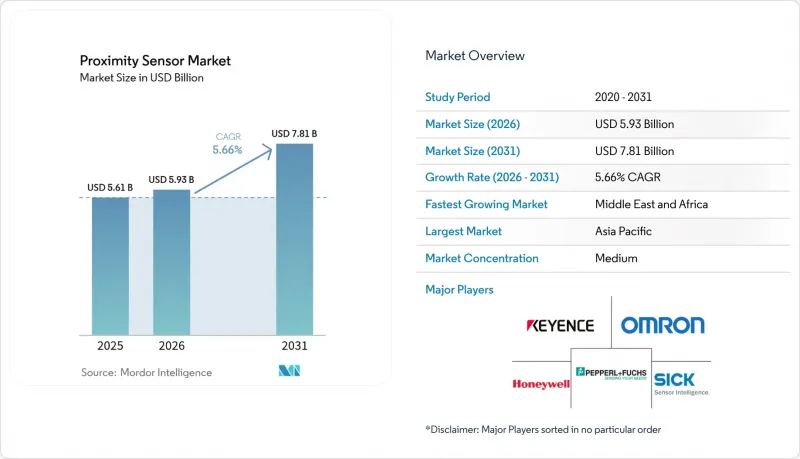
本報告依技術(電感式、電容式等)、產品類型(固定距離、可調距離)、檢測範圍(0-20mm、20-40m、米、40mm以上)、機殼(圓柱形、其他)、輸出類型(數位、類比、IO-Link)、配線方式(兩線制、其他)、用戶產業區進行細分汽車、其他)和終端用戶。市場預測以美元計價。
全球接近感測器市場趨勢及洞察
亞洲現有工廠受工業4.0主導的改裝需求
中國、越南和印尼的製造商更傾向於升級現有生產線,採用支援IO-Link的接近感測器,而不是新建工廠。透過5G監控,這些升級可實現15-20%的效率提升和30%的成本降低[gsma.com]。提供可直接替換的圓柱形設備、引腳高度相容PLC並具備雲端診斷功能的供應商在改裝競標中主導。與傳統控制系統的兼容性使用戶能夠避免長時間運作,因此預計接近感測器市場至少在2028年之前將保持強勁成長勢頭。
汽車OEM廠商必須使用通過ISO 26262認證的非接觸式定位偵測技術。
歐美汽車計畫現已指定使用符合ASIL C/D標準的電感線性和旋轉感測器,以取代易受雜散磁場影響的霍爾效應裝置。 Melexis的雙晶片架構可在12毫米行程範圍內實現±0.85%的精度,並為煞車、踏板和轉向模組提供內建冗餘[melexis.com]。認證成本導致供應鏈結構兩極化,迫使中小企業要麼授權其智慧財產權(IP),要麼退出市場,這進一步加劇了接近感測器市場的整合。
銅價波動對歐洲電感式感測器物料清單 (BOM) 的影響。
由於銅現貨價格達到三年來的最高點,銅捲成本上漲高達25%,這進一步擠壓了德國和義大利感測器製造商的利潤空間,而這些製造商本就因電價飆升而苦苦掙扎。大型供應商透過避險和垂直整合銅供應鏈來應對風險,而小型公司則面臨季度價格調整,導致競爭力下降。
細分市場分析
預計到2025年,電感式感測器將佔總銷售額的34.60%,鞏固其作為沖壓生產線和數控機床金屬檢測事實上的標準選擇的地位,並融入整個接近感測器市場。其堅固耐用的鐵氧體磁芯線圈具有耐油、耐碎屑和抗振動的特性,是亞太地區工廠改造的理想選擇。電容式感測器的複合年成長率高達9.35%,目前已能檢測製藥無塵室中電感式感測器無法檢測的塑膠機殼和液位。混合技術的趨勢——將霍爾效應用於角度檢測,將電容式檢測用於存在檢測——正促使供應商開發多物理場專用積體電路(ASIC),以簡化安裝並減少產品種類。
由於單一電容式感測器無需機械接觸即可檢測玻璃、樹脂或穀物的含量,從而符合食品安全法規,因此其應用正在加速成長。光電式感測器在需要檢測距離達 10 公尺的粉塵輸送機等應用場景中佔據著一定的市場佔有率,而超音波感測器則用於光學感測器無法檢測的化學品儲存槽。磁性 xMR 感測器在電動車牽引馬達領域正不斷擴大市場佔有率,因為該領域對磁場方向控制的精度要求極高,達到毫米級。這些變化共同確保了接近感測器市場的多元化和穩健發展。
受成本效益驅動,預計到2025年,固定距離汽缸將佔出貨量的59.30%。在全年生產相同車門面板的汽車沖壓廠中,固定閾值是防止錯誤重新校準的首選。同時,電子組裝的小批量生產推動了具有IO-Link參數化功能的可變距離型號的市場需求,使其複合年成長率達到8.12%。生產工程師透過微調板載韌體而非更換硬體,顯著縮短了換型時間。在轉型為無人(無人值守)操作的工廠中,智慧可變距離設備將EQ時間戳記和循環計數傳輸到MES儀表板,深化了數位孿生技術,並提高了人們對接近感測器市場的認知。
維修團隊指出,單一可調式感測器即可覆蓋多種夾具距離,從而減少了備件需求,抵消了其較高的標價。供應商正競相透過諸如 LED 引導示教模式和基於 NFC 的智慧型手機配置功能等特性,進一步提升產品的易用性。從長遠來看,基於韌體的測量範圍調整有望成為柔軟性工廠的標配功能。
受智慧型手機取放功能、馬達整流和卡扣式品質檢測等技術的推動,預計到2025年,0-20毫米感測器將繼續佔據接近感測器市場44.40%的佔有率。其堅固的固態結構優於機械限位開關,可減少誤剔除。然而,倉庫自動化、自主移動機器人(AMR)和托盤穿梭系統要求在超過2米的直線視線範圍內實現安全檢測,因此,40毫米以上感測器的市場正以6.95%的複合年成長率快速成長。供應商正透過增強型收發器來應對這一需求,這些收發器即使在霧天也能探測到4米遠的目標,並採用波束成形光學技術,與LiDAR和雷達配合使用,使機器人能夠實現360°全方位感知。
在物流領域,遠距離近距離偵測技術無需高解析度視覺系統即可在盲區實現碰撞規避。結合超音波和光電技術的混合感測器正在市場上湧現,它們將距離檢測和存在檢測整合到單一產品單元中,從而減輕了高層貨架的故障檢測和佈線工作。
區域分析
預計到2025年,亞太地區在接近感測器市場將保持35.70%的佔有率,主要得益於中國工廠數位化補貼、日本在機器人出口領域的主導地位以及韓國的半導體投資。將IO-Link感測器改造到現有(棕地)生產線上,無需新建生產線即可提高產量,從而解決了區域資本支出(CapEx)的限制。零件製造商正在將感測器組裝廠集中到智慧型手機生產基地附近,即使在產品週期緊張的情況下也能縮短前置作業時間。各國政府正在津貼5G專用網路,建立感測器數據骨幹網,以支援即時品管循環。
歐洲仍然是重要的基本客群。德國一級供應商要求線控轉向應用採用符合ASIL-D標準的電感式編碼器,而法國航太整合商則指定ELDEC感測器用於嚴苛的渦輪機艙環境。由於銅價波動和持續高企的電費推高了歐洲的物料清單(BOM),加上一些線圈繞製製程轉移到中歐,研發中心也越來越靠近原始設備製造商(OEM)。歐洲大陸為實現「淨零排放工廠」所做的努力正在推動IO-Link診斷技術的發展,該技術能夠減少廢料和能源浪費,並促進接近感測器市場中先進應用案例的普及。
在北美,航太、能源以及快速成長的電動車供應鏈領域的需求強勁且已趨於成熟。美國電網現代化計畫正在為用於監測斷路器位置和閥門狀態的接近感測器開闢新的細分市場。Schneider Electric7億美元的資本投資表明,美國國內對配備工廠校準感測器的數位化開關設備和配電盤的需求強勁。加拿大礦業自動化和墨西哥汽車組裝的出口也進一步推動了該地區的需求。
中東地區以7.18%的複合年成長率領跑,沙烏地阿拉伯的石化和公共產業工廠正在部署預測維修系統,每個工廠配備數百個IO-Link近距離感測器節點。非洲和南美洲雖然仍處於自動化應用的早期階段,但正透過物流和食品加工廠奠定基礎,為全球接近感測器市場提供長期成長潛力。
其他好處:
- Excel格式的市場預測(ME)表
- 3個月的分析師支持
目錄
第1章:引言
- 研究假設和市場定義
- 調查範圍
第2章:調查方法
第3章執行摘要
第4章 市場狀況
- 市場概覽
- 市場促進因素
- 亞洲現有工廠受工業4.0主導的維修需求
- 汽車OEM廠商對符合ISO 26262認證的非接觸式位置測量技術的要求。
- 智慧型手機中Mini-LED/LED背光的整合(亞太地區)
- 美國聯邦航空管理局 (FAA) 和歐洲航空安全局 (EASA) 向固態起落架接近感測器過渡
- 物聯網在建築自動化和智慧基礎設施中的整合
- 歐洲離散製造生產線中IO-Link的應用現狀
- 市場限制因素
- 歐洲線圈銅價的波動正在影響感應元件的物料清單 (BOM)。
- 美國高功率電動車逆變器電磁相容性不足
- 食品級光電感測器因冷凝而故障。
- ATEX區域認證處理時間延長,導致中東地區的專案延長。
- 價值供應鏈分析
- 監理趨勢(IEC 60947-5-2,ISO 13849)
- 技術趨勢(晶片級霍爾效應、體聲波、MEMS混合)
- 波特五力分析
- 投資和資金籌措分析
第5章 市場規模與成長預測
- 透過技術
- 歸納法
- 電容式
- 光電
- 磁性(霍爾效應和引線)
- 超音波
- 紅外線和其他
- 依產品類型
- 固定距離感測器
- 距離可調式感測器
- 檢測範圍
- 0~20 mm
- 20~40 mm
- 超過 40 毫米
- 住宅/外形規格
- 圓柱形
- 長方形
- 插槽/頻道
- 微型/PCB安裝型
- 環形和對射式
- 透過生產方法
- 數字(NPN/PNP)
- 模擬量(0-10V/4-20mA)
- IO-Link 無線智慧介面
- 按類型進行頻道佈線
- 兩線制交流/直流
- 三線直流
- 四線互補型
- 按最終用戶行業分類
- 航太/國防
- 車
- 工業自動化與機器人技術
- 家用電子電器和穿戴式裝置
- 食品/飲料加工
- 醫療保健和醫療設備
- 建築自動化和智慧基礎設施
- 其他行業(採礦業、農業、海運業)
- 按地區
- 北美洲
- 美國
- 加拿大
- 墨西哥
- 歐洲
- 英國
- 德國
- 法國
- 義大利
- 其他歐洲國家
- 亞太地區
- 中國
- 日本
- 印度
- 韓國
- 其他亞太國家
- 中東
- 以色列
- 沙烏地阿拉伯
- 阿拉伯聯合大公國
- 土耳其
- 其他中東國家
- 非洲
- 南非
- 埃及
- 其他非洲國家
- 南美洲
- 巴西
- 阿根廷
- 其他南美國家
- 北美洲
第6章 競爭情勢
- 市場集中度
- 策略趨勢
- 市佔率分析
- 公司簡介
- Keyence Corporation
- Omron Corporation
- Pepperl+Fuchs GmbH
- Sick AG
- Panasonic Holdings Corp.
- Honeywell International Inc.
- STMicroelectronics NV
- Schneider Electric SE
- Rockwell Automation Inc.
- IFM Electronic GmbH
- Turck Holding GmbH
- Datalogic SpA
- Delta Electronics Inc.
- Autonics Corporation
- Balluff GmbH
- Banner Engineering Corp.
- Texas Instruments Inc.
- Broadcom Inc.
- Littelfuse Inc.
- Baumer Group
- Vishay Intertechnology
- BorgWarner Inc.
- Allegro MicroSystems
- Leuze electronic GmbH
第7章 市場機會與未來展望
According to Mordor Intelligence, the proximity sensors market size is expected to grow from USD 5.61 billion in 2025 to USD 5.93 billion in 2026 and is forecast to reach USD 7.81 billion by 2031 at 5.66% CAGR over 2026-2031.
This report is Segmented by Technology (Inductive, Capacitive, and More), Product Type (Fixed-Distance, Adjustable-Distance), Sensing Range (0-20mm, 20-40m, M, Greater Than 40mm), Housing (Cylindrical, and More), Output Type (Digital, Analog, IO-Link), Channel Wiring (2-Wire, and More), End-User Industry (Automotive, and More), and Geography. The Market Forecasts are Provided in Terms of Value (USD).
Global Proximity Sensor Market Trends and Insights
Industry 4.0-led Retro-Fit Demand in Brownfield Asian Factories
Manufacturers across China, Vietnam, and Indonesia prefer upgrading existing lines with IO-Link-ready proximity sensors rather than building new plants, unlocking 15-20% efficiency gains and 30% cost cuts through 5G-enabled monitoring [gsma.com]. Suppliers offering drop-in cylindrical devices with PLC-friendly pinouts yet cloud-ready diagnostics dominate retro-fit tenders. Compatibility with legacy controls shields buyers from lengthy downtime, keeping the proximity sensors market buoyant until at least 2028.
Automotive OEM Mandates for ISO 26262-Certified Contactless Positioning
European and U.S. vehicle programs now specify inductive linear and rotary sensors qualified to ASIL C/D, displacing Hall-effect devices sensitive to stray fields. Dual-die architectures introduced by Melexis achieve +-0.85% accuracy over 12 mm strokes and offer built-in redundancy for brake, pedal, and steering modules [melexis.com]. Certification costs create a two-tier supply landscape, pushing smaller firms to license IP or exit, and further consolidating the proximity sensors market.
Coil-Copper Cost Volatility Impacting Inductive BOM in Europe
Three-year highs in copper spot prices raise coil costs by up to 25%, squeezing margins for German and Italian sensor producers already burdened by elevated electricity tariffs. Larger vendors hedge or vertically integrate copper supply, but smaller firms confront price-list resets quarterly, hampering competitiveness.
Other drivers and restraints analyzed in the detailed report include:
- Mini-LED/µLED Back-Light Integration in Smartphones (APAC)
- FAA & EASA Transition to Solid-State Landing-Gear Proximity Sensors
- EMC Compliance Failures in High-Power EV Inverters (US)
For complete list of drivers and restraints, kindly check the Table Of Contents.
Segment Analysis
Inductive units delivered 34.60% of 2025 revenue, validating their status as the de-facto choice for metal detection on press lines and CNC machines embedded across the proximity sensors market. Rugged ferrite-core coils endure oil, chips, and vibration, ideal for retro-fits in APAC factories. Capacitive devices, advancing at 9.35% CAGR, now sense plastic housings and fluid levels in pharmaceutical clean rooms where inductive devices fail. The hybridization trend-combining Hall-effect for angle and capacitive for presence-pushes suppliers toward multi-physics ASICs that simplify installation and reduce SKU count.
Capacitive adoption accelerates because one sensor can cover glass, resin, or grain level without mechanical contact, aligning with food-safety mandates. Photoelectric SKUs retain niches requiring 10 m targeting over dusty conveyors, while ultrasonic variants serve chemical vats impervious to optical methods. Magnetic xMR sensors gain share within EV traction motors needing millidegree precision for field-oriented control. Collectively, these transitions keep the proximity sensors market varied and resilient.
Skewing to cost efficiency, fixed-distance cylinders amassed 59.30% of 2025 shipments. Automotive stamping plants, running identical door panels year-round, favor fixed thresholds to avoid accidental recalibration. However, short batch runs in electronics assembly spark an 8.12% CAGR for adjustable-distance models equipped with IO-Link parameterization. Production engineers tweak on-board firmware rather than swapping hardware, slashing changeover times. In plants moving toward lights-out operation, smart adjustable devices feed EQ timestamps and cycle counts to MES dashboards, deepening digital twins and elevating the proximity sensors market profile.
Maintenance teams cite reduced spares when one adjustable sensor covers multiple jig distances, offsetting its higher list price. Suppliers compete on LED-guided teach modes and NFC smartphone setup, reinforcing ease of use. Long term, firmware-driven range tuning is expected to become the default in flexible factories.
Smartphone pick-and-place stages, electric-motor commutation, and snap-fit quality checks keep 0-20 mm sensors at 44.40% of proximity sensors market size in 2025. Their solid-state ruggedness beats mechanical limit switches and reduces false rejects. Yet warehouse automation, AMRs, and pallet-shuttle systems require line-of-sight safety at two-meter plus distances, lifting>40 mm devices at a 6.95% CAGR. Suppliers respond with amplified transceivers and beam-forming optics capable of 4 m detection even in fog, complementing LiDAR and radar for 360° robot perception.
In intralogistics, longer-range proximity avoids blind-spot collisions without the cost of high-resolution vision. Hybrid ultrasonic-photoelectric stacks enter this space, integrating distance and presence into one SKU, reducing points of failure and wiring labor in high-bay racking.
Complete Report Scope:
- By Technology
- Inductive
- Capacitive
- Photoelectric
- Magnetic (Hall-Effect and Reed)
- Ultrasonic
- Infra-Red and Others
- By Product Type
- Fixed-Distance Sensors
- Adjustable-Distance Sensors
- By Sensing Range
- 0 - 20 mm
- 20 - 40 mm
- Greater than 40 mm
- By Housing / Form Factor
- Cylindrical
- Rectangular
- Slot / Channel
- Miniature / PCB-Mount
- Ring and Through-Beam
- By Output Type
- Digital (NPN / PNP)
- Analog (0-10 V / 4-20 mA)
- IO-Link and Other Smart Interfaces
- By Channel Wiring
- 2-Wire AC/DC
- 3-Wire DC
- 4-Wire Complementary
- By End-user Industry
- Aerospace and Defense
- Automotive
- Industrial Automation and Robotics
- Consumer Electronics and Wearables
- Food and Beverage Processing
- Healthcare and Medical Devices
- Building Automation and Smart Infrastructure
- Other Industries (Mining, Agriculture, Marine)
- By Geography
- North America
- United States
- Canada
- Mexico
- Europe
- United Kingdom
- Germany
- France
- Italy
- Rest of Europe
- Asia-Pacific
- China
- Japan
- India
- South Korea
- Rest of Asia-Pacific
- Middle East
- Israel
- Saudi Arabia
- United Arab Emirates
- Turkey
- Rest of Middle East
- Africa
- South Africa
- Egypt
- Rest of Africa
- South America
- Brazil
- Argentina
- Rest of South America
- North America
Geography Analysis
Asia-Pacific retained 35.70% proximity sensors market share in 2025, buoyed by China's factory digitalization grants, Japan's robotics export leadership, and South Korea's semiconductor investments. Retro-fitting brownfield lines with IO-Link sensors boosts output without new buildings, aligning with local CapEx restrictions. Component makers co-locate sensor assembly near smartphone clusters, shrinking lead times amid tight product cycles. Governments subsidize 5G private networks, anchoring sensor data backbones that support real-time quality loops.
Europe remains a premium buyer base. German Tier-1s demand ASIL-D inductive encoders for steer-by-wire, while French aerospace integrators specify ELDEC sensors for harsh turbine bays. Continual copper price waves and high electricity tariffs raise European BOMs, nudging some coil-winding to Central Europe yet retaining R&D centers near OEMs. The continent's push for net-zero factories incentivizes IO-Link diagnostics that trim scrap and energy waste, reinforcing advanced use-case uptake across the proximity sensors market.
North America records steady but mature consumption, concentrated in aerospace, energy, and a burgeoning EV supply chain. U.S. energy grid modernization programs open niches for proximity sensors monitoring breaker position and valve status. Schneider Electric's USD 700 million cap-ex illustrates domestic appetite for digitized switchgear and panelboards that embed factory-calibrated sensors. Canada's mining automation and Mexico's auto assembly exports deepen regional demand.
The Middle East delivers the quickest 7.18% CAGR, with Saudi Arabia's petrochemical and utility plants installing predictive-maintenance suites featuring hundreds of IO-Link proximity nodes per site. Africa and South America, while early in automation adoption, lay groundwork through logistics and food-processing plants, offering long-tail upside to the global proximity sensors market.
- Keyence Corporation
- Omron Corporation
- Pepperl+Fuchs GmbH
- Sick AG
- Panasonic Holdings Corp.
- Honeywell International Inc.
- STMicroelectronics N.V.
- Schneider Electric SE
- Rockwell Automation Inc.
- IFM Electronic GmbH
- Turck Holding GmbH
- Datalogic SpA
- Delta Electronics Inc.
- Autonics Corporation
- Balluff GmbH
- Banner Engineering Corp.
- Texas Instruments Inc.
- Broadcom Inc.
- Littelfuse Inc.
- Baumer Group
- Vishay Intertechnology
- BorgWarner Inc.
- Allegro MicroSystems
- Leuze electronic GmbH
Additional Benefits:
- The market estimate (ME) sheet in Excel format
- 3 months of analyst support
TABLE OF CONTENTS
1 INTRODUCTION
- 1.1 Study Assumptions and Market Definition
- 1.2 Scope of the Study
2 RESEARCH METHODOLOGY
3 EXECUTIVE SUMMARY
4 MARKET LANDSCAPE
- 4.1 Market Overview
- 4.2 Market Drivers
- 4.2.1 Industry 4.0-led Retro-Fit Demand in Brownfield Asian Factories
- 4.2.2 Automotive OEM Mandates for ISO 26262-Certified Contactless Positioning
- 4.2.3 Mini-LED/LED Back-Light Integration in Smartphones (Asia-Pacific)
- 4.2.4 FAA and EASA Transition to Solid-State Landing-Gear Proximity Sensors
- 4.2.5 Building Automation and Smart Infrastructure IoT Integration
- 4.2.6 IO-Link Adoption in European Discrete Manufacturing Lines
- 4.3 Market Restraints
- 4.3.1 Coil-Copper Cost Volatility Impacting Inductive BOM in Europe
- 4.3.2 EMC Compliance Failures in High-Power EV Inverters (US)
- 4.3.3 Condensation-Driven False Trips in Food-Grade Photoelectric Sensors
- 4.3.4 ATEX-Zone Certification Lead-Times Delaying Middle-East Projects
- 4.4 Value / Supply-Chain Analysis
- 4.5 Regulatory Outlook (IEC 60947-5-2, ISO 13849)
- 4.6 Technological Outlook (Chip-level Hall, BAW, MEMS Hybrids)
- 4.7 Porter's Five Forces Analysis
- 4.7.1 Threat of New Entrants
- 4.7.2 Bargaining Power of Buyers
- 4.7.3 Bargaining Power of Suppliers
- 4.7.4 Threat of Substitute Products
- 4.7.5 Intensity of Competitive Rivalry
- 4.8 Investment and Funding Analysis
5 MARKET SIZE AND GROWTH FORECASTS (VALUE)
- 5.1 By Technology
- 5.1.1 Inductive
- 5.1.2 Capacitive
- 5.1.3 Photoelectric
- 5.1.4 Magnetic (Hall-Effect and Reed)
- 5.1.5 Ultrasonic
- 5.1.6 Infra-Red and Others
- 5.2 By Product Type
- 5.2.1 Fixed-Distance Sensors
- 5.2.2 Adjustable-Distance Sensors
- 5.3 By Sensing Range
- 5.3.1 0 - 20 mm
- 5.3.2 20 - 40 mm
- 5.3.3 Greater than 40 mm
- 5.4 By Housing / Form Factor
- 5.4.1 Cylindrical
- 5.4.2 Rectangular
- 5.4.3 Slot / Channel
- 5.4.4 Miniature / PCB-Mount
- 5.4.5 Ring and Through-Beam
- 5.5 By Output Type
- 5.5.1 Digital (NPN / PNP)
- 5.5.2 Analog (0-10 V / 4-20 mA)
- 5.5.3 IO-Link and Other Smart Interfaces
- 5.6 By Channel Wiring
- 5.6.1 2-Wire AC/DC
- 5.6.2 3-Wire DC
- 5.6.3 4-Wire Complementary
- 5.7 By End-user Industry
- 5.7.1 Aerospace and Defense
- 5.7.2 Automotive
- 5.7.3 Industrial Automation and Robotics
- 5.7.4 Consumer Electronics and Wearables
- 5.7.5 Food and Beverage Processing
- 5.7.6 Healthcare and Medical Devices
- 5.7.7 Building Automation and Smart Infrastructure
- 5.7.8 Other Industries (Mining, Agriculture, Marine)
- 5.8 By Geography
- 5.8.1 North America
- 5.8.1.1 United States
- 5.8.1.2 Canada
- 5.8.1.3 Mexico
- 5.8.2 Europe
- 5.8.2.1 United Kingdom
- 5.8.2.2 Germany
- 5.8.2.3 France
- 5.8.2.4 Italy
- 5.8.2.5 Rest of Europe
- 5.8.3 Asia-Pacific
- 5.8.3.1 China
- 5.8.3.2 Japan
- 5.8.3.3 India
- 5.8.3.4 South Korea
- 5.8.3.5 Rest of Asia-Pacific
- 5.8.4 Middle East
- 5.8.4.1 Israel
- 5.8.4.2 Saudi Arabia
- 5.8.4.3 United Arab Emirates
- 5.8.4.4 Turkey
- 5.8.4.5 Rest of Middle East
- 5.8.5 Africa
- 5.8.5.1 South Africa
- 5.8.5.2 Egypt
- 5.8.5.3 Rest of Africa
- 5.8.6 South America
- 5.8.6.1 Brazil
- 5.8.6.2 Argentina
- 5.8.6.3 Rest of South America
- 5.8.1 North America
6 COMPETITIVE LANDSCAPE
- 6.1 Market Concentration
- 6.2 Strategic Moves
- 6.3 Market Share Analysis
- 6.4 Company Profiles {(includes Global level Overview, Market level overview, Core Segments, Financials as available, Strategic Information, Market Rank/Share for key companies, Products and Services, and Recent Developments)}
- 6.4.1 Keyence Corporation
- 6.4.2 Omron Corporation
- 6.4.3 Pepperl+Fuchs GmbH
- 6.4.4 Sick AG
- 6.4.5 Panasonic Holdings Corp.
- 6.4.6 Honeywell International Inc.
- 6.4.7 STMicroelectronics N.V.
- 6.4.8 Schneider Electric SE
- 6.4.9 Rockwell Automation Inc.
- 6.4.10 IFM Electronic GmbH
- 6.4.11 Turck Holding GmbH
- 6.4.12 Datalogic SpA
- 6.4.13 Delta Electronics Inc.
- 6.4.14 Autonics Corporation
- 6.4.15 Balluff GmbH
- 6.4.16 Banner Engineering Corp.
- 6.4.17 Texas Instruments Inc.
- 6.4.18 Broadcom Inc.
- 6.4.19 Littelfuse Inc.
- 6.4.20 Baumer Group
- 6.4.21 Vishay Intertechnology
- 6.4.22 BorgWarner Inc.
- 6.4.23 Allegro MicroSystems
- 6.4.24 Leuze electronic GmbH
7 MARKET OPPORTUNITIES AND FUTURE OUTLOOK
- 7.1 White-Space and Unmet-Need Assessment

 接近感測器市場:按技術、類型、檢測範圍、安裝方式、供電電壓、應用、終端用戶產業和分銷管道分類-2026-2032年全球市場預測
 接近感測器市場報告:按技術、檢測範圍、終端用戶產業和地區分類(2026-2034 年)
 鐵接近感測器市場報告:趨勢、預測和競爭分析(至2035年)
 全球接近感測器市場規模、佔有率、趨勢和成長分析報告(2026-2034)
 2026年全球接近感測器市場報告
 接近感測器市場規模、佔有率和成長分析:按技術、產品類型和產業預測,2026-2033年
 智慧型手機接近感測器市場規模、佔有率和成長分析:按感測器類型、智慧型手機類別、應用、技術、銷售管道和地區分類 - 2026-2033 年行業預測
 行動電話接近感測器市場規模、佔有率和成長分析:按產品類型、功能、技術類型、最終用戶產業和地區分類 - 2026-2033 年產業預測
 食品業接近接近感測器市場規模、佔有率和成長分析:按感測器類型、應用領域、技術採用狀況、最終用戶、地區和產業預測,2026-2033年
 近發引信感測器市場規模、佔有率和成長分析:按產品類型、技術、應用、最終用戶和地區分類-2026-2033年產業預測