


 |
市場調查報告書
商品編碼
2155002
南美洲氣霧罐市場:市場佔有率分析、產業趨勢與統計及成長預測(2026-2031 年)South America Aerosol Cans - Market Share Analysis, Industry Trends & Statistics, Growth Forecasts (2026 - 2031) |
||||||

※ 本網頁內容可能與最新版本有所差異。詳細情況請與我們聯繫。
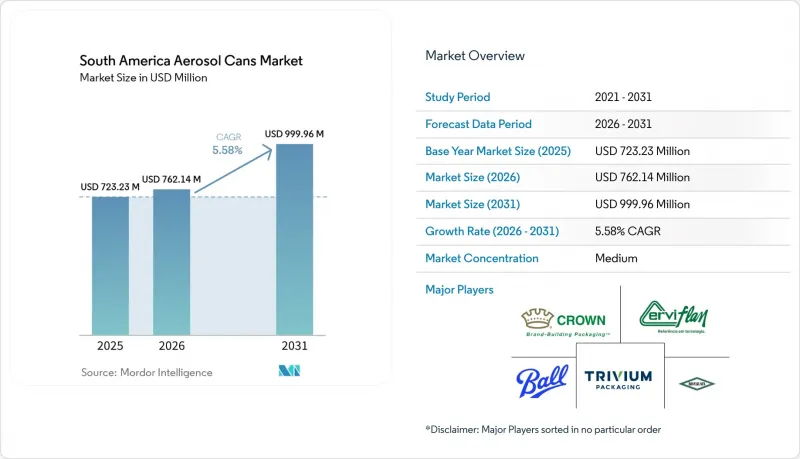
根據 Mordor Intelligence 預測,南美氣霧罐市場規模將從 2025 年的 7.2323 億美元和 2026 年的 7.6214 億美元成長到 2031 年的 9.9996 億美元,2026 年至 2031 年的年複合成長率(CAGR)為 5.58%。
南美洲氣霧罐市場趨勢與洞察
個人護理和化妝品氣霧劑的擴張
巴西個人護理市場是南美洲氣霧罐市場最大的需求來源。氣霧除臭劑、身體噴霧和髮膠噴霧因其可控的非接觸式使用方式,仍然是重要的產品形式。該品類受益於氣霧除臭劑在巴西的廣泛應用以及龐大的零售分銷網路。 2024年,Grupo Boticario在其除臭劑和乾洗香波產品線中引入了再生鋁包裝。該公司報告稱,此舉已減少了超過240噸的二氧化碳排放量和超過100噸的鋁廢棄物。該舉措將個人保健產品的需求與對再生材料和可追溯供應鏈的要求聯繫起來。此外,由於巴西國家衛生監督局(ANVISA)對化妝品配方和標籤有相關規定,因此,了解相關法規對於該品類產品的供應商至關重要。
鋁和鋼包裝的可回收性優勢
鋁的高回收率正在推動南美洲,尤其是巴西的噴霧罐市場對這種材料的採用。根據國際鋁業協會統計,2023年南美洲和加勒比海地區的鋁罐回收率達到了94.0%。這一回收率不僅有利於採購再生材料,也為品牌所有者提供了建構循環經濟體系的強力支持。在巴西的包裝產業,2025年1月至9月期間消耗了45.15萬噸鋁,其中60%為再生鋁。 2024年,空噴霧罐被歸類為非危險廢棄物,降低了回收過程中的處理門檻。然而,為了使這項益處惠及全部區域,仍需在收集系統中實現安全減壓,並建立面向消費者的收集點。
環境合規性與逆向物流成本
對於氣霧劑包裝供應商而言,環境合規要求日益嚴格。由於回收和處理過程中殘留推進劑可能帶來的安全風險,氣霧劑容器的逆向物流也更加複雜。典型的金屬回收設施可能需要減壓設備和經過訓練的操作人員。雖然巴西對空罐的重新分類掃清了一道障礙,但尚未建立完整的消費者回收網路。生產者延伸責任制 (EPR) 的要求可能會將回收和報告的成本轉嫁給品牌所有者和包裝供應商。在市政回收系統尚未完善的國家,南美洲氣霧劑罐市場面臨更大的壓力。能夠支援安全回收計劃並提供清晰包裝說明的供應商,在滿足這些要求方面更具優勢。
細分市場分析
到2025年,鋁將佔據南美氣霧罐市場58.63%的佔有率,成為該市場使用量最大的材料。預計到2031年,鋁的年複合成長率將達到6.12%,成為成長最快的材料。鋁材可用於製作輕巧的包裝,適用於除臭劑、髮膠噴霧、身體噴霧等產品。巴西完善的回收體系支持了消費品牌「使用再生材料」的承諾。品牌採購計畫越來越重視可追溯性和低碳金屬的採購。這催生了難以用替代材料滿足的需求。在南美洲氣霧罐產業,鋁材也被用於製作造型和裝飾精美的高階產品。
2026年,Trivium Packaging Brazil憑藉其採用先進鋁合金的阿迪達斯原型包裝獲得了高度讚譽。據該公司稱,該設計在保持強度和塗層品質的同時,重量減輕了25%,二氧化碳排放量減少了50%以上。鋼材和馬口鐵在家用殺蟲劑、油漆和工業氣霧劑領域仍然發揮著至關重要的作用。這些材料適用於三件式結構設計和成熟的填充生產線。塑膠和其他材料則用於小規模的特殊應用,包括非加壓包裝。鋼材的需求與油漆和清漆相關活動密切相關,而這些活動更容易受到工業週期的影響。鋁材因其可回收性和在個人護理領域的應用而保持領先地位。
到2025年,一體式罐將佔據57.62%的市場佔有率,成為最大的罐型。預計到2031年,這種罐型將以6.43%的複合年成長率成長。其無縫的內壁適用於對塗層敏感的個人保健產品配方,並能降低污染風險。巴西的快速填充工藝也促進了其應用。一體成型鋁罐的生產非常適合除臭劑和身體噴霧劑等產品的大量生產。這種結構也滿足了對高階裝飾和再生鋁的需求。這些特點使一體式罐在南美洲氣霧罐市場佔據了領先地位。
波爾公司於2025年9月與巴西品牌Soffie和Aeroflex合作,推出了獲得ASI認證的氣霧罐。產品包括除臭劑、髮膠噴霧、乾洗香波和身體噴霧,認證資訊印在包裝上。兩片式罐仍然是食品和飲料氣霧劑產品的常用包裝。三片式焊接罐則繼續用於工業塗料、溶劑和工業氣霧劑產品。這些包裝形式在材料和製造方面具有優勢,能夠滿足各自特定的壓力和塗層要求。然而,一體式罐更適合個人護理應用,而個人護理正是最大的市場。醫療保健灌裝商對清潔均勻的罐內環境也有需求,這也推動了一體式罐的成長。
其他好處:
- Excel格式的市場預測(ME)表
- 3個月的分析師支持
目錄
第1章:引言
- 研究假設和市場定義
- 調查範圍
第2章:調查方法
第3章執行摘要
第4章 市場狀況
- 市場概覽
- 市場促進因素
- 擴大個人護理和化妝品氣霧劑產品市場
- 鋁和鋼包裝的可回收性優勢
- 拓展在汽車保養與噴漆領域的應用。
- 對便捷衛生的分發方式的需求
- 現場氣霧劑填充和契約製造能力
- 透過精細的裝飾和巧妙設計的罐體優質化。
- 市場限制因素
- 遵守環境法規和逆向物流成本
- 鋁、鋼、馬口鐵和推進劑的成本波動
- 與泵式噴霧器、扳機式噴霧器和可填充產品形式的產品競爭。
- 回收廢棄氣霧劑容器的基礎設施有限。
- 產業價值鏈分析
- 監理情勢
- 技術展望
- 宏觀經濟因素對市場的影響
- 波特五力分析
- 生命週期與碳足跡分析
第5章 市場規模與成長預測
- 材料類型
- 鋁
- 鋼
- 馬口鐵
- 塑膠
- 其他材料類型
- 可輸入
- 一件
- 兩件套
- 3 件
- 按推進劑類型
- 壓縮氣體
- 液化氣
- 碳氫化合物
- DME
- 其他液化氣體
- 閥門式氣囊
- 按產能
- 少於100毫升
- 101ml~300ml
- 301ml~500ml
- 超過500毫升
- 按最終用戶行業分類
- 個人護理化妝品
- 居家照護
- 汽車和工業
- 醫療和藥品
- 食品/飲料
- 油漆和清漆
- 其他終端用戶產業
- 國家
- 巴西
- 阿根廷
- 智利
- 哥倫比亞
- 秘魯
- 其他南美國家
第6章 競爭情勢
- 市場集中度
- 策略趨勢
- 市佔率分析
- 公司簡介
- Ball Corporation
- Trivium Packaging BV
- Crown Holdings, Inc.
- Brasilata Comercio e Industria Ltda.
- Cerviflan Embalagens Metalicas Ltda.
- CCL Industries Inc.
- Mauser Packaging Solutions
- CANPACK SA
- Tecnocap SpA
- Aluex SA
- Envases Group
- Grupo Comeca Argentina SA
- Bispharma Packaging
- Impacta SA
- LINHARDT Group GmbH
- TUBEX GmbH
- Nussbaum Group
- Montebello Packaging
- ALLTUB Group
- CONDENSA SA
第7章 市場機會與未來展望
According to Mordor Intelligence, the South America aerosol cans market size is projected to expand from USD 723.23 million in 2025 and USD 762.14 million in 2026 to USD 999.96 million by 2031, registering a CAGR of 5.58% between 2026 and 2031.
South America Aerosol Cans Market Trends and Insights
Expansion of Personal Care and Cosmetics Aerosols
Brazil's personal care base provides the largest demand pool for the South America aerosol cans market. Aerosol deodorants, body sprays, and hairsprays remain important formats because they provide controlled, contact-free application. The category benefits from established use of aerosol deodorants in Brazil and from broad retail distribution. Grupo Boticario introduced post-consumer recycled aluminum packaging for deodorant and dry-shampoo lines in 2024, reporting that the move avoided more than 240 tonnes of CO2 emissions and over 100 tonnes of aluminum waste. This action links personal care demand with requirements for recycled material and a traceable supply. ANVISA requirements for cosmetic formulations and labeling also make regulatory knowledge important for suppliers serving this category.
Recyclability Advantage of Aluminum and Steel Packaging
Aluminum recovery strengthens the material case for the South America aerosol cans market, particularly in Brazil. The International Aluminum Institute reported that South America and the Caribbean achieved a 94.0% aluminum can collection rate in 2023. This collection performance supports recycled-content sourcing and gives brand owners an established circularity narrative. Brazil's packaging sector consumed 451,500 tonnes of aluminum between January and September 2025, with recycled content accounting for 60% of the aluminum used.The 2024 classification of empty aerosol packs as non-hazardous waste reduced a handling barrier for recycling channels. Collection systems still need safe depressurization and consumer return points before this advantage can extend evenly across the region.
Environmental Compliance and Reverse-Logistics Costs
Environmental compliance is becoming more demanding for aerosol packaging suppliers. Reverse logistics is more complex for aerosol packs because residual propellant can create safety risks during collection and processing. Standard metal recycling facilities may need depressurizing equipment and trained operators. Brazil's empty-can reclassification removed one barrier, but it did not create a complete consumer collection network. Extended producer responsibility requirements can shift collection and reporting costs to brand owners and packaging suppliers. The South America aerosol cans market faces greater pressure in countries that lack accessible municipal return systems. Suppliers that can support safe collection programs and clear packaging instructions are better placed to manage this requirement.
Other drivers and restraints analyzed in the detailed report include:
- Growth of Automotive Maintenance and Spray Paint Applications
- Demand for Convenient and Hygienic Dispensing Formats
- Volatility in Aluminum, Steel, Tinplate, and Propellant Costs
For complete list of drivers and restraints, kindly check the Table Of Contents.
Segment Analysis
Aluminum commanded 58.63% of the market in 2025, making it the largest material used in the South America aerosol cans market. It is projected to expand at a 6.12% CAGR through 2031, making it the fastest-growing material. Aluminum supports lightweight packaging for deodorants, hairsprays, and body sprays. Its established recovery system in Brazil supports recycled-content claims for consumer brands. Brand procurement programs increasingly place value on traceable, lower-carbon metal sourcing. This adds demand support that is less available to alternative materials. The South America aerosol cans industry also uses aluminum in premium shapes and decorated formats.
Trivium Packaging Brasil received recognition in 2026 for an adidas prototype using an advanced aluminum alloy. The company said the design can reduce weight by 25% and carbon emissions by more than 50% while maintaining strength and coating quality. Steel and tinplate remain relevant for household insecticides, paints, and industrial aerosols. These materials fit three-piece designs and established technical filling lines. Plastic and other materials are used in smaller specialty applications, including non-pressurized packs. Steel demand remains connected to paint and varnish activity, which is more exposed to industrial cycles. Aluminum's combination of recycling performance and personal care use supports its leading position.
One-piece cans held 57.62% of the market in 2025, the largest share by can type. The format is expected to expand at a 6.43% CAGR through 2031. A seamless interior suits coating-sensitive personal care formulations and reduces contamination concerns. High-speed filling operations in Brazil also support its use. One-piece aluminum can production is well-suited to the high volumes associated with deodorants and body sprays. This structure aligns with the demand for premium decoration and recycled aluminum content. These features give one-piece cans a leading role in the South America aerosol cans market.
Ball Corporation launched ASI-certified aerosol cans with Brazilian brands Soffie and Aeroflex in September 2025. The launch covered deodorant, hairspray, dry shampoo, and body spray products, with certification information shown on the pack. Two-piece cans remain common for food and beverage aerosol uses. Three-piece welded cans continue to be used for industrial paints, solvents, and technical aerosols. Those formats offer material and production advantages for their specific pressure and coating requirements. One-piece cans, nevertheless, align more closely with the largest personal care uses. Their growth is also supported by healthcare fillers that require clean and consistent interior surfaces.
Complete Report Scope:
- By Material Type
- Aluminum
- Steel
- Tinplate
- Plastic
- Other Material Types
- By Can Type
- One-Piece
- Two-Piece
- Three-Piece
- By Propellant Type
- Compressed Gas
- Liquefied Gas
- Hydrocarbon
- DME
- Other Liquefied Gas
- Bag-on-Valve
- By Capacity
- Less Than 100ml
- 101ml-300ml
- 301ml-500ml
- More Than 500ml
- By End-User Industry
- Personal Care and Cosmetics
- Household Care
- Automotive and Industrial
- Healthcare and Pharmaceutical
- Food and Beverage
- Paints and Varnishes
- Other End-User Industries
- By Country
- Brazil
- Argentina
- Chile
- Colombia
- Peru
- Rest of South America
List of Companies Covered in this Report:
- Ball Corporation
- Trivium Packaging B.V.
- Crown Holdings, Inc.
- Brasilata Comercio e Industria Ltda.
- Cerviflan Embalagens Metalicas Ltda.
- CCL Industries Inc.
- Mauser Packaging Solutions
- CANPACK S.A.
- Tecnocap S.p.A.
- Aluex S.A.
- Envases Group
- Grupo Comeca Argentina S.A.
- Bispharma Packaging
- Impacta S.A.
- LINHARDT Group GmbH
- TUBEX GmbH
- Nussbaum Group
- Montebello Packaging
- ALLTUB Group
- CONDENSA S.A.
Additional Benefits:
- The market estimate (ME) sheet in Excel format
- 3 months of analyst support
TABLE OF CONTENTS
1 INTRODUCTION
- 1.1 Study Assumptions and Market Definition
- 1.2 Scope of the Study
2 RESEARCH METHODOLOGY
3 EXECUTIVE SUMMARY
4 MARKET LANDSCAPE
- 4.1 Market Overview
- 4.2 Market Drivers
- 4.2.1 Expansion of Personal Care and Cosmetics Aerosols
- 4.2.2 Recyclability Advantage of Aluminum and Steel Packaging
- 4.2.3 Growth of Automotive Maintenance and Spray Paint Applications
- 4.2.4 Demand for Convenient and Hygienic Dispensing Formats
- 4.2.5 Localized Aerosol Filling and Contract Manufacturing Capacity
- 4.2.6 Premiumization Through High-Definition Decoration and Shaped Cans
- 4.3 Market Restraints
- 4.3.1 Environmental Compliance and Reverse-Logistics Costs
- 4.3.2 Volatility in Aluminum, Steel, Tinplate, and Propellant Costs
- 4.3.3 Competition from Pump Sprays, Trigger Sprays, and Refillable Formats
- 4.3.4 Limited Collection Infrastructure for Post-Consumer Aerosol Containers
- 4.4 Industry Value Chain Analysis
- 4.5 Regulatory Landscape
- 4.6 Technological Outlook
- 4.7 Impact of Macroeconomic Factors on the Market
- 4.8 Porter's Five Forces Analysis
- 4.8.1 Bargaining Power of Suppliers
- 4.8.2 Bargaining Power of Buyers
- 4.8.3 Threat of New Entrants
- 4.8.4 Threat of Substitutes
- 4.8.5 Competitive Rivalry
- 4.9 Lifecycle and Carbon-Footprint Analysis
5 MARKET SIZE AND GROWTH FORECASTS (VALUE)
- 5.1 By Material Type
- 5.1.1 Aluminum
- 5.1.2 Steel
- 5.1.3 Tinplate
- 5.1.4 Plastic
- 5.1.5 Other Material Types
- 5.2 By Can Type
- 5.2.1 One-Piece
- 5.2.2 Two-Piece
- 5.2.3 Three-Piece
- 5.3 By Propellant Type
- 5.3.1 Compressed Gas
- 5.3.2 Liquefied Gas
- 5.3.2.1 Hydrocarbon
- 5.3.2.2 DME
- 5.3.2.3 Other Liquefied Gas
- 5.3.3 Bag-on-Valve
- 5.4 By Capacity
- 5.4.1 Less Than 100ml
- 5.4.2 101ml-300ml
- 5.4.3 301ml-500ml
- 5.4.4 More Than 500ml
- 5.5 By End-User Industry
- 5.5.1 Personal Care and Cosmetics
- 5.5.2 Household Care
- 5.5.3 Automotive and Industrial
- 5.5.4 Healthcare and Pharmaceutical
- 5.5.5 Food and Beverage
- 5.5.6 Paints and Varnishes
- 5.5.7 Other End-User Industries
- 5.6 By Country
- 5.6.1 Brazil
- 5.6.2 Argentina
- 5.6.3 Chile
- 5.6.4 Colombia
- 5.6.5 Peru
- 5.6.6 Rest of South America
6 COMPETITIVE LANDSCAPE
- 6.1 Market Concentration
- 6.2 Strategic Moves
- 6.3 Market Share Analysis
- 6.4 Company Profiles (includes Global Level Overview, Market Level Overview, Core Segments, Financials as available, Strategic Information, Market Rank/Share, Products and Services, Recent Developments)
- 6.4.1 Ball Corporation
- 6.4.2 Trivium Packaging B.V.
- 6.4.3 Crown Holdings, Inc.
- 6.4.4 Brasilata Comercio e Industria Ltda.
- 6.4.5 Cerviflan Embalagens Metalicas Ltda.
- 6.4.6 CCL Industries Inc.
- 6.4.7 Mauser Packaging Solutions
- 6.4.8 CANPACK S.A.
- 6.4.9 Tecnocap S.p.A.
- 6.4.10 Aluex S.A.
- 6.4.11 Envases Group
- 6.4.12 Grupo Comeca Argentina S.A.
- 6.4.13 Bispharma Packaging
- 6.4.14 Impacta S.A.
- 6.4.15 LINHARDT Group GmbH
- 6.4.16 TUBEX GmbH
- 6.4.17 Nussbaum Group
- 6.4.18 Montebello Packaging
- 6.4.19 ALLTUB Group
- 6.4.20 CONDENSA S.A.
7 MARKET OPPORTUNITIES AND FUTURE OUTLOOK
- 7.1 White-Space and Unmet-Need Assessment

 氣霧罐市場報告:按產品類型、材質、推進劑、容量、應用和地區分類(2026-2034 年)
 氣霧罐市場規模、佔有率、成長及全球產業分析:按類型和應用、區域洞察及2026-2034年預測
 氣霧罐處理系統市場按類型、最終用途、處理方法、材料和銷售管道,全球預測,2026-2032年
 2026年全球氣霧罐市場報告
 氣霧罐市場-全球產業規模、佔有率、趨勢、機會、預測:按產品類型、推進劑類型、最終用戶、地區和競爭對手分類,2021-2031年
 北美氣霧罐市場:市場佔有率分析、產業趨勢與統計、成長預測(2026-2031)氣霧罐:市場佔有率分析、產業趨勢與統計、成長預測(2026-2031)日本氣霧罐市場報告:按產品類型、材質、推進劑、容量、應用和地區分類,2026-2034年全球氣霧罐市場:未來預測(2025-2030)
 氣霧罐市場機會、成長動力、產業趨勢分析與 2025 - 2034 年預測