


 |
市場調查報告書
商品編碼
2155000
南美慣性系統:市場佔有率分析、產業趨勢與統計、成長預測(2026-2031 年)South America Inertial Systems - Market Share Analysis, Industry Trends & Statistics, Growth Forecasts (2026 - 2031) |
||||||

※ 本網頁內容可能與最新版本有所差異。詳細情況請與我們聯繫。
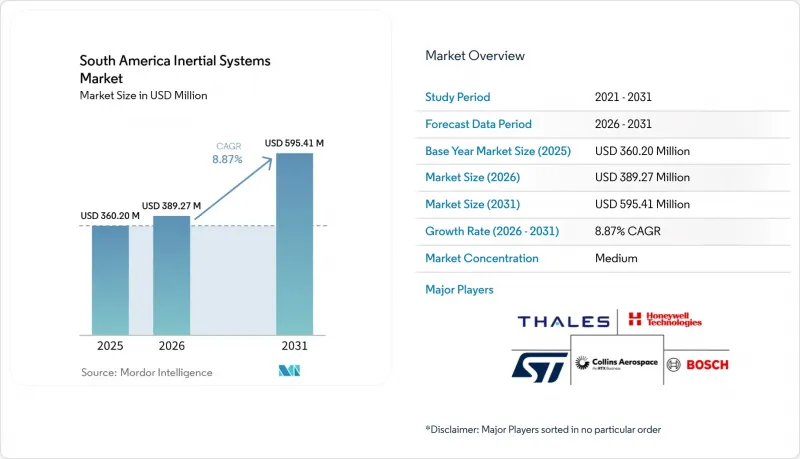
據 Mordor Intelligence 稱,南美慣性系統市場預計將從 2025 年的 3.602 億美元成長到 2026 年的 3.8927 億美元,到 2031 年達到 5.9541 億美元,2026 年至 2031 年的複合年成長率為 8.87%。
南美慣性系統市場趨勢與洞察
國防和航太平台現代化
巴西、阿根廷和哥倫比亞的平台現代化改造正在支撐南美慣性系統市場的持續需求。巴西的「塔曼達雷」級護衛艦計畫於2029年前交付四艘艦艇,其首艘護衛艦已於2026年2月服役,並配備了整合式導航和艦橋系統。每艘艦艇都需要在平台層面進行導航整合,這支撐了安裝、認證和運行階段對慣性設備的需求。阿根廷的F-16現代化改造計畫引進了對符合北約航空電子標準的整合GPS和慣性導航系統的需求。戰鬥機、護衛艦和直升機的同步現代化改造為供應商提供了多個長期專案的機會,而不是單一的採購週期。這種組合也滿足了初始平台交付完成後後續升級的需求。
擴大無人機、無人地面車輛和無人水下航行器的部署。
隨著無人機、無人地面車輛和無人水下載具系統的廣泛部署,對能夠承受衝擊並具備校準性能的緊湊型感測器的需求日益成長。南美慣性系統市場正從中受益,因為無人平台利用慣性輸入來實現穩定、導引、姿態控制和位置估計。巴西於2026年1月成功完成了其噴射無人機「信天翁渦旋」(Albatros Vortex)的首飛,該計畫是巴西國防部和空軍合作協議的一部分。 2026年5月,阿根廷公開展示了一款配備陀螺穩定武器砲塔和第一人稱觀點(FPV)無人機部署能力的無人地面車輛(UGV)。這些項目表明,該地區的採購活動正從傳統的有人平台擴展到多個無人領域。這些需求要求系統體積更小、成本更低,同時維持可靠的作戰性能。
對高精度慣性元件的進口依賴
在南美洲,滿足導航和戰略精度要求的加速計和陀螺儀的國內生產能力有限。因此,南美洲慣性系統市場依賴少數幾家獲得國際認證的製造商,這些製造商的產品應用於軍用飛機、海上導航和精確導引武器。出口限制制約了這些產品的供應,並可能使區域專案的交付計劃複雜化。 《國際武器貿易條例》(ITAR)對國防相關產品及其相關技術資料設定了限制,這可能會影響跨境供應合約。此外,如果合約以外幣計價,對進口的依賴將推高本地採購成本。儘管巴西致力於開發國產SNI-GNSS系統,展現了其長期發展本土能力的決心,但在可預見的未來,對高精度組件的需求可能仍將依賴海外採購。
細分市場分析
2025年,慣性測量單元(IMU)在南美慣性系統市場佔有33.81%的佔有率,預計2026年至2031年將以10.13%的複合年成長率成長。這一市場地位反映了IMU在國防和民用領域的導航、穩定和導引武器的應用。在巴西,SIATT公司位於卡卡帕瓦的工廠正在大規模生產MANSUP反艦飛彈和MAX 1.2 AC反戰車飛彈,以滿足市場對導引子系統的需求。 2025年9月,SIATT公司在聖若澤杜斯坎普斯新建了一座6,000平方公尺的工廠,擴大了產能。該工廠包括研發實驗室以及MANSUP、MAX 1.2 AC和SisGAAz系統的生產線。此外,IMU也應用於海上能源、無人機、航太發射和工業導航等領域。由於該組件可在多個平台上使用,因此對特定採購計劃的依賴性較低。
加速計和陀螺儀為慣性測量單元 (IMU) 和更複雜的慣性組件提供基礎感測輸入。這些感測器的需求與 IMU 和慣性導航系統的生產速度密切相關,而非單一的最終用途。磁力計在海事和採礦領域的方位角參考應用中繼續發揮至關重要的作用。姿態航向參考系統 (AHRS) 設備在海上石油作業中正日益普及,例如 Exail 公司與巴西石油公司 (Petrobras) 簽訂契約,向其運營的浮式生產儲卸油船 (FPSO)交付30 套 Quadrans AHRS 設備。傾角儀和導航電腦正透過自主和遠端操作的工業系統創造收益。這些組件的組合為南美慣性系統產業進入高精度國防項目和大批量商業應用領域提供了機會。本地整合要求通常有利於同時具備感測器能力和工程支援的供應商。
其他好處:
- Excel格式的市場預測(ME)表
- 3個月的分析師支持
目錄
第1章:引言
- 研究假設和市場定義
- 調查範圍
第2章:調查方法
第3章執行摘要
第4章 市場狀況
- 市場概覽
- 市場促進因素
- 國防和航太平台現代化
- 擴大無人機、無人地面車輛和無人水下航行器的部署
- MEMS小型化和系統成本降低
- 當全球導航衛星系統 (GNSS) 不可用時,導航和反干擾的要求
- 南美洲石油、天然氣和採礦業的自動化
- 巴西國防和電子產業的在地化和一體化
- 市場限制因素
- 高品質慣性測量元件的導入依賴性
- 長期認證和認可流程
- 積分、校準和漂移校正的複雜度。
- 外匯波動與國防採購失衡
- 產業價值鏈分析
- 監理情勢
- 技術展望
- 波特五力分析
- 宏觀經濟因素對市場的影響
第5章 市場規模與成長預測
- 按組件
- 加速計
- 陀螺儀
- 慣性測量單元(IMU)
- 磁力計
- 姿勢、方向和參考系統
- 其他規則
- 透過技術
- MEMS
- 光纖陀螺儀
- 環形雷射陀螺儀
- 振動陀螺儀
- 半球共振器陀螺儀
- 機械慣性導航系統
- 透過使用
- 航太/國防
- 能源基礎設施
- 家用電子產品
- 產業
- 車
- 醫學領域
- 陸路/交通運輸
- 其他用途
- 國家
- 巴西
- 阿根廷
- 哥倫比亞
- 其他南美國家
第6章 競爭情勢
- 市場集中度
- 策略趨勢
- 市佔率分析
- 公司簡介
- Honeywell International Inc.
- Collins Aerospace
- Safran Electronics & Defense
- Thales Group
- Northrop Grumman Corporation
- STMicroelectronics NV
- Analog Devices, Inc.
- Robert Bosch GmbH
- TDK Corporation
- Murata Manufacturing Co., Ltd.
- KVH Industries, Inc.
- EMCORE Corporation
- Teledyne Technologies Incorporated
- Trimble Inc.
- VectorNav Technologies, LLC
- Exail Technologies
- Kearfott Corporation
- Silicon Sensing Systems Limited
- AEL Sistemas SA
- Embraer SA
- SIATT Sistemas de Defesa Ltda.
- INVAP SE
- HORUSEYE TECH Systems Engineering
第7章 市場機會與未來展望
According to Mordor Intelligence, the South America inertial systems market size is expected to increase from USD 360.20 million in 2025 to USD 389.27 million in 2026 and reach USD 595.41 million by 2031, growing at a CAGR of 8.87% over 2026-2031.
South America Inertial Systems Market Trends and Insights
Defense and Aerospace Platform Modernization
Platform modernization in Brazil, Argentina, and Colombia supports sustained demand within the South America inertial systems market. Brazil's Tamandare-class frigate program covers 4 vessels scheduled for delivery through 2029, and its first frigate entered service with an integrated navigation and bridge system in February 2026. Each vessel requires navigation integration at the platform level, which supports demand for inertial equipment during installation, qualification, and service. Argentina's F-16 modernization program introduces embedded GPS and inertial navigation requirements that are consistent with NATO-aligned avionics standards. The concurrent modernization of fighter aircraft, frigates, and helicopters gives suppliers several long-duration program opportunities instead of a single procurement cycle. This mix also supports replacement demand after the original platform deliveries are complete.
Expansion of UAV, UGV, and UUV Deployment
The expansion of unmanned air, ground, and subsea systems increases demand for compact sensors that can withstand shock and operate with calibrated performance profiles. The South America inertial systems market benefits because unmanned platforms use inertial inputs for stabilization, guidance, attitude reference, and position estimation. Brazil conducted the first confirmed flight of the Albatroz Vortex jet-powered UAV in January 2026 under a cooperation arrangement involving the Ministry of Defense and the Air Force. Argentina publicly demonstrated a UGV with a gyrostabilized weapon turret and first-person-view drone deployment capability in May 2026. These programs show that regional procurement is extending beyond conventional crewed platforms into several unmanned domains. Their requirements favor smaller and more cost-efficient systems while maintaining reliable field performance.
Import Dependence for High-Grade Inertial Components
South America has limited domestic capacity for accelerometers and gyroscopes that meet navigation-grade and strategic-grade accuracy requirements. The South America inertial systems market, therefore, relies on a concentrated group of internationally qualified manufacturers for military aircraft, ship navigation, and precision-guided weapons. Export controls can restrict the availability of these products and complicate delivery planning for regional programs. The International Traffic in Arms Regulations establish controls for defense articles and related technical data, which can affect cross-border supply arrangements. Import dependence also raises local procurement costs when contracts are denominated in foreign currencies. Brazil's work on a domestic SNI-GNSS system points to a longer-term effort to develop local capability, but high-grade component demand remains externally sourced in the near term.
Other drivers and restraints analyzed in the detailed report include:
- GNSS-Denied Navigation and Anti-Jam Requirements
- Oil, Gas, and Mining Automation
- Long Qualification and Certification Cycles
For complete list of drivers and restraints, kindly check the Table Of Contents.
Segment Analysis
IMUs held 33.81% of the South America inertial systems market share in 2025 and are projected to expand at a 10.13% CAGR between 2026 and 2031. This position reflects their use in navigation, stabilization, and guided-weapon guidance across defense and civil applications. Brazil's serial production of the MANSUP anti-ship missile and MAX 1.2 AC anti-tank missile at SIATT's Cacapava facility supports demand for guidance subsystems. SIATT expanded its production capability through a new 6,000 m2 facility in Sao Jose dos Campos in September 2025, with research laboratories and lines for MANSUP, MAX 1.2 AC, and SisGAAz systems. IMUs also serve offshore energy, UAV, space-launch, and industrial navigation functions. Their use across several platforms makes the component less dependent on any one procurement program.
Accelerometers and gyroscopes provide the basic sensing inputs used in IMUs and more complex inertial assemblies. Their demand is linked to the production rate of IMUs and inertial navigation systems rather than to a single end use. Magnetometers retain a focused role in heading-reference applications across maritime and mining operations. AHRS equipment has gained support in offshore oil and gas work, as shown by Exail's contract for 30 Quadrans AHRS units for Petrobras-operated FPSOs. Inclinometers and navigation computers add revenue through autonomous and remotely operated industrial systems. The component mix gives the South America inertial systems industry exposure to high-precision defense programs and larger-volume commercial uses. Local integration requirements can favor suppliers that combine sensor capability with engineering support.
Complete Report Scope:
- By Component
- Accelerometers
- Gyroscopes
- Inertial Measurement Units (IMUs)
- Magnetometers
- Attitude Heading and Reference Systems
- Other Components
- By Technology
- MEMS
- Fiber-Optic Gyro
- Ring Laser Gyro
- Vibrating Gyro
- Hemispherical Resonator Gyro
- Mechanical Inertial Navigational Systems
- By Applications
- Aerospace and Defense
- Energy and Infrastructure
- Consumer Electronics
- Industrial
- Automotive
- Medical
- Land and Transportation
- Other Applications
- By Country
- Brazil
- Argentina
- Colombia
- Rest of South America
List of Companies Covered in this Report:
- Honeywell International Inc.
- Collins Aerospace
- Safran Electronics & Defense
- Thales Group
- Northrop Grumman Corporation
- STMicroelectronics N.V.
- Analog Devices, Inc.
- Robert Bosch GmbH
- TDK Corporation
- Murata Manufacturing Co., Ltd.
- KVH Industries, Inc.
- EMCORE Corporation
- Teledyne Technologies Incorporated
- Trimble Inc.
- VectorNav Technologies, LLC
- Exail Technologies
- Kearfott Corporation
- Silicon Sensing Systems Limited
- AEL Sistemas S.A.
- Embraer S.A.
- SIATT Sistemas de Defesa Ltda.
- INVAP S.E.
- HORUSEYE TECH Systems Engineering
Additional Benefits:
- The market estimate (ME) sheet in Excel format
- 3 months of analyst support
TABLE OF CONTENTS
1 INTRODUCTION
- 1.1 Study Assumptions and Market Definition
- 1.2 Scope of the Study
2 RESEARCH METHODOLOGY
3 EXECUTIVE SUMMARY
4 MARKET LANDSCAPE
- 4.1 Market Overview
- 4.2 Market Drivers
- 4.2.1 Defense and Aerospace Platform Modernization
- 4.2.2 Expansion of UAV, UGV and UUV Deployment
- 4.2.3 MEMS Miniaturization and Lower System Cost
- 4.2.4 GNSS-Denied Navigation and Anti-Jam Requirements
- 4.2.5 South American Oil, Gas and Mining Automation
- 4.2.6 Localized Defense-Electronics Integration in Brazil
- 4.3 Market Restraints
- 4.3.1 Import Dependence for High-Grade Inertial Components
- 4.3.2 Long Qualification and Certification Cycles
- 4.3.3 Integration, Calibration and Drift-Compensation Complexity
- 4.3.4 Currency Volatility and Uneven Defense Procurement
- 4.4 Industry Value Chain Analysis
- 4.5 Regulatory Landscape
- 4.6 Technological Outlook
- 4.7 Porter's Five Forces Analysis
- 4.7.1 Threat of New Entrants
- 4.7.2 Bargaining Power of Suppliers
- 4.7.3 Bargaining Power of Buyers
- 4.7.4 Threat of Substitutes
- 4.7.5 Competitive Rivalry
- 4.8 Impact of Macroeconomic Factors on the Market
5 MARKET SIZE AND GROWTH FORECASTS (VALUE)
- 5.1 By Component
- 5.1.1 Accelerometers
- 5.1.2 Gyroscopes
- 5.1.3 Inertial Measurement Units (IMUs)
- 5.1.4 Magnetometers
- 5.1.5 Attitude Heading and Reference Systems
- 5.1.6 Other Components
- 5.2 By Technology
- 5.2.1 MEMS
- 5.2.2 Fiber-Optic Gyro
- 5.2.3 Ring Laser Gyro
- 5.2.4 Vibrating Gyro
- 5.2.5 Hemispherical Resonator Gyro
- 5.2.6 Mechanical Inertial Navigational Systems
- 5.3 By Applications
- 5.3.1 Aerospace and Defense
- 5.3.2 Energy and Infrastructure
- 5.3.3 Consumer Electronics
- 5.3.4 Industrial
- 5.3.5 Automotive
- 5.3.6 Medical
- 5.3.7 Land and Transportation
- 5.3.8 Other Applications
- 5.4 By Country
- 5.4.1 Brazil
- 5.4.2 Argentina
- 5.4.3 Colombia
- 5.4.4 Rest of South America
6 COMPETITIVE LANDSCAPE
- 6.1 Market Concentration
- 6.2 Strategic Moves
- 6.3 Market Share Analysis
- 6.4 Company Profiles (includes Global Level Overview, Market Level Overview, Core Segments, Financials as available, Strategic Information, Market Rank/Share, Products and Services, Recent Developments)
- 6.4.1 Honeywell International Inc.
- 6.4.2 Collins Aerospace
- 6.4.3 Safran Electronics & Defense
- 6.4.4 Thales Group
- 6.4.5 Northrop Grumman Corporation
- 6.4.6 STMicroelectronics N.V.
- 6.4.7 Analog Devices, Inc.
- 6.4.8 Robert Bosch GmbH
- 6.4.9 TDK Corporation
- 6.4.10 Murata Manufacturing Co., Ltd.
- 6.4.11 KVH Industries, Inc.
- 6.4.12 EMCORE Corporation
- 6.4.13 Teledyne Technologies Incorporated
- 6.4.14 Trimble Inc.
- 6.4.15 VectorNav Technologies, LLC
- 6.4.16 Exail Technologies
- 6.4.17 Kearfott Corporation
- 6.4.18 Silicon Sensing Systems Limited
- 6.4.19 AEL Sistemas S.A.
- 6.4.20 Embraer S.A.
- 6.4.21 SIATT Sistemas de Defesa Ltda.
- 6.4.22 INVAP S.E.
- 6.4.23 HORUSEYE TECH Systems Engineering
7 MARKET OPPORTUNITIES AND FUTURE OUTLOOK
- 7.1 White-Space and Unmet-Need Assessment

 高階慣性系統:市場佔有率分析、產業趨勢與統計及成長預測(2026-2031)汽車慣性系統:市場佔有率分析、產業趨勢與統計、成長預測(2026-2031)
 2026年全球視覺里程計相機市場報告2026年全球視覺慣性定位(VIO)系統市場報告
 高階慣性測量系統市場:依平台、技術、架構和應用分類-2026-2032年全球市場預測
 交通慣性系統市場分析及預測(至2035年):依類型、產品類型、服務、技術、組件、應用、最終用戶、功能、安裝類型及模式分類慣性系統市場分析及預測(至2035年):依類型、產品類型、技術、組件、應用、最終用戶、部署類型、功能、安裝類型及解決方案分類戰術慣性系統市場分析及預測(至2035年):依類型、產品類型、服務、技術、組件、應用、形狀、材質、設備及最終用戶分類陸地應用慣性系統市場分析及預測(至2035年):依類型、產品類型、服務、技術、組件、應用、設備、最終使用者、功能及安裝類型分類2026年全球慣性參考系統市場報告