


 |
市場調查報告書
商品編碼
2113670
汽車慣性系統:市場佔有率分析、產業趨勢與統計、成長預測(2026-2031)Automotive Inertial Systems - Market Share Analysis, Industry Trends & Statistics, Growth Forecasts (2026 - 2031) |
||||||

※ 本網頁內容可能與最新版本有所差異。詳細情況請與我們聯繫。
根據 Mordor Intelligence 預測,汽車慣性系統市場將從 2025 年的 31.1 億美元成長到 2026 年的 34.3 億美元,然後在 2031 年達到 56.1 億美元,2026 年至 2031 年的複合年成長率為 10.31%。
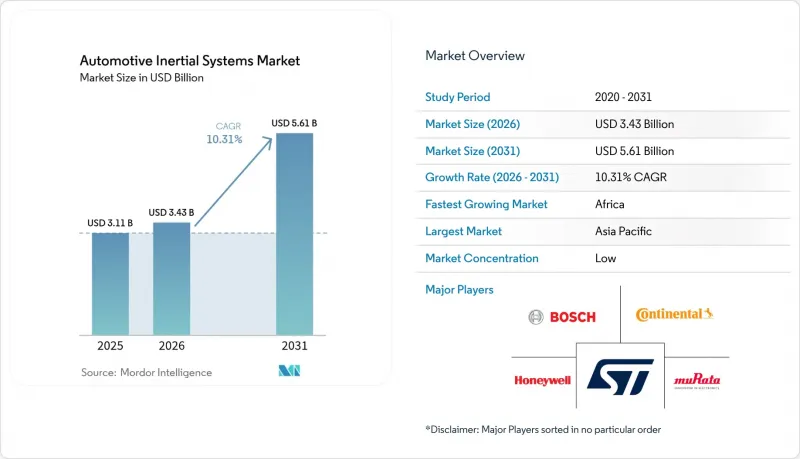
本報告按組件(加速計、陀螺儀等)、車輛類型(乘用車、輕型商用車等)、技術(MEMS、光纖陀螺儀等)、應用(電子穩定控制系統、高級駕駛輔助系統等)、銷售管道(OEM原廠配套、售後市場)及地區進行細分。市場預測以美元計價。
全球汽車慣性系統市場趨勢及洞察
MEMS製造流程的進步
透過結合晶圓層次電子構裝和穿透矽通孔(TSV) 技術,MEMS 陀螺儀的尺寸相比 2024 年的裝置可縮小 40%,從而使一級供應商能夠在緊湊型 ADAS 域控制器中整合冗餘的 IMU,而無需重新設計多層基板。台灣晶圓廠向 12 吋矽的過渡將使單位成本降低 28%,同時晶圓開片數量翻倍。這對於實現許多汽車製造商為入門級車型設定的低於 100 億美元的物料清單 (BOM) 目標至關重要。博斯的 MEMS 和 CMOS 整合「TheELMA」技術消除了鍵合線中的寄生元件,並將頻寬擴展了十倍至 10 kHz,從而使先前需要笨重分立電子元件的主動懸吊應用成為可能。然而,由於深度蝕刻,良率仍取決於缺陷密度,當缺陷密度超過 0.1 cm⁻² 時,獲得汽車認證將變得無利可圖。持續對真空晶圓層次電子構裝進行資本投資,預計將腔體壓力降低到 1 Pa 以下,從而即使在高 G 碰撞條件下也能穩定品質因數和偏差。
高級駕駛輔助系統(ADAS)中慣性測量單元(IMU)的應用日益廣泛。
對於自動緊急煞車和車道維持輔助等駕駛輔助功能,目前採用6軸慣性測量單元(IMU)的資料與視覺和雷達資料以400 Hz的頻率融合,以精確估計車輛的運動狀態。 Euro NCAP 2025協議規定,只有在緊急操作期間橫向加速度保持在0.3 g以下,才能獲得滿分,而閾值只有透過封閉回路型IMU回饋才能實現。將獨立的加速計和陀螺儀整合到整合式IMU中,可以降低8-12美元的組件成本,並省去兩次獨立的校準過程,從而加速了即使在注重成本的緊湊型轎車中的應用。中國的GB/T 38186資料登錄規範規定,L2+級車輛的IMU訊號記錄頻率必須至少為100 Hz,這實際上確立了基本性能標準,有利於提供功能齊全的模組的解決方案供應商。
安全關鍵型應用的高昂校準成本
符合ASIL-D標準的汽車慣性測量單元(IMU)必須進行-40 度C至+125 度C的多軸溫度循環測試,持續18至24小時,測試箱精度為0.1 度C。這使得每台IMU的出廠價格增加12至18美元。 ISO 26262可追溯性要求每年對校準設備進行重新認證,這可能花費超過3萬美元,對於小規模的二級供應商而言是一筆不小的開支。儲存在非揮發性記憶體中的多項式溫度偏差校正會增加韌體的複雜性,並將檢驗週期延長6至9個月。一些前景廣闊的基於機器學習的校準技術預計在2小時內完成處理,但這些技術仍在等待汽車行業的認證,這延緩了短期內減輕成本的進程。
細分市場分析
到2025年,加速計將佔據汽車慣性系統市場38.05%的佔有率,用於支援安全氣囊展開、側翻檢測以及注重成本效益的電子穩定控制系統(ESC)。相較之下,整合式慣性測量單元(IMU)預計將以12.34%的複合年成長率成長,因為汽車製造商將加速計和陀螺儀通道整合到六軸單片封裝中,以減少印刷基板的面積。博世的BHI360將MEMS堆疊與Arm Cortex-M0處理器結合,並在本地運行感測器融合演算法,從而將電控系統(ECU)的負載降低了30%。
目前,獨立式陀螺儀主要用於線控轉向應用中的特定偏航率環路,但售價超過1000美元的慣性導航系統仍僅限於高階自動駕駛先導計畫。從分立式加速計轉向IMU反映了半導體產業向共封裝方向發展的更廣泛趨勢。這種趨勢使得每塊基板可以減少兩個ADC通道、一個穩壓器和幾個被動元件,從而有可能降低系統成本15-20%。因此,儘管加速計在汽車慣性系統市場仍保持著銷售優勢,但整合式IMU的採用率正在上升。
到2025年,乘用車將佔總銷售量的54.60%。然而,成長最快的細分市場是精密導航土木工程和農業機械。非公路機械市場預計將以11.10%的複合年成長率實現顯著成長。Caterpillar的創新「坡度控制」系統採用雙慣性測量單元(IMU)和全球導航衛星系統(GNSS)接收器,能夠以小於1公分的精度控制刀片高度,從而將作業週期縮短25%。
同時,約翰迪爾的「機器沉降」技術利用慣性測量單元(IMU)的俯仰和橫滾數據,使運糧車在運輸過程中與聯合收割機保持5厘米以內的距離。這種精度可減少3-5%的收割損失。另一方面,日本小松公司將IMU整合到鏟鬥控制迴路中,實現了2公分的開溝精度,同時顯著降低了操作員40%的疲勞。這些先進的應用需要高更新頻率和穩健的設計,從而加速了感測器的普及,其部署速度超過了乘用車領域的現有應用。
區域分析
預計到2025年,亞太地區將佔全球銷售量的43.20%。這主要得益於中國輕型汽車產量達到3000萬輛,以及印度以500萬輛的年產量成為世界第三大市場。中國的電子穩定控制系統(ESC)測試規範要求在駐留正弦波工況下,橫擺角速度的追蹤精度控制在5%以內,並優先選用刷新率為400Hz的六軸慣性測量單元(IMU)。在日本,政府對商用車輛加裝高級駕駛輔助系統(ADAS)提供30%的津貼,刺激了對售後市場模組的需求。同時,在韓國世宗試驗場,L4級試驗計畫強制要求使用雙冗餘感測器。
非洲是成長最快的地區,複合年成長率達10.72%,這主要得益於南非的「汽車生產與發展計畫」以及埃及將感測器進口關稅從40%降至10%。預計到2024年,南非的汽車產量將達到63.1萬輛,汽車製造商(OEM)甚至開始為入門車型配備電子穩定控制系統(ESC),以滿足南部非洲發展共同體(SADC)的統一法規。在埃及,感測器模組領域已吸引了2億美元的投資,尤其是在齋戒月10日工業區,這使得開羅成為區域供應中心。在北美和歐洲,由於ESC市場已經飽和,人們的焦點正轉向高階駕駛輔助系統(ADAS)的升級。美國國家公路交通安全管理局(NHTSA)正在考慮一項關於重型卡車自動緊急煞車的新法規,該法規將強制要求每年40萬輛美國7-8級車輛配備基於慣性測量單元(IMU)的側翻檢測系統。歐盟預計2024年將生產1,320萬輛汽車,並將其2025年歐洲新車安全評鑑協會(Euro NCAP)星級評定與一項橫向控制指數掛鉤,該指數要求車輛具備即時慣性回饋功能。中東市場預計2024年將進口180萬輛汽車,並正在遵守波灣合作理事會(GCC)的標準,該標準強制要求輕型商用車安裝電子穩定控制系統(ESC)。南美洲在高級駕駛輔助系統(ADAS)的普及方面落後於其他國家,但計劃在2027年前逐步實施南方共同市場關於商用車ESC的第140號法規,這將為巴西210萬輛的汽車市場創造售後市場機會。
其他好處:
- Excel格式的市場預測(ME)表
- 3個月的分析師支持
目錄
第1章:引言
- 市場分析與定義的前提條件
- 分析範圍
第2章 分析方法
第3章執行摘要
第4章 市場狀況
- 市場概覽
- 市場促進因素
- MEMS製造流程的進步
- 高級駕駛輔助系統(ADAS)中慣性測量單元(IMU)的應用日益廣泛。
- 提高乘用車自動駕駛水平
- 精密農業機械的需求日益成長
- 關於電子穩定控制系統(ESC)的嚴格安全法規
- 用於摩托車的低成本固體慣性測量單元(IMU)已經問世。
- 市場限制因素
- 安全關鍵型應用的高昂校準成本
- 感測器訊號漂移限制了長期導航精度。
- 供應鏈集中在少數幾家MEMS代工廠
- 通用加速計的價格壓力
- 價值鏈分析
- 監理情勢
- 技術展望
- 波特五力分析
- 投資分析
第5章 市場規模與成長預測
- 按組件
- 加速計
- 陀螺儀
- 慣性測量單元(IMU)
- 慣性導航系統(INS)
- 其他規則
- 按車輛類型
- 搭乘用車
- 輕型商用車
- 大型商用車輛
- 非公路用車
- 透過技術
- MEMS
- 光纖陀螺儀
- 環形雷射陀螺儀
- 其他
- 透過使用
- 電子穩定控制系統(ESC)
- 高級駕駛輔助系統(ADAS)
- 導航和航位推算
- 懸吊和底盤控制
- 按銷售管道
- OEM 原廠設備
- 售後市場
- 按地區
- 北美洲
- 美國
- 加拿大
- 墨西哥
- 南美洲
- 巴西
- 阿根廷
- 其他南美國家
- 歐洲
- 德國
- 英國
- 法國
- 義大利
- 西班牙
- 其他歐洲國家
- 亞太地區
- 中國
- 印度
- 日本
- 韓國
- ASEAN
- 其他亞太國家
- 中東和非洲
- 中東
- 沙烏地阿拉伯
- 阿拉伯聯合大公國
- 其他中東國家
- 非洲
- 南非
- 奈及利亞
- 其他非洲國家
- 中東
- 北美洲
第6章 競爭情勢
- 市場集中度
- 策略趨勢
- 市佔率分析
- 公司簡介
- Robert Bosch GmbH
- Continental AG
- Honeywell International Inc.
- STMicroelectronics NV
- Murata Manufacturing Co., Ltd.
- TE Connectivity Ltd.
- Analog Devices, Inc.
- Infineon Technologies AG
- Safran Electronics and Defense(Safran SA)
- Thales Group
- EMCORE Corporation
- MEMSIC, Inc.
- Lord Corporation(MicroStrain Inc.)
- Xsens Technologies BV
- VectorNav Technologies, LLC
- SBG Systems SAS
- Aceinna Inc.
- Sensonor AS
- TDK Corporation(InvenSense)
- NXP Semiconductors NV
第7章 市場機會與未來展望
According to Mordor Intelligence, the automotive inertial systems market size is expected to grow from USD 3.11 billion in 2025 to USD 3.43 billion in 2026 and is forecast to reach USD 5.61 billion by 2031 at 10.31% CAGR over 2026-2031.
This report is Segmented by Component (Accelerometer, Gyroscope, and More), Vehicle Type (Passenger Cars, Light Commercial Vehicles, and More), Technology (MEMS, Fiber-Optic Gyro, and More), Application (Electronic Stability Control, Advanced Driver Assistance Systems, and More), Sales Channel (OEM-Fitted, and Aftermarket), and Geography. The Market Forecasts are Provided in Terms of Value (USD).
Global Automotive Inertial Systems Market Trends and Insights
Advancements In MEMS Manufacturing Processes
Wafer-level packaging combined with through-silicon vias trims MEMS gyroscope footprints by 40% versus 2024 devices, letting Tier 1 suppliers place redundant IMUs inside compact ADAS domain controllers without redesigning multilayer boards. Transitioning to 12-inch silicon at Taiwanese fabs reduces per-unit cost by 28% while doubling wafer starts, a key enabler for the sub-USD 10 billion bill-of-materials target many automakers stipulate for entry-segment vehicles. Bosch's ThELMA co-integration of MEMS and CMOS eliminates bond-wire parasitics and increases bandwidth tenfold to 10 kHz, unlocking active-suspension use cases that previously required bulky discrete electronics. Yield, however, remains hostage to deep-etch defect density; if faults exceed 0.1 cm-2, automotive qualification turns uneconomical. Continued capex in vacuum wafer-level packaging is forecast to reduce cavity pressure below 1 Pa, thereby stabilizing the quality factor and bias over high-G crash profiles.
Rising Adoption Of Inertial Measurement Units In ADAS
Driver-assistance features such as automatic emergency braking and lane-keeping support now blend six-axis IMU data with vision and radar streams at 400 Hz for precise ego-motion estimates. Euro NCAP's 2025 protocol awards full points only when lateral accelerations remain under 0.3 g during emergency maneuvers, a threshold that is viable solely with closed-loop IMU feedback. Integrating discrete accelerometers and gyroscopes into unified IMUs reduces USD 8-12 from the bill of materials and eliminates two separate calibration stages, thereby accelerating adoption, even in cost-sensitive compact cars. China's GB/T 38186 data-logging rule requires Level 2+ vehicles to record IMU signals at a minimum of 100 Hz, effectively establishing a baseline performance tier that favors solution providers shipping fully characterized modules.
High Calibration Costs For Safety-Critical Applications
Automotive-grade IMUs intended for ASIL-D functions must undergo 18-24 hours of multi-axis temperature cycling from -40 °C to +125 °C with 0.1 °C chamber precision, adding USD 12-18 per unit at the factory gate. ISO 26262 traceability requires the annual recertification of calibration rigs, which can cost over USD 30,000, a non-trivial expense for small Tier 2 suppliers. Polynomial temperature-bias corrections stored in non-volatile memory increase firmware complexity and validation cycles by six to nine months. Machine-learning calibration, promising a two-hour throughput, is still awaiting automotive qualification, delaying near-term relief.
Other drivers and restraints analyzed in the detailed report include:
- Increasing Vehicle Autonomy Levels Across Passenger Cars
- Stringent Safety Mandates On Electronic Stability Control
- Sensor Signal Drift Limiting Long-Term Navigation Accuracy
For complete list of drivers and restraints, kindly check the Table Of Contents.
Segment Analysis
Accelerometers held 38.05% of the automotive inertial systems market share in 2025, underpinning airbag triggers, rollover detection, and cost-sensitive ESC. In contrast, integrated IMUs will post a 12.34% CAGR as automakers merge accelerometer and gyroscope channels inside six-axis monolithic packages to shrink printed-circuit footprints. Bosch's BHI360 couples a MEMS stack with an Arm Cortex-M0 processor that executes sensor-fusion algorithms locally, offloading 30% of the electronic control unit's load.
Standalone gyroscopes now serve niche yaw-rate loops in steer-by-wire applications, while premium inertial navigation systems, costing above USD 1,000, remain confined to high-end autonomy pilots. The migration from discrete accelerometers to IMUs reflects broader semiconductor trends toward co-packaging, which can eliminate two ADC channels, one voltage regulator, and several passive components per board, resulting in a 15-20% reduction in system cost. Integrated IMUs, therefore, command growing design wins despite accelerometers' numeric supremacy within the automotive inertial systems market.
Passenger cars accounted for a significant 54.60% of total revenue in 2025. However, it's the precision-guided earthmoving and farming equipment that's witnessing the most rapid growth. Off-highway machinery is projected to expand at an impressive 11.10% CAGR. Caterpillar's innovative Grade Control system, utilizing dual IMUs and GNSS receivers, ensures blade height precision within 1 cm, effectively shortening duty cycles 25%.
Meanwhile, John Deere's Machine Sync technology harnesses IMU data on pitch and roll, allowing grain carts to stay within 5 cm of combines during transfers. This precision helps in reducing harvest losses by 3-5%. Komatsu, on the other hand, integrates IMUs into bucket-control loops, achieving trench accuracy of 2 cm and cutting down operator fatigue by a notable 40%. Such advanced applications demand high update rates and robust designs, leading to the quicker adoption of sensors, which outpace their already established use in the passenger car sector.
Complete Report Scope:
- By Component
- Accelerometer
- Gyroscope
- Inertial Measurement Units (IMU)
- Inertial Navigation Systems (INS)
- Other Components
- By Vehicle Type
- Passenger Cars
- Light Commercial Vehicles
- Heavy Commercial Vehicles
- Off-Highway Vehicles
- By Technology
- MEMS
- Fiber-Optic Gyro
- Ring-Laser Gyro
- Others
- By Application
- Electronic Stability Control
- Advanced Driver Assistance Systems
- Navigation and Dead-Reckoning
- Suspension and Chassis Control
- By Sales Channel
- OEM-Fitted
- Aftermarket
- By Geography
- North America
- United States
- Canada
- Mexico
- South America
- Brazil
- Argentina
- Rest of South America
- Europe
- Germany
- United Kingdom
- France
- Italy
- Spain
- Rest of Europe
- Asia-Pacific
- China
- India
- Japan
- South Korea
- ASEAN
- Rest of Asia-Pacific
- Middle East and Africa
- Middle East
- Saudi Arabia
- United Arab Emirates
- Rest of Middle East
- Africa
- South Africa
- Nigeria
- Rest of Africa
- Middle East
- North America
Geography Analysis
Asia-Pacific commanded 43.20% of 2025 revenue as China built 30 million light vehicles and India rose to the world's third-largest market at 5 million units. China's ESC test spec requires yaw-rate tracking within 5% during sine-with-dwell maneuvers, favoring six-axis IMUs with 400 Hz update rates. Japan subsidizes 30% of ADAS retrofit bills for commercial fleets, boosting demand for aftermarket modules, while South Korea's Sejong testbed mandates dual-redundant sensors for Level 4 pilots.
Africa is the fastest-growing region, with a 10.72% CAGR, driven by South Africa's Automotive Production and Development Programme and Egypt's tariff reduction on sensor imports from 40% to 10%. South Africa produced 631,000 vehicles in 2024, and OEMs have begun equipping entry-level trims with ESC to meet the harmonized rules of the Southern African Development Community. Egypt attracted USD 200 million of sensor-module investment clustered around the 10th of Ramadan industrial zone, positioning Cairo as a regional supply hub. North America and Europe focus on ADAS upgrades in otherwise saturated ESC environments. NHTSA's pending rule for automatic emergency braking on heavy trucks will obligate IMU-based rollover detection on 400,000 U.S. Class 7-8 units annually. The European Union manufactured 13.2 million vehicles in 2024, and ties 2025 Euro NCAP star ratings to lateral-control metrics that require real-time inertial feedback. Middle East markets, which imported 1.8 million vehicles in 2024, align with Gulf Cooperation Council standards that enforce ESC for light commercial vehicles. South America lags on ADAS but will phase Mercosur Regulation 140 for commercial-vehicle ESC by 2027, opening retrofit opportunities in Brazil's 2.1 million-unit industry.
- Robert Bosch GmbH
- Continental AG
- Honeywell International Inc.
- STMicroelectronics N.V.
- Murata Manufacturing Co., Ltd.
- TE Connectivity Ltd.
- Analog Devices, Inc.
- Infineon Technologies AG
- Safran Electronics and Defense (Safran S.A.)
- Thales Group
- EMCORE Corporation
- MEMSIC, Inc.
- Lord Corporation (MicroStrain Inc.)
- Xsens Technologies B.V.
- VectorNav Technologies, LLC
- SBG Systems S.A.S.
- Aceinna Inc.
- Sensonor AS
- TDK Corporation (InvenSense)
- NXP Semiconductors N.V.
Additional Benefits:
- The market estimate (ME) sheet in Excel format
- 3 months of analyst support
TABLE OF CONTENTS
1 INTRODUCTION
- 1.1 Study Assumptions and Market Definition
- 1.2 Scope of the Study
2 RESEARCH METHODOLOGY
3 EXECUTIVE SUMMARY
4 MARKET LANDSCAPE
- 4.1 Market Overview
- 4.2 Market Drivers
- 4.2.1 Advancements in MEMS Manufacturing Processes
- 4.2.2 Rising Adoption of Inertial Measurement Units in ADAS
- 4.2.3 Increasing Vehicle Autonomy Levels Across Passenger Cars
- 4.2.4 Growing Demand for Precision Farming Machinery
- 4.2.5 Stringent Safety Mandates on Electronic Stability Control
- 4.2.6 Emergence of Low-Cost Solid-State IMUs for Two-Wheelers
- 4.3 Market Restraints
- 4.3.1 High Calibration Costs for Safety-Critical Applications
- 4.3.2 Sensor Signal Drift Limiting Long-Term Navigation Accuracy
- 4.3.3 Supply Chain Concentration in Few MEMS Foundries
- 4.3.4 Price Pressure from Commodity Accelerometers
- 4.4 Value Chain Analysis
- 4.5 Regulatory Landscape
- 4.6 Technological Outlook
- 4.7 Porter's Five Forces Analysis
- 4.7.1 Bargaining Power of Suppliers
- 4.7.2 Bargaining Power of Buyers
- 4.7.3 Threat of New Entrants
- 4.7.4 Threat of Substitutes
- 4.7.5 Intensity of Competitive Rivalry
- 4.8 Investment Analysis
5 MARKET SIZE AND GROWTH FORECASTS (VALUE)
- 5.1 By Component
- 5.1.1 Accelerometer
- 5.1.2 Gyroscope
- 5.1.3 Inertial Measurement Units (IMU)
- 5.1.4 Inertial Navigation Systems (INS)
- 5.1.5 Other Components
- 5.2 By Vehicle Type
- 5.2.1 Passenger Cars
- 5.2.2 Light Commercial Vehicles
- 5.2.3 Heavy Commercial Vehicles
- 5.2.4 Off-Highway Vehicles
- 5.3 By Technology
- 5.3.1 MEMS
- 5.3.2 Fiber-Optic Gyro
- 5.3.3 Ring-Laser Gyro
- 5.3.4 Others
- 5.4 By Application
- 5.4.1 Electronic Stability Control
- 5.4.2 Advanced Driver Assistance Systems
- 5.4.3 Navigation and Dead-Reckoning
- 5.4.4 Suspension and Chassis Control
- 5.5 By Sales Channel
- 5.5.1 OEM-Fitted
- 5.5.2 Aftermarket
- 5.6 By Geography
- 5.6.1 North America
- 5.6.1.1 United States
- 5.6.1.2 Canada
- 5.6.1.3 Mexico
- 5.6.2 South America
- 5.6.2.1 Brazil
- 5.6.2.2 Argentina
- 5.6.2.3 Rest of South America
- 5.6.3 Europe
- 5.6.3.1 Germany
- 5.6.3.2 United Kingdom
- 5.6.3.3 France
- 5.6.3.4 Italy
- 5.6.3.5 Spain
- 5.6.3.6 Rest of Europe
- 5.6.4 Asia-Pacific
- 5.6.4.1 China
- 5.6.4.2 India
- 5.6.4.3 Japan
- 5.6.4.4 South Korea
- 5.6.4.5 ASEAN
- 5.6.4.6 Rest of Asia-Pacific
- 5.6.5 Middle East and Africa
- 5.6.5.1 Middle East
- 5.6.5.1.1 Saudi Arabia
- 5.6.5.1.2 United Arab Emirates
- 5.6.5.1.3 Rest of Middle East
- 5.6.5.2 Africa
- 5.6.5.2.1 South Africa
- 5.6.5.2.2 Nigeria
- 5.6.5.2.3 Rest of Africa
- 5.6.5.1 Middle East
- 5.6.1 North America
6 COMPETITIVE LANDSCAPE
- 6.1 Market Concentration
- 6.2 Strategic Moves
- 6.3 Market Share Analysis
- 6.4 Company Profiles (includes Global level Overview, Market level overview, Core Segments, Financials as available, Strategic Information, Market Rank/Share for key companies, Products and Services, and Recent Developments)
- 6.4.1 Robert Bosch GmbH
- 6.4.2 Continental AG
- 6.4.3 Honeywell International Inc.
- 6.4.4 STMicroelectronics N.V.
- 6.4.5 Murata Manufacturing Co., Ltd.
- 6.4.6 TE Connectivity Ltd.
- 6.4.7 Analog Devices, Inc.
- 6.4.8 Infineon Technologies AG
- 6.4.9 Safran Electronics and Defense (Safran S.A.)
- 6.4.10 Thales Group
- 6.4.11 EMCORE Corporation
- 6.4.12 MEMSIC, Inc.
- 6.4.13 Lord Corporation (MicroStrain Inc.)
- 6.4.14 Xsens Technologies B.V.
- 6.4.15 VectorNav Technologies, LLC
- 6.4.16 SBG Systems S.A.S.
- 6.4.17 Aceinna Inc.
- 6.4.18 Sensonor AS
- 6.4.19 TDK Corporation (InvenSense)
- 6.4.20 NXP Semiconductors N.V.
7 MARKET OPPORTUNITIES AND FUTURE OUTLOOK
- 7.1 White-space and Unmet-Need Assessment

 慣性系統市場:全球預測,2026-2032年
 高階慣性系統:市場佔有率分析、產業趨勢與統計及成長預測(2026-2031)
 2026年全球視覺里程計相機市場報告
 戰術慣性系統市場報告:趨勢、預測與競爭分析(至2035年)2026年全球視覺慣性定位(VIO)系統市場報告高階慣性測量系統市場:依平台、技術、架構和應用分類-2026-2032年全球市場預測
 交通慣性系統市場分析及預測(至2035年):依類型、產品類型、服務、技術、組件、應用、最終用戶、功能、安裝類型及模式分類慣性系統市場分析及預測(至2035年):依類型、產品類型、技術、組件、應用、最終用戶、部署類型、功能、安裝類型及解決方案分類戰術慣性系統市場分析及預測(至2035年):依類型、產品類型、服務、技術、組件、應用、形狀、材質、設備及最終用戶分類陸地應用慣性系統市場分析及預測(至2035年):依類型、產品類型、服務、技術、組件、應用、設備、最終使用者、功能及安裝類型分類