


 |
市場調查報告書
商品編碼
2154965
南美洲化妝品包裝市場:市場佔有率分析、產業趨勢與統計及成長預測(2026-2031)South America Cosmetic Packaging - Market Share Analysis, Industry Trends & Statistics, Growth Forecasts (2026 - 2031) |
||||||

※ 本網頁內容可能與最新版本有所差異。詳細情況請與我們聯繫。
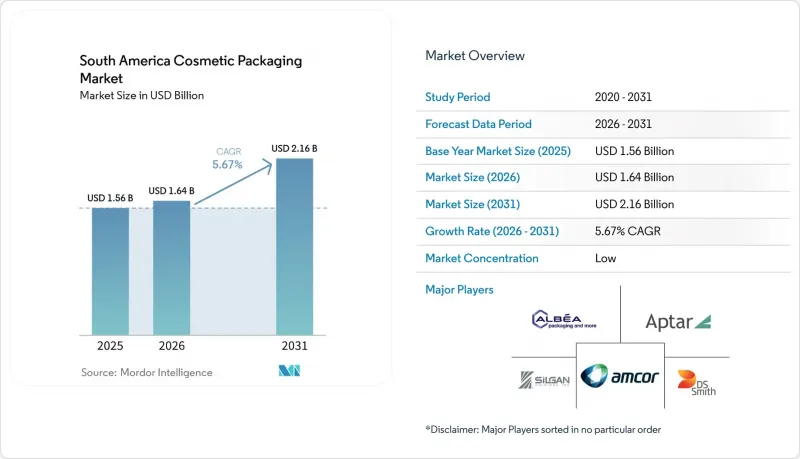
據 Mordor Intelligence 稱,2025 年南美化妝品包裝市場價值 15.6 億美元,預計到 2026 年將從 16.4 億美元成長到 2031 年的 21.6 億美元。
預測期(2026-2031 年)的複合年成長率預計為 5.67%。
南美化妝品包裝市場趨勢與洞察
高階及精品美容產品的消費趨勢
南美化妝品包裝市場正受惠於巴西、阿根廷和智利等國對高階和精品美容產品日益成長的需求。這些國家的品牌在產品開發的早期階段就開始調整包裝要求。預計到2031年,該地區的高階美妝市場將保持顯著的複合年成長率。零售價格的上漲推動了對能夠使產品在銷售點脫穎而出、並在競爭激烈的零售環境中凸顯產品品質的材料、裝飾和分配系統的需求成長。因此,供應商越來越需要提供玻璃、層壓金屬、真空瓶和可重複填充的設計,這要求品牌、設計和生產團隊之間進行更緊密的合作。預計到2031年,巴西的高階美妝市場也將維持較高的複合年成長率,從而支撐對這些高規格包裝形式的需求。精品美妝市場則透過以更實惠的價格提供高階功能,擴大了增值包裝的基本客群。
輕包裝,適合電子商務。
數位美妝零售的興起正在改變產品進入生產階段前包裝的評估方式。這是因為線上訂單處理流程在傳統的商店展示標準之外,增加了對配送和產品外觀的要求。該地區美妝和個人護理行業的電商管道在2024年之前的五年內將以顯著的複合年成長率成長,因此,配送過程中的耐用性成為一項至關重要的設計考量。品牌需要能夠承受配送過程中搬運的包裝,同時也要保持適合線上產品頁面、試用裝活動和開箱影片的外觀。 2025年4月,Aptar Beauty在哥倫比亞、阿根廷、巴西和墨西哥為其Sierra、Moda和Luna系列產品推出了本地生產的無氣包裝。該公司根據ISTA-6電子商務協議設計了這些包裝,並採用了可回收的PP和PCR(消費後回收)材料。這種方法能夠快速地向區域品牌供貨,並使輕便、便於配送的包裝在南美化妝品包裝市場更具實用性。
再生樹脂價格波動
即使品牌所有者承諾採用更永續的材料規格,再生樹脂的成本也可能限制加工商提高再生材料含量的速度。 2026 年中,再生 PET 的溢價仍比原生樹脂高出 20-30%,預計到 2027 年才會趨於正常。依賴使用過的再生樹脂的南美加工商可能面臨更高的採購成本,尤其是在需要進口樹脂來滿足品質、一致性或數量要求的情況下。這些成本可能會擠壓加工商的利潤空間,並推高面向價格敏感型消費者的大眾市場美妝品牌所有者的產品價格。此外,國內回收能力有限,使得買家容易受到北美和歐洲供應市場運輸成本和定價的影響。由此產生的價格差異可能會減緩除強制性要求之外的自願採用再生材料的步伐。
細分市場分析
2025年,塑膠在南美洲化妝品包裝市場佔據58.82%的佔有率。這主要得益於塑膠的成本效益、加工柔軟性以及巴西和哥倫比亞成熟加工商的生產能力。 PET因其高透明度和適用於各種形狀(從洗髮精瓶到精華液容器)而被廣泛應用。 PET的高可回收性也使其成為品牌滿足材料和法規要求的關鍵材料。 PP和PE因其優異的性價比,仍是瓶蓋、軟管和軟包裝內襯的常用材料。紙張和紙板在可折疊紙盒中的應用日益廣泛,尤其是在與巴西加工商合作的獨立品牌中。
預計到2031年,玻璃包裝將以6.94%的複合年成長率成長,成為南美化妝品包裝市場中成長速度最快的材料類型。這一地位反映了市場對兼具高階外觀和循環設計理念的包裝的需求。玻璃尤其適用於香水、精華液和身體油等產品,因為這些產品的重量、透明度和觸感是其定位的重要組成部分。在2026年BIOFACH展會上,Gellesheimer展示了採用廢棄玻璃瓶製成的高回收玻璃,以及輕巧的造型和可重複填充的天然化妝品解決方案。此外,高階品牌仍然可以利用玻璃來實現高價值設計,同時實踐使用可重複利用和回收材料的目標。
瓶罐在護膚、護髮和香水領域仍扮演核心角色,預計2025年將佔南美洲化妝品包裝市場規模的39.74%。精華液、乳霜、護髮素和乳液等產品持續推動對這些包裝形式的需求。在高階價位區間,品牌擴大採用真空瓶、玻璃罐和更精緻的瓶蓋。可折疊紙盒被用作補充裝和高階禮品套裝的外包裝。隨著線上零售商對緊湊、認證且耐用的運輸包裝的需求不斷成長,瓦楞紙箱的重要性也日益凸顯。
預計到2031年,軟包裝小袋和小袋的複合年成長率將達到6.78%,在所有產品類型中成長最高。在哥倫比亞和秘魯,這些包裝形式已被用於線上樣品分發、旅行、補充裝系統以及低價策略。軟包裝形式也滿足了品牌拓展二、三線城市市場、滿足小批量採購需求的需求。自2025年以來,InvPack的單批次灌裝機已在南美洲投入使用,證明了該地區具備靈活的單批次化妝品填充能力。南美洲化妝品包裝產業可以利用這些包裝形式,在便利性、成本和配送效率之間取得平衡。
其他好處:
- Excel格式的市場預測(ME)表
- 3個月的分析師支持
目錄
第1章:引言
- 研究假設和市場定義
- 調查範圍
第2章:調查方法
第3章執行摘要
第4章 市場狀況
- 市場概覽
- 宏觀經濟因素對市場的影響
- 市場促進因素
- 高階及精品美容產品的消費趨勢
- 輕量級格式,適合電子商務
- 可重複填充和使用的計量系統
- 具有認證功能的智慧包裝
- 對符合碳標籤標準的包裝的需求
- 面向獨立美妝品牌的區域性小批量包裝
- 市場限制因素
- 再生樹脂價格波動
- 與塑膠包裝相關的法規和合規成本
- 與新型生物材料填充線不相容
- 逆向物流與回收之間的差距
- 產業價值鏈分析
- 監理情勢
- 技術展望
- 波特五力分析
第5章 市場規模與成長預測
- 材料類型
- 塑膠
- 聚對苯二甲酸乙二醇酯(PET)
- 聚丙烯(PP)
- 聚乙烯(PE)
- 其他塑膠
- 玻璃
- 金屬
- 紙張和紙板
- 塑膠
- 依產品類型
- 瓶子和罐子
- 管子和棍子
- 折疊紙箱
- 紙板運輸箱
- 軟性包裝袋
- 其他產品類型
- 分配機構
- 泵浦類型
- 滴管/移液器
- 噴霧/霧
- 黏/扭轉向上
- 罐子/湯匙
- 依化妝品類型
- 護膚
- 臉部保養
- 身體保養
- 護髮
- 彩妝
- 香水及香氛
- 其他化妝品類型
- 護膚
- 國家
- 巴西
- 阿根廷
- 智利
- 哥倫比亞
- 秘魯
- 其他南美國家
第6章 競爭情勢
- 市場集中度
- 策略趨勢
- 市佔率分析
- 公司簡介
- Albea SA
- AptarGroup Inc.
- Amcor plc
- Silgan Holdings Inc.
- DS Smith PLC
- Graham Packaging LP
- Quadpack Industries SA
- Libo Cosmetics Co. Ltd
- Gerresheimer AG
- Ball Corporation
- Verescence France SA
- Cosmopak Ltd
- Raepak Ltd
- Rieke Corporation
- Huhtamaki Oyj
- ALPLA Werke Alwin Lehner GmbH
- HCP Packaging Co. Ltd
- Wheaton Brasil Vidros SA
- Thomriss Industria e Comercio Ltda.
- C-Pack Creative Packaging SA
- Simex SAS
- SOINCO SAS
- TUBAPLAS SA
- Ibratec Artes Graficas Ltda.
- Brasilata SA
第7章 市場機會與未來展望
According to Mordor Intelligence, the South America cosmetic packaging market size was valued at USD 1.56 billion in 2025 and is estimated to expand from USD 1.64 billion in 2026 to reach USD 2.16 billion by 2031, at a CAGR of 5.67% during the forecast period (2026-2031).
South America Cosmetic Packaging Market Trends and Insights
Premium and Masstige Beauty Consumption
The South America cosmetic packaging market is benefiting from greater demand for premium and masstige beauty products in Brazil, Argentina, and Chile, where brands are changing packaging requirements early in product development. The regional premium beauty segment is projected to expand at a notable CAGR through 2031. Higher retail prices raise demand for materials, decoration, and dispensing systems that make a product feel differentiated at the point of sale and reinforce product quality in a crowded retail environment. Suppliers are consequently receiving more requests for glass, laminated metal, airless dispensers, and refillable designs, which require closer coordination among brand, design, and production teams. Brazil's premium beauty segment is projected to expand at a significant CAGR through 2031, supporting demand for these higher-specification formats. The masstige tier broadens the customer base for value-added packaging by bringing premium features to more accessible price points.
E-Commerce-Friendly Lightweight Formats
Digital beauty retail is changing how brands evaluate packaging before a product enters production, because online fulfillment adds shipping and presentation requirements to the usual shelf-display criteria. The region's beauty and personal care e-commerce channel expanded at a significant CAGR during the 5 years through 2024, making delivery durability a central design consideration. Brands need packaging that withstands parcel handling while maintaining an appearance suited to online product pages, sampling programs, and unboxing. Aptar Beauty launched the Sierra, Moda, and Luna airless packs in April 2025, with local production in Colombia, Argentina, Brazil, and Mexico. The company designed the formats for ISTA-6 e-commerce protocols and included recycle-ready PP and PCR-capable components. This approach supports faster supply to regional brands and makes lightweight, delivery-ready formats more practical for the South America cosmetic packaging market.
Recycled-Resin Price Volatility
Recycled-resin costs can limit the pace at which converters adopt higher recycled content, even when brand owners have committed to more sustainable material specifications. In mid-2026, recycled PET premiums tracked 20-30% above virgin-resin parity, and normalization was not expected before 2027. South American converters that need post-consumer recycled resin can face higher procurement costs, especially when imported resin is needed to meet quality, consistency, or volume requirements. Those costs can reduce converter margins or raise prices for brand owners serving price-sensitive consumers and competing in mass beauty categories. Limited domestic recycling capacity also exposes buyers to freight costs and pricing conditions in North American and European supply markets. The resulting price gap can slow voluntary adoption of recycled materials beyond mandatory requirements.
Other drivers and restraints analyzed in the detailed report include:
- Refillable and Reusable Delivery Systems
- Authentication-Enabled Smart Packaging
- Plastic Packaging Regulation and Compliance Costs
For complete list of drivers and restraints, kindly check the Table Of Contents.
Segment Analysis
Plastics held 58.82% of the South America cosmetic packaging market share in 2025, supported by cost efficiency, processing flexibility, and established converter capacity in Brazil and Colombia. PET is widely used because it offers clarity and suits a range of formats, from shampoo bottles to serum containers. Its recyclability profile also makes PET relevant as brands respond to material and regulatory requirements. PP and PE remain common in caps, tubes, and flexible liners because they offer favorable cost-to-weight performance. Paper and paperboard are increasingly used for folding cartons, especially by independent brands working with Brazilian converters.
Glass is projected to expand at a 6.94% CAGR through 2031, the fastest rate among material types in the South America cosmetic packaging market. Its position reflects demand for premium presentation and packaging that supports circular design claims. Glass is particularly suited to fragrance, serums, body oils, and other products where weight, clarity, and tactile quality are part of product positioning. Gerresheimer presented high post-consumer recycled-content glass, lightweight formats, and refillable solutions for natural cosmetics at BIOFACH 2026. Even so, premium brands can use glass to combine higher-value design with reuse and recycled-content objectives.
Bottles and jars accounted for 39.74% of the South America cosmetic packaging market size in 2025, as they remain central to skin care, hair care, and fragrance applications. Serums, facial creams, conditioners, and lotion products continue to support demand for these formats. In premium price tiers, brands are increasingly using airless bottles, glass jars, and more elaborate closures. Folding cartons provide outer packaging for refill systems and premium gift sets. Corrugated transit boxes are also becoming increasingly important as online retail drives demand for compact, certified, and resilient shipping packaging.
Flexible sachets and pouches are projected to expand at a 6.78% CAGR through 2031, the fastest rate within product types. These formats serve online sample fulfillment, travel use, refill systems, and lower entry-price strategies in Colombia and Peru. Flexible formats also meet the needs of brands entering Tier 2 and Tier 3 cities, where purchase sizes are smaller. The InvPack single-dose machine, used across South America since 2025, showed the regional availability of flexible single-dose cosmetic filling capabilities. The South America cosmetic packaging industry can use these formats to balance convenience, cost, and delivery performance.
Complete Report Scope:
- By Material Type
- Plastics
- Polyethylene Terephthalate (PET)
- Polypropylene (PP)
- Polyethylene (PE)
- Other Plastics
- Glass
- Metal
- Paper and Paperboard
- Plastics
- By Product Type
- Bottles and Jars
- Tubes and Sticks
- Folding Cartons
- Corrugated Transit Boxes
- Flexible Sachets and Pouches
- Other Product Type
- By Dispensing Mechanism
- Pump-Based
- Dropper / Pipette
- Spray / Mist
- Stick / Twist-Up
- Jar / Scoop
- By Cosmetic Type
- Skin Care
- Facial Care
- Body Care
- Hair Care
- Color Cosmetics
- Perfumes and Fragrances
- Other Cosmetics Type
- Skin Care
- By Country
- Brazil
- Argentina
- Chile
- Colombia
- Peru
- Rest of South America
List of Companies Covered in this Report:
- Albea SA
- AptarGroup Inc.
- Amcor plc
- Silgan Holdings Inc.
- DS Smith PLC
- Graham Packaging LP
- Quadpack Industries SA
- Libo Cosmetics Co. Ltd
- Gerresheimer AG
- Ball Corporation
- Verescence France SA
- Cosmopak Ltd
- Raepak Ltd
- Rieke Corporation
- Huhtamaki Oyj
- ALPLA Werke Alwin Lehner GmbH
- HCP Packaging Co. Ltd
- Wheaton Brasil Vidros S.A.
- Thomriss Industria e Comercio Ltda.
- C-Pack Creative Packaging S.A.
- Simex S.A.S.
- SOINCO S.A.S.
- TUBAPLAS S.A.
- Ibratec Artes Graficas Ltda.
- Brasilata S.A.
Additional Benefits:
- The market estimate (ME) sheet in Excel format
- 3 months of analyst support
TABLE OF CONTENTS
1 INTRODUCTION
- 1.1 Study Assumptions and Market Definition
- 1.2 Scope of the Study
2 RESEARCH METHODOLOGY
3 EXECUTIVE SUMMARY
4 MARKET LANDSCAPE
- 4.1 Market Overview
- 4.2 Impact of Macroeconomic Factors on the Market
- 4.3 Market Drivers
- 4.3.1 Premium and Masstige Beauty Consumption
- 4.3.2 E-Commerce-Friendly Lightweight Formats
- 4.3.3 Refillable and Reusable Delivery Systems
- 4.3.4 Authentication-Enabled Smart Packaging
- 4.3.5 Carbon-Label-Ready Packaging Demand
- 4.3.6 Localized Small-Batch Packaging for Indie Beauty Brands
- 4.4 Market Restraints
- 4.4.1 Recycled-Resin Price Volatility
- 4.4.2 Plastic Packaging Regulation and Compliance Costs
- 4.4.3 Filling-Line Incompatibility of Novel Biomaterials
- 4.4.4 Reverse-Logistics and Collection Gaps
- 4.5 Industry Value Chain Analysis
- 4.6 Regulatory Landscape
- 4.7 Technological Outlook
- 4.8 Porter's Five Forces Analysis
- 4.8.1 Bargaining Power of Suppliers
- 4.8.2 Bargaining Power of Buyers
- 4.8.3 Threat of New Entrants
- 4.8.4 Threat of Substitute Products
- 4.8.5 Intensity of Competitive Rivalry
5 MARKET SIZE AND GROWTH FORECASTS (VALUE)
- 5.1 By Material Type
- 5.1.1 Plastics
- 5.1.1.1 Polyethylene Terephthalate (PET)
- 5.1.1.2 Polypropylene (PP)
- 5.1.1.3 Polyethylene (PE)
- 5.1.1.4 Other Plastics
- 5.1.2 Glass
- 5.1.3 Metal
- 5.1.4 Paper and Paperboard
- 5.1.1 Plastics
- 5.2 By Product Type
- 5.2.1 Bottles and Jars
- 5.2.2 Tubes and Sticks
- 5.2.3 Folding Cartons
- 5.2.4 Corrugated Transit Boxes
- 5.2.5 Flexible Sachets and Pouches
- 5.2.6 Other Product Type
- 5.3 By Dispensing Mechanism
- 5.3.1 Pump-Based
- 5.3.2 Dropper / Pipette
- 5.3.3 Spray / Mist
- 5.3.4 Stick / Twist-Up
- 5.3.5 Jar / Scoop
- 5.4 By Cosmetic Type
- 5.4.1 Skin Care
- 5.4.1.1 Facial Care
- 5.4.1.2 Body Care
- 5.4.2 Hair Care
- 5.4.3 Color Cosmetics
- 5.4.4 Perfumes and Fragrances
- 5.4.5 Other Cosmetics Type
- 5.4.1 Skin Care
- 5.5 By Country
- 5.5.1 Brazil
- 5.5.2 Argentina
- 5.5.3 Chile
- 5.5.4 Colombia
- 5.5.5 Peru
- 5.5.6 Rest of South America
6 COMPETITIVE LANDSCAPE
- 6.1 Market Concentration
- 6.2 Strategic Moves
- 6.3 Market Share Analysis
- 6.4 Company Profiles (includes Global Level Overview, Market Level Overview, Core Segments, Financials as available, Strategic Information, Market Rank/Share, Products and Services, Recent Developments)
- 6.4.1 Albea SA
- 6.4.2 AptarGroup Inc.
- 6.4.3 Amcor plc
- 6.4.4 Silgan Holdings Inc.
- 6.4.5 DS Smith PLC
- 6.4.6 Graham Packaging LP
- 6.4.7 Quadpack Industries SA
- 6.4.8 Libo Cosmetics Co. Ltd
- 6.4.9 Gerresheimer AG
- 6.4.10 Ball Corporation
- 6.4.11 Verescence France SA
- 6.4.12 Cosmopak Ltd
- 6.4.13 Raepak Ltd
- 6.4.14 Rieke Corporation
- 6.4.15 Huhtamaki Oyj
- 6.4.16 ALPLA Werke Alwin Lehner GmbH
- 6.4.17 HCP Packaging Co. Ltd
- 6.4.18 Wheaton Brasil Vidros S.A.
- 6.4.19 Thomriss Industria e Comercio Ltda.
- 6.4.20 C-Pack Creative Packaging S.A.
- 6.4.21 Simex S.A.S.
- 6.4.22 SOINCO S.A.S.
- 6.4.23 TUBAPLAS S.A.
- 6.4.24 Ibratec Artes Graficas Ltda.
- 6.4.25 Brasilata S.A.
7 MARKET OPPORTUNITIES AND FUTURE OUTLOOK
- 7.1 White-Space and Unmet-Need Assessment

 化妝品和盥洗用品容器市場報告:趨勢、預測和競爭分析(至2035年)
 唇蜜管市場規模、佔有率和成長分析:按材質、產品類型、產能、封蓋類型、最終用戶和地區分類-產業預測,2026-2033年
 歐洲化妝品包裝:市場佔有率分析、產業趨勢與統計及成長預測(2026-2031)中東和非洲化妝品包裝市場:市場佔有率分析、行業趨勢和統計數據以及成長預測(2026-2031 年)
 化妝品施用器泡沫市場-全球市場預測(2026-2032)
 化妝品包裝市場報告:按產品類型、材料類型、容量、化妝品類型和地區分類(2026-2034 年)
 玻璃化妝品瓶市場規模、佔有率和趨勢分析報告:按產品類型、應用、產能、地區和細分市場預測(2026-2033 年)
 化妝品塑膠包裝市場:商業機會、成長要素、產業趨勢分析及2026-2035年預測化妝品包裝市場機會、成長促進因素、產業趨勢分析及預測(2026-2035年)
 全球化妝品包裝市場:市場規模、趨勢與預測(至2034年)