


 |
市場調查報告書
商品編碼
2154927
南美洲輸送機市場:市場佔有率分析、產業趨勢與統計及成長預測(2026-2031 年)South America Conveyors - Market Share Analysis, Industry Trends & Statistics, Growth Forecasts (2026 - 2031) |
||||||

※ 本網頁內容可能與最新版本有所差異。詳細情況請與我們聯繫。
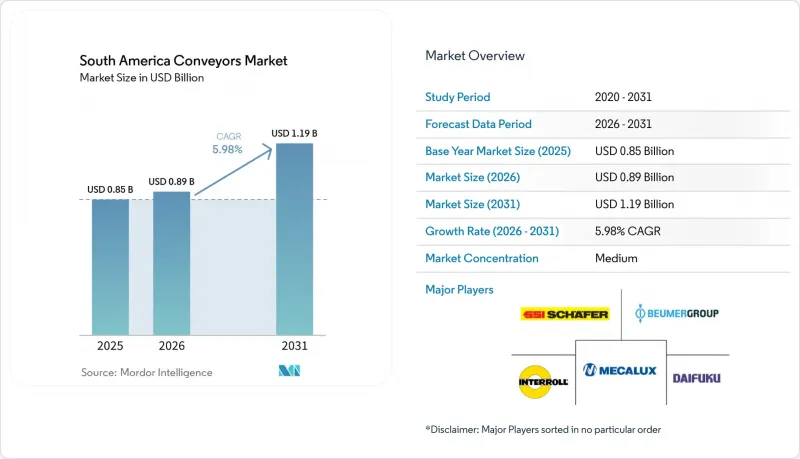
據 Mordor Intelligence 稱,2025 年南美輸送機市場價值 8.5 億美元,預計到 2031 年將從 2026 年的 8.9 億美元成長至 11.9 億美元,預測期(2026-2031 年)複合年成長率為 5.98%。
南美洲輸送機市場趨勢與洞察
採礦設備投資和從礦場到加工廠的輸送機維修。
在南美洲輸送機市場,採礦業的投資正在推動長距離、高容量輸送設備的需求。這種需求在銅礦、鐵礦石和鋰礦開採地尤其顯著,因為這些礦場的物料必須穿越崎嶇的地形,從礦區運送到破碎機和加工廠。根據草案,該地區32家礦業公司的總資本支出預計將從2025年的755億美元增加到2026年的819億美元,2025年的成長率僅為2%。礦業營運商正優先引入電動礦到加工廠的輸送系統,以減少對柴油運輸卡車的依賴,控制能源成本,並確保各作業階段之間的連續運輸。 2025年1月,TAKRAF公司從智利科拉瓦西礦業公司(Minera Colahuasi)的烏希納(Uhina)擴建計畫獲得了三台輸送機的訂單。該計畫將一座遷址後的破碎站與位於海拔4535公尺處的現有礦石運輸網路連接起來。新安裝的設備擴大整合了狀態監測、自動化檢測工具和預測性維護平台,這可能會將供應商的業務範圍從最初的設備銷售擴展到維護、分析和支援服務。
電子商務履約與倉庫自動化
在南美,電子商務履約的投資正在推動對履約市場單元處理設備的需求。這是因為企業正在建立系統,以便更快、更精準地管理其物流設施內的小包裹、訂單、退貨和庫存流動。作為物流現代化改造的一部分,Mercado Libre 在其位於聖保羅附近的卡哈馬爾物流中心安裝了 125 台機器人分類機。該系統每天可處理 10.5 萬件商品。 2025 年 12 月,阿根廷郵政 (Correo Argentino) 也運作了一套機器人小包裹分揀系統,該系統由 240 台自主機器人和輸送機分揀機組成,每小時可處理 9000 個小包裹。隨著處理能力、履約佈局、機器人部署和產品種類的變化,滾筒式和模組化生產線可能需要不斷升級。這為那些較少依賴礦業投資週期的供應商創造了商機。此外,倉庫業者需要能夠處理分類軟體、揀貨流程、包裝站和交貨期限的設備。除了實體輸送機線之外,控制系統和整合服務也至關重要。
高初始資本投入
初始成本仍是南美洲輸送機市場的阻礙因素。對於超過10公里的陸上採礦系統而言,情況尤其如此,因為這些系統需要專業的工程設計、結構施工、電力系統以及大規模的安裝工作。完整的安裝工程可能需要數千萬美元到超過1億美元的投資,這超出了許多小規模企業的近期資本規劃。巴西的高利率和阿根廷持續的通貨膨脹可能會延長專案的投資回收期,使得繼續營運舊設備更具吸引力。中小型製造商和零售商可能會選擇維護現有設備,增加維護工作或分階段進行小規模採購,而不是進行全面的設備升級。巴西的ABNT安全標準、環境文件以及貸款機構的ESG(環境、社會和治理)要求增加了採購前規範制定、測試、報告和資金籌措方面的工作量,這可能會給內部技術能力有限的企業帶來更大的負擔。
細分市場分析
2025年,皮帶輸送機在南美洲輸送機市佔率中佔34.72%。這主要得益於礦石在長距離和高低落差較大的地區進行連續輸送的需求。織物和鋼絲皮帶設計適用於礦場的高噸位處理和長期運作。 TAKRAF於2025年1月獲得了智利Collahuasi銅礦擴建計畫的訂單,其中包括三條陸上輸送機。重型皮帶系統也廣泛應用於選礦廠、堆場、農業設施和港口碼頭。這些成功的應用帶動了對皮帶、托輥、滑輪、控制設備、偵測和維護服務的需求。 2026年5月,大陸集團在巴西推出了用於露天礦場和開挖礦的VersaFlex單層皮帶。該產品採用高性能聚酯材料,減輕了皮帶重量並降低了相關的碳排放。這些產品的發展表明,除了處理能力之外,生命週期成本和能源性能的重要性也日益凸顯。礦業採購負責人在評估大型專案的皮帶解決方案時,也會考慮更換週期、現場服務可用性、安全功能以及整合監控設備的可能性。
在南美洲輸送機市場,預計到2031年,滾筒輸送機的複合年成長率將達到6.43%。它們廣泛應用於履約中心,用於儲存、分類、運輸和訂單處理。區域控制的滾筒系統可以與自動化倉庫佈局中的自主移動機器人協同運作。阿根廷郵政的分類系統將機器人與分類輸送機結合,每小時可處理9,000個小包裹。托盤輸送機用於工廠和物流中心,支援貨物的重複移動。架空輸送機用於需要節省占地面積的組裝作業。板條式、鍊式、螺旋式和氣動式輸送系統服務於汽車、機場、食品、粉末和特殊散裝搬運等領域。這些類別將供應商的業務範圍擴展到採礦相關項目之外。此外,這些多樣化的設計要求使供應商能夠滿足更廣泛行業和物流領域客戶的需求,提供組裝、分類、儲存、運輸和加工服務。
2025年南美洲輸送機市場中,散裝搬運佔總貨運量的56.34%。在採礦、農業和出口物流領域,礦石、穀物、紙漿和其他大量物料的連續運輸至關重要。輸送機線在連接礦場、破碎、倉儲、鐵路和港口控制設備發揮關鍵作用。固定式散裝輸送系統通常根據特定場地的處理量、地形和運作條件進行設計。其龐大的規模對結構設備、輸送帶、滑輪、驅動裝置、控制系統和維護提出了更高的要求。港口現代化和採礦/加工專案進一步將這種需求與出口基礎設施連結起來。大規模營運商也會評估能耗和可靠性,因為計劃外運作可能會擾亂龐大的生產系統。這些營運需求使具備相關工程和服務能力的供應商擁有顯著優勢。此外,專案設計至關重要,因為輸送路線、轉運點、粉塵控制要求和維護通道必須根據每個礦場、碼頭或加工廠的具體情況進行客製化。
在南美洲輸送機市場,單元處理預計到2031年將以6.52%的複合年成長率成長。小包裹的成長推動了履約中心對分類輸送機、傾斜托盤系統和高速皮帶彎道的投資。巴西、哥倫比亞和阿根廷是這些項目的關鍵地點。營運商正在部署單元處理子系統,以提高SKU(庫存管理單元)的可追溯性,同時又不影響大宗業務的正常運作。這項需求促使模組化佈局應運而生,因為可以根據產品組合和處理能力需求進行調整。英特羅公司2025年在美洲的業績反映了來自宅配、速遞、小包裹和時尚產業客戶的投資。醫藥和食品物流中心在競標也可能要求符合ISO 9001品管標準。合規性要求可能有利於擁有成熟系統效能記錄的供應商。在選擇單元處理解決方案之前,買家可能會評估設備的可靠性、清潔要求、可追溯性需求以及與倉庫管理流程的整合。
其他好處:
- Excel格式的市場預測(ME)表
- 3個月的分析師支持
目錄
第1章:引言
- 研究假設和市場定義
- 調查範圍
第2章:調查方法
第3章執行摘要
第4章 市場狀況
- 市場概覽
- 市場促進因素
- 礦山設備投資及從礦山到選礦廠的輸送機維修。
- 電子商務履約與倉庫自動化
- 巴西製造業現代化
- 基礎設施和港口發展
- 擴大電池用金屬和重要礦物的加工規模。
- 現場輸送機製造及服務系統
- 市場限制因素
- 大量初始資本投資
- 經濟波動和專案核准延誤
- 依賴進口零件和較長的前置作業時間
- 整合舊有系統以及熟練維護人員短缺。
- 宏觀經濟因素對市場的影響
- 產業價值鏈分析
- 監理情勢
- 技術展望
- 波特五力分析
第5章 市場規模與成長預測
- 依產品類型
- 皮帶輸送機
- 滾筒輸送機
- 托盤輸送機
- 高架輸送機
- 板條/鍊式輸送機
- 螺旋輸送機和氣動輸送設備
- 負載類型
- 單元處理
- 散裝搬運
- 按最終用戶行業分類
- 飛機場
- 零售與電子商務
- 車
- 食品/飲料
- 製藥
- 採礦和採石
- 製造業(離散型和流程型)
- 其他終端用戶產業
- 系統配置
- 固定/線性
- 模組化/靈活
- 按組件
- 輸送設備
- 驅動裝置和控制設備
- 軟體和分析
- 按地區
- 巴西
- 阿根廷
- 智利
- 哥倫比亞
- 其他南美國家
第6章 競爭情勢
- 市場集中度
- 策略趨勢
- 市佔率分析
- 公司簡介
- BEUMER Group GmbH & Co. KG
- Interroll Holding AG
- Daifuku Co., Ltd.
- Mecalux, SA
- SSI SCHAFER AG
- Dorner Mfg. Corp.
- Hytrol Conveyor Company, Inc.
- TAKRAF GmbH
- PROK Pty Ltd
- Dos Santos International, LLC
- RULMECA SpA
- The Flexible Steel Lacing Company
- Conveyor Dynamics, Inc.
- Martin Engineering Company
- Ashworth Bros., Inc.
- Cambelt International LLC
- Nitta Corporation
- Habasit AG
- Forbo International SA
第7章 市場機會與未來展望
According to Mordor Intelligence, the South America conveyors market size was valued at USD 0.85 billion in 2025 and is estimated to grow from USD 0.89 billion in 2026 to reach USD 1.19 billion by 2031, at a CAGR of 5.98% during the forecast period (2026-2031).
South America Conveyors Market Trends and Insights
Mining CAPEX And Pit-To-Plant Conveyor Retrofits
Mining investment supports demand for long-distance and high-capacity equipment in the South America conveyors market, particularly in operations involving copper, iron ore, and lithium, where material must be moved through difficult terrain from extraction sites to crushers and processing plants. The draft projected mining CAPEX across 32 active regional companies at USD 81.9 billion in 2026, up from USD 75.5 billion in 2025, reflecting only 2% growth in 2025. Mine operators are prioritizing electrified pit-to-plant systems to reduce reliance on diesel haul trucks, manage energy costs, and maintain continuous movement between operating stages. TAKRAF received a January 2025 order for 3 conveyors at Minera Collahuasi's Ujina growth project in Chile, connecting a relocated crushing station to the existing ore network at 4,535 meters above sea level. New installations increasingly include condition monitoring, automated inspection tools, and predictive maintenance platforms, which can extend supplier activity beyond the initial equipment sale into maintenance, analytics, and support services.
E-Commerce Fulfillment And Warehouse Automation
E-commerce fulfillment investment is strengthening demand for unit-handling equipment in the South America conveyors market, as operators build faster and more controlled flows for parcels, orders, returns, and inventory within distribution facilities. Mercado Libre deployed 125 robotic separators at its Cajamar distribution center near Sao Paulo, with a capacity to process 105,000 items per day, as part of its fulfillment modernization. Correo Argentino opened a robotic package-sorting system in December 2025, featuring 240 autonomous robots and a conveyor sorter processing 9,000 parcels per hour. Roller and modular lines can generate recurring upgrades as throughput, fulfillment layouts, robot deployments, and product assortments change, providing suppliers with a source of activity less dependent on mining investment cycles. Warehouse operators also require equipment that can work with sorting software, picking processes, packaging stations, and delivery cutoffs, making controls and integration services important alongside the physical conveyor line.
High Initial Capital Investment
Initial costs remain a restraint for the South America conveyors market, especially for overland mining systems longer than 10 km that require specialized engineering, structural works, power systems, and extensive installation activity. Full installations can require investments from tens of millions to more than USD 100 million, placing them outside the immediate capital plans of many smaller operators. High interest rates in Brazil and persistent inflation in Argentina can extend project payback assessments and increase the appeal of keeping older assets in service. Smaller manufacturers and retailers may retain existing equipment, add maintenance work, or phase in smaller purchases instead of approving a full line replacement. Brazilian ABNT safety requirements, environmental documentation, and lender ESG covenants can add specification, testing, reporting, and financing work before procurement, placing a greater burden on operators with limited internal engineering capacity.
Other drivers and restraints analyzed in the detailed report include:
- Manufacturing Modernization In Brazil
- Infrastructure And Port Development
- Economic Volatility and Project-Approval Delays
For complete list of drivers and restraints, kindly check the Table Of Contents.
Segment Analysis
Belt conveyors held 34.72% of the South America conveyors market share in 2025, supported by continuous ore hauling across long distances and changing elevations. Fabric and steel-cord belt designs are suited to high tonnage and extended operating periods at mining sites. TAKRAF's January 2025 Collahuasi order covered 3 overland conveyors for a copper mine growth project in Chile. Heavy belt systems also serve processing plants, stockyards, agricultural operations, and port terminals. Their installed base creates demand for belts, idlers, pulleys, controls, inspection, and service. Continental introduced its VersaFlex single-ply belt in Brazil during May 2026 for surface and open-pit mining applications. The product used High-Performance Polyester to reduce belt weight and associated carbon impact. These product changes show that lifecycle cost and energy performance are increasingly considered with throughput capacity. Mining buyers also consider replacement intervals, local service availability, safety performance, and the ability to incorporate monitoring devices when assessing a belt solution for a major project.
Roller conveyors are projected to expand at a 6.43% CAGR through 2031 in the South America conveyors market. Fulfillment centers use them for accumulation, sorting, transfers, and order handling. Zone-controlled roller systems can operate alongside autonomous mobile robots in automated warehouse layouts. The Correo Argentino sorting system combined robots with a sorter conveyor capable of processing 9,000 parcels each hour. Pallet conveyors support repeatable movement of loaded goods in factories and distribution centers. Overhead conveyors serve assembly operations where floor space must remain available. Slat, chain, screw, and pneumatic systems address automotive, airport, food, powder, and specialized bulk-handling applications. These categories broaden suppliers' exposure beyond mining-related projects. Their varied design requirements also allow suppliers to serve assembly, sorting, storage, handling, and processing tasks across a wider group of industrial and logistics customers.
Bulk handling accounted for 56.34% of the South America conveyors market size by load type in 2025. Mining, agriculture, and export logistics rely on the continuous movement of ore, grain, pulp, and other high-volume materials. Conveyor lines help link extraction, crushing, storage, rail, and port operations. Fixed bulk systems are commonly designed around site-specific tonnage, terrain, and operating conditions. Their scale supports demand for structural equipment, belts, pulleys, drives, controls, and maintenance. Port modernization and mining-processing projects keep this demand connected to export infrastructure. Large operators also evaluate energy use and reliability because unscheduled downtime can disrupt wider production systems. This operating need favors suppliers with relevant engineering and service capabilities. It also makes project design important because conveyor routes, transfer points, dust-control needs, and maintenance access must be tailored to each mine, terminal, or processing operation.
Unit handling is projected to expand at a 6.52% CAGR through 2031 in the South America conveyors market. Parcel growth supports investment in sortation conveyors, tilt-tray systems, and high-speed belt curves at fulfillment hubs. Brazil, Colombia, and Argentina are important locations for these projects. Operators are adding unit-handling subsystems to improve stock keeping unit traceability without disrupting bulk operations. This requirement supports modular layouts that can change with product mixes and throughput needs. Interroll's 2025 performance in the Americas reflected investment by courier, express, parcel, and fashion customers. Pharmaceutical and food distribution centers may also specify ISO 9001 quality-management practices in tenders. Compliance requirements can favor established suppliers with documented system performance. Buyers may assess equipment reliability, cleaning requirements, traceability needs, and integration with warehouse management processes before they select a unit-handling solution.
Complete Report Scope:
- By Product Type
- Belt Conveyors
- Roller Conveyors
- Pallet Conveyors
- Overhead Conveyors
- Slat/Chain Conveyors
- Screw and Pneumatic Conveyors
- By Load Type
- Unit Handling
- Bulk Handling
- By End-User Industry
- Airports
- Retail and E-commerce
- Automotive
- Food and Beverage
- Pharmaceuticals
- Mining and Quarrying
- Manufacturing (Discrete and Process)
- Other End-User Industries
- By System Configuration
- Fixed/Linear
- Modular/Flexible
- By Component
- Conveying Equipment
- Drives and Controls
- Software and Analytics
- By Geography
- Brazil
- Argentina
- Chile
- Colombia
- Rest of South America
List of Companies Covered in this Report:
- BEUMER Group GmbH & Co. KG
- Interroll Holding AG
- Daifuku Co., Ltd.
- Mecalux, S.A.
- SSI SCHAFER AG
- Dorner Mfg. Corp.
- Hytrol Conveyor Company, Inc.
- TAKRAF GmbH
- PROK Pty Ltd
- Dos Santos International, LLC
- RULMECA S.p.A.
- The Flexible Steel Lacing Company
- Conveyor Dynamics, Inc.
- Martin Engineering Company
- Ashworth Bros., Inc.
- Cambelt International LLC
- Nitta Corporation
- Habasit AG
- Forbo International SA
Additional Benefits:
- The market estimate (ME) sheet in Excel format
- 3 months of analyst support
TABLE OF CONTENTS
1 INTRODUCTION
- 1.1 Study Assumptions and Market Definition
- 1.2 Scope of the Study
2 RESEARCH METHODOLOGY
3 EXECUTIVE SUMMARY
4 MARKET LANDSCAPE
- 4.1 Market Overview
- 4.2 Market Drivers
- 4.2.1 Mining CAPEX and Pit-to-Plant Conveyor Retrofits
- 4.2.2 E-Commerce Fulfillment and Warehouse Automation
- 4.2.3 Manufacturing Modernization in Brazil
- 4.2.4 Infrastructure and Port Development
- 4.2.5 Battery-Metal and Critical-Mineral Processing Expansion
- 4.2.6 Localized Conveyor Manufacturing and Service Capacity
- 4.3 Market Restraints
- 4.3.1 High Initial Capital Investment
- 4.3.2 Economic Volatility and Project-Approval Delays
- 4.3.3 Imported Component Dependence and Long Lead Times
- 4.3.4 Legacy-System Integration and Skilled-Maintenance Constraints
- 4.4 Impact of Macroeconomic Factors on the Market
- 4.5 Industry Value Chain Analysis
- 4.6 Regulatory Landscape
- 4.7 Technological Outlook
- 4.8 Porter's Five Forces Analysis
- 4.8.1 Bargaining Power of Suppliers
- 4.8.2 Bargaining Power of Buyers
- 4.8.3 Threat of New Entrants
- 4.8.4 Threat of Substitutes
- 4.8.5 Competitive Rivalry
5 MARKET SIZE AND GROWTH FORECASTS (VALUE)
- 5.1 By Product Type
- 5.1.1 Belt Conveyors
- 5.1.2 Roller Conveyors
- 5.1.3 Pallet Conveyors
- 5.1.4 Overhead Conveyors
- 5.1.5 Slat/Chain Conveyors
- 5.1.6 Screw and Pneumatic Conveyors
- 5.2 By Load Type
- 5.2.1 Unit Handling
- 5.2.2 Bulk Handling
- 5.3 By End-User Industry
- 5.3.1 Airports
- 5.3.2 Retail and E-commerce
- 5.3.3 Automotive
- 5.3.4 Food and Beverage
- 5.3.5 Pharmaceuticals
- 5.3.6 Mining and Quarrying
- 5.3.7 Manufacturing (Discrete and Process)
- 5.3.8 Other End-User Industries
- 5.4 By System Configuration
- 5.4.1 Fixed/Linear
- 5.4.2 Modular/Flexible
- 5.5 By Component
- 5.5.1 Conveying Equipment
- 5.5.2 Drives and Controls
- 5.5.3 Software and Analytics
- 5.6 By Geography
- 5.6.1 Brazil
- 5.6.2 Argentina
- 5.6.3 Chile
- 5.6.4 Colombia
- 5.6.5 Rest of South America
6 COMPETITIVE LANDSCAPE
- 6.1 Market Concentration
- 6.2 Strategic Moves
- 6.3 Market Share Analysis
- 6.4 Company Profiles (includes Global Level Overview, Market Level Overview, Core Segments, Financials as available, Strategic Information, Market Rank/Share, Products and Services, Recent Developments)
- 6.4.1 BEUMER Group GmbH & Co. KG
- 6.4.2 Interroll Holding AG
- 6.4.3 Daifuku Co., Ltd.
- 6.4.4 Mecalux, S.A.
- 6.4.5 SSI SCHAFER AG
- 6.4.6 Dorner Mfg. Corp.
- 6.4.7 Hytrol Conveyor Company, Inc.
- 6.4.8 TAKRAF GmbH
- 6.4.9 PROK Pty Ltd
- 6.4.10 Dos Santos International, LLC
- 6.4.11 RULMECA S.p.A.
- 6.4.12 The Flexible Steel Lacing Company
- 6.4.13 Conveyor Dynamics, Inc.
- 6.4.14 Martin Engineering Company
- 6.4.15 Ashworth Bros., Inc.
- 6.4.16 Cambelt International LLC
- 6.4.17 Nitta Corporation
- 6.4.18 Habasit AG
- 6.4.19 Forbo International SA
7 MARKET OPPORTUNITIES AND FUTURE OUTLOOK
- 7.1 White-Space and Unmet-Need Assessment

 曲線輸送輥市場:全球市場預測,2026-2032年橡膠塗層板鏈市場:全球市場預測,2026-2032年
 螺旋輸送機市場規模、佔有率和成長分析:按產品類型、方向、應用、最終用戶、驅動類型、銷售管道和地區分類 - 產業預測,2026-2033年
 螺旋輸送機市場規模、佔有率和成長分析:按輸送機類型、螺旋類型、應用、最終用戶產業、營運方式和地區分類-2026-2033年產業預測
 冷凍食品輸送機系統市場規模、佔有率和成長分析:按輸送機類型、應用、食品類型、最終用戶和地區分類-2026-2033年產業預測
 升降輸送機市場規模、佔有率和成長分析:按輸送機類型、應用、最終用戶、驅動系統和地區分類-2026-2033年產業預測
 滅菌輸送機市場規模、佔有率和成長分析:按輸送機類型、滅菌技術、應用、最終用戶、自動化程度和地區分類-2026-2033年產業預測
 智慧輸送機自動化市場預測至2034年-按輸送機類型、組件、自動化程度、應用、最終用戶和地區分類的全球分析
 輸送系統市場規模、佔有率、成長、全球產業分析、區域趨勢及2026-2034年預測。
 中東和非洲輸送機市場:市場佔有率分析、行業趨勢和統計數據以及成長預測(2026-2031 年)