


 |
市場調查報告書
商品編碼
2154908
南美洲無線網狀網路:市場佔有率分析、產業趨勢與統計及成長預測(2026-2031 年)South America Wireless Mesh Networking - Market Share Analysis, Industry Trends & Statistics, Growth Forecasts (2026 - 2031) |
||||||

※ 本網頁內容可能與最新版本有所差異。詳細情況請與我們聯繫。
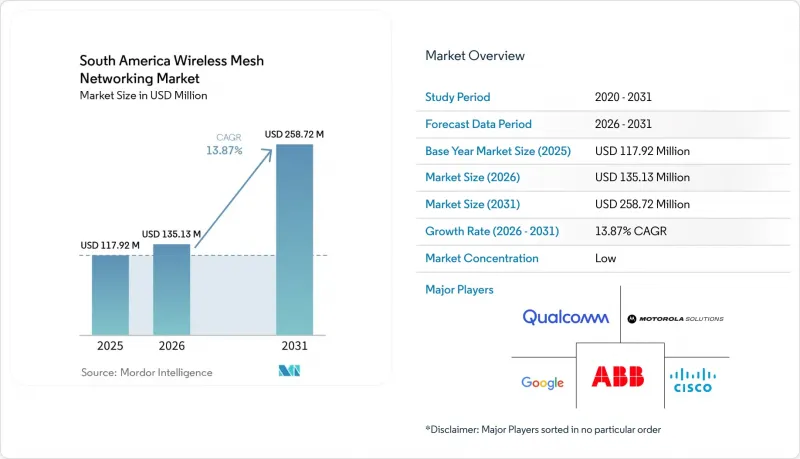
據 Mordor Intelligence 稱,2025 年南美無線網狀網路市場價值為 1.1792 億美元,預計在預測期(2026-2031 年)內將以 13.87% 的複合年成長率成長,到 2031 年達到 2.5872 億美元。
南美洲無線網狀網路市場趨勢與洞察
智慧城市和智慧電網部署的擴展
智慧城市和智慧電網專案正在推動南美洲無線網狀網路市場持續成長的採購活動。 2025年,SABESP與Vivo和IDEMIA達成為期14年的夥伴關係,將在聖保羅部署440萬台智慧水錶。該專案需要一個能夠管理數百萬個終端連接的現場區域網路。海星公司也在巴西分階段部署了超過130萬台Wi-SUN智慧水錶。這些項目將使供應商能夠更清楚地了解需求預測,並有可能促進整個南美洲無線網狀網路市場的本地服務投資。 Wi-SUN FAN將於2026年7月標準化為ISO/IEC/IEEE 32857:2026,為採購者提供通用框架。
工業IoT(IIoT) 和遠端資產監控的成長
工業IoT(IIoT) 和遠端監控正在推動南美洲對無線網狀網路的需求,尤其是在採礦業。採礦業是成長最快的終端用戶產業,預計到 2031 年將以 14.72% 的複合年成長率成長。 Rajant Kinetic Mesh BreadCrumb 節點已應用於秘魯的地下礦井,支援行動裝置在 10 毫秒以下的切換。 Wenco 在智利的一座金礦中採用了 Rajant Kinetic Mesh 網路來部署其車輛管理系統。此次部署表明,網路建設可以在幾週內完成,而不是幾個月。因此,買家目前正在評估供應商是否能夠在單一的操作環境中整合遠端控制、車輛管理系統和定位工具。
較高的初始實施和整合成本
高昂的初始部署和整合成本阻礙了南美洲無線網狀網路市場的部分項目。工業戶外設備需要堅固的機殼,而採礦應用可能需要ATEX或IECEx認證。這些規範會增加設備成本,業者才能在享受到諸如減少停機時間和改進遙測功能等優勢之前完成這些成本。此外,阿根廷的外匯波動可能會進一步延遲硬體採購。小規模的市政當局可能缺乏全面部署網路所需的資金。訂閱和網路即服務(NaaS)可以降低初始資本負擔,而且它們在巴西的普及速度更快。
細分市場分析
到2025年,基礎設施無線網狀網路將佔全部區域的48.22%。這一佔有率反映了固定節點骨幹網路在公共產業、公共安全、市政服務和校園網路中的廣泛應用。固定安裝系統支援可預測的無線規劃和既定的操作流程,並且與許多公共產業使用的傳統監控系統相容。政府和公共產業的競標往往傾向於選擇具有清晰認證文件的設備。巴西完善的認證架構也支持了這種對標準化固定網路設備的偏好。客戶端網狀系統在感測器、儀表、照明和環境監測的部署中仍然發揮著重要作用。這些系統通常非常適合資料量較小且低功耗至關重要的場所。由於其廣泛的部署基礎,基礎設施網路在南美洲的整體無線網狀網路市場中繼續佔據重要地位。
混合無線網狀網路預計到2031年將以14.28%的複合年成長率成長。其價值在於將固定覆蓋與行動用戶端功能結合。節點無需手動修改即可作為客戶端、網路基地台和中繼器使用。這在露天礦場、物流樞紐和擁有移動資產的工業園區非常實用。 Rajant的InstaMesh技術即使在同時使用多條路徑的情況下也能實現低於10毫秒的切換。這項功能使得設備能夠在不斷變化的地形和訊號環境中運作。這種混合設計還支援地下環境中的工人追蹤和安全應用。供應商必須證明該系統能夠與現有的自動化和基於位置的平台整合。這些要求有利於那些具備整合能力和豐富工業部署經驗的供應商。
截至2025年,2.4 GHz頻段佔全部區域的38.43%。此頻寬在智慧電錶、市政Wi-Fi和公共產業應用中擁有廣泛的部署經驗。它仍然適用於優先考慮遠距離通訊而非高吞吐量的場景。 1 GHz以下頻段的設備也用於需要覆蓋範圍和滲透性建築物能力的頻寬區域網路。 Wi-SUN FAN符合IEEE 802.15.4g標準,並已應用於公共產業部署。 4.9 GHz頻段在巴西的公共安全通訊中扮演獨特的角色。 Wi-SUN FAN的標準化計畫於2026年7月完成,這將進一步明確1 GHz以下頻段和2.4 GHz公共產業網路之間互通性的路徑。然而,Wi-Fi在都市區的擴展可能會增加對2.4 GHz頻段的干擾。因此,採購方需要在覆蓋範圍需求、可用頻寬和運作密度之間進行權衡。
預計從2026年到2031年,5 GHz頻段的複合年成長率將達到14.37%。戶外工業用戶不僅需要網路覆蓋範圍,還需要網路容量。鑑於現有頻段認證的現狀,5 GHz頻段在短期內是許多部署場景的實用選擇。 2026年8月,思科發表了Wireless 9177系列產品,該系列產品具備三頻Wi-Fi 7、超高可靠性無線回程傳輸以及6 GHz自動頻率調節功能。此舉顯示思科專注於戶外移動性和工業回程傳輸領域。 Cambium公司在最近的報告期間內,其ePMP 4000無線設備的全球出貨量顯著成長。該公司還報告稱,北美地區在新開放頻段上運行的設備出貨量也相當可觀。南美地區的使用者在新的頻段認證和監管框架到位之前,可以使用現有頻段。這些發展趨勢將使頻段規劃和設備升級路徑變得更加重要。
其他好處:
- Excel格式的市場預測(ME)表
- 3個月的分析師支持
目錄
第1章:引言
- 研究假設和市場定義
- 調查範圍
第2章:調查方法
第3章執行摘要
第4章 市場狀況
- 市場概覽
- 市場促進因素
- 智慧城市和智慧電網部署的擴展
- 工業IoT(IIoT) 和遠端資產監控的成長
- 偏遠地區和惡劣地形對穩定連結的需求。
- 擴展 5G、寬頻和邊緣連接基礎設施
- 巴西引領數位基礎設施現代化進程
- 在公共產業和工業運營中整合多重通訊協定網狀網路
- 市場限制因素
- 較高的初始實施和整合成本
- 網路安全、隱私和設備認證相關的風險
- 頻段分類、認證和互通性要求
- 偏遠礦區、能源區和農村地區缺乏當地技術支援。
- 產業價值鏈分析
- 宏觀經濟因素對市場的影響
- 監理情勢
- 波特五力分析
第5章 市場規模與成長預測
- 以建築學為例
- 基於基礎設施的無線網狀網路
- 混合無線網狀網路
- 基於客戶端的無線網狀網路
- 透過射頻
- 1 GHz 以下頻段
- 2.4 GHz頻段
- 4.9 GHz頻段
- 5 GHz頻段
- 透過使用
- 室內的
- 戶外的
- 最終用戶
- 政府
- 智慧城市與智慧倉庫
- 衛生保健
- 運輸/物流
- 石油和天然氣
- 礦業
- 教育
- 飯店業
- 按地區
- 巴西
- 阿根廷
- 智利
- 哥倫比亞
- 秘魯
- 其他南美國家
第6章 競爭情勢
- 市場集中度
- 策略趨勢
- 市佔率分析
- 公司簡介
- Motorola Solutions, Inc.
- ABB Ltd.
- Cisco Systems, Inc.
- Google LLC
- Qualcomm Incorporated
- TP-Link Corporation Limited
- Qorvo, Inc.
- D-Link Corporation
- ASUSTeK Computer Inc.
- CommScope Holding Company, Inc.
- Cambium Networks Corporation
- Rajant Corporation
- Hewlett Packard Enterprise Company
- Wirepas Oy
- Zebra Technologies Corporation
- Digi International Inc.
- Ubiquiti Inc.
- Radioenge Telecomunicacoes Ltda.
- OneRF Networks
- Samtech SA
第7章 市場機會與未來展望
According to Mordor Intelligence, the South America wireless mesh networking market size was valued at USD 117.92 million in 2025 and is estimated to reach USD 258.72 million by 2031, at a CAGR of 13.87% during the forecast period (2026-2031).
South America Wireless Mesh Networking Market Trends and Insights
Expanding Smart-City and Smart-Grid Deployments
Smart-city and smart-grid programs are creating sustained purchasing activity for the South America wireless mesh networking market. SABESP entered a 14-year partnership with Vivo and IDEMIA in 2025 to deploy 4.4 million smart water meters in Sao Paulo. The project requires a field-area network that can manage millions of endpoint connections. Haixing has also deployed more than 1.3 million Wi-SUN smart meters across several Brazilian contract phases. These programs give suppliers clearer volume expectations and can support local service investments across the South America wireless mesh networking market. Wi-SUN FAN became ISO/IEC/IEEE 32857:2026 in July 2026, which gives buyers a common framework for multi-vendor procurement.
Growth of Industrial IoT and Remote Asset Monitoring
Industrial IoT and remote monitoring are increasing the demand for the South America wireless mesh networking market, especially at mine sites. Mining is the fastest-growing end-user category, with a projected CAGR of 14.72% through 2031. Rajant Kinetic Mesh BreadCrumb nodes used in Peruvian underground mining can support sub-10-millisecond handoffs for moving equipment. Wenco used a Rajant Kinetic Mesh network for a Chilean gold mine fleet-management installation. The deployment showed that a network can be introduced in weeks rather than months. Buyers are consequently assessing whether a supplier can connect teleoperation, fleet systems, and positioning tools within one operating environment.
High Initial Deployment and Integration Costs
Initial deployment and integration costs limit some projects in the South America wireless mesh networking market. Industrial outdoor equipment needs rugged enclosures and may need ATEX or IECEx certification for mining. These specifications increase equipment costs before an operator gains benefits from lower downtime or improved telemetry. Foreign-exchange volatility can further delay hardware purchases in Argentina. Smaller municipalities may also lack funding for a full network rollout. Subscription and network-as-a-service offers can reduce the upfront capital burden, although adoption is progressing faster in Brazil.
Other drivers and restraints analyzed in the detailed report include:
- Demand for Resilient Connectivity in Remote and Challenging Terrain
- Expansion of 5G, Broadband, and Edge-Connected Infrastructure
- Cybersecurity, Privacy, and Device-Authentication Risks
For complete list of drivers and restraints, kindly check the Table Of Contents.
Segment Analysis
Infrastructure wireless mesh networks held 48.22% of the regional total in 2025. Their position reflects widespread use of fixed-node backbones for utilities, public safety, municipal services, and campus networks. Fixed installations support predictable radio planning and established operating procedures. They also align with legacy supervisory control systems used by many utilities. Government and utility tenders often favor equipment with clear certification documentation. Brazil's established certification framework supports this preference for standardized fixed-network equipment. Client mesh systems remain useful for sensor, meter, lighting, and environmental-monitoring deployments. These systems generally suit locations where low data volumes and low power use matter most. The large installed base keeps infrastructure networks important across the South America wireless mesh networking market.
Hybrid wireless mesh networks are expected to expand at a 14.28% CAGR through 2031. Their value comes from combining fixed coverage with mobile client capability. A node can work as a client, access point, and repeater without manual changes. This is useful for open-pit mines, logistics hubs, and industrial parks with moving assets. Rajant's InstaMesh technology supports sub-10-millisecond handoffs across simultaneous paths. The capability supports equipment that moves through changing terrain and signal conditions. Hybrid designs can also support worker-tracking and safety applications in underground settings. Suppliers must still show that systems work with existing automation and location platforms. These requirements favor suppliers with integration capacity and strong industrial deployment experience.
The 2.4 GHz band accounted for 38.43% of the regional total in 2025. It has a broad installed base in smart metering, municipal Wi-Fi, and legacy utility applications. The band remains suitable where long-range matters more than high throughput. Sub-1 GHz equipment also serves field-area networks that need range and building penetration. Wi-SUN FAN works with IEEE 802.15.4g and is used in utility-oriented deployments. The 4.9 GHz band has a specialized role in Brazilian public safety communications. Wi-SUN FAN's July 2026 standardization offers a clearer interoperability path for sub-1 GHz and 2.4 GHz utility networks. Urban Wi-Fi expansion can, however, increase interference in the 2.4 GHz band. Buyers are therefore balancing coverage needs with available spectrum and operational density.
The 5 GHz band is projected to expand at a 14.37% CAGR during 2026-2031. Outdoor industrial users require capacity as well as network reach. Existing spectrum authorizations make 5 GHz a practical near-term option in many deployments. Cisco introduced its Wireless 9177 Series in August 2026 with tri-band Wi-Fi 7, Ultra-Reliable Wireless Backhaul, and 6 GHz Automated Frequency Coordination. The release indicates vendor focus on outdoor mobility and industrial backhaul. Cambium reported significant global shipments of ePMP 4000 radios by a recent reporting period. It also reported substantial shipments of units operating in newly available spectrum bands across North America. South American buyers can use currently available spectrum bands while certification and coordination frameworks for newer bands develop. This progression will place greater importance on spectrum planning and equipment upgrade paths.
Complete Report Scope:
- By Architecture
- Infrastructure Wireless Mesh Networks
- Hybrid Wireless Mesh Networks
- Client Wireless Mesh Networks
- By Radio Frequency
- Sub-1 GHz Band
- 2.4 GHz Band
- 4.9 GHz Band
- 5 GHz Band
- By Application
- Indoor
- Outdoor
- By End-User
- Government
- Smart Cities and Smart Warehouses
- Healthcare
- Transportation and Logistics
- Oil and Gas
- Mining
- Education
- Hospitality
- By Geography
- Brazil
- Argentina
- Chile
- Colombia
- Peru
- Rest of South America
List of Companies Covered in this Report:
- Motorola Solutions, Inc.
- ABB Ltd.
- Cisco Systems, Inc.
- Google LLC
- Qualcomm Incorporated
- TP-Link Corporation Limited
- Qorvo, Inc.
- D-Link Corporation
- ASUSTeK Computer Inc.
- CommScope Holding Company, Inc.
- Cambium Networks Corporation
- Rajant Corporation
- Hewlett Packard Enterprise Company
- Wirepas Oy
- Zebra Technologies Corporation
- Digi International Inc.
- Ubiquiti Inc.
- Radioenge Telecomunicacoes Ltda.
- OneRF Networks
- Samtech S.A.
Additional Benefits:
- The market estimate (ME) sheet in Excel format
- 3 months of analyst support
TABLE OF CONTENTS
1 INTRODUCTION
- 1.1 Study Assumptions and Market Definition
- 1.2 Scope of the Study
2 RESEARCH METHODOLOGY
3 EXECUTIVE SUMMARY
4 MARKET LANDSCAPE
- 4.1 Market Overview
- 4.2 Market Drivers
- 4.2.1 Expanding Smart-City and Smart-Grid Deployments
- 4.2.2 Growth of Industrial IoT and Remote Asset Monitoring
- 4.2.3 Demand for Resilient Connectivity in Remote and Challenging Terrain
- 4.2.4 Expansion of 5G, Broadband, and Edge-Connected Infrastructure
- 4.2.5 Brazil-Led Digital Infrastructure Modernization
- 4.2.6 Multi-Protocol Mesh Integration for Utilities and Industrial Operations
- 4.3 Market Restraints
- 4.3.1 High Initial Deployment and Integration Costs
- 4.3.2 Cybersecurity, Privacy, and Device-Authentication Risks
- 4.3.3 Fragmented Spectrum, Certification, and Interoperability Requirements
- 4.3.4 Limited Local Technical Support in Remote Mining, Energy, and Rural Areas
- 4.4 Industry Value Chain Analysis
- 4.5 Impact of Macroeconomic Factors on the Market
- 4.6 Regulatory Landscape
- 4.7 Porter's Five Forces Analysis
- 4.7.1 Bargaining Power of Suppliers
- 4.7.2 Bargaining Power of Buyers
- 4.7.3 Threat of New Entrants
- 4.7.4 Threat of Substitutes
- 4.7.5 Competitive Rivalry
5 MARKET SIZE AND GROWTH FORECASTS (VALUE)
- 5.1 By Architecture
- 5.1.1 Infrastructure Wireless Mesh Networks
- 5.1.2 Hybrid Wireless Mesh Networks
- 5.1.3 Client Wireless Mesh Networks
- 5.2 By Radio Frequency
- 5.2.1 Sub-1 GHz Band
- 5.2.2 2.4 GHz Band
- 5.2.3 4.9 GHz Band
- 5.2.4 5 GHz Band
- 5.3 By Application
- 5.3.1 Indoor
- 5.3.2 Outdoor
- 5.4 By End-User
- 5.4.1 Government
- 5.4.2 Smart Cities and Smart Warehouses
- 5.4.3 Healthcare
- 5.4.4 Transportation and Logistics
- 5.4.5 Oil and Gas
- 5.4.6 Mining
- 5.4.7 Education
- 5.4.8 Hospitality
- 5.5 By Geography
- 5.5.1 Brazil
- 5.5.2 Argentina
- 5.5.3 Chile
- 5.5.4 Colombia
- 5.5.5 Peru
- 5.5.6 Rest of South America
6 COMPETITIVE LANDSCAPE
- 6.1 Market Concentration
- 6.2 Strategic Moves
- 6.3 Market Share Analysis
- 6.4 Company Profiles (includes Global Level Overview, Market Level Overview, Core Segments, Financials as available, Strategic Information, Market Rank/Share, Products and Services, Recent Developments)
- 6.4.1 Motorola Solutions, Inc.
- 6.4.2 ABB Ltd.
- 6.4.3 Cisco Systems, Inc.
- 6.4.4 Google LLC
- 6.4.5 Qualcomm Incorporated
- 6.4.6 TP-Link Corporation Limited
- 6.4.7 Qorvo, Inc.
- 6.4.8 D-Link Corporation
- 6.4.9 ASUSTeK Computer Inc.
- 6.4.10 CommScope Holding Company, Inc.
- 6.4.11 Cambium Networks Corporation
- 6.4.12 Rajant Corporation
- 6.4.13 Hewlett Packard Enterprise Company
- 6.4.14 Wirepas Oy
- 6.4.15 Zebra Technologies Corporation
- 6.4.16 Digi International Inc.
- 6.4.17 Ubiquiti Inc.
- 6.4.18 Radioenge Telecomunicacoes Ltda.
- 6.4.19 OneRF Networks
- 6.4.20 Samtech S.A.
7 MARKET OPPORTUNITIES AND FUTURE OUTLOOK
- 7.1 White-Space and Unmet-Need Assessment

 無線網狀網路設備市場:全球市場預測,2026-2032年
 行動專案網路(MANET)市場規模、佔有率和成長分析:按組件、通訊方式、應用、網路類型、最終用戶和地區分類-2026-2033年產業預測
 無線網狀網路:市場佔有率分析、行業趨勢和統計數據、成長預測(2026-2031 年)
 全球無線網狀網路市場(至2035年):產業趨勢與預測
 2026年全球無線網狀網路市場報告
 無線網狀網路市場分析及預測(至2035年):依類型、產品類型、服務、技術、組件、應用、部署類型、最終用戶、功能及安裝類型分類
 全球無線網狀網路市場規模、佔有率、趨勢和成長分析報告(2026-2034年)
 無線網狀網路市場 - 全球產業規模、佔有率、趨勢、機會、預測:按無線頻率、應用、最終用途、地區和競爭格局分類,2021-2031年
 無線網狀網路市場規模、佔有率和成長分析(按組件、網狀設計、服務、射頻、應用和地區分類)-2026-2033年產業預測
 全球無線網狀網路市場規模、佔有率、趨勢分析報告:依無線電頻率、應用、最終用途、地區、展望與預測,2024-2031 年