


 |
市場調查報告書
商品編碼
2121718
無線網狀網路:市場佔有率分析、行業趨勢和統計數據、成長預測(2026-2031 年)Wireless Mesh Networking - Market Share Analysis, Industry Trends & Statistics, Growth Forecasts (2026 - 2031) |
||||||

※ 本網頁內容可能與最新版本有所差異。詳細情況請與我們聯繫。
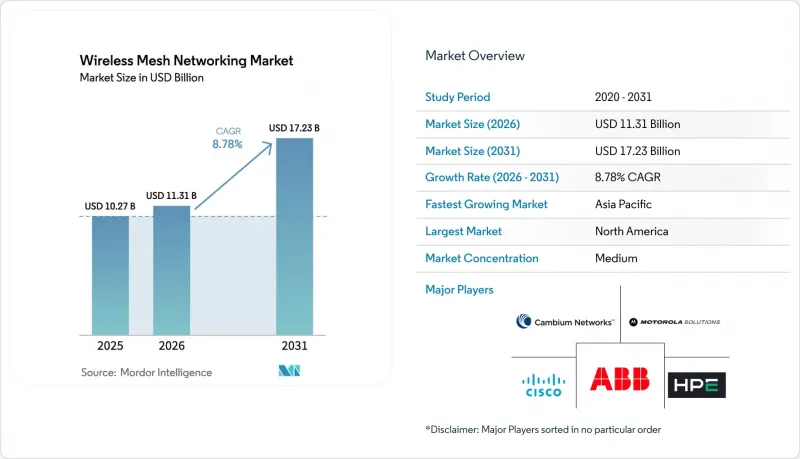
據 Mordor Intelligence 稱,2025 年無線網狀網路市值為 102.7 億美元,預計到 2031 年將從 2026 年的 113.1 億美元成長至 172.3 億美元,預測期(2026-2031 年)的複合年成長率為 8.78%。
本報告按架構(混合無線網狀網路、用戶端無線網狀網路及其他)、射頻(2.4GHz頻段、5GHz頻段及其他)、應用(室內、室外)、最終用戶(政府、醫療保健、運輸與物流、石油天然氣、採礦、教育、飯店及其他)和地區進行細分。市場預測以美元(USD)為單位。
全球無線網狀網路市場趨勢與洞察
擴大智慧城市基礎設施的應用
目前,城市負責人正在將網狀無線設備整合到路燈、交通號誌和公共設施配電櫃中,用於回程傳輸監控攝影機、空氣品質感測器和公共Wi-Fi入口網站。在墨爾本,透過減少現場巡檢次數和最佳化垃圾收集路線,這項投資在18個月內就收回了成本。卡加利市透過思科超可靠無線回傳技術,將Gigabit連接擴展到公園和公共運輸候車區,證明網狀網路可以作為光纖的補充而非替代。然而,美國國家標準與技術實驗室(NIST)對42個先導計畫的研究發現,專有應用程式介面(API)阻礙了不同供應商之間的互通性。
工業IoT應用範圍擴大
為了適應移動機器人和基於位置的系統,製造商正在用 Wi-Fi 6 網狀網路取代乙太網路線路。在一家德國汽車工廠部署了 200 個具備時間敏感型網路擴充能力的網路基地台後,意外停機時間減少了 30%。 WirelessHART 的頻道跳頻功能即使在高度擁塞的環境中也能確保 99.9% 的可靠性。 Wirepas Mesh 等分散式協定已使歐洲物流中心的 5 萬個托盤追蹤器能夠在無需直線視線的基礎設施環境中運作。
多點跳躍拓撲中的安全漏洞
由於每個節點都兼具路由器的功能,攻擊面隨之擴大。美國國家標準與技術研究院 (NIST) 警告稱,僅靠邊界防禦不足以應對威脅,因為被攻破的中繼節點可能攔截或丟棄資料包而不被察覺。 2024 年揭露的 Zyxel韌體漏洞影響了 10 萬套消費級網狀網路套件,使攻擊者能夠遠端執行程式碼。學術研究人員也證明,WPA2 和 WPA3 用戶端的混合使用會導致降級攻擊,迫使節點使用安全性較低的加密方法。目前,買家要求使用通過 FIPS 140-3 認證的加密模組,這推高了部署成本。
細分市場分析
到2025年,基礎設施節點將佔據無線網狀網路市場48.56%的佔有率,凸顯了客戶對集中式管理、RADIUS認證和基於SNMP的效能監控的需求趨勢。這種架構透過零接觸配置和人工智慧驅動的無線最佳化縮短了部署週期。大規模市政機構擴大採用控制器來實施視訊回程傳輸和公共Wi-Fi的服務品質(QoS)措施,而國防機構則優先考慮關鍵任務流量的確定性延遲。
混合拓樸結構正以9.34%的複合年成長率快速成長,其融合了閘道器路由和P2P路由,使現場設備能夠在閘道器發生故障時繞過擁塞的閘道器。配備Rajant Kinetic Mesh的礦用卡車能夠快速切換會話,港口營運商即使在沒有可見基礎設施的情況下也能保持起重機、運輸車和護航車輛之間的連接。隨著工廠使用支援企業級WLAN和P2P的邊緣閘道器維修其傳統基礎設施,混合部署中的無線網狀網路市場預計將持續成長。
由於其高滲透率、現有的感測器基礎設施以及全球範圍內的免許可使用政策,預計到2025年,2.4GHz頻段將占到總收入的42.38%。公共產業正在電線杆安裝2.4GHz節點,用於自動化配電的遙測;農業合作社則在其果園的茂密植被中鋪設2.4GHz感測器。然而,頻道擁塞仍然是一個嚴峻的問題,因為大多數地區只有三個不重疊的頻道。
隨著Wi-Fi 6E和Wi-Fi 7的升級,5GHz頻段的複合年成長率(CAGR)預計將達到9.56%。在倉庫中,80MHz和160MHz頻道正被用於延遲低於10毫秒的自主機器人。相較之下,低於1GHz的LoRaWAN網狀網路可在10公里範圍內連接儀表和灌溉閥門,電力消耗僅為毫瓦級。隨著室外網路基地台採用10Gigabit乙太網路和基於GPS的時間同步技術來實現工業自動化,5GHz無線網狀網路市場正在快速擴張。
區域分析
預計到2025年,北美將佔全球銷售額的36.92%,這得益於BEAD津貼(424.5億美元),該撥款用於資助人口普查區建設網狀網路。目前,已有超過30個州在其寬頻提案書中批准了無線網狀網路,從而加速了其在農村平原和阿巴拉契亞山脈山麓地區的部署。加拿大17.5億加元(約12.9億美元)的「全民寬頻基金」也以類似的方式支持原住民社區建造混合光纖網狀網路。
預計到2031年,亞太地區的年複合成長率(CAGR)將達到9.82%。在中國,新建工業園區強制要求部署網狀網路,深圳的城市網路利用6GHz和5GHz頻段整合了交通監控攝影機、空氣品質感測器和公共Wi-Fi。印度的「智慧城市計畫」正在資助建設100個戶外網狀網路,用於公車專用道、數位素養中心和城市公園。日本的「社會5.0」計畫和韓國1,500億韓元(約1.13億美元)的預算正在支持智慧工廠和抗災社區的建設,而澳洲的「本地連接計畫」則為連接農業合作社和光纖骨幹網的本地網狀網路提供津貼。
歐洲透過德國和法國的「工業4.0」試點計畫維持其市場佔有率。在這些項目中,兩國製造商正在為機器人單元部署時間敏感型Wi-Fi 6網狀網路。英國耗資2億英鎊(約2.54億美元)的「Gigabit計畫」正利用網狀網路技術彌合荒野和山區「最後一公里」的通訊鴻溝。在中東,防爆網狀網路正在油田部署,沙烏地阿拉伯的「2030願景」計畫投資興建NEOM和利雅德等智慧城市。在南美洲,智利和巴西的礦業公司正在地下隧道部署網狀網路,以實現自動駕駛運輸卡車的遙測功能。同時,阿根廷正在拍賣5GHz頻段,固定無線和網狀寬頻。
其他好處
- Excel格式的市場預測(ME)表
- 3個月的分析師支持
目錄
第1章:引言
- 研究假設和市場定義
- 調查範圍
第2章:調查方法
第3章執行摘要
第4章 市場狀況
- 市場概覽
- 市場促進因素
- 擴大智慧城市基礎設施的應用
- 擴大工業IoT的應用
- 對可靠的公共安全通訊的需求日益成長
- Wi-Fi 6 和 Wi-Fi 7 標準的快速發展
- 無電池能源採集網狀節點的出現。
- 地方政府為區域城市提供寬頻刺激津貼
- 市場限制因素
- 多點跳躍拓撲中的安全漏洞
- 供應商之間協議缺乏互通性
- 加強地方政府對與電線杆節點相關的景觀特徵的監管。
- 由於6GHz頻段僅限於室內使用的措施,頻率重新分配面臨壓力
- 宏觀經濟因素對市場的影響
- 產業價值鏈分析
- 監理情勢
- 技術展望
- 波特五力分析
第5章 市場規模與成長預測
- 以建築學為例
- 基礎設施無線網狀網路
- 混合無線網狀網路
- 用戶端無線網狀網路
- 透過射頻
- 1GHz以下頻段
- 2.4GHz頻段
- 4.9GHz頻段
- 5GHz頻段
- 透過使用
- 室內的
- 戶外的
- 最終用戶
- 政府
- 智慧城市與智慧倉庫
- 衛生保健
- 運輸/物流
- 石油和天然氣
- 礦業
- 教育
- 飯店業
- 按地區
- 北美洲
- 美國
- 加拿大
- 墨西哥
- 歐洲
- 德國
- 英國
- 法國
- 俄羅斯
- 其他歐洲國家
- 亞太地區
- 中國
- 日本
- 印度
- 韓國
- 澳洲
- 其他亞太國家
- 中東和非洲
- 中東
- 沙烏地阿拉伯
- 阿拉伯聯合大公國
- 其他中東國家
- 非洲
- 南非
- 埃及
- 其他非洲地區
- 中東
- 南美洲
- 巴西
- 阿根廷
- 南美洲其他地區
- 北美洲
第6章 競爭情勢
- 市場集中度
- 策略趨勢
- 市佔率分析
- 公司簡介
- Cisco Systems, Inc
- Hewlett Packard Enterprise
- Motorola Solutions
- ABB Ltd
- Cambium Networks
- Rajant Corporation
- Ruckus Networks(CommScope)
- Synapse Wireless
- Strix Systems
- Firetide Inc.
- BelAir Networks
- Wirepas Oy
- Fluidmesh Networks
- Zebra Technologies
- Digi International
- Qorvo, Inc.
- Qualcomm Technologies
- Ubiquiti Inc.
- Unicom Systems
- General Dynamics Mission Systems
- SCAN RF Projects
第7章 市場機會與未來展望
According to Mordor Intelligence, the wireless mesh networking market size was valued at USD 10.27 billion in 2025 and is estimated to grow from USD 11.31 billion in 2026 to reach USD 17.23 billion by 2031, at a CAGR of 8.78% during the forecast period (2026-2031).
This report is Segmented by Architecture (Hybrid Wireless Mesh Networks, Client Wireless Mesh Networks, and More), Radio Frequency (2. 4 GHz Band, 5 GHz Band, and More), Application (Indoor, and Outdoor), End-User (Government, Healthcare, Transportation and Logistics, Oil and Gas, Mining, Education, Hospitality, and More), and Geography. The Market Forecasts are Provided in Terms of Value (USD).
Global Wireless Mesh Networking Market Trends and Insights
Increasing Adoption of Smart City Infrastructure
City planners now embed mesh radios in streetlights, traffic signals, and utility cabinets to backhaul surveillance cameras, air-quality sensors, and public Wi-Fi portals. Melbourne demonstrated payback within 18 months by lowering truck rolls and optimizing refuse collection routes. Calgary extended gigabit connectivity to parks and transit shelters through Cisco Ultra-Reliable Wireless Backhaul, proving that mesh can complement rather than replace fiber. However, a National Institute of Standards and Technology survey of 42 pilots found that proprietary APIs hinder cross-vendor interoperability.
Growth of Industrial IoT Deployments
Manufacturers are swapping Ethernet drops for Wi-Fi 6 mesh to support mobile robots and location systems. A German automotive plant cut unplanned downtime by 30% after installing 200 access points with time-sensitive networking extensions. WirelessHART's channel hopping secures 99.9% reliability in heavy-interference settings. Decentralized protocols such as Wirepas Mesh have enabled 50,000 pallet trackers to operate without line-of-sight infrastructure across European logistics hubs.
Security Vulnerabilities in Multi-Hop Topologies
Each node doubles as a router, enlarging the attack surface. NIST warns that perimeter defenses are insufficient because an infiltrated relay can intercept or drop packets undetected. A Zyxel firmware flaw disclosed in 2024 affected 100,000 consumer mesh kits and allowed remote code execution. Academic researchers also showed that mixed WPA2 and WPA3 clients enable downgrade attacks, forcing nodes to weaker encryption. Buyers now demand FIPS 140-3-validated cryptographic modules, which are raising deployment costs.
Other drivers and restraints analyzed in the detailed report include:
- Rising Demand for Reliable Public Safety Communications
- Rapid Evolution of Wi-Fi 6 and Wi-Fi 7 Standards
- Lack of Interoperability Across Vendor Protocols
For complete list of drivers and restraints, kindly check the Table Of Contents.
Segment Analysis
Infrastructure nodes captured 48.56% of the Wireless Mesh Networking market share in 2025, underscoring customer preference for centralized control, RADIUS authentication, and SNMP-based performance monitoring. This architecture shortens provisioning cycles through zero-touch configuration and artificial-intelligence radio optimization. Large municipalities gravitate toward controllers to enforce quality-of-service policies for video backhaul and public Wi-Fi, while defense agencies value deterministic latency for mission-critical traffic.
Hybrid topologies are growing at a 9.34% CAGR because they blend gateway and peer-to-peer routing, allowing field devices to detour around congested gateways during outages. Mining trucks equipped with Rajant Kinetic Mesh hand off sessions at vehicular speeds, and port operators maintain connectivity across cranes, carriers, and guided vehicles without line-of-sight infrastructure. The Wireless Mesh Networking market size for hybrid deployments is set to widen as factories retrofit older infrastructure with edge gateways that speak both Enterprise WLAN and peer-to-peer.
The 2.4 GHz band accounted for 42.38% of 2025 revenue, thanks to deep penetration, a legacy sensor base, and global license-exempt status. Utilities string 2.4 GHz nodes on power poles for distribution-automation telemetry, and agricultural cooperatives blanket orchards with 2.4 GHz sensors that punch through dense foliage. However, channel congestion remains acute because only three non-overlapping channels exist in most regions.
Wi-Fi 6E and Wi-Fi 7 upgrades are pushing the 5 GHz band toward a 9.56% CAGR. Warehouses adopt 80 MHz and 160 MHz channels for autonomous robots that need sub-10 millisecond latency. In contrast, sub-1 GHz LoRaWAN mesh connects meters and irrigation valves across 10-kilometer ranges with milliwatt power budgets. The Wireless Mesh Networking market in the 5 GHz band is expanding rapidly as outdoor access points adopt 10-gigabit Ethernet and GPS-timed synchronization for industrial automation.
Complete Report Scope:
- By Architecture
- Infrastructure Wireless Mesh Networks
- Hybrid Wireless Mesh Networks
- Client Wireless Mesh Networks
- By Radio Frequency
- Sub-1 GHz Band
- 2.4 GHz Band
- 4.9 GHz Band
- 5 GHz Band
- By Application
- Indoor
- Outdoor
- By End-User
- Government
- Smart Cities and Smart Warehouses
- Healthcare
- Transportation and Logistics
- Oil and Gas
- Mining
- Education
- Hospitality
- By Geography
- North America
- United States
- Canada
- Mexico
- Europe
- Germany
- United Kingdom
- France
- Russia
- Rest of Europe
- Asia-Pacific
- China
- Japan
- India
- South Korea
- Australia
- Rest of Asia-Pacific
- Middle East and Africa
- Middle East
- Saudi Arabia
- United Arab Emirates
- Rest of Middle East
- Africa
- South Africa
- Egypt
- Rest of Africa
- Middle East
- South America
- Brazil
- Argentina
- Rest of South America
- North America
Geography Analysis
North America accounted for 36.92% of revenue in 2025, buoyed by USD 42.45 billion in BEAD grants that fund mesh for unserved census blocks. Over 30 states now allow wireless mesh in their broadband RFPs, accelerating rollouts in rural plains and Appalachian foothills. Canada's CAD 1.75 billion (USD 1.29 billion) Universal Broadband Fund similarly backs hybrid fiber-mesh builds to First Nations communities.
Asia-Pacific is set for a 9.82% CAGR through 2031. China mandates mesh in new industrial parks, and Shenzhen's citywide network integrates traffic cameras, air-quality probes, and public Wi-Fi across 6 GHz and 5 GHz spectrum. India's Smart Cities Mission is financing 100 outdoor mesh networks for bus corridors, digital-literacy centers, and city parks. Japan's Society 5.0 program and South Korea's KRW 150 billion (USD 113 million) budget support smart factories and disaster-resilient communities, while Australia's Regional Connectivity Program subsidizes rural mesh networks that connect agricultural co-ops to fiber backbones.
Europe sustains its share through Industry 4.0 pilots in Germany and France, where manufacturers run time-sensitive Wi-Fi 6 mesh networks for robotic cells. The United Kingdom's GBP 200 million (USD 254 million) Gigabit program taps mesh to bridge last-mile gaps in moors and fells. The Middle East deploys explosion-proof mesh in oilfields, and Saudi Arabia's Vision 2030 earmarks smart-city spend in NEOM and Riyadh. South American miners in Chile and Brazil outfit underground tunnels with mesh to telemeter autonomous haul trucks, while Argentina auctions 5 GHz for fixed-wireless and mesh broadband.
- Cisco Systems, Inc
- Hewlett Packard Enterprise
- Motorola Solutions
- ABB Ltd
- Cambium Networks
- Rajant Corporation
- Ruckus Networks (CommScope)
- Synapse Wireless
- Strix Systems
- Firetide Inc.
- BelAir Networks
- Wirepas Oy
- Fluidmesh Networks
- Zebra Technologies
- Digi International
- Qorvo, Inc.
- Qualcomm Technologies
- Ubiquiti Inc.
- Unicom Systems
- General Dynamics Mission Systems
- SCAN RF Projects
Additional Benefits:
- The market estimate (ME) sheet in Excel format
- 3 months of analyst support
TABLE OF CONTENTS
1 INTRODUCTION
- 1.1 Study Assumptions and Market Definition
- 1.2 Scope of the Study
2 RESEARCH METHODOLOGY
3 EXECUTIVE SUMMARY
4 MARKET LANDSCAPE
- 4.1 Market Overview
- 4.2 Market Drivers
- 4.2.1 Increasing Adoption of Smart City Infrastructure
- 4.2.2 Growth of Industrial IoT Deployments
- 4.2.3 Rising Demand for Reliable Public Safety Communications
- 4.2.4 Rapid Evolution of Wi-Fi 6 and Wi-Fi 7 Standards
- 4.2.5 Emergence of Battery-Free, Energy-Harvesting Mesh Nodes
- 4.2.6 Municipal Broadband Stimulus Grants in Secondary Cities
- 4.3 Market Restraints
- 4.3.1 Security Vulnerabilities in Multi-Hop Topologies
- 4.3.2 Lack of Interoperability Across Vendor Protocols
- 4.3.3 Tightening Municipal Aesthetic Regulations on Pole-Mounted Nodes
- 4.3.4 Spectrum Re-Farming Pressures from 6 GHz Indoor-Only Policies
- 4.4 Impact of Macroeconomic Factors on the Market
- 4.5 Industry Value Chain Analysis
- 4.6 Regulatory Landscape
- 4.7 Technological Outlook
- 4.8 Porter's Five Forces Analysis
- 4.8.1 Threat of New Entrants
- 4.8.2 Bargaining Power of Buyers
- 4.8.3 Bargaining Power of Suppliers
- 4.8.4 Threat of Substitutes
- 4.8.5 Intensity of Competitive Rivalry
5 MARKET SIZE AND GROWTH FORECASTS (VALUE)
- 5.1 By Architecture
- 5.1.1 Infrastructure Wireless Mesh Networks
- 5.1.2 Hybrid Wireless Mesh Networks
- 5.1.3 Client Wireless Mesh Networks
- 5.2 By Radio Frequency
- 5.2.1 Sub-1 GHz Band
- 5.2.2 2.4 GHz Band
- 5.2.3 4.9 GHz Band
- 5.2.4 5 GHz Band
- 5.3 By Application
- 5.3.1 Indoor
- 5.3.2 Outdoor
- 5.4 By End-User
- 5.4.1 Government
- 5.4.2 Smart Cities and Smart Warehouses
- 5.4.3 Healthcare
- 5.4.4 Transportation and Logistics
- 5.4.5 Oil and Gas
- 5.4.6 Mining
- 5.4.7 Education
- 5.4.8 Hospitality
- 5.5 By Geography
- 5.5.1 North America
- 5.5.1.1 United States
- 5.5.1.2 Canada
- 5.5.1.3 Mexico
- 5.5.2 Europe
- 5.5.2.1 Germany
- 5.5.2.2 United Kingdom
- 5.5.2.3 France
- 5.5.2.4 Russia
- 5.5.2.5 Rest of Europe
- 5.5.3 Asia-Pacific
- 5.5.3.1 China
- 5.5.3.2 Japan
- 5.5.3.3 India
- 5.5.3.4 South Korea
- 5.5.3.5 Australia
- 5.5.3.6 Rest of Asia-Pacific
- 5.5.4 Middle East and Africa
- 5.5.4.1 Middle East
- 5.5.4.1.1 Saudi Arabia
- 5.5.4.1.2 United Arab Emirates
- 5.5.4.1.3 Rest of Middle East
- 5.5.4.2 Africa
- 5.5.4.2.1 South Africa
- 5.5.4.2.2 Egypt
- 5.5.4.2.3 Rest of Africa
- 5.5.4.1 Middle East
- 5.5.5 South America
- 5.5.5.1 Brazil
- 5.5.5.2 Argentina
- 5.5.5.3 Rest of South America
- 5.5.1 North America
6 COMPETITIVE LANDSCAPE
- 6.1 Market Concentration
- 6.2 Strategic Moves
- 6.3 Market Share Analysis
- 6.4 Company Profiles {(includes Global Level Overview, Market Level Overview, Core Segments, Financials as available, Strategic Information, Market Rank/Share for key companies, Products and Services, and Recent Developments)}
- 6.4.1 Cisco Systems, Inc
- 6.4.2 Hewlett Packard Enterprise
- 6.4.3 Motorola Solutions
- 6.4.4 ABB Ltd
- 6.4.5 Cambium Networks
- 6.4.6 Rajant Corporation
- 6.4.7 Ruckus Networks (CommScope)
- 6.4.8 Synapse Wireless
- 6.4.9 Strix Systems
- 6.4.10 Firetide Inc.
- 6.4.11 BelAir Networks
- 6.4.12 Wirepas Oy
- 6.4.13 Fluidmesh Networks
- 6.4.14 Zebra Technologies
- 6.4.15 Digi International
- 6.4.16 Qorvo, Inc.
- 6.4.17 Qualcomm Technologies
- 6.4.18 Ubiquiti Inc.
- 6.4.19 Unicom Systems
- 6.4.20 General Dynamics Mission Systems
- 6.4.21 SCAN RF Projects
7 MARKET OPPORTUNITIES AND FUTURE OUTLOOK
- 7.1 White-Space and Unmet-Need Assessment

 無線網狀網路市場:按組件、類型、技術、安裝環境、回程傳輸方式、應用和最終用戶分類-2026-2032年全球市場預測家庭無線網狀網路市場:按組件、技術標準、連接類型、節點數量、安裝類型、應用和最終用戶分類-2026-2032年全球市場預測
 全球無線網狀網路市場(至2035年):產業趨勢與預測
 2026年全球無線網狀網路市場報告
 無線網狀網路市場分析及預測(至2035年):依類型、產品類型、服務、技術、組件、應用、部署類型、最終用戶、功能及安裝類型分類
 全球無線網狀網路市場規模、佔有率、趨勢和成長分析報告(2026-2034年)
 無線網狀網路市場 - 全球產業規模、佔有率、趨勢、機會、預測:按無線頻率、應用、最終用途、地區和競爭格局分類,2021-2031年
 無線網狀網路市場規模、佔有率和成長分析(按組件、網狀設計、服務、射頻、應用和地區分類)-2026-2033年產業預測
 全球無線網狀網路市場規模、佔有率、趨勢分析報告:依無線電頻率、應用、最終用途、地區、展望與預測,2024-2031 年全球無線網狀網路市場規模:按射頻、按網狀設計、按組件、按應用、按最終用途、按地區、覆蓋範圍和預測