


 |
市場調查報告書
商品編碼
2154906
南美洲自動導引車:市佔率分析、產業趨勢與統計及成長預測(2026-2031 年)South America Automated Guided Vehicles - Market Share Analysis, Industry Trends & Statistics, Growth Forecasts (2026 - 2031) |
||||||

※ 本網頁內容可能與最新版本有所差異。詳細情況請與我們聯繫。
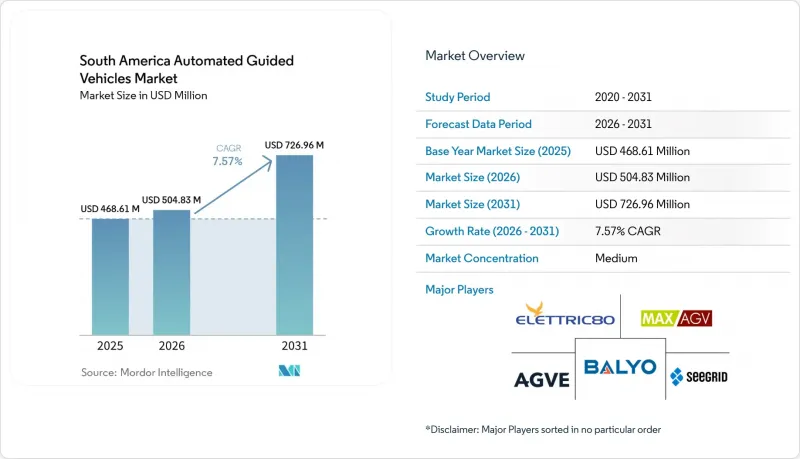
據 Mordor Intelligence 稱,2025 年南美洲自動導引運輸車(AGV) 市場價值為 4.6861 億美元,預計到 2031 年將達到 7.2696 億美元,而 2026 年為 5.041 億美元,預測期(2026-2031 年)的複合年成長率為 7.57%。
南美洲自動導引運輸車(AGV)市場趨勢與洞察
電子商務與全通路履約的拓展
隨著對快速履約的需求不斷成長,南美洲各地的物流業者正在改變其倉庫容量規劃方式。亞馬遜巴西的目標是到2026年將其在巴西八個主要城市的快速商務營運規模擴大三倍,並力爭在年底前實現15分鐘送達,同時承諾在聖保羅和里約熱內盧實現15分鐘送達。這些服務標準促使企業需要頻繁且精準地在儲存、分類和出貨區域之間進行貨物轉運。在僅靠人工無法維持這種高效物流的情況下,南美洲的自動導引運輸車(AGV)市場正從中受益。此外,有限的倉庫空間使得在現有設施內提升處理能力比擴建建築面積更具吸引力。手推車式車輛和底盤式車輛系統非常適合在繁忙的履約作業中重複搬運輕型物品。
倉庫人手不足和提高生產力的壓力
在熟練的揀貨、檢驗和堆高機操作人員短缺的地區,倉儲業者正尋求擴大其處理能力。由於區域物流網路的需求和工作安排差異顯著,這種限制影響著日常服務的可靠性。馬士基指出,在巴西的物流走廊,近岸外包和電子商務的活性化推動了AGV和AMR在內部運輸中應用的增加。因此,南美AGV市場主要依靠那些旨在穩定物料運輸而非完全取代人工操作的項目。牽引車、平板車和托盤系統為從事重複性運輸作業的中型企業提供了切實可行的選擇。這種「營運連續性」的理由或許能讓經營團隊更容易批准自動化方案,從而在人手不足期間維持服務水準。
初始投資額高,投資回收期長
AGV系統需要車輛、場地準備、軟體、系統整合和持續服務等成本。對於阿根廷的買家而言,這些成本尤其沉重,因為外匯波動和資金籌措風險會顯著增加進口設備的實際成本。中型製造商和第三方物流供應商在預期收入不確定時,可能面臨漫長的內部審核流程。資金籌措條件也因地區而異,巴西的買家可能更容易獲得補貼貸款,因此比小規模的市場的買家更容易部署自動化系統。對於能夠提供本地資金籌措和管理服務的供應商而言,南美洲自動導引運輸車(AGV)市場仍然具有吸引力。這種差異可能使本土供應商以及具備區域法律應對力和服務交付能力的國際知名公司獲得優勢。
細分市場分析
2025年,牽引式/曳引機式/標籤式AGV在南美洲自動導引車(AGV)市場佔有23.47%的佔有率。它們在汽車組裝供貨和物流中心物料運輸方面發揮著重要作用,推動了巴西、阿根廷和智利市場對這類車輛的持續需求。汽車產業叢集需要零件沿著既定路線定期運輸,而標籤式AGV的配置恰好滿足此需求。位於阿納波利斯的生產線就是數位化製造投資的典範,可能需要協調的物流支援。 Stellantis公司也正在對其工廠進行現代化改造,並實施第二班次生產,其位於波爾圖雷亞爾的工廠將於2026年7月開始量產Jeep Avenger車型。在這種環境下,能夠使物料交付與生產計劃相匹配的車輛具有顯著優勢。
預計從2026年到2031年,手推車式和小包覆AGV的複合年成長率將達到8.13%。此類車輛的主要應用場景是電子商務和微型倉配中心頻繁搬運輕型包裹。南美洲小型AGV市場規模龐大,這得歸功於其在狹窄通道和混合交通環境中運作的設施。 2025年7月,大陸集團發表了NXS 300,這是一款自動化小型物料搬運車,具備手推車相容性、全方位移動能力和360度障礙物偵測功能。自動堆高機、單元貨載、組裝式和托盤搬運車式AGV則致力於解決大規模的工業物料流問題。雷曼機器人公司報告稱,一家巴西大型物流公司已採用自動堆高機,顯示汽車工廠以外的產業也不斷擴大其應用範圍。
預計到2025年,汽車產業將佔據南美洲自動導引車(AGV)市場26.94%的佔有率。汽車及零件製造商需要可靠的零件搬運系統,以滿足特定的重量、交貨和品質要求。長安汽車在設計位於安納波利斯的工廠時,就圍繞著高度自動化生產線和本地化供應鏈的整合。 Stellantis預計於2026年在其位於雷亞爾港的工廠啟動一項價值30億巴西幣(約合5.55億美元)的現代化和擴建項目。這些投資預計將滿足對自動化生產線供應和零件運輸的需求。由於汽車行業的物流需求與生產的連續性密切相關,因此該行業仍然是穩定的買家。
預計2026年至2031年,零售和電子商務產業將以7.89%的複合年成長率成長。快速配送模式要求履約中心更頻繁地進行揀貨、分類和出貨作業。南美洲的自動導引運輸車(AGV)市場正在透過高度柔軟性的車輛來滿足這一需求,這些車輛可以在佈局不斷變化的環境中與人類工人協同運作。其他終端使用者領域包括食品飲料、物流和第三方物流(3PL)、醫藥和醫療保健、電子電氣、航太和國防以及一般製造業。食品飲料出口商正在推動冷鏈自動化,尤其是在可追溯性和溫控物流至關重要的領域。根據HAI Robotics的一份報告,RD Saude計劃在巴拉那州隆德里納建造一個擁有200多台機器人的自動化物流中心,預計將於2027年運作。
其他好處:
- Excel格式的市場預測(ME)表
- 3個月的分析師支持
目錄
第1章:引言
- 研究假設和市場定義
- 調查範圍
第2章:調查方法
第3章執行摘要
第4章 市場狀況
- 市場概覽
- 市場促進因素
- 電子商務與全通路履約的拓展
- 倉庫勞動供給與生產力壓力
- 製造業現代化與工業4.0的引入
- 重複性物料搬運的安全要求
- 智利、秘魯和巴西的港口和多式聯運碼頭自動化
- 出口型食品飲料物流現代化
- 市場限制因素
- 前期投資額高,投資回收期長。
- WMS、ERP、MES 和車輛管理系統整合的複雜性。
- 本地AGV工程維修專家短缺
- 南美洲各設施之間的基礎設施差異
- 宏觀經濟因素對市場的影響
- 產業價值鏈分析
- 監理情勢
- 技術展望
- 波特五力分析
第5章 市場規模與成長預測
- 依產品類型
- 自動堆高機(AGV)
- 牽引式/曳引機式/拖船式自動導引車
- 單元貨載AGV
- 用於組裝的AGV
- 托盤搬運車AGV
- 手推車式及小包覆式AGV
- 專用AGV
- 其他產品類型
- 按最終用戶行業分類
- 車
- 食品/飲料
- 零售與電子商務
- 電子與電機工程
- 藥品和醫療保健
- 物流和第三方物流(3PL)
- 航太/國防
- 一般製造業
- 其他終端用戶產業
- 按有效載荷能力
- 不足500公斤
- 500~1,000 kg
- 1,000~2,000 kg
- 2000公斤或以上
- 透過使用
- 物料運輸及裝卸
- 揀貨和分揀
- 解除安裝拖車
- 包裝和托盤堆垛
- 組裝過程
- 冷鍊和冷藏保管
- 危險物質的處理
- 按地區
- 巴西
- 阿根廷
- 智利
- 哥倫比亞
- 其他南美國家
第6章 競爭情勢
- 市場集中度
- 策略趨勢
- 市佔率分析
- 公司簡介
- AGVE Group AB
- MAXAGV AB
- Elettric 80 SpA
- BALYO SA
- Seegrid Corporation
- Swisslog Holding AG
- AGILOX Services GmbH
- Robotnik Automation SLL
- Autonomous Solutions, Inc.
- Locus Robotics Corporation
- inVia Robotics, Inc.
- Cassioli Srl
- Murata Machinery, Ltd.
- E&K Automation GmbH
- Transbotics Corporation
- Savant Automation, Inc.
- VisionNav Robotics(Shenzhen)Co., Ltd.
第7章 市場機會與未來展望
According to Mordor Intelligence, the South America automated guided vehicles market size was valued at USD 468.61 million in 2025 and estimated to grow from USD 504.1 million in 2026 to reach USD 726.96 million by 2031, at a CAGR of 7.57% during the forecast period (2026-2031).
South America Automated Guided Vehicles Market Trends and Insights
E-Commerce and Omnichannel Fulfillment Expansion
Rapid fulfillment requirements are changing how logistics operators plan warehouse capacity across South America. Amazon Brazil has quick-commerce operations in 8 major Brazilian cities in 2026 and is targeting a 3x increase in volume by year-end, with 15-minute delivery commitments in Sao Paulo and Rio de Janeiro. Such service standards increase the need for frequent, accurate movement between storage, sorting, and dispatch areas. The South America automated guided vehicles market benefits where operators cannot sustain those flows through manual processes alone. Constrained warehouse space also makes higher throughput within existing facilities more attractive than expanding the building footprint. Cart-style vehicles and under-rider systems are well-suited to repeated, low-weight movements in busy fulfillment operations.
Warehouse Labor Availability and Productivity Pressure
Warehouse operators are expanding capacity in locations where skilled picking, checking, and forklift labor is limited. This constraint affects daily service reliability because demand volumes and work schedules vary considerably across regional logistics networks. Maersk identified Brazil's logistics corridors as a setting where nearshoring and e-commerce activity support greater use of AGVs and AMRs for internal transport. The South America automated guided vehicles market is consequently supported by projects that stabilize material movement rather than replace every human task. Tow tractors, cart vehicles, and pallet systems offer practical options for mid-sized operators with recurring transport work. This operating-continuity rationale can make automation approvals easier when management is seeking to protect service levels during labor shortages.
High Initial Investment and Extended Payback Periods
AGV systems require spending on vehicles, site preparation, software, integration, and ongoing service. These costs are particularly difficult for buyers in Argentina, where exchange-rate conditions and financing risks can raise the effective cost of imported equipment. Mid-sized manufacturers and third-party logistics providers may face extended internal approval processes when projected returns are uncertain. Financing conditions also differ across the region, which can give Brazilian buyers with subsidized credit better access to automation than buyers in smaller markets. The South America automated guided vehicles market remains more accessible to suppliers that can provide local financing structures or managed-service options. This difference can favor domestic providers and internationally established firms with regional legal and service capabilities.
Other drivers and restraints analyzed in the detailed report include:
- Manufacturing Modernization and Industry 4.0 Adoption
- Safety Requirements for Repetitive Material Movement
- Integration Complexity Across WMS, ERP, MES, and Fleet-Control Systems
For complete list of drivers and restraints, kindly check the Table Of Contents.
Segment Analysis
Tow/Tractor/Tug AGVs held 23.47% of the South America automated guided vehicles market in 2025. Their role in automotive assembly feeding and distribution-center transport supports continued demand in Brazil, Argentina, and Chile. Automotive clusters require regular movement of components along defined routes, which suits tugger configurations. The Anapolis production line demonstrates the type of digitalized manufacturing investment that can require coordinated intralogistics support. Stellantis also began series production of the Jeep Avenger at Porto Real in July 2026, alongside modernization and the addition of a second production shift. These settings favor vehicles that can align material delivery with production schedules.
Cart and Small-Load AGVs are projected to grow at an 8.13% CAGR between 2026 and 2031. Frequent low-weight movements in e-commerce and micro-fulfillment sites provide the main use case for this format. The South America automated guided vehicles market size for smaller formats is supported by facilities that operate with narrow aisles and mixed traffic. Continental introduced the NXS 300 automated small-load carrier in July 2025, designed for cart compatibility, omnidirectional movement, and 360-degree obstacle detection. Automated Forklift, Unit-Load, Assembly Line, and Pallet Truck AGVs serve larger industrial material flows. Reeman Robotics reported autonomous forklift deployment at a major Brazilian logistics company, showing adoption beyond automotive plants.
Automotive is projected to account for 26.94% of the South America automated guided vehicles market share in 2025. Vehicle and component manufacturers require reliable parts handling that meets specific weight, timing, and quality requirements. Changan designed its Anapolis facility around a highly automated production line and localized supply chain integration. Stellantis is expected to begin a BRL 3 billion (USD 555 million) modernization and expansion cycle at its Porto Real facility in 2026. These investments are expected to support demand for automated line feeding and component transport. The automotive industry remains a stable buyer group, as its intralogistics requirements are closely linked to production continuity.
Retail and E-Commerce is projected to expand at a 7.89% CAGR from 2026 to 2031. Fast delivery models require more frequent picking, sorting, and dispatch activity across fulfillment locations. The South America automated guided vehicles market serves this need through flexible vehicles that can operate alongside workers in changing layouts. Food and Beverage, Logistics and 3PL, Pharmaceutical and Healthcare, Electronics and Electrical, Aerospace and Defense, and General Manufacturing make up the remaining end-user base. Food and beverage exporters are increasing cold-chain automation where traceability and temperature-controlled flows are important. HAI Robotics reported that RD Saude plans an automated distribution center in Londrina, Parana, with more than 200 robots and planned operation in 2027.
Complete Report Scope:
- By Product Type
- Automated Forklift AGVs
- Tow/Tractor/Tug AGVs
- Unit-Load AGVs
- Assembly Line AGVs
- Pallet Truck AGVs
- Cart and Small-Load AGVs
- Special-Purpose AGVs
- Other Product Types
- By End-User Industry
- Automotive
- Food and Beverage
- Retail and E-Commerce
- Electronics and Electrical
- Pharmaceutical and Healthcare
- Logistics and Third-Party Logistics (3PL)
- Aerospace and Defense
- General Manufacturing
- Other End-User Industries
- By Payload Capacity
- Less than 500 kg
- 500-1,000 kg
- 1,000-2,000 kg
- Above 2,000 kg
- By Application
- Material Handling and Transportation
- Order Picking and Sortation
- Trailer Loading and Unloading
- Packaging and Palletizing
- Assembly Operations
- Cold Chain and Refrigerated Storage
- Hazardous Materials Handling
- By Geography
- Brazil
- Argentina
- Chile
- Colombia
- Rest of South America
List of Companies Covered in this Report:
- AGVE Group AB
- MAXAGV AB
- Elettric 80 S.p.A.
- BALYO SA
- Seegrid Corporation
- Swisslog Holding AG
- AGILOX Services GmbH
- Robotnik Automation S.L.L.
- Autonomous Solutions, Inc.
- Locus Robotics Corporation
- inVia Robotics, Inc.
- Cassioli S.r.l.
- Murata Machinery, Ltd.
- E&K Automation GmbH
- Transbotics Corporation
- Savant Automation, Inc.
- VisionNav Robotics (Shenzhen) Co., Ltd.
Additional Benefits:
- The market estimate (ME) sheet in Excel format
- 3 months of analyst support
TABLE OF CONTENTS
1 INTRODUCTION
- 1.1 Study Assumptions and Market Definition
- 1.2 Scope of the Study
2 RESEARCH METHODOLOGY
3 EXECUTIVE SUMMARY
4 MARKET LANDSCAPE
- 4.1 Market Overview
- 4.2 Market Drivers
- 4.2.1 E-Commerce and Omnichannel Fulfillment Expansion
- 4.2.2 Warehouse Labor Availability and Productivity Pressure
- 4.2.3 Manufacturing Modernization and Industry 4.0 Adoption
- 4.2.4 Safety Requirements for Repetitive Material Movement
- 4.2.5 Port and Intermodal Terminal Automation in Chile, Peru, and Brazil
- 4.2.6 Export-Oriented Food and Beverage Logistics Modernization
- 4.3 Market Restraints
- 4.3.1 High Initial Investment and Extended Payback Periods
- 4.3.2 Integration Complexity Across WMS, ERP, MES, and Fleet-Control Systems
- 4.3.3 Shortage of Local AGV Engineering and Maintenance Specialists
- 4.3.4 Infrastructure Variability Across South American Facilities
- 4.4 Impact of Macroeconomic Factors on the Market
- 4.5 Industry Value Chain Analysis
- 4.6 Regulatory Landscape
- 4.7 Technological Outlook
- 4.8 Porter's Five Forces Analysis
- 4.8.1 Bargaining Power of Suppliers
- 4.8.2 Bargaining Power of Buyers
- 4.8.3 Threat of New Entrants
- 4.8.4 Threat of Substitutes
- 4.8.5 Competitive Rivalry
5 MARKET SIZE AND GROWTH FORECASTS (VALUE)
- 5.1 By Product Type
- 5.1.1 Automated Forklift AGVs
- 5.1.2 Tow/Tractor/Tug AGVs
- 5.1.3 Unit-Load AGVs
- 5.1.4 Assembly Line AGVs
- 5.1.5 Pallet Truck AGVs
- 5.1.6 Cart and Small-Load AGVs
- 5.1.7 Special-Purpose AGVs
- 5.1.8 Other Product Types
- 5.2 By End-User Industry
- 5.2.1 Automotive
- 5.2.2 Food and Beverage
- 5.2.3 Retail and E-Commerce
- 5.2.4 Electronics and Electrical
- 5.2.5 Pharmaceutical and Healthcare
- 5.2.6 Logistics and Third-Party Logistics (3PL)
- 5.2.7 Aerospace and Defense
- 5.2.8 General Manufacturing
- 5.2.9 Other End-User Industries
- 5.3 By Payload Capacity
- 5.3.1 Less than 500 kg
- 5.3.2 500-1,000 kg
- 5.3.3 1,000-2,000 kg
- 5.3.4 Above 2,000 kg
- 5.4 By Application
- 5.4.1 Material Handling and Transportation
- 5.4.2 Order Picking and Sortation
- 5.4.3 Trailer Loading and Unloading
- 5.4.4 Packaging and Palletizing
- 5.4.5 Assembly Operations
- 5.4.6 Cold Chain and Refrigerated Storage
- 5.4.7 Hazardous Materials Handling
- 5.5 By Geography
- 5.5.1 Brazil
- 5.5.2 Argentina
- 5.5.3 Chile
- 5.5.4 Colombia
- 5.5.5 Rest of South America
6 COMPETITIVE LANDSCAPE
- 6.1 Market Concentration
- 6.2 Strategic Moves
- 6.3 Market Share Analysis
- 6.4 Company Profiles (includes Global Level Overview, Market Level Overview, Core Segments, Financials as available, Strategic Information, Market Rank/Share, Products and Services, Recent Developments)
- 6.4.1 AGVE Group AB
- 6.4.2 MAXAGV AB
- 6.4.3 Elettric 80 S.p.A.
- 6.4.4 BALYO SA
- 6.4.5 Seegrid Corporation
- 6.4.6 Swisslog Holding AG
- 6.4.7 AGILOX Services GmbH
- 6.4.8 Robotnik Automation S.L.L.
- 6.4.9 Autonomous Solutions, Inc.
- 6.4.10 Locus Robotics Corporation
- 6.4.11 inVia Robotics, Inc.
- 6.4.12 Cassioli S.r.l.
- 6.4.13 Murata Machinery, Ltd.
- 6.4.14 E&K Automation GmbH
- 6.4.15 Transbotics Corporation
- 6.4.16 Savant Automation, Inc.
- 6.4.17 VisionNav Robotics (Shenzhen) Co., Ltd.
7 MARKET OPPORTUNITIES AND FUTURE OUTLOOK
- 7.1 White-Space and Unmet-Need Assessment

 潛水式拖曳AGV市場:全球市場預測,2026-2032年
 自動導引運輸車(AGV)市場規模、佔有率、成長率、全球產業分析、區域趨勢及2026年至2034年預測無軌採礦機械市場:全球市場預測,2026-2032年無軌礦用車輛市場:全球市場預測,2026-2032年自動導引運輸車(AGV)全球市場規模、佔有率、趨勢和成長分析報告(2026-2034)
 2026-2030年全球自動導引車(AGV)市場
 自動導引運輸車(AGV):市場佔有率分析、產業趨勢與統計及成長預測(2026-2031)北美自動導引車:市佔率分析、產業趨勢與統計及成長預測(2026-2031 年)歐洲自動導引車(AGV):市場佔有率分析、行業趨勢和統計數據以及成長預測(2026-2031 年)
 自動導引運輸車(AGV)市場規模、佔有率和趨勢分析報告:按車輛類型、導航技術、應用、行業、組件、電池類型、運作模式和細分市場進行預測(2026-2033 年)