


 |
市場調查報告書
商品編碼
2120616
北美自動導引車:市佔率分析、產業趨勢與統計及成長預測(2026-2031 年)North America Automated Guided Vehicle - Market Share Analysis, Industry Trends & Statistics, Growth Forecasts (2026 - 2031) |
||||||

※ 本網頁內容可能與最新版本有所差異。詳細情況請與我們聯繫。
據 Mordor Intelligence 稱,2026 年北美自動導引運輸車(AGV) 市場價值為 18.5 億美元,預計到 2031 年將達到 32.9 億美元,複合年成長率為 12.19%。
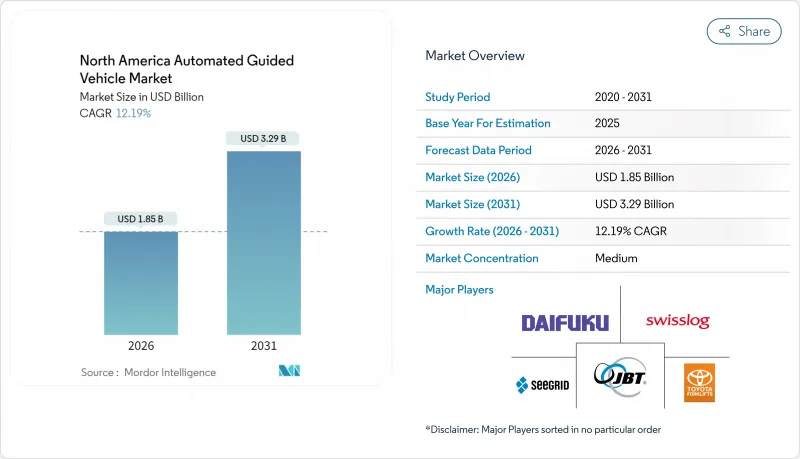
本報告按車輛類型(自動堆高機、牽引車/標籤車、單元貨載運輸車、組裝等)、導航方式(雷射、磁力、視覺/SLAM等)、組件(硬體、軟體、服務)、電池(鉛酸電池、鋰離子電池等)、最終用戶(汽車、食品飲料等)和地區進行細分。市場預測以美元計價。
北美自動導引運輸車(AGV)市場趨勢與洞察
電子商務物流的履約發展正在加速倉庫自動化的普及。
隨著當日達需求的不斷成長,第三方物流供應商 (3PL) 和零售商被迫升級其傳統設施,實施利用自動導引車 (AGV) 的「產品到人」工作流程。亞馬遜計劃在 2024 年底部署超過 75 萬台移動機器人,並持續擴大其機器人數量以滿足訂單週期目標。沃爾瑪計劃在 2024 年投資 2 億美元,在其 42 個區域配送中心 (DC) 部署自動化堆高機,目標是將工傷率降低 30%。到 2025 年,美國線上零售市場滲透率將達到總銷售額的 16.3%,AGV 的部署主要集中在德克薩斯州、加州、賓州和俄亥俄州。在這些地區,高密度的履約使得資本密集投資成為可能。自動導引車 (AGV) 市場正受益於這種從依賴輸送機的分類方式向能夠靈活適應不斷成長的 SKU 數量的移動系統的轉變。儘管加拿大和墨西哥的電子商務基礎較弱,但它們的發展軌跡相似,而且這一趨勢仍然是短期需求的最大驅動力。
物流中心人事費用上升和人手不足
預計到2025年,美國物料搬運工人的平均時薪將達到17.85美元,比2020年增加22%。同時,儘管提供了招募獎金,內陸物流走廊的職缺率仍超過8%。目前,從自動化經濟角度來看,用一台投資8萬美元的鋰離子堆高機取代兩個全職工作是划算的,而且這筆投資可以在24個月內收回成本。員工流動帶來的成本進一步放大了節省的成本,因為每位離職員工都可能導致相當於其年薪50%至60%的招募成本和業務中斷損失。因此,自動導引運輸車(AGV)市場的競爭差距正在擴大,一方是財力雄厚的大公司,另一方則是苦苦掙扎、難以依靠自有資金運作的中型公司。在加拿大,安大略省的黃金馬蹄地區也出現了類似的薪資上漲趨勢。然而,在墨西哥,人事費用優勢意味著對自動化的需求要么受到抑制,要么沒有完全消除,尤其是在出口導向工廠。
中型倉庫的初始系統和整合成本較高
在佔地 20 萬平方英尺的設施中部署承包的AGV 系統,即使不包括工作流程設計和員工培訓,成本也可能需要 150 萬至 250 萬美元。整合商通常會額外收取 30% 至 40% 的費用用於客製化和安全檢驗,這意味著對於年收入低於 5,000 萬美元的企業而言,投資回收期將超過五年。美國物流地產平均租賃期限僅為六年,這進一步延長了投資回收期。因此,自動化技術的應用仍然集中在大型企業,阻礙了自動導引車 (AGV) 在中型企業市場的滲透。提供模組化、低基礎設施影響解決方案的供應商,預計在預測期內緩解這些限制。
細分市場分析
2025年,自動化堆高機的銷售量仍佔總銷售量的34.49%,這主要得益於工廠從柴油堆高機轉向鋰離子堆高機,以滿足美國職業安全與健康管理局 (OSHA) 的空氣品質法規要求並減少維修停機時間。雖然這個成熟類別構成了北美自動導引車 (AGV) 市場的基礎,但混合動力和全向運輸車輛正以12.94%的成長率蓬勃發展,這主要得益於冷藏倉庫和製藥業對橫向移動的需求。牽引車和列車仍然是汽車行業套件組裝的主要設備。同時,單元貨載運輸車正在實現交叉轉運中心托盤入庫操作的自動化。配備升降台和視覺感測器的組裝車輛能夠以毫米級的精度牢固地固定電池組。專用機械服務於危險物品和無塵室等細分市場,利潤率高,使供應商能夠抵禦價格主導的衝擊。
2025年至2026年間,製造商開始將協作式機械臂與移動底座結合,將運輸平台轉變為能夠在移動中取回和檢測零件的操作系統。豐田計劃於2025年推出配備協作機器人的堆高機,這表明移動性和可操作性正在融合,並有可能減少車輛數量。隨著鋰離子電池改裝套件的推出,升級選擇更加豐富,預測性維護軟體的普及使運轉率接近98%,北美自動導引車(AGV)市場正在加速從設備購買模式轉向基於性能的訂閱模式。
在高通量汽車和食品加工廠,由於反射柵格技術的成熟應用,預計到2025年,雷射導引系統將占到銷售額的58.11%。然而,基於攝影機的視覺和SLAM平台正以12.55%的複合年成長率快速成長,這主要得益於影像感測器成本的下降和開放原始碼庫的日趨成熟。租賃物流中心的營運商正在加速採用視覺技術,因為他們更傾向於無需基礎設施且無需業主批准的導航方式。在反射和粉塵會干擾光學系統的室外鋼鐵廠和金屬密集型環境中,磁導航和導引導航仍然被應用。自然導航正在將GPS、IMU和雷射雷達整合到港口堆場和貨櫃碼頭,作為連接室內外區域的橋樑技術。
日益激烈的競爭正在再形成價格格局。中國供應商利用低成本攝影機,以低於歐洲雷射雷達供應商的價格提供產品,迫使現有企業更加重視軟體差異化。 OTTO Motors 已證明,將攝影機和LiDAR融合,可在複雜通道中實現亞10毫米的精度和與雷射雷達相當的性能。隨著多感測器融合技術的成熟,北美自動導引車 (AGV) 市場的反射器維護預算將逐步減少,從而可以將節省的營運成本 (OPEX) 用於車輛性能的提升。
其他好處:
- Excel格式的市場預測(ME)表
- 3個月的分析師支持
目錄
第1章:引言
- 研究假設和市場定義
- 調查範圍
第2章:調查方法
第3章執行摘要
第4章 市場狀況
- 市場概覽
- 市場促進因素
- 電子商務物流的履約發展正在加速倉庫自動化的普及。
- 美國和加拿大物流中心人事費用上升和人手不足
- 汽車OEM生產設施向電動車平台的現代化改造需要靈活的物料流動。
- 更嚴格的職業安全與健康法規要求採用符合人體工學設計的物料搬運設備。
- 美國擴大本土化激勵措施,正在促進待開發區智慧工廠的發展。
- AI 驅動的車隊編配能夠為現有設施中的多機器人系統帶來投資回報 (ROI)。
- 市場限制因素
- 中型倉庫系統初始實施及整合成本較高
- 大型高金屬密度設施中間歇性無線訊號盲點。
- 區域城市缺乏熟練技術人員對AGV進行維護和檢查
- 新興的自主移動機器人替代技術正在蠶食固定路徑自動導引車的支出。
- 產業價值鏈分析
- 監理情勢
- 技術展望
- 宏觀經濟因素對市場的影響
- 波特五力分析
第5章 市場規模與成長預測
- 車輛類型
- 自動堆高機
- 拖車/標籤
- 單元貨載裝載機
- 組裝車輛
- 混合/全向
- 特種車輛
- 導航技術
- 雷射導
- 磁感應
- 視覺/SLAM 導引
- 感應/導線導向
- 自然導航
- 按組件
- 硬體
- 軟體
- 服務
- 依電池類型
- 鉛酸
- 鋰離子
- 鎳基
- 燃料電池
- 按最終用戶行業分類
- 車
- 食品/飲料
- 零售與電子商務
- 電子設備和電氣裝置
- 一般製造業
- 醫療和藥品
- 物流和倉儲
- 國家
- 美國
- 加拿大
- 墨西哥
第6章 競爭情勢
- 市場集中度
- 策略趨勢
- 市佔率分析
- 公司簡介
- Amerden Inc.
- Swisslog Holding AG
- SSI Schaefer AG
- Daifuku Co., Ltd.
- Jungheinrich AG
- Murata Machinery, Ltd.
- Dematic Group Sa rl
- Toyota Material Handling, Inc.
- Transbotics Corporation
- John Bean Technologies Corporation
- System Logistics SpA
- Seegrid Corporation
- Locus Robotics Corp.
- OTTO Motors, LLC
- Vecna Robotics, Inc.
- Balyo SA
- Crown Equipment Corporation
- Hyster-Yale Materials Handling, Inc.
- E&K Automation GmbH
- Bastian Solutions, LLC
第7章 市場機會與未來展望
According to Mordor Intelligence, the North America automated guided vehicle market size is valued at USD 1.85 billion in 2026 and is projected to reach USD 3.29 billion by 2031, advancing at a 12.19% CAGR.
This report is Segmented by Vehicle Type (Automated Forklift, Tow/Tugger, Unit Load Carrier, Assembly Line, and More), Navigation (Laser, Magnetic, Vision/SLAM, and More), Component (Hardware, Software, and Service), Battery (Lead-Acid, Lithium-Ion, and More), End-User (Automotive, Food and Beverage, and More), and Geography. The Market Forecasts are Provided in Terms of Value (USD).
North America Automated Guided Vehicle Market Trends and Insights
E-Commerce Fulfilment Boom Accelerating Warehouse Automation Adoption
Rising same-day delivery expectations are pushing 3PLs and retailers to upgrade legacy facilities with goods-to-person workflows powered by AGVs. Amazon deployed more than 750,000 mobile robots by late 2024 and continues to scale fleets to meet order-cycle targets. Walmart invested USD 200 million in automated forklifts across 42 regional DCs in 2024, targeting a 30% drop in injury rates. As U.S. online retail penetration reached 16.3% of total sales in 2025, AGV installations clustered in Texas, California, Pennsylvania, and Ohio, where fulfillment density justifies capital intensity. The automated guided vehicle market benefits from this shift away from conveyor-bound sortation toward mobile systems that flex with SKU proliferation. With Canada and Mexico following similar trajectories, albeit at lower e-commerce baselines, the driver remains the single largest uplift to near-term demand.
Rising Labor Costs and Shortages in Logistics Hubs
Median hourly wages for U.S. material movers climbed to USD 17.85 in 2025, a 22% increase since 2020, while vacancy rates in inland logistics corridors topped 8% despite signing bonuses. Automation economics now favor replacing two full-time positions with one lithium-ion forklift at a capital cost of USD 80,000, yielding payback inside 24 months. Turnover costs compound savings, as each employee exit can cost 50% to 60% of annual salary in recruitment and downtime. Consequently, the automated guided vehicle market is widening the competitive divide between large operators with cheap capital and mid-sized firms struggling to self-finance. Canada shows identical wage inflation patterns in Ontario's Golden Horseshoe region, while Mexico's labor cost advantage tempers but does not negate automation pull, especially for export-oriented factories.
High Up-Front System and Integration Costs for Mid-Sized Warehouses
A turnkey AGV deployment in a 200,000 square-foot facility can require USD 1.5 million to USD 2.5 million before workflow engineering and staff training. Integrators often add 30% to 40% for customization and safety validation, stretching payback beyond five years for operators with revenue below USD 50 million. Short lease terms in U.S. distribution real estate, averaging six years, further hinder amortization. As a result, automation density remains concentrated among large enterprises, slowing penetration of the automated guided vehicle market in the mid-tier segment. Vendors responding with modular, infrastructure-light offerings could soften this drag over the forecast window.
Other drivers and restraints analyzed in the detailed report include:
- Automotive OEM Re-Tooling for EV Platforms Demanding Flexible Material Flow
- AI-Enabled Fleet Orchestration Unlocking Multi-Robot ROI in Brownfield Sites
- Emerging AMR Alternatives Cannibalizing Fixed-Path AGV Spending
For complete list of drivers and restraints, kindly check the Table Of Contents.
Segment Analysis
Automated forklifts retained 34.49% of 2025 revenue as factories replaced diesel units with lithium-ion models to satisfy OSHA air-quality rules and slash maintenance downtime. This mature cohort underpins the North America automated guided vehicle market, yet hybrid and omni-directional carriers are emerging with a 12.94% growth trajectory fueled by cold-storage and pharma demand for lateral motion. Tow and tugger trains remain staples in automotive kitting, whereas unit-load carriers automate inbound pallet transfers in cross-docks. Assembly-line vehicles, fitted with lift tables and vision sensors, secure battery packs with millimeter precision. Special-purpose machines serve hazardous and cleanroom niches, justifying premium margins and buffering vendors against price-led competition.
During 2025-2026, manufacturers began pairing collaborative arms with mobile bases, converting transport platforms into manipulation systems that pick or inspect components on the fly. Toyota's cobot-equipped forklift debuted in 2025, signaling a convergence of mobility and dexterity that could compress fleet sizes. Lithium-ion retrofit kits broaden upgrade options, while predictive-maintenance software pushes uptime toward 98%, reinforcing the North America automated guided vehicle market's shift from capital purchase to performance subscription.
Laser guidance owned 58.11% of 2025 revenue thanks to proven reflector grids in high-throughput automotive and food plants. Still, camera-based vision and SLAM platforms are expanding at a 12.55% CAGR as image-sensor costs fall and open-source libraries mature. Operators in leased distribution centers favour infrastructure-free navigation to avoid landlord approvals, propelling vision adoption. Magnetic and inductive lines linger in outdoor mills and metal-dense environments where reflections or dust confound optics. Natural navigation blends GPS, IMU, and lidar for port yards and container terminals, providing bridge technology between indoor and outdoor zones.
Competitive intensity is reshaping price curves. Chinese vendors use low-cost cameras to undercut European laser players, compelling incumbents to emphasize software differentiation. OTTO Motors achieved sub-10-millimeter precision by fusing cameras with lidar, proving parity with lasers in structured aisles. As multi-sensor fusion matures, the North America automated guided vehicle market may see a gradual phase-out of reflector maintenance budgets, freeing opex for fleet expansion.
Complete Report Scope:
- By Vehicle Type
- Automated Forklift
- Tow/Tugger
- Unit Load Carrier
- Assembly Line Vehicle
- Hybrid / Omni-Directional
- Special Purpose Vehicle
- By Navigation Technology
- Laser Guidance
- Magnetic Guidance
- Vision / SLAM Guidance
- Inductive / Wire Guidance
- Natural Navigation
- By Component
- Hardware
- Software
- Services
- By Battery Type
- Lead-Acid
- Lithium-Ion
- Nickel-Based
- Fuel Cell
- By End-User Industry
- Automotive
- Food and Beverage
- Retail and E-commerce
- Electronics and Electricals
- General Manufacturing
- Healthcare and Pharmaceuticals
- Logistics and Warehousing
- By Country
- United States
- Canada
- Mexico
List of Companies Covered in this Report:
- Amerden Inc.
- Swisslog Holding AG
- SSI Schaefer AG
- Daifuku Co., Ltd.
- Jungheinrich AG
- Murata Machinery, Ltd.
- Dematic Group S.a r.l.
- Toyota Material Handling, Inc.
- Transbotics Corporation
- John Bean Technologies Corporation
- System Logistics S.p.A.
- Seegrid Corporation
- Locus Robotics Corp.
- OTTO Motors, LLC
- Vecna Robotics, Inc.
- Balyo S.A.
- Crown Equipment Corporation
- Hyster-Yale Materials Handling, Inc.
- E&K Automation GmbH
- Bastian Solutions, LLC
Additional Benefits:
- The market estimate (ME) sheet in Excel format
- 3 months of analyst support
TABLE OF CONTENTS
1 INTRODUCTION
- 1.1 Study Assumptions and Market Definition
- 1.2 Scope of the Study
2 RESEARCH METHODOLOGY
3 EXECUTIVE SUMMARY
4 MARKET LANDSCAPE
- 4.1 Market Overview
- 4.2 Market Drivers
- 4.2.1 E-commerce Fulfilment Boom Accelerating Warehouse Automation Adoption
- 4.2.2 Rising Labor Costs and Shortages in U.S. and Canadian Logistics Hubs
- 4.2.3 Automotive OEM Re-tooling for EV Platforms Demanding Flexible Material Flow
- 4.2.4 Stricter Workplace-Safety Regulations Mandating Ergonomic Material Handling
- 4.2.5 Expansion of U.S. On-shoring Incentives Fueling Greenfield Smart-Factory Builds
- 4.2.6 AI-Enabled Fleet Orchestration Unlocking Multi-Robot ROI in Brownfield Sites
- 4.3 Market Restraints
- 4.3.1 High Up-Front System and Integration Costs for Mid-Sized Warehouses
- 4.3.2 Intermittent Wireless Dead-Zones in Large Metal-Dense Facilities
- 4.3.3 Limited Skilled Technicians for AGV Maintenance in Secondary Cities
- 4.3.4 Emerging AMR Alternatives Cannibalising Fixed-Path AGV Spending
- 4.4 Industry Value Chain Analysis
- 4.5 Regulatory Landscape
- 4.6 Technological Outlook
- 4.7 Impact of Macroeconomic Factors on the Market
- 4.8 Porter's Five Forces Analysis
- 4.8.1 Bargaining Power of Buyers
- 4.8.2 Bargaining Power of Suppliers
- 4.8.3 Threat of New Entrants
- 4.8.4 Threat of Substitute Products
- 4.8.5 Intensity of Competitive Rivalry
5 MARKET SIZE AND GROWTH FORECASTS (VALUE)
- 5.1 By Vehicle Type
- 5.1.1 Automated Forklift
- 5.1.2 Tow/Tugger
- 5.1.3 Unit Load Carrier
- 5.1.4 Assembly Line Vehicle
- 5.1.5 Hybrid / Omni-Directional
- 5.1.6 Special Purpose Vehicle
- 5.2 By Navigation Technology
- 5.2.1 Laser Guidance
- 5.2.2 Magnetic Guidance
- 5.2.3 Vision / SLAM Guidance
- 5.2.4 Inductive / Wire Guidance
- 5.2.5 Natural Navigation
- 5.3 By Component
- 5.3.1 Hardware
- 5.3.2 Software
- 5.3.3 Services
- 5.4 By Battery Type
- 5.4.1 Lead-Acid
- 5.4.2 Lithium-Ion
- 5.4.3 Nickel-Based
- 5.4.4 Fuel Cell
- 5.5 By End-User Industry
- 5.5.1 Automotive
- 5.5.2 Food and Beverage
- 5.5.3 Retail and E-commerce
- 5.5.4 Electronics and Electricals
- 5.5.5 General Manufacturing
- 5.5.6 Healthcare and Pharmaceuticals
- 5.5.7 Logistics and Warehousing
- 5.6 By Country
- 5.6.1 United States
- 5.6.2 Canada
- 5.6.3 Mexico
6 COMPETITIVE LANDSCAPE
- 6.1 Market Concentration
- 6.2 Strategic Moves
- 6.3 Market Share Analysis
- 6.4 Company Profiles (includes Global level Overview, Market level overview, Core Segments, Financials as available, Strategic Information, Market Rank/Share for key companies, Products & Services, and Recent Developments)
- 6.4.1 Amerden Inc.
- 6.4.2 Swisslog Holding AG
- 6.4.3 SSI Schaefer AG
- 6.4.4 Daifuku Co., Ltd.
- 6.4.5 Jungheinrich AG
- 6.4.6 Murata Machinery, Ltd.
- 6.4.7 Dematic Group S.a r.l.
- 6.4.8 Toyota Material Handling, Inc.
- 6.4.9 Transbotics Corporation
- 6.4.10 John Bean Technologies Corporation
- 6.4.11 System Logistics S.p.A.
- 6.4.12 Seegrid Corporation
- 6.4.13 Locus Robotics Corp.
- 6.4.14 OTTO Motors, LLC
- 6.4.15 Vecna Robotics, Inc.
- 6.4.16 Balyo S.A.
- 6.4.17 Crown Equipment Corporation
- 6.4.18 Hyster-Yale Materials Handling, Inc.
- 6.4.19 E&K Automation GmbH
- 6.4.20 Bastian Solutions, LLC
7 MARKET OPPORTUNITIES and FUTURE OUTLOOK
- 7.1 White-Space and Unmet-Need Assessment

 自動導引運輸車(AGV)全球市場規模、佔有率、趨勢和成長分析報告(2026-2034)
 2026-2030年全球自動導引車(AGV)市場
 自動導引運輸車(AGV):市場佔有率分析、產業趨勢與統計及成長預測(2026-2031)歐洲自動導引車(AGV):市場佔有率分析、行業趨勢和統計數據以及成長預測(2026-2031 年)
 自動導引運輸車(AGV) 市場預測至 2034 年—按組件、車輛類型、導航技術、應用、最終用戶和地區分類的全球分析
 自動導引車(AGV)市場:按組件、車輛類型、導航技術、有效載荷能力、應用、最終用戶和分銷管道分類-2026-2032年全球市場預測
 自動導引運輸車(AGV)市場規模、佔有率和趨勢分析報告:按車輛類型、導航技術、應用、行業、組件、電池類型、運作模式和細分市場進行預測(2026-2033 年)
 自動導引運輸車(AGV)市場規模、佔有率、趨勢和預測:按類型、驅動方式、導航技術、應用、行業和地區分類,2026-2034年
 2026年全球自主地面車輛(AGV)市場報告小型AGV市場:按類型、導航技術、負載容量、應用和最終用戶分類-2026-2032年全球市場預測