


 |
市場調查報告書
商品編碼
2154901
南美洲醫藥玻璃包裝:市場佔有率分析、產業趨勢與統計及成長預測(2026-2031)South America Pharmaceutical Glass Packaging - Market Share Analysis, Industry Trends & Statistics, Growth Forecasts (2026 - 2031) |
||||||

※ 本網頁內容可能與最新版本有所差異。詳細情況請與我們聯繫。
據 Mordor Intelligence 稱,2025 年南美醫藥玻璃包裝市場價值 14.7 億美元,預計將從 2026 年的 15.6 億美元成長到 2031 年的 21.1 億美元。
預測期(2026-2031 年)的複合年成長率預計為 6.23%。
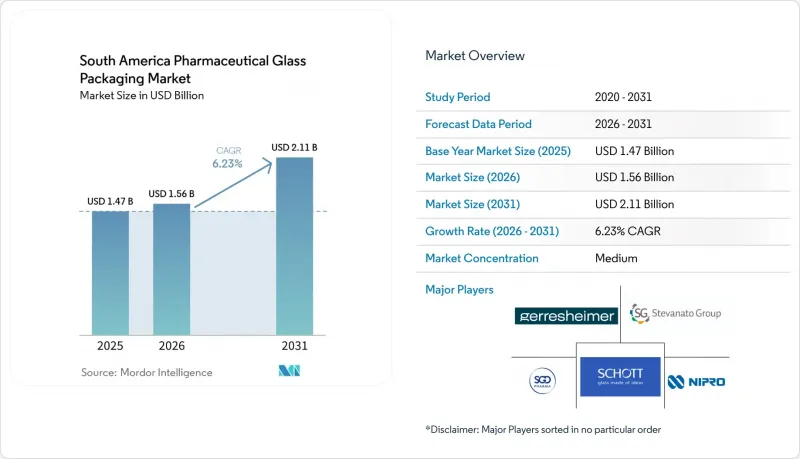
南美洲醫藥玻璃包裝市場趨勢及洞察。
擴大注射劑和生物製藥的生產規模
巴西注射劑生產基地正向更複雜的生物製藥和高價值注射轉型。 2026年1月,Blau Farmaceutica宣布Pembrolizumab單抗單株抗體生物相似藥已實現完全本土化開發,並報告其原料藥(API)生產設施已獲得巴西國家衛生監督局(ANVISA)GMP認證。這項進展支撐了對I型硼矽酸玻璃管瓶和預灌封注射器的需求,因為生物製藥需要經過認證的初級包裝容器。 2026年7月,Aurobindo Pharma旗下的CuraTeQ Biologics位於海德拉巴的工廠也獲得了ANVISA GMP認證,該工廠擁有用於生物類似藥的管瓶灌裝和預填充注射器生產線。每個新的生物製藥專案在商業化供應開始之前都需要進行容器合格,這給包裝供應商帶來了持續的工作。這些合格要求也阻礙了在容器性能至關重要的應用領域中玻璃容器的淘汰。此外,由於更換供應商可能需要進一步的合格評定工作,包裝決策需符合臨床和商業性計劃。這意味著,與低規格包裝相比,獲得認證的包裝容器供應商將在生物製藥生產項目中發揮更永續的作用。
巴西生物相似藥的在地化與公共採購
巴西的公共採購體系透過「生產發展夥伴關係」計畫支持本地生產,該計畫將技術轉移與預計採購量掛鉤。這項機制降低了國內製造業的投資風險,並為經認證的玻璃容器創造了更穩定的需求。 2025年9月,巴西國家衛生監督局(ANVISA)發布了生物相似藥上市許可建議,其中包括Denosumab、曲妥珠單抗和阿柏西普。根據2025年公佈的平均外匯,阿柏西普的Funded、三星Bioepis和Bionovis計畫在Fundacao Ezequiel Dias醫院的設備升級方面投入了4,200萬巴西幣(約740萬美元)。公立醫院通常使用多劑量製劑以降低單劑量成本,這推動了管瓶的消耗。因此,採購狀態的透明度有助於供應商制定需求計劃,並使其能夠準備必要的品質文件。此外,這也使得人們的關注點從簡單的單價轉向服務可靠性、文件記錄以及確保整個競標週期內穩定供應的能力。能夠同時滿足本地生產和公共採購要求的供應商,更有能力滿足這項需求。
進口原料及外匯風險
南美洲醫藥玻璃包裝市場依賴進口高純度硼矽酸玻璃管。這種依賴使買家面臨外匯波動風險,並可能導致在巴西和阿根廷的收貨成本居高不下。目前,國內生產尚無法大規模供應醫藥級硼矽酸玻璃管。建立熔爐和拉管製程需要大量資金、專業的製程控制以及持續的市場需求。如果需要提供關於萃取物和洗脫液的額外證據,監管政策的變更也可能增加文件成本。對於小規模學名藥生產商和藥房而言,管理外匯風險和規格相關的成本可能是最具挑戰性的。如果買家等待更有利的外匯或轉而選擇規格較低的替代品,則可能導致採購延誤。當合約價格以外幣計價,而當地報銷條款未能同步調整時,這個問題尤其突出。
細分市場分析
由於廣泛應用於疫苗、注射用生物製劑和標準腸外給藥製劑,管瓶預計到2025年將佔據南美醫藥玻璃包裝市場19.82%的佔有率。其現有地位反映了全部區域公共和私人處方集的需求。用於多劑量給藥的I型硼矽酸管瓶在公共衛生計畫中發揮至關重要的作用,有助於實現經濟的劑型。學名藥生產商和契約製造也依賴這種品質可靠的管瓶包裝形式。安瓿瓶繼續用於注射用止痛藥、抗發炎藥和低成本腸外製劑。瓶裝製劑在口服溶液和外用藥物中仍發揮重要作用,儘管與注射劑相比,這些應用中玻璃的使用量往往較低。
預計到2031年,卡式注射器和預灌封注射器將以7.49%的複合年成長率成長,成為南美醫藥玻璃包裝市場成長最快的產品形式。自動注射器的普及和GLP-1受體促效劑的研發管線正在推動即用型劑型的普及。生技藥品開發商也優先考慮能夠最大限度減少填充過程中操作的密封容器。 RTU聯盟的成立旨在幫助製造商和契約製造製造商過渡到即用型管瓶和卡式注射器系統。在巴西,與需要新建國內玻璃成型設備的型號相比,採用進口組件和國產無菌組裝的型號可能更快地推廣這些劑型。 ABNT NBR 11280(安瓿瓶)和ABNT NBR 11819(藥瓶)仍然是這些應用供應商的基本標準。
2025年,I型硼硼矽酸玻璃佔南美洲醫藥玻璃包裝市場27.46%的市佔率。這一佔有率反映了其在生技藥品、疫苗和易損注射劑領域的應用。這種材料具有高價值注射劑所需的耐水解性。當客戶傾向於選擇成熟材料而非新的容器合格流程時,這對供應商而言具有優勢。 II型經處理的鈉鈣玻璃用於水性注射劑,此類注射劑的相互作用風險可控。 III型鈉鈣玻璃適用於對耐水解性要求不高的口服液瓶,以及某些獸藥應用。
預計到2031年,I型硼矽酸玻璃將以7.23%的複合年成長率成長,成為南美洲醫藥玻璃包裝市場中成長速度最快的玻璃類別。生物相似藥、單株抗體和GLP-1製劑的需求推動了對高規格初級包裝容器的需求。鑑於I型玻璃在注射給藥應用領域久經考驗,監管文件要求可能會進一步促進這一趨勢。因此,隨著複雜注射劑在公共採購中扮演越來越重要的角色,I型玻璃與處理過的或標準鈉鈣玻璃之間的市場佔有率差距可能會進一步擴大。此外,產品組合的變化也提高了低缺陷管材、可靠的品質記錄和區域技術支援的重要性。這將有利於那些能夠提供玻璃供應和合格支援的供應商。
其他好處:
- Excel格式的市場預測(ME)表
- 3個月的分析師支持
目錄
第1章:引言
- 研究假設和市場定義
- 調查範圍
第2章:調查方法
第3章執行摘要
第4章 市場狀況
- 市場概覽
- 宏觀經濟因素對市場的影響
- 市場促進因素
- 擴大注射劑和生物製藥的生產規模
- 巴西生物相似藥的在地化與公共採購
- 即用型滅菌包裝平台的成長
- 擴大疫苗生產能力及灌裝/表面處理工程能力。
- 畜牧供應鏈中的獸醫疫苗接種
- 進口高純度玻璃的區域認證中心
- 市場限制因素
- 進口原料及外匯風險
- 標準注射藥物應用中的聚合物替代品
- 與高耗能熔煉和爐窯運轉率。
- 合格中與損壞、分層和萃取物相關的風險。
- 產業價值鏈分析
- 監理情勢
- 技術展望
- 波特五力分析
第5章 市場規模與成長預測
- 依產品
- 瓶子
- 管瓶
- 安瓿
- 藥筒和預填充式注射器
- 其他產品
- 玻璃類型
- I型硼硼矽酸玻璃
- II 型處理鈉鈣玻璃
- 第三型鈉鈣玻璃
- 其他玻璃類型
- 製劑形式
- 注射藥物
- 口服液體藥物
- 眼科/鼻腔
- 外用
- 最終用戶
- 製藥創新公司
- 學名藥和合約生產商
- 生技公司
- 藥局
- 動物用藥品
- 按地區
- 巴西
- 阿根廷
- 哥倫比亞
- 其他南美國家
第6章 競爭情勢
- 市場集中度
- 策略趨勢
- 市佔率分析
- 公司簡介
- Gerresheimer AG
- SCHOTT AG
- Stevanato Group SpA
- Nipro Corporation
- SGD SA
- Corning Incorporated
- West Pharmaceutical Services, Inc.
- Bormioli Pharma SpA
- Ardagh Glass Packaging
- Stoelzle Oberglas GmbH
- Beatson Clark Limited
- Shandong Pharmaceutical Glass Co., Ltd.
- Chongqing Zhengchuan Pharmaceutical Packaging Co., Ltd.
- Cangzhou Four Star Glass Co., Ltd.
- DWK Life Sciences GmbH
- Origin Pharma Packaging Limited
- Vitro, SAB de CV
- AptarGroup, Inc.
- Becton, Dickinson and Company
- Owens-Illinois, Inc.
第7章 市場機會與未來展望
According to Mordor Intelligence, the South America pharmaceutical glass packaging market size was valued at USD 1.47 billion in 2025 and estimated to expand from USD 1.56 billion in 2026 to reach USD 2.11 billion by 2031, at a CAGR of 6.23% during the forecast period (2026-2031).
South America Pharmaceutical Glass Packaging Market Trends and Insights
Expansion of Injectable and Biologic Drug Manufacturing
Brazil's injectable manufacturing base is moving toward more complex biologics and higher-value parenteral medicines. In January 2026, Blau Farmaceutica announced fully integrated domestic development of a pembrolizumab monoclonal antibody biosimilar and reported ANVISA GMP certification for its API facility. This development supports demand for Type I borosilicate vials and prefillable syringes because biologic products require qualified primary containers. Aurobindo Pharma's CuraTeQ Biologics received ANVISA GMP certification in July 2026 for its Hyderabad facility, including vial filling and prefillable syringe lines for biosimilar products.Each new biologic program requires container qualification before commercial supply, creating a recurring workstream for packaging suppliers. These qualification requirements also slow the replacement of glass in applications where established container performance remains important. They also tie packaging decisions to clinical and commercial timelines, since a supplier change may require further compatibility work. This gives qualified container suppliers a more durable role in biologic production programs than in lower-specification packaging categories.
Brazil Biosimilar Localization and Public Procurement
Brazil's public procurement system supports local production through Partnerships for Productive Development, which link technology transfer to expected purchase volumes. This structure can reduce the investment risk for domestic manufacturing and create a steadier requirement for qualified glass containers. In September 2025, ANVISA issued favorable marketing authorization recommendations for biosimilars, including denosumab, trastuzumab, and aflibercept. The Funed, Samsung Bioepis, and Bionovis program for aflibercept included BRL 42 million (USD 7.4 million) in upgrades at Fundacao Ezequiel Dias, based on the stated 2025 average exchange rate. Public hospitals often use multi-dose formats to reduce per-dose costs, which favors glass vial consumption. Procurement visibility, therefore, supports demand planning for suppliers capable of meeting the required quality documentation. It also shifts attention from simple unit pricing to service reliability, documentation readiness, and stable availability across tender cycles. Suppliers that can support both local manufacturing and public procurement requirements are positioned to address this demand.
Imported Raw Materials and Currency Exposure
The South America pharmaceutical glass packaging market relies on imported high-purity borosilicate tubing. This reliance leaves buyers exposed to currency movements and higher landed costs in Brazil and Argentina. Domestic production does not currently provide pharmaceutical-grade borosilicate tubing at commercial scale. Developing a furnace and tube-drawing operation requires significant capital, specialized process control, and sustained demand. Regulatory changes can also raise documentation costs when they require additional extractables and leachables evidence. Smaller generic manufacturers and compounding pharmacies may find it hardest to manage both foreign-currency exposure and specification-related costs. Procurement delays can result when buyers wait for more favorable exchange conditions or switch to lower-specification options. The issue is most immediate where contracts are priced in foreign currency and local reimbursement conditions do not change at the same pace.
Other drivers and restraints analyzed in the detailed report include:
- Growth of Ready-to-Use Sterile Packaging Platforms
- Vaccine and Fill-Finish Capacity Expansion
- Polymer Substitution in Standard Injectable Applications
For complete list of drivers and restraints, kindly check the Table Of Contents.
Segment Analysis
Vials held 19.82% of the South America pharmaceutical glass packaging market share in 2025, supported by their broad use in vaccines, injectable biologics, and standard parenteral medicines. Their established role reflects the requirements of public and private formularies across the region. Multi-dose Type I borosilicate vials are relevant to public health programs because they support economical dosing formats. Generic manufacturers and contract manufacturing organizations also rely on familiar vial configurations with established quality records. Ampoules continued to serve injectable analgesics, anti-inflammatory medicines, and lower-value parenteral products. Bottles remained relevant to oral liquids and topical medicines, although these applications carry less glass intensity than injectables.
Cartridges and prefillable syringes are projected to expand at a CAGR of 7.49% through 2031, making them the fastest-growing product format in the South America pharmaceutical glass packaging market. Auto-injector adoption and GLP-1 receptor agonist pipelines support the shift toward patient-ready delivery formats. Biologic developers also value closed containers that can limit handling during filling operations. The Alliance for RTU was designed to help manufacturers and contract manufacturers shift toward ready-to-use vial and cartridge systems. Brazil's use of imported components and domestic sterile assembly may enable faster adoption of these formats than a model requiring new domestic glass-forming assets. ABNT NBR 11280 for ampoules and ABNT NBR 11819 for pharmaceutical bottles remain baseline standards for suppliers serving these uses.
Type I borosilicate accounted for 27.46% of the South America pharmaceutical glass packaging market size in 2025. Its position reflects its use in biologics, vaccines, and sensitive injectable products. The material offers the hydrolytic resistance expected for high-value parenteral medicines. Suppliers benefit when customers prefer an established material rather than undertake a new container qualification process. Type II treated soda-lime glass serves aqueous injectables with controlled interaction risk. Type III soda-lime glass remains suitable for oral liquid bottles and selected veterinary uses where high hydrolytic resistance is less critical.
Type I borosilicate is projected to expand at a CAGR of 7.23% through 2031, the highest rate among glass categories in the South America pharmaceutical glass packaging market. Biosimilars, monoclonal antibodies, and GLP-1 medicines are supporting demand for high-specification primary containers. Regulatory documentation requirements can reinforce this preference because Type I glass carries a recognized performance history in parenteral applications. The share gap between Type I and treated or standard soda-lime grades can therefore widen as complex injectables take a larger role in public procurement. The product mix also raises the value placed on low-defect tubing, robust quality records, and regional technical support. This favors suppliers that can pair glass supply with qualification assistance.
Complete Report Scope:
- By Product
- Bottles
- Vials
- Ampoules
- Cartridges and Prefillable Syringes
- Other Products
- By Glass Type
- Type I Borosilicate
- Type II Treated Soda-Lime
- Type III Soda-Lime
- Other Glass Types
- By Drug Formulation
- Injectables
- Oral Liquids
- Ophthalmic/Nasal
- Topical
- By End-User
- Pharma Innovator Companies
- Generic and CMOs
- Biotech Firms
- Compounding Pharmacies
- Veterinary Pharma
- By Geography
- Brazil
- Argentina
- Colombia
- Rest of South America
List of Companies Covered in this Report:
- Gerresheimer AG
- SCHOTT AG
- Stevanato Group S.p.A.
- Nipro Corporation
- SGD S.A.
- Corning Incorporated
- West Pharmaceutical Services, Inc.
- Bormioli Pharma S.p.A.
- Ardagh Glass Packaging
- Stoelzle Oberglas GmbH
- Beatson Clark Limited
- Shandong Pharmaceutical Glass Co., Ltd.
- Chongqing Zhengchuan Pharmaceutical Packaging Co., Ltd.
- Cangzhou Four Star Glass Co., Ltd.
- DWK Life Sciences GmbH
- Origin Pharma Packaging Limited
- Vitro, S.A.B. de C.V.
- AptarGroup, Inc.
- Becton, Dickinson and Company
- Owens-Illinois, Inc.
Additional Benefits:
- The market estimate (ME) sheet in Excel format
- 3 months of analyst support
TABLE OF CONTENTS
1 INTRODUCTION
- 1.1 Study Assumptions and Market Definition
- 1.2 Scope of the Study
2 RESEARCH METHODOLOGY
3 EXECUTIVE SUMMARY
4 MARKET LANDSCAPE
- 4.1 Market Overview
- 4.2 Impact of Macroeconomic Factors on the Market
- 4.3 Market Drivers
- 4.3.1 Expansion of Injectable and Biologic Drug Manufacturing
- 4.3.2 Brazil Biosimilar Localization and Public Procurement
- 4.3.3 Growth of Ready-to-Use Sterile Packaging Platforms
- 4.3.4 Vaccine and Fill-Finish Capacity Expansion
- 4.3.5 Veterinary Vaccination Across Livestock Supply Chains
- 4.3.6 Regional Qualification Hubs for Imported High-Purity Glass
- 4.4 Market Restraints
- 4.4.1 Imported Raw Materials and Currency Exposure
- 4.4.2 Polymer Substitution in Standard Injectable Applications
- 4.4.3 Energy-Intensive Melting and Furnace Utilization Risk
- 4.4.4 Breakage, Delamination, and Extractables Qualification Risk
- 4.5 Industry Value Chain Analysis
- 4.6 Regulatory Landscape
- 4.7 Technological Outlook
- 4.8 Porter's Five Forces Analysis
- 4.8.1 Bargaining Power of Suppliers
- 4.8.2 Bargaining Power of Buyers
- 4.8.3 Threat of New Entrants
- 4.8.4 Threat of Substitutes
- 4.8.5 Competitive Rivalry
5 MARKET SIZE AND GROWTH FORECASTS (VALUE)
- 5.1 By Product
- 5.1.1 Bottles
- 5.1.2 Vials
- 5.1.3 Ampoules
- 5.1.4 Cartridges and Prefillable Syringes
- 5.1.5 Other Products
- 5.2 By Glass Type
- 5.2.1 Type I Borosilicate
- 5.2.2 Type II Treated Soda-Lime
- 5.2.3 Type III Soda-Lime
- 5.2.4 Other Glass Types
- 5.3 By Drug Formulation
- 5.3.1 Injectables
- 5.3.2 Oral Liquids
- 5.3.3 Ophthalmic/Nasal
- 5.3.4 Topical
- 5.4 By End-User
- 5.4.1 Pharma Innovator Companies
- 5.4.2 Generic and CMOs
- 5.4.3 Biotech Firms
- 5.4.4 Compounding Pharmacies
- 5.4.5 Veterinary Pharma
- 5.5 By Geography
- 5.5.1 Brazil
- 5.5.2 Argentina
- 5.5.3 Colombia
- 5.5.4 Rest of South America
6 COMPETITIVE LANDSCAPE
- 6.1 Market Concentration
- 6.2 Strategic Moves
- 6.3 Market Share Analysis
- 6.4 Company Profiles (includes Global Level Overview, Market Level Overview, Core Segments, Financials as available, Strategic Information, Market Rank/Share, Products and Services, Recent Developments)
- 6.4.1 Gerresheimer AG
- 6.4.2 SCHOTT AG
- 6.4.3 Stevanato Group S.p.A.
- 6.4.4 Nipro Corporation
- 6.4.5 SGD S.A.
- 6.4.6 Corning Incorporated
- 6.4.7 West Pharmaceutical Services, Inc.
- 6.4.8 Bormioli Pharma S.p.A.
- 6.4.9 Ardagh Glass Packaging
- 6.4.10 Stoelzle Oberglas GmbH
- 6.4.11 Beatson Clark Limited
- 6.4.12 Shandong Pharmaceutical Glass Co., Ltd.
- 6.4.13 Chongqing Zhengchuan Pharmaceutical Packaging Co., Ltd.
- 6.4.14 Cangzhou Four Star Glass Co., Ltd.
- 6.4.15 DWK Life Sciences GmbH
- 6.4.16 Origin Pharma Packaging Limited
- 6.4.17 Vitro, S.A.B. de C.V.
- 6.4.18 AptarGroup, Inc.
- 6.4.19 Becton, Dickinson and Company
- 6.4.20 Owens-Illinois, Inc.
7 MARKET OPPORTUNITIES AND FUTURE OUTLOOK
- 7.1 White-Space and Unmet-Need Assessment

 醫藥玻璃包裝市場規模、佔有率、成長、全球產業分析、區域趨勢及2026年至2034年預測。
 2026-2030年全球醫藥玻璃容器市場
 2034年醫藥玻璃包裝市場預測-全球產品類型、玻璃類型、包裝形式、藥品類型、容量、最終用戶和地區分析
 醫藥玻璃容器:市場佔有率分析、產業趨勢與統計、成長預測(2026-2031)
 醫藥玻璃包裝市場-全球市場預測(2026-2032年)
 安瓿和注射器市場:按產品類型、材料、最終用戶和地區分類
 醫藥玻璃包裝市場:按產品類型、材料類型、製造流程、應用、最終用途、國家和地區分類-全球產業分析、市場規模、市場佔有率和預測(2026-2033 年)
 醫藥玻璃包裝市場報告:按產品類型、藥品類型、應用和地區分類(2026-2034 年)2026-2034年全球醫藥玻璃包裝市場規模、佔有率、趨勢和成長分析報告
 2026年全球醫藥玻璃器皿市場報告