


 |
市場調查報告書
商品編碼
2123270
醫藥玻璃容器:市場佔有率分析、產業趨勢與統計、成長預測(2026-2031)Pharmaceutical Glass Packaging - Market Share Analysis, Industry Trends & Statistics, Growth Forecasts (2026 - 2031) |
||||||

※ 本網頁內容可能與最新版本有所差異。詳細情況請與我們聯繫。
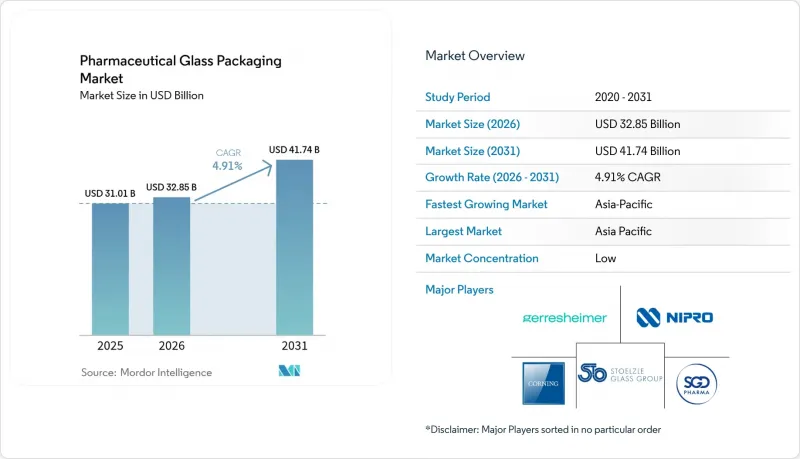
2025 年醫藥玻璃容器市場價值為 310.1 億美元,預計到 2031 年將達到 417.4 億美元,而 2026 年為 328.5 億美元,預測期(2026-2031 年)複合年成長率為 4.91%。
本報告按產品類型(瓶裝、管瓶、安瓿瓶等)、玻璃類型(I型硼矽酸玻璃、II型處理鈉鈣玻璃等)、藥物劑型(注射劑、口服溶液、滴眼液/鼻噴劑等)、最終用戶(創新製藥公司、學名藥生產商和合約生產商等)以及地區進行細分。市場預測以美元計價。
全球醫藥玻璃容器市場趨勢及洞察
拓展生物製藥及注射藥物研發管線
生物製藥後期階段藥物的激增推動了醫藥玻璃容器市場的發展,預計到2025年,將有2517種候選藥物進入II期和III期臨床試驗。其中超過三分之二的藥物需要使用低洗脫I型容器進行腸外給藥,以在24個月的保存期限內保護蛋白質結構。單株抗體療法的年上市量可能超過1.5億支管瓶或預灌封注射器,這將形成多年的基本負載,從而保障生產設施的正常運轉率。細胞和基因療法目前佔研發管線的近五分之一,由於需要萃取物含量低於1ppm的預滅菌管瓶,因此對競爭性包裝材料提出了很高的技術挑戰。 West Pharmaceutical Services和Stevanart Group對即用型填充生產線的投資正在推動這種高純度包裝形式的轉變。
新冠疫情後擴大疫苗填充及包裝產能
2020年至2024年間,全球疫苗填充和包裝產能增加了47%,每年新增83億劑。這一成長主要發生在印度、印尼、南非和巴西。這些生產線均採用2毫升和5毫升的I型管瓶,用於mRNA疫苗和病毒載體疫苗。印度塞拉姆研究所計劃將其新冠疫情疫苗產量的80%用於常規免疫接種,這將確保每年約12億管瓶的產量。目前,23個中低收入國家正在建立或擴大國內疫苗生產線,其中19個國家已指定使用I型玻璃瓶,反映出相關監管法規的日益完善。
COP/COC聚合物注射器的快速普及
隨著製藥公司逐步淘汰玻璃注射器筒體中的矽油和鎢浸出物,預計到2025年,聚合物注射器的市佔率將達到18%。Terumo Corporation公司於2025年3月收購Recipharm公司的資產,預計到2027年,其聚合物注射器產能將成長兩倍,達到6億支,這將加劇玻璃注射器製造商面臨的競爭壓力。器械設計人員也指出,聚合物注射器的尺寸精度提高了25%,無需額外的目視檢查即可加快填充速度,從而降低了高通量生物製藥生產線的整體擁有成本(TCO)。此外,FDA在2024年發布的容器和密封系統指南中批准了COP和COC作為合適的腸外給藥容器材料,這也進一步擴大了監管機構的認可度。
細分市場分析
2025年,管瓶在醫藥玻璃包裝市場中佔據40.53%的佔有率。這反映了管瓶具有優勢。預計2026年至2031年,卡式注射器和預灌封注射器的複合年成長率將達到5.93%,這主要得益於製藥業向以患者為中心的醫療醫療設備轉型,這些器材能夠幫助慢性病患者更好地用藥,提高用藥依從性,並減少就醫次數。用於口服溶液和眼用製劑的瓶子呈現溫和成長,因為印度和中國的學名藥生產商正在擴大其兒童懸浮液產品線。與此同時,安瓿瓶的市佔率正在下降,因為其在自動化灌裝過程中的高破損率抵消了其一次性包裝的便利性。
在生物製藥領域,從管瓶到預灌封注射器的轉變正在加速,Stevanat集團的“EZ-fill nests”和Geresheimer的“Gx RTF”注射器避免了二次包裝和冷鏈的複雜性。 2024年10月,Nipro與康寧合作推出了“Velocity Vial”,該產品可將顆粒含量降低高達96%,這凸顯了在注射器普及率不斷提高的情況下,管瓶的重要性依然不容忽視。在胰島素和GLP-1注射劑領域,藥筒佔據主導地位,其在多劑量給藥方面具有高精度優勢,而West Pharmaceutical Services的「Westar」即用型組件正逐漸成為行業標準。在氣密性至關重要的急診醫學和獸醫市場,安瓿瓶仍然很受歡迎。 「其他產品」細分市場,如雙腔管瓶和吹灌封密封件,正以4.2%的複合年成長率快速成長,因為合約研發生產機構(CDMO)正在尋求專有包裝以防止生物相似藥的替代。
到2025年,I型硼矽酸玻璃將佔醫藥玻璃容器市場54.56%的佔有率,預計到2031年將以5.67%的複合年成長率成長,因為其化學耐久性將成為生物製藥、疫苗和高pH注射的標準配置。經二氧化硫表面處理的II型鈉鈣玻璃用於價格敏感學名藥,但其市場佔有率正在下降,因為I型玻璃在全球應用中日益普及,以避免昂貴的重複檢驗。 III型鈉鈣玻璃僅限於非注射劑型,例如口服溶液和外用製劑,其複合年成長率僅為3.8%,因為其在兒童懸浮液市場中被輕質塑膠蠶食了市場佔有率。
帕多瓦大學對血漿離子交換的研究表明,改性I型模具表面可將蛋白質吸附降低68%,鈉離子洗脫降低82%,因此無需使用黏度降低劑即可達到超過150 mg/ml的濃度。這項突破性成果引起了抗體藥物複合體(ADC)開發商的注意。肖特公司宣布了一項覆蓋德國和印度的4.5億美元投資計劃,旨在將客製化I型模具的前置作業時間縮短12至18個月,該計劃於2025年啟動。儘管 II 型玻璃在預算受限的市場(尤其是在撒哈拉以南非洲和南亞)需求強勁,但其 35-50% 的價格優勢並未吸引那些需要進行嚴格萃取物測試、並要求使用 I 型玻璃的創新公司。 「其他玻璃產品」系列(包括用於光敏感藥物的琥珀色管瓶和低摩擦塗層產品,例如「Velocity Vial」)的複合年成長率 (CAGR) 為 6.1%,這得益於企業追求功能差異化,而 ISO 15378 可追溯性法規的實施進一步鞏固了 I 型玻璃的優勢。
區域分析
預計到2025年,亞太地區將佔據34.96%的市場。這反映了中國90億支的年產量以及印度作為全球填充和包裝中心的崛起。日本企業正專注於高精度注射器和表面處理管瓶的生產,並出口到世界各地。與ICH Q3D的監管協調正在推動標準化,尤其是在I型玻璃方面,該地區的複合年成長率預計將達到5.2%。
亞太地區預計將以5.88%的複合年成長率成長,主要受各地疫苗接種強制令和「非洲疫苗生產舉措」的推動。南非、肯亞和奈及利亞熔煉爐的建設正在緩解原料進口帶來的物流挑戰。由於產能仍落後於需求,跨國公司正透過合資企業儘早搶佔市場佔有率。
預計到2025年,歐洲和北美合計佔全球需求的42.1%,隨著即用型玻璃的普及和人工智慧檢測技術的引入,交易量和利潤率均有所提高。歐盟綠色交易下的回收目標已將主要成員國的玻璃屑回收率提升至78%,進一步強化了對玻璃永續性的評估。南美洲的複合年成長率(CAGR)為4.7%,這主要得益於巴西對生物相似藥的推廣以及政府強製本地生產包裝的採購法規。
其他好處:
- Excel格式的市場預測(ME)表
- 3個月的分析師支持
目錄
第1章:引言
- 研究假設和市場定義
- 調查範圍
第2章:調查方法
第3章執行摘要
第4章 市場狀況
- 市場概覽
- 市場促進因素
- 擴大生技藥品和注射的研發管線
- 新冠疫情後疫苗填充和包裝產能的擴張
- 過渡到即用型(RTU)管瓶和注射器
- 高附加價值I型硼矽酸玻璃的需求不斷成長
- 製藥業的永續發展法規正在提高玻璃的可回收性。
- 人工智慧驅動的線上品管降低了玻璃的缺陷率。
- 市場限制因素
- COP/COC聚合物注射器的快速普及
- 堿灰和能源價格的波動推高了玻璃成本。
- 對高活性藥物脫落和破損的擔憂
- 各地區容器玻璃熔爐產能不足
- 產業價值/供應鏈分析
- 監理展望
- 技術展望
- 宏觀經濟因素對市場的影響
- 波特五力分析
第5章 市場規模與成長預測
- 依產品
- 瓶子
- 管瓶
- 安瓿
- 藥筒和預填充式注射器
- 其他產品
- 玻璃類型
- I型硼硼矽酸玻璃
- II 型處理鈉鈣玻璃
- 第三型鈉鈣玻璃
- 其他玻璃類型
- 配方
- 注射藥物
- 口服液體藥物
- 眼科/鼻科
- 外用
- 最終用戶
- 製藥創新公司
- 學名藥和合約生產商
- 生技公司
- 藥局
- 動物用藥品
- 按地區
- 北美洲
- 美國
- 加拿大
- 墨西哥
- 歐洲
- 德國
- 英國
- 法國
- 義大利
- 西班牙
- 俄羅斯
- 其他歐洲國家
- 亞太地區
- 中國
- 印度
- 日本
- 韓國
- 澳洲和紐西蘭
- 其他亞太國家
- 中東和非洲
- 中東
- 非洲
- 南美洲
- 巴西
- 阿根廷
- 其他南美國家
- 北美洲
第6章 競爭情勢
- 市場集中度
- 策略趨勢
- 市佔率分析
- 公司簡介
- Gerresheimer AG
- Schott AG
- SGD Pharma
- Stevanato Group
- Corning Inc.
- Nipro Corporation
- West Pharmaceutical Services Inc.
- Bormioli Pharma SpA
- Owens-Illinois Inc.(Ardagh Glass Pharma)
- Stoelzle Oberglas GmbH
- Beatson Clark Ltd.
- Shandong Medicinal Glass Co. Ltd.
- Arab Pharmaceutical Glass Co.
- Piramal Glass Private Ltd.
- Sisecam Group
- Baxter BioPharma Solutions LLC
- Kindeva Drug Delivery LP
- Origin Pharma Packaging Ltd.
- DWK Life Sciences GmbH
- GerroMed GmbH
第7章 市場機會與未來展望
According to Mordor Intelligence, the pharmaceutical glass packaging market size was valued at USD 31.01 billion in 2025 and is estimated to grow from USD 32.85 billion in 2026 to reach USD 41.74 billion by 2031, at a CAGR of 4.91% during the forecast period (2026-2031).
This report is Segmented by Product (Bottles, Vials, Ampoules, and More), Glass Type (Type I Borosilicate, Type II Treated Soda-Lime, and More), Drug Formulation (Injectables, Oral Liquids, Ophthalmic/Nasal, and More), End-User (Pharma Innovator Companies, Generic and CMOs, and More), and Geography. The Market Forecasts are Provided in Terms of Value (USD).
Global Pharmaceutical Glass Packaging Market Trends and Insights
Expansion Of Biologics And Injectable Drugs Pipeline
The pharmaceutical glass packaging market is riding a surge of late-stage biologics, with 2,517 candidates in Phase II and III by 2025. More than two-thirds require parenteral delivery in low-extractable Type I containers to safeguard protein structure during a 24-month shelf life. Annual launch volumes for monoclonal antibody therapies can top 150 million vials or prefillable syringes, establishing a multi-year base load that smooths capacity utilization. Cell and gene therapies now account for almost one-fifth of the pipeline and require pre-sterilized vials with extractables below 1 ppm, raising the technical barrier for competing materials. Investment in RTU filling lines by both West Pharmaceutical Services and Stevanato Group underpins this shift toward high-purity formats.
Mounting Vaccine Fill-Finish Capacity Post-COVID
Global fill-finish throughput expanded 47 % between 2020-2024, adding 8.3 billion annual doses, largely in India, Indonesia, South Africa, and Brazil. Those lines were standardized on 2- and 5-milliliter Type I vials compatible with mRNA and viral-vector vaccines. Serum Institute of India intends to retain 80 % of its COVID-era output for routine immunizations, locking in roughly 1.2 billion vials per year. Twenty-three low- and middle-income countries have now established or expanded domestic vaccine lines, and 19 of them specify Type I glass, reflecting regulatory familiarity.
Rapid Adoption Of COP/COC Polymer Syringes
Polymer syringes reached 18% market share in 2025 as drug firms moved to eliminate silicon oil and tungsten leachables from glass barrels. Terumo's March 2025 acquisition of Recipharm's assets will triple polymer syringe capacity to 600 million units by 2027, intensifying competitive pressure on glass producers. Device designers also cite a 25% gain in dimensional precision, enabling higher-speed filling without additional vision checks, thereby lowering the total cost of ownership for high-throughput biologics lines. Regulatory acceptance is expanding after the FDA acknowledged COP and COC as suitable parenteral container materials in its 2024 guidance on container-closure systems.
Other drivers and restraints analyzed in the detailed report include:
- Shift To Ready-To-Use Vials And Syringes
- Rising Demand for High-Value Borosilicate Type I Glass
- Volatile Soda-Ash and Energy Prices Inflating Glass Cost
For complete list of drivers and restraints, kindly check the Table Of Contents.
Segment Analysis
Vials held a 40.53% share of the pharmaceutical glass packaging market in 2025, reflecting their entrenched position in vaccine fill-finish, lyophilized biologics, and multi-dose injectable applications, where established filling lines and regulatory familiarity give the format an edge. Cartridges and prefillable syringes are projected to grow at a 5.93% CAGR from 2026-2031, driven by patient-centric delivery for chronic diseases and the drug industry's pivot toward devices that improve adherence and reduce hospital visits. Bottles, used for oral liquids and ophthalmic preparations, register modest gains as generic producers in India and China expand pediatric suspension portfolios, while ampoules slip as single-use convenience is outweighed by higher breakage during automated filling.
The swing from vials to prefillable syringes accelerates in biologics, where Stevanato Group's EZ-fill nests and Gerresheimer's Gx RTF syringes bypass secondary packaging and cold-chain complexity. Nipro's October 2024 partnership with Corning to distribute Velocity Vial, which reduces particulate levels by up to 96%, highlights the push to sustain vial relevance even as syringe adoption climbs. Cartridges dominate insulin and GLP-1 devices, leveraging multi-dose precision and West Pharmaceutical Services' Westar ready-to-use components as the de-facto standard. Ampoules still serve emergency medicine and veterinary markets that prize hermetic sealing, and the "other product" niche, dual-chamber vials and blow-fill-seal, expands at a 4.2 % CAGR as CDMOs pursue proprietary packages that deter biosimilar substitution.
Type I borosilicate glass captured 54.56% of the pharmaceutical glass packaging market share in 2025 and is forecast to expand at a 5.67% CAGR through 2031 as biologics, vaccines, and high-pH injectables standardize on its chemical durability. Type II treated soda-lime, upgraded by sulfur dioxide surface treatment, serves price-sensitive generics but loses ground as global filings increasingly default to Type I to avoid costly revalidation. Type III soda-lime, limited to non-parenteral formats such as oral liquids and topicals, grows only 3.8% CAGR as lightweight plastics erode share in pediatric suspensions.
Plasma ion-exchange research from the University of Padua shows that modified Type I surfaces cut protein adsorption 68 % and sodium leaching by 82 %, enabling concentrations above 150 mg/ml without viscosity reducers, a breakthrough attracting antibody-drug conjugate developers. Schott's USD 450 million investment program, announced in 2025 and spanning Germany and India, aims to reduce 12-18-month lead times for custom Type I molds. Type II glass clings to markets constrained by budgetary pressures, notably sub-Saharan Africa and South Asia, yet its 35-50% price discount fails to entice innovators locked into Type I by stringent extractables tests. "Other glass" lines, amber formats for light-sensitive drugs and low-friction coatings like Velocity Vial, push a 6.1 % CAGR as firms chase functional differentiation, and ISO 15378 traceability rules further cement Type I dominance.
Complete Report Scope:
- By Product
- Bottles
- Vials
- Ampoules
- Cartridges and Prefillable Syringes
- Other Product
- By Glass Type
- Type I Borosilicate
- Type II Treated Soda-Lime
- Type III Soda-Lime
- Other Glass Type
- By Drug Formulation
- Injectables
- Oral Liquids
- Ophthalmic / Nasal
- Topical
- By End-User
- Pharma Innovator Companies
- Generic and CMOs
- Biotech Firms
- Compounding Pharmacies
- Veterinary Pharma
- By Geography
- North America
- United States
- Canada
- Mexico
- Europe
- Germany
- United Kingdom
- France
- Italy
- Spain
- Russia
- Rest of Europe
- Asia-Pacific
- China
- India
- Japan
- South Korea
- Australia and New Zealand
- Rest of Asia-Pacific
- Middle East and Africa
- Middle East
- Africa
- South America
- Brazil
- Argentina
- Rest of South America
- North America
Geography Analysis
Asia-Pacific captured 34.96 % in 2025, reflecting China's 9 billion-unit output and India's emergence as a global fill-finish hub. Japanese firms focus on high-precision syringes and surface-engineered vials exported worldwide. Regulatory alignment with ICH Q3D promotes standardization around Type I glass, driving a 5.2% regional CAGR.
Asia-Pacific is poised for a 5.88% CAGR, driven by local vaccine mandates and the African Vaccine Manufacturing Initiative. Furnace builds in South Africa, Kenya, and Nigeria offset logistical hurdles associated with raw-material imports. Capacity still lags demand, so multinationals are entering joint ventures to secure early market share.
Europe and North America together accounted for 42.1% of 2025 demand, driving trading volume growth and margin accretion through RTU conversions and AI inspection rollouts. Recycling targets under the EU Green Deal raise cullet recovery rates to 78% in leading member states, reinforcing glass's sustainability narrative. South America advances at a 4.7% CAGR, led by Brazil's biosimilar push and government procurement rules that localize packaging.
- Gerresheimer AG
- Schott AG
- SGD Pharma
- Stevanato Group
- Corning Inc.
- Nipro Corporation
- West Pharmaceutical Services Inc.
- Bormioli Pharma S.p.A.
- Owens-Illinois Inc. (Ardagh Glass Pharma)
- Stoelzle Oberglas GmbH
- Beatson Clark Ltd.
- Shandong Medicinal Glass Co. Ltd.
- Arab Pharmaceutical Glass Co.
- Piramal Glass Private Ltd.
- Sisecam Group
- Baxter BioPharma Solutions LLC
- Kindeva Drug Delivery L.P.
- Origin Pharma Packaging Ltd.
- DWK Life Sciences GmbH
- GerroMed GmbH
Additional Benefits:
- The market estimate (ME) sheet in Excel format
- 3 months of analyst support
TABLE OF CONTENTS
1 INTRODUCTION
- 1.1 Study Assumptions and Market Definition
- 1.2 Scope of the Study
2 RESEARCH METHODOLOGY
3 EXECUTIVE SUMMARY
4 MARKET LANDSCAPE
- 4.1 Market Overview
- 4.2 Market Drivers
- 4.2.1 Expansion of Biologics and Injectable Drugs Pipeline
- 4.2.2 Mounting Vaccine Fill-Finish Capacity Post-COVID
- 4.2.3 Shift to Ready-to-Use (RTU) Vials and Syringes
- 4.2.4 Rising Demand for High-Value Borosilicate Type-I Glass
- 4.2.5 Pharma Sustainability Mandates Boosting Glass Recyclability
- 4.2.6 AI-Enabled Inline QC Reducing Glass Defect Rates
- 4.3 Market Restraints
- 4.3.1 Rapid Adoption of COP/COC Polymer Syringes
- 4.3.2 Volatile Soda-Ash and Energy Prices Inflating Glass Cost
- 4.3.3 Delamination and Breakage Concerns in Ultra-Potent Drugs
- 4.3.4 Regional Container-Glass Furnace Capacity Shortages
- 4.4 Industry Value / Supply-Chain Analysis
- 4.5 Regulatory Outlook
- 4.6 Technological Outlook
- 4.7 Impact of Macroeconomic Factors on the Market
- 4.8 Porter's Five Forces Analysis
- 4.8.1 Bargaining Power of Suppliers
- 4.8.2 Bargaining Power of Buyers
- 4.8.3 Threat of New Entrants
- 4.8.4 Threat of Substitutes
- 4.8.5 Competitive Rivalry
5 MARKET SIZE AND GROWTH FORECASTS (VALUE)
- 5.1 By Product
- 5.1.1 Bottles
- 5.1.2 Vials
- 5.1.3 Ampoules
- 5.1.4 Cartridges and Prefillable Syringes
- 5.1.5 Other Product
- 5.2 By Glass Type
- 5.2.1 Type I Borosilicate
- 5.2.2 Type II Treated Soda-Lime
- 5.2.3 Type III Soda-Lime
- 5.2.4 Other Glass Type
- 5.3 By Drug Formulation
- 5.3.1 Injectables
- 5.3.2 Oral Liquids
- 5.3.3 Ophthalmic / Nasal
- 5.3.4 Topical
- 5.4 By End-User
- 5.4.1 Pharma Innovator Companies
- 5.4.2 Generic and CMOs
- 5.4.3 Biotech Firms
- 5.4.4 Compounding Pharmacies
- 5.4.5 Veterinary Pharma
- 5.5 By Geography
- 5.5.1 North America
- 5.5.1.1 United States
- 5.5.1.2 Canada
- 5.5.1.3 Mexico
- 5.5.2 Europe
- 5.5.2.1 Germany
- 5.5.2.2 United Kingdom
- 5.5.2.3 France
- 5.5.2.4 Italy
- 5.5.2.5 Spain
- 5.5.2.6 Russia
- 5.5.2.7 Rest of Europe
- 5.5.3 Asia-Pacific
- 5.5.3.1 China
- 5.5.3.2 India
- 5.5.3.3 Japan
- 5.5.3.4 South Korea
- 5.5.3.5 Australia and New Zealand
- 5.5.3.6 Rest of Asia-Pacific
- 5.5.4 Middle East and Africa
- 5.5.4.1 Middle East
- 5.5.4.2 Africa
- 5.5.5 South America
- 5.5.5.1 Brazil
- 5.5.5.2 Argentina
- 5.5.5.3 Rest of South America
- 5.5.1 North America
6 COMPETITIVE LANDSCAPE
- 6.1 Market Concentration
- 6.2 Strategic Moves
- 6.3 Market Share Analysis
- 6.4 Company Profiles (includes Global Level Overview, Market Level Overview, Core Segments, Financials as available, Strategic Information, Market Rank/Share, Products and Services, Recent Developments)
- 6.4.1 Gerresheimer AG
- 6.4.2 Schott AG
- 6.4.3 SGD Pharma
- 6.4.4 Stevanato Group
- 6.4.5 Corning Inc.
- 6.4.6 Nipro Corporation
- 6.4.7 West Pharmaceutical Services Inc.
- 6.4.8 Bormioli Pharma S.p.A.
- 6.4.9 Owens-Illinois Inc. (Ardagh Glass Pharma)
- 6.4.10 Stoelzle Oberglas GmbH
- 6.4.11 Beatson Clark Ltd.
- 6.4.12 Shandong Medicinal Glass Co. Ltd.
- 6.4.13 Arab Pharmaceutical Glass Co.
- 6.4.14 Piramal Glass Private Ltd.
- 6.4.15 Sisecam Group
- 6.4.16 Baxter BioPharma Solutions LLC
- 6.4.17 Kindeva Drug Delivery L.P.
- 6.4.18 Origin Pharma Packaging Ltd.
- 6.4.19 DWK Life Sciences GmbH
- 6.4.20 GerroMed GmbH
7 MARKET OPPORTUNITIES AND FUTURE OUTLOOK
- 7.1 White-Space and Unmet-Need Assessment

 2026-2030年全球醫藥玻璃容器市場
 2034年醫藥玻璃包裝市場預測-全球產品類型、玻璃類型、包裝形式、藥品類型、容量、最終用戶和地區分析
 醫藥玻璃包裝市場-全球市場預測(2026-2032年)
 安瓿和注射器市場:按產品類型、材料、最終用戶和地區分類
 醫藥玻璃包裝市場:按產品類型、材料類型、製造流程、應用、最終用途、國家和地區分類-全球產業分析、市場規模、市場佔有率和預測(2026-2033 年)
 醫藥玻璃包裝市場報告:按產品類型、藥品類型、應用和地區分類(2026-2034 年)
 2026-2034年全球醫藥玻璃包裝市場規模、佔有率、趨勢和成長分析報告
 2026 年至 2035 年醫藥玻璃包裝的市場機會、成長要素、產業趨勢分析與預測。
 2026年全球醫藥玻璃器皿市場報告全球安瓿瓶和注射器市場規模、佔有率、趨勢和成長分析報告(2026-2034年)