


 |
市場調查報告書
商品編碼
2154899
NFV MANO 軟體:市場佔有率分析、產業趨勢和統計數據、成長預測(2026-2031 年)NFV MANO Software - Market Share Analysis, Industry Trends & Statistics, Growth Forecasts (2026 - 2031) |
||||||

※ 本網頁內容可能與最新版本有所差異。詳細情況請與我們聯繫。
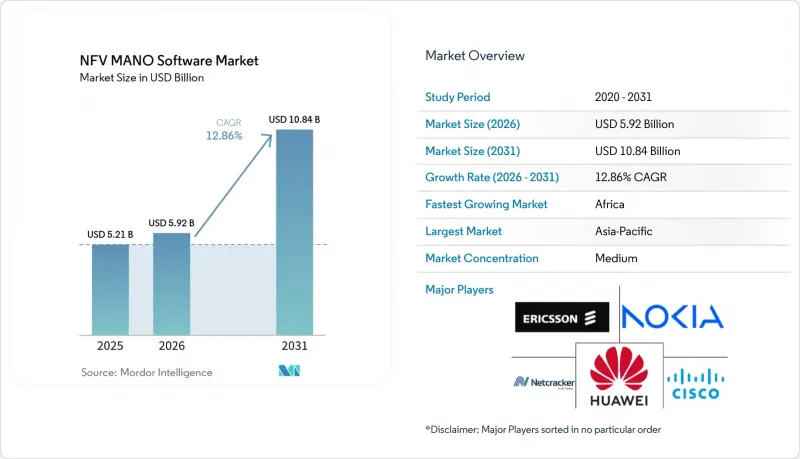
根據 Mordor Intelligence 預測,NFV MANO 軟體市場將從 2025 年的 52.1 億美元和 2026 年的 59.2 億美元成長到 2031 年的 108.4 億美元,2026 年至 2031 年的年複合成長率(CAGR)為 12.86%。
全球NFV MANO軟體市場趨勢與洞察
5G獨立組網和網路切片的編配
5G獨立組網的部署推動了對編配的需求成長。這是因為網路切片需要在無線接取網路、核心網路和傳輸網域之間進行協調的生命週期管理。由於切片是在共用實體基礎設施上建構的邏輯端到端網路,運營商需要一個平台來管理這些域中切片的設計、激活、擴展、保障和停用。 NFV MANO軟體市場受益於幫助營運商在創建、修改和停用切片時避免依賴手動工作流程。手動工作流程會導致服務交付延遲、消耗專用資源,並限制差異化服務交付的效用。當企業客戶期望在不斷變化的應用組合中獲得可靠的效能、快速啟動和清晰的服務等級保障時,這種影響尤其顯著。在比利時進行5G獨立網路切片試驗後,Orange於2025年6月選擇愛立信在其歐洲子公司實施服務編配與保障。該試驗支援專用網路、地理圍欄和固定無線存取。透過加速網路切片激活,營運商無需重建底層網路即可提供具有特定效能保證的企業級服務,並能快速回應不斷變化的用戶需求。 NFV MANO 軟體市場的角色正在不斷擴大,尤其是在專用網路和固定無線存取領域,這些領域需要獨特的運作參數、受控覆蓋區域以及特定於服務的容量規則。 O-RAN 聯盟規範第五版已於 2025 年 11 月完成,其中包含了 AI 驅動的管理規範,將編配要求擴展到了解耦式無線網路。
電信業者從資本支出轉向營運支出的轉變
網路虛擬化正從基於虛擬網路功能 (VNF) 的設計轉向基於雲端功能功能 (CNF) 的原生橫向雲端平台。這種轉變意味著從最初的專有硬體採購轉向共用基礎設施、自動化、營運效率,以及在通用雲端資源上持續運行工作負載的能力,同時減少各個網路域之間的重複工作。德國電信已記錄了一種橫向電信雲端架構,支援在 20 萬個虛擬 CPU (vCPU) 上運行 40 個工作負載,並計劃在 2028 年將工作負載數量增加到 80 個。該公司在 2026 年的數據中預測,從 2026 年到 2030 年,行動核心在橫向雲方案上的支出複合年成長率 (CAGR) 將達到 16%,而垂直整合堆疊的複合年成長率僅為 8%。因此,NFV MANO 軟體市場更青睞那些能夠自動化管理整個共用雲端資源生命週期,同時保持通訊服務(包括跨多個域和位置的複雜工作負載)所需的可靠性、營運控制和服務連續性的平台。 ETSI 預計 VNF 和 CNF 環境將在過渡期間共存,這需要統一的管理介面,使得簡單的單步遷移變得困難。
整合傳統OSS/BSS系統的複雜性
傳統OSS/BSS環境仍是部署的核心限制因素。這是因為許多系統是在NFV架構出現之前建構的,並且是為靜態的、基於硬體的服務流程設計的。現代MANO平台必須能夠與故障、配置、收費、效能和安全系統協同工作,同時又不中斷已建立的配置和收費工作流程。這通常需要在多個供應商系統之間使用客製化適配器,從而增加了實施、測試、維護和持續變更管理所需的時間和協調負擔。 VNF和CNF的平行運行為整合過程增加了不同的資料模型、說明格式和資源抽象層。因此,整合團隊必須針對不同的技術方案進行最佳化,同時確保服務事件能夠到達下游業務系統,包括配置、收費和客戶支援流程,並維持服務的連續性。雖然符合TM Forum的開放API可以減輕這種負擔,但由於其採用率的差異,它作為通用解決方案在不同電信業者(具有不同的傳統環境、業務流程和供應商關係)中的作用有限。
細分市場分析
到2025年,解決方案將佔據NFV MANO軟體市場77.72%的佔有率。這一領先地位反映了在虛擬化專案早期階段,營運商在平台授權、整合中間件和專有說明工具鏈方面的投入。由於電信業者需要一個通用平台來進行服務設計、資源分配和生命週期管理,因此解決方案仍然至關重要。隨著網路日益分散化,NFV MANO軟體產業將繼續依賴這些平台。然而,即使在初始部署完成後,對支援的需求也不會消失。電信業者正在將重心轉移到日常營運、最佳化、升級和雲端原生遷移。
預計2026年至2031年,服務市場將以13.86%的複合年成長率成長。隨著部署需求的增加,託管服務、專業服務、培訓和支援的重要性日益凸顯。供應商可以透過提供託管式MANO服務和自動化升級,將一次性軟體交易轉化為多年合約。這種機制使電信業者能夠持續維護AI驅動的保障、多供應商服務管理和GitOps工作流程。 ETSI Release 5包含託管資料分析功能和意圖管理介面,這進一步增加了營運需求。因此,在NFV MANO軟體市場中,交付能力的重要性正超越平台功能。
到2025年,NFV編排器將佔NFV MANO軟體需求的27.18%。它們負責管理整個基礎設施和網路功能管理層中服務的打包、實例化、擴展和終止。此功能還支援服務等級保證、切片管理和端到端資源分配。這些角色使得NFV編排器對於電信業者建構差異化企業服務至關重要。虛擬化基礎設施管理器和虛擬化網路功能管理器繼續負責電信業者現有網路中的大部分生命週期自動化。
預計到 2031 年,容器基礎設施服務管理器的複合年成長率將達到 13.39%。這一成長速度反映了網路功能從虛擬網路轉向雲端原生網路功能的轉變。德國電信報告稱,到 2030 年,雲端原生網路 (CNF) 將佔行動核心網路功能總支出的 76%,而 2025 年這一比例為 36%。隨著邊緣部署的擴展,分散式基礎架構站點之間的連接需求不斷成長,廣域網路基礎架構管理器的重要性也日益凸顯。 3GPP 的協調閉迴路控制支援跨管理功能的零接觸自動化。該框架為 MANO 的容器和基礎設施管理藍圖奠定了基礎,並且在電信業者需要跨雲端資源、網路功能和服務保障流程進行協調自動化時,其重要性日益凸顯。
區域分析
到2025年,亞太地區將佔據NFV MANO軟體市場32.07%的佔有率。中國、韓國、日本和印度透過其5G獨立組網部署活動鞏固了這一地位。印度雲端原生核心架構的發展動能也推動了對編配工具的持續需求。韓國電信業者在完成初始獨立網路部署後,正著力透過網路切片來獲利,這需要先進的NFV編排器功能和企業級服務管理。
北美、歐洲以及中東和非洲也是需求集中的關鍵地區。在歐洲,核心網路正透過採用橫向雲架構和更加重視標準合規性來現代化。德國電信的「橫向電信雲端」支援在20萬個虛擬CPU上運行40個工作負載,目標是在2028年達到80個工作負載。北美電信業者在完成初步投資後,正持續擴展其5G獨立組網基礎設施。歐洲電信標準化協會(ETSI)的要求和歐洲網路安全框架正在影響MANO平台的採購標準。
在中東和非洲,各市場的情況不盡相同。波灣合作理事會(GCC)成員國,例如沙烏地阿拉伯和阿拉伯聯合大公國(阿拉伯聯合大公國),其電信業者正在投資5G獨立組網和更廣泛網路的現代化改造。預計到2031年,非洲的複合年成長率將達到13.79%,是各區域中成長最快的。待開發區5G網路可以避免營運商在傳統4G虛擬網路功能(VNF)環境下面臨的OSS/BSS整合方面的一些負擔。南美市場規模較小,但隨著巴西和阿根廷大力推動獨立組網系統的部署,市場需求正在成長。巴西的5G執照合約包含涵蓋範圍和品質方面的義務,這推動了對自動化保障和編配的投資。
其他好處:
- Excel格式的市場預測(ME)表
- 3個月的分析師支持
目錄
第1章:引言
- 研究假設和市場定義
- 調查範圍
第2章:調查方法
第3章執行摘要
第4章 市場狀況
- 市場概覽
- 市場促進因素
- 5G獨立組網和網路切片的編配
- 電信業者從資本支出轉向營運支出的轉變
- 引入邊緣雲端和分散式網路功能
- 封閉回路型自動化與人工智慧驅動的服務保障
- 開放式無線接取網路和多廠商網路解耦
- 私人 5G 和產業專用的網路虛擬化
- 市場限制因素
- 整合傳統OSS/BSS系統的複雜性
- VNF 與 CNF 之間的互通性差距
- 缺乏雲端原生電信業務營運技能
- 安全、主權和供應鏈風險
- 宏觀經濟因素對市場的影響
- 產業價值鏈分析
- 監理情勢
- 技術展望
- 波特五力分析
第5章 市場規模與成長預測
- 按組件
- 解決方案
- 服務
- MANO 功能
- NFV 編排器
- 虛擬化網路功能管理器
- 虛擬化基礎架構管理器
- 廣域網路基礎架構管理器
- 容器基礎架構服務管理員
- 部署模式
- 現場
- 雲
- 最終用戶
- 電信服務供應商
- 雲端服務供應商
- 公司
- 政府和國防機構
- 資料中心營運商
- 託管網路服務供應商
- 按組織規模
- 大公司
- 小型企業
- 按地區
- 北美洲
- 美國
- 加拿大
- 墨西哥
- 歐洲
- 英國
- 德國
- 法國
- 義大利
- 西班牙
- 俄羅斯
- 其他歐洲國家
- 亞太地區
- 中國
- 印度
- 日本
- 韓國
- 澳洲和紐西蘭
- 其他亞太國家
- 南美洲
- 巴西
- 阿根廷
- 其他南美國家
- 中東
- 沙烏地阿拉伯
- 阿拉伯聯合大公國
- 土耳其
- 其他中東國家
- 非洲
- 南非
- 奈及利亞
- 其他非洲國家
- 北美洲
第6章 競爭情勢
- 市場集中度
- 策略趨勢
- 市佔率分析
- 公司簡介
- Ericsson AB
- Nokia Corporation
- Huawei Technologies Co., Ltd.
- Netcracker Technology Corporation
- Cisco Systems, Inc.
- Amdocs Limited
- Hewlett Packard Enterprise Company
- VMware, Inc.
- Red Hat, Inc.
- Juniper Networks, Inc.
- Oracle Corporation
- ZTE Corporation
- NEC Corporation
- Samsung Electronics Co., Ltd.
- Wind River Systems, Inc.
- SUSE SA
- Dell Technologies Inc.
- IBM Corporation
- Mavenir Systems, Inc.
- Ribbon Communications Inc.
第7章 市場機會與未來展望
According to Mordor Intelligence, the NFV MANO software market size is projected to expand from USD 5.21 billion in 2025 and USD 5.92 billion in 2026 to USD 10.84 billion by 2031, registering a CAGR of 12.86% between 2026 and 2031.
Global NFV MANO Software Market Trends and Insights
5G Standalone and Network Slicing Orchestration
5G Standalone deployment raises demand for orchestration because network slicing requires coordinated lifecycle management across radio, core, and transport domains. A slice is a logical end-to-end network on shared physical infrastructure, so operators need a platform that can manage its design, activation, scaling, assurance, and retirement across these domains. The NFV MANO software market benefits when operators need to create, modify, and retire slices without relying on manual workflows that can delay service delivery, consume specialist resources, and limit the practical use of differentiated service offers, particularly where enterprise customers expect reliable performance, rapid activation, and clear service-level commitments across a changing mix of applications. Orange selected Ericsson in June 2025 to deploy Service Orchestration and Assurance across its European affiliates after a 5G Standalone slicing trial in Belgium, supporting private networks, geofencing, and fixed wireless access. Faster slice activation can help operators offer enterprise services with specific performance commitments and respond to changes in user needs without rebuilding the underlying network, especially where private networks and fixed wireless access require distinct operating parameters, controlled coverage areas, and service-specific capacity rules, which broadens the role of the NFV MANO software market. O-RAN Alliance Specification Release 5, completed in November 2025, included AI-driven management specifications that extend orchestration requirements into disaggregated radio networks.
Telco CAPEX-to-OPEX Migration
Network virtualization is moving from VNF-based designs toward CNF-native horizontal cloud platforms. This change shifts attention from initial proprietary hardware purchases to shared infrastructure, automation, operating efficiency, and the ability to run workloads consistently across common cloud resources while reducing duplication among separate network domains. Deutsche Telekom documented a Horizontal TelCo Cloud architecture that supports 40 workloads on 200,000 vCPUs and targets 80 workloads by 2028. The company's 2026 material projected a 16% CAGR for mobile core spending on horizontal cloud approaches between 2026 and 2030, compared with 8% for vertically integrated stacks. The NFV MANO software market therefore favors platforms that can automate lifecycle management across shared cloud resources while retaining the reliability, operational control, and service continuity required for telecom services, including complex workloads that span multiple domains and locations. ETSI expects VNF and CNF environments to coexist during the transition, which keeps unified management interfaces necessary and prevents a simple one-step migration.
Legacy OSS/BSS Integration Complexity
Legacy OSS/BSS environments remain a core limitation on adoption because many systems predate NFV architecture and were designed for static, hardware-based service processes. A modern MANO platform must connect with fault, configuration, accounting, performance, and security systems without interrupting established provisioning and charging workflows. This work often requires custom adapters across several vendor systems, which increases the time and coordination required for implementation, testing, maintenance, and ongoing change management. Parallel VNF and CNF operations add different data models, descriptor formats, and resource abstraction layers to the integration task. Integration teams must then support separate technical approaches while preserving service continuity and making sure that service events still reach downstream business systems, including provisioning, billing, charging, and customer-support processes. TM Forum Open API alignment can reduce this burden, but uneven adoption limits its role as a common solution across operator environments with different legacy estates, business processes, and supplier relationships.
Other drivers and restraints analyzed in the detailed report include:
- Edge Cloud and Distributed Network Function Deployment
- Closed-Loop Automation and AI-Assisted Service Assurance
- VNF and CNF Interoperability Gaps
For complete list of drivers and restraints, kindly check the Table Of Contents.
Segment Analysis
Solutions accounted for 77.72% of the NFV MANO software market share in 2025. This leadership reflected spending on platform licenses, integration middleware, and proprietary descriptor toolchains during initial virtualization programs. Solutions remain central because operators need a common platform for service design, resource coordination, and lifecycle control. The NFV MANO software industry continues to rely on these platforms as networks become more distributed. Yet initial deployment work does not end the need for support. Operators are shifting attention toward daily operations, optimization, upgrades, and cloud-native migration.
Services are projected to expand at a 13.86% CAGR from 2026 to 2031. Managed services, professional services, training, and support are becoming more important as implementation requirements increase. Vendors can turn one-time software transactions into multi-year contracts by providing managed MANO services and automated upgrades. This arrangement can help operators sustain AI-driven assurance, multi-vendor service management, and GitOps workflows. ETSI Release 5 includes management data analytics functions and intent management interfaces that add operating requirements. The NFV MANO software market therefore gives greater weight to delivery capabilities alongside platform functionality.
NFV Orchestrator held 27.18% of NFV MANO software demand in 2025. It manages service packaging, instantiation, scaling, and termination across infrastructure and network-function management layers. The function also supports service-level commitments, slice management, and end-to-end resource allocation. These responsibilities make it central to operators that are creating differentiated enterprise services. Virtualized Infrastructure Manager and Virtualized Network Function Manager functions continue to cover much of the lifecycle automation in installed operator networks.
Container Infrastructure Service Manager is projected to expand at a 13.39% CAGR through 2031. The pace reflects the move from virtual network functions to cloud-native network functions. Deutsche Telekom reported that CNFs are expected to represent 76% of total mobile core network function expenditure by 2030, compared with 36% in 2025. Wide Area Network Infrastructure Manager is also becoming more relevant as edge deployments increase connectivity requirements among distributed infrastructure points. 3GPP's Coordinated Closed Control Loop supports zero-touch automation across management functions. This framework is shaping MANO roadmaps for container and infrastructure management, particularly where operators need coordinated automation across cloud resources, network functions, and service-assurance processes.
Complete Report Scope:
- By Component
- Solutions
- Services
- By MANO Function
- NFV Orchestrator
- Virtualized Network Function Manager
- Virtualized Infrastructure Manager
- Wide Area Network Infrastructure Manager
- Container Infrastructure Service Manager
- By Deployment Mode
- On-Premises
- Cloud
- By End-user
- Telecom Service Providers
- Cloud Service Providers
- Enterprises
- Government and Defense Organizations
- Data Center Operators
- Managed Network Service Providers
- By Organization Size
- Large Enterprises
- Small and Medium Enterprises
- By Geography
- North America
- United States
- Canada
- Mexico
- Europe
- United Kingdom
- Germany
- France
- Italy
- Spain
- Russia
- Rest of Europe
- Asia-Pacific
- China
- India
- Japan
- South Korea
- Australia and New Zealand
- Rest of Asia-Pacific
- South America
- Brazil
- Argentina
- Rest of South America
- Middle East
- Saudi Arabia
- United Arab Emirates
- Turkey
- Rest of Middle East
- Africa
- South Africa
- Nigeria
- Rest of Africa
- North America
Geography Analysis
Asia-Pacific held 32.07% of the NFV MANO software market share in 2025. China, South Korea, Japan, and India supported this position through 5G Standalone rollout activity. India's momentum in cloud-native core architecture supports continuing demand for orchestration tools. South Korean operators are focusing on network slicing monetization after initial Standalone deployments. This requires advanced NFV Orchestrator capabilities and enterprise service-level management.
North America and Europe, the Middle East, and Africa form another major demand concentration. Europe is modernizing core networks through horizontal cloud architectures and greater attention to standards compliance. Deutsche Telekom's Horizontal TelCo Cloud supports 40 workloads on 200,000 vCPUs and targets 80 workloads by 2028. North American operators continue to extend 5G Standalone infrastructure after their initial investments. ETSI requirements and European cybersecurity frameworks influence procurement criteria for MANO platforms.
The Middle East and Africa presents different conditions across its markets. Gulf Cooperation Council operators in Saudi Arabia and the United Arab Emirates are investing in 5G Standalone and wider network modernization. Africa is projected to expand at a 13.79% CAGR through 2031, the highest regional rate. Greenfield 5G networks can avoid part of the OSS/BSS integration burden faced by operators with older 4G VNF estates. South America is smaller but has increasing demand as Brazil and Argentina advance their Standalone programs. Brazil's 5G licensing commitments include coverage and quality obligations that support investment in automated assurance and orchestration.
- Ericsson AB
- Nokia Corporation
- Huawei Technologies Co., Ltd.
- Netcracker Technology Corporation
- Cisco Systems, Inc.
- Amdocs Limited
- Hewlett Packard Enterprise Company
- VMware, Inc.
- Red Hat, Inc.
- Juniper Networks, Inc.
- Oracle Corporation
- ZTE Corporation
- NEC Corporation
- Samsung Electronics Co., Ltd.
- Wind River Systems, Inc.
- SUSE S.A.
- Dell Technologies Inc.
- IBM Corporation
- Mavenir Systems, Inc.
- Ribbon Communications Inc.
Additional Benefits:
- The market estimate (ME) sheet in Excel format
- 3 months of analyst support
TABLE OF CONTENTS
1 INTRODUCTION
- 1.1 Study Assumptions and Market Definition
- 1.2 Scope of the Study
2 RESEARCH METHODOLOGY
3 EXECUTIVE SUMMARY
4 MARKET LANDSCAPE
- 4.1 Market Overview
- 4.2 Market Drivers
- 4.2.1 5G Standalone and Network Slicing Orchestration
- 4.2.2 Telco CAPEX-to-OPEX Migration
- 4.2.3 Edge Cloud and Distributed Network Function Deployment
- 4.2.4 Closed-Loop Automation and AI-Assisted Service Assurance
- 4.2.5 Open RAN and Multi-Vendor Network Disaggregation
- 4.2.6 Private 5G and Industry-Specific Network Virtualization
- 4.3 Market Restraints
- 4.3.1 Legacy OSS/BSS Integration Complexity
- 4.3.2 VNF and CNF Interoperability Gaps
- 4.3.3 Cloud-Native Telco Operations Skills Shortage
- 4.3.4 Security, Sovereignty, and Supply-Chain Exposure
- 4.4 Impact of Macroeconomic Factors on the Market
- 4.5 Industry Value Chain Analysis
- 4.6 Regulatory Landscape
- 4.7 Technological Outlook
- 4.8 Porter's Five Forces Analysis
- 4.8.1 Bargaining Power of Suppliers
- 4.8.2 Bargaining Power of Buyers
- 4.8.3 Threat of New Entrants
- 4.8.4 Threat of Substitutes
- 4.8.5 Competitive Rivalry
5 MARKET SIZE AND GROWTH FORECASTS (VALUE)
- 5.1 By Component
- 5.1.1 Solutions
- 5.1.2 Services
- 5.2 By MANO Function
- 5.2.1 NFV Orchestrator
- 5.2.2 Virtualized Network Function Manager
- 5.2.3 Virtualized Infrastructure Manager
- 5.2.4 Wide Area Network Infrastructure Manager
- 5.2.5 Container Infrastructure Service Manager
- 5.3 By Deployment Mode
- 5.3.1 On-Premises
- 5.3.2 Cloud
- 5.4 By End-user
- 5.4.1 Telecom Service Providers
- 5.4.2 Cloud Service Providers
- 5.4.3 Enterprises
- 5.4.4 Government and Defense Organizations
- 5.4.5 Data Center Operators
- 5.4.6 Managed Network Service Providers
- 5.5 By Organization Size
- 5.5.1 Large Enterprises
- 5.5.2 Small and Medium Enterprises
- 5.6 By Geography
- 5.6.1 North America
- 5.6.1.1 United States
- 5.6.1.2 Canada
- 5.6.1.3 Mexico
- 5.6.2 Europe
- 5.6.2.1 United Kingdom
- 5.6.2.2 Germany
- 5.6.2.3 France
- 5.6.2.4 Italy
- 5.6.2.5 Spain
- 5.6.2.6 Russia
- 5.6.2.7 Rest of Europe
- 5.6.3 Asia-Pacific
- 5.6.3.1 China
- 5.6.3.2 India
- 5.6.3.3 Japan
- 5.6.3.4 South Korea
- 5.6.3.5 Australia and New Zealand
- 5.6.3.6 Rest of Asia-Pacific
- 5.6.4 South America
- 5.6.4.1 Brazil
- 5.6.4.2 Argentina
- 5.6.4.3 Rest of South America
- 5.6.5 Middle East
- 5.6.5.1 Saudi Arabia
- 5.6.5.2 United Arab Emirates
- 5.6.5.3 Turkey
- 5.6.5.4 Rest of Middle East
- 5.6.6 Africa
- 5.6.6.1 South Africa
- 5.6.6.2 Nigeria
- 5.6.6.3 Rest of Africa
- 5.6.1 North America
6 COMPETITIVE LANDSCAPE
- 6.1 Market Concentration
- 6.2 Strategic Moves
- 6.3 Market Share Analysis
- 6.4 Company Profiles (includes Global Level Overview, Market Level Overview, Core Segments, Financials as available, Strategic Information, Market Rank/Share, Products and Services, Recent Developments)
- 6.4.1 Ericsson AB
- 6.4.2 Nokia Corporation
- 6.4.3 Huawei Technologies Co., Ltd.
- 6.4.4 Netcracker Technology Corporation
- 6.4.5 Cisco Systems, Inc.
- 6.4.6 Amdocs Limited
- 6.4.7 Hewlett Packard Enterprise Company
- 6.4.8 VMware, Inc.
- 6.4.9 Red Hat, Inc.
- 6.4.10 Juniper Networks, Inc.
- 6.4.11 Oracle Corporation
- 6.4.12 ZTE Corporation
- 6.4.13 NEC Corporation
- 6.4.14 Samsung Electronics Co., Ltd.
- 6.4.15 Wind River Systems, Inc.
- 6.4.16 SUSE S.A.
- 6.4.17 Dell Technologies Inc.
- 6.4.18 IBM Corporation
- 6.4.19 Mavenir Systems, Inc.
- 6.4.20 Ribbon Communications Inc.
7 MARKET OPPORTUNITIES AND FUTURE OUTLOOK
- 7.1 White-Space and Unmet-Need Assessment

 網路功能虛擬化 (NFV) 市場預測至 2034 年——按組件、虛擬網路功能、部署模式、技術、應用、最終用戶和地區分類的全球分析
 網路功能虛擬化 (NFV) 市場 – 全球市場預測 2026–2032
 網路功能虛擬化 (NFV) 市場報告:按產品/服務、部署方式、企業規模、應用領域、最終用戶和地區分類 (2026–2034)
 2026年全球網路功能虛擬化市場報告
 網路功能虛擬化 (NFV) 市場規模、佔有率和成長分析(按組件、部署類型、組織規模、應用、最終用戶和地區分類)—2026-2033 年產業預測
 SDN 和 NFV - 全球市場佔有率和排名、總收入和需求預測(2025-2031 年)
 5G核心網路進展及部署模式:調查結果與分析
 雲端原生自動化和ETSI NFV MANO:演進,轉移,共存策略