


 |
市場調查報告書
商品編碼
2154898
南美洲IP攝影機:市佔率分析、產業趨勢與統計及成長預測(2026-2031年)South America IP Camera - Market Share Analysis, Industry Trends & Statistics, Growth Forecasts (2026 - 2031) |
||||||

※ 本網頁內容可能與最新版本有所差異。詳細情況請與我們聯繫。
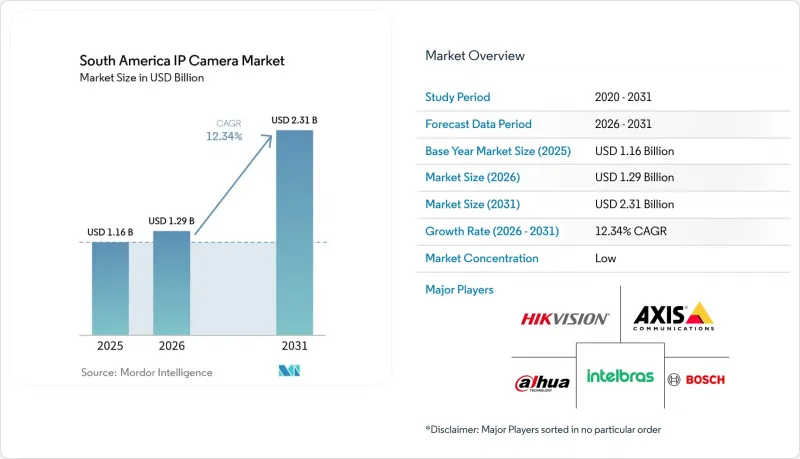
據 Mordor Intelligence 稱,2025 年南美 IP 攝影機市場價值為 116 萬美元,預計在 2026 年至 2031 年的預測期內將以 12.34% 的複合年成長率成長,到 2031 年達到 231 萬美元。
南美洲IP攝影機市場趨勢與洞察
加大對公共安全和城市監控的投入
在南美洲IP攝影機市場,政府採購是主要需求來源,尤其是在城市正以共用控制室系統取代獨立監控設備的地區。根據《環球報》(O GLOBO)報道,里約熱內盧州於2026年1月啟動了「哨兵計畫」(Programa Sentinela),這大規模採購人工智慧攝影機的計畫。該計劃的規模帶動了對攝影機、分析工具、網路基礎設施、資料儲存、現場安裝和指揮中心服務的需求。截至2026年7月,位於麥德林的C5i指揮中心正在建置中,該中心將整合人工智慧影像分析、無人機監控、車牌辨識系統和一個專用資料中心。此類專案更青睞能夠支援整合系統並協調多個技術層面的供應商,而不僅僅是銷售單一設備的供應商。此外,框架協議可能會提高尋求公共部門合約的供應商的資格要求,包括現場部署能力和提供持續服務的能力。
在現有設備中以 IP 取代類比訊號
現有的類比基礎設施導致南美洲IP攝影機市場,尤其是工業設施、商業建築和小規模市政設施,更換週期較長。 Usiminas公司利用編碼器底盤,將其位於Cubatao的工廠從模擬系統升級到IP系統,該機箱可保留現有的同軸電纜,從而減少了大規模工業設施重新佈線的需要。這種方法最大限度地減少了對營運的干擾,充分利用了以往的佈線投資,並縮短了使用傳統設備的設施的過渡期。此外,人工智慧在巴西電子安防產業的日益普及,使得攝影機升級與對分析功能的需求緊密相連。隨著轉換套件的普及,在需要盡量減少實體變更的週期性升級專案中,硬體價格可能會面臨下行壓力。因此,軟體授權、系統整合、分析配置和服務合約在南美洲IP攝影機市場的價值可能會增加。
與隱私、網路安全和資料主權相關的風險
在南美洲IP攝影機市場,隱私合規性是一項至關重要的採購挑戰。巴西的《一般資料保護法》(LGPD) 將包括臉部影像在內的生物識別資料視為敏感個人數據,因此處理此類資料必須有法律依據。智利的資料保護法引入了新的義務,預計將在未來幾年內生效;而秘魯已頒布法規,限制在公共場所進行生物識別監控。這些不同的法規要求供應商調整系統配置、資料保存策略和存取控制。網路安全同樣至關重要,因為連網攝影機可能成為入侵更廣泛企業網路的入口。據 CrowdStrike 稱,南美洲的勒索軟體攻擊數量逐年顯著增加,其中巴西受影響最為嚴重。因此,明確設備憑證、網路分段、軟體更新以及連網攝影機安裝後管理的責任歸屬變得日益重要。
細分市場分析
2025年,固定攝影機在南美洲IP攝影機市場佔有50.14%的佔有率。這主要是由於固定邊界線、入口、走廊、零售商店、銀行和住宅建築等場所需要大規模安裝此類攝影機。其操作簡便,適用於拍攝範圍和視野穩定的場所。預計到2031年,雲台攝影機(PTZ攝影機)的年複合成長率將達到12.82%,因為警察、交通和周界安防團隊需要定向光學設備。在指揮中心應用中,一台雲台攝影機即可覆蓋通常需要多台固定攝影機才能覆蓋的區域。 2025年8月,韓華視覺在利馬的聖地亞哥·德·蘇爾科區部署了約2000台人工智慧攝影機,這些攝影機具備車牌識別和360度多感測器功能。此次部署展示了在傳統固定攝影機網路之外,實現主動式廣域監控的可行性。此外,它還表明,當單一設計無法同時提供持續監控和靈活觀察不斷變化的活動時,地方政府可以利用多種攝影機格式的組合。
對於需要調節焦距但又不想承擔全電動運動相關成本的商業建築管理人員來說,變焦攝影機仍然非常實用。因此,南美洲IP攝影機市場提供了介於固定式和雲台攝影機之間的實用選擇。隨著人工智慧驅動的追蹤功能的出現,軟體相容性在雲台攝影機系統的部署中變得日益重要。聖保羅的「Smart Sampa」平台和里約熱內盧的「CIVITAS」計畫展示了大型公共系統如何採用分析驅動的監控架構。追蹤性能取決於攝影機、影像管理系統和分析平台之間的協同工作。這提高了公共競標中認證整合解決方案的重要性,可能會限制軟體夥伴關係夥伴關係薄弱的供應商的機會。這也為買家提供了一個切實可行的理由,讓他們能夠全面評估分析功能、攝影機控制、警報功能以及操作員工作流程的可靠性,而不是僅僅根據技術規格來選擇設備。
其他好處:
- Excel格式的市場預測(ME)表
- 3個月的分析師支持
目錄
第1章:引言
- 研究假設和市場定義
- 調查範圍
第2章:調查方法
第3章執行摘要
第4章 市場狀況
- 市場概覽
- 市場促進因素
- 加大對公共安全和城市監控的投入
- 在現有設備中以 IP 取代類比訊號
- 擴大智慧城市和交通監控計劃
- 降低相機、儲存和邊緣處理的成本。
- 面向分散式位置的雲端管理監控系統
- 在連結不穩定的環境中進行局部分析
- 市場限制因素
- 與隱私、網路安全和資料主權相關的風險
- 高昂的初始設定和維護成本
- 進口關稅、外匯波動、稅制的複雜性。
- 主要城市以外地區認證整合商短缺
- 產業價值鏈分析
- 宏觀經濟因素對市場的影響
- 監理情勢
- 技術展望
- 波特五力分析
第5章 市場規模與成長預測
- 相機設計類型
- 固定類型
- 雲台變焦(PTZ)
- 漸進多焦點
- 按最終用戶行業分類
- 住宅
- 商業
- 產業
- 政府和執法機關
- 按地區
- 巴西
- 阿根廷
- 智利
- 哥倫比亞
- 秘魯
- 其他南美國家
第6章 競爭情勢
- 市場集中度
- 策略趨勢
- 市佔率分析
- 公司簡介
- Hangzhou Hikvision Digital Technology Co., Ltd.
- Zhejiang Dahua Technology Co., Ltd.
- Intelbras SA
- Axis Communications AB
- Robert Bosch GmbH
- Hanwha Vision Co., Ltd.
- Honeywell International Inc.
- Panasonic Holdings Corporation
- Sony Group Corporation
- Motorola Solutions, Inc.
- VIVOTEK Inc.
- Zhejiang Uniview Technologies Co., Ltd.
- Tiandy Technologies Co., Ltd.
- Teledyne FLIR LLC
- Pelco, Inc.
- Genetec Inc.
- Eagle Eye Networks, Inc.
- Milestone Systems A/S
- Johnson Controls International plc
- Schneider Electric SE
第7章 市場機會與未來展望
According to Mordor Intelligence, the South America IP camera market size was valued at USD 1.16 million in 2025 and is estimated to expand to USD 2.31 million by 2031, at a CAGR of 12.34% during the forecast period 2026-2031.
South America IP Camera Market Trends and Insights
Rising Public Safety and Urban Surveillance Investment
Government procurement is a major source of volume for the South America IP camera market, especially where cities are replacing separate monitoring tools with shared control-room systems. Rio de Janeiro state launched Programa Sentinela in January 2026, involving a major procurement of AI cameras across municipalities and control centers, according to O GLOBO. The scale of the program supports demand for cameras, analytics, network infrastructure, data storage, field installation, and command-center services. Medellin's C5i command center was under construction as of July 2026 and includes AI video analytics, drone monitoring, license-plate readers, and a dedicated data center. These projects favor suppliers that can support integrated systems instead of single-device sales and coordinate several technology layers. Framework agreements may also raise the qualification requirements for vendors seeking public-sector contracts, including local implementation and continuing service capacity.
Analog to IP Replacement Across Existing Installations
Existing analog installations create a long replacement cycle for the South America IP camera market, particularly in industrial facilities, commercial buildings, and smaller municipal sites. Usiminas upgraded its Cubatao facility from analog to IP using an encoder chassis that retained existing coaxial cable runs, reducing the need for full rewiring at a large industrial site. This approach can reduce disruption, preserve earlier cabling investments, and shorten the transition for facilities with legacy equipment. The Brazilian electronic security sector is also increasing its use of AI, which links camera replacement with demand for analytics capability. As conversion kits become more available, hardware pricing may face pressure in routine replacement projects that need limited physical changes. Software licenses, system integration, analytics configuration, and service agreements could therefore carry more value in the South America IP camera market.
Privacy, Cybersecurity, and Data Sovereignty Exposure
Privacy compliance is a material procurement issue in the South America IP camera market. Brazil's LGPD treats biometric data, including facial images, as sensitive personal data and requires a legal basis for processing. Chile's data-protection law introduced new obligations that are scheduled to enter into force in the coming years, while Peru issued rules that restrict real-time biometric surveillance in public spaces. Different country rules require vendors to adapt system configurations, data retention practices, and access controls. Cybersecurity has become equally important because connected cameras can provide an entry point into wider corporate networks. CrowdStrike reported a notable year-over-year increase in ransomware attacks in South America, with Brazil the most affected country. This places greater attention on device credentials, network segmentation, software updates, and clear responsibility for managing connected cameras after installation.
Other drivers and restraints analyzed in the detailed report include:
- Expansion of Smart City and Transport Monitoring Programs
- Falling Camera, Storage, and Edge Processing Costs
- High Installation and Maintenance Costs
For complete list of drivers and restraints, kindly check the Table Of Contents.
Segment Analysis
Fixed cameras held 50.14% of the South America IP camera market share in 2025 because static perimeter, entrance, corridor, retail, banking, and residential applications require large installation volumes. Their simple operating model makes them suitable for sites where coverage areas and viewing angles remain stable. PTZ cameras are projected to expand at a CAGR of 12.82% through 2031 as police, transit operators, and perimeter-security teams need redirectable optics. A PTZ device can cover areas that could otherwise require several fixed cameras in command-center applications. Hanwha Vision deployed nearly 2,000 AI cameras in Lima's Santiago de Surco district in August 2025, including license-plate recognition and 360-degree multi-sensor capabilities. The deployment shows that active and wide-area coverage can be used alongside conventional fixed camera networks. It also illustrates how municipalities can combine several camera formats when a single design cannot provide both constant coverage and flexible views of changing activity.
Varifocal cameras remain relevant for commercial building managers that need adjustable focal lengths without the cost of fully motorized movement. The South America IP camera market therefore includes a practical middle tier between fixed and PTZ designs. AI-enabled tracking is increasing the importance of software compatibility for PTZ installations. Sao Paulo's Smart Sampa platform and Rio de Janeiro's CIVITAS program illustrate how major public systems are adopting analytics-driven monitoring architectures. Tracking performance depends on the camera, video management system, and analytics platform working together. This can make certified integrations more important in public tenders and can limit opportunities for suppliers with weak software partnerships. It also gives buyers a practical reason to assess the reliability of analytics, camera control, alerting, and operator workflows together rather than selecting devices on technical specifications alone.
Complete Report Scope:
- By Camera Design Type
- Fixed
- Pan-Tilt-Zoom (PTZ)
- Varifocal
- By End-user Industry
- Residential
- Commercial
- Industrial
- Government and Law Enforcement
- By Geography
- Brazil
- Argentina
- Chile
- Colombia
- Peru
- Rest of South America
List of Companies Covered in this Report:
- Hangzhou Hikvision Digital Technology Co., Ltd.
- Zhejiang Dahua Technology Co., Ltd.
- Intelbras S.A.
- Axis Communications AB
- Robert Bosch GmbH
- Hanwha Vision Co., Ltd.
- Honeywell International Inc.
- Panasonic Holdings Corporation
- Sony Group Corporation
- Motorola Solutions, Inc.
- VIVOTEK Inc.
- Zhejiang Uniview Technologies Co., Ltd.
- Tiandy Technologies Co., Ltd.
- Teledyne FLIR LLC
- Pelco, Inc.
- Genetec Inc.
- Eagle Eye Networks, Inc.
- Milestone Systems A/S
- Johnson Controls International plc
- Schneider Electric SE
Additional Benefits:
- The market estimate (ME) sheet in Excel format
- 3 months of analyst support
TABLE OF CONTENTS
1 INTRODUCTION
- 1.1 Study Assumptions and Market Definition
- 1.2 Scope of the Study
2 RESEARCH METHODOLOGY
3 EXECUTIVE SUMMARY
4 MARKET LANDSCAPE
- 4.1 Market Overview
- 4.2 Market Drivers
- 4.2.1 Rising Public-Safety and Urban-Surveillance Investment
- 4.2.2 Analog-to-IP Replacement Across Existing Installations
- 4.2.3 Expansion of Smart-City and Transport-Monitoring Programs
- 4.2.4 Falling Camera, Storage and Edge-Processing Costs
- 4.2.5 Cloud-Managed Surveillance for Distributed Sites
- 4.2.6 Localized Analytics for Unreliable Connectivity
- 4.3 Market Restraints
- 4.3.1 Privacy, Cybersecurity and Data-Sovereignty Exposure
- 4.3.2 High Installation and Maintenance Costs
- 4.3.3 Import Duties, Currency Volatility and Tax Complexity
- 4.3.4 Shortage of Certified Integrators Outside Major Cities
- 4.4 Industry Value Chain Analysis
- 4.5 Impact of Macroeconomic Factors on the Market
- 4.6 Regulatory Landscape
- 4.7 Technological Outlook
- 4.8 Porter's Five Forces Analysis
- 4.8.1 Bargaining Power of Suppliers
- 4.8.2 Bargaining Power of Buyers
- 4.8.3 Threat of New Entrants
- 4.8.4 Threat of Substitutes
- 4.8.5 Competitive Rivalry
5 MARKET SIZE AND GROWTH FORECASTS (VALUE)
- 5.1 By Camera Design Type
- 5.1.1 Fixed
- 5.1.2 Pan-Tilt-Zoom (PTZ)
- 5.1.3 Varifocal
- 5.2 By End-user Industry
- 5.2.1 Residential
- 5.2.2 Commercial
- 5.2.3 Industrial
- 5.2.4 Government and Law Enforcement
- 5.3 By Geography
- 5.3.1 Brazil
- 5.3.2 Argentina
- 5.3.3 Chile
- 5.3.4 Colombia
- 5.3.5 Peru
- 5.3.6 Rest of South America
6 COMPETITIVE LANDSCAPE
- 6.1 Market Concentration
- 6.2 Strategic Moves
- 6.3 Market Share Analysis
- 6.4 Company Profiles (includes Global Level Overview, Market Level Overview, Core Segments, Financials as available, Strategic Information, Market Rank/Share, Products and Services, Recent Developments)
- 6.4.1 Hangzhou Hikvision Digital Technology Co., Ltd.
- 6.4.2 Zhejiang Dahua Technology Co., Ltd.
- 6.4.3 Intelbras S.A.
- 6.4.4 Axis Communications AB
- 6.4.5 Robert Bosch GmbH
- 6.4.6 Hanwha Vision Co., Ltd.
- 6.4.7 Honeywell International Inc.
- 6.4.8 Panasonic Holdings Corporation
- 6.4.9 Sony Group Corporation
- 6.4.10 Motorola Solutions, Inc.
- 6.4.11 VIVOTEK Inc.
- 6.4.12 Zhejiang Uniview Technologies Co., Ltd.
- 6.4.13 Tiandy Technologies Co., Ltd.
- 6.4.14 Teledyne FLIR LLC
- 6.4.15 Pelco, Inc.
- 6.4.16 Genetec Inc.
- 6.4.17 Eagle Eye Networks, Inc.
- 6.4.18 Milestone Systems A/S
- 6.4.19 Johnson Controls International plc
- 6.4.20 Schneider Electric SE
7 MARKET OPPORTUNITIES AND FUTURE OUTLOOK
- 7.1 White-space and Unmet-need Assessment

 IP攝影機市場:產業趨勢及2035年全球預測-按組件、產品類型、連接方式、應用、地區及主要廠商分類
 IP攝影機市場機會、成長要素、產業趨勢分析及2026年至2035年預測
 2026年全球IP攝影機市場報告
 越南IP攝影機市場評估:按產品類型、解析度類型、連接類型、最終用途、分銷管道、地區、機會和預測(2018-2032年)
 IP攝影機市場規模、佔有率和成長分析(按組件、產品類型、連接類型、應用和地區分類)—2026-2033年產業預測
 IP 攝影機市場規模、佔有率、趨勢分析報告:按組件、產品類型、連接類型、應用、地區和細分市場預測,2025 年至 2030 年
 網際網路通訊協定(IP)攝影機市場:全球2025-2029
 到 2030 年 IP 攝影機市場預測:按攝影機類型、解析度、功能、連接性、應用程式、最終用戶和地區進行的全球分析