

 |
市場調查報告書
商品編碼
1959636
IP攝影機市場機會、成長要素、產業趨勢分析及2026年至2035年預測IP Camera Market Opportunity, Growth Drivers, Industry Trend Analysis, and Forecast 2026 - 2035 |
||||||

2025 年全球 IP 攝影機市場價值為 169 億美元,預計到 2035 年將達到 307 億美元,年複合成長率為 6.2%。
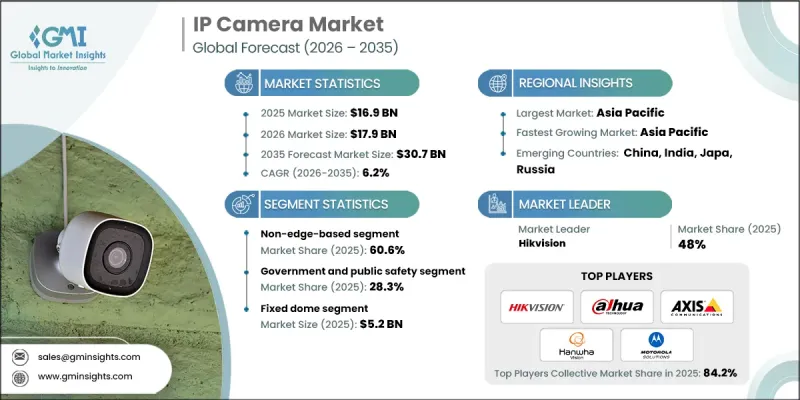
受企業對人工智慧視訊分析需求不斷成長、商業設施和交通環境中強制監視錄影機以及智慧家庭和連網安防系統在住宅和小型企業中日益普及的推動,IP攝影機市場正在蓬勃發展。各組織機構越來越依賴IP攝影機來增強安全性、提高情境察覺和實現即時監控。人工智慧、雲端儲存和邊緣運算的結合正在重塑監控網路,在提高可擴展性和成本效益的同時,也能提供可操作的洞察。基於雲端的解決方案減少了對昂貴的本地基礎設施的依賴,而支援邊緣運算的攝影機透過本地智慧處理,能夠更快地做出決策並減少網路擁塞。人工智慧驅動的影像分析技術的應用是IP攝影機市場的主要成長要素。基於雲端的影像管理系統因其柔軟性、更低的IT維護成本和擴充性而越來越受歡迎。政府支持計畫和其他促進安全雲採用的舉措,透過提供經濟高效且合規的多站點監控雲端解決方案,正在推動IP攝影機的普及。邊緣攝影機透過實現設備端智慧、降低延遲和提高即時響應能力,正在改變傳統的監控架構。
| 市場範圍 | |
|---|---|
| 開始年份 | 2025 |
| 預測年份 | 2026-2035 |
| 起始值 | 169億美元 |
| 預測金額 | 307億美元 |
| 複合年成長率 | 6.2% |
到2025年,非邊緣系統將佔據60.6%的市場。集中式系統在政府機構、商業設施和企業的大規模部署中仍然佔據主導地位。這是因為它們易於與現有平台整合,能夠實現統一監控,滿足合規性要求,並且在多攝影機網路中具有成本效益。
預計到2025年,政府和公共部門將佔據28.3%的市場。 IP攝影機在城市監控、邊境監測、執法和基礎設施保護方面發揮著至關重要的作用。各國政府正大力投資於持續監控、事件記錄和即時資訊擷取,推動了對大規模部署的穩定需求。長期基礎設施計劃和嚴格的公共法規為持續部署提供了支持,並確保了該領域的穩定成長。
預計到2025年,北美IP攝影機市佔率將達到25.1%。該地區的成長主要得益於對關鍵基礎設施保護、職場安全和城市安全措施的投資。企業和政府機構正擴大採用人工智慧驅動的視訊分析、雲端管理的監控系統和邊緣運算攝影機,以提高情境察覺和營運效率。即時分析和智慧視訊平台的整合,使公共和私營機構能夠及早發現威脅、最佳化保全行動並加強對安全法規的遵守。交通運輸、政府、零售和工業領域的強勁應用,持續推動北美市場的成長。
目錄
第1章:調查方法和範圍
第2章執行摘要
第3章業界考察
- 生態系分析
- 供應商情況
- 利潤率
- 成本結構
- 每個階段增加的價值
- 影響價值鏈的因素
- 中斷
- 影響產業的因素
- 促進因素
- 企業和政府機構對人工智慧驅動的影片分析的需求
- 交通運輸和零售業的強制性影像監控法規
- 基於雲端的影片儲存可降低本地基礎架構成本。
- 擴大 PoE 網路基礎設施的採用
- 智慧家庭和互聯安防生態系的擴展
- 產業潛在風險與挑戰
- 網路安全漏洞和頻繁發生的IP攝影機駭客攻擊事件
- 高解析度影片的高頻寬和儲存成本
- 市場機遇
- 邊緣AI相機無需依賴雲端即可實現即時分析。
- 新興二、三線城市的高成長需求
- 促進因素
- 成長潛力分析
- 監理情勢
- 北美洲
- 歐洲
- 亞太地區
- 拉丁美洲
- 中東和非洲
- 波特的分析
- PESTEL 分析
- 科技與創新趨勢
- 當前技術趨勢
- 新興技術
- 價格趨勢
- 按地區
- 依產品
- 定價策略
- 新興經營模式
- 合規要求
- 專利和智慧財產權分析
- 地緣政治和貿易趨勢
第4章 競爭情勢
- 介紹
- 企業市佔率分析
- 按地區
- 北美洲
- 歐洲
- 亞太地區
- 拉丁美洲
- 中東和非洲
- 市場集中度分析
- 按地區
- 主要企業的競爭標竿分析
- 財務績效比較
- 收入
- 利潤率
- 研究與開發
- 產品系列比較
- 產品線的廣度
- 科技
- 創新
- 地理位置比較
- 全球擴張分析
- 服務網路覆蓋
- 按地區分類的市場滲透率
- 競爭定位矩陣
- 領導企業
- 受讓人
- 追蹤者
- 小眾玩家
- 戰略展望矩陣
- 財務績效比較
- 主要進展
- 併購
- 夥伴關係與合作
- 技術進步
- 擴張和投資策略
- 數位轉型計劃
- 新興/Start-Ups競爭對手的發展趨勢
第5章 市場估價與預測:依相機類型分類,2022-2035年
- 固定穹頂類型
- 固定式子彈攝影機
- 固定箱型
- 固定砲塔
- PTZ
- 多感測器/全景
- 魚眼鏡頭
第6章 市場估算與預測:依影像技術分類,2022-2035年
- 可見光
- 熱感的
- 頻譜
第7章 市場估計與預測:依最大感測器解析度分類,2022-2035年
- 2MP 或更低(包括 1080p 全高清)
- 200萬像素至500萬像素
- 500萬像素至800萬像素(含4K超高清)
- 超過 8 兆像素
第8章 市場估算與預測:依處理架構分類,2022-2035年
- 邊緣
- 非邊緣
第9章 市場估計與預測:依最終用途產業分類,2022-2035年
- 政府/公共
- 零售和商業地產
- 銀行和金融服務
- 運輸/物流
- 衛生保健
- 教育
- 工業和製造業
- 公共產業和能源
- 住宅
第10章 市場估價與預測:依地區分類,2022-2035年
- 北美洲
- 美國
- 加拿大
- 歐洲
- 德國
- 英國
- 法國
- 西班牙
- 義大利
- 俄羅斯
- 亞太地區
- 中國
- 印度
- 日本
- 澳洲
- 韓國
- 拉丁美洲
- 巴西
- 墨西哥
- 阿根廷
- 中東和非洲
- 南非
- 沙烏地阿拉伯
- 阿拉伯聯合大公國
第11章:公司簡介
- 主要企業
- Hikvision-Hangzhou Hikvision Digital Technology Co., Ltd.
- Axis Communications AB
- Dahua Technology Co., Ltd.
- 按地區分類的主要企業
- 北美洲
- Motorola Solutions, Inc.
- Honeywell International Inc.
- 亞太地區
- Hanwha Vision Co., Ltd.
- CP Plus
- 歐洲
- Bosch Security Systems(Bosch GmbH)
- Mobotix AG
- 北美洲
- 特殊玩家/干擾者
- Vivotek Inc.
- Uniview(UNV)
- Sony Corporation
- Panasonic(i-PRO/Panasonic Security)
- IDIS Co., Ltd.
The Global IP Camera Market was valued at USD 16.9 billion in 2025 and is estimated to grow at a CAGR of 6.2% to reach USD 30.7 billion in 2035.
The expansion of the IP camera market is driven by increasing demand for AI-powered video analytics in enterprises, mandatory video surveillance requirements in commercial and transport environments, and the rising adoption of smart home and connected security systems for residential and small business applications. Organizations are increasingly relying on IP cameras to enhance security, improve situational awareness, and enable real-time monitoring. The combination of AI, cloud storage, and edge computing is reshaping surveillance networks, making them more scalable, cost-efficient, and capable of delivering actionable insights. Cloud-based solutions reduce reliance on expensive on-premise infrastructure, while edge-enabled cameras offer localized intelligence, allowing faster decision-making and reducing network congestion. The adoption of AI-driven video analytics is a primary growth factor for the IP camera market. Cloud-based video management systems are increasingly preferred due to their flexibility, lower IT maintenance costs, and scalability. Initiatives such as government-backed programs promoting secure cloud deployment encourage adoption by providing cost-effective, compliant cloud solutions for multi-site surveillance. Edge-based cameras are transforming traditional surveillance architectures by enabling on-device intelligence, reducing latency, and improving real-time response.
| Market Scope | |
|---|---|
| Start Year | 2025 |
| Forecast Year | 2026-2035 |
| Start Value | $16.9 Billion |
| Forecast Value | $30.7 Billion |
| CAGR | 6.2% |
The non-edge-based systems accounted for 60.6% share in 2025. Centralized systems remain dominant in large-scale government, commercial, and enterprise deployments because they integrate easily with legacy platforms, allow unified monitoring, and meet compliance requirements while being cost-effective for multi-camera networks.
The government and public safety segment held a 28.3% share in 2025. IP cameras play a critical role in city surveillance, border monitoring, law enforcement, and infrastructure protection. Governments are investing heavily in continuous monitoring, incident recording, and real-time intelligence, driving consistent demand for large-scale deployments. Long-term infrastructure projects and stringent public safety regulations support ongoing adoption, ensuring steady growth in this segment.
North America IP Camera Market accounted for 25.1% share in 2025. The region's growth is fueled by investments in critical infrastructure protection, workplace security, and urban safety initiatives. Organizations and governments are increasingly deploying AI-enabled video analytics, cloud-managed surveillance systems, and edge-enabled cameras to improve situational awareness and operational efficiency. The integration of real-time analytics with intelligent video platforms is helping public and private organizations detect threats faster, optimize security operations, and enhance compliance with safety regulations. Strong adoption across transportation, government facilities, retail, and industrial sectors continues to drive the North American market.
Key players in the Global IP Camera Market include Dahua Technology Co., Ltd., Uniview (UNV), Hanwha Vision Co., Ltd., Mobotix AG, Panasonic (i-PRO / Panasonic Security), Hangzhou Hikvision Digital Technology Co., Ltd., Axis Communications AB, IDIS Co., Ltd., Vivotek Inc., Honeywell International Inc., CP Plus, Bosch Security Systems (Bosch GmbH), Motorola Solutions, Inc., and Sony Corporation. Companies in the IP Camera Market strengthen their position through a combination of innovation, strategic partnerships, and regional expansion. They invest heavily in AI and edge computing technologies to enhance analytics, improve performance, and offer scalable cloud-based solutions. Collaborations with government agencies, large enterprises, and system integrators help secure long-term contracts and promote early adoption. Expanding manufacturing and distribution capabilities in emerging markets reduces costs and accelerates delivery. Product differentiation, including high-resolution imaging, cybersecurity enhancements, and integration with smart building platforms, increases competitiveness.
Table of Contents
Chapter 1 Methodology and Scope
- 1.1 Market scope and definition
- 1.2 Research design
- 1.2.1 Research approach
- 1.2.2 Data collection methods
- 1.3 Data mining sources
- 1.3.1 Global
- 1.3.2 Regional/Country
- 1.4 Base estimates and calculations
- 1.4.1 Base year calculation
- 1.4.2 Key trends for market estimation
- 1.5 Primary research and validation
- 1.5.1 Primary sources
- 1.6 Forecast model
- 1.7 Research assumptions and limitations
Chapter 2 Executive Summary
- 2.1 Industry 360° synopsis, 2022 - 2035
- 2.2 Key market trends
- 2.2.1 Camera type trends
- 2.2.2 Imaging technology trends
- 2.2.3 Maximum sensor resolution trends
- 2.2.4 Processing architecture trends
- 2.2.5 End-use industry trends
- 2.2.6 Regional trends
- 2.3 TAM Analysis, 2026-2035
- 2.4 CXO perspectives: Strategic imperatives
- 2.4.1 Executive decision points
- 2.4.2 critical success factors
- 2.5 Future outlook and strategic recommendations
Chapter 3 Industry Insights
- 3.1 Industry ecosystem analysis
- 3.1.1 Supplier Landscape
- 3.1.2 Profit Margin
- 3.1.3 Cost structure
- 3.1.4 Value addition at each stage
- 3.1.5 Factor affecting the value chain
- 3.1.6 Disruptions
- 3.2 Industry impact forces
- 3.2.1 Growth drivers
- 3.2.1.1 AI-powered video analytics demand from enterprises and governments
- 3.2.1.2 Mandatory video monitoring regulations in transportation and retail
- 3.2.1.3 Cloud-based video storage reducing on-premise infrastructure costs
- 3.2.1.4 Growing adoption of PoE-enabled network infrastructure
- 3.2.1.5 Expansion of smart homes and connected security ecosystems
- 3.2.2 Industry pitfalls and challenges
- 3.2.2.1 Cybersecurity vulnerabilities and frequent IP camera hacking incidents
- 3.2.2.2 High bandwidth and storage costs for high-resolution video
- 3.2.3 Market opportunities
- 3.2.3.1 Edge AI cameras for real-time analytics without cloud dependency
- 3.2.3.2 High-growth demand from emerging Tier-2 and Tier-3 cities
- 3.2.1 Growth drivers
- 3.3 Growth potential analysis
- 3.4 Regulatory landscape
- 3.4.1 North America
- 3.4.2 Europe
- 3.4.3 Asia Pacific
- 3.4.4 Latin America
- 3.4.5 Middle East & Africa
- 3.5 Porter’s analysis
- 3.6 PESTEL analysis
- 3.7 Technology and Innovation landscape
- 3.7.1 Current technological trends
- 3.7.2 Emerging technologies
- 3.8 Price trends
- 3.8.1 By region
- 3.8.2 By product
- 3.9 Pricing Strategies
- 3.10 Emerging Business Models
- 3.11 Compliance Requirements
- 3.12 Patent and IP analysis
- 3.13 Geopolitical and trade dynamics
Chapter 4 Competitive Landscape, 2025
- 4.1 Introduction
- 4.2 Company market share analysis
- 4.2.1 By region
- 4.2.1.1 North America
- 4.2.1.2 Europe
- 4.2.1.3 Asia Pacific
- 4.2.1.4 Latin America
- 4.2.1.5 Middle East & Africa
- 4.2.2 Market concentration analysis
- 4.2.1 By region
- 4.3 Competitive benchmarking of key players
- 4.3.1 Financial performance comparison
- 4.3.1.1 Revenue
- 4.3.1.2 Profit margin
- 4.3.1.3 R&D
- 4.3.2 Product portfolio comparison
- 4.3.2.1 Product range breadth
- 4.3.2.2 Technology
- 4.3.2.3 Innovation
- 4.3.3 Geographic presence comparison
- 4.3.3.1 Global footprint analysis
- 4.3.3.2 Service network coverage
- 4.3.3.3 Market penetration by region
- 4.3.4 Competitive positioning matrix
- 4.3.4.1 Leaders
- 4.3.4.2 Challengers
- 4.3.4.3 Followers
- 4.3.4.4 Niche players
- 4.3.5 Strategic outlook matrix
- 4.3.1 Financial performance comparison
- 4.4 Key developments
- 4.4.1 Mergers and acquisitions
- 4.4.2 Partnerships and collaborations
- 4.4.3 Technological advancements
- 4.4.4 Expansion and investment strategies
- 4.4.5 Digital transformation initiatives
- 4.5 Emerging/ startup competitors landscape
Chapter 5 Market Estimates and Forecast, By Camera Type, 2022 - 2035
- 5.1 Key trends
- 5.2 Fixed dome
- 5.3 Fixed bullet
- 5.4 Fixed box
- 5.5 Fixed turret
- 5.6 PTZ
- 5.7 Multi-sensor/panoramic
- 5.8 Fisheye
Chapter 6 Market Estimates and Forecast, By Imaging Technology, 2022 - 2035
- 6.1 Key trends
- 6.2 Visible light
- 6.3 Thermal
- 6.4 Bispectral
Chapter 7 Market Estimates and Forecast, By Maximum Sensor Resolution, 2022 - 2035
- 7.1 Key trends
- 7.2 Upto 2MP (including 1080p Full HD)
- 7.3 Above 2MP to 5MP
- 7.4 Above 5MP to 8MP (including 4K Ultra HD)
- 7.5 Above 8MP
Chapter 8 Market Estimates and Forecast, By Processing Architecture, 2022 - 2035
- 8.1 Key trends
- 8.2 Edge
- 8.3 Non-edge
Chapter 9 Market Estimates and Forecast, By End-use Industry, 2022 - 2035
- 9.1 Key trends
- 9.2 Government & public safety
- 9.3 Retail & commercial real estate
- 9.4 Banking & financial services
- 9.5 Transportation & logistics
- 9.6 Healthcare
- 9.7 Education
- 9.8 Industrial & manufacturing
- 9.9 Utilities & energy
- 9.10 Residential
Chapter 10 Market Estimates and Forecast, By Region, 2022 - 2035
- 10.1 Key trends
- 10.2 North America
- 10.2.1 U.S.
- 10.2.2 Canada
- 10.3 Europe
- 10.3.1 Germany
- 10.3.2 UK
- 10.3.3 France
- 10.3.4 Spain
- 10.3.5 Italy
- 10.3.6 Russia
- 10.4 Asia Pacific
- 10.4.1 China
- 10.4.2 India
- 10.4.3 Japan
- 10.4.4 Australia
- 10.4.5 South Korea
- 10.5 Latin America
- 10.5.1 Brazil
- 10.5.2 Mexico
- 10.5.3 Argentina
- 10.6 Middle East and Africa
- 10.6.1 South Africa
- 10.6.2 Saudi Arabia
- 10.6.3 UAE
Chapter 11 Company Profiles
- 11.1 Global Key Players
- 11.1.1 Hikvision - Hangzhou Hikvision Digital Technology Co., Ltd.
- 11.1.2 Axis Communications AB
- 11.1.3 Dahua Technology Co., Ltd.
- 11.2 Regional key players
- 11.2.1 North America
- 11.2.1.1 Motorola Solutions, Inc.
- 11.2.1.2 Honeywell International Inc.
- 11.2.2 Asia Pacific
- 11.2.2.1 Hanwha Vision Co., Ltd.
- 11.2.2.2 CP Plus
- 11.2.3 Europe
- 11.2.3.1 Bosch Security Systems (Bosch GmbH)
- 11.2.3.2 Mobotix AG
- 11.2.1 North America
- 11.3 Niche Players/Disruptors
- 11.3.1 Vivotek Inc.
- 11.3.2 Uniview (UNV)
- 11.3.3 Sony Corporation
- 11.3.4 Panasonic (i-PRO / Panasonic Security)
- 11.3.5 IDIS Co., Ltd.

 IP攝影機市場:產業趨勢及2035年全球預測-按組件、產品類型、連接方式、應用、地區及主要廠商分類
 IP攝影機市場:依產品類型、解析度、連接方式、安裝位置、鏡頭類型、最終用戶、應用程式和通路分類-2026-2032年全球預測
 2026年全球IP攝影機市場報告
 越南IP攝影機市場評估:按產品類型、解析度類型、連接類型、最終用途、分銷管道、地區、機會和預測(2018-2032年)
 IP攝影機市場規模、佔有率和成長分析(按組件、產品類型、連接類型、應用和地區分類)—2026-2033年產業預測
 IP 攝影機市場規模、佔有率、趨勢分析報告:按組件、產品類型、連接類型、應用、地區和細分市場預測,2025 年至 2030 年
 網際網路通訊協定(IP)攝影機市場:全球2025-2029
 到 2030 年 IP 攝影機市場預測:按攝影機類型、解析度、功能、連接性、應用程式、最終用戶和地區進行的全球分析