


 |
市場調查報告書
商品編碼
2154895
南美洲視訊會議硬體:市場佔有率分析、行業趨勢和統計數據以及成長預測(2026-2031 年)South America Video Conferencing Hardware - Market Share Analysis, Industry Trends & Statistics, Growth Forecasts (2026 - 2031) |
||||||

※ 本網頁內容可能與最新版本有所差異。詳細情況請與我們聯繫。
據 Mordor Intelligence 稱,南美視訊會議硬體市場預計將從 2025 年的 3.5362 億美元成長到 2026 年的 4.0668 億美元,到 2031 年達到 8.2667 億美元,2026 年至 2031 年的複合年成長率為 15.24%。
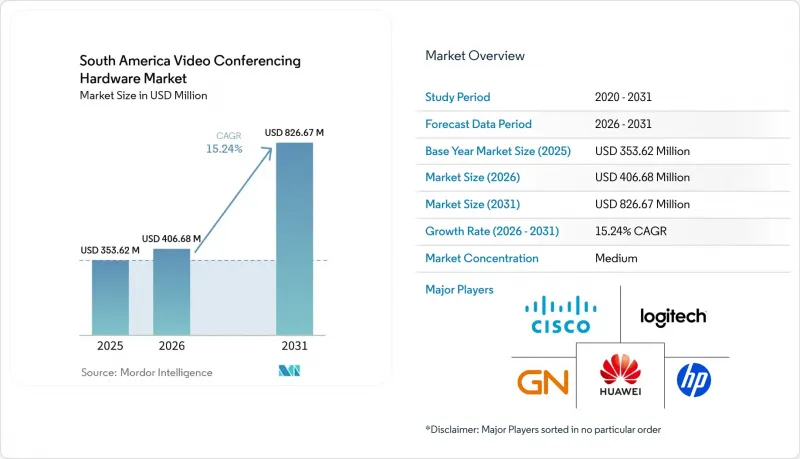
南美洲視訊會議硬體市場趨勢及洞察。
混合辦公和分散式團隊的擴展
混合辦公模式的興起正在改變南美洲對會議室硬體的需求。企業採用辦公室辦公與遠距辦公結合的混合模式,需求主要集中在預定的會議時段。這一趨勢促使企業更加需要無需專業影音支援即可使用的會議室。因此,企業正在標準化採用具備自動畫面調整和多麥克風等功能的雲端管理終端。隨著企業從臨時搭建的筆記型電腦方案轉向部署經過認證的會議室系統,南美洲的視訊會議硬體市場也從中受益。此外,秘魯新的遠程辦公法規進一步凸顯了安全可靠的系統對分散式團隊的重要性。
醫療保健和教育領域的數位轉型
醫療保健行業的需求日益與常規遠端醫療服務的採購而非緊急採購有關。巴西國家衛生系統(SUS)近期已在數千個城市提供了數百萬次遠距醫療服務。聯邦政府已在未來幾年內撥款巨資興建配備加護病房重症監護室(ICU)的智慧醫院。在教育領域,教育部計劃透過其「互聯教育創新政策」(Politica de Inovacao Educacao Connectada)在2026年5月前將10萬所公立學校連結起來。醫療保健和教育行業的負責人需要能夠在重複性會議和各種會議室環境中可靠運作的設備。這些項目正在推動南美洲視訊會議硬體市場對可靠的攝影機、顯示器和會議室音訊系統的需求。
高昂的硬體、安裝和維護成本
高階企業級終端設備仍然超出許多中型企業和公共部門買家的預算。主要供應商提供的認證協作終端安裝、整合和授權費用高昂。巴西的進口稅和工業稅增加了進口視訊通訊設備的落地成本。這種成本結構有利於能夠在多個地點標準化認證會議室的大型企業。而小規模組織則通常選擇軟體客戶端和消費級周邊周邊設備。南美視訊會議硬體市場對價格更實惠的認證會議室系統仍然存在未被滿足的需求。
細分市場分析
到2025年,協作式視訊會議設備將佔據南美洲視訊會議硬體市場34.56%的佔有率。其部署簡便的原因在於將攝影機、麥克風、揚聲器和平台認證整合於單一裝置中。這在主要城市以外地區內部影音技術有限的情況下尤其有利。微軟已通過核准設備生態系統正在推動企業在競標中採用經認證的一體化系統。預計到2031年,基於USB的整合式視訊會議設備將以15.73%的複合年成長率成長。在哥倫比亞、智利和阿根廷,筆記型電腦的普及推動了對支援自備設備辦公室(BYOD)的簡易會議室的需求,因此這類設備的需求最為旺盛。
羅技的 Rally AI Camera Pro 是協作式視訊會議系統轉型為高價值產品線的典型例子。該產品結合了雙鏡頭 AI 取景功能和壁掛式安裝選項,適用於負責人會議室。對於視野範圍大於整合式視訊會議系統範圍的會議室,PTZ 攝影機仍然至關重要。此外,在需要安全控制的政府和監管環境中,轉碼器系統仍然不可或缺。企業級耳機、揚聲器和麥克風陣列可滿足各種音訊環境以及大型會議室的聲學需求。 MCU 支援多站點會議,而套裝套件則可協助中小企業輕鬆完成承包部署。南美洲視訊會議硬體產業高度依賴微軟和 Zoom 的認證框架,因為這些框架對採購候選產品名單和定價有顯著影響。
至2025年,商業設施將佔終端用戶需求的62.27%。聖保羅、布宜諾斯艾利斯、波哥大和聖地牙哥的金融服務、科技和專業服務公司正優先實施標準化的職場系統。這些措施通常以認證產品為中心,旨在為不同辦公室提供一致的使用者體驗。預計到2031年,醫療機構的複合年成長率將達到15.62%。醫療系統正轉向可複製的遠距遠端醫療工作流程,這需要可靠的會議室設備和支援服務。由此產生的機構級需求比疫情期間的緊急採購更具永續性。
巴西的智慧醫院計畫支援臨床視訊終端的標準化採購。大學、政府機構和公共機構透過正式的競標流程採購這些解決方案。這些買家優先考慮合規記錄和本地分銷網路。資料居住要求也會影響受監管產業的部署決策。跨境合作提升了那些在符合當地法規的同時提供更廣泛互通性的系統的價值。因此,南美視訊會議硬體產業需要支援基於雲端、混合和本地部署的架構,以滿足多樣化的客戶需求。
其他好處:
- Excel格式的市場預測(ME)表
- 3個月的分析師支持
目錄
第1章:引言
- 研究假設和市場定義
- 調查範圍
第2章:調查方法
第3章執行摘要
第4章 市場狀況
- 市場概覽
- 市場促進因素
- 混合辦公和分散式團隊的擴展
- 醫療和教育領域的數位轉型
- 光纖、4G、5G和寬頻基礎設施的開發
- AI驅動的終端升級週期
- 擴張和地域分散,其中巴西處於領先地位。
- 互通性和平台認證要求
- 市場限制因素
- 高昂的硬體、安裝和維護成本
- 與連接限制和電力可靠性相關的問題
- 數據主權與監理之間的分歧
- 進口關稅、外匯波動和分銷管道中的庫存風險。
- 產業價值鏈分析
- 宏觀經濟因素對市場的影響
- 監理情勢
- 技術展望
- 波特五力分析
第5章 市場規模與成長預測
- 依硬體類型
- 多重控制單元(MCU)
- 合作酒吧
- 轉碼器系統
- USB攝影機
- 基於 USB 的整合條
- 其他套裝
- 企業級耳機
- 雲台攝影機
- 揚聲器和麥克風陣列
- 最終用戶
- 機構
- 商業設施
- 醫療機構
- 透過使用
- 小型會議空間
- 小規模會議室
- 大型會議室
- 負責人會議室及禮堂
- 部署模式
- 現場
- 雲端連線和混合
- 按地區
- 巴西
- 阿根廷
- 哥倫比亞
- 智利
- 秘魯
- 其他南美國家
第6章 競爭情勢
- 市場集中度
- 策略趨勢
- 市佔率分析
- 公司簡介
- Logitech International SA
- Cisco Systems, Inc.
- HP Inc.
- GN Audio A/S
- Huawei Technologies Co., Ltd.
- EPOS Group A/S
- Barco NV
- AVer Information Inc.
- Panasonic Corporation
- Dahua Technology Co., Ltd.
- Yealink Network Technology Co., Ltd.
- ClearOne, Inc.
- Crestron Electronics, Inc.
- Shure Incorporated
- Huddly AS
- Neatframe Ltd.
- Lifesize, Inc.
- Owl Labs Inc.
- DTEN Inc.
- Konftel AB
- MAXHUB, a brand of Returnstar Interactive Technology Group Co., Ltd.
- Lumens Digital Optics Inc.
- ZTE Corporation
- AudioCodes Ltd.
第7章 市場機會與未來展望
According to Mordor Intelligence, the South America video conferencing hardware market size is expected to increase from USD 353.62 million in 2025 to USD 406.68 million in 2026 and reach USD 826.67 million by 2031, expanding at a CAGR of 15.24% over 2026-2031.
South America Video Conferencing Hardware Market Trends and Insights
Hybrid Work and Distributed Team Expansion
Hybrid work has changed room hardware requirements across South America. Firms are using a mix of office and remote work that concentrates demand into scheduled meeting periods. This pattern increases the need for rooms that can be used without specialist AV support. Enterprises are therefore standardizing cloud-managed endpoints with automatic framing and multiple microphones. The South America video conferencing hardware market benefits when firms replace ad hoc laptop setups with certified room deployments. New telework obligations in Peru also reinforce the importance of secure and dependable systems for distributed teams.
Digital Transformation in Healthcare and Education
Healthcare demand is increasingly tied to recurring telehealth procurement rather than emergency purchasing. Brazil's SUS delivered millions of teleconsultations across thousands of municipalities over the recent period. The federal government allocated substantial funding for smart hospitals with interconnected ICUs over the coming years. In education, the Ministry of Education connected 100,000 public schools through Politica de Inovacao Educacao Conectada by May 2026. Health and education buyers need equipment that works reliably across repeated sessions and varied room formats. These programs support institutional demand for reliable cameras, displays, and room audio systems in the South America video conferencing hardware market.
High Hardware, Installation, and Maintenance Costs
Premium enterprise endpoints remain beyond the budget of many mid-market and public-sector buyers. Certified collaboration bars from leading suppliers carry high costs before installation, integration, and platform licensing. Brazilian import and industrial product taxes raise the landed cost of imported video communication equipment. The cost structure favors large enterprises that can standardize certified rooms across multiple sites. Smaller organizations often use software clients and consumer-grade peripherals instead. The South America video conferencing hardware market still has unmet demand for more affordable complete certified room systems.
Other drivers and restraints analyzed in the detailed report include:
- Fiber, 4G, 5G, and Broadband Infrastructure Improvements
- AI-Enabled Endpoint Upgrade Cycles
- Connectivity Limitations and Power Reliability Issues
For complete list of drivers and restraints, kindly check the Table Of Contents.
Segment Analysis
Collaboration Bars held 34.56% of the South America video conferencing hardware market size in 2025. They simplify deployment because the camera, microphone, speaker, and platform certification are integrated in one unit. This is valuable where in-house AV skills are limited outside major cities. Microsoft's approved device ecosystem reinforces the use of certified all-in-one systems in enterprise tenders. USB-Based Integrated Bars are projected to expand at a 15.73% CAGR through 2031. Their appeal is strongest in Colombia, Chile, and Argentina, where diverse laptop fleets increase demand for straightforward BYOD rooms.
Logitech's Rally AI Camera Pro illustrates the shift toward a higher-value collaboration bar category. The product combines dual-camera AI framing with an in-wall mounting option for boardrooms. PTZ cameras remain important where rooms exceed the field of view of an integrated bar. Codec systems remain relevant for government and regulated deployments that require security controls. Enterprise headsets, speakerphones, and microphone arrays address personal audio and larger-room acoustics. MCUs support multi-site conferencing, while bundled kits serve turnkey small and medium enterprise deployments. The South America video conferencing hardware industry relies on Microsoft and Zoom certification frameworks because these frameworks shape procurement shortlists and pricing.
Commercial Spaces held 62.27% of end-user demand in 2025. Financial services, technology, and professional services firms in Sao Paulo, Buenos Aires, Bogota, and Santiago have prioritized standardized workplace systems. Their programs commonly center on certified products that provide a consistent user experience across offices. Healthcare Facilities are projected to expand at a 15.62% CAGR through 2031. Health systems are moving toward repeatable telehealth workflows that require dependable room devices and support services. The resulting facility-level demand is more durable than emergency purchasing during the pandemic period.
Brazil's smart hospital program supports the standardized procurement of clinical video endpoints. Universities, government agencies, and public bodies procure these solutions through formal tender processes. These buyers prioritize compliance records and regional distribution coverage. Data residency requirements also influence deployment decisions in regulated sectors. Cross-border collaboration increases the value of systems that support local controls while enabling broader interoperability. Therefore, the South America video conferencing hardware industry must support cloud-based, hybrid, and on-premises architectures to meet diverse customer requirements.
Complete Report Scope:
- By Type of Hardware
- Multi-Control Units (MCU)
- Collaboration Bars
- Codec Systems
- USB Cameras
- USB-Based Integrated Bars
- Other Bundled Kits
- Enterprise Headsets
- PTZ Cameras
- Speakerphones and Microphone Arrays
- By End User
- Institutions
- Commercial Spaces
- Healthcare Facilities
- By Application
- Huddle Rooms
- Small Meeting Rooms
- Large Conference Rooms
- Boardrooms and Auditoriums
- By Deployment Mode
- On-Premises
- Cloud-Connected and Hybrid
- By Geography
- Brazil
- Argentina
- Colombia
- Chile
- Peru
- Rest of South America
List of Companies Covered in this Report:
- Logitech International S.A.
- Cisco Systems, Inc.
- HP Inc.
- GN Audio A/S
- Huawei Technologies Co., Ltd.
- EPOS Group A/S
- Barco NV
- AVer Information Inc.
- Panasonic Corporation
- Dahua Technology Co., Ltd.
- Yealink Network Technology Co., Ltd.
- ClearOne, Inc.
- Crestron Electronics, Inc.
- Shure Incorporated
- Huddly AS
- Neatframe Ltd.
- Lifesize, Inc.
- Owl Labs Inc.
- DTEN Inc.
- Konftel AB
- MAXHUB, a brand of Returnstar Interactive Technology Group Co., Ltd.
- Lumens Digital Optics Inc.
- ZTE Corporation
- AudioCodes Ltd.
Additional Benefits:
- The market estimate (ME) sheet in Excel format
- 3 months of analyst support
TABLE OF CONTENTS
1 INTRODUCTION
- 1.1 Study Assumptions and Market Definition
- 1.2 Scope of the Study
2 RESEARCH METHODOLOGY
3 EXECUTIVE SUMMARY
4 MARKET LANDSCAPE
- 4.1 Market Overview
- 4.2 Market Drivers
- 4.2.1 Hybrid Work and Distributed-Team Expansion
- 4.2.2 Digital Transformation in Healthcare and Education
- 4.2.3 Fiber, 4G, 5G, and Broadband Infrastructure Improvements
- 4.2.4 AI-Enabled Endpoint Upgrade Cycles
- 4.2.5 Brazil-Led Scale and Geographic Dispersion
- 4.2.6 Interoperability and Platform-Certification Requirements
- 4.3 Market Restraints
- 4.3.1 High Hardware, Installation, and Maintenance Costs
- 4.3.2 Connectivity Limitations and Power Reliability Issues
- 4.3.3 Data Sovereignty and Regulatory Fragmentation
- 4.3.4 Import Duties, Currency Volatility, and Channel Inventory Risk
- 4.4 Industry Value Chain Analysis
- 4.5 Impact of Macroeconomic Factors on the Market
- 4.6 Regulatory Landscape
- 4.7 Technological Outlook
- 4.8 Porter's Five Forces Analysis
- 4.8.1 Bargaining Power of Suppliers
- 4.8.2 Bargaining Power of Buyers
- 4.8.3 Threat of New Entrants
- 4.8.4 Threat of Substitutes
- 4.8.5 Competitive Rivalry
5 MARKET SIZE AND GROWTH FORECASTS (VALUE)
- 5.1 By Type of Hardware
- 5.1.1 Multi-Control Units (MCU)
- 5.1.2 Collaboration Bars
- 5.1.3 Codec Systems
- 5.1.4 USB Cameras
- 5.1.5 USB-Based Integrated Bars
- 5.1.6 Other Bundled Kits
- 5.1.7 Enterprise Headsets
- 5.1.8 PTZ Cameras
- 5.1.9 Speakerphones and Microphone Arrays
- 5.2 By End User
- 5.2.1 Institutions
- 5.2.2 Commercial Spaces
- 5.2.3 Healthcare Facilities
- 5.3 By Application
- 5.3.1 Huddle Rooms
- 5.3.2 Small Meeting Rooms
- 5.3.3 Large Conference Rooms
- 5.3.4 Boardrooms and Auditoriums
- 5.4 By Deployment Mode
- 5.4.1 On-Premises
- 5.4.2 Cloud-Connected and Hybrid
- 5.5 By Geography
- 5.5.1 Brazil
- 5.5.2 Argentina
- 5.5.3 Colombia
- 5.5.4 Chile
- 5.5.5 Peru
- 5.5.6 Rest of South America
6 COMPETITIVE LANDSCAPE
- 6.1 Market Concentration
- 6.2 Strategic Moves
- 6.3 Market Share Analysis
- 6.4 Company Profiles (includes Global Level Overview, Market Level Overview, Core Segments, Financials as available, Strategic Information, Market Rank/Share, Products and Services, Recent Developments)
- 6.4.1 Logitech International S.A.
- 6.4.2 Cisco Systems, Inc.
- 6.4.3 HP Inc.
- 6.4.4 GN Audio A/S
- 6.4.5 Huawei Technologies Co., Ltd.
- 6.4.6 EPOS Group A/S
- 6.4.7 Barco NV
- 6.4.8 AVer Information Inc.
- 6.4.9 Panasonic Corporation
- 6.4.10 Dahua Technology Co., Ltd.
- 6.4.11 Yealink Network Technology Co., Ltd.
- 6.4.12 ClearOne, Inc.
- 6.4.13 Crestron Electronics, Inc.
- 6.4.14 Shure Incorporated
- 6.4.15 Huddly AS
- 6.4.16 Neatframe Ltd.
- 6.4.17 Lifesize, Inc.
- 6.4.18 Owl Labs Inc.
- 6.4.19 DTEN Inc.
- 6.4.20 Konftel AB
- 6.4.21 MAXHUB, a brand of Returnstar Interactive Technology Group Co., Ltd.
- 6.4.22 Lumens Digital Optics Inc.
- 6.4.23 ZTE Corporation
- 6.4.24 AudioCodes Ltd.
7 MARKET OPPORTUNITIES AND FUTURE OUTLOOK
- 7.1 White-Space and Unmet-Need Assessment
- 7.2 Future Outlook, 2026-2031

 Wi-Fi會議系統市場:全球市場預測(2026-2032年)無紙化多媒體會議系統市場:全球市場預測,2026-2032年無紙化視訊會議解決方案市場:全球市場預測,2026-2032年
 無線Wi-Fi會議系統市場規模、佔有率和成長分析:按組件、連接方式、系統類型、應用、最終用戶和地區分類-2026-2033年產業預測網路與視訊會議SaaS市場-2026年至2032年全球市場預測
 全球視訊會議終端市場:預測至2030年
 視訊會議市場規模、佔有率和成長分析:按組件、部署類型、會議形式、通訊管道、應用、企業規模、最終用戶和地區分類—2026-2033年行業預測
 視訊會議市場分析及預測至 2035 年:按類型、產品、服務、技術、組件、應用、部署、最終用戶和解決方案分類。
 視訊會議市場:按組件、企業規模、型號、最終用戶和地區分類。
 2026年全球視訊會議市場報告