


 |
市場調查報告書
商品編碼
2154884
南美洲安全儀器系統:市場佔有率分析、產業趨勢與統計及成長預測(2026-2031 年)South America Safety Instrumented Systems - Market Share Analysis, Industry Trends & Statistics, Growth Forecasts (2026 - 2031) |
||||||

※ 本網頁內容可能與最新版本有所差異。詳細情況請與我們聯繫。
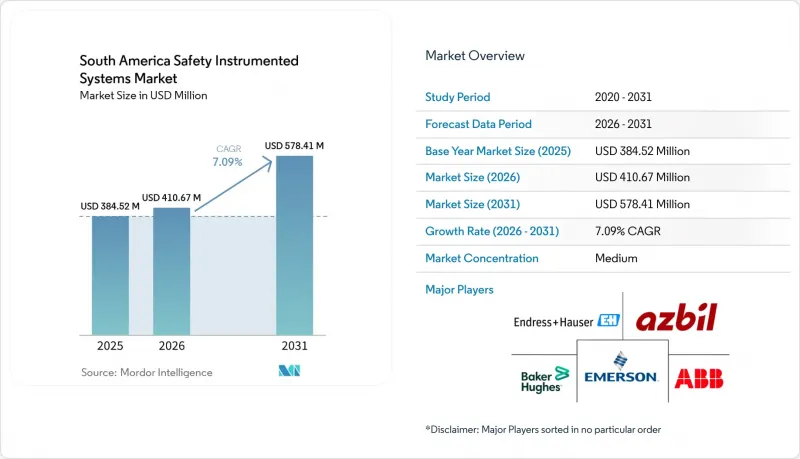
據 Mordor Intelligence 稱,2025 年南美安全儀器系統 (SIS) 市場價值為 3.8452 億美元,預計到 2031 年將達到 5.7841 億美元,高於 2026 年的 4.1067 億美元。
預計 2026 年至 2031 年的預測期內複合年成長率為 7.09%。
南美洲安全儀器系統市場趨勢與洞察
更嚴格的功能安全合規要求
在巴西,ABNT NBR IEC 61511-1:2024 標準於 2024 年 3 月發布,隨後分別於 2025 年 1 月和 2025 年 11 月發布了第二部分指南和關於確定安全完整性等級 (SIL) 的第三部分指南。這三個部分構成了一個國家框架,涵蓋安全儀器系統的風險分析、設計、運作、評估和退休。區域工程公司也將此巴西標準作為跨境工作的實用參考,因為在這些地區,相應的本地框架不夠詳細。這將改變南美洲的安全儀器系統市場,因為營運商將需要製定更正式的安全需求規格、檢驗記錄和功能安全評估。對於未記錄安全完整性等級 (SIL) 的資產,可能需要進行審查,以識別邏輯控制器、最終元件或投票配置的變更。因此,安全儀器將從非正式的運作實務轉向明確的採購和合規計畫。
海上石油設施的棕地維修
巴西的近海設施正逐漸成為安全系統現代化改造的中心樞紐。這是因為老化的設施需要定期升級,才能保持符合營運和安全要求。 2024年至2025年,佩萊格里諾油田的改造工程動員了700多名人員,使用了超過240噸的管道和結構件,充分展現了近海設施維修的規模。 2026年6月,羅克韋爾自動化公司發布了巴西某天然氣處理終端韌體現代化改造韌體的報告。該專案在未中斷營運的情況下達到了SIL 3安全等級。該終端的處理能力為1600立方公尺/小時,在工程實施前曾發生意外停機。此案例表明,一些安全挑戰可以透過軟體和韌體的變更來解決,而無需實施全面的硬體更換計劃。在南美洲安全儀器系統市場,由於生產連續性限制了更換方案的選擇,因此能夠修改運作中系統的供應商具有競爭優勢。
初始投資和生命週期維修成本高
一套完整的安全儀器系統需要經過認證的現場設備、邏輯控制器、最終組件、軟體和生命週期文件。與傳統的流程控制配置相比,這套系統需要更高的初始投資成本。在哥倫比亞和智利等非礦業地區的中型化學、食品、公共產業和工業企業,以及其他小規模的區域市場中,這項成本可能會限制其應用。生命週期成本還包括效能測試、獨立認證、備件和安全文件更新所需的人事費用。這些成本會在15-20年的資產生命週期內持續存在,並且在系統初始選用階段往往被低估。能夠降低現場測試要求或延長邏輯硬體使用壽命的供應商可以有效解決南美洲安全儀器系統市場面臨的重大限制因素。
細分市場分析
截至2025年,終端組件佔組件部分的38.62%。閥門、執行器和電磁閥至關重要,因為它們需要實體裝置來確保流程處於安全狀態,無論是緊急停止、壓力保護還是火災/氣體緊急應變。這些功能在海上石油系統中尤其重要,因為指定的反應時間和故障安全運行是基本要求。經認證的執行器組件、電磁閥組件和部分行程測試設備繼續支撐著該類別的現有收入基礎。安全感測器和邏輯控制器滿足了核心硬體的剩餘需求。邏輯控制器在FPSO專案中變得越來越重要,因為整合控制和安全系統將保護功能集中在一個冗餘平台內。 2026年6月,羅克韋爾自動化公司報告稱,已在巴西的一個偏遠天然氣液化設施部署了一套整合的製程控制、安全儀器和火災/氣體偵測功能系統。
軟體和服務預計到2031年將以7.64%的複合年成長率成長,是所有組件類別中成長最快的。此類別包括安全PLC配置工具、SIL檢驗應用、數位孿生檢驗平台、遠距離診斷和效能儀表板。這些工具正從一次性的工程支援工具轉變為貫穿整個運作和維護流程的系統。軟體訂閱和數位服務合約正成為一種經常性收入來源,這與大規模檢修期間的硬體採購截然不同。這種轉變也改變了競爭格局,供應商必須展現出可操作的診斷能力、整合能力和全生命週期支援。橫河電機的「CENTUM VP R7」在2026年6月由《控制工程》雜誌評選的「2026年度產品獎」中榮獲控制平台類別的金獎。該獎項體現了整合控制平台在煉油廠和海上營運商採購決策中的重要作用。
截至2025年,緊急停車系統佔應用領域的42.36%。這些系統在石油天然氣、化學和石化行業中保護人員、設備和生產資產,因為在這些行業中,碳氫化合物洩漏可能造成嚴重後果。在巴西的FPSO(浮式生產儲卸油裝置)中,這些系統的應用尤其重要,因為FPSO需要在上部加工設施、海底豎井和天然氣出口系統中實現協調的停車功能。其餘應用包括火災和氣體監測與控制、燃燒器管理系統以及渦輪機械控制。在處理易燃或有毒物質的封閉製程區域,火災和氣體偵測系統仍然至關重要。巴西石油公司(Petrobras)報告了一項案例研究,該研究實施了即時統計品管,利用動態限值識別正在形成的危險情況,從而在觸發緊急停車措施之前進行識別。這種方法旨在減少因故障導致的跳閘,並延長安全系統最終組件的使用壽命。這些運作作用凸顯了緊急停車系統在南美洲安全儀器系統市場中持續的重要性。
高可靠性壓力保護系統 (HIPPS) 預計到 2031 年將以 8.56% 的複合年成長率成長,在所有應用領域中成長最高。其應用主要受瓦卡穆埃爾塔油田和巴西鹽層下油田高壓井口和海底環境的驅動。由於浮式生產儲卸油裝置 (FPSO) 上部空間和重量的限制,傳統的洩壓裝置可能無法滿足所需的風險降低目標。此外,出口走廊沿線的管道壓縮站,尤其是在高天然氣流量區域,也需要可靠的過壓保護。與標準緊急停止系統相比,應用 HIPPS 需要更先進的專業工程技術。供應商必須支援完整的安全完整性等級 (SIL)檢驗、有據可查的需求因素分析以及經認證的終端組件的選擇。這些要求構成了較高的技術准入門檻,有利於那些擁有成熟安全工程能力的供應商。
其他好處:
- Excel格式的市場預測(ME)表
- 3個月的分析師支持
目錄
第1章:引言
- 研究假設和市場定義
- 調查範圍
第2章:調查方法
第3章執行摘要
第4章 市場狀況
- 市場概覽
- 市場促進因素
- 更嚴格的功能安全合規要求
- 海上石油設施的棕地維修
- 擴大石油化學和化學加工能力
- 利用工業物聯網進行安全診斷和預測性維護
- 在複雜設施中管理數位安全屏障
- 互聯工業運作對網路安全解決方案(SIS)的需求。
- 市場限制因素
- 高昂的初始投資和整個生命週期的維護成本
- 整合舊有系統的複雜性
- 認證功能安全專家短缺
- 驗證測試與暴露於運行旁路風險之間的時間間隔過長
- 宏觀經濟因素對市場的影響
- 產業價值鏈分析
- 監理情勢
- 技術展望
- 波特五力分析
第5章 市場規模與成長預測
- 按組件
- 安全感應器
- 邏輯控制器/安全PLC
- 最終元件(閥門、執行器、電磁閥)
- 軟體服務
- 透過使用
- 緊急停機系統
- 火災和氣體監控與控制
- 高可靠性壓力保護系統
- 燃燒器管理系統
- 渦輪機械控制
- 按最終用戶行業分類
- 石油和天然氣
- 化工/石油化工
- 發電
- 製藥和生命科學
- 食品/飲料
- 金屬和採礦
- 水和污水處理
- 其他終端用戶產業
- 按服務
- 工程和諮詢
- 整合和部署
- 測試、認證、審核
- 維護和培訓
- 按地區
- 巴西
- 阿根廷
- 智利
- 哥倫比亞
- 其他南美國家
第6章 競爭情勢
- 市場集中度
- 策略趨勢
- 市佔率分析
- 公司簡介
- ABB Ltd.
- Azbil Corporation
- Baker Hughes Company
- Emerson Electric Co.
- Endress+Hauser Group Services AG
- GE Vernova Inc.
- HIMA Paul Hildebrandt GmbH
- Honeywell International Inc.
- Johnson Controls International plc
- Mangan Inc.
- Mitsubishi Electric Corporation
- Moore Industries-International, Inc.
- OMRON Corporation
- Pepperl+Fuchs SE
- Proserv Group Inc.
- Rockwell Automation, Inc.
- Schneider Electric SE
- Siemens AG
- SIS-TECH Solutions LP
- Yokogawa Electric Corporation
第7章 市場機會與未來展望
According to Mordor Intelligence, the South America safety instrumented systems market size was valued at USD 384.52 million in 2025 and is estimated to grow from USD 410.67 million in 2026 to reach USD 578.41 million by 2031, at a CAGR of 7.09% during the forecast period, 2026-2031.
South America Safety Instrumented Systems Market Trends and Insights
Stricter Functional Safety Compliance Requirements
Brazil published ABNT NBR IEC 61511-1:2024 in March 2024, followed by Part 2 guidance in January 2025 and Part 3 guidance on safety integrity level determination in November 2025. The three parts provide a national framework that spans hazard analysis, design, operation, assessment, and decommissioning of safety instrumented systems. Regional engineering firms also use the Brazilian standard as a practical reference in cross-border work where comparable local frameworks are less detailed. This changes the South America safety instrumented systems market because operators must prepare more formal safety requirements specifications, verification records, and functional safety assessments. Assets without documented safety integrity level assignments may require reviews that identify changes to logic solvers, final elements, or voting configurations. The resulting work can move safety instrumentation from an informal operating practice into a defined procurement and compliance program.
Brownfield Upgrades Across Offshore Oil and Gas Facilities
Brazil's offshore fleet creates a concentrated base for safety-system modernization, as aging facilities require periodic upgrades to remain compliant with operating and safety requirements. The 2024-2025 Peregrino field campaign mobilized more than 700 personnel and involved more than 240 metric tons of fabricated piping and structures, showing the scale of offshore modification work. In June 2026, Rockwell Automation reported a firmware modernization at a Brazilian natural gas processing terminal that achieved SIL 3 compliance without interrupting operations. The terminal handled 1,600 m3/h and had experienced unplanned shutdowns before the project. This work shows that software and firmware changes can address some safety gaps without a full hardware replacement program. Suppliers that can modify systems in service can be well positioned where production continuity limits replacement options in the South America safety instrumented systems market.
High Upfront Investment and Lifecycle Maintenance Costs
A complete safety instrumented system requires certified field devices, a logic solver, final element assemblies, software, and lifecycle documentation. This package carries a higher capital cost than a conventional process control configuration. The cost can limit adoption among medium-size chemical, food, utility, and industrial plants in Colombia, Chile's non-mining base, and other smaller regional markets. Lifecycle costs also include proof-test labor, independent certification, spare parts, and updates to safety documentation. These costs continue over an asset life of 15-20 years and may be underestimated when the initial system is selected. Providers that reduce site testing requirements or extend the usable life of logic hardware can address a material constraint in the South America safety instrumented systems market.
Other drivers and restraints analyzed in the detailed report include:
- Expansion of Petrochemical and Chemical Processing Capacity
- IIoT-Enabled Safety Diagnostics and Predictive Maintenance
- Legacy-System Integration Complexity
For complete list of drivers and restraints, kindly check the Table Of Contents.
Segment Analysis
Final elements held 38.62% of the component segment in 2025. Valves, actuators, and solenoids are highly valuable because every emergency shutdown, pressure protection, or fire-and-gas response requires a physical device to move the process to a safe state. Their role is especially significant in offshore oil and gas systems, where a defined response time and fail-safe behavior are essential requirements. Certified actuator packages, solenoid assemblies, and partial-stroke testing equipment continue to support the category's established revenue position. Safety sensors and logic solvers account for the remaining demand for core hardware. Logic solvers are gaining importance on FPSO projects where integrated control and safety systems centralize protection functions within a redundant platform. In June 2026, Rockwell Automation reported an integrated system at a remote Brazilian gas liquefaction facility that combined process control, safety instrumented, and fire-and-gas functions.
Software and services are projected to grow at a 7.64% CAGR through 2031, the fastest rate among component categories. This group includes safety PLC configuration tools, SIL verification applications, digital twin validation platforms, remote diagnostics, and performance dashboards. These tools are moving from one-time engineering aids toward systems used throughout operation and maintenance. Software subscriptions and digital service agreements can provide recurring revenue that differs from hardware purchases made during major turnarounds. The shift also changes competition because suppliers must demonstrate usable diagnostics, integration capabilities, and lifecycle support. Yokogawa's CENTUM VP R7 received the Control Engineering 2026 Product of the Year Gold Award in the Control Platforms category in June 2026. The recognition reflected the role of integrated control platforms in procurement decisions for refinery and offshore operators.
Emergency shutdown systems held 42.36% of the application segment in 2025. These systems protect personnel, equipment, and production assets in oil and gas, chemicals, and petrochemicals, where hydrocarbon release can create severe consequences. Their use is particularly important on Brazilian FPSOs, which require coordinated shutdown functions for topside processing, subsea wellheads, and gas-export systems. Fire-and-gas monitoring and control, burner management systems, and turbomachinery control make up the remaining applications. Fire-and-gas systems remain necessary in enclosed process areas that handle flammable or toxic materials. Petrobras documented a real-time statistical quality control implementation that used dynamic limits to identify developing unsafe conditions before emergency shutdown actions were triggered. The approach was intended to reduce nuisance trips and preserve the operating life of the safety system's final elements. This operational role supports the continuing importance of emergency shutdown systems in the South America safety instrumented systems market.
High-integrity pressure protection systems are projected to grow at an 8.56% CAGR through 2031, the highest rate among applications. Their use is supported by high-pressure wellhead and subsea conditions in Vaca Muerta and Brazil's pre-salt fields. Conventional pressure relief configurations may not meet the required risk-reduction target within the space and weight limits of FPSO topsides. Pipeline compressor stations along export corridors also need dependable overpressure protection where gas volumes are high. A HIPPS application requires more specialized engineering than a standard emergency shutdown system. Suppliers must support full SIL verification, documented demand-rate analysis, and qualified final element selection. These requirements raise the technical threshold for participation and favor vendors with established safety engineering capability.
Complete Report Scope:
- By Component
- Safety Sensors
- Logic Solvers/Safety PLCs
- Final Elements (Valves, Actuators, and Solenoids)
- Software and Services
- By Applications
- Emergency Shutdown Systems
- Fire and Gas Monitoring and Control
- High-Integrity Pressure Protection Systems
- Burner Management Systems
- Turbomachinery Control
- By End-User Industry
- Oil and Gas
- Chemicals and Petrochemicals
- Power Generation
- Pharmaceuticals and Life Sciences
- Food and Beverage
- Metals and Mining
- Water and Wastewater
- Other End-User Industries
- By Service
- Engineering and Consulting
- Integration and Installation
- Testing, Certification, and Auditing
- Maintenance and Training
- By Geography
- Brazil
- Argentina
- Chile
- Colombia
- Rest of South America
List of Companies Covered in this Report:
- ABB Ltd.
- Azbil Corporation
- Baker Hughes Company
- Emerson Electric Co.
- Endress+Hauser Group Services AG
- GE Vernova Inc.
- HIMA Paul Hildebrandt GmbH
- Honeywell International Inc.
- Johnson Controls International plc
- Mangan Inc.
- Mitsubishi Electric Corporation
- Moore Industries-International, Inc.
- OMRON Corporation
- Pepperl+Fuchs SE
- Proserv Group Inc.
- Rockwell Automation, Inc.
- Schneider Electric SE
- Siemens AG
- SIS-TECH Solutions LP
- Yokogawa Electric Corporation
Additional Benefits:
- The market estimate (ME) sheet in Excel format
- 3 months of analyst support
TABLE OF CONTENTS
1 INTRODUCTION
- 1.1 Study Assumptions and Market Definition
- 1.2 Scope of the Study
2 RESEARCH METHODOLOGY
3 EXECUTIVE SUMMARY
4 MARKET LANDSCAPE
- 4.1 Market Overview
- 4.2 Market Drivers
- 4.2.1 Stricter Functional Safety Compliance Requirements
- 4.2.2 Brownfield Upgrades Across Offshore Oil and Gas Facilities
- 4.2.3 Expansion of Petrochemical and Chemical Processing Capacity
- 4.2.4 IIoT-Enabled Safety Diagnostics and Predictive Maintenance
- 4.2.5 Digital Safety Barrier Management Across Complex Facilities
- 4.2.6 Cybersecure SIS Demand in Connected Industrial Operations
- 4.3 Market Restraints
- 4.3.1 High Upfront Investment and Lifecycle Maintenance Costs
- 4.3.2 Legacy-System Integration Complexity
- 4.3.3 Shortage of Certified Functional Safety Professionals
- 4.3.4 Long Proof-Test Intervals and Operational Bypass Exposure
- 4.4 Impact of Macroeconomic Factors on the Market
- 4.5 Industry Value Chain Analysis
- 4.6 Regulatory Landscape
- 4.7 Technological Outlook
- 4.8 Porter's Five Forces Analysis
- 4.8.1 Bargaining Power of Suppliers
- 4.8.2 Bargaining Power of Buyers
- 4.8.3 Threat of New Entrants
- 4.8.4 Threat of Substitutes
- 4.8.5 Competitive Rivalry
5 MARKET SIZE AND GROWTH FORECASTS (VALUE)
- 5.1 By Component
- 5.1.1 Safety Sensors
- 5.1.2 Logic Solvers/Safety PLCs
- 5.1.3 Final Elements (Valves, Actuators, and Solenoids)
- 5.1.4 Software and Services
- 5.2 By Applications
- 5.2.1 Emergency Shutdown Systems
- 5.2.2 Fire and Gas Monitoring and Control
- 5.2.3 High-Integrity Pressure Protection Systems
- 5.2.4 Burner Management Systems
- 5.2.5 Turbomachinery Control
- 5.3 By End-User Industry
- 5.3.1 Oil and Gas
- 5.3.2 Chemicals and Petrochemicals
- 5.3.3 Power Generation
- 5.3.4 Pharmaceuticals and Life Sciences
- 5.3.5 Food and Beverage
- 5.3.6 Metals and Mining
- 5.3.7 Water and Wastewater
- 5.3.8 Other End-User Industries
- 5.4 By Service
- 5.4.1 Engineering and Consulting
- 5.4.2 Integration and Installation
- 5.4.3 Testing, Certification, and Auditing
- 5.4.4 Maintenance and Training
- 5.5 By Geography
- 5.5.1 Brazil
- 5.5.2 Argentina
- 5.5.3 Chile
- 5.5.4 Colombia
- 5.5.5 Rest of South America
6 COMPETITIVE LANDSCAPE
- 6.1 Market Concentration
- 6.2 Strategic Moves
- 6.3 Market Share Analysis
- 6.4 Company Profiles (includes Global Level Overview, Market Level Overview, Core Segments, Financials as available, Strategic Information, Market Rank/Share, Products and Services, Recent Developments)
- 6.4.1 ABB Ltd.
- 6.4.2 Azbil Corporation
- 6.4.3 Baker Hughes Company
- 6.4.4 Emerson Electric Co.
- 6.4.5 Endress+Hauser Group Services AG
- 6.4.6 GE Vernova Inc.
- 6.4.7 HIMA Paul Hildebrandt GmbH
- 6.4.8 Honeywell International Inc.
- 6.4.9 Johnson Controls International plc
- 6.4.10 Mangan Inc.
- 6.4.11 Mitsubishi Electric Corporation
- 6.4.12 Moore Industries-International, Inc.
- 6.4.13 OMRON Corporation
- 6.4.14 Pepperl+Fuchs SE
- 6.4.15 Proserv Group Inc.
- 6.4.16 Rockwell Automation, Inc.
- 6.4.17 Schneider Electric SE
- 6.4.18 Siemens AG
- 6.4.19 SIS-TECH Solutions LP
- 6.4.20 Yokogawa Electric Corporation
7 MARKET OPPORTUNITIES AND FUTURE OUTLOOK
- 7.1 White-Space and Unmet-Need Assessment

 安全儀器系統(SIS)市場:按組件、應用、服務、最終用戶、國家和地區分類-全球產業分析、市場規模、市場佔有率及2026年至2033年預測
 安全儀器系統:市場佔有率分析、產業趨勢與統計、成長預測(2026-2031)
 工業安全市場分析及預測(至2035年):類型、產品類型、服務、技術、組件、應用、部署狀態、最終用戶、解決方案
 化學品安全與合規解決方案市場預測至2034年-按解決方案類型、部署模式、組織規模、最終用戶和地區分類的全球分析
 2026年全球安全儀器系統市場報告安全儀器系統市場分析及預測(至2035年):依類型、產品類型、服務、技術、組件、應用、最終用戶、功能、安裝類型分類
 日本工業安全設備市場規模、佔有率、趨勢及預測(依產品類型、最終用途產業及地區分類,2026-2034年)
 安全儀器系統市場規模、佔有率及成長分析(按組件、產品、最終用途及地區分類)-2026-2033年產業預測
 工業安全市場規模、佔有率和成長分析(按組件、類型、安全類型、最終用戶和地區分類)-2026-2033年產業預測亞太地區安全儀器系統:市場佔有率分析、產業趨勢和成長預測(2025-2030 年)