


 |
市場調查報告書
商品編碼
2120685
安全儀器系統:市場佔有率分析、產業趨勢與統計、成長預測(2026-2031)Safety Instrumented System - Market Share Analysis, Industry Trends & Statistics, Growth Forecasts (2026 - 2031) |
||||||

※ 本網頁內容可能與最新版本有所差異。詳細情況請與我們聯繫。
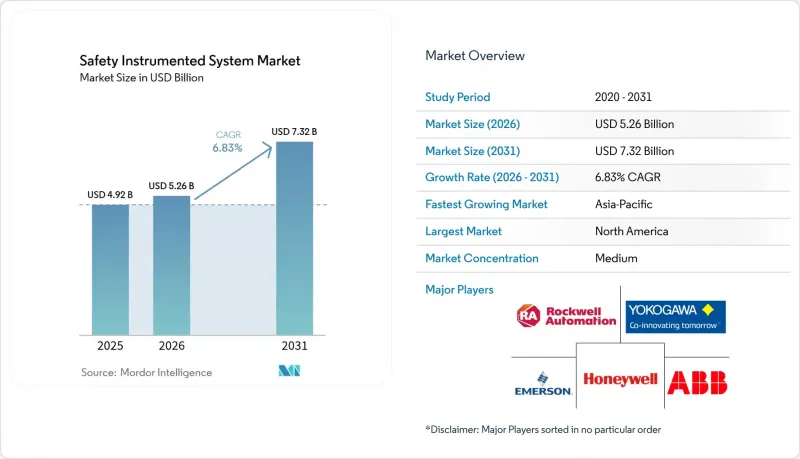
據 Mordor Intelligence 稱,2025 年安全儀器系統 (SIS) 市場價值為 49.2 億美元,預計到 2031 年將達到 73.2 億美元,而 2026 年為 52.6 億美元,預測期(2026-2031 年)的複合年成長率為 6.83%。
本報告按組件(安全感測器、邏輯控制器/安全PLC等)、應用(緊急停止系統、火災和氣體監測等)、終端用戶行業(石油和天然氣、化學和石化等)、服務(工程和諮詢、整合和安裝等)以及地區進行細分。市場預測以價值(美元)表示。
全球安全儀器系統(SIS)市場趨勢與洞察
全球範圍內更嚴格的功能安全法規正在推動系統性合規。
隨著IEC 61511和OSHA製程安全管理在全球的實施,安全儀器系統市場正從定期審核轉向持續效能檢驗,市場規模不斷擴大。預計到2024年後,功能安全評估將增加40%,這將加重工程資源的負擔並延長專案前置作業時間。傳統平台營運商面臨強制性改造,這為能夠投入資源並在18-24個月內交付承包升級方案的認證整合商創造了賣方市場。這種需求的成長也推高了TUV認證組件的價格,進一步加速了營收成長。
隨著老舊基礎設施升級改造達到現代標準,棕地維修正在加速進行。
當老舊煉油廠和化工廠維修為整合安全架構,而不是新建工廠時,安全儀器系統 (SIS) 市場將從中受益。棕地工廠維修已佔所有項目的 65%,其中墨西哥灣沿岸地區地區的工廠處於領先地位,因為保險公司將保險範圍與是否符合現行標準掛鉤。整合工程師透過將傳統協議與現代安全 PLC 整合,將事故風險緩解與減少停機時間相結合,通常可以將維修投資的回收期縮短至四年以內。
高昂的資本成本和生命週期成本為中型企業採用這項技術帶來了挑戰。
設施建設的總成本在500萬美元至1500萬美元之間,這對中型企業來說是一個巨大的障礙。年度維護成本佔初始投資的15%至20%,包括效能測試、零件更換和軟體修補程式。儘管合規壓力日益增大,但新興市場資金短缺阻礙了現代化改造計畫的實施。 「安全即服務 (SaaS)」訂閱模式允許將資金分攤到多年營運預算中,但資金籌措選擇仍然有限,尤其是在當地金融機構收取高額風險溢價的情況下。
細分市場分析
軟體和服務業以7.11%的複合年成長率領跑,主要得益於雲端分析、機器學習和虛擬試運行工具等新價值創造來源的推動。安全儀器系統(SIS)市場的軟體和服務規模預計將從2025年的12.7億美元成長到2031年的19.1億美元。人工智慧平台能夠區分真正的製程偏差與噪音,進而降低50%的故障率,並保障生產穩定。儘管感測器在銷售額上仍保持38.10%的領先優勢,但市場正轉向以數據為中心的解決方案,這些方案能夠為硬體提供可操作的洞察。
受高壓、高速應用需求不斷成長的推動,邏輯控制器和安全PLC市場正穩步成長。 FinalElements公司利用智慧執行器提供持續回饋,以增強認證測試的全面性。供應商正將感測器與基於訂閱的分析服務捆綁銷售,以將收入模式轉向週期性收費,並提高客戶留存率。
預計到2025年,緊急切斷系統將維持41.30%的市場佔有率,而高壓完整性保護系統(HIPPS)將以7.23%的複合年成長率成為成長最快的系統。氫氣管道和藍氨出口終端需要能夠在1000巴壓力下兩秒內切斷電源的HIPPS系統。隨著各國政府投入創紀錄的氫能相關獎勵,預計到2030年,與HIPPS相關的安全儀器系統(SIS)的市場規模將成長近一倍。隨著排放法規日益嚴格,火災和氣體監測正在加速發展,頻譜偵測器的引入旨在減少誤報。燃燒器管理系統和渦輪機械控制系統正與整個工廠的安全層整合,從而實現協調停機,避免連鎖故障。
區域分析
預計到2025年,北美將佔全球收入的39.24%,這主要得益於美國職業安全與健康管理局 (OSHA) 更嚴格的製程安全管理以及墨西哥灣沿岸地區的棕地計畫。光是美國每年就新增3,000多位認證功能安全工程師,維持了強勁的專案儲備。營運商正致力於提升分析能力,整合雲端儀錶板以視覺化安全指標,供經營團隊參考。加拿大上游液化LNG接收站正在投資建造符合SIL 3標準的高壓完整性保護系統 (HIPPS),以保護高壓管道。
由於SEVESO III指令以及將網路安全融入功能安全的「數位主權」理念的推廣,歐洲佔據了相當大的市場佔有率。德國和荷蘭的煉油廠正在實施預測性壓力測試以最佳化檢修流程。北海的近海平台正在改造通用資產安全系統,這些系統由陸上控制中心監控,減少了現場工作人員的需求。
亞太地區是成長最快的地區,複合年成長率達8.13%。在中國和印度,大規模化工產業園區從運作就配備了完善的安全措施,克服了傳統障礙。政府的氫能發展藍圖正在加速對高完整性壓力保護系統(HIPPS)的投資,而東南亞的石化中心則採用模組化的「安全即服務」模式來運作初始投資。在澳洲的採礦業,基於人工智慧的診斷系統正在被應用,以平衡超長的運作時間和工人安全需求。
在中東和非洲,石油收入正被用於建造高規格的煉油廠,這些煉油廠通常與國際許可證持有者合作建設,並將經認證的安全措施納入工程設計方案。在南美洲,採礦和生質燃料產業蓬勃發展,業者正努力滿足嚴格的環境標準和保險公司的要求。
其他好處:
- Excel格式的市場預測(ME)表
- 3個月的分析師支持
目錄
第1章:引言
- 研究假設和市場定義
- 調查範圍
第2章:調查方法
第3章執行摘要
第4章 市場狀況
- 市場概覽
- 市場促進因素
- 全球更嚴格的功能安全法規(IEC 61511、OSHA PSM)
- 石油、天然氣和化學工業的現有設施維修正在加速進行。
- 數位化診斷和工業物聯網可減少停機時間和概念驗證成本。
- 具備網路安全功能且通過 SIL 認證的架構正在推動升級需求。
- 適用於中型工廠的模組化「安全即服務」平台
- 脫碳(藍氫、碳捕獲、利用與封存)計畫需要新的氫致發電廠(HIPPS)。
- 市場限制因素
- 高昂的資本投資和全生命週期維修成本
- 整合舊有系統的複雜性
- TUV/CFSE認證安全工程師短缺
- SIL級組件供應鏈中的限制因素
- 產業價值鏈分析
- 監理情勢
- 技術展望
- 波特五力分析
第5章 市場規模與成長預測
- 按組件
- 安全感應器
- 邏輯控制器/安全PLC
- 最終元件(閥門、執行器、電磁閥)
- 軟體服務
- 透過使用
- 緊急停止系統(ESD)
- 火災和氣體監測與控制(FandG)
- 高可靠性壓力保護系統(HIPPS)
- 燃燒器管理系統(BMS)
- 渦輪機械控制(TMC)
- 按最終用戶行業分類
- 石油和天然氣
- 化工/石油化工
- 發電(包括核能和可再生能源)
- 製藥和生命科學
- 食品/飲料
- 金屬和採礦
- 水和污水處理
- 其他終端用戶產業
- 按服務
- 工程和諮詢
- 整合和部署
- 測試、認證、審核
- 維護和培訓
- 按地區
- 北美洲
- 南美洲
- 歐洲
- 亞太地區
- 中東和非洲
第6章 競爭情勢
- 市場集中度
- 策略趨勢
- 市佔率分析
- 公司簡介
- ABB Ltd.
- Baker Hughes Co.
- Emerson Electric Co.
- General Electric Co.
- HIMA Paul Hildebrandt GmbH and Co KG
- Honeywell International Inc.
- Johnson Controls International plc(Tyco Fire and Security)
- Mangan Inc.
- Mitsubishi Electric Corp.
- Moore Industries-International, Inc.
- Omron Corp.
- Pepperl+Fuchs SE
- Pilz GmbH and Co. KG
- Proserv Controls LLC
- Rockwell Automation Inc.
- Rotork plc
- Schneider Electric SE
- Schlumberger NV
- Siemens AG
- SIS-TECH Solutions LP
- Valmet Oyj
- Yokogawa Electric Corp.
第7章 市場機會與未來展望
According to Mordor Intelligence, the safety instrumented system market size was valued at USD 4.92 billion in 2025 and estimated to grow from USD 5.26 billion in 2026 to reach USD 7.32 billion by 2031, at a CAGR of 6.83% during the forecast period (2026-2031).
This report is Segmented by Component (Safety Sensors, Logic Solvers/Safety PLCs, and More), Application (Emergency Shutdown Systems, Fire and Gas Monitoring, and More), End-User Industry (Oil and Gas, Chemicals and Petrochemicals, and More), Service (Engineering and Consulting, Integration and Installation, and More), and Geography. The Market Forecasts are Provided in Terms of Value (USD).
Global Safety Instrumented System Market Trends and Insights
Stricter Global Functional-Safety Regulations Drive Systematic Compliance
Global enforcement of IEC 61511 and OSHA Process Safety Management elevates the Safety Instrumented System market as facilities migrate from periodic audits to continuous performance verification. Functional-safety assessments grew 40% since 2024, stretching engineering resources and elongating project lead times. Operators with legacy platforms face mandatory overhauls, creating a seller's market for certified integrators able to commit resources and deliver turnkey upgrades within eighteen to twenty-four months. High demand also supports premium pricing for TUV-certified components, reinforcing revenue growth momentum.
Brownfield Upgrades Accelerate as Aging Infrastructure Meets Modern Standards
The Safety Instrumented System market benefits when older refineries and chemical complexes retrofit integrated safety architectures instead of constructing new plants. Brownfield retrofits already represent 65% of projects; Gulf Coast facilities spearhead activity as insurance underwriters tie coverage to conformance with current standards. Integration engineers bridge legacy protocols with contemporary Safety PLCs, often shrinking retrofit payback to less than four years by combining incident-risk mitigation with downtime reduction.
High Capital and Lifecycle Costs Challenge Mid-Tier Adoption
Full-facility deployments range from USD 5 million to USD 15 million, a hurdle for mid-size operators. Annual upkeep absorbs 15-20% of initial cost, covering proof-testing, component swaps, and software patches. Capital scarcity in emerging markets hampers replacement planning despite mounting compliance pressure. "Safety-as-a-Service" subscription schemes now spread capital across multi-year operating budgets, yet financing options remain limited, especially where local lenders assign high risk premiums.
Other drivers and restraints analyzed in the detailed report include:
- Digitalized Diagnostics Transform Proof-Testing Economics
- SIL-Certified Cyber-Secure Architectures Address New Threats
- Legacy-System Integration Complexity Extends Timelines and Budgets
For complete list of drivers and restraints, kindly check the Table Of Contents.
Segment Analysis
Software and Services recorded the fastest 7.11% CAGR because cloud analytics, machine learning, and virtual-commissioning tools unlock fresh value streams. The Safety Instrumented System market size for Software and Services is projected to climb from USD 1.27 billion in 2025 to USD 1.91 billion by 2031. AI-enhanced platforms distinguish genuine process excursions from noise, cutting nuisance trips by 50% and conserving production. Sensors retain a 38.10% revenue lead, yet the market pivots toward data-centric offerings that complement hardware with actionable insight.
Logic Solvers and Safety PLCs grow at a steady clip, buoyed by rising demand for high-pressure and high-speed applications. Final Elements leverage smart actuators providing continuous feedback, strengthening proof-test coverage. Vendors bundle sensors with subscription analytics, shifting revenue toward recurring models and reinforcing stickiness among installed-base customers.
Emergency Shutdown retains 41.30% share in 2025, yet HIPPS experiences the highest 7.23% CAGR. Hydrogen pipelines and blue-ammonia export terminals require HIPPS capable of 2 second closure under 1,000 bar pressure. The Safety Instrumented System market size attached to HIPPS is forecast to almost double by 2030 as governments allocate record hydrogen incentives. Fire and Gas monitoring accelerates on stricter emissions controls, introducing multi-spectrum detectors that reduce false alarms. Burner Management Systems and Turbomachinery Control integrate with plant-wide safety layers, enabling coordinated shutdown to avert cascading failures.
Complete Report Scope:
- By Component
- Safety Sensors
- Logic Solvers / Safety PLCs
- Final Elements (Valves, Actuators, Solenoids)
- Software and Services
- By Application
- Emergency Shutdown Systems (ESD)
- Fire and Gas Monitoring and Control (FandG)
- High-Integrity Pressure Protection Systems (HIPPS)
- Burner Management Systems (BMS)
- Turbomachinery Control (TMC)
- By End-User Industry
- Oil and Gas
- Chemicals and Petrochemicals
- Power Generation (incl. Nuclear and Renewables)
- Pharmaceuticals and Life Sciences
- Food and Beverage
- Metals and Mining
- Water and Wastewater
- Other End-User Industries
- By Service
- Engineering and Consulting
- Integration and Installation
- Testing, Certification and Audit
- Maintenance and Training
- By Geography
- North America
- South America
- Europe
- Asia-Pacific
- Middle East and Africa
Geography Analysis
North America generated 39.24% of 2025 revenue on the back of OSHA Process Safety Management rigor and Gulf Coast brownfield programs. The United States alone houses more than 3,000 newly certified functional-safety engineers every year, sustaining a robust project pipeline. Operators focus on analytics upgrades, integrating cloud dashboards that visualize safety metrics for executive leadership. Canada's upstream LNG terminals invest in SIL 3 HIPPS to safeguard high-pressure pipelines.
Europe follows with sizeable share under SEVESO III and the push for digital sovereignty that embeds cybersecurity into functional safety. Refiners in Germany and the Netherlands add predictive proof-testing to optimize turnarounds. Offshore North Sea platforms retrofit common-asset safety suites monitored from onshore control centers, shrinking field labor requirements.
Asia-Pacific is the fastest-growing territory at 8.13% CAGR. China and India commission large chemical parks with integrated safety from day one, bypassing legacy barriers. Government hydrogen roadmaps fast-track HIPPS spending, while Southeast Asian petrochemical hubs adopt modular Safety-as-a-Service to cap upfront capital. Australia's mining sector deploys AI-based diagnostics to balance extreme uptime demands with worker-safety mandates.
The Middle East and Africa channel petro-revenues into high-spec refineries, often engaging international licensors that include certified safety as part of engineering packages. South America shows rising activity within mining and biofuels as operators align with stricter environmental standards and insurer expectations.
- ABB Ltd.
- Baker Hughes Co.
- Emerson Electric Co.
- General Electric Co.
- HIMA Paul Hildebrandt GmbH and Co KG
- Honeywell International Inc.
- Johnson Controls International plc (Tyco Fire and Security)
- Mangan Inc.
- Mitsubishi Electric Corp.
- Moore Industries-International, Inc.
- Omron Corp.
- Pepperl+Fuchs SE
- Pilz GmbH and Co. KG
- Proserv Controls LLC
- Rockwell Automation Inc.
- Rotork plc
- Schneider Electric SE
- Schlumberger NV
- Siemens AG
- SIS-TECH Solutions LP
- Valmet Oyj
- Yokogawa Electric Corp.
Additional Benefits:
- The market estimate (ME) sheet in Excel format
- 3 months of analyst support
TABLE OF CONTENTS
1 INTRODUCTION
- 1.1 Study Assumptions and Market Definition
- 1.2 Scope of the Study
2 RESEARCH METHODOLOGY
3 EXECUTIVE SUMMARY
4 MARKET LANDSCAPE
- 4.1 Market Overview
- 4.2 Market Drivers
- 4.2.1 Stricter global functional-safety regulations (IEC 61511, OSHA PSM)
- 4.2.2 Accelerating brown-field upgrades in oil and gas and chemicals
- 4.2.3 Digitalized diagnostics and IIoT cut downtime and proof-test cost
- 4.2.4 SIL-certified cyber-secure architectures drive replacement demand
- 4.2.5 Modular "Safety as-a-Service" platforms for mid-tier plants
- 4.2.6 Decarbonization (blue-H2, CCUS) projects require new HIPPS
- 4.3 Market Restraints
- 4.3.1 High capex and lifecycle maintenance cost
- 4.3.2 Legacy-system integration complexity
- 4.3.3 Shortage of TUV/CFSE-certified safety engineers
- 4.3.4 SIL-grade component supply-chain constraints
- 4.4 Industry Value Chain Analysis
- 4.5 Regulatory Landscape
- 4.6 Technological Outlook
- 4.7 Porter's Five Forces Analysis
- 4.7.1 Threat of New Entrants
- 4.7.2 Bargaining Power of Buyers
- 4.7.3 Bargaining Power of Suppliers
- 4.7.4 Threat of Substitutes
- 4.7.5 Intensity of Competitive Rivalry
5 MARKET SIZE AND GROWTH FORECASTS (VALUE)
- 5.1 By Component
- 5.1.1 Safety Sensors
- 5.1.2 Logic Solvers / Safety PLCs
- 5.1.3 Final Elements (Valves, Actuators, Solenoids)
- 5.1.4 Software and Services
- 5.2 By Application
- 5.2.1 Emergency Shutdown Systems (ESD)
- 5.2.2 Fire and Gas Monitoring and Control (FandG)
- 5.2.3 High-Integrity Pressure Protection Systems (HIPPS)
- 5.2.4 Burner Management Systems (BMS)
- 5.2.5 Turbomachinery Control (TMC)
- 5.3 By End-User Industry
- 5.3.1 Oil and Gas
- 5.3.2 Chemicals and Petrochemicals
- 5.3.3 Power Generation (incl. Nuclear and Renewables)
- 5.3.4 Pharmaceuticals and Life Sciences
- 5.3.5 Food and Beverage
- 5.3.6 Metals and Mining
- 5.3.7 Water and Wastewater
- 5.3.8 Other End-User Industries
- 5.4 By Service
- 5.4.1 Engineering and Consulting
- 5.4.2 Integration and Installation
- 5.4.3 Testing, Certification and Audit
- 5.4.4 Maintenance and Training
- 5.5 By Geography
- 5.5.1 North America
- 5.5.2 South America
- 5.5.3 Europe
- 5.5.4 Asia-Pacific
- 5.5.5 Middle East and Africa
6 COMPETITIVE LANDSCAPE
- 6.1 Market Concentration
- 6.2 Strategic Moves
- 6.3 Market Share Analysis
- 6.4 Company Profiles (includes Global-level Overview, Market-level Overview, Core Segments, Financials as available, Strategic Information, Market Rank/Share, Products and Services, Recent Developments)
- 6.4.1 ABB Ltd.
- 6.4.2 Baker Hughes Co.
- 6.4.3 Emerson Electric Co.
- 6.4.4 General Electric Co.
- 6.4.5 HIMA Paul Hildebrandt GmbH and Co KG
- 6.4.6 Honeywell International Inc.
- 6.4.7 Johnson Controls International plc (Tyco Fire and Security)
- 6.4.8 Mangan Inc.
- 6.4.9 Mitsubishi Electric Corp.
- 6.4.10 Moore Industries-International, Inc.
- 6.4.11 Omron Corp.
- 6.4.12 Pepperl+Fuchs SE
- 6.4.13 Pilz GmbH and Co. KG
- 6.4.14 Proserv Controls LLC
- 6.4.15 Rockwell Automation Inc.
- 6.4.16 Rotork plc
- 6.4.17 Schneider Electric SE
- 6.4.18 Schlumberger NV
- 6.4.19 Siemens AG
- 6.4.20 SIS-TECH Solutions LP
- 6.4.21 Valmet Oyj
- 6.4.22 Yokogawa Electric Corp.
7 MARKET OPPORTUNITIES AND FUTURE OUTLOOK
- 7.1 White-space and Unmet-need Assessment

 南美洲安全儀器系統:市場佔有率分析、產業趨勢與統計及成長預測(2026-2031 年)
 安全儀器系統(SIS)市場:按組件、應用、服務、最終用戶、國家和地區分類-全球產業分析、市場規模、市場佔有率及2026年至2033年預測
 工業安全市場分析及預測(至2035年):類型、產品類型、服務、技術、組件、應用、部署狀態、最終用戶、解決方案
 化學品安全與合規解決方案市場預測至2034年-按解決方案類型、部署模式、組織規模、最終用戶和地區分類的全球分析
 2026年全球安全儀器系統市場報告安全儀器系統市場分析及預測(至2035年):依類型、產品類型、服務、技術、組件、應用、最終用戶、功能、安裝類型分類
 日本工業安全設備市場規模、佔有率、趨勢及預測(依產品類型、最終用途產業及地區分類,2026-2034年)
 安全儀器系統市場規模、佔有率及成長分析(按組件、產品、最終用途及地區分類)-2026-2033年產業預測
 工業安全市場規模、佔有率和成長分析(按組件、類型、安全類型、最終用戶和地區分類)-2026-2033年產業預測亞太地區安全儀器系統:市場佔有率分析、產業趨勢和成長預測(2025-2030 年)