


 |
市場調查報告書
商品編碼
2154868
南美洲雙胍類藥物:市場佔有率分析、行業趨勢和統計數據、成長預測(2026-2031 年)South America Biguanide - Market Share Analysis, Industry Trends & Statistics, Growth Forecasts (2026 - 2031) |
||||||

※ 本網頁內容可能與最新版本有所差異。詳細情況請與我們聯繫。
根據 Mordor Intelligence 預測,南美洲的雙胍類藥物市場規模將從 2025 年的 3.3389 億美元成長到 2026 年的 3.4315 億美元,到 2031 年將達到 4.0467 億美元。
預測期(2026-2031 年)的複合年成長率預計為 3.35%。
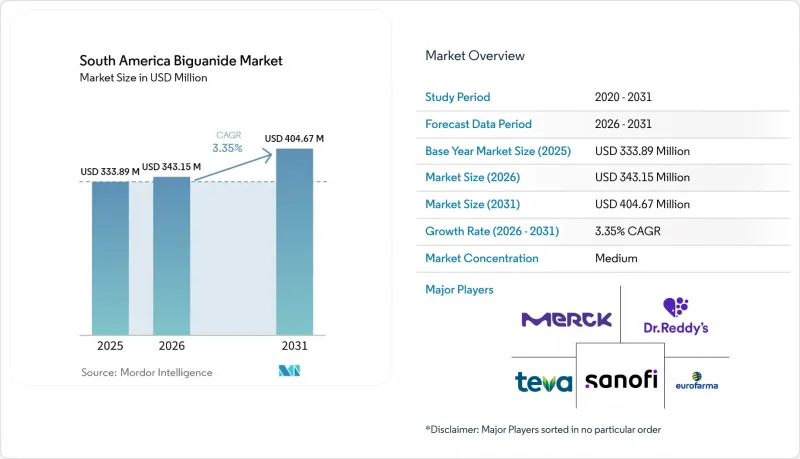
南美洲雙胍類藥物市場成長的主要促進因素是該地區糖尿病負擔沉重,以及公共醫療體系對低成本口服治療藥物的持續需求。本報告依劑型(速釋等)、製劑類型(組合藥物治療、複方製劑)、適應症(第二型糖尿病等)、通路(醫院藥局等)及國家(巴西、阿根廷、哥倫比亞、智利、秘魯及其他南美國家)進行細分。市場預測以美元計價。
南美洲雙胍類藥物市場的趨勢與洞察
2型糖尿病盛行率高
在南美洲雙胍類藥物市場,第2型糖尿病是最大的治療目標族群,佔該地區已確診和未確診糖尿病病例的大多數。根據國際糖尿病聯盟(IDF)的數據,2024年拉丁美洲共有3,540萬成年人患有糖尿病,年齡調整後的盛行率為10.1%。該組織預測,到2050年,盛行率將達到11.5%,並估計30.4%的糖尿病患者仍未確診。隨著篩檢在基層醫療和社區機構的普及,這部分未確診者有望獲得治療。 2024年,與糖尿病相關的醫療保健支出達到810億美元,凸顯了早期治療和提供經濟實惠治療方案的必要性。都市化進程加快、體力活動減少以及肥胖率上升,進一步擴大了需要長期血糖控制的患者群體。
繼續使用二甲雙胍作為第一線治療
二甲雙胍仍然是南美洲主要糖尿病治療指南中的標準初始治療藥物,這確保了南美洲雙胍類藥物市場的強勁需求。拉丁美洲糖尿病協會(Asociacion Latinoamericana de Diabetes)在2025年臨床指引中將二甲雙胍列為第二型糖尿病的初始治療藥物。巴西公共醫療系統(SUS)的指引將二甲雙胍定位為第一線單藥治療藥物,並建議如果胃腸道副作用影響治療的持續性,則使用緩釋二甲雙胍。這些指南至關重要,因為公共藥品目錄仍然對無法購買新型藥物的患者的用藥產生重大影響。此外,二甲雙胍良好的安全性記錄使得臨床醫生可以在各種初始治療方案中使用它。即使專科醫師為心血管高風險患者選擇新型藥物,二甲雙胍的這項特性也能確保其處方量維持穩定。
價格管制和競標驅動的利潤率下降
雖然競標採購模式維持了藥品價格的低位,但也給南美洲雙胍類藥物市場的供應商利潤率帶來了壓力。供應商必須在維持產品註冊、生物等效性和穩定供應標準的同時,展開價格競爭。這種壓力在巴西、智利、哥倫比亞和秘魯尤為顯著,因為這些國家的公共採購佔了巨大市場佔有率。阿根廷、哥倫比亞和秘魯也受到進口活性藥物成分和外匯波動的影響。這些成本使得小規模供應商難以在整個競標週期中維持價格承諾。因此,在當前商業環境中,規模、本地包裝能力和穩定的採購計畫備受重視。
細分市場分析
到2025年,速釋片將佔劑型細分市場的43.22%,成為南美洲雙胍類藥物劑型市場最大的組成部分。在巴西、哥倫比亞、智利和秘魯等國的公共採購中,速釋片備受青睞,因為這些國家的採購者優先考慮低成本的註冊學名藥。速釋片為處方醫生所熟知,並且已為大規模公共計畫建立了穩定的供應基礎。在藥品預算有限的地區,速釋片仍然十分重要,從而為參與競標的生產商提供了銷售量基礎。
緩釋片預計到2031年將以4.25%的複合年成長率成長,這主要得益於其良好的耐受性和學名藥供應量的增加。巴西全民健保系統(SUS)指引建議,當胃腸道反應可能影響治療的連續性時,應使用緩釋製劑。戈亞斯州的採購記錄顯示,二甲雙胍850毫克緩釋片已列入標準藥品清單。雖然緩釋製劑的單價通常比速釋製劑高出20%至40%,但這凸顯了其在標準片劑價格受競標壓力影響的情況下的價值。口服液製劑在兒童和老年患者中仍然發揮著小規模但穩定的作用,尤其適用於那些吞嚥藥片有困難的患者。
到2025年,單藥治療將佔製劑類型細分市場的52.36%,這反映了人們普遍認為二甲雙胍是許多第二型糖尿病患者一線治療的理想選擇。這一市場定位使其在南美洲雙胍類藥物市場中佔據最大的市場佔有率。二甲雙胍單藥治療藥物在公共醫療系統中易於取得和使用。其低成本是管理大量患者的醫療系統選擇該藥物的關鍵因素。即使聯合治療在某些患者中變得越來越普遍,單藥治療仍將是治療的主要切入點。
預計到2031年,固定劑量組合藥物的複合年成長率將達到5.31%,在所有劑型中增速最高。 2026年1月,巴西國家衛生監督局(ANVISA)批准了Empagliflozin和鹽酸二甲雙胍的複方製劑Jardiance Duo上市;同年5月,歐洲製藥協會(Europharma)批准了其學名藥的註冊,為更低成本的Dapagliflozin淨-二甲雙胍療法鋪平了道路。單片給藥方案減輕了病患的負擔,並簡化了藥局的配藥流程。 2025年《糖尿病管理指引》(SAD)建議,對於高風險患者,應從確診之日起採用聯合治療。這些產品的出現,使雙胍類藥物的應用範圍進一步擴大,成為更廣泛的口服糖尿病治療選擇。
其他好處:
- Excel格式的市場預測(ME)表
- 3個月的分析師支持
目錄
第1章:引言
- 研究假設和市場定義
- 調查範圍
第2章:調查方法
第3章執行摘要
第4章 市場狀況
- 市場概覽
- 市場促進因素
- 2型糖尿病盛行率高
- 繼續使用二甲雙胍作為第一線治療
- 在整個公共衛生系統中廣泛提供價格合理的學名藥
- 擴大二甲雙胍在卵巢症候群(PCOS)和妊娠糖尿病的應用。
- 公開競標週期和基於數量的採購
- 區域對本地包裝產品和生物等效產品的需求
- 市場限制因素
- 透過競標進行價格管制和降低利潤率
- 來自 GLP-1 受體促效劑和 SGLT-2 抑制劑的競爭加劇。
- 與NDMA和亞硝胺相關的合規成本
- 外匯波動及進口醫藥原料藥風險
- 供應鏈分析
- 監理情勢
- 技術展望
- 波特五力分析
第5章 市場規模與成長預測
- 按劑型
- 速釋片
- 緩釋片
- 口服液體藥物
- 依配方類型
- 單藥治療
- 固定劑量組合藥物(FDCs)
- 適應症
- 2型糖尿病
- 糖尿病前期
- 卵巢症候群
- 妊娠糖尿病
- 透過分銷管道
- 醫院藥房
- 零售藥房
- 網路藥房
- 其他分銷管道
- 國家
- 巴西
- 阿根廷
- 哥倫比亞
- 智利
- 秘魯
- 其他南美國家
第6章 競爭情勢
- 市場集中度
- 市佔率分析
- 公司簡介
- Ache Laboratorios Farmaceuticos SA
- Apotex Inc.
- Aurobindo Pharma Limited
- Boehringer Ingelheim International GmbH
- Bristol-Myers Squibb Company
- Dr. Reddy's Laboratories Limited
- EMS SA
- Eurofarma Laboratorios SA
- GSK plc
- Hypera SA
- Laboratorio Teuto Brasileiro SA
- Laboratorios Bago SA
- Lupin Limited
- Merck KGaA
- Roemmers SA
- Sandoz Group AG
- Sanofi
- Sun Pharmaceutical Industries Limited
- Takeda Pharmaceutical Company Limited
- Teva Pharmaceutical Industries Ltd.
第7章 市場機會與未來展望
According to Mordor Intelligence, the South America biguanide market is expected to increase from USD 333.89 million in 2025 to USD 343.15 million in 2026 to reach USD 404.67 million by 2031, at a CAGR of 3.35% during the forecast period (2026-2031).
The South American biguanide market is supported by the region's large diabetes burden and the continuing need for low-cost oral treatment within public health systems. This report is Segmented by Dosage Form (Immediate-Release, and More), Formulation Type (Monotherapy, Fixed-Dose Combinations (FDCs)), Indication (Type-2 Diabetes Mellitus, and More), Distribution Channel (Hospital Pharmacies, and More), and Country (Brazil, Argentina, Colombia, Chile, Peru, Rest of South America). Market Forecasts are Provided in Value (USD).
South America Biguanide Market Trends and Insights
High Type 2 Diabetes Prevalence
The South American biguanide market draws its largest treatment base from Type 2 diabetes, which represents most diagnosed and undiagnosed diabetes cases in the region. The IDF reported 35.4 million adults living with diabetes across South and Central America in 2024, with an age-standardized prevalence of 10.1%. It projected prevalence to reach 11.5% by 2050, and it estimated that 30.4% of affected adults were undiagnosed. This undiagnosed group can enter care as screening coverage improves in primary care and community settings. Diabetes-related health expenditure reached USD 81 billion in 2024, which reinforces the case for earlier treatment with affordable therapies. Urban growth, low physical activity, and rising obesity add to the patient base that requires long-term glucose management.
Continued First-Line Use of Metformin
Metformin remains the initial drug treatment in major South American diabetes pathways, which gives the South American biguanide market a durable base of demand. The Asociacion Latinoamericana de Diabetes included metformin as initial pharmacotherapy for Type 2 diabetes in its 2025 standards of care. Brazil's SUS treatment guidance describes metformin as the treatment of choice for monotherapy and recommends extended-release metformin when gastrointestinal effects affect persistence. The guidance matters because public formularies continue to shape medicine use for patients who cannot pay for newer classes. Metformin's established safety record also allows clinicians to use it across a broad range of early treatment settings. This role creates steady prescription volumes even when specialists select newer medicines for patients with elevated cardiovascular risk.
Price Controls and Tender-Driven Margin Compression
Tender-led purchasing holds medicine prices low, but it constrains supplier margins in the South American biguanide market. Suppliers must compete on price while maintaining product registration, bioequivalence, and continuous supply standards. This pressure is strongest in Brazil, Chile, Colombia, and Peru, where public purchasing represents a large share of demand. Argentina, Colombia, and Peru also face exposure to imported active pharmaceutical ingredients and foreign exchange movements. These costs can make it difficult for smaller suppliers to maintain pricing commitments across tender cycles. The result is a commercial environment that rewards scale, local packaging capacity, and stable procurement planning.
Other drivers and restraints analyzed in the detailed report include:
- Affordable Genericization Across Public Health Systems
- Expanding Metformin Use in PCOS and Gestational Diabetes
- Increasing Competition from GLP-1 Receptor Agonists and SGLT-2 Inhibitors
For complete list of drivers and restraints, kindly check the Table Of Contents.
Segment Analysis
Immediate-release tablets held 43.22% of the dosage-form segment in 2025, representing the largest component of the South American biguanide market for dosage forms. Public procurement in Brazil, Colombia, Chile, and Peru supports this format because buyers focus on low-cost registered generic products. Immediate-release tablets are familiar to prescribers and have an established supply base for high-volume public programs. The format remains important where medicine budgets are limited. It therefore provides the volume foundation for manufacturers participating in tenders.
Extended-release tablets are forecast to grow at a 4.25% CAGR through 2031, supported by tolerance benefits and wider generic availability. Brazil's SUS guidance recommends the extended-release form when gastrointestinal effects affect treatment persistence. A Goias state procurement record included metformin 850 mg extended-release tablets in the standard medicine list. Extended-release products typically carry unit prices that are 20% to 40% higher than immediate-release equivalents, which supports value where standard tablet prices are under tender pressure. Oral solutions retain a smaller stable role for pediatric and older patients who have difficulty swallowing tablets.
Monotherapy held 52.36% of the formulation-type segment in 2025, reflecting broad agreement that metformin is a suitable initial treatment for many people with Type 2 diabetes. This position accounts for the largest formulation contribution to the South American biguanide market. Standalone metformin is simple for public programs to procure and dispense. Its low cost is important in systems that manage large patient populations. Monotherapy will remain the core entry point even as combination treatment becomes more common for selected patients.
Fixed-dose combinations are forecast to expand at a 5.31% CAGR through 2031, the highest rate among formulation types. ANVISA approved Jardiance Duo, combining empagliflozin and metformin hydrochloride, in January 2026, and Eurofarma's May 2026 generic registration widened the route for lower-cost dapagliflozin-metformin treatment. Single-tablet regimens can reduce pill burden and simplify pharmacy procurement. SAD's 2025 guidance supports combination therapy from diagnosis for high-risk patients. These products bring the biguanide category closer to the broader oral antidiabetic treatment space.
Complete Report Scope:
- By Dosage Form
- Immediate-Release Tablets
- Extended-Release Tablets
- Oral Solutions
- By Formulation Type
- Monotherapy
- Fixed-Dose Combinations (FDCs)
- By Indication
- Type-2 Diabetes Mellitus
- Prediabetes
- Polycystic Ovary Syndrome
- Gestational Diabetes Mellitus
- By Distribution Channel
- Hospital Pharmacies
- Retail Pharmacies
- Online Pharmacies
- Other Distribution Channels
- By Country
- Brazil
- Argentina
- Colombia
- Chile
- Peru
- Rest of South America
List of Companies Covered in this Report:
- Ache Laboratorios Farmaceuticos S.A.
- Apotex
- Aurobindo Pharma
- Boehringer Ingelheim
- Bristol-Myers Squibb
- Dr. Reddy's Laboratories
- EMS S.A.
- Eurofarma Laboratorios S.A.
- GlaxoSmithKline
- Hypera S.A.
- Laboratorio Teuto Brasileiro S.A.
- Laboratorios Bago S.A.
- Lupin
- Merck
- Roemmers S.A.
- Sandoz Group AG
- Sanofi
- Sun Pharmaceuticals Industries
- Takeda Pharmaceuticals
- Teva Pharmaceutical Industries
Additional Benefits:
- The market estimate (ME) sheet in Excel format
- 3 months of analyst support
TABLE OF CONTENTS
1 Introduction
- 1.1 Study Assumptions and Market Definition
- 1.2 Scope of the Study
2 Research Methodology
3 Executive Summary
4 Market Landscape
- 4.1 Market Overview
- 4.2 Market Drivers
- 4.2.1 High Type 2 Diabetes Prevalence
- 4.2.2 Continued First-Line Use of Metformin
- 4.2.3 Affordable Genericization Across Public Health Systems
- 4.2.4 Expanding Metformin Use in PCOS and Gestational Diabetes
- 4.2.5 Public Tender Cycles and Volume-Based Procurement
- 4.2.6 Regional Demand for Locally Packaged and Bioequivalent Products
- 4.3 Market Restraints
- 4.3.1 Price Controls and Tender-Driven Margin Compression
- 4.3.2 Increasing Competition from GLP-1 Receptor Agonists and SGLT-2 Inhibitors
- 4.3.3 NDMA and Nitrosamine Compliance Costs
- 4.3.4 Currency Volatility and Imported Active Pharmaceutical Ingredient Exposure
- 4.4 Supply Chain Analysis
- 4.5 Regulatory Landscape
- 4.6 Technological Outlook
- 4.7 Porter's Five Forces Analysis
- 4.7.1 Threat of New Entrants
- 4.7.2 Bargaining Power of Suppliers
- 4.7.3 Bargaining Power of Buyers
- 4.7.4 Threat of Substitutes
- 4.7.5 Competitive Rivalry
5 Market Size & Growth Forecasts (Value, USD)
- 5.1 By Dosage Form
- 5.1.1 Immediate-Release Tablets
- 5.1.2 Extended-Release Tablets
- 5.1.3 Oral Solutions
- 5.2 By Formulation Type
- 5.2.1 Monotherapy
- 5.2.2 Fixed-Dose Combinations (FDCs)
- 5.3 By Indication
- 5.3.1 Type-2 Diabetes Mellitus
- 5.3.2 Prediabetes
- 5.3.3 Polycystic Ovary Syndrome
- 5.3.4 Gestational Diabetes Mellitus
- 5.4 By Distribution Channel
- 5.4.1 Hospital Pharmacies
- 5.4.2 Retail Pharmacies
- 5.4.3 Online Pharmacies
- 5.4.4 Other Distribution Channels
- 5.5 By Country
- 5.5.1 Brazil
- 5.5.2 Argentina
- 5.5.3 Colombia
- 5.5.4 Chile
- 5.5.5 Peru
- 5.5.6 Rest of South America
6 Competitive Landscape
- 6.1 Market Concentration
- 6.2 Market Share Analysis
- 6.3 Company Profiles (includes Global level Overview, Market level overview, Core Segments, Financials as available, Strategic Information, Market Rank/Share for key companies, Products & Services, Recent Developments)
- 6.3.1 Ache Laboratorios Farmaceuticos S.A.
- 6.3.2 Apotex Inc.
- 6.3.3 Aurobindo Pharma Limited
- 6.3.4 Boehringer Ingelheim International GmbH
- 6.3.5 Bristol-Myers Squibb Company
- 6.3.6 Dr. Reddy's Laboratories Limited
- 6.3.7 EMS S.A.
- 6.3.8 Eurofarma Laboratorios S.A.
- 6.3.9 GSK plc
- 6.3.10 Hypera S.A.
- 6.3.11 Laboratorio Teuto Brasileiro S.A.
- 6.3.12 Laboratorios Bago S.A.
- 6.3.13 Lupin Limited
- 6.3.14 Merck KGaA
- 6.3.15 Roemmers S.A.
- 6.3.16 Sandoz Group AG
- 6.3.17 Sanofi
- 6.3.18 Sun Pharmaceutical Industries Limited
- 6.3.19 Takeda Pharmaceutical Company Limited
- 6.3.20 Teva Pharmaceutical Industries Ltd.
7 Market Opportunities & Future Outlook
- 7.1 White-space & Unmet-need Assessment


