


 |
市場調查報告書
商品編碼
2122663
雙胍類藥物:市場佔有率分析、行業趨勢和統計數據、成長預測(2026-2031)Biguanides - Market Share Analysis, Industry Trends & Statistics, Growth Forecasts (2026 - 2031) |
||||||

※ 本網頁內容可能與最新版本有所差異。詳細情況請與我們聯繫。
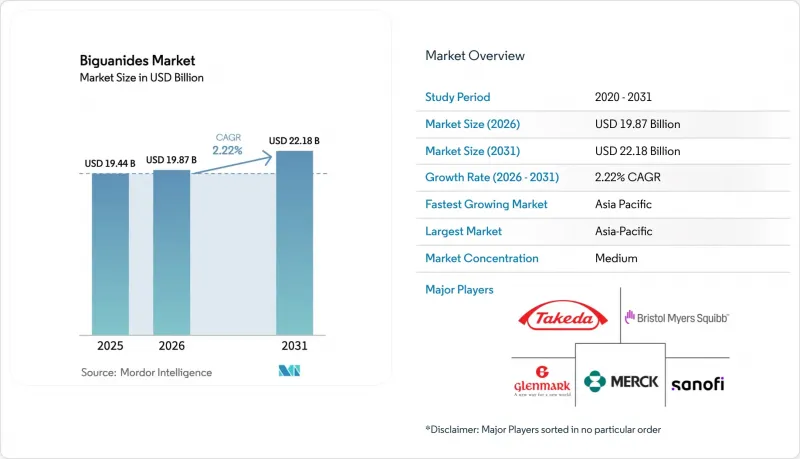
據 Mordor Intelligence 稱,2025 年雙胍類藥物市值為 194.4 億美元,預計到 2031 年將達到 221.8 億美元,而 2026 年為 198.7 億美元,預測期(2026-2031 年)的複合年成長率為 2.22%。
本報告按分子類型(二甲雙胍、苯乙雙胍、丁雙胍)、劑型(速釋片、其他)、適應症(第二型糖尿病、糖尿病前期、其他)、製劑類型(單藥治療、複方組合藥物)、分銷管道(醫院藥房、其他)和地區(北美、歐洲、其他)進行分類。市場預測以美元計價。
全球雙胍類藥物市場趨勢及洞察
全球第2型糖尿病(T2DM)盛行率正在上升。
預計到2045年,全球糖尿病患者人數將達到7.83億,二甲雙胍製劑的需求預計將持續旺盛。這一趨勢在亞太地區尤為顯著,因為該地區的糖尿病發病率成長最為迅速。在新興市場,由於學名藥的銷量顯著成長;而在已開發市場,能夠同時提供血糖控制和心血管獲益的高階固定劑量組合藥物更受青睞。儘管聯合治療發展勢頭強勁,但由於指引已再次確認二甲雙胍為第一線治療藥物,基準需求仍強勁。因此,生產商正採取雙管齊下的策略:一方面,維持面向注重成本的醫療保健系統的大宗旗艦片劑銷售;另一方面,推廣面向富裕消費者的優質製劑。隨著糖尿病在全球蔓延,各國政府面臨日益成長的醫療保健成本,雙胍類藥物市場的擴張必將與預防和早期療育計畫緊密相關。
在大多數糖尿病指南中,它佔據著一線治療藥物的主導地位。
2025 年糖尿病指引繼續將二甲雙胍置於初始藥物治療的核心地位,這一定位確保了其穩定的供應。修訂後的指南建議儘早引入其他藥物,例如 SGLT-2 抑制劑,從而增加了包含二甲雙胍的雙聯和聯合治療的機會。在採取預防策略的醫療保健系統中,二甲雙胍的臨床效用擴展至糖尿病前期,擴大了潛在適用人群。不同地區也存在差異。歐洲強調成本效益,北美強調基於結果的證據,而新興市場則優先考慮可負擔性而非療效最佳化。總體而言,指南的一致性確保了對二甲雙胍的需求,同時鼓勵製藥公司在聯合用藥比例、給藥便利性以及針對除糖尿病患者群體以外的其他病患小組進行創新。
由於 NDMA 雜質導致的回收率降低,削弱了配藥醫師的信心。
自2020年以來,一系列召回事件發生後,多個批次的二甲雙胍被發現含有超過監管限值的NDMA,迫使梯瓦製藥(Teva)和Apotex等公司召回其產品。最新研究表明,當藥片與亞硝酸鹽接觸時,NDMA可能在體內生成,這導致安全監測更加嚴格。為此,生產商已在其製粒過程中採用抗壞血酸等抗氧化劑,並加強了氣相檢測規程,但臨床醫生仍保持警惕。目前,美國和歐洲的監管機構要求在產品上市前提供逐批合格證書,延長了前置作業時間。雖然供應已趨於穩定,但人們對該藥物的認知不斷提高,正在加速轉向替代藥物,同時合規成本也在上升,因此預計雙胍類藥物市場的成長勢頭在短期內將會放緩。
細分市場分析
到2025年,二甲雙胍將佔據雙胍類藥物市場95.02%的佔有率,憑藉其無可比擬的臨床認可度和可負擔性,鞏固主導地位。二甲雙胍7.22%的複合年成長率表明,由於代謝腫瘤學領域未被滿足的需求以及特定地區的批准,小分子化合物的市場佔有率正在擴大。苯乙雙胍雖然過去曾因安全問題撤出市場,但由於其粒線體通透性高,抗腫瘤效果增強,如今在抗癌計畫中再次受到過程。主要供應商正在透過適度投資這些二甲雙胍類藥物來分散其投資組合風險,同時繼續大量生產二甲雙胍。小眾分子藥物具有更大的定價柔軟性,但其適應症有限,限制了其絕對銷售潛力。觀察人士預計二甲雙胍的市場佔有率將逐漸下降,但由於其廣泛的適應症支撐了其製劑銷量,因此在整個預測期內仍將保持其主導地位。僅二甲雙胍一項,其在雙胍類藥物市場的佔有率就超過 150 億美元,凸顯了該分子的結構重要性。
第二代化合物正吸引大量研究經費,旨在最佳化其生物利用度、誘導組織特異性AMPK活化以及降低乳酸性酸中毒的風險。一個歐洲研究聯盟正在研究微劑量丁雙胍預防肝細胞癌的療效,而一個日本研究團隊則在檢驗苯乙雙胍與查核點抑制劑的聯合治療。監管部門的批准取決於其安全性,初步結果表明,透過適當的劑量管理,其安全性可控。如果獲准在腫瘤領域進行臨床試驗,高定價策略或許能夠彌補患者群體較小的不足,從而為雙胍類藥物市場帶來穩定且持續的收入成長。
由於其成熟的製劑製程和最低的每毫克成本,速釋片在2025年仍維持59.85%的市佔率。同時,緩釋片的市佔率正以6.48%的複合年成長率成長,因為其每日一次的給藥方案提高了患者的依從性,並最大限度地減少了胃腸道不適。其獨特的親水性基質和雷射穿孔滲透泵實現了可控的溶出,從而提高了單價並延長了專利期限。 1000毫克的高劑量製劑減輕了用藥負擔,並符合超重患者的體重給藥指南。包括緩釋製劑在內的雙胍類藥物市場預計將從2026年的52.9億美元成長到2031年的72.3億美元。
口服液劑型雖然市佔率較小,但卻能滿足吞嚥藥片困難的兒童和老年人的需求。新型掩味輔料和低容量濃縮液旨在提高其接受度。顆粒劑型專為資源匱乏地區設計,可避免缺水問題,並簡化鄉村診所的給藥流程。總體而言,劑型多樣化有助於強化品牌識別,並使製造商能夠在成熟的治療領域中實現價格以外的差異化競爭。
區域分析
預計到2025年,亞太地區將佔全球銷售額的35.10%,複合年成長率(CAGR)為7.88%。這主要得益於中國的集中採購體系,該體系在擴大採購量的同時降低了價格;以及印度龐大的未治療糖尿病患者群體。快速的都市化和生活方式的改變正在推高糖尿病診斷率,即使實施了價格上限,新劑型的增加也勢在必行。東南亞各國政府正在將二甲雙胍納入全民健保計劃,並優先考慮價格可負擔性而非高價製劑。
北美是一個以價值為導向、成長緩慢的市場,成熟的支付者更傾向於選擇能夠改善心臟和腎臟功能的藥物。含二甲雙胍的固定劑量組合藥物仍然重要,但GLP-1受體促效劑在複方製劑中的優先順序越來越高。 NDMA召回事件的後續影響加速了醫院的藥物使用計劃,並提高了對供應商的文件要求。儘管銷量保持平穩,但由於平均售價上漲,收入仍然強勁。
在歐洲,創新與預算管理之間需要取得平衡。在國家醫療保健體系中,會協商基於用量的折扣,而緩釋製劑和複方片劑的報銷則需透過藥物經濟模型證明其能降低併發症率。歐洲藥品管理局(EMA)批准了以患者為中心的治療方案,例如每週一次的胰島素注射,這拓寬了治療選擇範圍,並促進了包含二甲雙胍的聯合治療。
在中東和非洲,糖尿病盛行率不斷上升,而基礎建設卻不完善。波灣合作理事會(GCC)成員國進口高品質品牌藥品,而撒哈拉以南非洲市場則依賴捐助者資助的學名藥。由於冷鏈不足和仿冒品商品流通,藥品供應穩定仍面臨挑戰。
在南美洲,尤其是在巴西,二甲雙胍在妊娠糖尿病治療方案的應用在巴西統一醫療系統(SUS)下日益普及。儘管價格管制限制了利潤空間,但公共採購涵蓋了龐大的人口,確保了受監管生產商的供貨量穩定。整體而言,區域差異迫使企業根據當地需求調整包裝、定價和分銷物流,從而在局部不利因素的情況下,維持了雙胍類藥物市場的整體擴張。
其他好處
- Excel格式的市場預測(ME)表
- 3個月的分析師支持
目錄
第1章:引言
- 研究假設和市場定義
- 調查範圍
第2章:調查方法
第3章執行摘要
第4章 市場狀況
- 市場概覽
- 市場促進因素
- 全球第2型糖尿病(T2DM)盛行率正在上升。
- 在大多數糖尿病指南中,它佔據著一線治療藥物的主導地位。
- 透過在低收入和中等收入國家快速推廣學名藥,實現藥品可負擔性。
- 二甲雙胍在女性健康領域(卵巢症候群(PCOS)、妊娠糖尿病(GDM))的使用日益增多
- 對雙胍類藥物作為抗衰老和抗癌藥物的研究
- 利用人工智慧逆轉分子應用,加速固定劑量組合藥物的開發。
- 市場限制因素
- 由於 NDMA 雜質導致的回收率降低,削弱了配藥醫師的信心。
- GLP-1 受體促效劑和 SGLT-2 抑制劑作為第一線治療藥物越來越受歡迎。
- 印度、中國和巴西的價格管制措施正在給利潤率帶來壓力。
- 電子商務通路中的非標準/仿冒二甲雙胍
- 波特五力模型
第5章 市場規模與成長預測
- 按分子
- 二甲雙胍
- 苯乙雙胍
- 丁雙胍
- 按劑型
- 速釋片
- 緩釋片
- 口服液
- 適應症
- 2型糖尿病
- 糖尿病前期
- 卵巢症候群(PCOS)
- 妊娠期糖尿病(GDM)
- 依配方類型
- 單藥治療
- 固定劑量組合藥物(FDCs)
- 透過分銷管道
- 醫院藥房
- 零售藥房
- 網路藥房
- 按地區
- 北美洲
- 美國
- 加拿大
- 墨西哥
- 歐洲
- 德國
- 英國
- 法國
- 義大利
- 西班牙
- 其他歐洲國家
- 亞太地區
- 中國
- 日本
- 印度
- 韓國
- 澳洲
- 其他亞太國家
- 中東和非洲
- GCC
- 南非
- 其他中東和非洲國家
- 南美洲
- 巴西
- 阿根廷
- 南美洲其他地區
- 北美洲
第6章 競爭情勢
- 市場集中度
- 市佔率分析
- 公司簡介
- Teva Pharmaceutical Industries
- Merck & Co.
- Takeda Pharmaceutical
- GSK plc
- Sanofi
- Boehringer Ingelheim
- Glenmark Pharma
- Zydus Lifesciences
- Bristol-Myers Squibb
- Sun Pharma
- Aurobindo Pharma
- Lupin Ltd.
- Ajanta Pharma
- Granules India
- Apotex
- IOL Chemicals & Pharma
- Sandoz AG
- Dr. Reddy's Laboratories
第7章 市場機會與未來展望
According to Mordor Intelligence, the biguanides market size was valued at USD 19.44 billion in 2025 and estimated to grow from USD 19.87 billion in 2026 to reach USD 22.18 billion by 2031, at a CAGR of 2.22% during the forecast period (2026-2031).
This report is Segmented by Molecule (Metformin, Phenformin, and Buformin), Dosage Form (Immediate-Release Tablets, and More), Indication (Type-2 Diabetes Mellitus, Prediabetes, and More), Formulation Type (Monotherapy and Fixed-Dose Combinations), Distribution Channel (Hospital Pharmacies, and More), and Geography (North America, Europe, and More). The Market Forecasts are Provided in Terms of Value (USD).
Global Biguanides Market Trends and Insights
Rising Global Prevalence of Type-2 Diabetes (T2DM)
The projected rise to 783 million diabetes cases by 2045 sustains prescription volumes for metformin, particularly in Asia-Pacific where incidence is climbing fastest. Emerging markets deliver high unit growth because competitive generics reduce entry price; developed markets prefer premium fixed-dose combinations that couple glycemic control with cardiovascular benefit. Guideline reaffirmation of metformin as first-line therapy sustains baseline demand even while combination therapy gains momentum. Manufacturers therefore pursue dual strategy: defend high-volume core tablets for cost-sensitive health systems and promote value-added formats in wealthier segments. The global footprint of diabetes ensures that biguanides market expansion remains linked to prevention and early intervention programs as governments confront mounting healthcare costs.
Favourable First-Line Therapy Status in Most Diabetes Guidelines
Diabetes guidelines for 2025 kept metformin at the center of initial pharmacologic treatment, a position that guarantees continued volume stability. The same updates advocate earlier introduction of add-on agents such as SGLT-2 inhibitors, increasing opportunities for dual and triple combinations that embed metformin. Health systems adopting preventive approaches extend metformin's clinical utility to prediabetes, enlarging its candidate pool. Regional nuances appear: Europe stresses cost-effectiveness, North America rewards outcome-based evidence, and emerging markets weigh affordability over optimization. Overall, guideline alignment secures metformin demand while encouraging manufacturers to innovate around combination ratios, dosing convenience, and patient groups beyond core diabetes.
NDMA Impurity Recalls Denting Prescriber Confidence
Successive recalls since 2020 exposed NDMA levels above regulatory limits in several metformin batches, forcing stock withdrawals from Teva, Apotex, and others. New research shows NDMA can form in-vivo when tablets encounter nitrites, intensifying safety scrutiny. Manufacturers responded by adopting antioxidants such as ascorbic acid in granulation and installing tighter gas-phase testing protocols, but clinician wariness lingers. U.S. and European regulators now require lot-specific certificates before market release, lengthening lead times. While supply has stabilized, heightened awareness accelerates switching to alternative drug classes and raises compliance costs, moderating the biguanides market trajectory in the near term.
Other drivers and restraints analyzed in the detailed report include:
- Rapid Genericisation Driving Affordability in LMICs
- Increasing Use of Metformin in Women's Health (PCOS, GDM)
- Rising Popularity of GLP-1 RAs & SGLT-2s as First-Line Options
For complete list of drivers and restraints, kindly check the Table Of Contents.
Segment Analysis
Metformin generated 95.02% of biguanides market revenue in 2025, underpinning class leadership through unmatched clinical familiarity and affordability. Buformin's 7.22% CAGR highlights how unmet needs in metabolic oncology and specific regional approvals allow smaller molecules to carve shares. Phenformin finds renewed interest in anticancer programs despite historic safety withdrawals, leveraging deeper mitochondrial penetration for enhanced tumoricidal effect. Major suppliers hedge portfolios by investing modest sums into these secondary biguanides while continuing high-volume metformin manufacture. Pricing flexibility is greater in niche molecules, but limited indication scope constrains absolute revenue potential. Observers expect metformin's share to taper gradually yet remain dominant throughout the forecast window as broader labels sustain prescriptions. The biguanides market size attached to metformin alone still exceeds USD 15 billion, underscoring the molecule's structural importance.
Second-generation molecules attract research funding aimed at optimizing bioavailability, targeting tissue-specific AMPK activation, and reducing lactic acidosis risk. European consortia explore buformin micro-dosing for hepatocellular carcinoma prevention, while Japanese groups test phenformin in combination with checkpoint inhibitors. Regulatory acceptance rests on demonstrable safety margins, and early results suggest manageable profiles with proper dosing controls. If oncology trials yield approval, premium pricing could offset smaller patient pools, contributing fresh but measured top-line additions to the biguanides market.
Immediate-release tablets retained a 59.85% share in 2025 owing to entrenched prescribing habits and the lowest cost per milligram. Extended-release tablets, though, are advancing at 6.48% CAGR as once-daily regimens boost adherence and minimize gastrointestinal discomfort. Proprietary hydrophilic matrices and laser-drilled osmotic pumps sustain controlled dissolution, commanding higher unit prices and lengthier patent life. High-strength 1,000 mg formats reduce pill burden and align with weight-based dosing guidelines in overweight populations. The biguanides market size tied to extended-release lines is projected to rise from USD 5.29 billion in 2026 to USD 7.23 billion by 2031.
Oral solutions, though minor, serve pediatric and geriatric segments unable to swallow tablets. Novel taste-masking excipients and small-volume concentrates aim to widen acceptance. Sachet granules tailored for low-resource settings bypass water scarcity issues and simplify dosing in rural clinics. Collectively, dosage-form diversification strengthens brand identity, allowing manufacturers to differentiate beyond price in a maturing therapeutic category.
Complete Report Scope:
- By Molecule
- Metformin
- Phenformin
- Buformin
- By Dosage Form
- Immediate-Release Tablets
- Extended-Release Tablets
- Oral Solution
- By Indication
- Type-2 Diabetes Mellitus
- Prediabetes
- Polycystic Ovary Syndrome (PCOS)
- Gestational Diabetes Mellitus (GDM)
- By Formulation Type
- Monotherapy
- Fixed-Dose Combinations (FDCs)
- By Distribution Channel
- Hospital Pharmacies
- Retail Pharmacies
- Online Pharmacies
- Geography
- North America
- United States
- Canada
- Mexico
- Europe
- Germany
- United Kingdom
- France
- Italy
- Spain
- Rest of Europe
- Asia-Pacific
- China
- Japan
- India
- South Korea
- Australia
- Rest of Asia-Pacific
- Middle East and Africa
- GCC
- South Africa
- Rest of Middle East and Africa
- South America
- Brazil
- Argentina
- Rest of South America
- North America
Geography Analysis
Asia-Pacific generated 35.10% of 2025 revenue and is on track to deliver an 7.88% CAGR, driven by China's centralized procurement that cut prices yet expanded volume and India's vast untreated diabetic base. Rapid urbanization coupled with lifestyle shifts boosts diagnosis rates, ensuring prescription growth even under price caps. Southeast Asian governments subsidize metformin within universal coverage schemes, emphasizing affordability over premium formulations.
North America embodies a value-focused yet slower-growing arena where sophisticated payers favor agents offering cardiorenal benefit. Fixed-dose combinations that integrate metformin maintain relevance, but GLP-1 receptor agonists increasingly command formulary preference. NDMA recall fallout accelerated hospital stewardship programs, raising documentation thresholds for suppliers. Despite flat volumes, revenue holds steady owing to higher average selling prices.
Europe balances innovation adoption with budget oversight. National health systems negotiate volume-based discounts yet reimburse extended-release and combination tablets when pharmacoeconomic models demonstrate reduced complications. EMA approvals of patient-centric modalities such as weekly insulin augment the therapeutic toolbox and encourage combination regimens featuring metformin.
Middle East & Africa experience rising diabetes prevalence but variable infrastructure. Gulf Cooperation Council states import high-quality brands, while sub-Saharan markets rely on donor-financed generics. Supply security challenges persist due to cold-chain gaps and counterfeit penetration.
South America, led by Brazil, witnesses rising metformin uptake in gestational diabetes protocols under the SUS system. Price controls limit margins, but public procurement covers vast populations, offering volume certainty for compliant manufacturers. Collectively, regional heterogeneity obliges companies to tailor packaging, price tiers, and distribution logistics, sustaining overall biguanides market expansion despite localized headwinds.
- Teva Pharmaceutical Industries
- Merck
- Takeda Pharmaceuticals
- GlaxoSmithKline
- Sanofi
- Boehringer Ingelheim
- Glenmark Pharma
- Zydus Lifesciences
- Bristol-Myers Squibb
- Sun Pharmaceuticals Industries
- Aurobindo Pharma
- Lupin
- Ajanta Pharma
- Granules India
- Apotex
- IOL Chemicals & Pharma
- Sandoz Group
- Dr. Reddy's Laboratories
Additional Benefits:
- The market estimate (ME) sheet in Excel format
- 3 months of analyst support
TABLE OF CONTENTS
1 Introduction
- 1.1 Study Assumptions & Market Definition
- 1.2 Scope of the Study
2 Research Methodology
3 Executive Summary
4 Market Landscape
- 4.1 Market Overview
- 4.2 Market Drivers
- 4.2.1 Rising Global Prevalence Of Type-2 Diabetes (T2DM)
- 4.2.2 Favourable First-Line Therapy Status In Most Diabetes Guidelines
- 4.2.3 Rapid Genericisation Driving Affordability In LMICs
- 4.2.4 Increasing Use of Metformin In Women's Health (PCOS, GDM)
- 4.2.5 Exploration of Biguanides As Geroprotective & Anti-Cancer Agents
- 4.2.6 AI-Enabled Molecule Repurposing Accelerating Fixed-Dose Combos
- 4.3 Market Restraints
- 4.3.1 NDMA Impurity Recalls Denting Prescriber Confidence
- 4.3.2 Rising Popularity Of GLP-1 Ras & SGLT-2s As First-Line Options
- 4.3.3 Price-Control Policies In India, China And Brazil Compressing Margins
- 4.3.4 Sub-Standard / Counterfeit Metformin In E-Commerce Channels
- 4.4 Porter's Five Forces
- 4.4.1 Bargaining Power of Suppliers
- 4.4.2 Bargaining Power of Buyers
- 4.4.3 Threat of New Entrants
- 4.4.4 Threat of Substitutes
- 4.4.5 Competitive Rivalry
5 Market Size & Growth Forecasts (Value, USD)
- 5.1 By Molecule
- 5.1.1 Metformin
- 5.1.2 Phenformin
- 5.1.3 Buformin
- 5.2 By Dosage Form
- 5.2.1 Immediate-Release Tablets
- 5.2.2 Extended-Release Tablets
- 5.2.3 Oral Solution
- 5.3 By Indication
- 5.3.1 Type-2 Diabetes Mellitus
- 5.3.2 Prediabetes
- 5.3.3 Polycystic Ovary Syndrome (PCOS)
- 5.3.4 Gestational Diabetes Mellitus (GDM)
- 5.4 By Formulation Type
- 5.4.1 Monotherapy
- 5.4.2 Fixed-Dose Combinations (FDCs)
- 5.5 By Distribution Channel
- 5.5.1 Hospital Pharmacies
- 5.5.2 Retail Pharmacies
- 5.5.3 Online Pharmacies
- 5.6 Geography
- 5.6.1 North America
- 5.6.1.1 United States
- 5.6.1.2 Canada
- 5.6.1.3 Mexico
- 5.6.2 Europe
- 5.6.2.1 Germany
- 5.6.2.2 United Kingdom
- 5.6.2.3 France
- 5.6.2.4 Italy
- 5.6.2.5 Spain
- 5.6.2.6 Rest of Europe
- 5.6.3 Asia-Pacific
- 5.6.3.1 China
- 5.6.3.2 Japan
- 5.6.3.3 India
- 5.6.3.4 South Korea
- 5.6.3.5 Australia
- 5.6.3.6 Rest of Asia-Pacific
- 5.6.4 Middle East and Africa
- 5.6.4.1 GCC
- 5.6.4.2 South Africa
- 5.6.4.3 Rest of Middle East and Africa
- 5.6.5 South America
- 5.6.5.1 Brazil
- 5.6.5.2 Argentina
- 5.6.5.3 Rest of South America
- 5.6.1 North America
6 Competitive Landscape
- 6.1 Market Concentration
- 6.2 Market Share Analysis
- 6.3 Company Profiles (includes Global level Overview, Market level overview, Core Segments, Financials as available, Strategic Information, Market Rank/Share for key companies, Products & Services, and Recent Developments)
- 6.3.1 Teva Pharmaceutical Industries
- 6.3.2 Merck & Co.
- 6.3.3 Takeda Pharmaceutical
- 6.3.4 GSK plc
- 6.3.5 Sanofi
- 6.3.6 Boehringer Ingelheim
- 6.3.7 Glenmark Pharma
- 6.3.8 Zydus Lifesciences
- 6.3.9 Bristol-Myers Squibb
- 6.3.10 Sun Pharma
- 6.3.11 Aurobindo Pharma
- 6.3.12 Lupin Ltd.
- 6.3.13 Ajanta Pharma
- 6.3.14 Granules India
- 6.3.15 Apotex
- 6.3.16 IOL Chemicals & Pharma
- 6.3.17 Sandoz AG
- 6.3.18 Dr. Reddy's Laboratories
7 Market Opportunities & Future Outlook
- 7.1 White-space & Unmet-Need Assessment


