

 |
市場調查報告書
商品編碼
2154858
滾珠軸承:市佔率分析、產業趨勢與統計、成長預測(2026-2031)Ball Bearing - Market Share Analysis, Industry Trends & Statistics, Growth Forecasts (2026 - 2031) |
||||||

※ 本網頁內容可能與最新版本有所差異。詳細情況請與我們聯繫。
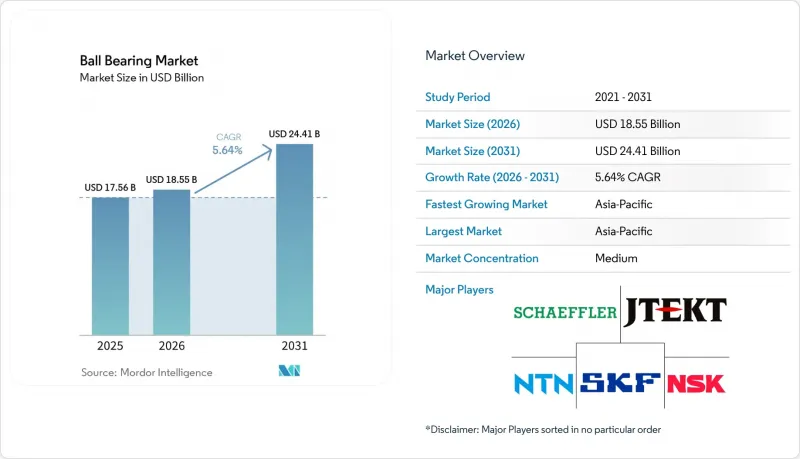
據 Mordor Intelligence 稱,2025 年滾珠軸承市值為 175.6 億美元,預計到 2031 年將達到 244.1 億美元,而 2026 年為 185.5 億美元,預測期(2026-2031 年)的複合年成長率為 5.64%。
全球滾珠軸承市場趨勢與洞察
汽車電氣化和高速電力驅動橋的引入
電動驅動架構不僅提高了現有的性能要求,也改變了軸承的規格。電驅動橋牽引馬達的轉速通常在 15,000 至 20,000 轉/分之間,但下一代設計正在發展,目標是超過 40,000 轉/分。為了適應如此高的轉速,保持架幾何形狀、潤滑劑保持性能和疲勞性能等方面都與內燃機動力動力傳動系統中使用的設計有所不同。 2026 年 6 月,捷太格特公司開始大量生產額定轉速為 40,000 轉/分的深溝球軸承,用於電動車的電力驅動橋。這些軸承採用樹脂保持架,與傳統設計相比,可將離心變形降低 70%。 2026 年 5 月,NTN 公司開始從其位於中國的製造地供應用於電力驅動橋的「樹脂模壓絕緣軸承」原型。這解決了電點蝕問題,並滿足了中國本土電動車和混合動力汽車製造商的需求。因此,滾珠軸承市場正在經歷專業領域的擴張,高速運作、電氣隔離和本地供給能力成為關鍵的採購要求。
工業自動化、機器人和智慧工廠的擴展
根據國際機器人聯合會(IFR)的數據,到2024年,全球工業機器人部署量將達到54.2萬台,其中466.4萬台運作。如此龐大的部署量不僅支撐了對新機器人的需求,也支撐了對軸承更換和升級的需求。協作機器人關節和高速選擇性柔順組裝機械臂系統需要公差小於10微米的小型或薄壁軸承。小型軸承也應用於伺服器冷卻風扇馬達和儲存設備主軸電機,並且其需求正在擴展到人工智慧(AI)資料中心的基礎設施領域。 2026年7月,MINEBEA MITSUMI INC.株式會社宣布投資580億日圓(約3.6億美元)擴建其位於東南亞的精密軸承製造工廠,旨在將產能提高30%,以滿足AI資料中心的需求。因此,滾珠軸承市場正在被應用於更廣泛的精密運動和基礎設施領域,而不僅限於傳統的工業設備領域。
軸承用鋼材和合金元素的成本波動
軸承製造商正受到GCr15高碳鉻鋼及相關合金材料成本的影響。根據美國地質調查局(USGS)報告顯示,鉻鐵價格從2022年的每磅3.19美元跌至2025年的每磅1.60美元。雖然這一跌幅暫時緩解了受現貨價格影響的生產商的壓力,但也顯示投入成本在產品開發週期內變化之快。鉻鐵產區的能源成本以及影響鉻鐵礦分銷的貿易政策變化可能會逆轉有利的成本狀況。沒有長期採購合約或鋼鐵供應鏈的小規模生產商受這些變化的影響更大。這種限制因素可能會進一步擴大大型製造商在滾珠軸承市場的成本優勢,並對低優先等級產品的品管施加壓力。
細分市場分析
到2025年,深溝球軸承將佔球軸承市場價值的32.67%。其徑向和軸向承載能力使其適用於汽車、電動馬達、家用電器、泵浦和工業設備。它們還能適應各種轉速、溫度和安裝方式。捷太格特公司(JTEKT Corporation)的40,000轉/分電橋產品展示了研發如何持續突破此類軸承的性能極限。角接觸球軸承、推力球軸承、微型球軸承和儀器球軸承則廣泛應用於精密主軸、變速箱、變速箱、資料中心風扇和醫療成像系統等領域。
預計到2031年,自調心球軸承的年複合成長率將達到6.12%。它們廣泛應用於農業機械、造紙和紡織設備以及礦用輸送機等領域,這些領域普遍存在軸撓曲現象。自調心球軸承的球形外圈允許一定的偏差,這是固定調心設計無法實現的。這減少了調心工作量,降低了維護資源有限的機械設備的擁有成本。東南亞和南亞智慧工廠的投資正在擴大對具備此功能的機械設備的市場需求。
區域分析
預計到2025年,亞太地區將佔據全球滾珠軸承市場41.78%的佔有率,並將以6.45%的複合年成長率持續成長至2031年。中國一體化電驅動橋平台的普及推動了對耐電蝕、高轉速深溝球軸承組件的需求。 NTN株式會社於2026年5月在中國建立了絕緣電驅動橋軸承的國內生產體系,而MINEBEA MITSUMI INC.株式會社則於2026年6月開始生產4萬轉/分的電力驅動橋軸承。日本是電動車、機器人和人工智慧(AI)基礎設施的製造中心和OEM需求中心,美蓓亞三美株式會社在2025年12月實現了3.5億個軸承的月產量。印度在2024年新增了3.4吉瓦的風電裝置容量,增幅達21%。同時,韓國和東南亞國協正在支持電子和汽車應用領域對軸承的需求。
北美滾珠軸承市場的需求主要受航太和國防採購、電動車製造以及工業自動化的驅動。美國擁有眾多高精度供應商,能夠滿足航太、醫療和國防應用領域嚴格的認證要求。 RBC軸承公司報告稱,2026會計年度淨銷售額達18.7億美元,其中航太和國防領域的銷售額成長了32.9%。製造業需求也正在推動加拿大和墨西哥的市場發展,而預測性維護則支撐了售後市場的更換需求。
在歐洲,汽車電氣化、精密機械和可再生能源設備的普及推動了對滾珠軸承的需求。德國憑藉其豪華汽車和工具機的生產,成為這項需求的關鍵驅動力。歐盟7排放標準也促進了對超低摩擦軸承的需求,而捨弗勒股份公司計劃在2026年底前將其位於施泰因哈根的生產基地整合到施韋因富特。北歐的離岸風力發電項目進一步刺激了需求,而在南美、中東和非洲,汽車組裝、農業機械、採礦、石油和天然氣加工以及新興的風發電工程是主要的需求促進因素。這些地區的滾珠軸承市場受到當地工業投資、精密軸承進口和物流條件的影響。
其他好處:
- Excel格式的市場預測(ME)表
- 3個月的分析師支持
目錄
第1章:引言
- 研究假設和市場定義
- 調查範圍
第2章:調查方法
第3章執行摘要
第4章 市場狀況
- 市場概覽
- 市場促進因素
- 汽車電氣化和高速電力驅動橋的引入
- 工業自動化、機器人和智慧工廠的擴展
- 擴大可再生能源和風力發電設施
- 對航太、國防和精密設備的需求
- 現有設備升級和預測性維護的需求
- 市場限制因素
- 軸承鋼和合金元素的成本波動
- 假冒軸承和分銷通路品質保證的差異
- 新型電動車和航太軸承設計中的認證瓶頸
- 價值鏈分析
- 波特五力分析
第5章 市場規模與成長預測
- 按類型
- 深溝球軸承
- 角接觸球軸承
- 自調心球軸承
- 推力球軸承
- 其他類型
- 材料
- 鉻鋼
- 不銹鋼
- 陶瓷製品
- 其他材料
- 透過使用
- 車
- 工業機械
- 採礦和建築
- 航太/國防
- 醫學領域
- 其他用途
- 按地區
- 亞太地區
- 中國
- 印度
- 日本
- 韓國
- 東南亞國協
- 其他亞太國家
- 北美洲
- 美國
- 加拿大
- 墨西哥
- 歐洲
- 德國
- 英國
- 法國
- 義大利
- 北歐國家
- 其他歐洲國家
- 南美洲
- 巴西
- 阿根廷
- 其他南美國家
- 中東和非洲
- 沙烏地阿拉伯
- 南非
- 其他中東和非洲國家
- 亞太地區
第6章 競爭情勢
- 市場集中度
- 策略趨勢
- 市佔率和排名分析
- 公司簡介
- C&U Group
- Harbin Bearing Manufacturing Co., Ltd.
- JTEKT Corporation
- MinebeaMitsumi Inc.
- Nachi America Inc.
- NACHI-FUJIKOSHI Corp.
- NSK Ltd.
- NTN Corporation
- RBC Bearings Incorporated
- Regal Rexnord Corporation
- Schaeffler AG
- SKF
- The Timken Company
- Wafangdian Bearing Group Corporation Limited
- ZWZ Bearings
第7章 市場機會與未來展望
According to Mordor Intelligence, the ball bearing market size was valued at USD 17.56 billion in 2025 and is estimated to grow from USD 18.55 billion in 2026 to reach USD 24.41 billion by 2031, at a CAGR of 5.64% during the forecast period (2026-2031).
Global Ball Bearing Market Trends and Insights
Automotive Electrification and High-Speed E-Axle Deployment
Electric drive architectures are changing bearing specifications rather than simply raising existing performance requirements. E-axle traction motors operate at 15,000-20,000 r/min, while next-generation designs are moving beyond 40,000 r/min. These speeds require different cage geometry, lubricant retention, and fatigue performance from designs used in internal combustion powertrains. JTEKT Corporation commenced mass production in June 2026 of a deep-groove ball bearing for electric vehicle e-axles rated at 40,000 r/min, using a resin cage designed to reduce centrifugal deformation by 70% against conventional designs. NTN Corporation began supplying prototype Resin Mold Insulated Bearings for e-axle applications from its China manufacturing operation in May 2026, addressing electrical pitting and the needs of local electric vehicle and hybrid electric vehicle producers. The ball bearing market is therefore gaining specialized positions where high-speed operation, electrical insulation, and local supply capability are important purchasing requirements.
Industrial Automation, Robotics, and Smart Factory Expansion
The International Federation of Robotics reported that 542,000 industrial robots were installed globally in 2024, and 4,664,000 units were in operation. This installed base supports demand for replacement bearings and upgrades alongside demand from new robot installations. Collaborative robot joints and high-speed Selective Compliance Assembly Robot Arm systems require miniature or thin-section bearings with sub-10-micron tolerances. Server cooling fan motors and storage-device spindle motors also use miniature bearings, extending demand into artificial intelligence data center infrastructure. MinebeaMitsumi Inc. announced in July 2026 that it would invest JPY 58 billion (approximately USD 360 million) in a Southeast Asian precision-bearing facility intended to increase capacity by 30% in response to artificial intelligence data center demand. The ball bearing market is consequently serving a broader set of precision-motion and infrastructure applications than its traditional industrial equipment base.
Volatility in Bearing-Grade Steel and Alloying-Element Costs
Bearing manufacturers are exposed to the cost of GCr15 high-carbon chromium steel and related alloying materials. The U.S. Geological Survey reported that ferrochromium prices declined from USD 3.19 per pound in 2022 to USD 1.60 per pound in 2025. The decline gave temporary relief to producers with spot-price exposure, but the movement also shows how sharply input costs can change over a product development cycle. Energy costs in ferrochromium-producing regions and trade-policy changes affecting chromite flows can reverse a favorable cost position. Smaller producers without long-term procurement contracts or integrated steel supply are more exposed to these changes. This restraint can widen the cost advantage of scale manufacturers in the ball bearing market and create pressure on quality controls for lower-priority grades.
Other drivers and restraints analyzed in the detailed report include:
- Renewable Energy and Wind-Turbine Capacity Additions
- Aerospace, Defense, and Precision-Equipment Demand
- Counterfeit Bearings and Uneven Quality Assurance Across Distribution Channels
For complete list of drivers and restraints, kindly check the Table Of Contents.
Segment Analysis
Deep groove ball bearings held 32.67% of the ball bearing market value in 2025. Their radial and axial load capability supports use in vehicles, electric motors, appliances, pumps, and industrial equipment. They operate across a wide range of speeds, temperatures, and mounting configurations. JTEKT Corporation's 40,000 r/min e-axle product shows that development is raising performance limits for this type. Angular contact, thrust, miniature, and instrument ball bearings serve precision spindles, transmissions, gearboxes, data center fans, and medical imaging systems.
Self-aligning ball bearings are projected to advance at a 6.12% CAGR through 2031. They are used in agricultural machinery, paper and textile equipment, and mining conveyors where shaft deflection is common. Their spherical outer raceway permits misalignment that fixed-alignment designs cannot manage. This reduces alignment work and can lower ownership costs for machinery with limited maintenance support. Smart-factory investment in Southeast Asia and South Asia is expanding the machinery base that needs this capability.
Complete Report Scope:
- By Type
- Deep Groove Ball Bearings
- Angular Contact Ball Bearings
- Self-Aligning Ball Bearings
- Thrust Ball Bearings
- Other Types
- By Material
- Chrome Steel
- Stainless Steel
- Ceramic
- Other Materials
- By Application
- Automotive
- Industrial Machinery
- Mining and Construction
- Aerospace and Defense
- Medical
- Other Applications
- By Geography
- Asia-Pacific
- China
- India
- Japan
- South Korea
- ASEAN Countries
- Rest of Asia-Pacific
- North America
- United States
- Canada
- Mexico
- Europe
- Germany
- United Kingdom
- France
- Italy
- NORDIC Countries
- Rest of Europe
- South America
- Brazil
- Argentina
- Rest of South America
- Middle East and Africa
- Saudi Arabia
- South Africa
- Rest of Middle East and Africa
- Asia-Pacific
Geography Analysis
Asia-Pacific held 41.78% of the ball bearing market share in 2025 and is projected to advance at a 6.45% CAGR through 2031. China's integrated e-axle platforms are increasing demand for electrical-pitting-resistant and high-speed deep-groove assemblies. NTN Corporation established a Chinese manufacturing capability for insulated e-axle bearings in May 2026, while JTEKT Corporation commenced 40,000 r/min e-axle bearing production in June 2026. Japan is a manufacturing and original equipment manufacturer demand center for electric vehicles, robotics, and artificial intelligence infrastructure, with MinebeaMitsumi Inc. recording a monthly output of 350 million bearing units in December 2025. India added 3.4 GW of wind capacity in 2024, a 21% increase, while South Korea and ASEAN countries support electronics and automotive bearing demand.
North America's ball bearing market demand is led by aerospace and defense procurement, electric vehicle manufacturing, and industrial automation. The United States has high-precision suppliers serving aerospace, medical, and defense applications with demanding approval requirements. RBC Bearings Incorporated recorded USD 1.87 billion in fiscal year 2026 net sales, including 32.9% growth in Aerospace and Defense revenue. Canada and Mexico add manufacturing demand, while predictive maintenance supports a replacement aftermarket.
Europe drives ball bearing market demand through automotive electrification, precision machinery, and renewable-energy equipment. Germany anchors demand through premium automotive manufacturing and machine-tool production. Euro 7 standards are supporting ultra-low-friction bearing demand, while Schaeffler AG will integrate Steinhagen production into Schweinfurt by the end of 2026. Nordic offshore wind projects provide further demand, while South America and Middle East and Africa depend on vehicle assembly, agricultural equipment, mining, oil and gas processing, and emerging wind projects. Local industrial investment, precision-bearing imports, and logistics conditions influence the ball bearing market across these regions.
- C&U Group
- Harbin Bearing Manufacturing Co., Ltd.
- JTEKT Corporation
- MinebeaMitsumi Inc.
- Nachi America Inc.
- NACHI-FUJIKOSHI Corp.
- NSK Ltd.
- NTN Corporation
- RBC Bearings Incorporated
- Regal Rexnord Corporation
- Schaeffler AG
- SKF
- The Timken Company
- Wafangdian Bearing Group Corporation Limited
- ZWZ Bearings
Additional Benefits:
- The market estimate (ME) sheet in Excel format
- 3 months of analyst support
TABLE OF CONTENTS
1 Introduction
- 1.1 Study Assumptions and Market Definition
- 1.2 Scope of the Study
2 Research Methodology
3 Executive Summary
4 Market Landscape
- 4.1 Market Overview
- 4.2 Market Drivers
- 4.2.1 Automotive Electrification and High-Speed E-Axle Deployment
- 4.2.2 Industrial Automation, Robotics, and Smart Factory Expansion
- 4.2.3 Renewable Energy and Wind-Turbine Capacity Additions
- 4.2.4 Aerospace, Defense, and Precision-Equipment Demand
- 4.2.5 Installed-Base Replacement and Predictive-Maintenance Demand
- 4.3 Market Restraints
- 4.3.1 Volatility in Bearing-Grade Steel and Alloying-Element Costs
- 4.3.2 Counterfeit Bearings and Uneven Quality Assurance Across Distribution Channels
- 4.3.3 Qualification Bottlenecks for New EV and Aerospace Bearing Designs
- 4.4 Value Chain Analysis
- 4.5 Porter's Five Forces Analysis
- 4.5.1 Threat of New Entrants
- 4.5.2 Bargaining Power of Suppliers
- 4.5.3 Bargaining Power of Buyers
- 4.5.4 Threat of Substitutes
- 4.5.5 Competitive Rivalry
5 Market Size and Growth Forecasts (Value)
- 5.1 By Type
- 5.1.1 Deep Groove Ball Bearings
- 5.1.2 Angular Contact Ball Bearings
- 5.1.3 Self-Aligning Ball Bearings
- 5.1.4 Thrust Ball Bearings
- 5.1.5 Other Types
- 5.2 By Material
- 5.2.1 Chrome Steel
- 5.2.2 Stainless Steel
- 5.2.3 Ceramic
- 5.2.4 Other Materials
- 5.3 By Application
- 5.3.1 Automotive
- 5.3.2 Industrial Machinery
- 5.3.3 Mining and Construction
- 5.3.4 Aerospace and Defense
- 5.3.5 Medical
- 5.3.6 Other Applications
- 5.4 By Geography
- 5.4.1 Asia-Pacific
- 5.4.1.1 China
- 5.4.1.2 India
- 5.4.1.3 Japan
- 5.4.1.4 South Korea
- 5.4.1.5 ASEAN Countries
- 5.4.1.6 Rest of Asia-Pacific
- 5.4.2 North America
- 5.4.2.1 United States
- 5.4.2.2 Canada
- 5.4.2.3 Mexico
- 5.4.3 Europe
- 5.4.3.1 Germany
- 5.4.3.2 United Kingdom
- 5.4.3.3 France
- 5.4.3.4 Italy
- 5.4.3.5 NORDIC Countries
- 5.4.3.6 Rest of Europe
- 5.4.4 South America
- 5.4.4.1 Brazil
- 5.4.4.2 Argentina
- 5.4.4.3 Rest of South America
- 5.4.5 Middle East and Africa
- 5.4.5.1 Saudi Arabia
- 5.4.5.2 South Africa
- 5.4.5.3 Rest of Middle East and Africa
- 5.4.1 Asia-Pacific
6 Competitive Landscape
- 6.1 Market Concentration
- 6.2 Strategic Moves
- 6.3 Market Share (%)/Ranking Analysis
- 6.4 Company Profiles (includes Global Overview, Market Overview, Core Segments, Financials as available, Strategic Information, Products and Services, and Recent Developments)
- 6.4.1 C&U Group
- 6.4.2 Harbin Bearing Manufacturing Co., Ltd.
- 6.4.3 JTEKT Corporation
- 6.4.4 MinebeaMitsumi Inc.
- 6.4.5 Nachi America Inc.
- 6.4.6 NACHI-FUJIKOSHI Corp.
- 6.4.7 NSK Ltd.
- 6.4.8 NTN Corporation
- 6.4.9 RBC Bearings Incorporated
- 6.4.10 Regal Rexnord Corporation
- 6.4.11 Schaeffler AG
- 6.4.12 SKF
- 6.4.13 The Timken Company
- 6.4.14 Wafangdian Bearing Group Corporation Limited
- 6.4.15 ZWZ Bearings
7 Market Opportunities and Future Outlook
- 7.1 White-Space and Unmet-Need Assessment

 全球滾珠軸承市場規模、佔有率、趨勢及成長分析報告(2026-2034)
 滾珠軸承市場(截至2034年)
 滾珠軸承市場機會、成長促進因素、產業趨勢分析及2026-2035年預測。
 2026-2030年全球滾珠軸承市場
 陶瓷球軸承市場報告:按原料、產品類型、應用和地區分類(2026-2034 年)小型滾珠軸承市場報告:按類型、應用和地區分類(2026-2034 年)滾珠軸承市場規模、佔有率、趨勢和預測:按應用和地區分類,2026-2034年
 球頭及相關零件市場:依車輛類型、類型、材質及通路分類-2026年至2032年全球市場預測滾珠軸承市場:按類型、材料、密封方式、尺寸範圍、終端用戶產業和銷售管道分類-2026-2032年全球市場預測微型滾珠軸承市場:按類型、密封件、材質、精度等級、潤滑類型、應用、終端用戶產業和銷售管道分類-2026-2032年全球預測