


 |
市場調查報告書
商品編碼
2109249
滾珠軸承市場機會、成長促進因素、產業趨勢分析及2026-2035年預測。Ball Bearing Market Opportunity, Growth Drivers, Industry Trend Analysis, and Forecast 2026 - 2035 |
||||||

全球滾珠軸承市場預計到 2025 年將價值 175 億美元,預計到 2035 年將以 5% 的複合年成長率成長至 286 億美元。
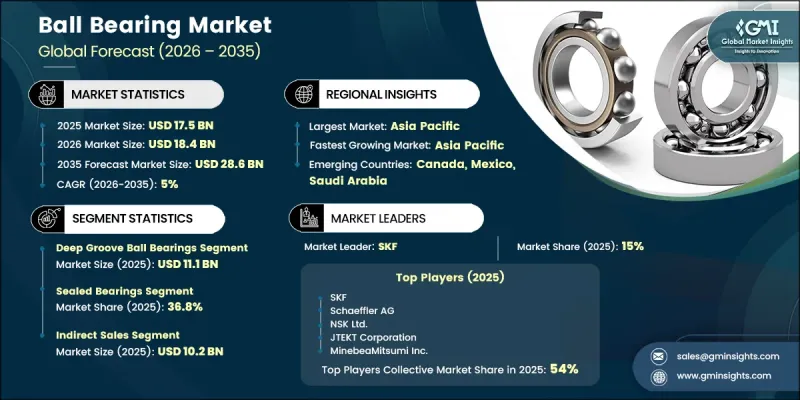
隨著汽車電氣化、工業自動化以及向清潔能源轉型不斷改變各行各業的需求模式,滾珠軸承市場持續擴張。電動動力傳動系統技術的日益普及為先進軸承解決方案創造了新的機遇,因為電動動力傳動系統需要比傳統汽車系統更精密的零件。這種變化提高了每輛車每個軸承的平均價值,並推動了對角接觸軸承和陶瓷混合軸承等先進軸承的需求。工業自動化也創造了強勁且永續的需求基礎,精密機械、機器人系統和自動化設備都需要高性能軸承解決方案。隨著製造商不斷提高營運效率並採用先進的生產技術,對更高精度、更耐用、更可靠的軸承的需求日益成長。向清潔能源系統和低碳製造方式的轉型進一步影響了產品規格,並推動了整個軸承供應鏈的創新。這些趨勢支撐著市場的長期成長,並增加了汽車、工業和能源產業對技術先進的軸承設計的需求。
| 市場範圍 | |
|---|---|
| 開始年份 | 2025 |
| 預測期 | 2026-2035 |
| 上市時的市場規模 | 175億美元 |
| 預測金額 | 286億美元 |
| 複合年成長率 | 5% |
到2025年,密封軸承市佔率將達到36.8%。由於馬達、工業設備和各種消費應用領域對低維護軸承解決方案的需求不斷成長,該細分市場將繼續保持主導地位。密封軸承的設計旨在使其在整個使用壽命期間保持潤滑劑,同時防止灰塵、濕氣和其他污染物進入。其降低維護需求和提高運作效率的特性,使其成為難以或難以進行常規潤滑的應用的理想選擇。設備製造商正擴大將免維護設計納入其產品規格,進一步推動了密封軸承配置的普及。
預計到2025年,深溝球軸承市場規模將達111億美元。由於其在各類旋轉設備中的廣泛應用,該細分市場仍保持最大佔有率。深溝球軸承因其能夠承受徑向和軸向負荷,並支援高速運轉而備受青睞。其多功能設計使其成為眾多應用領域的標準選擇,包括工業機械、馬達、交通運輸系統和家用電器。電氣化趨勢的不斷增強,以及馬達、輔助系統和動力裝置的持續普及,進一步擴大了對深溝球軸承解決方案的需求,並推動了該細分市場的成長。
預計2025年,美國滾珠軸承市佔率將達到74.3%,市場規模將達30億美元。美國持續引領區域市場,主要得益於其在工業自動化、先進製造、半導體生產和國防相關產業的大力投資。半導體製造設施的不斷擴建進一步推動了對用於先進生產設備和受控制造環境的高精度軸承解決方案的需求。全國各地新建製造設施的擴張也支撐了對能夠滿足嚴格性能要求(包括高精度、污染控制和高級精度等級)的特種軸承的需求。
目錄
第1章:調查方法和範圍
第2章執行摘要
第3章 行業洞察
- 產業生態系分析
- 供應商情況
- 利潤率
- 每個階段增加的價值
- 影響價值鏈的因素
- 影響產業的因素
- 促進因素
- 汽車生產擴張
- 工業自動化和工業4.0
- 工業機械需求不斷成長
- 產業潛在風險與挑戰
- 原物料價格波動
- 技術複雜性
- 機會
- 電動汽車軸承
- 智慧軸承和物聯網整合
- 促進因素
- 成長潛力分析
- 監理框架
- 滾珠軸承製造的 ISO 和 ANSI/ABMA 標準
- REACH 和 RoHS 合規性—對潤滑劑和塗料的影響
- 歐洲工業4.0和CE標誌要求
- 貿易政策與進出口法規(美國、歐盟、中國)
- 價格分析
- 2022-2025年歷史價格趨勢分析
- 依球員類型分類的定價策略(高級球員、超值球員、成本加成球員)
- 貿易數據分析
- 滾珠軸承進出口量及進口額趨勢
- 主要貿易路線及關稅影響(美中貿易、歐盟-亞洲貿易、亞洲內部貿易)
- 人工智慧和生成式人工智慧對市場的影響
- 人工智慧驅動的轉型:預測性維護、品管和設計最佳化。
- 按最終用戶群體分類的生成式人工智慧用例和部署藍圖
- 風險、限制和監管考量
- 生產能力和生產情況
- 按地區和主要生產商分類的製造能力
- 運轉率和擴張計劃
第4章 競爭情勢
- 介紹
- 企業市佔率分析
- 按地區
- 企業矩陣分析
- 主要市場公司的競爭分析
- 競爭定位矩陣
- 主要進展
- 併購
- 夥伴關係和聯盟
- 新產品發布
- 業務拓展計劃
第5章 市場估價與預測:依軸承類型分類,2022-2035年
- 深溝球軸承
- 角接觸球軸承
- 自調心球軸承
- 推力球軸承
- 四點接觸球軸承
- 其他(磁鐵、儀器和特殊類型)
第6章 市場估計與預測:依材料分類,2022-2035年
- 鋼/鉻鋼
- 陶瓷製品
- 混合
- 塑膠/聚合物
第7章 市場估價與預測:依密封件類型分類,2022-2035年
- 開式軸承
- 屏蔽軸承
- 密封軸承
第8章 市場估計與預測:依缸徑分類,2022-2035年
- 微型(內徑小於10毫米)
- 小直徑(內徑 10 至 30 毫米)
- 中等直徑(內徑 30-120 毫米)
- 大直徑(內徑 120 毫米或以上)
第9章 市場估計與預測:依最終用戶產業分類,2022-2035年
- 車
- 工業機械
- 航太/國防
- 採礦和建設業
- 其他(電氣設備、鐵路、風力發電等)
第10章 市場估價與預測:依通路分類,2022-2035年
- 直銷
- 間接銷售
第11章 市場估價與預測:按地區分類,2022-2035年
- 北美洲
- 美國
- 加拿大
- 歐洲
- 德國
- 英國
- 法國
- 義大利
- 西班牙
- 亞太地區
- 中國
- 日本
- 印度
- 澳洲
- 韓國
- 拉丁美洲
- 巴西
- 墨西哥
- 阿根廷
- 中東和非洲
- 南非
- 沙烏地阿拉伯
- UAE
第12章:公司簡介
- 世界公司
- SKF
- Schaeffler AG
- NSK Ltd.
- RBC Bearings Inc.
- NTN Corporation
- JTEKT Corporation
- Timken Company
- MinebeaMitsumi Inc.
- 本地公司
- C&U Group
- Wafangdian Bearing Group(ZWZ)
- LYC Bearing(Luoyang)
- Harbin Bearing Group(HRB)
- NBC Bearings(NEI)
- NRB Bearings Ltd.
- Nachi-Fujikoshi Corp.
- 新興企業
- GMN Paul Muller Industrie GmbH & Co. KG
- CeramicSpeed A/S
- THK Co., Ltd.
- IBC Walzlager GmbH
- Zhejiang Tianma Bearing Group
- Kitanihon Seiki Co., Ltd.
The Global Ball Bearing Market was valued at USD 17.5 billion in 2025 and is estimated to grow at a CAGR of 5% to reach USD 28.6 billion by 2035.
The ball bearing market is witnessing expansion as automotive electrification, industrial automation, and clean energy transformation continue to reshape demand patterns across multiple industries. The increasing adoption of electric drivetrain technologies is creating new opportunities for advanced bearing solutions, as electric powertrains require higher precision components compared with conventional vehicle systems. This shift is increasing the average value of bearings used per vehicle while driving demand for advanced categories, including angular contact and ceramic hybrid bearings. Industrial automation is also creating a strong and sustainable demand base, with precision machinery, robotic systems, and automated equipment requiring high-performance bearing solutions. As manufacturers continue to improve operational efficiency and adopt advanced production technologies, demand is rising for bearings that deliver greater accuracy, durability, and reliability. The transition toward cleaner energy systems and low-carbon manufacturing practices is further influencing product specifications and encouraging innovation throughout the bearing supply chain. These developments are supporting long-term market growth while increasing demand for technically advanced bearing designs across automotive, industrial, and energy applications.
| Market Scope | |
|---|---|
| Start Year | 2025 |
| Forecast Year | 2026-2035 |
| Start Value | $17.5 Billion |
| Forecast Value | $28.6 Billion |
| CAGR | 5% |
The sealed bearings segment accounted for a 36.8% share in 2025. The segment continues to maintain its leading position due to increasing preference for low-maintenance bearing solutions across electric motors, industrial equipment, and various consumer applications. Sealed bearings are designed to preserve lubricant throughout their operating life while preventing the entry of dust, moisture, and other contaminants. Their ability to reduce maintenance requirements and improve operational efficiency makes them highly suitable for applications where regular lubrication is difficult or restricted. Equipment manufacturers are increasingly incorporating maintenance-free designs into their product specifications, supporting stronger adoption of sealed bearing configurations.
The deep groove ball bearings segment captured USD 11.1 billion in 2025. This segment remains the largest due to its broad application range across different rotating equipment categories. Deep groove ball bearings are widely preferred because of their ability to handle both radial and axial loads while supporting high-speed operations. Their versatile design makes them a standard choice across numerous applications, including industrial machinery, electric motors, transportation systems, and household equipment. Rising electrification trends are further supporting segment growth, as increasing deployment of electric motors, auxiliary systems, and powered devices continues to create additional demand for deep groove bearing solutions.
U.S. Ball Bearing Market held a 74.3% share in 2025, generating USD 3 billion. The United States continues to lead the regional market due to strong investments in industrial automation, advanced manufacturing, semiconductor production, and defense-related industries. Increasing construction of semiconductor manufacturing facilities is creating additional demand for high-precision bearing solutions used in advanced production equipment and controlled manufacturing environments. The expansion of new fabrication facilities across the country is supporting the need for specialized bearings capable of meeting strict performance requirements, including high accuracy, contamination control, and advanced precision grades.
Major companies operating in the global ball bearing market include SKF, Schaeffler AG, NSK Ltd., RBC Bearings Inc., NTN Corporation, JTEKT Corporation, Timken Company, MinebeaMitsumi Inc., C&U Group, Wafangdian Bearing Group (ZWZ), LYC Bearing (Luoyang), Harbin Bearing Group (HRB), NBC Bearings (NEI), NRB Bearings Ltd., Nachi-Fujikoshi Corp., GMN Paul Muller Industrie GmbH & Co. KG, CeramicSpeed A/S, THK Co., Ltd., IBC Walzlager GmbH, Zhejiang Tianma Bearing Group, and Kitanihon Seiki Co., Ltd. Companies operating in the ball bearing market are strengthening their market position by investing in advanced manufacturing technologies, precision engineering capabilities, and product innovation. Manufacturers are focusing on developing high-performance bearing solutions that support evolving requirements across automotive, industrial automation, energy, and semiconductor applications. Strategic partnerships with equipment manufacturers and expansion of production facilities are helping companies improve market reach and strengthen customer relationships. Businesses are also enhancing research and development activities to introduce lightweight, durable, and energy-efficient bearing designs.
Table of Contents
Chapter 1 Methodology & Scope
- 1.1 Research approach
- 1.2 Quality Commitments
- 1.2.1 GMI AI policy & data integrity commitment
- 1.2.1.1 Source consistency protocol
- 1.2.1 GMI AI policy & data integrity commitment
- 1.3 Research Trail & Confidence Scoring
- 1.3.1 Research Trail Components
- 1.3.2 Scoring Components
- 1.4 Data Collection
- 1.4.1 Partial list of primary sources
- 1.5 Data mining sources
- 1.5.1 Paid sources
- 1.5.1.1 Sources, by region
- 1.5.1 Paid sources
- 1.6 Base estimates and calculations
- 1.6.1 Base year calculation for any one approach
- 1.7 Forecast model
- 1.7.1 Quantified market impact analysis
- 1.7.1.1 Mathematical impact of growth parameters on forecast
- 1.7.1 Quantified market impact analysis
- 1.8 Research transparency addendum
- 1.8.1 Source attribution framework
- 1.8.2 Quality assurance metrics
- 1.8.3 Our commitment to trust
Chapter 2 Executive Summary
- 2.1 Industry 360° synopsis
- 2.2 Key market trends
- 2.2.1 Regional
- 2.2.2 Bearing type
- 2.2.3 Material
- 2.2.4 Sealing type
- 2.2.5 Bore diameter
- 2.2.6 End user industry
- 2.2.7 Distribution channel
Chapter 3 Industry Insights
- 3.1 Industry ecosystem analysis
- 3.1.1 Supplier landscape
- 3.1.2 Profit margin
- 3.1.3 Value addition at each stage
- 3.1.4 Factor affecting the value chain
- 3.2 Industry impact forces
- 3.2.1 Growth drivers
- 3.2.1.1 Expansion of automotive production
- 3.2.1.2 Industrial automation and industry 4.0
- 3.2.1.3 Rising demand for industrial machinery
- 3.2.2 Industry pitfalls & challenges
- 3.2.2.1 Volatility in raw material prices
- 3.2.2.2 Technological complexity
- 3.2.3 Opportunities
- 3.2.3.1 Electric vehicle bearings
- 3.2.3.2 Smart bearings and IoT integration
- 3.2.1 Growth drivers
- 3.3 Growth potential analysis
- 3.4 Regulatory framework
- 3.4.1 ISO & ANSI/ABMA Standards for Ball Bearing Manufacturing
- 3.4.2 REACH & RoHS Compliance - Impact on Lubricants & Coatings
- 3.4.3 Industry 4.0 & CE Marking Requirements in Europe
- 3.4.4 Trade Policy & Import/Export Regulations (US, EU, China)
- 3.5 Pricing analysis (driven by primary research)
- 3.5.1 Historical price trend analysis (2022-2025)
- 3.5.2 Pricing strategy by player type (premium / value / cost-plus)
- 3.6 Trade data analysis (driven by paid database)
- 3.6.1 Import/export volume & value trends - ball bearings (HS Code 8482.10)
- 3.6.2 Key trade corridors & tariff impact (US-China, EU-Asia, Intra-Asia)
- 3.7 Impact of AI & generative AI on the market
- 3.7.1 AI-driven disruption - predictive maintenance, quality control & design optimization
- 3.7.2 GenAI use cases & adoption roadmap by end user segment
- 3.7.3 Risks, limitations & regulatory considerations
- 3.8 Capacity & production landscape (driven by primary research)
- 3.8.1 Installed manufacturing capacity by region & key producer
- 3.8.2 Capacity utilization rates & expansion pipelines
Chapter 4 Competitive Landscape, 2025
- 4.1 Introduction
- 4.2 Company market share analysis
- 4.2.1 By region
- 4.2.1.1 North America
- 4.2.1.2 Europe
- 4.2.1.3 Asia Pacific
- 4.2.1.4 Latin America
- 4.2.1.5 Middle East and Africa
- 4.2.1 By region
- 4.3 Company matrix analysis
- 4.4 Competitive analysis of major market players
- 4.5 Competitive positioning matrix
- 4.6 Key developments
- 4.6.1 Mergers & acquisitions
- 4.6.2 Partnerships & collaborations
- 4.6.3 New product launches
- 4.6.4 Expansion plans
Chapter 5 Market Estimates and Forecast, By Bearing Type, 2022 – 2035 (USD Billion) (Units)
- 5.1 Key trends
- 5.2 Deep groove ball bearings
- 5.3 Angular contact ball bearings
- 5.4 Self-aligning ball bearings
- 5.5 Thrust ball bearings
- 5.6 Four-point contact ball bearings
- 5.7 Others (magneto, instrument grade & specialty types)
Chapter 6 Market Estimates and Forecast, By Material, 2022 – 2035 (USD Billion) (Units)
- 6.1 Key trends
- 6.2 Steel / chrome steel
- 6.3 Ceramic
- 6.4 Hybrid
- 6.5 Plastic / polymer
Chapter 7 Market Estimates and Forecast, By Sealing Type, 2022 – 2035 (USD Billion) (Units)
- 7.1 Key trends
- 7.2 Open bearings
- 7.3 Shielded bearings
- 7.4 Sealed bearings
Chapter 8 Market Estimates and Forecast, By Bore Diameter, 2022 – 2035 (USD Billion) (Units)
- 8.1 Key trends
- 8.2 Miniature (Bore < 10 mm)
- 8.3 Small (Bore 10–30 mm)
- 8.4 Medium (Bore 30–120 mm)
- 8.5 Large (Bore > 120 mm)
Chapter 9 Market Estimates and Forecast, By End User Industry, 2022 – 2035 (USD Billion) (Units)
- 9.1 Key trends
- 9.2 Automotive
- 9.3 Industrial machinery
- 9.4 Aerospace & defense
- 9.5 Mining & construction
- 9.6 Others (electrical equipment, railways, wind energy, etc.)
Chapter 10 Market Estimates and Forecast, By Distribution Channel, 2022 – 2035 (USD Billion) (Units)
- 10.1 Key trends
- 10.2 Direct sales
- 10.3 Indirect sales
Chapter 11 Market Estimates and Forecast, By Region, 2022 – 2035 (USD Billion) (Units)
- 11.1 Key trends
- 11.2 North America
- 11.2.1 U.S.
- 11.2.2 Canada
- 11.3 Europe
- 11.3.1 Germany
- 11.3.2 UK
- 11.3.3 France
- 11.3.4 Italy
- 11.3.5 Spain
- 11.4 Asia Pacific
- 11.4.1 China
- 11.4.2 Japan
- 11.4.3 India
- 11.4.4 Australia
- 11.4.5 South Korea
- 11.5 Latin America
- 11.5.1 Brazil
- 11.5.2 Mexico
- 11.5.3 Argentina
- 11.6 Middle East and Africa
- 11.6.1 South Africa
- 11.6.2 Saudi Arabia
- 11.6.3 UAE
Chapter 12 Company Profiles
- 12.1 Global players
- 12.1.1 SKF
- 12.1.2 Schaeffler AG
- 12.1.3 NSK Ltd.
- 12.1.4 RBC Bearings Inc.
- 12.1.5 NTN Corporation
- 12.1.6 JTEKT Corporation
- 12.1.7 Timken Company
- 12.1.8 MinebeaMitsumi Inc.
- 12.2 Regional players
- 12.2.1 C&U Group
- 12.2.2 Wafangdian Bearing Group (ZWZ)
- 12.2.3 LYC Bearing (Luoyang)
- 12.2.4 Harbin Bearing Group (HRB)
- 12.2.5 NBC Bearings (NEI)
- 12.2.6 NRB Bearings Ltd.
- 12.2.7 Nachi-Fujikoshi Corp.
- 12.3 Emerging players
- 12.3.1 GMN Paul Muller Industrie GmbH & Co. KG
- 12.3.2 CeramicSpeed A/S
- 12.3.3 THK Co., Ltd.
- 12.3.4 IBC Walzlager GmbH
- 12.3.5 Zhejiang Tianma Bearing Group
- 12.3.6 Kitanihon Seiki Co., Ltd.

 2026-2030年全球滾珠軸承市場
 陶瓷球軸承市場報告:按原料、產品類型、應用和地區分類(2026-2034 年)小型滾珠軸承市場報告:按類型、應用和地區分類(2026-2034 年)滾珠軸承市場規模、佔有率、趨勢和預測:按應用和地區分類,2026-2034年
 2026-2034年全球滾珠軸承市場規模、佔有率、趨勢和成長分析報告
 球頭及相關零件市場:依車輛類型、類型、材質及通路分類-2026年至2032年全球市場預測滾珠軸承市場:按類型、材料、密封方式、尺寸範圍、終端用戶產業和銷售管道分類-2026-2032年全球市場預測微型滾珠軸承市場:按類型、密封件、材質、精度等級、潤滑類型、應用、終端用戶產業和銷售管道分類-2026-2032年全球預測
 鋼球市場:依材質、應用、地區分類小型深溝球軸承市場:按類型、材料、保持架材料、潤滑類型、應用、終端用戶產業、分銷管道分類,全球預測,2026-2032年