


 |
市場調查報告書
商品編碼
2154837
南美洲無線感測器市場:市場佔有率分析、產業趨勢與統計及成長預測(2026-2031 年)South America Wireless Sensors - Market Share Analysis, Industry Trends & Statistics, Growth Forecasts (2026 - 2031) |
||||||

※ 本網頁內容可能與最新版本有所差異。詳細情況請與我們聯繫。
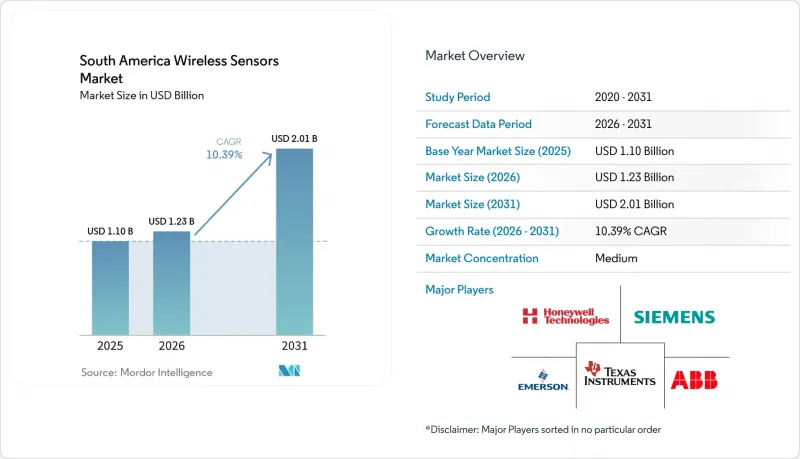
據 Mordor Intelligence 稱,2025 年南美無線感測器市場價值為 11 億美元,預計到 2031 年將達到 20.1 億美元,而 2026 年為 12.3 億美元,2026 年至 2031 年預測期內的複合年成長率為 10.39%。
南美無線感測器市場趨勢與洞察
工業4.0和工業IoT的引入
在南美工業領域,數位感測技術正被整合到現有營運中,推動了無線感測器在南美無線感測器市場的廣泛應用。巴西和阿根廷的工廠在2019年和2020年部署了首批無線節點,如今正以更先進的設備進行替換。買家更傾向於選擇具備邊緣處理和預測性維護功能的設備,而非基礎的遙測產品。隨著設備需要更先進的感測和通訊功能,這種替換活動提升了每次部署的價值。在2025年自動化展上,羅克韋爾自動化公司發表了用於預測性維護和改裝應用的邊緣物聯網感測工具。該公司專注於與現有工廠網路整合,這與成熟工業設施的升級需求不謀而合。 2026年3月,聖馬蒂尼奧公司與西班牙電信公司Telefónica Vivo簽署契約,將在四個農業工業園區部署44個行動電話基站,涵蓋範圍積達300萬公頃,用於支持智慧灌溉、環境監測和車輛遙測。
智慧城市和基礎設施數位化
在南美無線感測器市場,公共產業和城市專案正在推動高密度無線感測器的部署,這些感測器的採購週期較長。這些項目能夠滿足南美洲無線感測器市場對網路管理、計量表、閘道器及相關維護的持續需求。 2026年8月,SABESP、Telefonica Vivo和IDEMIA Secure Transactions正式簽署了一項為期14年的聯合舉措,旨在連接聖保羅和聖若澤杜斯坎普斯兩市的440萬個NB-IoT智慧水錶。此次部署將實現每小時用水量可視化、洩漏檢測和水量平衡管理。該系統還採用了符合GSMA SGP.32標準的eSIM架構。 2025年,皮達蒙洪加巴市部署了一個環境感測器網路,用於對附近農村和山區進行洪水和野火預警。此類大規模專案可以為中等規模城市提供一個成熟的模型,用於評估相關的感測器系統。
高昂的實施和整合成本
儘管單一無線節點的價格正在下降,但對於南美無線感測器市場的許多買家而言,整體部署成本仍然是一筆不小的負擔。閘道器基礎設施、IT和OT整合、網路安全措施以及網路管理都會增加專案預算。在巴西,ANATEL設備認證可能需要8到16週的測試和文件編制時間。即使是小規模項目,在啟動之前也需要經歷這一過程,從而產生額外的成本。此外,將傳統的分散式控制系統連接到新的無線網路還需要中間件、轉換硬體和邊緣閘道器。這些需求可能會使感測器系統的單位成本翻倍。擁有跨協議認證的整合商數量有限,這可能導致試運行週期延長,並延誤後續專案的批准。
細分市場分析
到2025年,溫度感測器將佔據南美無線感測器市場25.61%的佔有率,成為該市場最大的感測器類別。這一地位反映了其在南美無線感測器市場中廣泛的應用,包括食品冷鏈、發電冷卻系統、藥品儲存和工業製程監控等領域。能源和農業產業的業務活動為該類別的應用提供了穩定的基礎。由於熱事件會影響製程品質和設備效能,因此對可靠監控的需求持續成長。巴西的石油、天然氣和農產品綜合企業是此類設備的重要需求來源。無線溫度節點可以改善有線節點難以安裝區域的覆蓋範圍。此類別還能滿足分散式設施的日常監控需求。這些應用賦予了溫度感測器在無線感測器產業中廣泛的地位。
預計2026年至2031年間,影像感測器的複合年成長率將達到12.06%。這一成長與機器視覺技術從專用檢測站擴展到分散式應用密切相關。南美洲的汽車組裝和電子製造業是該技術的主要應用領域。這些系統能夠支援更靠近生產線的偵測、識別和製程控制功能。康耐視(Cognex)報告稱,2025年全年銷售額年增9%,2025年第四季銷售額年增10%。這一業績表明,機器視覺市場需求旺盛,為目的地設備製造商(OEM)供應鏈提供了支援。壓力感測器在確保巴西和阿根廷的管道健康和監測壓縮機方面繼續發揮著至關重要的作用。化學和氣體感測器、位置和接近感測器、振動感測器、流量感測器、濕度感測器、聲學感測器、液位感測器和力感測器則滿足了安全、維護、物流、水處理和農業等領域的專業應用需求。
其他好處:
- Excel格式的市場預測(ME)表
- 3個月的分析師支持
目錄
第1章:引言
- 研究假設和市場定義
- 調查範圍
第2章:調查方法
第3章執行摘要
第4章 市場狀況
- 市場概覽
- 市場促進因素
- 工業4.0和工業IoT的引入
- 智慧城市和基礎設施數位化
- 精密農業和遠端資產監控
- 降低無線連線成本和MEMS成本
- 無需電池即可能源採集,實現免維護節點
- 惡劣且難以進入的工業場所的維修需求
- 市場限制因素
- 高昂的實施和整合成本
- 與網路安全和資料隱私相關的風險
- 專有協定之間的互通性差距
- 偏遠地區電池更換及頻段限制
- 產業價值鏈分析
- 監理情勢
- 技術展望
- 波特五力分析
- 宏觀經濟因素對市場的影響
第5章 市場規模與成長預測
- 依感測器類型
- 壓力感測器
- 溫度感測器
- 化學和氣體感測器
- 位置和接近感測器
- 振動感測器
- 流量感測器
- 濕度感測器
- 影像感測器
- 其他感測器類型
- 按最終用戶行業分類
- 車
- 衛生保健
- 航太/國防
- 能源與電力
- 食品/飲料
- 農業
- 建築自動化和智慧家居
- 家用電子產品
- 物流/運輸
- 其他終端用戶產業
- 按部署環境
- 室內工業用途
- 戶外(惡劣環境)
- 偏遠/危險地點
- 水下/海底
- 基礎設施建設/住宅
- 按地區
- 巴西
- 阿根廷
- 智利
- 哥倫比亞
- 其他南美國家
第6章 競爭情勢
- 市場集中度
- 策略趨勢
- 市佔率分析
- 公司簡介
- ABB Ltd.
- Advantech Co., Ltd.
- Analog Devices, Inc.
- Banner Engineering Corp.
- Bosch Sensortec GmbH
- Disruptive Technologies AS
- Emerson Electric Co.
- Everactive, Inc.
- Honeywell International Inc.
- Libelium Comunicaciones Distribuidas SL
- Monnit Corporation
- NCD Inc.
- OMRON Corporation
- Onset Computer Corporation
- Phoenix Sensors LLC
- Rockwell Automation, Inc.
- Sensirion AG
- SensoScientific, Inc.
- Siemens AG
- Silicon Laboratories Inc.
- STMicroelectronics NV
- Swift Sensors Corporation
- Texas Instruments Incorporated
- Yokogawa Electric Corporation
第7章 市場機會與未來趨勢
- 評估閒置頻段和未滿足的需求
According to Mordor Intelligence, the South America wireless sensors market size was valued at USD 1.10 billion in 2025 and estimated to grow from USD 1.23 billion in 2026 to reach USD 2.01 billion by 2031, at a CAGR of 10.39% during the forecast period 2026-2031.
South America Wireless Sensors Market Trends and Insights
Industry 4.0 and Industrial IoT Adoption
Industrial sites in South America are integrating digital sensing into existing operations, which supports wider adoption of wireless sensors in the South America wireless sensors market. Plants in Brazil and Argentina that installed early wireless nodes during 2019 and 2020 are replacing them with more capable equipment. Buyers are choosing devices with edge processing and predictive maintenance capabilities rather than basic telemetry products. This replacement activity increases the value of each deployment when equipment requires greater sensing and communications capabilities. Rockwell Automation presented edge IoT sensing tools for predictive maintenance and retrofit use at Automation Fair 2025. The company's focus on integration with existing plant networks aligns with the upgrade requirements of established industrial sites. Sao Martinho contracted Telefonica Vivo in March 2026 to deploy 44 cellular towers across up to 3 million hectares, supporting smart irrigation, environmental monitoring, and fleet telemetry at 4 agro-industrial complexes.
Smart-City and Infrastructure Digitization
Utility and city programs drive dense wireless sensor deployments, with long procurement cycles, in the South America wireless sensors market. These programs can support recurring demand for network management, meters, gateways, and associated maintenance in the South America wireless sensors market. SABESP, Telefonica Vivo, and IDEMIA Secure Transactions formalized a 14-year initiative in August 2026 to connect 4.4 million NB-IoT smart water meters across Sao Paulo and Sao Jose dos Campos. The deployment supports hourly consumption visibility, leak detection, and water-balance management. It also uses an eSIM architecture designed to meet GSMA SGP.32 requirements. The city of Pindamonhangaba deployed environmental sensor networks for early warning of floods and wildfires across nearby rural and mountainous areas in 2025. Large programs can provide secondary cities with a proven model for evaluating related sensor systems.
High Deployment and Integration Costs
The price of an individual wireless node has fallen, but full deployment costs remain material for many buyers in the South America wireless sensors market. Gateway infrastructure, IT and OT integration, cybersecurity work, and network management add to the project budget. ANATEL device certification in Brazil can require 8-16 weeks of testing and documentation. This process adds expense before a small-batch project can proceed. Legacy distributed control systems also need middleware, translation hardware, and edge gateways to connect with newer wireless networks. Such requirements can double the unit cost of the sensor system. Limited availability of integrators with cross-protocol certification can extend commissioning and delay approval of later projects.
Other drivers and restraints analyzed in the detailed report include:
- Precision Agriculture and Remote Asset Monitoring
- Falling Wireless Connectivity and MEMS Costs
- Cybersecurity and Data-Privacy Exposure
For complete list of drivers and restraints, kindly check the Table Of Contents.
Segment Analysis
Temperature sensors held 25.61% of the South America wireless sensors market share in 2025, making them the largest sensor category in the South America wireless sensors market. Their position reflects broad use in food cold chains, power-generation cooling systems, pharmaceutical storage, and industrial process monitoring across the South America wireless sensors market. Energy and agro-industrial operations provide a stable installed base for this category. Thermal events can disrupt process quality and asset performance, which supports continued demand for reliable monitoring. Brazil's oil, gas, and agribusiness activities are important sources of demand for these devices. Wireless temperature nodes can improve coverage where installing a wired point is difficult. The category also supports routine monitoring requirements across dispersed facilities. These uses give temperature sensors a broad role in the wireless sensors industry.
Image sensors are projected to expand at a 12.06% CAGR from 2026 to 2031. Growth is linked to machine vision moving beyond dedicated inspection stations into distributed applications. Automotive assembly and electronics manufacturing in South America are key areas for adoption. These systems can support inspection, identification, and process control functions closer to the production line. Cognex reported 9% full-year revenue growth in 2025 and a 10% year-over-year revenue increase in the fourth quarter of 2025. The reported results indicate demand in machine-vision markets that serve original equipment manufacturer supply chains. Pressure sensors remain relevant to pipeline integrity and compressor monitoring in Brazil and Argentina. Chemical and gas, position and proximity, vibration, flow, humidity, acoustic, level, and force sensors address specialized safety, maintenance, logistics, water, and agricultural uses.
Complete Report Scope:
- By Sensor Type
- Pressure Sensors
- Temperature Sensors
- Chemical and Gas Sensors
- Position and Proximity Sensors
- Vibration Sensors
- Flow Sensors
- Humidity Sensors
- Image Sensors
- Other Sensor Types
- By End-user Industry
- Automotive
- Healthcare
- Aerospace and Defense
- Energy and Power
- Food and Beverage
- Agriculture
- Building Automation and Smart Homes
- Consumer Electronics
- Logistics and Transportation
- Other End-user Industries
- By Deployment Environment
- Indoor Industrial
- Outdoor Harsh
- Remote / Hazardous Locations
- Underwater / Subsea
- Building Infrastructure / Residential
- By Geography
- Brazil
- Argentina
- Chile
- Colombia
- Rest of South America
List of Companies Covered in this Report:
- ABB Ltd.
- Advantech Co., Ltd.
- Analog Devices, Inc.
- Banner Engineering Corp.
- Bosch Sensortec GmbH
- Disruptive Technologies AS
- Emerson Electric Co.
- Everactive, Inc.
- Honeywell International Inc.
- Libelium Comunicaciones Distribuidas S.L.
- Monnit Corporation
- NCD Inc.
- OMRON Corporation
- Onset Computer Corporation
- Phoenix Sensors LLC
- Rockwell Automation, Inc.
- Sensirion AG
- SensoScientific, Inc.
- Siemens AG
- Silicon Laboratories Inc.
- STMicroelectronics N.V.
- Swift Sensors Corporation
- Texas Instruments Incorporated
- Yokogawa Electric Corporation
Additional Benefits:
- The market estimate (ME) sheet in Excel format
- 3 months of analyst support
TABLE OF CONTENTS
1 INTRODUCTION
- 1.1 Study Assumptions and Market Definition
- 1.2 Scope of the Study
2 RESEARCH METHODOLOGY
3 EXECUTIVE SUMMARY
4 MARKET LANDSCAPE
- 4.1 Market Overview
- 4.2 Market Drivers
- 4.2.1 Industry 4.0 and Industrial IoT Adoption
- 4.2.2 Smart-City and Infrastructure Digitization
- 4.2.3 Precision Agriculture and Remote Asset Monitoring
- 4.2.4 Falling Wireless Connectivity and MEMS Costs
- 4.2.5 Battery-Free Energy Harvesting for Maintenance-Free Nodes
- 4.2.6 Retrofit Demand in Harsh and Inaccessible Industrial Sites
- 4.3 Market Restraints
- 4.3.1 High Deployment and Integration Costs
- 4.3.2 Cybersecurity and Data-Privacy Exposure
- 4.3.3 Interoperability Gaps Across Proprietary Protocols
- 4.3.4 Battery Replacement and Spectrum Constraints in Remote Sites
- 4.4 Industry Value Chain Analysis
- 4.5 Regulatory Landscape
- 4.6 Technological Outlook
- 4.7 Porter's Five Forces Analysis
- 4.7.1 Bargaining Power of Suppliers
- 4.7.2 Bargaining Power of Buyers
- 4.7.3 Threat of New Entrants
- 4.7.4 Threat of Substitutes
- 4.7.5 Competitive Rivalry
- 4.8 Impact of Macroeconomic Factors on the Market
5 MARKET SIZE AND GROWTH FORECASTS (VALUE)
- 5.1 By Sensor Type
- 5.1.1 Pressure Sensors
- 5.1.2 Temperature Sensors
- 5.1.3 Chemical and Gas Sensors
- 5.1.4 Position and Proximity Sensors
- 5.1.5 Vibration Sensors
- 5.1.6 Flow Sensors
- 5.1.7 Humidity Sensors
- 5.1.8 Image Sensors
- 5.1.9 Other Sensor Types
- 5.2 By End-user Industry
- 5.2.1 Automotive
- 5.2.2 Healthcare
- 5.2.3 Aerospace and Defense
- 5.2.4 Energy and Power
- 5.2.5 Food and Beverage
- 5.2.6 Agriculture
- 5.2.7 Building Automation and Smart Homes
- 5.2.8 Consumer Electronics
- 5.2.9 Logistics and Transportation
- 5.2.10 Other End-user Industries
- 5.3 By Deployment Environment
- 5.3.1 Indoor Industrial
- 5.3.2 Outdoor Harsh
- 5.3.3 Remote / Hazardous Locations
- 5.3.4 Underwater / Subsea
- 5.3.5 Building Infrastructure / Residential
- 5.4 By Geography
- 5.4.1 Brazil
- 5.4.2 Argentina
- 5.4.3 Chile
- 5.4.4 Colombia
- 5.4.5 Rest of South America
6 COMPETITIVE LANDSCAPE
- 6.1 Market Concentration
- 6.2 Strategic Moves
- 6.3 Market Share Analysis
- 6.4 Company Profiles (includes Global Level Overview, Market Level Overview, Core Segments, Financials as available, Strategic Information, Market Rank/Share, Products and Services, Recent Developments)
- 6.4.1 ABB Ltd.
- 6.4.2 Advantech Co., Ltd.
- 6.4.3 Analog Devices, Inc.
- 6.4.4 Banner Engineering Corp.
- 6.4.5 Bosch Sensortec GmbH
- 6.4.6 Disruptive Technologies AS
- 6.4.7 Emerson Electric Co.
- 6.4.8 Everactive, Inc.
- 6.4.9 Honeywell International Inc.
- 6.4.10 Libelium Comunicaciones Distribuidas S.L.
- 6.4.11 Monnit Corporation
- 6.4.12 NCD Inc.
- 6.4.13 OMRON Corporation
- 6.4.14 Onset Computer Corporation
- 6.4.15 Phoenix Sensors LLC
- 6.4.16 Rockwell Automation, Inc.
- 6.4.17 Sensirion AG
- 6.4.18 SensoScientific, Inc.
- 6.4.19 Siemens AG
- 6.4.20 Silicon Laboratories Inc.
- 6.4.21 STMicroelectronics N.V.
- 6.4.22 Swift Sensors Corporation
- 6.4.23 Texas Instruments Incorporated
- 6.4.24 Yokogawa Electric Corporation
7 MARKET OPPORTUNITIES AND FUTURE TRENDS
- 7.1 White-Space and Unmet-Need Assessment

 無線感測器:市場佔有率分析、產業趨勢與統計、成長預測(2026-2031)
 無線感測器市場:2026-2032年全球市場預測(依感測器類型、電源、連接方式、安裝配置、應用和部署環境分類)
 無線感測器標籤市場 - 全球產業規模、佔有率、趨勢、機會、預測:按類型、應用、地區和競爭格局分類,2021-2031年
 半導體無線感測器物聯網市場:按組件、感測器類型、連接方式、應用、最終用途、國家和地區分類-產業分析、市場規模、市場佔有率及2025年至2032年預測
 無線感測器市場規模、佔有率和成長分析(按類型、應用、最終用戶和地區分類)—2026-2033年產業預測中東和非洲無線感測器:市場佔有率分析、行業趨勢、統計和成長預測(2025-2030)亞太地區無線感測器:市場佔有率分析、產業趨勢和成長預測(2025-2030)北美無線感測器:市場佔有率分析、行業趨勢、統計和成長預測(2025-2030)拉丁美洲無線感測器:市場佔有率分析、行業趨勢和成長預測(2025-2030)歐洲無線感測器:市場佔有率分析、產業趨勢/統計、成長預測(2025-2030)