


 |
市場調查報告書
商品編碼
2154765
固體儲氫材料:市場佔有率分析、產業趨勢與統計、成長預測(2026-2031)Solid State Hydrogen Storage Materials - Market Share Analysis, Industry Trends & Statistics, Growth Forecasts (2026 - 2031) |
||||||

※ 本網頁內容可能與最新版本有所差異。詳細情況請與我們聯繫。
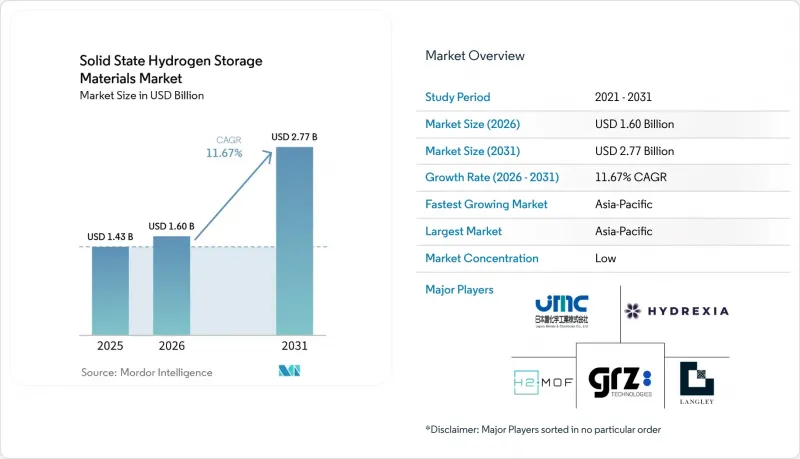
據 Mordor Intelligence 稱,2025 年固體氫儲存材料的市場規模為 14.3 億美元,預計到 2031 年將從 2026 年的 16 億美元成長到 27.7 億美元,預測期(2026-2031 年)的複合年成長率為 11.67%。
全球固體儲氫材料市場趨勢及洞察
對氫能基礎設施的投資
2025年,低排放量氫能專案的資本投資接近70億美元。 2026年,電解的投資佔比接近70%,首次超過碳捕獲氫氣的投資。 2026年超過85%的投資用於滿足工業和煉油廠現有的氫氣需求,從而支持對固定式金屬氫化物裝置的短期需求,並在氫氣已用作工業燃料的地區形成明確的初始基本客群。美國能源局研究發現,金屬氫化物系統所需的土地比170巴壓縮氣體儲存系統少65%,這有利於在配送中心和空間受限的工業場所部署。固體儲氫材料市場將受益於儲氫設備的直接採購以及營運商減少氫能基礎設施面積的需求。
燃料電池汽車和重型車輛的引進
商用卡車正在擴大對固體氫儲存材料的需求範圍,使其不再局限於輕型車輛。瑞士報告稱,到2025年將有1,600輛燃料電池卡車投入運作;H2Accelerate TRUCKS計畫已在六個歐盟成員國部署了125輛重型燃料電池卡車。該計畫的下一代加氫站的目標是每天供給能力超過1000公斤的氫氣。壓縮氣體儲槽每個需要200-300公斤的碳纖維增強材料,可能會降低負載容量。釩鈦合金在接近環境溫度和壓力的條件下實現了超過2wt%的可逆儲氫容量,證明了其作為車載儲氫材料的適用性。雖然日本和韓國仍然是重要的燃料電池電動車市場,但歐洲貨運公司正在開發對更高吞吐量系統的需求。
高昂的材料成本和系統整合成本
高昂的材料和系統整合成本仍然是固體儲氫材料市場商業化的障礙。 AB5合金中的稀土元素,特別是鑭,由於中國強大的加工能力,面臨供應集中的風險。美國能源局已將金屬氫化物生產成本的閾值設定為10美元/公斤,以確保其廣泛的商業性競爭力。在中小型儲氫設施中,熱交換器、壓力調節器、安全外殼和溫度控管組件的成本可能超過原料成本,這限制了分散式部署,並使採購決策高度依賴本地系統需求。 2025年5月,韓國材料科學研究院開發了一種鎂鎳錫合金,旨在降低製造成本和能耗。這種新型合金通常需要3-5年的製程放大期才能達到商業性成本平衡。
細分市場分析
截至2025年,金屬氫化物將佔據固體儲氫材料市場38.53%的佔有率,預計到2031年將以12.76%的複合年成長率成長。這一市場地位反映了其高體積能量密度以及與汽車、固定式電源和船舶應用中燃料電池系統的兼容性。 2025年7月,FDK開發了一種高容量AB2吸氫合金,其質量容量比比現有AB5材料高20%。 FDK於2025年7月開始提供部分顧客樣品,並計劃於2025年10月開始大量生產出貨。容量的提升將減少每個儲氫單元所需的合金質量,這對於汽車和航太等對重量敏感的行業來說至關重要。
複合氫化物可在低於 393 K 的溫度下實現可逆氫氣釋放,從而能夠利用燃料電池的廢熱運作。化學氫化物則用於需要再生氫的特殊系統,例如軍事和航太應用。碳基材料因其在吸附應用方面的潛力而備受關注,其中石墨烯複合材料和活性碳系統在受控條件下可實現 7-10 wt% 的儲氫容量。 H2MOF 正在被應用於無人機 (UAV) 的儲氫領域。固體儲氫材料市場正朝著基於溫度範圍、放電速率和總擁有成本 (TCO) 的材料選擇方向發展。
區域分析
預計到2025年,亞太地區將佔據固體儲氫材料市場32.81%的佔有率,並在2031年之前以13.34%的複合年成長率持續成長。在中國,政府主導的計畫正在支持下游儲氫技術的商業化。日本則透過FDK、三德株式會社和三井礦業冶煉株式會社等公司,為合金製造和系統研究做出貢獻。 2025年5月,韓國材料科學研究院(KIMS)開發出一種鎂鎳錫合金,旨在無需高壓容器或低溫設備即可安全儲存和運輸氫氣,從而進一步鞏固了其在亞太地區材料開發領域的地位。
印度的氫能發展仍處於起步階段,但隨著其氫能基礎設施的日益成熟,可望創造下游儲氫需求。其「國家綠色氫能計畫」的目標是到2030年每年生產500萬噸綠色氫。歐洲則著重於管道基礎設施建設和循環材料的採購。於2025年1月啟動的REMEDHYS項目,正在歐洲開發利用回收金屬的固體儲氫技術,並使用一台2兆瓦的質子交換膜電解槽對材料檢驗。在北美,政策的不確定性日益增加,但加州已於2026年8月撥款1500萬美元用於氫燃料加註基礎設施建設,作為其9,520萬美元「清潔交通計畫」的一部分。
南美洲、中東和非洲市場雖然規模較小,但對於專注於分散式和離網應用的供應商至關重要。 LAVO在沙烏地阿拉伯和南非開展業務,旨在實現資料中心和通訊塔的脫碳。沙烏地阿拉伯的綠氫出口計畫有望隨著交通基礎設施的建設,創造未來對儲氫的需求。巴西和阿根廷都制定了包含儲氫在內的可再生能源併網計劃,但預計到2028年,商業性採購規模仍將保持小規模。中東地區的高溫為吸附材料的溫度控管帶來了挑戰,因此吸附系統和熱穩定複合氫化物更適合在某些地區的應用。由此可見,固體儲氫材料市場的地理特徵是亞洲的大規模生產與其他地區更具專業化的商業機會相結合。
其他好處:
- Excel格式的市場預測(ME)表
- 3個月的分析師支持
目錄
第1章:引言
- 研究假設和市場定義
- 調查範圍
第2章:調查方法
第3章執行摘要
第4章 市場狀況
- 市場概覽
- 市場促進因素
- 對氫能基礎設施的投資
- 燃料電池汽車和大型移動車輛的引進
- 長期可再生能源儲存的需求
- 政府對氫相關產品的激勵措施和強制性脫碳
- 金屬氫化物系統中廢熱的整合
- 市場限制因素
- 高昂的材料成本和系統整合成本
- 吸附和解吸反應速率緩慢
- 溫度控管和散熱的複雜性
- 價值鏈分析
- 波特五力分析
第5章 市場規模與成長預測
- 材料類型
- 金屬氫化物
- 複合氫化物
- 化學氫化物
- 碳基材料
- 其他材料類型
- 儲存機制
- 吸收
- 吸附
- 其他儲存機制
- 透過使用
- 車
- 固定式發電
- 可攜式電源
- 航太
- 其他用途
- 按地區
- 亞太地區
- 中國
- 印度
- 日本
- 韓國
- 其他亞太國家
- 北美洲
- 美國
- 加拿大
- 墨西哥
- 歐洲
- 德國
- 英國
- 法國
- 義大利
- 其他歐洲國家
- 南美洲
- 巴西
- 阿根廷
- 其他南美國家
- 中東和非洲
- 沙烏地阿拉伯
- 南非
- 其他中東和非洲國家
- 亞太地區
第6章 競爭情勢
- 市場集中度
- 策略趨勢
- 市佔率和排名分析
- 公司簡介
- Ergenics Corp.
- GRZ Technologies
- H2GO Power Limited
- H2MOF
- Hydrexia
- Hystorsys
- Japan Metals & Chemicals Co., Ltd.
- Langley Holdings plc
- LAVO
- Mincatec Energy
- Mitsui Kinzoku Co., Ltd.
- NIPPON DENKO CO., LTD.
- Plasma Kinetics
- Safe Hydrogen LLC
- SANTOKU CORPORATION
第7章 市場機會與未來展望
According to Mordor Intelligence, the solid state hydrogen storage materials market size was valued at USD 1.43 billion in 2025 and is estimated to grow from USD 1.60 billion in 2026 to reach USD 2.77 billion by 2031, at a CAGR of 11.67% during the forecast period (2026-2031).
Global Solid State Hydrogen Storage Materials Market Trends and Insights
Hydrogen Infrastructure Investment
Capital spending on low-emissions hydrogen projects reached nearly USD 7 billion in 2025. Electrolysis accounted for nearly 70% of this 2026 investment, and it overtook carbon-capture-based hydrogen investment for the first time. More than 85% of investment in 2026 targets existing hydrogen demand in industry and refineries, which supports near-term demand for stationary metal hydride units and creates a defined initial customer base at sites where hydrogen is already used as an industrial feedstock. The U.S. Department of Energy found that metal hydride systems can require up to 65% less land than 170-bar compressed-gas storage, which can aid integration at delivery nodes and constrained industrial sites. The solid state hydrogen storage materials market can gain from direct storage procurement and from operators' need to reduce the footprint of hydrogen infrastructure.
Fuel-Cell Vehicle and Heavy-Duty Mobility Deployment
Commercial trucking expands the addressable demand base beyond light-duty vehicles within the solid state hydrogen storage materials market. Switzerland reported 1,600 fuel-cell trucks in operation by 2025, and the H2Accelerate TRUCKS program deployed 125 heavy-duty fuel-cell trucks across 6 European Union member states. A next-generation station in that program targets hydrogen dispensing capacity above 1,000 kg per day. Compressed-gas tanks need 200-300 kg of carbon-fiber reinforcement per vehicle, which can reduce payload capacity. Vanadium-titanium alloys achieved more than 2 weight percent (wt%) reversible hydrogen capacity at near-ambient temperatures and pressures, supporting their suitability for onboard storage. Japan and South Korea remain important fuel-cell electric vehicle markets, while European freight operators are shaping requirements for higher-throughput systems.
High Material and System-Integration Costs
High material and system-integration costs remain a commercialization barrier for the solid state hydrogen storage materials market. Rare-earth elements in AB5 alloys, particularly lanthanum, face supply-concentration risk because China has substantial processing capacity. The U.S. Department of Energy identified USD 10/kg as the metal hydride production-cost threshold for broad commercial competitiveness. Heat exchangers, pressure-regulation hardware, safety enclosures, and thermal-management assemblies can cost more than raw materials in small and medium installations, which limits distributed deployments and makes the purchase decision sensitive to local system requirements. In May 2025, the Korea Institute of Materials Science developed a magnesium-nickel-tin alloy intended to reduce manufacturing costs and energy use. New alloy compositions usually need 3-5 years of process scale-up before they can reach commercial cost parity.
Other drivers and restraints analyzed in the detailed report include:
- Long-Duration Renewable-Energy Storage Demand
- Government Hydrogen Incentives and Decarbonization Mandates
- Slow Absorption and Desorption Kinetics
For complete list of drivers and restraints, kindly check the Table Of Contents.
Segment Analysis
Metal hydrides held 38.53% of the solid state hydrogen storage materials market in 2025 and are projected to advance at a 12.76% CAGR through 2031. Their position reflected high volumetric energy density and compatibility with fuel-cell systems in automotive, stationary power, and maritime uses. In July 2025, FDK developed a high-capacity AB2-type hydrogen-absorbing alloy with 20% higher gravimetric capacity than incumbent AB5-type materials. FDK began sample supply to selected customers in July 2025 and planned mass-production shipments from October 2025. Higher capacity reduces the alloy mass required per storage unit, which matters in weight-sensitive automotive and aerospace installations.
Complex hydrides can provide reversible hydrogen release below 393 K, enabling operation with fuel-cell waste heat. Chemical hydrides serve specialized systems where regeneration is possible, including military and aerospace uses. Carbon-based materials are gaining traction in adsorption applications, with graphene composites and activated-carbon systems reaching 7-10 weight percent (wt%) storage capacity under controlled conditions. H2MOF applies reticular materials to unmanned aerial vehicle hydrogen storage. The solid state hydrogen storage materials market is moving toward material selection based on temperature range, discharge rate, and total cost of ownership.
Complete Report Scope:
- By Material Type
- Metal Hydrides
- Complex Hydrides
- Chemical Hydrides
- Carbon-Based Materials
- Other Material Types
- By Storage Mechanism
- Absorption
- Adsorption
- Other Storage Mechanisms
- By Application
- Automotive
- Stationary Power
- Portable Power
- Aerospace
- Other Applications
- By Geography
- Asia-Pacific
- China
- India
- Japan
- South Korea
- Rest of Asia-Pacific
- North America
- United States
- Canada
- Mexico
- Europe
- Germany
- United Kingdom
- France
- Italy
- Rest of Europe
- South America
- Brazil
- Argentina
- Rest of South America
- Middle-East and Africa
- Saudi Arabia
- South Africa
- Rest of Middle-East and Africa
- Asia-Pacific
Geography Analysis
Asia-Pacific held 32.81% of the solid state hydrogen storage materials market share in 2025 and is projected to advance at a 13.34% CAGR through 2031. State-backed programs support downstream storage commercialization in China. Japan contributes to alloy manufacturing and system research through companies including FDK, SANTOKU CORPORATION, and Mitsui Kinzoku Co., Ltd. In May 2025, the Korea Institute of Materials Science (KIMS) developed a magnesium-nickel-tin alloy intended for safe hydrogen storage and transport without high-pressure vessels or cryogenic equipment, reinforcing the region's role in materials development.
India is at an early stage and can create downstream storage demand as hydrogen infrastructure matures, with its National Green Hydrogen Mission targeting 5 million metric tons of green hydrogen production per year by 2030. Europe's role centers on pipeline infrastructure and circular materials sourcing. The REMEDHYS project began in January 2025 to develop solid-state storage from recycled European metals and validate the materials with a 2 MW proton exchange membrane electrolyzer. North America has more policy uncertainty, but California allocated USD 15 million for hydrogen refueling infrastructure in August 2026 within a USD 95.2 million Clean Transportation Program.
South America, and Middle-East and Africa markets are smaller but relevant to suppliers focused on distributed and off-grid uses. LAVO has operations in Saudi Arabia and South Africa for data-center and telecom-tower decarbonization. Saudi Arabia's green-hydrogen export plans can create future demand for storage as transport infrastructure develops. Brazil and Argentina have renewable-energy integration plans that include hydrogen storage, although commercial procurement is expected to remain modest through 2028. High ambient temperatures in the Middle-East create thermal-management challenges for absorption materials, making adsorption systems and thermally stabilized complex hydrides more suitable for some regional uses. The geographic profile of the solid state hydrogen storage materials market, therefore, combines high-volume Asian manufacturing with more specialized opportunities in other regions.
- Ergenics Corp.
- GRZ Technologies
- H2GO Power Limited
- H2MOF
- Hydrexia
- Hystorsys
- Japan Metals & Chemicals Co., Ltd.
- Langley Holdings plc
- LAVO
- Mincatec Energy
- Mitsui Kinzoku Co., Ltd.
- NIPPON DENKO CO., LTD.
- Plasma Kinetics
- Safe Hydrogen LLC
- SANTOKU CORPORATION
Additional Benefits:
- The market estimate (ME) sheet in Excel format
- 3 months of analyst support
TABLE OF CONTENTS
1 Introduction
- 1.1 Study Assumptions and Market Definition
- 1.2 Scope of the Study
2 Research Methodology
3 Executive Summary
4 Market Landscape
- 4.1 Market Overview
- 4.2 Market Drivers
- 4.2.1 Hydrogen Infrastructure Investment
- 4.2.2 Fuel-Cell Vehicle and Heavy-Duty Mobility Deployment
- 4.2.3 Long-Duration Renewable-Energy Storage Demand
- 4.2.4 Government Hydrogen Incentives and Decarbonization Mandates
- 4.2.5 Waste-Heat Integration in Metal-Hydride Systems
- 4.3 Market Restraints
- 4.3.1 High Material and System-Integration Costs
- 4.3.2 Slow Absorption and Desorption Kinetics
- 4.3.3 Thermal-Management and Heat-Rejection Complexity
- 4.4 Value Chain Analysis
- 4.5 Porter's Five Forces Analysis
- 4.5.1 Bargaining Power of Suppliers
- 4.5.2 Bargaining Power of Buyers
- 4.5.3 Threat of New Entrants
- 4.5.4 Threat of Substitutes
- 4.5.5 Competitive Rivalry
5 Market Size and Growth Forecasts (Value)
- 5.1 By Material Type
- 5.1.1 Metal Hydrides
- 5.1.2 Complex Hydrides
- 5.1.3 Chemical Hydrides
- 5.1.4 Carbon-Based Materials
- 5.1.5 Other Material Types
- 5.2 By Storage Mechanism
- 5.2.1 Absorption
- 5.2.2 Adsorption
- 5.2.3 Other Storage Mechanisms
- 5.3 By Application
- 5.3.1 Automotive
- 5.3.2 Stationary Power
- 5.3.3 Portable Power
- 5.3.4 Aerospace
- 5.3.5 Other Applications
- 5.4 By Geography
- 5.4.1 Asia-Pacific
- 5.4.1.1 China
- 5.4.1.2 India
- 5.4.1.3 Japan
- 5.4.1.4 South Korea
- 5.4.1.5 Rest of Asia-Pacific
- 5.4.2 North America
- 5.4.2.1 United States
- 5.4.2.2 Canada
- 5.4.2.3 Mexico
- 5.4.3 Europe
- 5.4.3.1 Germany
- 5.4.3.2 United Kingdom
- 5.4.3.3 France
- 5.4.3.4 Italy
- 5.4.3.5 Rest of Europe
- 5.4.4 South America
- 5.4.4.1 Brazil
- 5.4.4.2 Argentina
- 5.4.4.3 Rest of South America
- 5.4.5 Middle-East and Africa
- 5.4.5.1 Saudi Arabia
- 5.4.5.2 South Africa
- 5.4.5.3 Rest of Middle-East and Africa
- 5.4.1 Asia-Pacific
6 Competitive Landscape
- 6.1 Market Concentration
- 6.2 Strategic Moves
- 6.3 Market Share (%)/Ranking Analysis
- 6.4 Company Profiles (includes Global Overview, Market Overview, Core Segments, Financials as available, Strategic Information, Products and Services, and Recent Developments)
- 6.4.1 Ergenics Corp.
- 6.4.2 GRZ Technologies
- 6.4.3 H2GO Power Limited
- 6.4.4 H2MOF
- 6.4.5 Hydrexia
- 6.4.6 Hystorsys
- 6.4.7 Japan Metals & Chemicals Co., Ltd.
- 6.4.8 Langley Holdings plc
- 6.4.9 LAVO
- 6.4.10 Mincatec Energy
- 6.4.11 Mitsui Kinzoku Co., Ltd.
- 6.4.12 NIPPON DENKO CO., LTD.
- 6.4.13 Plasma Kinetics
- 6.4.14 Safe Hydrogen LLC
- 6.4.15 SANTOKU CORPORATION
7 Market Opportunities and Future Outlook
- 7.1 White-Space and Unmet-Need Assessment

 液氫儲存市場機會、成長要素、產業趨勢分析及2026-2035年預測
 液氫儲罐市場:全球市場預測,2026-2032年
 固體儲氫材料市場報告:趨勢、預測及競爭分析(至2035年)
 氫氣儲存市場預測至2034年-全球分析(按儲存方法、儲存技術、物理狀態、壓力範圍、系統容量、應用、終端用戶產業和地區分類)氫氣儲存系統市場預測至2034年-全球分析(按儲存技術、儲存材料、壓力等級、系統規模、應用、最終用戶、銷售管道和地區分類)2026 年至 2035 年金屬氫生產的市場機會、成長要素、產業趨勢分析與預測。緊湊型空氣壓縮系統市場預測至2034年-全球產品類型、動力源、壓力範圍、潤滑方式、技術、通路、應用及區域分析全球儲氫材料市場預測至2034年-按材料類型、儲存機制、形態、應用、最終用戶和地區分類的分析
 液氫儲罐市場 - 全球產業規模、佔有率、趨勢、機會、預測:按類型、應用、地區和競爭格局分類,2021-2031年
 地下儲氫市場規模、佔有率和成長分析:按儲存類型、終端用戶產業和地區分類-2026-2033年產業預測