

 |
市場調查報告書
商品編碼
2154744
散熱器:市場佔有率分析、產業趨勢與統計、成長預測(2026-2031)Heat Sinks - Market Share Analysis, Industry Trends & Statistics, Growth Forecasts (2026 - 2031) |
||||||

※ 本網頁內容可能與最新版本有所差異。詳細情況請與我們聯繫。
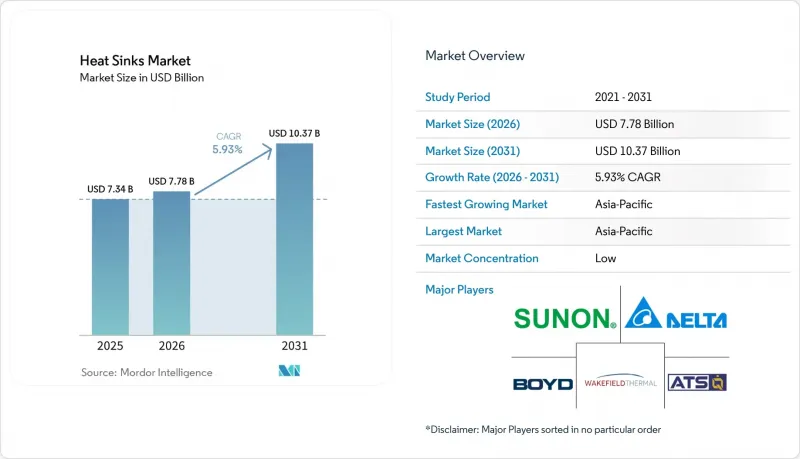
據 Mordor Intelligence 稱,2025 年散熱器市值為 73.4 億美元,預計到 2031 年將達到 103.7 億美元,而 2026 年為 77.8 億美元,預測期(2026-2031 年)的複合年成長率為 5.93%。
全球散熱器市場趨勢及洞察
人工智慧運算和高效能電子設備導致熱負荷增加。
人工智慧 (AI) 硬體的普及提高了伺服器和其他高效能電子設備的散熱標準。目前「Blackwell」世代圖形處理器 (GPU) 的熱通量可達 85–150 W/cm²,而傳統風冷鰭片陣列的極限僅為 30–40 W/cm²。美國能源局預測,到 2024 年,冷卻將佔資料中心能耗的 40%,因此散熱效率是影響設施營運成本的關鍵因素。隨著液冷技術在伺服器設計中的應用日益廣泛,散熱器正從基板級被動鰭片轉向整合式冷板。這些鋁銅組件是精密的熱界面,價格也高於傳統的沖壓成型鰭片陣列。這種轉變使擁有機械加工、刨削和真空釬硬焊能力的供應商在散熱器市場中佔優勢。
汽車電氣化和電力電子
電動車動力傳動系統對散熱器供應商提出了新的散熱要求。從矽絕緣柵雙極電晶體(IGBT) 到碳化矽金屬氧化物半導體場效電晶體(SiC MOSFET) 的轉變,導致小型功率模組內部產生的熱量增加。在 800V 電動車架構中,即使總功率損耗降低,局部熱通量也可能增加。主要原始設備製造商 (OEM) 的功率模組要求導熱界面材料在結溫下的熱導率超過 200 度C,並高於 2024 年的典型水平。汽車產品的認證越來越傾向於符合國際電工委員會 (IEC) 61287 和國際標準化組織 (ISO) 16750 的可靠性框架。這些要求有利於擁有認證測試基礎設施的成熟供應商,同時也提高了低成本散熱器製造商進入市場的技術門檻。
鋁、銅和先進材料成本上漲。
材料成本正日益成為散熱器製造商利潤率面臨的緊迫問題。 2026年1月,倫敦金屬交易所(LME)的銅價突破每噸13,300美元,鋁價也超過每噸3,000美元。對於採用現貨或近現貨採購方式的製造商而言,2024年1月至2026年3月期間,鋁成本上漲了25.7%,銅成本上漲了46.8%。金屬價格上漲推高了散熱器、機殼和熱敏元件組件的成本。如果成品價格的上漲速度跟不上原物料成本的上漲速度,季度或年度定價合約可能會導致成本回收延遲。在散熱器市場,沒有長期供應合約、內部冶煉設施或避險機制的製造商正面臨越來越大的利潤壓力。
細分市場分析
由於功耗低、機械結構簡單且能夠處理可控的熱負載,被動式散熱器預計到2025年將佔據散熱器市場54.32%的佔有率。主動式散熱器預計到2031年將以7.12%的複合年成長率成長,主要得益於伺服器、電動車逆變器和高功率射頻電子設備等應用對更高散熱能力的需求。被動式鰭片陣列結構無法有效應對目前人工智慧(AI)部署中報告的85-150 W/cm²的熱通量水準。混合式散熱器正被應用於耐環境產品、航太設備和戶外基礎設施產品。其主動元件可在超過設定溫度閾值的情況下運行,從而延長使用壽命,並在低負載下抑制雜訊。
人工智慧伺服器的擴展與主動式散熱設計的應用密切相關。在機架中密集安裝功耗為 100–200 kW 的圖形處理器 (GPU) 時,晶片和機架層面的溫度控管都至關重要。整合風扇控制和結溫監測功能的供應商可以提供更靈敏的氣流控制。 Advanced Thermal Solutions, Inc. 於 2025 年 12 月發布了一款適用於 NVIDIA Jetson Thor 模組的散熱解決方案,其中包括一個主動式風扇選項,支援 50 度C下 175 W 的熱設計功率。在散熱器市場,客戶對針對其特定 AI 部署環境最佳化的設計需求日益成長。
區域分析
預計到2025年,亞太地區將佔據散熱器市場42.34%的佔有率,並將以6.82%的複合年成長率成長至2031年。台灣ODM(目的地設計製造商)企業的存在為該地區提供了充足的冷板和用於人工智慧伺服器的散熱模組產能。受冷板和液冷模組需求的推動,Auras Technology已將2026年營收成長預期從60%上調至70%,其2026年7月營收年增率超過一倍。中國新能源汽車的生產、韓國DRAM和顯示器製造以及日本人工智慧資料中心的發展,都支撐著該地區散熱器市場的整體需求。
北美仍然是超大規模資料中心和人工智慧圖形處理器 (GPU)叢集投資的主要中心。美國能源局對資料中心能源效率的重視推動了對最佳化散熱器和冷板組件的需求。在歐洲,德國的工業自動化和電力電子產業基礎為市場提供了支撐。 Fischer Elektronik GmbH & Co. KG 於 2025 年擴展了其擠壓鋁產品線,新增了 SK 706、SK 707、SK 708 和 SK 709 系列散熱器。這些產品專為自然對流工業應用而設計。
在巴西和沙烏地阿拉伯,資料中心和通訊基礎設施正作為數位經濟計畫的一部分進行擴建。這些專案需要能夠在高溫環境下運作的主動和被動式溫度控管元件。在南非,採礦和重工業活動支撐著馬達驅動裝置和電力轉換系統對散熱器的需求。這些地區嚴重依賴從亞洲和歐洲製造商進口產品。雖然這種依賴性可能會增加物流風險,但也為當地組裝企業與成熟供應商合作提供了機會。
其他好處:
- Excel格式的市場預測(ME)表
- 3個月的分析師支持
目錄
第1章:引言
- 研究假設和市場定義
- 調查範圍
第2章:調查方法
第3章執行摘要
第4章 市場狀況
- 市場概覽
- 市場促進因素
- 人工智慧運算和高效能電子設備導致熱負荷增加。
- 車輛電氣化和電力電子
- 電子設備小型化
- 資料中心、雲端運算和5G基礎設施的擴展
- 針對邊緣人工智慧、機器人和光電的應用特定熱性能評估。
- 市場限制因素
- 鋁、銅和先進材料成本上漲。
- 緊湊系統中噪音、空間和重量的限制
- 熱設計需要在性能、可靠性和可製造性之間進行權衡。
- 價值鏈分析
- 波特五力分析
第5章 市場規模與成長預測
- 按類型
- 被動式散熱器
- 主動式散熱器
- 混合式散熱器
- 按內容
- 鋁
- 銅
- 銅鋁合金
- 其他物質
- 按最終用戶行業分類
- 家用電子產品
- 車
- 航太/國防
- 資訊科技/通訊
- 醫療設備
- 一般工業
- 其他終端用戶產業
- 按地區
- 亞太地區
- 中國
- 印度
- 日本
- 韓國
- 東南亞國協
- 其他亞太國家
- 北美洲
- 美國
- 加拿大
- 墨西哥
- 歐洲
- 德國
- 英國
- 法國
- 義大利
- 北歐國家
- 其他歐洲國家
- 南美洲
- 巴西
- 阿根廷
- 其他南美國家
- 中東和非洲
- 沙烏地阿拉伯
- 南非
- 其他中東和非洲國家
- 亞太地區
第6章 競爭情勢
- 市場集中度
- 策略趨勢
- 市佔率和排名分析
- 公司簡介
- Advanced Cooling Technologies, Inc.
- Advanced Thermal Solutions, Inc.
- Auras Technology Co.,Ltd.
- Boyd
- CTS Corporation
- Delta Electronics, Inc.
- Fischer Elektronik GmbH & Co. KG
- Mersen
- Ohmite Mfg Co.
- SUNONWEALTH ELECTRIC MACHINE INDUSTRY CO., LTD.
- TE Connectivity
- Wakefield Thermal, Inc.
第7章 市場機會與未來展望
According to Mordor Intelligence, the heat sinks market size was valued at USD 7.34 billion in 2025 and is estimated to grow from USD 7.78 billion in 2026 to reach USD 10.37 billion by 2031, at a CAGR of 5.93% during the forecast period (2026-2031).
Global Heat Sinks Market Trends and Insights
Rising Thermal Loads from AI Computing and High-Performance Electronics
Artificial intelligence hardware has raised the thermal baseline for servers and other high-performance electronics. Current Blackwell-era graphics processing unit deployments have heat flux levels of 85 to 150 W/cm2, compared with the 30 to 40 W/cm2 limit of conventional air-cooled fin arrays. The U.S. Department of Energy stated in 2024 that cooling accounted for up to 40% of data center energy use, which makes thermal efficiency important to facility operating costs. As liquid cooling reaches deeper into server designs, heat sinks are shifting from board-level passive fins to integrated cold plates. These aluminum and copper assemblies are precision thermal interfaces and can carry higher selling prices than conventional stamped fin arrays. This shift favors suppliers with machining, skiving, and vacuum-brazing capabilities in the heat sinks market.
Electrification of Vehicles and Power Electronics
Electric vehicle powertrains are creating new thermal requirements for heat sink suppliers. The move from silicon insulated-gate bipolar transistors to silicon carbide metal-oxide-semiconductor field-effect transistors has placed more heat within smaller power modules. In 800 V electric vehicle architectures, local heat flux can rise even when total power losses fall. Leading original equipment manufacturer power modules had junction temperatures above 200 °C and required thermal interface materials with conductivity above the levels common in 2024. Automotive qualification increasingly follows International Electrotechnical Commission 61287 and International Organization for Standardization 16750 reliability frameworks. These requirements favor established suppliers with certified test infrastructure and raise technical barriers for lower-cost producers in the heat sinks market.
Rising Aluminum, Copper and Advanced-Material Costs
Material costs are an immediate margin issue for heat sink manufacturers. Copper prices on the London Metal Exchange exceeded USD 13,300 per metric ton in January 2026, while aluminum traded above USD 3,000 per metric ton. Aluminum costs rose 25.7%, and copper costs rose 46.8% from January 2024 through March 2026 for manufacturers buying on spot or near-spot terms. Higher metal prices raise the cost of heat sinks, enclosures, and thermally sensitive component assemblies. Quarterly and annual pricing contracts can delay cost recovery when finished-product prices do not move at the same pace as input costs. Manufacturers without long-term supply agreements, internal smelting, or hedging programs face greater pressure on margins in the heat sinks market.
Other drivers and restraints analyzed in the detailed report include:
- Expansion of Data Centers, Cloud Computing and 5G Infrastructure
- Miniaturization of Electronic Devices
- Noise, Space and Weight Constraints in Compact Systems
For complete list of drivers and restraints, kindly check the Table Of Contents.
Segment Analysis
Passive heat sinks held 54.32% of the heat sinks market share in 2025 because they use no power, have a simple mechanical structure, and serve applications with manageable thermal loads. Active heat sinks are projected to advance at a 7.12% CAGR through 2031 as server, electric vehicle inverter, and high-power radio-frequency electronics applications require greater cooling capacity. Passive fin-array geometry cannot adequately manage the 85 to 150 W/cm2 heat flux levels cited for current artificial intelligence deployments. Hybrid heat sinks serve ruggedized, aerospace, and outdoor infrastructure products. Their active elements can operate above set temperature thresholds, which can extend service life while limiting noise during light-load operation.
The artificial intelligence server buildout is closely linked to the adoption of active designs. Graphics processing unit-dense racks operating at 100 to 200 kW require heat management at the chip and rack levels. Suppliers that integrate fan controls with junction-temperature monitoring can provide more responsive airflow control. Advanced Thermal Solutions, Inc. introduced thermal solutions for NVIDIA Jetson Thor modules in December 2025, including an active blower option rated to 175 W thermal design power at 50 °C. Customers are increasingly seeking designs tailored to their specific artificial intelligence deployment conditions in the heat sinks market.
Complete Report Scope:
- By Type
- Passive Heat Sinks
- Active Heat Sinks
- Hybrid Heat Sinks
- By Substance
- Aluminum
- Copper
- Copper-Aluminum Alloy
- Other Substances
- By End-User Industry
- Consumer Electronics
- Automotive
- Aerospace and Defense
- IT and Telecommunications
- Medical Equipment
- General Industries
- Other End-User Industries
- By Geography
- Asia-Pacific
- China
- India
- Japan
- South Korea
- ASEAN Countries
- Rest of Asia-Pacific
- North America
- United States
- Canada
- Mexico
- Europe
- Germany
- United Kingdom
- France
- Italy
- NORDIC Countries
- Rest of Europe
- South America
- Brazil
- Argentina
- Rest of South America
- Middle East and Africa
- Saudi Arabia
- South Africa
- Rest of Middle East and Africa
- Asia-Pacific
Geography Analysis
Asia-Pacific held 42.34% of the heat sinks market share in 2025 and is projected to advance at a 6.82% CAGR through 2031. Taiwan's original design manufacturer cluster gives the region substantial capacity for artificial intelligence server cold plates and thermal modules. Auras Technology Co., Ltd. raised its 2026 revenue growth forecast to 60% to 70%, and its July 2026 revenue more than doubled from the prior year on cold-plate and liquid-cooling-module demand. China's new-energy vehicle production, South Korea's dynamic random-access memory and display manufacturing, and Japan's artificial intelligence data center development support demand across the regional heat sinks market.
North America remains a major destination for hyperscale data center investment and artificial intelligence graphics processing unit clusters. The U.S. Department of Energy's focus on data center energy efficiency supports procurement interest in optimized heat sink and cold-plate assemblies. Europe is supported by Germany's industrial automation and power electronics base. Fischer Elektronik GmbH & Co. KG expanded its extruded aluminum product range with the SK 706, SK 707, SK 708, and SK 709 heat sink series in 2025. The products were designed for free-convection industrial use.
Brazil and Saudi Arabia are expanding data centers and telecommunications infrastructure under digital economy programs. These projects require active and passive thermal assemblies that can operate in high ambient temperatures. South Africa's mining and heavy industrial activities support demand for heat sinks used in motor drives and power conversion systems. These regions rely heavily on imports from Asian and European manufacturers. This dependence can increase logistics exposure but can also create an opportunity for regional assembly operations connected to established suppliers.
- Advanced Cooling Technologies, Inc.
- Advanced Thermal Solutions, Inc.
- Auras Technology Co.,Ltd.
- Boyd
- CTS Corporation
- Delta Electronics, Inc.
- Fischer Elektronik GmbH & Co. KG
- Mersen
- Ohmite Mfg Co.
- SUNONWEALTH ELECTRIC MACHINE INDUSTRY CO., LTD.
- TE Connectivity
- Wakefield Thermal, Inc.
Additional Benefits:
- The market estimate (ME) sheet in Excel format
- 3 months of analyst support
TABLE OF CONTENTS
1 Introduction
- 1.1 Study Assumptions and Market Definition
- 1.2 Scope of the Study
2 Research Methodology
3 Executive Summary
4 Market Landscape
- 4.1 Market Overview
- 4.2 Market Drivers
- 4.2.1 Rising Thermal Loads From AI Computing and High-Performance Electronics
- 4.2.2 Electrification of Vehicles and Power Electronics
- 4.2.3 Miniaturization of Electronic Devices
- 4.2.4 Expansion of Data Centers, Cloud Computing and 5G Infrastructure
- 4.2.5 Application-Specific Thermal Qualification for Edge AI, Robotics and Photonics
- 4.3 Market Restraints
- 4.3.1 Rising Aluminum, Copper and Advanced-Material Costs
- 4.3.2 Noise, Space and Weight Constraints in Compact Systems
- 4.3.3 Thermal-Design Trade-Offs Between Performance, Reliability and Manufacturability
- 4.4 Value Chain Analysis
- 4.5 Porter's Five Forces Analysis
- 4.5.1 Bargaining Power of Suppliers
- 4.5.2 Bargaining Power of Buyers
- 4.5.3 Threat of New Entrants
- 4.5.4 Threat of Substitutes
- 4.5.5 Competitive Rivalry
5 Market Size and Growth Forecasts (Value)
- 5.1 By Type
- 5.1.1 Passive Heat Sinks
- 5.1.2 Active Heat Sinks
- 5.1.3 Hybrid Heat Sinks
- 5.2 By Substance
- 5.2.1 Aluminum
- 5.2.2 Copper
- 5.2.3 Copper-Aluminum Alloy
- 5.2.4 Other Substances
- 5.3 By End-User Industry
- 5.3.1 Consumer Electronics
- 5.3.2 Automotive
- 5.3.3 Aerospace and Defense
- 5.3.4 IT and Telecommunications
- 5.3.5 Medical Equipment
- 5.3.6 General Industries
- 5.3.7 Other End-User Industries
- 5.4 By Geography
- 5.4.1 Asia-Pacific
- 5.4.1.1 China
- 5.4.1.2 India
- 5.4.1.3 Japan
- 5.4.1.4 South Korea
- 5.4.1.5 ASEAN Countries
- 5.4.1.6 Rest of Asia-Pacific
- 5.4.2 North America
- 5.4.2.1 United States
- 5.4.2.2 Canada
- 5.4.2.3 Mexico
- 5.4.3 Europe
- 5.4.3.1 Germany
- 5.4.3.2 United Kingdom
- 5.4.3.3 France
- 5.4.3.4 Italy
- 5.4.3.5 NORDIC Countries
- 5.4.3.6 Rest of Europe
- 5.4.4 South America
- 5.4.4.1 Brazil
- 5.4.4.2 Argentina
- 5.4.4.3 Rest of South America
- 5.4.5 Middle East and Africa
- 5.4.5.1 Saudi Arabia
- 5.4.5.2 South Africa
- 5.4.5.3 Rest of Middle East and Africa
- 5.4.1 Asia-Pacific
6 Competitive Landscape
- 6.1 Market Concentration
- 6.2 Strategic Moves
- 6.3 Market Share (%)/Ranking Analysis
- 6.4 Company Profiles (includes Global Overview, Market Overview, Core Segments, Financials as available, Strategic Information, Products and Services, and Recent Developments)
- 6.4.1 Advanced Cooling Technologies, Inc.
- 6.4.2 Advanced Thermal Solutions, Inc.
- 6.4.3 Auras Technology Co.,Ltd.
- 6.4.4 Boyd
- 6.4.5 CTS Corporation
- 6.4.6 Delta Electronics, Inc.
- 6.4.7 Fischer Elektronik GmbH & Co. KG
- 6.4.8 Mersen
- 6.4.9 Ohmite Mfg Co.
- 6.4.10 SUNONWEALTH ELECTRIC MACHINE INDUSTRY CO., LTD.
- 6.4.11 TE Connectivity
- 6.4.12 Wakefield Thermal, Inc.
7 Market Opportunities and Future Outlook
- 7.1 White-Space and Unmet-Need Assessment

 超低溫空冷模組市場:全球市場預測(2026-2032年)斯特林低溫冷卻器市場:全球市場預測,2026-2032年精密銅散熱器市場:全球市場預測,2026-2032年
 半導體散熱器市場報告:至2035年的趨勢、預測與競爭分析液冷散熱器市場報告:至2035年的趨勢、預測與競爭分析空間低溫冷卻設備市場報告:趨勢、預測與競爭分析(至2035年)
 散熱材料:市場佔有率分析、產業趨勢與統計、成長預測(2026-2031)
 全球蒸汽室市場預測(至2034年)-按類型、材料、應用、最終用戶和地區分類的分析散熱器市場預測至2034年-按產品類型、材質、製造流程、冷卻技術、應用和地區分類的全球分析
 熱導板:全球市場