


 |
市場調查報告書
商品編碼
2154746
中東和非洲農業機械:市場佔有率分析、行業趨勢和統計數據以及成長預測(2026-2031 年)Middle East and Africa Farm Implements - Market Share Analysis, Industry Trends & Statistics, Growth Forecasts (2026 - 2031) |
||||||

※ 本網頁內容可能與最新版本有所差異。詳細情況請與我們聯繫。
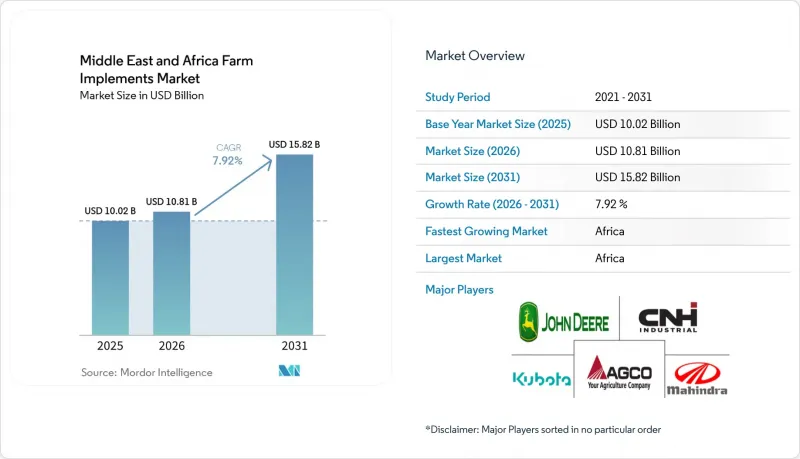
據 Mordor Intelligence 稱,2025 年中東和非洲的農業機械市場價值為 100.2 億美元,預計將從 2026 年的 108.1 億美元成長到 2031 年的 158.2 億美元,2026 年至 2031 年的複合年成長率為 7.92%。
中東及非洲農業機械市場趨勢及洞察
旨在保障糧食安全的機械化項目
政府的糧食安全計畫是中東和非洲農業機械需求的主要驅動力。 2026年2月,聯合國糧食及農業組織(糧農組織)與坦尚尼亞政府聯合舉辦了一次區域農業機械化會議,坦尚尼亞在會上宣布了其「2026-2036年國家農業機械化戰略」。該策略符合非洲永續農業機械化的框架,並支持從公共機械儲存設施向私營機械化服務供應商的過渡。由於私人營運商更有獎勵保持其機械的正常運作,因此他們推動了農業設備和零件的持續採購以及維護服務的需求。 2026年1月,迪爾公司透過其子公司AGCOMS國際貿易有限公司,在奈及利亞國家農業發展基金的框架下簽署了一份價值7000萬美元的契約,採購2000台曳引機和100台聯合收割機。該合約還包括本地組裝和支援服務。與獨特的補貼計劃相比,這些項目為農業機械提供了更穩定的需求來源。這些措施旨在提高農業生產力和國內糧食產量,並最終擴大全部區域對農業設備的需求。
透過農業機械租賃平台為小規模農戶提供便利
農業機械租賃平台正在擴大小規模農戶獲得機械化服務的管道,使他們能夠負擔得起外包機械設備的費用。 「Hello Tractor」平台連接了非洲20多個國家的250多萬小規模農戶和6500多家農業機械所有者。該公司還報告稱,其計量型貸款組合的不良債務率低於2%,這表明基於服務的准入和農業機械融資可以幫助提高機械利用率,即使在傳統貸款管道有限的地區也是如此。更高的利用率提高了農業機械所有者的資產盈利,並鼓勵他們擁有更多機械,從而進一步創造對配套設備的需求。在肯亞、尚比亞和辛巴威進行的研究表明,獲得機械化服務顯著提高了收入,尤其是在低收入農戶中。隨著機械化服務的擴展,用於土地準備、播種、施肥和作物保護等關鍵作業的農業機械(包括犁、耙、中耕機、播種機、插秧機、肥料撒佈機以及曳引機式或牽引式噴霧器)的需求日益成長。這使得小規模農戶無需單獨購買和維護整套農業機械,即可利用機械化耕作。
高昂的初始成本和小規模農戶貸款的限制
高昂的設備成本仍是中東和非洲農業機械市場面臨的一大阻礙因素。對於31至70馬力的曳引機而言,初始投資可能超過許多小規模農戶的年現金收入。對非洲農業和糧食系統的研究表明,獲得機械購買所需的金融服務仍然是一個長期存在的結構性障礙。在南非,商業農場和某些政府計畫的參與者更容易獲得用於購買機械的正規貸款。利率風險和抵押要求可能會限制那些無法提供土地所有權證明的女性農民獲得機械貸款。租賃服務和計量型付費方案可以緩解這些障礙,但它們並不能完全解決從基本耕作工具過渡到多功能精密設備的成本問題。
細分市場分析
到2025年,曳引機將佔據中東和非洲農業機械市場最大的佔有率,達到32.7%。作為牽引式和懸掛式農機具的主要動力來源,曳引機推動了犁地、播種機、噴霧器和飼料機械的需求。因此,購買曳引機可能會導致對配套附件的額外支出。收割機在南非的穀物和油籽種植園以及衣索比亞政府支持的聯合收割機採購計畫中仍然佔有重要地位。土地準備和耕作設備在商業農場和小規模的農機升級改造中均有應用。隨著生產者從撒播轉向劃播,並更好地控制投入品的使用,播種、播種和施肥設備的重要性日益凸顯。在滴灌和中心樞軸式灌溉系統較成熟的海灣市場,灌溉和作物保護設備需求強勁。乾草和飼料設備在東非牧區仍然保持良好的市場需求。
精密農業和自主農機設備預計將成為成長最快的產品類型,2026年至2031年的複合年成長率將達到8.2%。中東和非洲的農業設備市場規模成長主要受水資源效率、人事費用和智慧農業計畫需求的驅動。目前,大部分的技術應用都是在現有機械的基礎上進行升級,而非直接取代傳統設備。感測器套件、可變應用控制設備、無人機連動噴灑器和導航模組等都可以改裝到現有的曳引機和農機設備上。這將擴大精密農業功能的應用範圍,同時也有助於傳統設備的銷售。根據相關文件,埃及的Egrobots公司將於2025年推出由埃及工程師開發的自主收割機器人。此外,根據同一份文件,加納的3Farmate公司將於2026年4月獲得其自主農業機器人「未來農業機械與自動化(FAMA)」的政府認證。這些案例表明,本土開發的解決方案與進口技術正在並存發展。
其他好處:
- Excel格式的市場預測(ME)表
- 3個月的分析師支持
目錄
第1章:引言
- 研究假設和市場定義
- 調查範圍
第2章:調查方法
第3章執行摘要
第4章 市場狀況
- 市場概覽
- 市場促進因素
- 旨在保障糧食安全的機械化項目
- 小規模農戶透過設備租賃平台使用
- 商業農業和出口導向農業的擴張
- 精準農業機械的節水需求
- 勞動力短缺和農業勞動成本上升
- 本地組裝及進口替代的優惠待遇
- 市場限制因素
- 前期投入成本高,且小規模農戶貸款管道有限
- 農村地區服務和零件供應網路的分散化
- 外匯波動和進口成本
- 土地所有權和地塊分割所帶來的限制
- 監理情勢
- 技術展望
- 波特五力分析
- 市場促進因素
第5章 市場規模與成長預測
- 依產品類型
- 聯結機
- 收割機
- 土壤準備及農業設備
- 種植、播種和施肥設備
- 用於灌溉和作物保護的農業機械
- 精準自主農業設備
- 乾草和飼料設備
- 其他農業設備
- 透過操作模式
- 動力農業設備
- 非動力農業設備
- 依輸出類型
- 小於30馬力
- 31~70 HP
- 71~130 HP
- 130馬力或以上
- 按地區
- 中東
- 沙烏地阿拉伯
- 阿拉伯聯合大公國
- 土耳其
- 以色列
- 埃及
- 其他中東國家
- 非洲
- 南非
- 奈及利亞
- 肯亞
- 衣索比亞
- 其他非洲國家
- 中東
第6章 競爭情勢
- 市場集中度
- 策略趨勢
- 市佔率分析
- 公司簡介
- Deere & Company
- CNH Industrial NV
- AGCO Corporation
- Kubota Corporation
- Mahindra & Mahindra Limited
- CLAAS KGaA mbH
- SAME Deutz-Fahr(SDF Group)
- Yanmar Co. Ltd.(Yanmar Holdings Co., Ltd.)
- JC Bamford Excavators Ltd.-JCB(JCB Group)
- Weichai Lovol Intelligent Agricultural Technology Co., Ltd.
- Zoomlion Heavy Industry Science and Technology Co., Ltd.
- Dongfeng Agricultural Machinery Group Co., Ltd.
- Zetor Tractors as
- Lindsay Corporation
- Alamo Group Inc.
第7章 市場機會與未來展望
According to Mordor Intelligence, the Middle East and Africa farm implements market size was valued at USD 10.02 billion in 2025 and is forecast to grow from USD 10.81 billion in 2026 to USD 15.82 billion by 2031, at a CAGR of 7.92% from 2026 to 2031.
Middle East and Africa Farm Implements Market Trends and Insights
Food-Security-Led Mechanization Programs
Government food security programs are a major driver of demand for farm implements in the Middle East and Africa. In February 2026, the Food and Agriculture Organization of the United Nations and the Government of Tanzania held a regional mechanization conference, where Tanzania launched its National Agricultural Mechanization Strategy 2026-2036. The strategy aligns with the sustainable agricultural mechanization in Africa framework and supports a move from public machinery depots toward private mechanization service providers. Private operators have a stronger incentive to keep machinery in use, which supports recurring purchases of implements and parts, as well as maintenance services. In January 2026, Deere & Company, through AGCOMS International Trading Limited under the Nigerian National Agricultural Development Fund framework, signed a USD 70 million agreement for 2,000 tractors and 100 combine harvesters, including commitments for local assembly and support. These programs provide a more stable source of demand for equipment than isolated subsidy programs. These initiatives are intended to improve agricultural productivity and domestic food production, thereby increasing demand for farm implements across the region.
Smallholder Access Through Equipment-Hire Platforms
Equipment-hire platforms are expanding access to mechanization for smallholder farms that cannot afford to purchase machinery and implements outright. Hello Tractor connects more than 2.5 million smallholder farmers with over 6,500 equipment owners across more than 20 African countries. The company also reports a non-performing loan rate of below 2% for its pay-as-you-go financing portfolio, indicating that service-based access and equipment financing can support machinery utilization where conventional lending is limited.Higher utilization improves equipment owners' asset economics and can encourage fleet expansion, creating additional demand for compatible farm implements. Research covering Kenya, Zambia, and Zimbabwe found that hired mechanization services generated statistically significant income gains, particularly among lower-income farm households. As mechanization services expand, demand for implements used in key operations such as soil preparation, planting, fertilization, and crop protection increases, including plows, harrows, cultivators, seeders, planters, fertilizer spreaders, and tractor-mounted or trailed sprayers. This allows smallholders to access mechanized farm operations without having to purchase and maintain a complete set of implements individually.
High Upfront Cost and Limited Smallholder Credit
High equipment costs remain an immediate constraint on the Middle East and Africa farm implements market. Tractors in the 31-70 horsepower range require an upfront investment that can exceed the annual cash income of many smallholder households. Research on African agrifood systems identifies access to financial services for machinery purchases as a continuing structural barrier. Formal lending for machinery remains more available to commercial farms in South Africa and participants in specific government programs. Interest-rate risk and collateral requirements can limit equipment financing for women farmers who lack documented land tenure. Hire services and pay-as-you-go structures reduce the barrier, but do not fully address the cost of moving from basic tillage tools to multi-function precision equipment.
Other drivers and restraints analyzed in the detailed report include:
- Expansion of Commercial and Export-Oriented Farming
- Water-efficiency Requirements for Precision Implements
- Fragmented Rural Service and Spare-Parts Networks
For complete list of drivers and restraints, kindly check the Table Of Contents.
Segment Analysis
Tractors accounted for the largest Middle East and Africa farm implements market share in 2025, at 32.7%. Their role as the primary power source for towed and mounted tools supports demand for tillage equipment, planters, sprayers, and forage equipment. A tractor purchase can therefore lead to additional spending on compatible attachments. Harvesters remain an important category for South African grain and oilseed estates and government-backed combine procurement in Ethiopia. Soil preparation and cultivation equipment serve both commercial farms and smallholder upgrades. Planting, seeding, and fertilizing equipment gain relevance as producers shift from broadcast sowing toward row planting and more controlled input use. Irrigation and crop-protection implements serve Gulf markets with established drip and center-pivot systems. Haying and forage equipment retains demand in East Africa's pastoral livestock areas.
Precision and autonomous implements are forecast to be the fastest-growing product category, with a CAGR of 8.2% from 2026 to 2031. Their Middle East and Africa farm implements market size is supported by water-efficiency needs, labor costs, and smart-agriculture programs. Most adoption is occurring as an addition to existing machinery rather than as a replacement for conventional equipment. Sensor kits, variable-rate controls, drone-linked sprayers, and guidance modules can be installed with existing tractors and implements. This supports continued sales of conventional equipment while expanding the use of precision features. Egypt's Egrobots introduced an autonomous harvesting robot in 2025 that was developed by Egyptian engineers, according to the supplied material. Ghana's 3Farmate received government recognition in April 2026 for its Future Agricultural Machinery and Automation (FAMA) autonomous farming robot, also according to the supplied material. These examples indicate that locally developed solutions are emerging alongside imported technology.
Complete Report Scope:
- By Product Type
- Tractors
- Harvesters
- Soil Preparation and Cultivation Equipment
- Planting, Seeding, and Fertilizing Equipment
- Irrigation and Crop-Protection Implements
- Precision and Autonomous Implements
- Haying and Forage Equipment
- Other Implements
- By Mode of Operation
- Powered Implements
- Unpowered Implements
- By Power Output
- Below 30 HP
- 31-70 HP
- 71-130 HP
- Above 130 HP
- By Geography
- Middle East
- Saudi Arabia
- United Arab Emirates
- Turkey
- Israel
- Egypt
- Rest of Middle East
- Africa
- South Africa
- Nigeria
- Kenya
- Ethiopia
- Rest of Africa
- Middle East
List of Companies Covered in this Report:
- Deere & Company
- CNH Industrial N.V.
- AGCO Corporation
- Kubota Corporation
- Mahindra & Mahindra Limited
- CLAAS KGaA mbH
- SAME Deutz-Fahr (SDF Group)
- Yanmar Co. Ltd. (Yanmar Holdings Co., Ltd.)
- J.C. Bamford Excavators Ltd. - JCB (JCB Group)
- Weichai Lovol Intelligent Agricultural Technology Co., Ltd.
- Zoomlion Heavy Industry Science and Technology Co., Ltd.
- Dongfeng Agricultural Machinery Group Co., Ltd.
- Zetor Tractors a.s.
- Lindsay Corporation
- Alamo Group Inc.
Additional Benefits:
- The market estimate (ME) sheet in Excel format
- 3 months of analyst support
TABLE OF CONTENTS
1 Introduction
- 1.1 Study Assumptions and Market Definition
- 1.1.1 Scope of the Study
2 Research Methodology
3 Executive Summary
4 Market Landscape
- 4.1 Market Overview
- 4.1.1 Market Drivers
- 4.1.1.1 Food-security-led mechanization programs
- 4.1.1.2 Smallholder access through equipment-hire platforms
- 4.1.1.3 Expansion of commercial and export-oriented farming
- 4.1.1.4 Water-efficiency requirements for precision implements
- 4.1.1.5 Labor scarcity and rising farm labor costs
- 4.1.1.6 Local assembly and import-substitution incentives
- 4.1.2 Market Restraints
- 4.1.2.1 High upfront cost and limited smallholder credit
- 4.1.2.2 Fragmented rural service and spare-parts networks
- 4.1.2.3 Foreign-exchange and import-cost volatility
- 4.1.2.4 Land-tenure and plot-fragmentation constraints
- 4.1.3 Regulatory Landscape
- 4.1.4 Technological Outlook
- 4.1.5 Porter's Five Forces Analysis
- 4.1.5.1 Threat of New Entrants
- 4.1.5.2 Bargaining Power of Suppliers
- 4.1.5.3 Bargaining Power of Buyers
- 4.1.5.4 Threat of Substitutes
- 4.1.5.5 Intensity of Competitive Rivalry
- 4.1.1 Market Drivers
5 Market Size and Growth Forecasts (Value, USD)
- 5.1 By Product Type
- 5.1.1 Tractors
- 5.1.2 Harvesters
- 5.1.3 Soil Preparation and Cultivation Equipment
- 5.1.4 Planting, Seeding, and Fertilizing Equipment
- 5.1.5 Irrigation and Crop-Protection Implements
- 5.1.6 Precision and Autonomous Implements
- 5.1.7 Haying and Forage Equipment
- 5.1.8 Other Implements
- 5.2 By Mode of Operation
- 5.2.1 Powered Implements
- 5.2.2 Unpowered Implements
- 5.3 By Power Output
- 5.3.1 Below 30 HP
- 5.3.2 31-70 HP
- 5.3.3 71-130 HP
- 5.3.4 Above 130 HP
- 5.4 By Geography
- 5.4.1 Middle East
- 5.4.1.1 Saudi Arabia
- 5.4.1.2 United Arab Emirates
- 5.4.1.3 Turkey
- 5.4.1.4 Israel
- 5.4.1.5 Egypt
- 5.4.1.6 Rest of Middle East
- 5.4.2 Africa
- 5.4.2.1 South Africa
- 5.4.2.2 Nigeria
- 5.4.2.3 Kenya
- 5.4.2.4 Ethiopia
- 5.4.2.5 Rest of Africa
- 5.4.1 Middle East
6 Competitive Landscape
- 6.1 Market Concentration
- 6.2 Strategic Moves
- 6.3 Market Share Analysis
- 6.4 Company Profiles (includes Global-level Overview, Market-level Overview, Core Segments, Financials as available, Strategic Information, Market Rank/Share for key companies, Products and Services, and Recent Developments)
- 6.4.1 Deere & Company
- 6.4.2 CNH Industrial N.V.
- 6.4.3 AGCO Corporation
- 6.4.4 Kubota Corporation
- 6.4.5 Mahindra & Mahindra Limited
- 6.4.6 CLAAS KGaA mbH
- 6.4.7 SAME Deutz-Fahr (SDF Group)
- 6.4.8 Yanmar Co. Ltd. (Yanmar Holdings Co., Ltd.)
- 6.4.9 J.C. Bamford Excavators Ltd. - JCB (JCB Group)
- 6.4.10 Weichai Lovol Intelligent Agricultural Technology Co., Ltd.
- 6.4.11 Zoomlion Heavy Industry Science and Technology Co., Ltd.
- 6.4.12 Dongfeng Agricultural Machinery Group Co., Ltd.
- 6.4.13 Zetor Tractors a.s.
- 6.4.14 Lindsay Corporation
- 6.4.15 Alamo Group Inc.
7 Market Opportunities and Future Outlook

 農業機械皮帶市場:全球市場預測(2026-2032年)
 南美洲農業機械:市場佔有率分析、行業趨勢和統計數據以及成長預測(2026-2031 年)
 核子掩體市場:按類型、建造類型和地區分類
 全球農業機械市場規模、佔有率、趨勢和成長分析報告(2026-2034年)
 日本農業機械市場規模、佔有率、趨勢和預測:按類型、應用和地區分類,2026-2034年
 2026年全球農業機械市場報告農業產業鏈管理市場按組件、部署模式、業務模式、功能和最終用戶分類,全球預測(2026-2032)
 農業機械市場規模、佔有率和趨勢分析報告:按產品類型、動力來源、公司規模、最終用途、地區和細分市場預測(2025-2033 年)
 到 2030 年農業設備市場預測:按機器類型、操作、功能、容量、銷售管道和地區進行的全球分析
 農業犁市場報告:趨勢、預測和競爭分析(至 2030 年)