


 |
市場調查報告書
商品編碼
2154729
南美洲基於卡片的門禁系統:市佔率分析、產業趨勢與統計及成長預測(2026-2031 年)South America Card-Based Access Control - Market Share Analysis, Industry Trends & Statistics, Growth Forecasts (2026 - 2031) |
||||||

※ 本網頁內容可能與最新版本有所差異。詳細情況請與我們聯繫。
據 Mordor Intelligence 稱,2025 年南美洲基於卡的門禁控制市場價值為 3.0451 億美元,預計到 2031 年將達到 4.9872 億美元,而 2026 年為 3.3038 億美元,預測期(2026-2031 年)的複合年成長率為 8.58%。
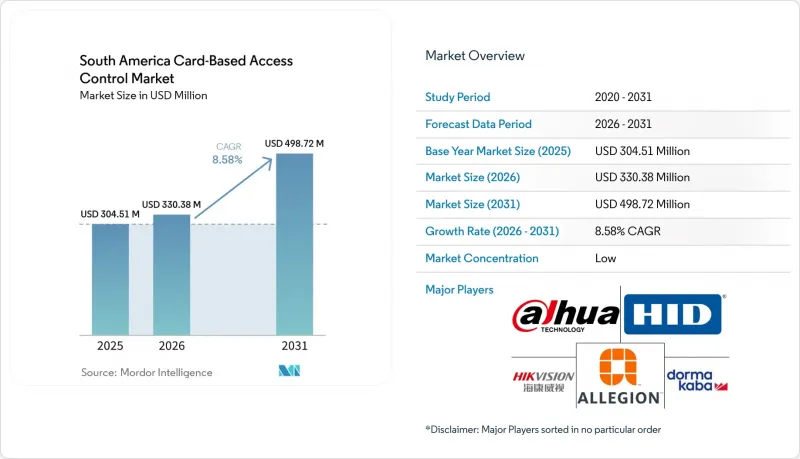
南美洲卡片式門禁市場趨勢與洞察
日益成長的安全需求和公共部門投資
政府機構日益重視關鍵設施的門禁管制。巴西的資料保護法規進一步凸顯了記錄進入許可權和活動日誌對於處理敏感資訊的機構的重要性。商業房地產管理公司和銀行可以利用這些記錄來支援內部稽核和合規流程。波哥大的C4計畫將於2026年整合1,200個新的監控點,這增加了保護相關營運區域的需求。該計劃支援在伺服器機房、指揮中心和限制存取區域實施電子身份驗證,從而增強了南美洲基於卡片的存取控制市場。南美洲基於卡片的存取控制市場將受益於公共採購中存取記錄標準的提高。
智慧卡和RFID技術的演變
對於已擁有讀卡機網路的設施而言,RFID 和智慧卡系統提供了一種切實可行的升級方案。 ISO/IEC 14443 和 ISO/IEC 15693 標準支援可互通的非接觸式和近距離卡的部署。加密的認證資訊解決了銀行、醫療機構和政府機構中存在的卡片複製問題。現有的智慧控制器支援多站點部署中的高用戶量和加密通訊。此外,軟體更新允許在無需立即更換所有讀卡機的情況下實現認證功能。這使得南美洲的卡式門禁管制市場能夠滿足那些既需要更高安全性又需要謹慎管理資本投資的客戶的需求。
高昂的初始成本和總擁有成本
以卡片為基礎的系統需要購買讀卡機、控制器、面板、鎖、線路、憑證和軟體。高昂的資金籌措成本和設備價格可能導致中小企業推遲專案。在有關稅、外匯波動或在地採購要求的市場,進口硬體會進一步增加成本壓力。基於雲端的門禁系統可以透過將部分成本轉移到定期訂閱中來降低初始購置成本。向遠端管理的轉變表明,買家正在考慮以訂閱模式取代硬體驅動型專案。如果供應商無法提供分階段部署、資金籌措或訂閱選項,南美基於卡片的門禁系統市場將面臨失去小規模客戶的風險。
細分市場分析
2025年,RFID近距離感應卡在南美洲卡片式的門禁控制市場佔據了42.36%的佔有率。其應用範圍已擴展至辦公大樓、工業園區和政府機構。許多傳統讀卡機採用125 kHz技術,支援低成本的近距離感應卡。這種相容性使得RFID成為大規模維修專案中的實用選擇,因為在這些專案中更換讀卡機的成本將非常高昂。刷卡在該類別中的市佔率最小,且呈下降趨勢。
智慧卡目前仍主要應用於磁條卡易損易複製的老舊飯店等場所。預計2026年至2031年,智慧卡的複合年成長率將達到9.72%。接觸式和非接觸式智慧卡可為需要更高安全性的應用程式提供加密憑證管理。銀行、醫療機構和政府機構可利用這些憑證來加強身分驗證管理。在南美洲的卡式門禁市場,實體智慧卡和採用同等加密技術的行動憑證也正朝著同一方向發展。
截至2025年,讀卡機佔組件類別的38.41%。由於所有需要門禁控制的門都需要讀卡器,因此它們仍然是大多數項目中使用最頻繁的硬體設備。低成本的近距離讀卡機在對價格敏感的部署中仍然很常見。支援OSDP v2協定的非接觸式讀卡機在企業和金融機構的設施中越來越受歡迎。小鍵盤提供了一種基於PIN碼的備份或覆蓋方式。
電子鎖構成門禁系統的實體驅動層。預計2026年至2031年間,門禁控制面板的複合年成長率將達到10.14%。多門相容面板可與人力資源系統、訪客管理系統和雲端平台整合。韌體升級面板可在保持與現有讀卡機硬體相容性的同時,增加身份驗證資訊支援。這種方法使得南美洲基於卡片的門禁市場能夠實現以面板為中心的升級,而無需更換整個系統。
其他好處:
- Excel格式的市場預測(ME)表
- 3個月的分析師支持
目錄
第1章:引言
- 研究假設和市場定義
- 調查範圍
第2章:調查方法
第3章執行摘要
第4章 市場狀況
- 市場概覽
- 市場促進因素
- 智慧卡和RFID技術的演變
- 日益成長的安全需求和公共部門投資
- 建築、物流和智慧城市基礎設施的擴張
- 都市區犯罪率上升,資產保護需求日益成長
- 向行動、雲端和多技術轉型資格
- 近岸外包和分散式設施中認證資訊的互通性
- 市場限制因素
- 高昂的初始成本和總擁有成本
- 生物識別和純行動裝置替代方案的可用性
- 對隱私、網路安全和資料管治的擔憂
- 與進口、認證、連接和電力基礎設施相關的障礙。
- 宏觀經濟因素對市場的影響
- 產業供應鏈分析
- 科技趨勢
- 監理情勢
- 波特五力分析
第5章 市場規模與成長預測
- 按卡片類型
- 刷卡式卡片
- RFID感應卡
- 智慧卡(接觸式和非接觸式)
- 按組件
- 讀卡器
- 門禁小鍵盤
- 存取控制面板
- 電子鎖具
- 其他規則
- 按最終用戶行業分類
- 商業
- 住宅
- 政府
- 產業
- 運輸和物流
- 衛生保健
- 軍事/國防
- 其他終端用戶產業
- 不同的發展
- 現場
- 雲
- 混合
- 通過認證技術
- 磁條
- RFID/NFC
- 接觸式智慧卡
- 接觸型智慧卡
- 多技術認證資訊
- 按地區
- 巴西
- 阿根廷
- 哥倫比亞
- 智利
- 其他南美國家
第6章 競爭情勢
- 市場集中度
- 策略趨勢
- 市佔率分析
- 公司簡介
- ASSA ABLOY AB
- HID Global Corporation
- dormakaba Holding AG
- Allegion plc
- Gallagher Group Limited
- SALTO Systems, SL
- Nedap NV
- Identiv, Inc.
- Suprema Inc.
- Vanderbilt Industries, Inc.
- Paxton Access Ltd.
- Axis Communications AB
- Genetec Inc.
- Hangzhou Hikvision Digital Technology Co., Ltd.
- Dahua Technology Co., Ltd.
- IDEMIA Identity and Security France SAS
- Thales SA
- Intelbras SA Industria de Telecomunicacao Eletronica Brasileira
- Secom Co., Ltd.
- Bosch Sicherheitssysteme GmbH
- Johnson Controls International plc
- Honeywell International Inc.
第7章 市場機會與未來展望
According to Mordor Intelligence, the South America Card-Based access control market size was valued at USD 304.51 million in 2025 and is estimated to grow from USD 330.38 million in 2026 to reach USD 498.72 million by 2031, at a CAGR of 8.58% during the forecast period (2026-2031).
South America Card-Based Access Control Market Trends and Insights
Rising Security Requirements and Public-Sector Investment
Government agencies are placing greater emphasis on controlled access in critical facilities. Brazil's data protection rules have increased the value of documented access rights and activity logs for organizations handling sensitive information. Commercial property managers and banks can use these records to support internal oversight and compliance processes. Bogota's C4 program integrated 1,200 new monitoring points in 2026, increasing the need to protect associated operational areas. This setting supports electronic credentials for server rooms, command centers, and restricted work areas, which strengthens the South America Card-Based Access Control Market. The South America Card-Based Access Control Market benefits when public procurement raises the expected standard for access documentation.
Evolution of Smart Card and RFID Technology
RFID and smart card systems provide a practical upgrade route for facilities with established reader networks. ISO/IEC 14443 and ISO/IEC 15693 specifications support interoperable contactless and vicinity-card deployments. Cryptographic credentials can address cloning concerns in banking, healthcare, and government facilities. Available intelligent controllers support high user volumes and encrypted communication for multi-site deployments. Software updates can also introduce credential functions without immediately replacing every reader. This helps the South America Card-Based Access Control Market serve customers who need improved security but must manage capital spending carefully.
High Upfront Cost and Total Cost of Ownership
Card-based systems require spending on readers, controllers, panels, locks, cabling, credentials, and software. Smaller businesses may delay projects when financing costs and equipment prices are high. Imported hardware can create further cost pressure in markets with tariffs, exchange-rate volatility, or local-content requirements. Cloud-based access control can reduce the upfront purchase cost by shifting some costs to recurring subscriptions. The move toward remote management shows that buyers are considering subscription-based alternatives to hardware-led projects. The South America Card-Based Access Control Market may lose smaller accounts when suppliers cannot offer staged deployments, financing, or subscription options.
Other drivers and restraints analyzed in the detailed report include:
- Construction, Logistics, and Smart-City Infrastructure Expansion
- Increasing Urban Crime and Asset-Protection Requirements
- Availability of Biometric and Mobile-Only Alternatives
For complete list of drivers and restraints, kindly check the Table Of Contents.
Segment Analysis
RFID proximity cards held 42.36% of the South America Card Based Access Control Market share in 2025. Their installed base spans offices, industrial campuses, and government facilities. Many legacy readers use 125 kHz technology and work with low-cost proximity cards. This compatibility makes RFID a practical option for large retrofits where reader replacement would be expensive. Swipe cards represented the smallest and declining portion of this category.
Their use remains concentrated in older hospitality installations, where magnetic stripes are vulnerable to damage and cloning. Smart cards are projected to grow at a 9.72% CAGR during 2026-2031. Contact and contactless smart cards provide encrypted credential management for higher-security applications. Banking, healthcare, and government sites can use these credentials to strengthen identity controls. The South America Card-Based Access Control Market supports a parallel shift toward both physical smart cards and mobile credentials that use comparable encryption.
Card readers accounted for 38.41% of the component category in 2025. Every controlled door needs a reader, making readers the highest-volume hardware item in most projects. Lower-cost proximity readers remain common in price-sensitive installations. Contactless readers with OSDP v2 protocols are gaining use in corporate and financial facilities. Keypads provide a PIN-based backup or override method.
Electronic locks form the physical actuation layer for controlled doors. Access control panels are forecast to grow at a 10.14% CAGR from 2026 to 2031. Multi-door panels can integrate with human resources, visitor management, and cloud platforms. Firmware-enabled panels can add credential support while retaining compatibility with existing reader hardware. This approach gives the South America Card-Based Access Control Market a panel-led path for upgrades instead of requiring a complete system replacement.
Complete Report Scope:
- By Card Type
- Swipe Cards
- RFID Proximity Cards
- Smart Card (Contact and Contactless)
- By Component
- Card Readers
- Access Control Keypads
- Access Control Panels
- Electronic Lock Hardware
- Other Components
- By End-user Vertical
- Commercial
- Residential
- Government
- Industrial
- Transport and Logistics
- Healthcare
- Military and Defense
- Other End-user Verticals
- By Deployment
- On-Premises
- Cloud
- Hybrid
- By Authentication Technology
- Magnetic Stripe
- RFID / NFC
- Contact Smart Card
- Contactless Smart Card
- Multi-Technology Credential
- By Geography
- Brazil
- Argentina
- Colombia
- Chile
- Rest of South America
List of Companies Covered in this Report:
- ASSA ABLOY AB
- HID Global Corporation
- dormakaba Holding AG
- Allegion plc
- Gallagher Group Limited
- SALTO Systems, S.L.
- Nedap N.V.
- Identiv, Inc.
- Suprema Inc.
- Vanderbilt Industries, Inc.
- Paxton Access Ltd.
- Axis Communications AB
- Genetec Inc.
- Hangzhou Hikvision Digital Technology Co., Ltd.
- Dahua Technology Co., Ltd.
- IDEMIA Identity and Security France SAS
- Thales S.A.
- Intelbras S.A. Industria de Telecomunicacao Eletronica Brasileira
- Secom Co., Ltd.
- Bosch Sicherheitssysteme GmbH
- Johnson Controls International plc
- Honeywell International Inc.
Additional Benefits:
- The market estimate (ME) sheet in Excel format
- 3 months of analyst support
TABLE OF CONTENTS
1 INTRODUCTION
- 1.1 Study Assumptions and Market Definition
- 1.2 Scope of the Study
2 RESEARCH METHODOLOGY
3 EXECUTIVE SUMMARY
4 MARKET LANDSCAPE
- 4.1 Market Overview
- 4.2 Market Drivers
- 4.2.1 Evolution of Smart Card and RFID Technology
- 4.2.2 Rising Security Requirements and Public-Sector Investment
- 4.2.3 Construction, Logistics, and Smart-City Infrastructure Expansion
- 4.2.4 Increasing Urban Crime and Asset-Protection Requirements
- 4.2.5 Migration to Mobile, Cloud, and Multi-Technology Credentials
- 4.2.6 Credential Interoperability for Near-Shoring and Distributed Facilities
- 4.3 Market Restraints
- 4.3.1 High Upfront Cost and Total Cost of Ownership
- 4.3.2 Availability of Biometric and Mobile-Only Alternatives
- 4.3.3 Privacy, Cybersecurity, and Data-Governance Concerns
- 4.3.4 Import, Certification, Connectivity, and Power-Infrastructure Barriers
- 4.4 Impact of Macroeconomic Factors on the Market
- 4.5 Industry Supply-Chain Analysis
- 4.6 Technology Outlook
- 4.7 Regulatory Landscape
- 4.8 Porter's Five Forces Analysis
- 4.8.1 Threat of New Entrants
- 4.8.2 Bargaining Power of Suppliers
- 4.8.3 Bargaining Power of Buyers
- 4.8.4 Threat of Substitutes
- 4.8.5 Intensity of Competitive Rivalry
5 MARKET SIZE AND GROWTH FORECASTS (VALUE)
- 5.1 By Card Type
- 5.1.1 Swipe Cards
- 5.1.2 RFID Proximity Cards
- 5.1.3 Smart Card (Contact and Contactless)
- 5.2 By Component
- 5.2.1 Card Readers
- 5.2.2 Access Control Keypads
- 5.2.3 Access Control Panels
- 5.2.4 Electronic Lock Hardware
- 5.2.5 Other Components
- 5.3 By End-user Vertical
- 5.3.1 Commercial
- 5.3.2 Residential
- 5.3.3 Government
- 5.3.4 Industrial
- 5.3.5 Transport and Logistics
- 5.3.6 Healthcare
- 5.3.7 Military and Defense
- 5.3.8 Other End-user Verticals
- 5.4 By Deployment
- 5.4.1 On-Premises
- 5.4.2 Cloud
- 5.4.3 Hybrid
- 5.5 By Authentication Technology
- 5.5.1 Magnetic Stripe
- 5.5.2 RFID / NFC
- 5.5.3 Contact Smart Card
- 5.5.4 Contactless Smart Card
- 5.5.5 Multi-Technology Credential
- 5.6 By Geography
- 5.6.1 Brazil
- 5.6.2 Argentina
- 5.6.3 Colombia
- 5.6.4 Chile
- 5.6.5 Rest of South America
6 COMPETITIVE LANDSCAPE
- 6.1 Market Concentration
- 6.2 Strategic Moves
- 6.3 Market Share Analysis
- 6.4 Company Profiles (includes Global Level Overview, Market Level Overview, Core Segments, Financials as available, Strategic Information, Market Rank/Share, Products and Services, Recent Developments)
- 6.4.1 ASSA ABLOY AB
- 6.4.2 HID Global Corporation
- 6.4.3 dormakaba Holding AG
- 6.4.4 Allegion plc
- 6.4.5 Gallagher Group Limited
- 6.4.6 SALTO Systems, S.L.
- 6.4.7 Nedap N.V.
- 6.4.8 Identiv, Inc.
- 6.4.9 Suprema Inc.
- 6.4.10 Vanderbilt Industries, Inc.
- 6.4.11 Paxton Access Ltd.
- 6.4.12 Axis Communications AB
- 6.4.13 Genetec Inc.
- 6.4.14 Hangzhou Hikvision Digital Technology Co., Ltd.
- 6.4.15 Dahua Technology Co., Ltd.
- 6.4.16 IDEMIA Identity and Security France SAS
- 6.4.17 Thales S.A.
- 6.4.18 Intelbras S.A. Industria de Telecomunicacao Eletronica Brasileira
- 6.4.19 Secom Co., Ltd.
- 6.4.20 Bosch Sicherheitssysteme GmbH
- 6.4.21 Johnson Controls International plc
- 6.4.22 Honeywell International Inc.
7 MARKET OPPORTUNITIES AND FUTURE OUTLOOK
- 7.1 White-Space and Unmet-Need Assessment

 物聯網身分和存取管理市場規模、佔有率和趨勢分析報告:按組件、身份驗證方法、部署類型、組織規模、最終用戶、地區和細分市場預測(2026-2033 年)
 2026-2030年全球實體身分與存取管理市場
 存取控制和身分驗證市場:按產品類型、組件、部署模式、身分驗證方法、最終用戶、國家和地區分類-全球產業分析、市場規模、市場佔有率及2026年至2033年預測
 行人用最終用途、材料、操作方式、通路、安裝方式及門扇類型分類,全球預測(2026-2032年)
 存取管理市場按元件、部署類型、最終用戶和地區分類
 存取控制和身分驗證市場 - 全球產業規模、佔有率、趨勢、機會和預測(按組件、服務產品、存取控制即服務、垂直產業、地區和競爭格局分類),2021-2031 年
 存取控制和身份驗證市場規模、佔有率和成長分析(按組件、身份驗證類型、部署模式、最終用戶行業和地區分類)——行業預測,2026-2033年