

 |
市場調查報告書
商品編碼
2154510
南美洲人工採油系統:市佔率分析、產業趨勢與統計及成長預測(2026-2031 年)South America Artificial Lift Systems - Market Share Analysis, Industry Trends & Statistics, Growth Forecasts (2026 - 2031) |
||||||

※ 本網頁內容可能與最新版本有所差異。詳細情況請與我們聯繫。
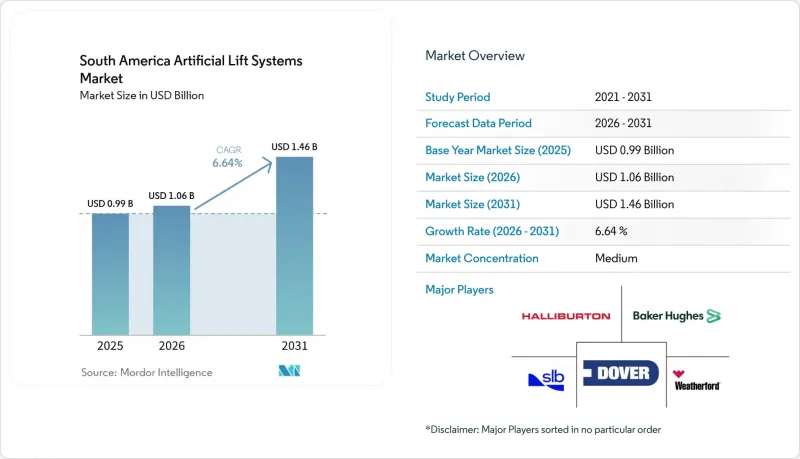
根據 Mordor Intelligence 預測,南美洲人工石油提取系統市場規模預計在 2025 年達到 9.9 億美元,在 2026 年達到 10.6 億美元,在 2031 年達到 14.6 億美元。
預計 2026 年至 2031 年的複合年成長率為 6.64%。
南美洲人工榨油系統市場趨勢與洞察
成熟油井的再生利用及其生產壽命的延長
南美洲成熟的油田在天然儲存壓力下降後,依賴人工開採。這使得現有油田對設備的更換、維修和維護需求持續不斷。哥倫比亞國家石油公司(Ecopetrol)正致力於降低其人工開採系統的故障率和能耗,包括在哥倫比亞安裝電潛泵(ESP)、機械泵和螺桿泵。這些努力表明,隨著油井老化,營運商為何優先考慮泵浦的可靠性和能源效率。因此,南美洲人工開採系統市場不僅包含新鑽井的需求,也包含與生產維護相關的需求。即使營運商推遲一些不太重要的擴建項目,這項基礎也能支撐服務活動。
在成熟油井中,由於不同油田的產量、流體黏度和含氣量存在差異,需要更廣泛的抽油方法。當流體流量較大時,作業者會採用電潛泵(ESP),而升降杆和精密抽油機(PCP)系統在許多現有的陸上作業中仍然發揮著至關重要的作用。現場團隊必須定期維護這些系統,因為延誤維修會導致產量損失。當需要快速進行修井或設備更換時,本地服務基礎設施至關重要。南美洲的人工採油系統市場受益於此,因為服務合約可以跨越多個作業週期。擁有附近庫存和經驗豐富的現場工作人員的供應商可以最大限度地減少作業者的停機時間。
巴西的鹽層下下層和圭亞那不斷擴大的海洋開發
巴西的鹽鹽層下油氣開發案仍是該地區海上系統的主要需求來源。巴西石油公司(Petrobras)報告稱,其鹽層下油氣生產在2025年將達到日產256萬桶原油的水平。該公司還報告稱,其FPSO「Almirante Tamandare」號在2025年將實現日產27萬桶原油。此類開發案需要能夠在深海壓力、大量天然氣和惡劣流體條件下運作的設備。南美洲人工採油系統市場正受益於一些項目,這些項目將泵送方式的選擇納入了油井和生產系統的設計中。供應商必須滿足技術資格要求才能參與這些專案。
圭亞那正在為該地區的石油需求基礎開闢一條新的海上開發途徑。埃克森美孚公司報告稱,Stubbroke區塊的日產量在2025年11月達到了90萬桶。該公司表示,Uar FPSO將於2026年投產,設計日產量為25萬桶。隨著新計畫的推進,整個擴大的井口網路對合適的完井、監測和生產支援系統的需求日益成長。海上業者非常重視運作壽命,因為水下介入作業可能既困難又昂貴。這促使他們採用能夠在需要大規模干預之前識別作業問題的監控系統。
超深海作業和修井的經濟學
深海提升系統必須可靠地運作,因為更換系統可能需要專用船舶、海底設備和周密的計畫。這導致巴西鹽層下油田和圭亞那近海開發案的故障成本飆升。 2025年發表在《石油技術雜誌》(Journal of Petroleum Technology)上的一篇報導探討了巴西超深海重油油田亞特蘭大油田的電潛泵(ESP)運作挑戰。報導解釋了重油、天然氣狀況和水深如何使電潛泵的運作變得複雜。這些情況可能需要投資於延長運作壽命和監測,而不是頻繁更換。因此,南美洲人工採油系統市場必須權衡高規格硬體的價值和乾預成本。
營運商透過更加重視設備合格和故障預防來降低這種風險。在高風險生產環境中,也可以採用冗餘配置和監控工具。這種方法有利於在嚴苛的海洋應用領域擁有豐富經驗的成熟供應商。同時,由於業者需要仔細審查可靠性和服務能力,採購流程也會延長。高昂的干預成本可能會降低營運商在關鍵油井中試運行未經驗證系統的意願。儘管南美洲人工採油系統市場對合格的供應商仍然具有吸引力,但進軍深海作業需要極高的技術可靠性。
細分市場分析
截至2025年,電潛泵(ESP)將佔南美洲人工採油系統市場32.6%的佔有率,預計到2031年將以6.8%的複合年成長率成長。電潛泵正被應用於近海和深海高產油井。由於其高度的適應性,電潛泵的應用範圍十分廣泛,從成熟的常規油井到複雜的已完井近海油井均有涉及。巴西石油公司(Petrobras)在鹽層下生產架構中採用人工採油系統,因為在這些領域,設備的可靠性至關重要。 BW Energy公司於2025年5月宣布了其馬隆巴專案(Malomba Project)的決策,該專案包括六口配備地下電潛泵系統的初始水平生產井。
在處理高黏度流體和成熟儲存的陸上作業中,螺桿泵仍然發揮著至關重要的作用。升降杆在全部區域仍佔據相當大的佔有率。在電潛泵不適用的油井中,則採用氣舉、柱塞舉升、液壓泵和其他系統。由於沒有一種系統適用於所有油井,人工採油系統產業依賴多種技術的組合。 ISO 15551:2023 標準規定了安裝在管內的電潛泵系統的設計檢驗、性能評估和功能評估的要求。
截至2025年,垂直井佔南美洲人工採油系統市場57.4%的佔有率。隨著非傳統資源開發的擴大,預計到2031年,水平井的複合年成長率將達到7.1%。垂直井的安裝主要集中在阿根廷、哥倫比亞和巴西等已開發的陸上盆地。水平井的完井可能需要不同的泵浦配置和更強大的氣體處理能力。在南美洲人工採油系統市場中,隨著傳統型礦區多口井的開發,水平井的市場規模正在擴大。
水平井提升設備的安裝需要周密的規劃,其中應考慮井口設計和儲存壓力變化。設備必須能夠在不增加故障風險的前提下維持穩定的流量。設計過程包括對泵浦入口、氣體行為和輸出的評估。擁有非傳統資源開發經驗的全球供應商可以將成熟的設計方案引入該地區。本地服務團隊對於井場的安裝和故障排除仍然至關重要。
其他好處:
- Excel格式的市場預測(ME)表
- 3個月的分析師支持
目錄
第1章:引言
- 研究假設和市場定義
- 調查範圍
第2章:調查方法
第3章執行摘要
第4章 市場狀況
- 市場概覽
- 市場促進因素
- 成熟健康油井的再生利用及其生產壽命的延長
- Vaca Muerta 水平井開發
- 巴西鹽層下帶和圭亞那沿海海洋開發擴張
- 數位電梯最佳化和遠端監控
- 腐蝕性環境起重設備的區域供應基地
- 高氣油比井的自動化氣體處理維修
- 市場限制因素
- 原油價格波動導致上游資本投資優先。
- 超深海作業和修井的經濟學
- 特殊彈性體與電力電子供應瓶頸
- 能夠操作自動化設備的現場人員短缺
- 供應鏈分析
- 波特五力分析
- 科技趨勢
- 監理情勢
- 投資分析
第5章 市場規模與成長預測
- 按電梯類型
- 電動潛水幫浦(ESP)
- 螺桿幫浦(PCP)
- 升降杆(樑式、吸桿式)
- 氣舉
- 液壓活塞泵和噴射泵
- 柱塞式升降機
- 其他專用系統(液壓潛水式、毛細管式)
- 按類型分類的井眼方向
- 水平井
- 垂直井
- 按儲層類型
- 傳統的
- 傳統型(頁岩/緻密)
- 透過使用
- 陸上
- 離岸
- 按組件
- 泵浦
- 引擎
- 變速驅動及控制設備
- 地面設備
- 配件(感應器、密封件、墊片)
- 按服務
- 安裝和試運行
- 最佳化和監測
- 維護、修理和大修 (MRO)
- 按地區
- 巴西
- 阿根廷
- 蓋亞那
- 哥倫比亞
- 智利
- 其他南美國家
第6章 競爭情勢
- 市場集中度
- 策略趨勢
- 市佔率分析
- 公司簡介
- Baker Hughes Company
- AccessESP
- Alkhorayef Petroleum Company
- Borets International Limited
- Dover Corporation
- Flotek Industries, Inc.
- Halliburton Company
- JJ Tech Systems
- Kudu Industries Inc.
- NOV Inc.
- Novomet Group
- Novomet Oil Services Holding Ltd.
- Odessa Separator
- PCM Artificial Lift
- SLB
- Tenaris SA
- Weatherford International plc
第7章 市場機會與未來展望
According to Mordor Intelligence, the South America artificial lift systems market size is projected to be USD 0.99 billion in 2025, USD 1.06 billion in 2026, and reach USD 1.46 billion by 2031, at a CAGR of 6.64% from 2026 to 2031.
South America Artificial Lift Systems Market Trends and Insights
Mature-Well Rejuvenation And Production-Life Extension
Mature producing fields across South America rely on artificial lift after natural reservoir pressure declines. This creates recurring demand for equipment replacement, repairs, and service work across established basins. Ecopetrol has addressed failure reduction and energy use in its artificial lifting systems, covering ESP, mechanical pumping, and progressive cavity pump installations in Colombia. The work shows why operators focus on pump reliability and energy performance as wells age. The South America artificial lift systems market therefore includes demand that is tied to preserving production, rather than only to new drilling. That base can support service activity when operators delay less essential expansion projects.
Mature wells also require a broader mix of lift methods because water production, fluid viscosity, and gas content vary across fields. Operators use ESPs where high fluid volumes justify the system, while rod lift and PCP systems remain relevant in many established onshore operations. Field teams must maintain these systems regularly because deferred repairs can result in lost output. Local service capacity is important when workovers or equipment changes are needed quickly. The South America artificial lift systems market benefits from this installed base because service contracts can continue through several intervention cycles. Suppliers that hold nearby inventory and experienced field crews can reduce downtime for operators.
Brazil Pre-Salt And Guyana Offshore Expansion
Brazil's pre-salt program remains a major source of offshore system demand in the region. Petrobras reported 2.56 million barrels of oil equivalent per day from its own pre-salt production in 2025. The company also reported that the Almirante Tamandare FPSO produced 270,000 barrels per day during 2025. These developments require equipment that can operate under deepwater pressure, high gas volumes, and demanding fluid conditions. The South America artificial lift systems market gains from projects where lift selection is incorporated into well and production-system design. Suppliers need to meet technical qualification requirements before they can participate in these projects.
Guyana adds another offshore development path to the regional demand base. ExxonMobil reported that Stabroek Block production reached 900,000 barrels per day in November 2025. The company stated that the Uaru FPSO began operations in 2026 with a design rate of 250,000 barrels per day. New projects increase the need for qualified completion, monitoring, and production-support systems across added well clusters. Offshore operators place high value on run life because subsea intervention can be difficult and expensive. This encourages the use of monitoring systems that identify operating issues before they require a major intervention.
Ultra-Deepwater Intervention And Workover Economics
Deepwater lift systems must operate reliably because replacement can require specialized vessels, subsea equipment, and detailed planning. This raises the cost of failures in Brazil's pre-salt fields and Guyana's offshore developments. A 2025 article in the Journal of Petroleum Technology discussed operating challenges for an ESP in the ultra-deepwater, heavy-oil Atlanta field in Brazil. The article described how heavy oil, gas conditions, and water depth complicate ESP operation. These conditions can shift investment toward run-life improvements and monitoring instead of frequent replacement activity. The South America artificial lift systems market must therefore balance the value of high-specification hardware against the cost of intervention.
Operators reduce this exposure by placing greater emphasis on equipment qualification and failure prevention. They may use redundant configurations or monitoring tools where the production risk is high. This approach can favor established suppliers with experience in demanding offshore applications. It can also lengthen purchasing processes because operators review reliability and service capability closely. High intervention costs can limit the willingness to test unproven systems in critical wells. The South America artificial lift systems market remains attractive for qualified providers, but entry into deepwater work requires significant technical credibility.
Other drivers and restraints analyzed in the detailed report include:
- Digital Lift Optimization And Remote Surveillance
- Automated Gas-Handling Retrofits In High-GOR Wells
- Specialty-Elastomer And Power-Electronics Bottlenecks
For complete list of drivers and restraints, kindly check the Table Of Contents.
Segment Analysis
Electric submersible pumps held 32.6% of the South America artificial lift systems market in 2025 and are forecast to grow at a 6.8% CAGR through 2031. ESPs serve high-volume wells across offshore and deep onshore applications. Their adaptability supports use from mature conventional wells to complex offshore completions. Petrobras uses artificial lift within its pre-salt production architecture, where equipment reliability is important. BW Energy's May 2025 Maromba decision included 6 initial horizontal production wells with downhole ESP systems.
Progressive cavity pumps remain important in onshore operations with viscous fluids and mature reservoirs. Rod lift retains a substantial installed base across older producing areas. Gas lift, plunger lift, hydraulic pumps, and other systems serve wells where ESPs are less suitable. The artificial lift systems industry depends on this broad technology mix because no single system suits every well. ISO 15551:2023 sets requirements for design verification, performance ratings, and functional evaluation for tubing-deployed ESP systems.
Vertical wells accounted for 57.4% of the South America artificial lift systems market in 2025. Horizontal wells are projected to grow at a 7.1% CAGR through 2031 as unconventional development expands. The vertical installed base is concentrated in established onshore basins across Argentina, Colombia, and Brazil. Horizontal completions can require different pump geometry and stronger gas-handling capability. The South America artificial lift systems market size for horizontal wells is growing with multi-well development in unconventional acreage.
Lift installation in horizontal wells requires planning around completion design and reservoir pressure changes. Equipment must support stable flow without increasing failure risk. The design process includes pump intake, gas behavior, and power assessments. Global suppliers with unconventional experience can bring proven designs to the region. Local service teams remain essential for installation and troubleshooting at the well site.
Complete Report Scope:
- By Lift Type
- Electric Submersible Pumps (ESP)
- Progressive Cavity Pump (PCP)
- Rod Lift (Beam, Sucker-Rod)
- Gas Lift
- Hydraulic Piston & Jet Pumps
- Plunger Lift
- Other Niche Systems (Hydraulic Submersible, Capillary)
- By Well Orientation
- Horizontal Wells
- Vertical Wells
- By Reservoir Type
- Conventional
- Unconventional (Shale/Tight)
- By Application
- Onshore
- Offshore
- By Component
- Pump
- Motor
- Variable Speed Drive & Controls
- Surface Equipment
- Ancillary (Sensors, Seal-Sections, Packers)
- By Service
- Installation and Commissioning
- Optimization and Monitoring
- Maintenance, Repair & Overhaul (MRO)
- By Geography
- Brazil
- Argentina
- Guyana
- Colombia
- Chile
- Rest of South America
List of Companies Covered in this Report:
- Baker Hughes Company
- AccessESP
- Alkhorayef Petroleum Company
- Borets International Limited
- Dover Corporation
- Flotek Industries, Inc.
- Halliburton Company
- JJ Tech Systems
- Kudu Industries Inc.
- NOV Inc.
- Novomet Group
- Novomet Oil Services Holding Ltd.
- Odessa Separator
- PCM Artificial Lift
- SLB
- Tenaris S.A.
- Weatherford International plc
Additional Benefits:
- The market estimate (ME) sheet in Excel format
- 3 months of analyst support
TABLE OF CONTENTS
1 INTRODUCTION
- 1.1 Study Assumptions and Market Definition
- 1.2 Scope of the Study
2 RESEARCH METHODOLOGY
3 EXECUTIVE SUMMARY
4 MARKET LANDSCAPE
- 4.1 Market Overview
- 4.2 Market Drivers
- 4.2.1 Mature-Well Rejuvenation and Production-Life Extension
- 4.2.2 Vaca Muerta Horizontal-Well Development
- 4.2.3 Brazil Pre-Salt and Guyana-Adjacent Offshore Expansion
- 4.2.4 Digital Lift Optimization and Remote Surveillance
- 4.2.5 Local Supply Hubs for Corrosive-Service Lift Equipment
- 4.2.6 Automated Gas-Handling Retrofits in High-GOR Wells
- 4.3 Market Restraints
- 4.3.1 Crude-Price-Driven Upstream CAPEX Deferrals
- 4.3.2 Ultra-Deepwater Intervention and Workover Economics
- 4.3.3 Specialty-Elastomer and Power-Electronics Bottlenecks
- 4.3.4 Shortage of Automation-Ready Field Personnel
- 4.4 Supply-Chain Analysis
- 4.5 Porter's Five Forces Analysis
- 4.5.1 Bargaining Power of Suppliers
- 4.5.2 Bargaining Power of Buyers
- 4.5.3 Threat of New Entrants
- 4.5.4 Threat of Substitutes
- 4.5.5 Competitive Rivalry
- 4.6 Technology Outlook
- 4.7 Regulatory Landscape
- 4.8 Investment Analysis
5 MARKET SIZE AND GROWTH FORECASTS
- 5.1 By Lift Type
- 5.1.1 Electric Submersible Pumps (ESP)
- 5.1.2 Progressive Cavity Pump (PCP)
- 5.1.3 Rod Lift (Beam, Sucker-Rod)
- 5.1.4 Gas Lift
- 5.1.5 Hydraulic Piston & Jet Pumps
- 5.1.6 Plunger Lift
- 5.1.7 Other Niche Systems (Hydraulic Submersible, Capillary)
- 5.2 By Well Orientation
- 5.2.1 Horizontal Wells
- 5.2.2 Vertical Wells
- 5.3 By Reservoir Type
- 5.3.1 Conventional
- 5.3.2 Unconventional (Shale/Tight)
- 5.4 By Application
- 5.4.1 Onshore
- 5.4.2 Offshore
- 5.5 By Component
- 5.5.1 Pump
- 5.5.2 Motor
- 5.5.3 Variable Speed Drive & Controls
- 5.5.4 Surface Equipment
- 5.5.5 Ancillary (Sensors, Seal-Sections, Packers)
- 5.6 By Service
- 5.6.1 Installation and Commissioning
- 5.6.2 Optimization and Monitoring
- 5.6.3 Maintenance, Repair & Overhaul (MRO)
- 5.7 By Geography
- 5.7.1 Brazil
- 5.7.2 Argentina
- 5.7.3 Guyana
- 5.7.4 Colombia
- 5.7.5 Chile
- 5.7.6 Rest of South America
6 COMPETITIVE LANDSCAPE
- 6.1 Market Concentration
- 6.2 Strategic Moves
- 6.3 Market Share Analysis
- 6.4 Company Profiles (includes Global Level Overview, Market Level Overview, Core Segments, Financials as available, Strategic Information, Market Rank/Share, Products and Services, Recent Developments)
- 6.4.1 Baker Hughes Company
- 6.4.2 AccessESP
- 6.4.3 Alkhorayef Petroleum Company
- 6.4.4 Borets International Limited
- 6.4.5 Dover Corporation
- 6.4.6 Flotek Industries, Inc.
- 6.4.7 Halliburton Company
- 6.4.8 JJ Tech Systems
- 6.4.9 Kudu Industries Inc.
- 6.4.10 NOV Inc.
- 6.4.11 Novomet Group
- 6.4.12 Novomet Oil Services Holding Ltd.
- 6.4.13 Odessa Separator
- 6.4.14 PCM Artificial Lift
- 6.4.15 SLB
- 6.4.16 Tenaris S.A.
- 6.4.17 Weatherford International plc
7 MARKET OPPORTUNITIES AND FUTURE OUTLOOK
- 7.1 White-space & Unmet-need Assessment

 全球人工榨油系統市場
 人工採油系統市場規模、佔有率和趨勢分析報告:按產品、組件、機制、井類型、技術、地區和細分市場預測(2026-2033 年)
 2026-2030年全球人工採油系統市場
 人工油脂提取系統:市場佔有率分析、產業趨勢與統計、成長預測(2026-2031)
 人工採油系統市場報告:依抽油、井型、機制、應用和地區分類(2026-2034 年)
 2026-2034年全球人工油脂萃取系統市場規模、佔有率、趨勢及成長分析報告
 桿式起重系統市場 - 全球產業規模、佔有率、趨勢、機會、預測:按類型、最終用戶、地區和競爭格局分類,2021-2031年陸基人工採油系統市場-全球產業規模、佔有率、趨勢、機會與預測:按技術、最終用戶、地區和競爭對手分類,2021-2031年全球人工舉升系統市場:市場規模、佔有率、成長率、產業分析、類型、應用及區域分析、未來預測(2026-2034)人工採油系統市場-2026-2031年預測