


 |
市場調查報告書
商品編碼
2154508
多域網路編配軟體:市場佔有率分析、行業趨勢和統計數據以及成長預測(2026-2031 年)Multi-Domain Network Orchestration Software - Market Share Analysis, Industry Trends & Statistics, Growth Forecasts (2026 - 2031) |
||||||

※ 本網頁內容可能與最新版本有所差異。詳細情況請與我們聯繫。
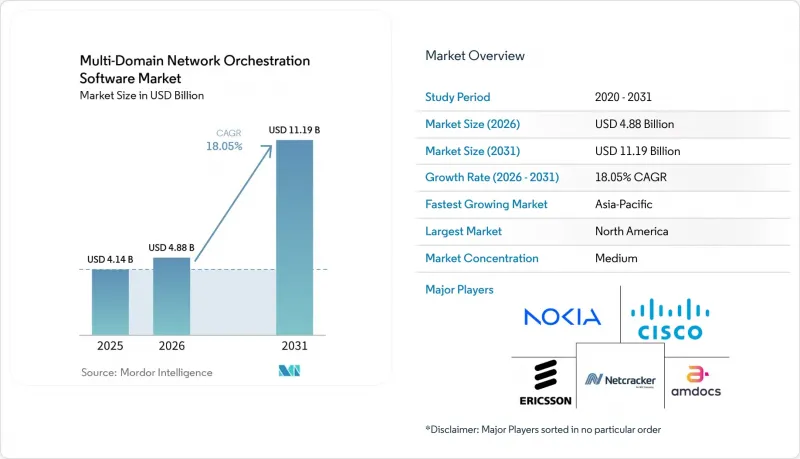
據 Mordor Intelligence 稱,2025 年多域網路編配軟體市場價值為 41.4 億美元,預計在 2026 年至 2031 年的預測期內將以 18.05% 的複合年成長率成長,到 2031 年達到 111.9 億美元。
全球多域網路編配軟體市場趨勢與洞察
透過 5G 獨立組網和網路切片實現獲利
多域網路編配軟體市場正受惠於5G獨立網路(SA)的普及,SA已將網路切片從單純的規劃概念轉變為一項商業服務。根據愛立信預測,基於5G SA網路切片的商用差異化連接服務將於2026年第二季交付84項,高於2025年11月的65項。每項服務的交付都需要在無線、傳輸和核心網域之間協調服務啟動、保障和服務等級協定(SLA)的履行。與點對點配置相比,管理多個運作中切片的營運商需要更頻繁地進行狀態匹配。中國行動、德國電信和OTE集團正在企業和消費者環境中實現基於切片的服務的商業化,其中OTE的「Priority Pass」展示瞭如何為客戶打包頻寬保障。各廠商的標準化政策使得互通性成為多域網路編配軟體市場中更關鍵的採購標準。這是因為電信業者需要即使在底層網路元件發生變化的情況下,服務工作流程也能繼續正常運作。
人工智慧驅動的閉合迴路網路運行
多域網路編配軟體市場正從服務啟動擴展到持續監控和自動化維護。 2026年2月,NTT DOCOMO將一款基於代理的AI系統商業化,該系統可為超過一百萬台設備提供即時網路維護支援。該平台分析警告和流量數據以識別異常和故障,並向工程師提供維護建議。 2026年6月,諾基亞推出了“自主網路代理庫”,旨在實現跨IP、固定、光纖通訊和無線接取網路的階段性自動化。跨域一致的清單、本體和網路狀態資料對於這些應用至關重要。 ETSI將精確的數位孿生視為在分層多域網路中實現可靠的閉合迴路意圖的基礎。
遺留資產資訊不準確和數據不一致
傳統資產資訊的不準確性持續限制多域網路編配軟體市場的發展。當資料庫以不同格式說明相同實體資產時,自動化工作流程可能導致錯誤的配置和修復決策。 TM Forum 的 Catalyst C26.0.916 旨在將混合網路匹配時間縮短 60%,將不匹配預測準確率提高 85%,並將服務等級協定 (SLA) 違約和訂單遺失率降低 40%。財務企業記錄與營運 OSS 庫存之間的差異進一步加劇了這一問題,尤其是在已退役設備仍保留在記錄中或新資產尚未正式投入運作的情況下。由於網路每天都在變化,僅靠定期現場勘測無法完全應對這項挑戰。電信業者在部署大規模 AI 驅動的自動化系統之前,需要可靠的即時網路狀態資料。這項需求使得資料校正工作在多域網路編配軟體市場中佔據優先地位,甚至優先於許多計劃中的功能的部署。
細分市場分析
預計到2025年,解決方案將佔多域網路編配軟體市場總收入的62.54%。此細分市場包括多網域服務編配平台、網域編配和控制器整合工具,以及清單、發現和協調層。多域服務編配平台支援服務設計、跨域分解和即時啟動。控制器整合工具將進階服務意圖轉換為營運商可在不同網路網域中使用的配置。隨著營運商採用需要機器可讀服務定義的「網路即服務」(NaaS)產品,服務目錄和分解工具正日益受到關注。
隨著電信業者尋求支援以推進複雜的現代化項目,預計到2031年,服務市場將以20.11%的複合年成長率成長。諮詢顧問服務、整合部署以及託管營運和支援涵蓋了交付流程的各個階段,從設計決策到日常營運支援。隨著電信營運商將整合風險轉移給供應商,並要求供應商明確服務連續性的責任,營運管理和支援的重要性日益凸顯。在多域網路編配軟體產業,能夠提供部署後日常營運支援的供應商更受青睞,而能夠在整個部署過程中明確記錄營運責任的供應商也備受重視。 ETSI指出,缺乏統一的抽象概念正在將雲端原生生命週期管理的全部負擔轉移到OSS和BSS團隊身上。
在多域網路編配軟體市場,預計到2025年,雲端部署將佔據68.11%的市場佔有率,並以19.67%的複合年成長率持續成長至2031年。雲端平台縮短了本地部署環境中的部分資本支出週期,並且可以透過增加網路切片進行擴展,而無需相應增加人員。諾基亞預計在2025年6月發布「自治網路架構」(Autonomous Network Fabric),提供基於Google雲端的SaaS部署、透過Google分散式雲端進行的本地部署以及混合部署選項。在多域網路編配軟體市場,雲端交付被用於滿足基於訂閱的購買模式和不斷變化的編配的需求。由於資料居住要求和合法攔截合規等國家法規,混合部署在印度等市場仍然至關重要。
對於管理關鍵國家基礎設施的一級電信業者而言,本地部署仍然至關重要。混合配置是非雲端部署方案中成長最快的選擇。這是因為營運商可以將策略關鍵型工作負載保留在本地,同時利用雲端容量執行其他編配任務。寬頻論壇的 MR-530-1.0.0 定義了一個域編排器模型,該模型既可在雲端環境中運行,也可在本地環境中運行,並支援端到端服務編排。電信業者正在歐洲有線網路現代化專案和南美網路服務供應商(ISP) 專案中考慮採用此模型。因此,多域網路編配軟體產業需要支援部署柔軟性,而不是單一的運作模式,市場可能會更青睞那些能夠在不造成服務工作流程碎片化的情況下保持這種靈活性的平台。
區域分析
預計到2025年,北美將佔據多域網路編配軟體市場28.77%的佔有率。美國主要營運商持續推動OSS和BSS的現代化,加上基於雲端的批發和企業服務,預計將為多域網路編配軟體市場創造穩定的需求基礎。 T-Mobile計劃於2026年1月與Netcracker合作擴展雲端平台,這凸顯了營運商利用編配為合作夥伴和行動虛擬網路營運商(MVNO)部署和調整批發服務的預期趨勢。在加拿大和墨西哥,企業自動化專案正在推動需求成長,而StratoWeave作為專有編配平台的開放原始碼替代方案,也吸引了營運商的參與。
預計到2031年,亞太地區的複合年成長率將達到20.06%,在所有地區中最高。中國移動、中國聯通和中國電信正透過其5G獨立組網(SA)部署和網路切片工作,對網路編配產生顯著需求。中國移動預計將與華為、GSMA和其他合作夥伴在2026年上海世界行動通訊大會(MWC Shanghai 2026)上推出OpenAN,為LF Networking的L4級自治網路計畫提供初始組件。在印度,為滿足國內資料居住需求而部署的雲端原生5G核心網路正在推動對多廠商整合的需求。在馬來西亞,TuneTalk向雲端原生架構的遷移正在影響整個東南亞地區的規劃。在日本,NTT Docomo預計將於2026年6月採用諾基亞的MantaRay AutoPilot,在15分鐘內完成基於意圖的無線接取網路最佳化週期,無需手動輸入參數。
歐洲是全球第三大區域市場,其特點是營運商網路分散、多廠商網路以及結構完善的開放式無線存取網(Open RAN)專案。由於歐洲營運商通常需要在其無線領域管理來自五家或更多廠商的硬體和軟體,因此愛立信和諾基亞在該市場的合作尤其重要。預計Telenet和BICS將在2025年至2026年間推動Netcracker的開源專案。同時,在中東和非洲地區,stc集團、華為和Cassava Technologies等公司正在加速推進相關專案。 Cassava計劃於2026年3月推出一個自主網路平台,利用NVIDIA的AI基礎設施來支援非洲的多代網路。南美洲正在崛起,成為混合光纖和行動編配需求集中的地區。
其他好處:
- Excel格式的市場預測(ME)表
- 3個月的分析師支持
目錄
第1章:引言
- 研究假設和市場定義
- 調查範圍
第2章:調查方法
第3章執行摘要
第4章 市場狀況
- 市場概覽
- 市場促進因素
- 5G獨立組網和網路切片的商業化
- 雲端原生和混合網路的擴展
- 多廠商網路的複雜性
- 人工智慧驅動的封閉回路型網路運行
- 整合庫存和跨域資料標準化
- 基於意圖的服務生命週期自動化
- 市場限制因素
- 傳統庫存數據和數據匹配中的不準確性
- 高階整合與轉型風險
- 生產網路中的自主行為管治
- 專有適配器和廠商鎖定
- 宏觀經濟因素對市場的影響
- 產業價值鏈分析
- 監理情勢
- 技術展望
- 波特五力分析
第5章 市場規模與成長預測
- 按組件
- 解決方案
- 多域服務編配平台
- 網域編配和控制器間協調
- 服務目錄和拆卸
- 庫存管理、發現和驗證。
- 其他解決方案
- 服務
- 諮詢和顧問服務
- 整合與部署
- 營運管理與支持
- 解決方案
- 不同的發展
- 雲
- 現場
- 混合
- 透過使用
- 服務交付和零接觸配置
- 服務保障和服務等級協定管理
- 網路切片和切片生命週期管理
- 網路最佳化與流量工程
- 故障管理和自動修復
- 其他用途
- 最終用戶
- 行動電信商
- 固定線路電信業者
- 網際服務供應商
- 雲端服務供應商
- 有線電視網路營運商
- 其他最終用戶
- 按地區
- 北美洲
- 美國
- 加拿大
- 墨西哥
- 其他北美國家
- 南美洲
- 巴西
- 阿根廷
- 其他南美國家
- 歐洲
- 德國
- 英國
- 法國
- 義大利
- 俄羅斯
- 其他歐洲國家
- 亞太地區
- 中國
- 日本
- 印度
- 韓國
- 澳洲
- 其他亞太國家
- 中東
- 沙烏地阿拉伯
- 阿拉伯聯合大公國
- 土耳其
- 其他中東國家
- 非洲
- 南非
- 奈及利亞
- 埃及
- 其他非洲國家
- 北美洲
第6章 競爭情勢
- 市場集中度
- 策略趨勢
- 市佔率分析
- 公司簡介
- Amdocs Limited
- Ciena Corporation
- Cisco Systems, Inc.
- Telefonaktiebolaget LM Ericsson
- Huawei Technologies Co., Ltd.
- Nokia Corporation
- ZTE Corporation
- Netcracker Technology Corporation
- IBM Corporation
- Hewlett Packard Enterprise Company
- Juniper Networks, Inc.
- Oracle Corporation
- NEC Corporation
- Fujitsu Limited
- Rakuten Group, Inc.
- Itential, Inc.
- Inmanta NV
- Whale Cloud Technology Co., Ltd.
- Comarch SA
- Mavenir Systems, Inc.
- Anuta Networks, Inc.
- Red Hat, Inc.
- Broadcom Inc.
第7章 市場機會與未來展望
According to Mordor Intelligence, the multi-domain network orchestration software market size was valued at USD 4.14 billion in 2025 and estimated to expand to USD 11.19 billion by 2031, at a CAGR of 18.05% during the forecast period 2026-2031.
Global Multi-Domain Network Orchestration Software Market Trends and Insights
5G Standalone and Network Slicing Monetization
The multi-domain network orchestration software market is benefiting as 5G standalone networks make network slicing a commercial service rather than a planning concept. Ericsson reported 84 commercial differentiated-connectivity offerings based on 5G standalone network slicing in Q2 2026, compared with 65 in November 2025. Each offering needs coordinated service activation, assurance, and service-level agreement enforcement across radio, transport, and core domains. Operators managing multiple live slices experience more frequent state reconciliation than with point-to-point provisioning. China Mobile, Deutsche Telekom, and OTE Group are monetizing slice-based services in enterprise and consumer settings, while OTE's Priority Pass shows how bandwidth assurance can be packaged for customers. Standards activity around cross-vendor coordination is making interoperability a more important purchase criterion for the multi-domain network orchestration software market, since operators need service workflows that can remain functional as underlying network components change.
AI-Enabled Closed-Loop Network Operations
The multi-domain network orchestration software market is broadening beyond service activation to include continuous monitoring and automated maintenance. NTT DOCOMO commercially deployed an agentic AI system in February 2026 that supports network maintenance across more than 1 million devices in real time. The platform analyzes alarm and traffic data, identifies anomalies and failure points, and provides maintenance recommendations to engineers. Nokia introduced an Autonomous Networks Agent Library in June 2026 for staged automation across IP, fixed, optical, and radio access networks. These uses depend on consistent inventory, ontology, and network-state data across domains. ETSI identifies accurate digital twins as an enabling layer for dependable closed-loop intent fulfillment in hierarchical, multi-domain networks.
Legacy Inventory Inaccuracy and Data Reconciliation
Legacy inventory inaccuracies continue to constrain the multi-domain network orchestration software market. When databases describe the same physical assets in different formats, automated workflows may trigger incorrect provisioning or remediation decisions. TM Forum's Catalyst C26.0.916 targets a 60% reduction in hybrid-network reconciliation time, an 85% improvement in discrepancy prediction accuracy, and a 40% reduction in service-level agreement breaches and order fallout. Differences between financial enterprise records and operational OSS inventories further complicate the issue, particularly when retired equipment remains recorded or new assets are not formally commissioned. Periodic site surveys cannot fully resolve this challenge because networks change daily. Operators need reliable, real-time network state data before they can deploy AI-driven automation at scale. This requirement places data correction work ahead of many planned feature deployments in the multi-domain network orchestration software market.
Other drivers and restraints analyzed in the detailed report include:
- Cloud-Native and Hybrid Network Expansion
- Multi-Vendor Network Complexity
- High Integration and Migration Risk
For complete list of drivers and restraints, kindly check the Table Of Contents.
Segment Analysis
Solutions are expected to account for 62.54% of total revenue in the multi-domain network orchestration software market in 2025. This segment includes multi-domain service orchestration platforms, domain orchestration and controller coordination tools, and inventory, discovery, and reconciliation layers. Multi-domain service orchestration platforms support service design, cross-domain decomposition, and real-time activation. Controller coordination tools translate high-level service intent into configurations that operators can use across diverse network domains. Service catalog and decomposition tools are gaining attention as operators introduce network-as-a-service products that require machine-readable service definitions.
Services are projected to expand at a 20.11% CAGR through 2031, as operators seek support for complex modernization programs. Consulting and advisory services, integration and implementation, and managed operations and support address different stages of the delivery process, from design decisions to daily operational support. Managed operations and support are becoming more important as operators transfer integration risk to vendors and seek clear accountability for service continuity. The multi-domain network orchestration software industry is placing greater value on providers that can support daily operations after implementation, while the multi-domain network orchestration software market rewards vendors that can document clear operating responsibilities throughout a deployment. ETSI notes that the lack of unified abstraction shifts the full burden of cloud-native lifecycle management to OSS and BSS teams.
Cloud deployment is expected to hold a 68.11% share in 2025 and expand at a 19.67% CAGR through 2031 in the multi-domain network orchestration software market. Cloud platforms reduce some on-premises capital expenditure cycles and can scale with additional network slices without requiring proportional growth in headcount. Nokia is expected to launch Autonomous Network Fabric in June 2025 with SaaS deployment on Google Cloud, on-premises deployment through Google Distributed Cloud, and hybrid options. The multi-domain network orchestration software market is using cloud delivery to support subscription-based purchasing and variable orchestration workloads. National requirements for data residency and lawful-interception compliance keep hybrid deployment relevant in markets such as India.
On-premises deployment remains important for Tier-1 operators that manage critical national infrastructure. Hybrid configurations are the fastest-expanding option within the non-cloud group because they allow operators to retain policy-sensitive workloads on-site while using cloud capacity for other orchestration tasks. Broadband Forum's MR-530-1.0.0 defines a domain-orchestrator model that can operate in cloud or on-premises environments and support an end-to-end service orchestrator. Operators are considering this model in European cable modernization and South American internet service provider programs. Therefore, the multi-domain network orchestration software industry must support deployment flexibility rather than a single operating model, and the market is likely to favor platforms that preserve this choice without splitting service workflows.
Complete Report Scope:
- By Component
- Solutions
- Multi-Domain Service Orchestration Platforms
- Domain Orchestration and Controller Coordination
- Service Catalog and Decomposition
- Inventory, Discovery, and Reconciliation
- Other Solutions
- Services
- Consulting and Advisory
- Integration and Implementation
- Managed Operations and Support
- Solutions
- By Deployment
- Cloud
- On-Premises
- Hybrid
- By Application
- Service Fulfillment and Zero-Touch Provisioning
- Service Assurance and SLA Management
- Network Slicing and Slice Lifecycle Management
- Network Optimization and Traffic Engineering
- Fault Management and Automated Remediation
- Other Applications
- By End User
- Mobile Network Operators
- Fixed Network Operators
- Internet Service Providers
- Cloud Service Providers
- Cable Network Operators
- Other End Users
- By Geography
- North America
- United States
- Canada
- Mexico
- Rest of North America
- South America
- Brazil
- Argentina
- Rest of South America
- Europe
- Germany
- United Kingdom
- France
- Italy
- Russia
- Rest of Europe
- Asia-Pacific
- China
- Japan
- India
- South Korea
- Australia
- Rest of Asia-Pacific
- Middle East
- Saudi Arabia
- United Arab Emirates
- Turkey
- Rest of Middle East
- Africa
- South Africa
- Nigeria
- Egypt
- Rest of Africa
- North America
Geography Analysis
North America is expected to hold a 28.77% share in 2025 in the multi-domain network orchestration software market. Ongoing OSS and BSS modernization by major United States carriers, along with cloud-based wholesale and enterprise services, is expected to create a steady base of demand for the multi-domain network orchestration software market. T-Mobile's planned cloud-platform expansion with Netcracker in January 2026 highlights how operators are expected to use orchestration to introduce and adapt wholesale offerings for partners and mobile virtual network operators. Canada and Mexico are adding demand through enterprise automation programs, while StratoWeave is attracting operator participation as an open-source alternative to proprietary orchestration platforms.
Asia-Pacific is projected to expand at a CAGR of 20.06% through 2031, the highest among regions. China Mobile, China Unicom, and China Telecom are creating substantial orchestration requirements through 5G standalone deployments and network slicing activities. China Mobile is expected to join Huawei, GSMA, and other partners in launching OpenAN at MWC Shanghai 2026, contributing initial components to LF Networking for Level 4 autonomous network work. India is increasing cloud-native 5G core deployments to meet domestic data-residency requirements, generating multi-vendor integration work. In Malaysia, Tune Talk's cloud-native transition is influencing planning across Southeast Asia. In Japan, NTT DOCOMO is expected to use Nokia's MantaRay AutoPilot in June 2026 to complete an intent-based radio access network optimization cycle in less than 15 minutes without manual parameter input.
Europe is the third-largest regional market, shaped by a fragmented carrier landscape, multi-vendor networks, and structured Open RAN programs. The Ericsson-Nokia marketplace collaboration is particularly relevant because European operators often manage hardware and software from five or more vendors within a radio domain. Telenet and BICS are expected to advance Netcracker OSS programs during 2025 and 2026. Meanwhile, the Middle East and Africa are accelerating through projects from stc Group, Huawei, and Cassava Technologies. Cassava is expected to launch an autonomous network platform in March 2026, using NVIDIA AI infrastructure to support multi-generation networks in Africa. South America is emerging as a demand pocket for hybrid fiber and mobile orchestration.
- Amdocs Limited
- Ciena Corporation
- Cisco Systems, Inc.
- Telefonaktiebolaget LM Ericsson
- Huawei Technologies Co., Ltd.
- Nokia Corporation
- ZTE Corporation
- Netcracker Technology Corporation
- IBM Corporation
- Hewlett Packard Enterprise Company
- Juniper Networks, Inc.
- Oracle Corporation
- NEC Corporation
- Fujitsu Limited
- Rakuten Group, Inc.
- Itential, Inc.
- Inmanta NV
- Whale Cloud Technology Co., Ltd.
- Comarch S.A.
- Mavenir Systems, Inc.
- Anuta Networks, Inc.
- Red Hat, Inc.
- Broadcom Inc.
Additional Benefits:
- The market estimate (ME) sheet in Excel format
- 3 months of analyst support
TABLE OF CONTENTS
1 INTRODUCTION
- 1.1 Study Assumptions and Market Definition
- 1.2 Scope of the Study
2 RESEARCH METHODOLOGY
3 EXECUTIVE SUMMARY
4 MARKET LANDSCAPE
- 4.1 Market Overview
- 4.2 Market Drivers
- 4.2.1 5G Standalone and Network Slicing Monetization
- 4.2.2 Cloud-Native and Hybrid Network Expansion
- 4.2.3 Multi-Vendor Network Complexity
- 4.2.4 AI-Enabled Closed-Loop Network Operations
- 4.2.5 Federated Inventory and Cross-Domain Data Normalization
- 4.2.6 Intent-Based Service Lifecycle Automation
- 4.3 Market Restraints
- 4.3.1 Legacy Inventory Inaccuracy and Data Reconciliation
- 4.3.2 High Integration and Migration Risk
- 4.3.3 Autonomous-Action Governance in Production Networks
- 4.3.4 Proprietary Adapters and Vendor Lock-In
- 4.4 Impact of Macroeconomic Factors on the Market
- 4.5 Industry Value Chain Analysis
- 4.6 Regulatory Landscape
- 4.7 Technological Outlook
- 4.8 Porter's Five Forces Analysis
- 4.8.1 Threat of New Entrants
- 4.8.2 Bargaining Power of Suppliers
- 4.8.3 Bargaining Power of Buyers
- 4.8.4 Threat of Substitutes
- 4.8.5 Intensity of Competitive Rivalry
5 MARKET SIZE AND GROWTH FORECASTS (VALUE)
- 5.1 By Component
- 5.1.1 Solutions
- 5.1.1.1 Multi-Domain Service Orchestration Platforms
- 5.1.1.2 Domain Orchestration and Controller Coordination
- 5.1.1.3 Service Catalog and Decomposition
- 5.1.1.4 Inventory, Discovery, and Reconciliation
- 5.1.1.5 Other Solutions
- 5.1.2 Services
- 5.1.2.1 Consulting and Advisory
- 5.1.2.2 Integration and Implementation
- 5.1.2.3 Managed Operations and Support
- 5.1.1 Solutions
- 5.2 By Deployment
- 5.2.1 Cloud
- 5.2.2 On-Premises
- 5.2.3 Hybrid
- 5.3 By Application
- 5.3.1 Service Fulfillment and Zero-Touch Provisioning
- 5.3.2 Service Assurance and SLA Management
- 5.3.3 Network Slicing and Slice Lifecycle Management
- 5.3.4 Network Optimization and Traffic Engineering
- 5.3.5 Fault Management and Automated Remediation
- 5.3.6 Other Applications
- 5.4 By End User
- 5.4.1 Mobile Network Operators
- 5.4.2 Fixed Network Operators
- 5.4.3 Internet Service Providers
- 5.4.4 Cloud Service Providers
- 5.4.5 Cable Network Operators
- 5.4.6 Other End Users
- 5.5 By Geography
- 5.5.1 North America
- 5.5.1.1 United States
- 5.5.1.2 Canada
- 5.5.1.3 Mexico
- 5.5.1.4 Rest of North America
- 5.5.2 South America
- 5.5.2.1 Brazil
- 5.5.2.2 Argentina
- 5.5.2.3 Rest of South America
- 5.5.3 Europe
- 5.5.3.1 Germany
- 5.5.3.2 United Kingdom
- 5.5.3.3 France
- 5.5.3.4 Italy
- 5.5.3.5 Russia
- 5.5.3.6 Rest of Europe
- 5.5.4 Asia-Pacific
- 5.5.4.1 China
- 5.5.4.2 Japan
- 5.5.4.3 India
- 5.5.4.4 South Korea
- 5.5.4.5 Australia
- 5.5.4.6 Rest of Asia-Pacific
- 5.5.5 Middle East
- 5.5.5.1 Saudi Arabia
- 5.5.5.2 United Arab Emirates
- 5.5.5.3 Turkey
- 5.5.5.4 Rest of Middle East
- 5.5.6 Africa
- 5.5.6.1 South Africa
- 5.5.6.2 Nigeria
- 5.5.6.3 Egypt
- 5.5.6.4 Rest of Africa
- 5.5.1 North America
6 COMPETITIVE LANDSCAPE
- 6.1 Market Concentration
- 6.2 Strategic Moves
- 6.3 Market Share Analysis
- 6.4 Company Profiles (includes Global Level Overview, Market Level Overview, Core Segments, Financials as available, Strategic Information, Market Rank/Share, Products and Services, Recent Developments)
- 6.4.1 Amdocs Limited
- 6.4.2 Ciena Corporation
- 6.4.3 Cisco Systems, Inc.
- 6.4.4 Telefonaktiebolaget LM Ericsson
- 6.4.5 Huawei Technologies Co., Ltd.
- 6.4.6 Nokia Corporation
- 6.4.7 ZTE Corporation
- 6.4.8 Netcracker Technology Corporation
- 6.4.9 IBM Corporation
- 6.4.10 Hewlett Packard Enterprise Company
- 6.4.11 Juniper Networks, Inc.
- 6.4.12 Oracle Corporation
- 6.4.13 NEC Corporation
- 6.4.14 Fujitsu Limited
- 6.4.15 Rakuten Group, Inc.
- 6.4.16 Itential, Inc.
- 6.4.17 Inmanta NV
- 6.4.18 Whale Cloud Technology Co., Ltd.
- 6.4.19 Comarch S.A.
- 6.4.20 Mavenir Systems, Inc.
- 6.4.21 Anuta Networks, Inc.
- 6.4.22 Red Hat, Inc.
- 6.4.23 Broadcom Inc.
7 MARKET OPPORTUNITIES AND FUTURE OUTLOOK
- 7.1 White-Space and Unmet-Need Assessment

 固定線路通訊服務:研究訂閱固定服務:全球趨勢與預測,2025-2030 年通訊硬體市場報告:趨勢、預測與競爭分析(至2035年)
 LC光纖連接器市場:全球市場預測,2026-2032年
 數位微波通訊市場分析及預測(至2035年):類型、產品、服務、技術、組件、應用、部署、最終用戶、功能
 毫微微基地台設備市場規模、佔有率和成長分析:按組件、技術、應用、最終用戶、部署類型和地區分類-2026-2033年產業預測
 固定線路通訊:市場佔有率分析、產業趨勢與統計資料、成長預測(2026-2031 年)通訊設備市場:按產品類型、技術、部署模式和最終用戶分類的全球市場預測 – 2026-2032 年
 2026年全球直徑邊緣處理劑市場報告2026年全球通訊硬體市場報告