


 |
市場調查報告書
商品編碼
2154506
潔淨標示防黴劑:市場佔有率分析、行業趨勢和統計數據以及成長預測(2026-2031 年)Clean Label Mold Inhibitors - Market Share Analysis, Industry Trends & Statistics, Growth Forecasts (2026 - 2031) |
||||||

※ 本網頁內容可能與最新版本有所差異。詳細情況請與我們聯繫。
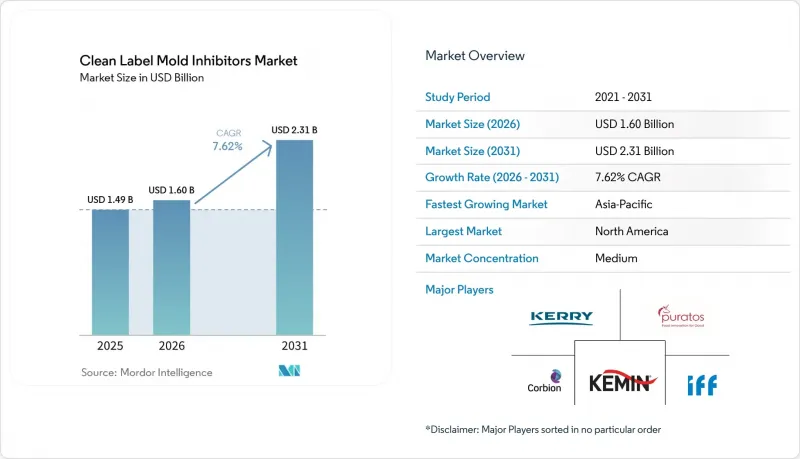
根據 Mordor Intelligence 預測,潔淨標示黴菌抑制劑市場規模預計將在 2025 年達到 14.9 億美元,2026 年達到 16 億美元,到 2031 年達到 23.1 億美元,2026 年至 2031 年的複合年成長率為 7.62%。
全球潔淨標示殺菌劑市場趨勢及洞察
對潔淨標示食品原料的需求日益成長
零售商推動的潔淨標示要求正在加速防黴劑的應用,尤其是在自有品牌烘焙產品領域。為消除合成防腐劑而進行的配方變更要求,促使供應商之間形成協調一致的需求,從而推動了現有採購和合約流程的大規模變革。在北美和歐洲,原料透明度正成為品牌所有者在採購和產品開發中的核心標準。因此,潔淨標示殺菌劑正從一種高階配方選項轉變為工業麵包、玉米餅和包裝零食等應用領域的主流要求。減少食品廢棄物的努力進一步推動了這一趨勢,因為有效的天然防黴劑有助於延長產品保存期限,並減少分銷和零售通路的損失。
從合成防腐劑過渡到天然防腐劑
潔淨標示抗真菌成分市場的發展得益於不斷完善的監管和標籤環境,該環境提高了合成食品添加劑的可見性和監管力度。歐盟法規 1169/2011 強制要求清晰標註食品訊息,歐洲食品安全局 (EFSA) 也持續審查已獲許可的食品添加劑。 2026 年 8 月,美國衛生與公眾服務部 (HHS)提案對已自願認定為「公認安全 (GRAS)」的食品成分實施通報要求。在此背景下,緩衝醋和小麥培養體系擁有完善的文檔,可協助製造商評估其合規性並制定商業化路線圖。雖然美國提案的要求可能會增強擁有全面安全文件支援的成分的競爭力,但新的培養萃取物在上市前可能需要額外的通報和監管檢驗。因此,監管準備和合規文件正日益成為產品選擇的重要標準,監管因素也直接納入配方和採購決策中。
與傳統防腐劑相比成本較高
潔淨標示黴菌抑制劑的使用成本通常是傳統防腐劑(例如丙酸鈣和山梨酸鉀)的1.5到3倍,這構成了推廣應用的一大障礙,尤其是在價格敏感的市場。此外,農產品價格波動會影響發酵小麥和發酵葡萄糖等原料,與更標準化的石化替代品相比,這會增加採購的不確定性。為了應對這項成本挑戰,AB Mauri推出了BakeGard Ultra CL,這是一種由乾醋和發酵小麥粉混合而成的產品,定位為更具成本效益的潔淨標示防腐解決方案,適用於烘焙企業。雖然這種混合系統可能有助於市場准入並促進更廣泛的應用,但激烈的價格競爭可能會進一步擠壓供應商的利潤空間。此外,增加劑量對感官特性的影響仍然是配方的重要限制,這要求製造商最佳化風味、酸度、劑量和防黴性能之間的平衡。
細分市場分析
2025年,醋基產品佔據了潔淨標示防黴劑市場38.40%的佔有率。這得歸功於其在工業麵包和玉米餅生產中得到的高度監管認可和廣泛應用。緩衝醋系統無需對現有麵包製作設備進行重大改造即可整合到高速混合製程。此外,其乾粉和液體兩種形式的供應,使其能夠柔軟性應用於整條生產線。預計到2031年,發酵小麥粉的複合年成長率將達到8.02%,成為潔淨標示防黴劑市場中成長最快的原料類型。對酸麵團發酵的研究表明,添加濃度為0.5%的特定菌種可以抑制麵包中的黑麴菌和普通青黴長達10天。 Corbion和Lallemand Baking為商業烘焙提供發酵小麥解決方案,而Kemin則向麵包和玉米餅生產商銷售其濃縮發酵產品「SHIELD Pure」。澱粉類食品是蛋糕、鬆餅和玉米餅的替代品,尤其是在需要無麩質食品的情況下。
區域分析
到2025年,北美將佔據潔淨標示防黴劑市場36.20%的佔有率,成為小麥發酵劑和醋基黴菌抑制劑最成熟的區域市場。大規模麵包和玉米餅生產商已將這些解決方案應用於其商業生產系統多年。隨著生產商對食品應用文件和監管要求的理解不斷加深,成熟的天然防腐體係有望從中受益。零售商主導的原料標準進一步提升了對高認可度防腐解決方案的需求,而在加拿大,食品藥品法規的現代化也引入了新的合規要求。
歐洲是第二大區域市場,這得益於其成熟的工業烘焙產業以及對食品添加劑透明度的持續重視。德國、英國和法國仍然是主要的國內市場,這得益於其完善的烘焙產品精煉體系。在這些市場運作的供應商需要同時滿足感官特性、保存期限要求和清潔成分標籤的要求,從而滿足市場對與現有生產流程相容的發酵麵粉、醋和有機酸類保藏系統的需求。
預計到2031年,南美洲將以8.46%的複合年成長率成長,主要驅動力來自巴西和阿根廷不斷成長的需求。包裝烘焙產品的擴張、都市化以及消費者對成分標籤日益成長的關注,都增強了對可靠的常溫保存解決方案在更廣泛分銷網路中的需求。巴西的生物來源配料產業預計在2025年也將顯著成長,從而進一步推動生物來源和天然解決方案的普及。亞太地區也面臨類似的成長機遇,都市化和消費模式的轉變推動了對常溫保存包裝烘焙產品的需求成長。中東和非洲地區仍是一個新興市場,預計未來需求將受益於烘焙連鎖店的擴張、國際零售業態的進入以及符合清真標準的發酵型防腐劑的普及。
其他好處:
- Excel格式的市場預測(ME)表
- 3個月的分析師支持
目錄
第1章:引言
- 研究假設和市場定義
- 調查範圍
第2章:調查方法
第3章執行摘要
第4章 市場狀況
- 市場概覽
- 市場促進因素
- 對潔淨標示食品原料的需求日益成長
- 從合成防腐劑過渡到天然防腐劑
- 延長保存期限的需求日益成長
- 包裝烘焙產品消費量增加
- 利用發酵技術拓展保藏工藝
- 人們對減少食物廢棄物的興趣日益濃厚。
- 市場限制因素
- 它比傳統防腐劑更貴。
- 不同食品應用中的效果存在差異
- 高劑量下可能產生的感官效應
- 複雜的配方和監管要求
- 供應鏈分析
- 監理情勢
- 波特五力分析
第5章 市場規模與成長預測
- 依成分類型
- 發酵小麥粉
- 醋基
- 澱粉類
- 有機酸類型
- 其他
- 按形式
- 粉末
- 液體
- 透過使用
- 食品/飲料
- 麵包糖果甜點
- 乳製品和乳製品替代品
- 飲料
- 烹飪用食材/即食食品
- 其他
- 動物飼料
- 製藥
- 個人護理化妝品
- 食品/飲料
- 按地區
- 北美洲
- 美國
- 加拿大
- 墨西哥
- 其他北美國家
- 歐洲
- 德國
- 英國
- 法國
- 西班牙
- 義大利
- 荷蘭
- 其他歐洲國家
- 亞太地區
- 中國
- 印度
- 日本
- 澳洲
- 其他亞太國家
- 南美洲
- 巴西
- 阿根廷
- 其他南美國家
- 中東和非洲
- 阿拉伯聯合大公國
- 南非
- 沙烏地阿拉伯
- 其他中東和非洲國家
- 北美洲
第6章 競爭情勢
- 市場集中度
- 策略趨勢
- 市場排名分析
- 公司簡介
- Corbion NV
- Kemin Industries
- Kerry Group
- Puratos
- DSM-Firmenich
- Cain Food Industries
- Sunson Biotechnology
- BioVeritas
- Associated British Foods plc
- BDF Natural Ingredients
- Lallemand LLC
- International Flavors & Fragrance, Inc.
- Lesaffre Corporation
- Cargill, Incorporated
- Tate & Lyle PLC
- Galactic SA
- J&K Ingredients Inc.
- Ribus, Inc.
- Sacco System
- BASF SE
第7章 市場機會與未來展望
According to Mordor Intelligence, the clean label mold ingredients market size is projected to be USD 1.49 billion in 2025, USD 1.60 billion in 2026, and reach USD 2.31 billion by 2031, growing at a CAGR of 7.62% from 2026 to 2031.
Global Clean Label Mold Inhibitors Market Trends and Insights
Rising Demand for Clean-Label Food Ingredients
Retailer-led clean label mandates are accelerating the adoption of mold control ingredients, particularly across private-label bakery programs. Reformulation requirements to eliminate synthetic preservatives create coordinated demand across suppliers, driving large-scale changes within defined procurement and contract cycles. In North America and Europe, ingredient transparency is increasingly becoming a core sourcing and product-development criterion for brand owners. As a result, clean label mold inhibitors are transitioning from a premium-value formulation option to a mainstream requirement across industrial bread, tortillas, and packaged snack applications. The trend is further supported by food-waste reduction initiatives, as effective natural mold control helps extend product shelf life and reduce losses across distribution and retail channels.
Shift from Synthetic to Natural Preservatives
The clean label mold ingredients market is supported by an evolving regulatory and labeling environment that increases the visibility and scrutiny of synthetic food additives. EU Regulation 1169/2011 requires food information to be presented clearly, while the European Food Safety Authority (EFSA) continues to review permitted food additives . In August 2026, the U.S. Department of Health and Human Services (HHS) proposed mandatory notification requirements for substances used in food under self-affirmed Generally Recognized as Safe (GRAS) conclusions . Within this environment, buffered vinegar and cultured wheat systems offer established documentation that can support manufacturers in assessing regulatory compliance and commercialization pathways. The proposed U.S. requirements could strengthen the competitive position of ingredients supported by comprehensive safety dossiers, while newer cultured extracts may require additional notification and regulatory validation before market entry. Consequently, regulatory readiness and compliance documentation are becoming increasingly important product-selection criteria, integrating regulatory considerations directly into formulation and procurement decisions.
Higher Cost Versus Conventional Preservatives
Clean label mold inhibitors typically carry a 1.5-3.0x cost-in-use premium compared with conventional preservatives such as calcium propionate and potassium sorbate, creating a significant adoption barrier, particularly in price-sensitive markets. In addition, agricultural commodity volatility affecting inputs such as cultured wheat and cultured dextrose can increase procurement uncertainty relative to more standardized petrochemical-derived alternatives. To address this cost challenge, AB Mauri introduced BakeGard Ultra CL, a dried vinegar and cultured wheat flour blend positioned as a more cost-effective clean label preservation solution for bakeries. Such hybrid systems can improve market accessibility and support wider adoption, although competitive pricing may place additional pressure on supplier margins. Furthermore, sensory impact at higher inclusion levels remains a key formulation constraint, requiring manufacturers to optimize the balance between flavor, acidity, dosage levels, and mold inhibition performance.
Other drivers and restraints analyzed in the detailed report include:
- Expansion of Fermentation-Based Preservation Technologies
- Growing Packaged Bakery Product Consumption
- Variable Efficacy Across Food Applications
For complete list of drivers and restraints, kindly check the Table Of Contents.
Segment Analysis
Vinegar-based products accounted for 38.40% of the clean-label mold ingredients market in 2025, supported by regulatory familiarity and established use across industrial bread and tortilla production. Buffered vinegar systems can be integrated into high-speed mixing processes without significant modifications to existing bakery equipment, while availability in both dry and liquid formats provides flexibility across production lines. Fermented flour is projected to grow at an 8.02% CAGR through 2031, making it the fastest-growing ingredient type in the clean-label mold ingredients market. Research on sourdough-type fermentates found that selected cultures inhibited Aspergillus niger and Penicillium commune in bread for 10 days at a 0.5% inclusion rate. Corbion and Lallemand Baking offer cultured wheat solutions for commercial bakery applications, while Kemin markets SHIELD Pure as a concentrated fermentate for bread and tortilla producers. Starch-based systems provide an alternative for cakes, muffins, and tortillas, particularly where gluten-free positioning is required.
Complete Report Scope:
- By Ingredient Type
- Fermented Flour
- Vinegar-Based
- Starch-Based
- Organic-Acid Based
- Others
- By Form
- Powder
- Liquid
- By Application
- Food and Beverages
- Bakery and Confectionery
- Dairy and Dairy Alternatives
- Beverages
- Ready-To-Cook/Ready-To-Eat Foods
- Others
- Animal Feed
- Pharmaceuticals
- Personal Care and Cosmetics
- Food and Beverages
- By Geography
- North America
- United States
- Canada
- Mexico
- Rest of North America
- Europe
- Germany
- United Kingdom
- France
- Spain
- Italy
- Netherlands
- Rest of Europe
- Asia-Pacific
- China
- India
- Japan
- Australia
- Rest of Asia-Pacific
- South America
- Brazil
- Argentina
- Rest of South America
- Middle East and Africa
- United Arab Emirates
- South Africa
- Saudi Arabia
- Rest of Middle East and Africa
- North America
Geography Analysis
North America accounted for 36.20% of the clean-label mold ingredients market in 2025, making it the most established regional market for cultured wheat and vinegar-based mold inhibitors. Large-scale bread and tortilla manufacturers have incorporated these solutions into commercial production systems for several years. Established natural preservation systems may benefit from greater manufacturer familiarity with their food-use documentation and regulatory positioning. Retailer-driven ingredient standards further strengthen demand for recognizable preservation solutions, while Canada introduces additional compliance considerations through modernization of its Food and Drug Regulations.
Europe represents the second-largest regional market, supported by mature industrial bakery industries and continued emphasis on food additive transparency. Germany, the United Kingdom, and France remain key national markets, supported by established bakery reformulation programs. Suppliers operating across these markets must simultaneously address sensory performance, shelf-life requirements, and clean ingredient declarations, supporting demand for cultured flour, vinegar, and organic-acid-based preservation systems compatible with existing production processes.
South America is projected to expand at an 8.46% CAGR through 2031, driven primarily by demand growth in Brazil and Argentina. Packaged bakery expansion, urbanization, and increasing consumer attention to ingredient labels are strengthening demand for reliable ambient shelf-life solutions across broader distribution networks. Brazil's biological inputs sector also recorded significant activity in 2025, supporting wider acceptance of biological and naturally derived solutions. Asia-Pacific presents a similar growth opportunity as urbanization and changing purchasing patterns increase demand for shelf-stable packaged bakery products. Middle East and Africa remains an emerging market, with future demand supported by expanding bakery chains, international retail formats, and adoption of halal-compatible, fermentation-derived preservation ingredients.
- Corbion N.V.
- Kemin Industries
- Kerry Group
- Puratos
- DSM-Firmenich
- Cain Food Industries
- Sunson Biotechnology
- BioVeritas
- Associated British Foods plc
- BDF Natural Ingredients
- Lallemand LLC
- International Flavors & Fragrance, Inc.
- Lesaffre Corporation
- Cargill, Incorporated
- Tate & Lyle PLC
- Galactic SA
- J&K Ingredients Inc.
- Ribus, Inc.
- Sacco System
- BASF SE
Additional Benefits:
- The market estimate (ME) sheet in Excel format
- 3 months of analyst support
TABLE OF CONTENTS
1 INTRODUCTION
- 1.1 Study Assumptions and Market Definition
- 1.2 Scope of the Study
2 RESEARCH METHODOLOGY
3 EXECUTIVE SUMMARY
4 MARKET LANDSCAPE
- 4.1 Market Overview
- 4.2 Market Drivers
- 4.2.1 Rising demand for clean-label food ingredients
- 4.2.2 Shift from synthetic to natural preservatives
- 4.2.3 Increasing demand for extended shelf life
- 4.2.4 Growing packaged bakery product consumption
- 4.2.5 Expansion of fermentation-based preservation technologies
- 4.2.6 Rising focus on food waste reduction
- 4.3 Market Restraints
- 4.3.1 Higher cost versus conventional preservatives
- 4.3.2 Variable efficacy across food applications
- 4.3.3 Potential sensory impacts at higher dosages
- 4.3.4 Complex formulation and regulatory requirements
- 4.4 Supply-Chain Analysis
- 4.5 Regulatory Landscape
- 4.6 Porter's Five Forces Analysis
- 4.6.1 Bargaining Power of Buyers/Consumers
- 4.6.2 Bargaining Power of Suppliers
- 4.6.3 Threat of New Entrants
- 4.6.4 Threat of Substitute Products
- 4.6.5 Intensity of Competitive Rivalry
5 MARKET SIZE AND GROWTH FORECASTS (VALUE & VOLUME)
- 5.1 By Ingredient Type
- 5.1.1 Fermented Flour
- 5.1.2 Vinegar-Based
- 5.1.3 Starch-Based
- 5.1.4 Organic-Acid Based
- 5.1.5 Others
- 5.2 By Form
- 5.2.1 Powder
- 5.2.2 Liquid
- 5.3 By Application
- 5.3.1 Food and Beverages
- 5.3.1.1 Bakery and Confectionery
- 5.3.1.2 Dairy and Dairy Alternatives
- 5.3.1.3 Beverages
- 5.3.1.4 Ready-To-Cook/Ready-To-Eat Foods
- 5.3.1.5 Others
- 5.3.2 Animal Feed
- 5.3.3 Pharmaceuticals
- 5.3.4 Personal Care and Cosmetics
- 5.3.1 Food and Beverages
- 5.4 By Geography
- 5.4.1 North America
- 5.4.1.1 United States
- 5.4.1.2 Canada
- 5.4.1.3 Mexico
- 5.4.1.4 Rest of North America
- 5.4.2 Europe
- 5.4.2.1 Germany
- 5.4.2.2 United Kingdom
- 5.4.2.3 France
- 5.4.2.4 Spain
- 5.4.2.5 Italy
- 5.4.2.6 Netherlands
- 5.4.2.7 Rest of Europe
- 5.4.3 Asia-Pacific
- 5.4.3.1 China
- 5.4.3.2 India
- 5.4.3.3 Japan
- 5.4.3.4 Australia
- 5.4.3.5 Rest of Asia-Pacific
- 5.4.4 South America
- 5.4.4.1 Brazil
- 5.4.4.2 Argentina
- 5.4.4.3 Rest of South America
- 5.4.5 Middle East and Africa
- 5.4.5.1 United Arab Emirates
- 5.4.5.2 South Africa
- 5.4.5.3 Saudi Arabia
- 5.4.5.4 Rest of Middle East and Africa
- 5.4.1 North America
6 COMPETITIVE LANDSCAPE
- 6.1 Market Concentration
- 6.2 Strategic Moves
- 6.3 Market Ranking Analysis
- 6.4 Company Profiles (includes Global level Overview, Market level overview, Core Segments, Financials as available, Strategic Information, Market Rank/Share for key companies, Products and Services, and Recent Developments)
- 6.4.1 Corbion N.V.
- 6.4.2 Kemin Industries
- 6.4.3 Kerry Group
- 6.4.4 Puratos
- 6.4.5 DSM-Firmenich
- 6.4.6 Cain Food Industries
- 6.4.7 Sunson Biotechnology
- 6.4.8 BioVeritas
- 6.4.9 Associated British Foods plc
- 6.4.10 BDF Natural Ingredients
- 6.4.11 Lallemand LLC
- 6.4.12 International Flavors & Fragrance, Inc.
- 6.4.13 Lesaffre Corporation
- 6.4.14 Cargill, Incorporated
- 6.4.15 Tate & Lyle PLC
- 6.4.16 Galactic SA
- 6.4.17 J&K Ingredients Inc.
- 6.4.18 Ribus, Inc.
- 6.4.19 Sacco System
- 6.4.20 BASF SE


