


 |
市場調查報告書
商品編碼
2154495
AI原生平台即服務(PaaS):市佔率分析、產業趨勢與統計及成長預測(2026-2031年)AI-Native Platform-as-a-Service (PaaS) - Market Share Analysis, Industry Trends & Statistics, Growth Forecasts (2026 - 2031) |
||||||

※ 本網頁內容可能與最新版本有所差異。詳細情況請與我們聯繫。
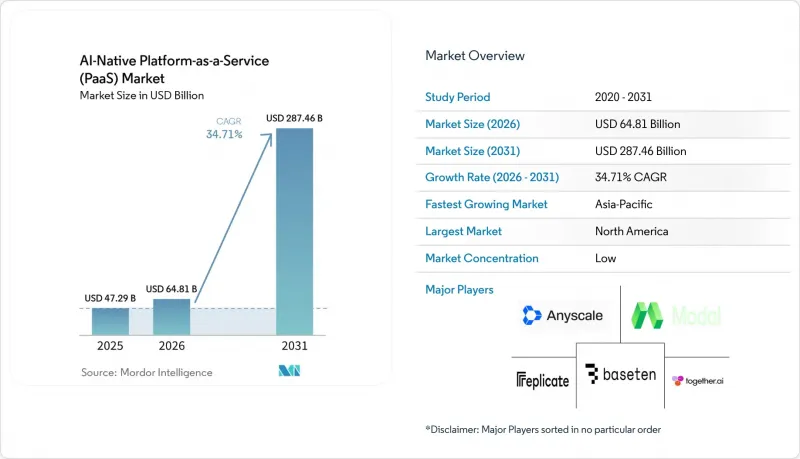
根據 Mordor Intelligence 預測,人工智慧原生平台即服務 (PaaS) 市場規模預計將從 2025 年的 472.9 億美元成長到 2026 年的 648.1 億美元,到 2031 年將達到 2874.6 億美元,2026 年至 2031 年的複合年成長率為 4.71%。
全球人工智慧原生平台即服務 (PaaS) 市場趨勢與洞察
從人工智慧實驗階段過渡到生產環境
從實驗環境到生產環境的過渡是人工智慧原生平台即服務 (PaaS) 市場需求的最大驅動力。生產系統需要可靠的模型運作、管治、監控和服務等級保證,而臨時部署的本地堆疊通常無法提供這些。儘管各行各業的組織都在將人工智慧代理部署到實際工作流程中,但可靠的擴展仍然是一個挑戰。這一差距促使企業投資於那些即使在系統啟動運行後也能透過模型漂移檢查、重新訓練觸發器、審計日誌和成本監控來管理運作的平台。企業團隊不僅評估模型質量,還評估評估、監控、存取控制和工作負載路由。如果供應商能夠在一個統一的、可管理的運作環境中,將這些功能整合到多個模型和代理程式中,人工智慧原生 PaaS 市場將從中受益。
人工智慧代理和多模型應用的普及
企業正從調用單一模型轉向連接模型、工具、資料來源和代理的應用程式。這使得編配、記憶體管理、評估和存取控制成為人工智慧原生平台即服務 (PaaS) 市場的核心功能。 2026 年 6 月,Anyscale 發布了其 Azure 整合功能的公開預覽版,使客戶能夠在託管的 Azure 租用戶中,針對多模態資料準備、微調、推理和運行代理工作負載。該公司報告稱,與分散的技術堆疊相比,實驗速度最多可提升四倍,人工智慧總體擁有成本 (TCO) 最多可降低 90%。 2026 年 7 月,LangChain 和 NVIDIA 發布了「NemoClaw Deep Agents」藍圖,其基準測試對比顯示,NVIDIA Nemotron 3 Ultra 將推理成本降低至封閉式模型的十分之一。 AI原生平台即服務(PaaS)市場的發展動力源自於對能夠管理代理間通訊、工具呼叫、記憶體和權限的通用環境的需求。
人工智慧加速器的成本和容量波動性
加速器的可用性和定價可能會延遲平台採用決策,尤其對於需要專用容量的客戶而言更是如此。即使是配置類似的加速器,不同雲端供應商之間的價格差異也很大,這使得訓練和推理成本的估算變得複雜。這種不確定性對無法預先獲得大量容量的中小型企業 (SME) 構成了特別嚴峻的挑戰。由於推理在人工智慧運算中佔很大比例,推理成本會影響提供者的利潤率和客戶定價。人工智慧原生平台即服務 (PaaS) 市場可以透過靈活的購買選項、工作負載調度、使用量上限、模型選擇工具以及對多種加速器架構的支援來緩解這些擔憂。雖然這些措施無法完全消除容量限制,但它們有助於使人工智慧原生 PaaS 市場對注重預算的用戶更具實用性。
細分市場分析
到2025年,應用和代理開發平台將佔據33.42%的市場。這一市場地位反映了市場對能夠縮短從模型原型設計到可管理生產工作流程路徑的工具的需求。模型推理和服務平台為生產工作負載提供執行環境。隨著企業根據特定資料和業務任務調整現有模型,模型訓練和微調平台將繼續發揮關鍵作用。人工智慧資料、向量和搜尋服務也支援搜尋增強和基於知識的應用。總而言之,這些平台表明,買家需要的是整合的工作流程,而不是獨立的模型介面。
預計到2031年,人工智慧可觀測性、評估和管治服務將以35.69%的複合年成長率成長,成為平台層中成長最快的領域。 Dynatrace在2025年發布的報告顯示,29%的受訪者在選擇可觀測性平台時,將人工智慧功能視為首要考量。 Pinecone在法蘭克福的發布會上推出了“專用讀取節點”,該公司表示,該技術能夠針對特定高吞吐量搜尋工作負載,大規模應用時節省高達97%的成本。 CoreWeave於2025年5月完成了對Weights and Biases的收購,將計算基礎設施與實驗追蹤和可觀測性功能整合在一起。這些趨勢表明,評估和監控正成為營運平台不可或缺的一部分。在人工智慧原生平台即服務(PaaS)產業,能夠將這些功能與開發和服務工具整合的供應商很可能擁有競爭優勢。
到2025年,雲端部署將佔據78.81%的市場。這一主導地位得益於彈性容量、快速配置以及無需大量前期投資即可存取專用運算資源。雲端服務還簡化了對託管資料庫、建模服務和監控工具的存取。當團隊需要快速推出或修改工作負載時,這些優勢至關重要。對許多組織而言,雲端仍然是實現生產級人工智慧處理能力的最直接途徑。因此,人工智慧原生平台即服務(PaaS)市場仍高度依賴雲端交付。
預計到 2031 年,本地部署將以 35.11% 的複合年成長率成長。這一成長動能反映了對敏感資料、模型權重和工作負載儲存位置的控制需求。 Anyscale 的 Azure 整合可讓客戶在其自身的 Azure 租用戶中執行資料準備、微調、推理和代理工作負載。這種方法展示了託管平台如何在客戶定義的基礎設施範圍內運作。它還支援「自帶雲端 (BYOC)」模式,將服務管理與客戶控制相結合。因此,客戶可控的部署可以擴展,而無需嚴格地在公共雲端和本地基礎設施之間做出選擇。
區域分析
到2025年,北美將佔全球需求的39.77%。該地區受益於基礎設施提供者的集中、企業在技術方面的支出以及對人工智慧能力的積極投資。許多領先的平台公司,包括Anyscale、Together AI、Pinecone、Arize AI、LangChain和Weights and Biases,都將總部或主要營運地點設在北美。這些供應商正在推動本地客戶採用相關技術,並支撐著來自軟體、雲端運算、通訊、金融服務和生命科學等各行各業的強勁需求。
在歐洲,企業需求不斷成長,但資料在地化和系統管治是阻礙因素,Pinecone 於 2026 年 5 月推出AWS 法蘭克福區域,旨在解決這些問題。歐盟的「人工智慧法」正推動相關人工智慧系統更加重視透明度、文件記錄和風險管理。南美洲仍處於人工智慧應用的早期階段,但巴西的技術生態系統及其金融服務的現代化正成為重要的需求來源。中東正成為人工智慧基礎設施資本的戰略來源,阿美創投公司 (Aramco Ventures) 領投 Together AI 於 2026 年 7 月完成的 8 億美元 C資金籌措便印證了這一點。非洲目前在人工智慧領域的應用有限,但正透過政府的數位轉型計畫以及跨國公司在南非、奈及利亞和埃及的部署而發展壯大。
預計到2031年,亞太地區將以35.58%的複合年成長率成長,成為所有地區中成長最快的地區。這一成長主要得益於大型企業的需求、強勁的雲端投資以及政府主導的人工智慧能力建構項目。日本、韓國、印度、中國以及全部區域在地化人工智慧平台的重要需求中心。能夠支援本地語言、資料駐留、區域託管和客戶驅動型部署的供應商,將能夠更好地滿足這些需求。這進一步鞏固了人工智慧原生PaaS市場在全球分散式基礎設施中的區域地位。
其他好處:
- Excel格式的市場預測(ME)表
- 3個月的分析師支持
目錄
第1章:引言
- 研究假設和市場定義
- 調查範圍
第2章:調查方法
第3章執行摘要
第4章 市場狀況
- 市場概覽
- 市場促進因素
- 從人工智慧實驗階段過渡到運行階段
- 對低延遲生成式人工智慧推理的需求
- 擴大開放體重模型採用範圍
- 開發者對託管 GPU 和無伺服器工作負載的偏好
- 人工智慧代理和多模型應用的激增
- 分散的人工智慧工具鏈催生了對整合平台的需求。
- 市場限制因素
- 人工智慧加速器成本和容量的波動
- 資料隱私、主權和監管約束
- 隔離與安全執行GPU工作負載的複雜性
- 模型漂移、評估不確定性和不可預測的推斷經濟學
- 宏觀經濟因素對市場的影響
- 產業價值鏈分析
- 監理情勢
- 技術展望
- 波特五力分析
第5章 市場規模與成長預測
- 平台層
- 模型推理與服務平台
- 應用和代理開發平台
- 模型學習與微調平台
- 人工智慧資料、向量和搜尋服務
- 人工智慧可觀測性、評估和管治服務
- 按部署模式
- 雲
- 現場
- 透過使用
- 生成式人工智慧的應用領域
- 自然語言處理
- 電腦視覺和多模態人工智慧
- 推薦和個人化
- 預測分析與傳統機器學習
- 其他用途
- 按組織規模
- 大公司
- 小型企業
- 按最終用戶行業分類
- 零售與電子商務
- 資訊科技/通訊
- 銀行業、金融服務業及保險業
- 醫療保健和生命科學
- 媒體與娛樂
- 其他終端用戶產業
- 按地區
- 北美洲
- 美國
- 加拿大
- 墨西哥
- 南美洲
- 巴西
- 阿根廷
- 其他南美國家
- 歐洲
- 德國
- 英國
- 法國
- 義大利
- 西班牙
- 其他歐洲國家
- 亞太地區
- 中國
- 印度
- 日本
- 韓國
- 其他亞太國家
- 中東
- 阿拉伯聯合大公國
- 沙烏地阿拉伯
- 土耳其
- 其他中東國家
- 非洲
- 南非
- 奈及利亞
- 埃及
- 其他非洲國家
- 北美洲
第6章 競爭情勢
- 市場集中度
- 策略趨勢
- 市佔率分析
- 公司簡介
- Anyscale, Inc.
- Baseten Labs, Inc.
- Modal Labs, Inc.
- Replicate, LLC
- Runpod Inc.
- TogetherAI, Inc.
- Fireworks AI, Inc.
- Northflank Ltd
- Beam Cloud, Inc.
- BentoML, Inc.
- Predibase, Inc.
- Lightning AI, Inc.
- Hugging Face, Inc.
- Pinecone Systems, Inc.
- Weaviate BV
- Qdrant Solutions GmbH
- Zilliz, Inc.
- Arize AI, Inc.
- LangChain, Inc.
- Weights & Biases, Inc.
- Lepton AI, Inc.
- OctoML, Inc.
第7章 市場機會與未來展望
According to Mordor Intelligence, the AI-native platform-as-a-service (PaaS) market size is expected to expand from USD 47.29 billion in 2025 to USD 64.81 billion in 2026, and is forecast to reach USD 287.46 billion by 2031, at a 34.71% CAGR over 2026-2031.
Global AI-Native Platform-as-a-Service (PaaS) Market Trends and Insights
Enterprise Shift From AI Experiments to Production Applications
The shift from experimentation to production is the strongest driver of demand for the AI-native platform-as-a-service (PaaS) market. Production systems require dependable model operations, governance, monitoring, and service-level commitments that temporary internal stacks often cannot provide. Organizations across sectors are moving AI agents into live workflows, yet reliable scaling remains difficult. This gap directs spending toward platforms that manage performance after a system goes live through model drift checks, retraining triggers, audit records, and cost monitoring. Enterprise teams assess evaluation, monitoring, access controls, and workload routing alongside model quality. The AI-native platform-as-a-service (PaaS) market benefits when providers bring these functions together across multiple models and agents within a single controlled operating environment.
AI Agent and Multi-Model Application Proliferation
Organizations are moving beyond single-model calls toward applications that coordinate models, tools, data sources, and agents. This makes orchestration, memory handling, evaluation, and access control central functions in the AI-native platform-as-a-service (PaaS) market. Anyscale introduced a public preview of its Azure integration in June 2026, allowing multimodal data preparation, fine-tuning, inference, and agent workloads within a customer-controlled Azure tenancy. The company reported up to 4 times faster experimentation and up to 90% lower total AI cost of ownership than with fragmented stacks. LangChain and NVIDIA launched the NemoClaw Deep Agents blueprint in July 2026, and its benchmark comparison stated that NVIDIA Nemotron 3 Ultra delivered 10 times lower inference cost than the nearest-performing closed model. The AI-native platform-as-a-service (PaaS) market is supported by demand for common environments that can manage agent communication, tool calls, memory, and permissions.
AI Accelerator Cost and Capacity Volatility
Accelerator availability and pricing can delay platform commitments, especially for customers who need dedicated capacity. Pricing can vary widely between cloud providers for comparable accelerator configurations, complicating estimates for training and inference costs. This uncertainty is particularly challenging for small and medium-sized enterprises that cannot reserve large amounts of capacity in advance. Inference costs can affect provider margins and customer pricing because inference accounts for a large share of AI compute. The AI-native platform-as-a-service (PaaS) market can reduce this concern through flexible purchasing options, workload scheduling, usage caps, model selection tools, and support for multiple accelerator architectures. These measures help make the AI-native platform-as-a-service (PaaS) market more practical for budget-conscious users, though they do not remove capacity constraints.
Other drivers and restraints analyzed in the detailed report include:
- Demand for Low-Latency Generative AI Inference
- Expansion of Open-Weight Model Deployment
- Data Privacy, Sovereignty, and Regulatory Constraints
For complete list of drivers and restraints, kindly check the Table Of Contents.
Segment Analysis
Application and Agent Development Platforms held 33.42% of the market in 2025. Their position reflects demand for tools that shorten the path from a model prototype to a managed production workflow. Model Inference and Serving Platforms provide the runtime layer for production workloads. Model Training and Fine-Tuning Platforms remain important as organizations adjust existing models for specialized data and business tasks. AI Data, Vector, and Retrieval Services also support retrieval-augmented generation and knowledge-based applications. Together, these layers show that buyers need an integrated workflow rather than a stand-alone model endpoint.
AI Observability, Evaluation, and Governance Services is projected to expand at a 35.69% CAGR through 2031, the fastest pace within the platform layer. Dynatrace reported in 2025 that AI capabilities were the leading criterion for selecting an observability platform for 29% of respondents. Pinecone's Frankfurt launch included Dedicated Read Nodes, which the company stated could deliver up to 97% cost reduction at scale for applicable high-throughput retrieval workloads. CoreWeave completed its acquisition of Weights and Biases in May 2025, linking compute infrastructure with experiment tracking and observability. These developments indicate that evaluation and monitoring are becoming part of the operating platform. The AI-native platform-as-a-service (PaaS) industry is likely to favor vendors that connect these functions with development and serving tools.
Cloud deployment accounted for 78.81% of the market in 2025. Its lead is supported by elastic capacity, rapid provisioning, and access to specialized compute without major upfront investment. Cloud services can also simplify access to managed databases, model services, and monitoring tools. These advantages matter when teams need to launch and modify workloads quickly. For many organizations, cloud remains the most direct way to reach production-scale AI capacity. The AI-native platform-as-a-service (PaaS) market, therefore, continues to rely heavily on cloud delivery.
On-premise deployment is projected to expand at a 35.11% CAGR through 2031. This momentum reflects the need for control over sensitive data, model weights, and workload locations. Anyscale's Azure integration allows customers to run data preparation, fine-tuning, inference, and agent workloads within their own Azure tenancy. This approach shows how managed platforms can operate within customer-defined infrastructure boundaries. It also supports a bring-your-own-cloud model that combines service management with customer control. Customer-controlled deployments can therefore expand without requiring a strict choice between public cloud and local infrastructure.
Complete Report Scope:
- By Platform Layer
- Model Inference and Serving Platforms
- Application and Agent Development Platforms
- Model Training and Fine-Tuning Platforms
- AI Data, Vector, and Retrieval Services
- AI Observability, Evaluation, and Governance Services
- By Deployment Model
- Cloud
- On-Premise
- By Application
- Generative AI Applications
- Natural Language Processing
- Computer Vision and Multimodal AI
- Recommendation and Personalization
- Predictive Analytics and Classical Machine Learning
- Other Applications
- By Organization Size
- Large Enterprises
- Small and Medium Enterprises
- By End-User Industry
- Retail and E-Commerce
- IT and Telecommunications
- Banking, Financial Services, and Insurance
- Healthcare and Life Sciences
- Media and Entertainment
- Other End-User Industries
- By Geography
- North America
- United States
- Canada
- Mexico
- South America
- Brazil
- Argentina
- Rest of South America
- Europe
- Germany
- United Kingdom
- France
- Italy
- Spain
- Rest of Europe
- Asia-Pacific
- China
- India
- Japan
- South Korea
- Rest of Asia-Pacific
- Middle East
- United Arab Emirates
- Saudi Arabia
- Turkey
- Rest of Middle East
- Africa
- South Africa
- Nigeria
- Egypt
- Rest of Africa
- North America
Geography Analysis
North America held 39.77% of global demand in 2025. The region benefits from a concentration of infrastructure providers, enterprise technology spending, and active investment in AI capacity. Many leading platform companies have headquarters or major operations in North America, including Anyscale, Together AI, Pinecone, Arize AI, LangChain, and Weights and Biases. This supplier base supports local customer adoption and strong demand from organizations across software, cloud, telecommunications, financial services, and life sciences.
Europe has expanding enterprise demand, but data localization and system governance pose constraints that Pinecone addressed with its AWS Frankfurt region launch in May 2026. The European Union's AI Act supports a stronger focus on transparency, documentation, and risk management for relevant AI systems. South America remains in an earlier stage of adoption, with Brazil's technology ecosystem and financial services modernization providing important demand channels. The Middle East is becoming a strategic source of AI infrastructure capital, as shown by Aramco Ventures leading Together AI's USD 800 million Series C in July 2026. Africa has a limited current presence and is developing through government digital transformation programs and multinational deployments in South Africa, Nigeria, and Egypt.
Asia-Pacific is projected to expand at a 35.58% CAGR through 2031, the fastest regional rate. The region combines large enterprise demand, active cloud investment, and programs focused on sovereign AI capabilities. Japan, South Korea, India, China, and the wider Asia-Pacific region are important demand centers for localized AI platforms. Providers that can support local languages, data residency, regional hosting, and customer-controlled deployments are positioned to address these needs. This supports the regional role of the AI-native PaaS market in distributed global infrastructure.
- Anyscale, Inc.
- Baseten Labs, Inc.
- Modal Labs, Inc.
- Replicate, LLC
- Runpod Inc.
- TogetherAI, Inc.
- Fireworks AI, Inc.
- Northflank Ltd
- Beam Cloud, Inc.
- BentoML, Inc.
- Predibase, Inc.
- Lightning AI, Inc.
- Hugging Face, Inc.
- Pinecone Systems, Inc.
- Weaviate B.V.
- Qdrant Solutions GmbH
- Zilliz, Inc.
- Arize AI, Inc.
- LangChain, Inc.
- Weights & Biases, Inc.
- Lepton AI, Inc.
- OctoML, Inc.
Additional Benefits:
- The market estimate (ME) sheet in Excel format
- 3 months of analyst support
TABLE OF CONTENTS
1 INTRODUCTION
- 1.1 Study Assumptions and Market Definition
- 1.2 Scope of the Study
2 RESEARCH METHODOLOGY
3 EXECUTIVE SUMMARY
4 MARKET LANDSCAPE
- 4.1 Market Overview
- 4.2 Market Drivers
- 4.2.1 Enterprise Shift from AI Experiments to Production Applications
- 4.2.2 Demand for Low-Latency Generative AI Inference
- 4.2.3 Expansion of Open-Weight Model Deployment
- 4.2.4 Developer Preference for Managed GPU and Serverless Workloads
- 4.2.5 AI Agent and Multi-Model Application Proliferation
- 4.2.6 Fragmented AI Toolchains Creating Demand for Unified Platforms
- 4.3 Market Restraints
- 4.3.1 AI Accelerator Cost and Capacity Volatility
- 4.3.2 Data Privacy, Sovereignty, and Regulatory Constraints
- 4.3.3 GPU Workload Isolation and Secure Execution Complexity
- 4.3.4 Model Drift, Evaluation Uncertainty, and Unpredictable Inference Economics
- 4.4 Impact of Macroeconomic Factors on the Market
- 4.5 Industry Value Chain Analysis
- 4.6 Regulatory Landscape
- 4.7 Technological Outlook
- 4.8 Porter's Five Forces Analysis
- 4.8.1 Threat of New Entrants
- 4.8.2 Bargaining Power of Suppliers
- 4.8.3 Bargaining Power of Buyers
- 4.8.4 Threat of Substitutes
- 4.8.5 Intensity of Competitive Rivalry
5 MARKET SIZE AND GROWTH FORECASTS (VALUE)
- 5.1 By Platform Layer
- 5.1.1 Model Inference and Serving Platforms
- 5.1.2 Application and Agent Development Platforms
- 5.1.3 Model Training and Fine-Tuning Platforms
- 5.1.4 AI Data, Vector, and Retrieval Services
- 5.1.5 AI Observability, Evaluation, and Governance Services
- 5.2 By Deployment Model
- 5.2.1 Cloud
- 5.2.2 On-Premise
- 5.3 By Application
- 5.3.1 Generative AI Applications
- 5.3.2 Natural Language Processing
- 5.3.3 Computer Vision and Multimodal AI
- 5.3.4 Recommendation and Personalization
- 5.3.5 Predictive Analytics and Classical Machine Learning
- 5.3.6 Other Applications
- 5.4 By Organization Size
- 5.4.1 Large Enterprises
- 5.4.2 Small and Medium Enterprises
- 5.5 By End-User Industry
- 5.5.1 Retail and E-Commerce
- 5.5.2 IT and Telecommunications
- 5.5.3 Banking, Financial Services, and Insurance
- 5.5.4 Healthcare and Life Sciences
- 5.5.5 Media and Entertainment
- 5.5.6 Other End-User Industries
- 5.6 By Geography
- 5.6.1 North America
- 5.6.1.1 United States
- 5.6.1.2 Canada
- 5.6.1.3 Mexico
- 5.6.2 South America
- 5.6.2.1 Brazil
- 5.6.2.2 Argentina
- 5.6.2.3 Rest of South America
- 5.6.3 Europe
- 5.6.3.1 Germany
- 5.6.3.2 United Kingdom
- 5.6.3.3 France
- 5.6.3.4 Italy
- 5.6.3.5 Spain
- 5.6.3.6 Rest of Europe
- 5.6.4 Asia-Pacific
- 5.6.4.1 China
- 5.6.4.2 India
- 5.6.4.3 Japan
- 5.6.4.4 South Korea
- 5.6.4.5 Rest of Asia-Pacific
- 5.6.5 Middle East
- 5.6.5.1 United Arab Emirates
- 5.6.5.2 Saudi Arabia
- 5.6.5.3 Turkey
- 5.6.5.4 Rest of Middle East
- 5.6.6 Africa
- 5.6.6.1 South Africa
- 5.6.6.2 Nigeria
- 5.6.6.3 Egypt
- 5.6.6.4 Rest of Africa
- 5.6.1 North America
6 COMPETITIVE LANDSCAPE
- 6.1 Market Concentration
- 6.2 Strategic Moves
- 6.3 Market Share Analysis
- 6.4 Company Profiles (includes Global Level Overview, Market Level Overview, Core Segments, Financials as available, Strategic Information, Market Rank/Share, Products and Services, Recent Developments)
- 6.4.1 Anyscale, Inc.
- 6.4.2 Baseten Labs, Inc.
- 6.4.3 Modal Labs, Inc.
- 6.4.4 Replicate, LLC
- 6.4.5 Runpod Inc.
- 6.4.6 TogetherAI, Inc.
- 6.4.7 Fireworks AI, Inc.
- 6.4.8 Northflank Ltd
- 6.4.9 Beam Cloud, Inc.
- 6.4.10 BentoML, Inc.
- 6.4.11 Predibase, Inc.
- 6.4.12 Lightning AI, Inc.
- 6.4.13 Hugging Face, Inc.
- 6.4.14 Pinecone Systems, Inc.
- 6.4.15 Weaviate B.V.
- 6.4.16 Qdrant Solutions GmbH
- 6.4.17 Zilliz, Inc.
- 6.4.18 Arize AI, Inc.
- 6.4.19 LangChain, Inc.
- 6.4.20 Weights & Biases, Inc.
- 6.4.21 Lepton AI, Inc.
- 6.4.22 OctoML, Inc.
7 MARKET OPPORTUNITIES AND FUTURE OUTLOOK
- 7.1 White-Space and Unmet-Need Assessment

 個人化引擎軟體:市場佔有率分析、產業趨勢與統計、成長預測(2026-2031)
 平台即服務 (PaaS) 市場預測至 2034 年-按服務類型、部署模式、企業規模、組織職能、產業和地區分類的全球分析
 2026年全球稀疏模型供應市場報告
 平台即服務 (PaaS) 全球市場規模、佔有率、趨勢和成長分析報告(2026-2034 年)行動體驗個人化市場預測至2034年-按個人化類型、技術平台、最終用戶和地區分類的全球分析雲端電信整合市場預測至2034年:按組件、部署類型、組織規模、最終用戶和地區分類的全球分析
 BPM 和 RPA 市場規模、佔有率和成長分析:按組件、部署類型、組織規模、應用、最終用戶行業和地區分類——2026 年至 2033 年行業預測
 平台即服務 (PaaS) 市場分析及至 2035 年預測:按類型、產品、服務、技術、組件、應用、部署、最終用戶和解決方案分類2026年全球平台即服務(PaaS)市場報告
 平台即服務 (PaaS) 市場:按類型、部署模式、最終用戶和區域分類