


 |
市場調查報告書
商品編碼
2117606
個人化引擎軟體:市場佔有率分析、產業趨勢與統計、成長預測(2026-2031)Personalization Engine Software - Market Share Analysis, Industry Trends & Statistics, Growth Forecasts (2026 - 2031) |
||||||

※ 本網頁內容可能與最新版本有所差異。詳細情況請與我們聯繫。
據 Mordor Intelligence 稱,2025 年個人化引擎軟體市值為 36.6 億美元,預計到 2031 年將達到 119.3 億美元,而 2026 年為 44.1 億美元,2026 年至 2031 年預測期內的複合年成長率為 22.02%。
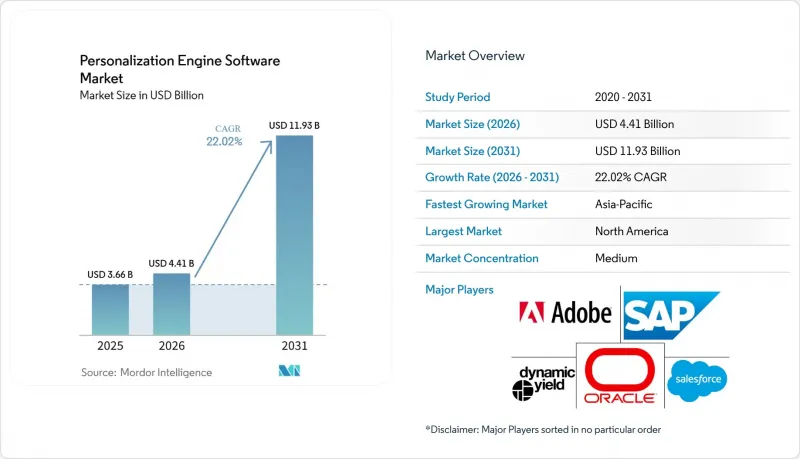
本報告按元件(平台和服務)、部署類型(雲端、本地部署、混合部署)、企業規模(大型企業和中小企業)、應用程式(網站個人化、行動應用個人化等)、最終用戶(IT與電信、零售與電子商務等)以及地區進行細分。市場預測以美元計價。
全球個人化引擎軟體市場趨勢與洞察
對即時、個人化客戶體驗的需求日益成長。
即時決策已成為企業回應當前客戶行為而非過往活動的關鍵需求。當平台能夠將即時數據、人工智慧和人工主導的業務規則貫穿客戶互動的各個環節時,個人化引擎軟體市場將從中受益。串流系統可以適應各種回應時間,從競標所需的亞毫秒決策到推播通知和宣傳活動觸發所需的較長回應時間。如果客戶情況自上次資料更新以來發生變化,基於批次的流程可能會產生不相關的建議。在瀏覽、購買和服務互動頻繁的電子商務環境中,這個問題尤其突出。因此,支援實況活動處理的供應商能夠滿足企業尋求更快客戶參與的明確營運需求。
人工智慧驅動的建議引擎的迅速普及
人工智慧驅動的建議工具正日益被用於輔助內容、時間、管道和客戶互動等方面的決策,其功能已不再局限於產品提案。因此,個人化引擎軟體市場正朝著能夠支援生命週期互動、客戶流失預防、交叉銷售以及「最佳推薦 (NBA)」流程的系統方向發展。這一趨勢提升了部署、模型管治、整合和客製化服務的重要性。由於許多組織在初始平台部署後需要持續支持,預計從 2026 年到 2031 年,服務市場將以 25.83% 的複合年成長率成長。當組織擁有足夠的資料品質、已通過核准的內容以及完善的治理控制時,管治決策可以減少其對固定流程範本的依賴。最終價值取決於組織能否持續評估結果並將這些洞察融入後續互動中。
客戶接觸點的資料分散。
資料碎片化限制了個人化的有效性,因為模型只能接收關於客戶的不完整資訊。資料來源之間協調不力會導致重複的客戶畫像、不一致的授權記錄以及跨通路客戶互動的矛盾。個人化引擎軟體市場需要透過增強與資料倉儲、客戶資料平台、客戶關係管理 (CRM) 系統和電商應用的連接來解決此限制。 2026 年 6 月,Databricks 發布了 CustomerLake,這是一個基於代理的客戶資料平台,整合到 Databricks Lakehouse 中,無需資料遷移即可整合客戶資料、身分解析、細分和個人化功能。同樣在 2026 年 6 月,Insider One 發布了適用於管治的零複製細分功能,使品牌能夠直接從管治的Snowflake 數據環境中構建和激活受眾群體。這些方法反映了市場對直接使用受管控資料而非在不相連的平台上產生額外副本的架構的需求。
細分市場分析
到2025年,平台軟體將佔據個人化引擎軟體市場72.41%的佔有率。這反映了企業對整合環境的需求,該環境能夠整合資料擷取、受眾創建、實驗、決策和內容傳送功能。整合平台可以減少使用多個獨立的客戶參與產品時出現的同步延遲。由於資料流不一致會削弱即時決策能力,企業越來越傾向於尋求通用的編配層。平台的採用也反映了企業需要透過一套協調的工作流程來管理不斷成長的客戶管道。儘管對平台的需求很高,但這並不意味著對專家實施支援的需求會降低。相反,實施品質變得更加關鍵,因為它需要內部系統、資料來源和業務流程之間的協調。
隨著企業尋求在實施、資料整合、工作流程設計、模型管治和持續最佳化方面的支持,服務市場預計將在2026年至2031年間以25.83%的複合年成長率成長。個人化引擎軟體市場的服務規模成長主要源自於將技術與客戶資料處理實務和已通過核准的互動策略相協調的實際複雜性。專業服務團隊和認證合作夥伴網路有助於供應商在軟體銷售之後維持長期的客戶關係。隨著供應商更深入參與客戶資料和互動運營,這些關係也可能增加客戶的轉換成本。此外,隨著企業對人工智慧系統管理文件的需求日益成長,管治要求也成為一項新的考量。因此,具備強大實施能力的供應商不僅在軟體功能方面具有競爭力,而且在營運支援方面也更具優勢。
預計到2025年,雲端部署將佔據68.19%的市場佔有率,為模型訓練、即時推理、事件處理和內容傳送提供可擴展的運算資源。即時個人化通常需要在處理大量客戶活動的同時保持快速回應。雲端環境使企業無需建置和營運大規模的本地基礎架構即可處理此類工作負載。此外,該模式還使企業能夠透過軟體更新和託管服務更輕鬆地採用新功能。對於跨多個管道運作且需要持續存取共用客戶資料的企業而言,雲端交付尤其重要。這些優勢使得雲端部署成為個人化引擎軟體市場的主導部署模式。
隨著各組織在雲端的可擴展性與資料儲存和安全義務之間尋求平衡,混合雲的採用率預計將在 2026 年至 2031 年間以 24.43% 的複合年成長率成長。 AWS 於 2026 年 1 月推出了歐洲主權雲,旨在支援歐洲客戶滿足其主權和合規性需求。金融服務、醫療保健、政府機構和其他受監管使用者可以將敏感身分資料保留在私有或受控環境中,並利用雲端資源進行敏感度較低的處理、聚合資料、模型訓練或內容傳送。這種分區架構支援那些無法將所有客戶資料遷移到公共雲端環境的組織。對於能夠在不同環境中支援身分、授權管理和事件處理的供應商而言,混合系統可能成為關鍵的差異化優勢。
區域分析
預計到2025年,北美將佔據個人化引擎軟體市場36.42%的佔有率。這主要歸功於該地區雲端服務供應商、企業技術採購商、數位商務營運商以及客戶資料基礎設施的廣泛存在。美國仍然是主要的需求市場,因為許多大型企業擁有成熟的客戶關係管理(CRM)、分析、行銷自動化和商務系統。高密度的雲端基礎設施支援頻繁的模型訓練和客戶事件的即時處理。該地區的企業也積極採用基於代理的人工智慧(AI)工具來提升客戶參與。 Adobe、 銷售團隊、Optimizely和Blaze等供應商持續為企業客戶開發AI驅動的編配功能。在加拿大,對「先徵得同意」方法的需求日益成長;在墨西哥,使用雲端原生平台的大型零售商和金融服務公司正逐步採用這種方法。
由於消費者高度參與數位化活動,以及企業日益成長的滿足嚴格隱私和管治要求的需求,歐洲已成為個人化引擎軟體市場的領先地區。歐洲資料保護委員會 (EDPB) 發布的《匿名化指南 02/2026》正在影響企業評估行為事件資料和匿名化實踐的方式。德國、英國和法國仍然是主要的國內市場,擁有成熟的數位商務活動和資源充足的企業技術團隊。歐盟人工智慧立法正在影響供應商如何為涉及自動化客戶畫像和決策的應用場景做好準備。供應商正在透過開發可解釋性功能、稽核記錄、同意流程和監控選項來應對此變更。南美洲正從小規模的基數發展壯大,巴西的電子商務生態系統支撐著零售、金融服務和數位媒體領域的需求。包括阿根廷在內的南美國家也正在採用基於雲端的系統,從而減少了對大規模本地技術基礎設施的需求。
預計亞太地區在2026年至2031年間將以25.18%的複合年成長率成長,成為成長最快的區域市場。在印度的電子商務和金融科技領域,個人化平台正被應用於客戶獲取、產品發現、客戶支援和互動等各個環節。 「印度堆疊」(India Stack)提供了一個數位身分基礎設施,支援在相關的商業和金融觸點上進行基於使用者授權的資料共用。韓國和日本擁有高度發展的互聯商務和設備生態系統,因此對跨設備的永續身分解析的需求日益成長。由於東南亞地區在語言、文化和消費行為方面存在顯著差異,因此需要在地化的模式。中國的平台營運商正在將建議功能整合到其超級應用生態系統中,這些應用程式每天服務於龐大的用戶群。中東和非洲仍處於應用初期。沙烏地阿拉伯和阿拉伯聯合大公國正透過國家數位轉型優先事項來支持需求,而在南非和奈及利亞,個人化主要應用於行動商務和普惠金融領域。
其他好處:
- Excel格式的市場預測(ME)表
- 3個月的分析師支持
目錄
第1章:引言
- 研究假設和市場定義
- 調查範圍
第2章:調查方法
第3章執行摘要
第4章 市場狀況
- 市場概覽
- 市場促進因素
- 對即時、個人化客戶體驗的需求日益成長。
- 擴大第一方資料的使用範圍
- 人工智慧驅動的建議引擎的迅速普及
- 全通路商務與跨裝置身分解析
- 保護隱私的個人化架構
- 從基於規則的分割過渡到自主決策
- 市場限制因素
- 客戶觸點之間的資料碎片化
- 對個人資訊分析和同意的監管限制
- 與傳統行銷技術和客戶數據平台整合的複雜性。
- 高優先級用例中的模型漂移和可解釋性限制
- 宏觀經濟因素對市場的影響
- 產業價值鏈分析
- 科技趨勢
- 監理情勢
- 波特五力分析
第5章 市場規模與成長預測
- 按組件
- 平台
- 服務
- 部署模式
- 雲
- 現場
- 混合
- 按公司規模
- 大公司
- 小型企業
- 透過使用
- 網站個人化
- 行動應用個性化
- 電子郵件和宣傳活動的個人化
- 個性化搜尋和建議
- 全通路客戶旅程的編配
- 最終用戶
- IT/通訊
- BFSI
- 醫療保健和生命科學
- 零售與電子商務
- 教育和研究機構
- 媒體與娛樂
- 政府/行政部門
- 其他終端用戶產業
- 按地區
- 北美洲
- 美國
- 加拿大
- 墨西哥
- 南美洲
- 巴西
- 阿根廷
- 其他南美國家
- 歐洲
- 德國
- 英國
- 法國
- 俄羅斯
- 西班牙
- 其他歐洲國家
- 亞太地區
- 中國
- 日本
- 印度
- 韓國
- 東南亞
- 其他亞太國家
- 中東和非洲
- 中東
- 沙烏地阿拉伯
- 阿拉伯聯合大公國
- 其他中東國家
- 非洲
- 南非
- 奈及利亞
- 其他非洲國家
- 中東
- 北美洲
第6章 競爭情勢
- 市場集中度
- 策略趨勢
- 市佔率分析
- 公司簡介
- Adobe Inc.
- Salesforce, Inc.
- SAP SE
- Oracle Corporation
- Microsoft Corporation
- IBM Corporation
- Optimizely, Inc.
- Bloomreach, Inc.
- Dynamic Yield Ltd.
- Insider Technology, Inc.
- Braze, Inc.
- Twilio Inc.
- Sitecore Corporation A/S
- Evergage, Inc.
- Coveo Solutions Inc.
- Nosto Solutions Ltd.
- SAP Emarsys
- Unbxd Inc.
- RichRelevance, Inc.
- Insider
- Barilliance Ltd.
- VWO Software Pvt. Ltd.
- Qubit Digital Ltd.
- Kibo Commerce, Inc.
- Yotpo Ltd.
- Algolia, Inc.
第7章 市場機會與未來展望
According to Mordor Intelligence, the personalization engine software market size was valued at USD 3.66 billion in 2025 and estimated to grow from USD 4.41 billion in 2026 to reach USD 11.93 billion by 2031, at a CAGR of 22.02% during the forecast period from 2026 to 2031.
This report is Segmented by Component (Platform, and Services), Deployment Mode (Cloud, On-Premise, and Hybrid), Enterprise Size (Large Enterprises, and Small and Medium Enterprises), Application (Website Personalization, Mobile App Personalization, and More), End User (IT and Telecom, Retail and E-Commerce, and More), and Geography. The Market Forecasts are Provided in Terms of Value (USD).
Global Personalization Engine Software Market Trends and Insights
Rising Demand for Real-Time Personalized Customer Experiences
Real-time decisioning has become an important requirement for organizations that need to respond to current customer behavior rather than past activity. The Personalization Engine Software Market benefits when platforms can combine live data, artificial intelligence, and human-led business rules during a customer interaction. Streaming systems can support different response windows, ranging from sub-100 millisecond decisions for bidding to longer response times for push notifications and campaign triggers. Batch-based processes can produce irrelevant recommendations when a customer's circumstances have changed since the prior data refresh. This issue is particularly material in commerce settings where browsing, purchasing, and service interactions occur frequently. Providers that support live event processing can therefore address a clear operational need for organizations seeking more responsive customer engagement.
Rapid Adoption of AI-Powered Recommendation Engines
AI-powered recommendation tools are moving beyond product suggestions and are increasingly being used to support decisions on content, timing, channel, and customer treatment. The Personalization Engine Software Market is therefore moving toward systems that can support lifecycle engagement, churn prevention, cross-selling, and next-best-action processes. This development increases the importance of implementation, model governance, integration, and customization services. Services are projected to expand at a CAGR of 25.83% from 2026 to 2031, as many organizations require ongoing support after initial platform deployment. Autonomous decisioning can reduce dependence on fixed journey templates when organizations have sufficient data quality, approved content, and governance controls. The resulting value depends on whether the organization can continuously evaluate outcomes and apply those learnings to subsequent interactions.
Data Fragmentation Across Customer Touchpoints
Data fragmentation limits the effectiveness of personalization because the model receives an incomplete view of the customer. Disconnected data sources can create duplicate profiles, inconsistent consent records, and conflicting customer interactions across channels. The Personalization Engine Software Market must address this constraint through better connectivity with data warehouses, customer data platforms, customer relationship management systems, and commerce applications. Databricks introduced CustomerLake in June 2026 as an agentic customer data platform embedded within the Databricks Lakehouse, combining customer data, identity resolution, segmentation, and personalization without requiring data movement. Insider One also introduced Zero Copy Segmentation for Snowflake in June 2026, enabling brands to build and activate audiences directly from governed Snowflake data environments. These approaches reflect demand for architectures that use governed data directly instead of generating additional copies across disconnected platforms.
Other drivers and restraints analyzed in the detailed report include:
- Expansion of First-Party Data Activation
- Omnichannel Commerce and Cross-Device Identity Resolution
- Regulatory Constraints on Profiling and Consent
For complete list of drivers and restraints, kindly check the Table Of Contents.
Segment Analysis
Platform software held 72.41% of the Personalization Engine Software Market share in 2025, reflecting enterprise demand for integrated environments that combine data ingestion, audience creation, experimentation, decisioning, and content delivery. A unified platform can reduce the synchronization delays that arise when multiple disconnected point products are used for customer engagement. Enterprises are increasingly seeking a common orchestration layer because inconsistent data movement can weaken real-time decisions. Platform adoption also reflects the need to manage a growing number of customer channels from a coordinated set of workflows. The concentration of platform demand does not remove the need for specialized implementation support. It instead makes implementation quality more important because deployment requires connections across internal systems, data sources, and business processes.
Services are projected to grow at a CAGR of 25.83% from 2026 to 2031 as organizations seek support for implementation, data integration, workflow design, model governance, and ongoing optimization. The Personalization Engine Software Market size for services is supported by the practical complexity of aligning technology with customer data practices and approved engagement policies. Professional services teams and certified partner networks can help providers maintain longer customer relationships after the original software sale. These relationships may also raise switching costs when the provider becomes embedded in the customer's data and engagement operations. Governance requirements are adding another consideration, as organizations increasingly expect documentation for AI system management. Providers with strong implementation capabilities can therefore compete on operational support as well as software functionality.
Cloud deployment held 68.19% of the market in 2025 because it provides scalable computing resources for model training, live inference, event processing, and content delivery. Real-time personalization can require organizations to process high volumes of customer activity while maintaining rapid response times. Cloud environments support this workload without requiring every customer to build and operate large internal infrastructure estates. The model also helps organizations introduce new features through software updates and managed services. Cloud delivery is particularly relevant for companies that operate in several channels and need consistent access to shared customer data. These benefits have made cloud deployment the dominant deployment mode in the Personalization Engine Software Market.
Hybrid deployment is projected to grow at a CAGR of 24.43% from 2026 to 2031 as organizations balance cloud scalability with data residency and security obligations. AWS launched its European Sovereign Cloud in January 2026 to support customers with sovereignty and compliance needs in Europe. Financial services, healthcare, government, and other regulated users may retain sensitive identity data within private or controlled environments. They can then use cloud resources for less sensitive processing, aggregated data, model training, or content delivery. This split architecture supports organizations that cannot move all customer data to a public cloud environment. Hybrid systems may become a meaningful differentiator for vendors that can support identity resolution, consent controls, and event processing across separate environments.
Complete Report Scope:
- By Component
- Platform
- Services
- By Deployment Mode
- Cloud
- On-Premise
- Hybrid
- By Enterprise Size
- Large Enterprises
- Small and Medium Enterprises
- By Application
- Website Personalization
- Mobile App Personalization
- Email and Campaign Personalization
- Personalized Search and Recommendations
- Omnichannel Customer Journey Orchestration
- By End-User
- IT and Telecommunication
- BFSI
- Healthcare and Life Sciences
- Retail and E-Commerce
- Education and Research Institutions
- Media and Entertainment
- Government and Administration
- Other End-User Industries
- By Geography
- North America
- United States
- Canada
- Mexico
- South America
- Brazil
- Argentina
- Rest of South America
- Europe
- Germany
- United Kingdom
- France
- Russia
- Spain
- Rest of Europe
- Asia-Pacific
- China
- Japan
- India
- South Korea
- Southeast Asia
- Rest of Asia-Pacific
- Middle East and Africa
- Middle East
- Saudi Arabia
- United Arab Emirates
- Rest of Middle East
- Africa
- South Africa
- Nigeria
- Rest of Africa
- Middle East
- North America
Geography Analysis
North America held 36.42% of the Personalization Engine Software Market share in 2025 because the region has a substantial base of cloud providers, enterprise technology buyers, digital commerce operators, and customer-data infrastructure. The United States remains the central demand market because many large organizations have mature customer relationship management, analytics, marketing automation, and commerce systems. High cloud infrastructure density supports frequent model training and the real-time processing of customer events. Companies in the region are also actively introducing agentic artificial intelligence tools for customer engagement. Adobe, Salesforce, Optimizely, Braze, and other providers continue to develop AI-supported orchestration capabilities for enterprise customers. Canada is supporting demand for consent-first approaches, while Mexico is seeing adoption among large retail and financial services organizations using cloud-native platforms.
Europe is a major region for the Personalization Engine Software Market because consumer digital engagement is high, and organizations increasingly need tools that meet strict privacy and governance requirements. The European Data Protection Board's Guidelines 02/2026 on Anonymization affects how organizations evaluate behavioral event data and anonymization practices. Germany, the United Kingdom, and France remain major national markets with mature digital commerce activity and well-resourced enterprise technology teams. The EU AI Act is influencing how vendors prepare for use cases involving automated customer profiling and decisioning. Providers are responding by developing explainability features, audit records, consent processes, and oversight options. South America is expanding from a smaller base, with Brazil's e-commerce ecosystem supporting demand across retail, financial services, and digital media. Argentina and other South American countries are also adopting cloud-based systems that reduce the need for extensive local technology infrastructure.
Asia-Pacific is projected to grow at a CAGR of 25.18% from 2026 to 2031, making it the fastest-growing regional segment. India's e-commerce and fintech sectors are deploying personalization platforms across customer acquisition, product discovery, customer support, and engagement programs. India Stack provides a digital identity infrastructure that supports consent-based data sharing across relevant commercial and financial touchpoints. South Korea and Japan have advanced connected commerce and device ecosystems that increase the need for persistent cross-device identity resolution. Southeast Asia requires localization-aware models because languages, cultures, and purchasing behaviors vary widely across the region. Chinese platform operators are embedding recommendation intelligence into super-app ecosystems that serve large daily user bases. The Middle East and Africa remain at an earlier stage of adoption, with Saudi Arabia and the United Arab Emirates supporting demand through national digital transformation priorities, while South Africa and Nigeria are primarily using personalization in mobile commerce and financial inclusion applications.
- Adobe Inc.
- Salesforce, Inc.
- SAP SE
- Oracle Corporation
- Microsoft Corporation
- IBM Corporation
- Optimizely, Inc.
- Bloomreach, Inc.
- Dynamic Yield Ltd.
- Insider Technology, Inc.
- Braze, Inc.
- Twilio Inc.
- Sitecore Corporation A/S
- Evergage, Inc.
- Coveo Solutions Inc.
- Nosto Solutions Ltd.
- SAP Emarsys
- Unbxd Inc.
- RichRelevance, Inc.
- Insider
- Barilliance Ltd.
- VWO Software Pvt. Ltd.
- Qubit Digital Ltd.
- Kibo Commerce, Inc.
- Yotpo Ltd.
- Algolia, Inc.
Additional Benefits:
- The market estimate (ME) sheet in Excel format
- 3 months of analyst support
TABLE OF CONTENTS
1 INTRODUCTION
- 1.1 Study Assumptions and Market Definition
- 1.2 Scope of the Study
2 RESEARCH METHODOLOGY
3 EXECUTIVE SUMMARY
4 MARKET LANDSCAPE
- 4.1 Market Overview
- 4.2 Market Drivers
- 4.2.1 Rising Demand for Real-Time Personalized Customer Experiences
- 4.2.2 Expansion of First-Party Data Activation
- 4.2.3 Rapid Adoption of AI-Powered Recommendation Engines
- 4.2.4 Omnichannel Commerce and Cross-Device Identity Resolution
- 4.2.5 Privacy-Safe Personalization Architectures
- 4.2.6 Migration From Rule-Based Segmentation to Autonomous Decisioning
- 4.3 Market Restraints
- 4.3.1 Data Fragmentation Across Customer Touchpoints
- 4.3.2 Regulatory Constraints on Profiling and Consent
- 4.3.3 Integration Complexity with Legacy MarTech and CDP Stacks
- 4.3.4 Model Drift And Limited Explainability in High-Stakes Use Cases
- 4.4 Impact of Macroeconomic Factors on the Market
- 4.5 Industry Value-Chain Analysis
- 4.6 Technology Outlook
- 4.7 Regulatory Landscape
- 4.8 Porter's Five Forces Analysis
- 4.8.1 Threat of New Entrants
- 4.8.2 Bargaining Power of Suppliers
- 4.8.3 Bargaining Power of Buyers
- 4.8.4 Threat of Substitutes
- 4.8.5 Intensity of Competitive Rivalry
5 MARKET SIZE AND GROWTH FORECASTS (VALUE)
- 5.1 By Component
- 5.1.1 Platform
- 5.1.2 Services
- 5.2 By Deployment Mode
- 5.2.1 Cloud
- 5.2.2 On-Premise
- 5.2.3 Hybrid
- 5.3 By Enterprise Size
- 5.3.1 Large Enterprises
- 5.3.2 Small and Medium Enterprises
- 5.4 By Application
- 5.4.1 Website Personalization
- 5.4.2 Mobile App Personalization
- 5.4.3 Email and Campaign Personalization
- 5.4.4 Personalized Search and Recommendations
- 5.4.5 Omnichannel Customer Journey Orchestration
- 5.5 By End-User
- 5.5.1 IT and Telecommunication
- 5.5.2 BFSI
- 5.5.3 Healthcare and Life Sciences
- 5.5.4 Retail and E-Commerce
- 5.5.5 Education and Research Institutions
- 5.5.6 Media and Entertainment
- 5.5.7 Government and Administration
- 5.5.8 Other End-User Industries
- 5.6 By Geography
- 5.6.1 North America
- 5.6.1.1 United States
- 5.6.1.2 Canada
- 5.6.1.3 Mexico
- 5.6.2 South America
- 5.6.2.1 Brazil
- 5.6.2.2 Argentina
- 5.6.2.3 Rest of South America
- 5.6.3 Europe
- 5.6.3.1 Germany
- 5.6.3.2 United Kingdom
- 5.6.3.3 France
- 5.6.3.4 Russia
- 5.6.3.5 Spain
- 5.6.3.6 Rest of Europe
- 5.6.4 Asia-Pacific
- 5.6.4.1 China
- 5.6.4.2 Japan
- 5.6.4.3 India
- 5.6.4.4 South Korea
- 5.6.4.5 Southeast Asia
- 5.6.4.6 Rest of Asia-Pacific
- 5.6.5 Middle East and Africa
- 5.6.5.1 Middle East
- 5.6.5.1.1 Saudi Arabia
- 5.6.5.1.2 United Arab Emirates
- 5.6.5.1.3 Rest of Middle East
- 5.6.5.2 Africa
- 5.6.5.2.1 South Africa
- 5.6.5.2.2 Nigeria
- 5.6.5.2.3 Rest of Africa
- 5.6.5.1 Middle East
- 5.6.1 North America
6 COMPETITIVE LANDSCAPE
- 6.1 Market Concentration
- 6.2 Strategic Moves
- 6.3 Market Share Analysis
- 6.4 Company Profiles (includes Global Level Overview, Market Level Overview, Core Segments, Financials as available, Strategic Information, Market Rank/Share, Products and Services, Recent Developments)
- 6.4.1 Adobe Inc.
- 6.4.2 Salesforce, Inc.
- 6.4.3 SAP SE
- 6.4.4 Oracle Corporation
- 6.4.5 Microsoft Corporation
- 6.4.6 IBM Corporation
- 6.4.7 Optimizely, Inc.
- 6.4.8 Bloomreach, Inc.
- 6.4.9 Dynamic Yield Ltd.
- 6.4.10 Insider Technology, Inc.
- 6.4.11 Braze, Inc.
- 6.4.12 Twilio Inc.
- 6.4.13 Sitecore Corporation A/S
- 6.4.14 Evergage, Inc.
- 6.4.15 Coveo Solutions Inc.
- 6.4.16 Nosto Solutions Ltd.
- 6.4.17 SAP Emarsys
- 6.4.18 Unbxd Inc.
- 6.4.19 RichRelevance, Inc.
- 6.4.20 Insider
- 6.4.21 Barilliance Ltd.
- 6.4.22 VWO Software Pvt. Ltd.
- 6.4.23 Qubit Digital Ltd.
- 6.4.24 Kibo Commerce, Inc.
- 6.4.25 Yotpo Ltd.
- 6.4.26 Algolia, Inc.
7 MARKET OPPORTUNITIES AND FUTURE OUTLOOK
- 7.1 White-Space and Unmet-Need Assessment

 平台即服務 (PaaS) 市場預測至 2034 年-按服務類型、部署模式、企業規模、組織職能、產業和地區分類的全球分析
 平台即服務 (PaaS) 市場:按服務類型、供應商類型、定價模式、部署類型、組織規模和產業分類-2026-2032 年全球市場預測
 2026年全球稀疏模型供應市場報告
 平台即服務 (PaaS) 全球市場規模、佔有率、趨勢和成長分析報告(2026-2034 年)行動體驗個人化市場預測至2034年-按個人化類型、技術平台、最終用戶和地區分類的全球分析雲端電信整合市場預測至2034年:按組件、部署類型、組織規模、最終用戶和地區分類的全球分析
 BPM 和 RPA 市場規模、佔有率和成長分析:按組件、部署類型、組織規模、應用、最終用戶行業和地區分類——2026 年至 2033 年行業預測
 平台即服務 (PaaS) 市場分析及至 2035 年預測:按類型、產品、服務、技術、組件、應用、部署、最終用戶和解決方案分類2026年全球平台即服務(PaaS)市場報告
 平台即服務 (PaaS) 市場:按類型、部署模式、最終用戶和區域分類