


 |
市場調查報告書
商品編碼
2154459
AR抬頭顯示器(HUD)軟體:市佔率分析、產業趨勢與統計、成長預測(2026-2031)AR Head-Up Display (HUD) Software - Market Share Analysis, Industry Trends & Statistics, Growth Forecasts (2026 - 2031) |
||||||

※ 本網頁內容可能與最新版本有所差異。詳細情況請與我們聯繫。
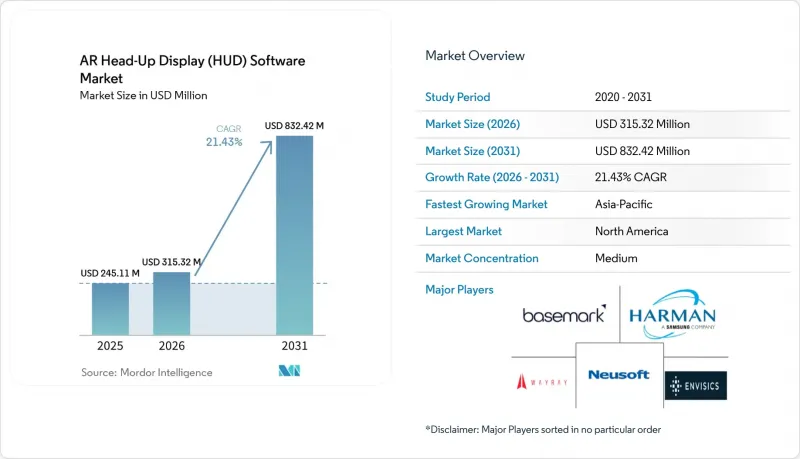
據 Mordor Intelligence 稱,AR抬頭顯示器(HUD) 軟體市場預計將從 2025 年的 2.4511 億美元成長到 2026 年的 3.1532 億美元,到 2031 年達到 8.3242 億美元,2026 年至 2031 年的複合年成長率為 21.3%。
全球擴增實境抬頭顯示器(HUD)軟體市場趨勢與洞察
與 ADAS(進階駕駛輔助系統)相關的、基於情境的駕駛引導的需求。
由於高級駕駛輔助系統 (ADAS) 的要求,在駕駛員注意力至關重要的車輛項目中,基於擋風玻璃的上下文引導變得日益重要。擴增實境 (AR) 抬頭顯示器 (HUD) 軟體可在駕駛者的前方視野內顯示車道、碰撞和路線資訊。因此,AR抬頭顯示器(HUD) 軟體市場需要能夠將來自攝影機、雷達、GPS 和其他感測器的輸入與穩定、即時的渲染相結合。哈曼宣布,其「Ready Vision」AR HUD 將於 2026 年開始在歐洲車輛上量產,該系統具有基於人工智慧和機器學習的遮擋處理功能,用於 ADAS 視覺化。雖然量產顯示這些系統已超越概念車的範疇,但仍需針對每個車輛項目檢驗。擴大部署範圍將促進軟體平台的標準化,但同時也將加劇具有類似生產經驗的供應商之間的價格競爭。
軟體定義車輛架構可實現 AR-HUD 功能擴充。
軟體定義車輛架構將功能升級與初始硬體採購週期解耦。這為擴增實境抬頭顯示器(HUD) 軟體市場開闢了道路,使其能夠透過空中下載 (OTA) 更新,在車輛的整個生命週期內提供新的視覺功能。 ISO/TS 20003:2026 標準規定了乘用車和商用車空中下載更新序列的人機介面要求。Panasonic Automotive Systems在 2025 年 12 月於歐洲上市的馬自達 CX-5 中,將空中編配功能整合到 HUD、儀錶群和資訊娛樂系統中。 2026 年,現代汽車集團宣布其目標是到 2030 年在 2,000 萬輛汽車上部署 Pleos Connect 系統,並持續透過空中下載增強 AR 和 AI 功能。這些專案將生命週期管理作為軟體價值的核心要素,因為隨著駕駛輔助模型的改進,疊加層也會隨之改變。
即時註冊和延遲檢驗的挑戰
實現精準的空間疊加需要感測器輸入和顯示圖形之間極低的延遲。如果擴增實境(AR)車道線在煞車或轉彎時偏離道路標線,則顯示的可靠性會降低,並可能導致安全審核。 AR HUD軟體產業必須整合來自攝影機、雷達、LiDAR、GPS和慣性感測器的輸入,同時保持一致的對齊。在2025年9月的IAA Mobility展會上,AUMOVIO展示了一種無鏡面3D HUD概念,利用基於軟體的影像最佳化技術來適應擋風玻璃的曲率。雖然該概念可以減輕一些車輛特定的光學處理工作,但每個程序仍然需要進行感測器融合和延遲檢驗。對於尚未擁有多個汽車應用認證的供應商而言,這將延長其量產時間。
細分市場分析
到2025年,作業系統和中介軟體將佔AR抬頭顯示器(HUD)軟體市場銷售額的38.43%,成為該市場中最大的軟體細分領域。所有擴增實境(AR)體驗都依賴檢驗的運行時環境,這些環境支援導航疊加、ADAS視覺化和資訊娛樂功能。 BlackBerry QNX、Android Automotive OS和基於Linux的專有堆疊都在爭奪這一市場地位。由於車輛項目通常在整個生產週期中使用選定的運行時環境,因此平台選擇可以轉換為未來幾年的許可收入。Panasonic汽車系統在馬自達CX-5上展示了這一點,該公司從2025年12月開始將駕駛座控制器與HUD、儀錶叢集和資訊娛樂功能整合在一起。這種配置確保了中間件的選擇在車輛開發過程的早期階段就得以確定。客製化軟體的作用相對較小,主要用於需要獨特視覺標誌的高階項目。然而,其高昂的單價開發成本可能會限制其在各種車型中的應用。
「開發、校準和測試工具」市場預計到2031年將以22.31%的複合年成長率成長,成為軟體類別中成長最快的市場。隨著AR功能在更多車型中的應用,可重現檢驗工具的需求也日益成長。 2025年8月,Basemark更新了Rocksolid AR Studio,使其能夠與Gemini AI、Google Maps和Android Automotive整合。 2026年的版本新增了對macOS的支援以及可用於生產的參考項目。這些版本使設計人員能夠在最終選擇硬體之前測試視覺功能。在2026年國際消費電子展(CES)上,VESA發布了“DisplayPort Automotive Extension v1.1”,其中包含一個軟體模擬器,用於根據功能安全和安全性設定檔檢驗顯示管道。使用通用工具可以減輕認證負擔,尤其對於跨多個OEM平台營運的供應商而言更是如此。
預計到2025年,AR渲染和合成將佔總收入的24.29%,成為最大的功能細分市場。在抬頭顯示器(HUD)軟體市場,渲染引擎對於實現穩定的影格速率、正確的透視效果和精確的視覺資訊定位至關重要。如果顯示的影像不夠清晰或定位不準確,其他功能的效用將受到限制。目前,生產程序主要集中在與安全相關的顯示功能上,使得「導航和尋路」以及「ADAS和安全視覺化」成為第二大收入來源。 「車輛和感測器資料整合」通常與一級系統交付捆綁銷售,而不是作為單獨的軟體許可出售。這種捆綁銷售方式限制了其對收入的直接貢獻,但它仍然是技術性能的核心。 「多螢幕人機編配」隨著車輛中採用更廣泛、更多樣化的顯示佈局而變得日益重要。
預計到2031年,空中下載(OTA)更新和生命週期管理將以22.02%的複合年成長率成長。這項功能將使AR軟體從車輛項目的臨時組件轉變為可在購買後持續維護的服務。 ISO/TS 20003:2026為空中軟體更新期間的駕駛介面提供了一個通用框架。 2026年4月,西門子表示,空中下載更新的範圍正從資訊娛樂系統擴展到ADAS感知模型和安全系統軟體。 2026年5月,LG電子宣布與Google合作,這將使單一系統晶片(SoC)能夠驅動多個車載顯示器。這提高了人機互動(HMI)編配的重要性,因為每個顯示器都需要提供一致的體驗。因此,在AR抬頭顯示器(HUD)軟體市場,生命週期管理很可能成為供應商的一項永久性合約條款。
區域分析
到2025年,亞太地區將佔全球AR抬頭顯示器軟體市場中最大的區域佔有率。這主要得益於中國新能源汽車的生產、智慧駕駛座的普及以及大規模的乘用車保有量。 2025年,中國配備AR HUD的乘用車數量將達439萬輛,搭載率達19.11%。日本和韓國透過向全球供應駕駛座系統的專案做出貢獻,其中包括Panasonic汽車、電裝和現代摩比斯等公司。這些供應商也將本國市場開發的軟體運行時環境整合到銷往北美和歐洲的車輛中。該地區的銷售量促進了AR HUD軟體市場中原始設備製造商(OEM)、軟體供應商和電子產品製造商之間的區域合作。因此,亞太地區在目前的生產部署和未來的平台認證中發揮核心作用。
北美和歐洲是擴增實境抬頭顯示器(HUD)軟體的成熟市場,相關法規和對高階車載體驗的需求推動了軟體內容的成長。在北美,凱迪拉克的VISTIQ和Lucid的Gravity已進入2025-2026年的量產階段,展現了擴增實境技術在高階電動車的應用。在歐洲,歐盟通用安全法規II(GDPR II)的實施,使得駕駛輔助功能的需求仍然強勁。德國憑藉寶馬、大眾集團和梅賽德斯-奔馳的項目,在區域採購中處於領先地位。英國、法國和義大利仍然是次要的軟體市場。俄羅斯的地緣政治局勢持續限制美國和歐洲用戶取得擴增實境軟體平台。此外,出於對駕駛員互動的監管考慮,擋風玻璃投影技術更受青睞,因為它可以減少駕駛員查看多個車載螢幕的需求。
預計到2031年,中東地區的複合年成長率將達到22.36%,成為成長最快的區域市場。沙烏地阿拉伯「2030願景」中的出行策略以及阿拉伯聯合大公國作為豪華車市場的地位,正在推動對先進駕駛座功能的需求。許多配備AR抬頭顯示系統的車輛都是從歐洲和亞洲品牌進口的高階車型。因此,該地區的收入更依賴進口和選裝配置,而非本地汽車生產。在南美洲,隨著巴西生產基地的建設和聯網汽車的普及,預計將出現長期發展機會。非洲仍處於起步階段,其中南非是近期值得關注的市場。由於車輛老化和進口關稅限制了高階汽車的普及,在目前階段,售後改裝仍將是該地區更現實的選擇。
其他好處:
- Excel格式的市場預測(ME)表
- 3個月的分析師支持
目錄
第1章:引言
- 研究假設和市場定義
- 調查範圍
第2章:調查方法
第3章執行摘要
第4章 市場狀況
- 市場概覽
- 宏觀經濟因素對市場的影響
- 市場促進因素
- 對與ADAS相關的、情境相關的駕駛輔助功能的需求
- 軟體定義的車輛架構正在擴展可實現的 AR-HUD 功能範圍。
- 運算和感測器成本的下降推動了中檔汽車的普及。
- 透過身臨其境型導航打造差異化的電動車駕駛座。
- 透過多層渲染改進深度感知安全通訊
- 以中國為首的智慧駕駛座的普及,正在加速AR-HUD的銷售。
- 市場限制因素
- 即時註冊和延遲檢驗負擔
- 擋風玻璃光學元件和車載運算的整合成本很高。
- 駕駛分心和人為因素導致核准風險
- 感測器融合疊加中的網路安全和資料完整性風險
- 產業價值鏈分析
- 監理情勢
- 技術展望
- 波特五力分析
第5章 市場規模與成長預測
- 軟體類型
- 客製化軟體
- 作業系統及中介軟體
- 開發、校準和測試工具
- 按功能分類的軟體
- AR渲染和合成
- 導航和路線引導
- ADAS和安全視覺化
- 車輛和感測器數據的整合
- 多螢幕人機介面編配
- 無線更新與生命週期管理
- 透過使用
- 導航和興趣點 (POI) 顯示
- 車道導引和轉向可視化
- 碰撞預警和駕駛輔助
- 交通標誌識別和速度信息
- 夜視和惡劣天氣支持
- 資訊娛樂與情境商務
- 車輛類型
- 搭乘用車
- 輕型商用車
- 大型商用車輛
- 無人計程車及自動駕駛班車
- 摩托車和微型交通工具
- 最終用戶
- 目的地設備製造商
- 一級和二級汽車零件供應商
- 售後市場和改裝整合商
- 按地區
- 北美洲
- 美國
- 加拿大
- 墨西哥
- 南美洲
- 巴西
- 阿根廷
- 其他南美國家
- 歐洲
- 英國
- 德國
- 法國
- 義大利
- 西班牙
- 俄羅斯
- 其他歐洲國家
- 亞太地區
- 中國
- 日本
- 印度
- 韓國
- 澳洲
- 其他亞太國家
- 中東
- 阿拉伯聯合大公國
- 沙烏地阿拉伯
- 其他中東國家
- 非洲
- 南非
- 埃及
- 其他非洲國家
- 北美洲
第6章 競爭情勢
- 市場集中度
- 策略趨勢
- 市佔率分析
- 公司簡介
- Basemark Oy
- Envisics Ltd.
- WayRay AG
- CY Vision, Inc.
- DigiLens, Inc.
- Ceres Holographics Limited
- Epitone GmbH
- FUTURUS Technology Co., Ltd.
- E-Lead Electronic Co., Ltd.
- ADAYO Intelligent Equipment Co., Ltd.
- Neusoft Corporation
- OneSight Technology Co., Ltd.
- Jingwei Hirain Technologies Co., Ltd.
- Shanghai New Vision Automotive Electronics Co., Ltd.
- Zhejiang Chief Technology Co., Ltd.
- Tianma Microelectronics Co., Ltd.
- Coretronic Corporation
- Maxell, Ltd.
- Appotronics Corporation Limited
- MicroVision, Inc.
- Holographic Labs Limited
- Dispelix Oy
- Luminit LLC
- SeeReal Technologies SA
第7章 市場機會與未來展望
According to Mordor Intelligence, the AR head-up display (HUD) software market size is expected to increase from USD 245.11 million in 2025 to USD 315.32 million in 2026 and reach USD 832.42 million by 2031, expanding at a CAGR of 21.43% over 2026-2031.
Global AR Head-Up Display (HUD) Software Market Trends and Insights
ADAS-Linked Demand for Contextual Driver Guidance
ADAS requirements are making contextual windshield guidance more relevant to vehicle programs that prioritize driver attention. AR HUD software can present lane, collision, and route information within the driver's forward field of view. This requires the AR head-up display (HUD) software market to combine camera, radar, GPS, and other sensor inputs with stable real-time rendering. HARMAN stated that its Ready Vision AR HUD entered series production in European vehicles in 2026 and includes AI and machine-learning-based occlusion handling for ADAS visualization. Production deployment shows that these systems have moved beyond isolated concept vehicles, although each vehicle program still needs validation. Wider deployment can standardize software platforms, but it also raises price pressure among suppliers with comparable production credentials.
Software-Defined Vehicle Architectures Expand Deployable AR-HUD Functions
Software-defined vehicle architectures separate feature upgrades from the original hardware purchase cycle. This gives the AR head-up display (HUD) software market a route to deliver new visual functions through over-the-air updates during a vehicle's life. ISO/TS 20003:2026 sets human-machine interface requirements for over-the-air update sequences in passenger and commercial vehicles. Panasonic Automotive Systems integrated an over-the-air orchestration function across the HUD, instrument cluster, and infotainment system in the Mazda CX-5 introduced in Europe in December 2025. Hyundai Motor Group stated in 2026 that Pleos Connect is intended to reach 20 million vehicles by 2030 with continued AR and AI enhancements delivered over the air. These programs make lifecycle management a core part of software value because overlays can change as driver-assistance models improve.
Real-Time Registration and Latency Validation Burden
Accurate spatial overlays need very low latency between sensor input and displayed graphics. If an AR lane marker moves away from a painted road line during braking or a turn, the display can reduce trust and face safety review. The AR HUD software industry must integrate camera, radar, LiDAR, GPS, and inertial inputs while retaining consistent alignment. AUMOVIO presented a mirrorless 3D HUD concept at IAA Mobility in September 2025 that uses software-assisted image optimization to adapt to windshield curvature. The concept can reduce some vehicle-specific optical work, but sensor fusion and latency validation remain necessary for each program. This burden slows time to production for suppliers that do not already have several certified vehicle applications.
Other drivers and restraints analyzed in the detailed report include:
- Falling Computing and Sensor Costs Enable Mid-Range Vehicle Penetration
- Electric Vehicle Cockpit Differentiation Through Immersive Navigation
- High Integration Cost Across Windshield Optics and Vehicle Compute
For complete list of drivers and restraints, kindly check the Table Of Contents.
Segment Analysis
Operating System and Middleware Software held 38.43% of revenue in 2025, making it the largest software-type segment in the AR head-up display (HUD) software market. Every augmented-reality experience depends on a verified runtime that supports navigation overlays, ADAS visualization, and infotainment functions. BlackBerry QNX, Android Automotive OS, and proprietary Linux-based stacks compete for this role. Platform selection can lead to multiyear licensing revenue because a vehicle program normally uses the selected runtime for its production cycle. Panasonic Automotive Systems illustrated this connection when its cockpit controller coordinated HUD, cluster, and infotainment functions for Mazda's CX-5 from December 2025. The arrangement places middleware decisions early in the vehicle-development process. Custom Software holds a smaller role but serves premium programs that need a distinctive visual identity. Its higher per-unit development cost can limit use across a wide range of vehicle variants.
Development, Calibration and Testing Tools is projected to expand at a 22.31% CAGR through 2031, the highest rate within software type. More AR functions across more vehicle models increase the need for repeatable validation tools. Basemark updated Rocksolid AR Studio in August 2025 with Gemini AI, Google Maps, and Android Automotive integration. Its 2026 release added macOS support and production-ready reference projects. These releases allow designers to test visual functions before making a final hardware choice. VESA released DisplayPort Automotive Extension v1.1 at CES 2026 with a software emulator for validating display pipelines against functional safety and security profiles. Common tools can lower the burden of qualification, especially for suppliers seeking to work across more than one OEM platform.
AR Rendering and Composition accounted for 24.29% of revenue in 2025 and was the largest functional segment. The AR head-up display (HUD) software market relies on rendering engines to provide stable frame rates, correct perspective, and accurate placement of visual information. Other functions have limited usefulness if the displayed image is not clear and aligned. Navigation and Wayfinding and ADAS and Safety Visualization form the next major revenue bands because production programs currently focus on safety-related display functions. Vehicle and Sensor Data Integration is often bundled into tier-1 system deliveries rather than sold as a separate software license. This bundling moderates its direct revenue contribution while keeping it central to technical performance. Multiscreen HMI Orchestration is becoming more relevant as vehicle interiors use wider and multiple display layouts.
Over-the-Air Update and Lifecycle Management is projected to expand at a 22.02% CAGR through 2031. This function changes AR software from a one-time vehicle-program component into a service that can be maintained after purchase. ISO/TS 20003:2026 provides a common framework for the driver interface during over-the-air software updates. Siemens stated in April 2026 that over-the-air updates now extend beyond infotainment to ADAS perception models and safety-system software. LG Electronics announced a May 2026 partnership with Google that supports one system-on-chip driving multiple automotive displays. This increases the importance of HMI orchestration because each display must present a consistent experience. Lifecycle management can therefore become a recurring contractual function for suppliers in the AR head-up display (HUD) software market.
Complete Report Scope:
- By Software Type
- Custom Software
- Operating System and Middleware Software
- Development, Calibration and Testing Tools
- By Software Function
- AR Rendering and Composition
- Navigation and Wayfinding
- ADAS and Safety Visualization
- Vehicle and Sensor Data Integration
- Multiscreen HMI Orchestration
- Over-the-Air Update and Lifecycle Management
- By Application
- Navigation and Point-of-Interest Display
- Lane Guidance and Maneuver Visualization
- Collision Warning and Driver Assistance
- Traffic Sign Recognition and Speed Information
- Night Vision and Adverse-Weather Assistance
- Infotainment and Contextual Commerce
- By Vehicle Type
- Passenger Cars
- Light Commercial Vehicles
- Heavy Commercial Vehicles
- Robotaxis and Autonomous Shuttles
- Two-Wheelers and Micromobility Vehicles
- By End User
- Original Equipment Manufacturers
- Tier-1 and Tier-2 Automotive Suppliers
- Aftermarket and Retrofit Integrators
- By Geography
- North America
- United States
- Canada
- Mexico
- South America
- Brazil
- Argentina
- Rest of South America
- Europe
- United Kingdom
- Germany
- France
- Italy
- Spain
- Russia
- Rest of Europe
- Asia-Pacific
- China
- Japan
- India
- South Korea
- Australia
- Rest of Asia-Pacific
- Middle East
- United Arab Emirates
- Saudi Arabia
- Rest of Middle East
- Africa
- South Africa
- Egypt
- Rest of Africa
- North America
Geography Analysis
Asia-Pacific accounted for 34.39% of global revenue in 2025 and held the largest regional position in the AR head-up display (HUD) software market. The region is supported by China's new-energy vehicle production, intelligent cockpit adoption, and large passenger-car base. China's passenger-car AR HUD installations reached 4.39 million units in 2025, with a 19.11% fitment rate. Japan and South Korea contribute through Panasonic Automotive, Denso, and Hyundai Mobis programs that supply cockpit systems globally. These suppliers also embed software runtimes developed in their home markets into vehicles sold in North America and Europe. The region's volume supports local relationships among OEMs, software suppliers, and electronics manufacturers in the AR HUD software market. This makes Asia-Pacific central to current production deployment and future platform qualification.
North America and Europe are established AR head-up display (HUD) software market regions where regulation and demand for premium in-vehicle experiences support higher software content. In North America, the Cadillac VISTIQ and Lucid Gravity moved into 2025-2026 production programs that demonstrate the use of AR functions in premium electric vehicles. Europe has a sustained driver-assistance requirement through the EU General Safety Regulation II. Germany leads regional procurement through BMW, Volkswagen Group, and Mercedes-Benz programs. The United Kingdom, France, and Italy remain secondary software program markets. Russia's geopolitical conditions continue to limit access to Western AR software platforms. Regulatory attention to driver interaction also favors windshield-projected information when it can reduce the need to look across several cabin screens.
The Middle East is projected to expand at a 22.36% CAGR through 2031, making it the fastest-growing regional segment. Saudi Arabia's Vision 2030 mobility agenda and the UAE's luxury-vehicle base support demand for advanced cockpit features. Most vehicles carrying AR HUD systems are imported premium models from European and Asian brands. Revenue therefore depends more on imports and option uptake than on local vehicle production. South America offers a longer-term opportunity as Brazil's production base and connected-car adoption develop. Africa remains at an earlier stage, with South Africa as the most immediate market. Older fleets and import tariffs limit premium-vehicle penetration, which makes retrofitting a more practical near-term route in the region.
- Basemark Oy
- Envisics Ltd.
- WayRay AG
- CY Vision, Inc.
- DigiLens, Inc.
- Ceres Holographics Limited
- Epitone GmbH
- FUTURUS Technology Co., Ltd.
- E-Lead Electronic Co., Ltd.
- ADAYO Intelligent Equipment Co., Ltd.
- Neusoft Corporation
- OneSight Technology Co., Ltd.
- Jingwei Hirain Technologies Co., Ltd.
- Shanghai New Vision Automotive Electronics Co., Ltd.
- Zhejiang Chief Technology Co., Ltd.
- Tianma Microelectronics Co., Ltd.
- Coretronic Corporation
- Maxell, Ltd.
- Appotronics Corporation Limited
- MicroVision, Inc.
- Holographic Labs Limited
- Dispelix Oy
- Luminit LLC
- SeeReal Technologies S.A.
Additional Benefits:
- The market estimate (ME) sheet in Excel format
- 3 months of analyst support
TABLE OF CONTENTS
1 INTRODUCTION
- 1.1 Study Assumptions and Market Definition
- 1.2 Scope of the Study
2 RESEARCH METHODOLOGY
3 EXECUTIVE SUMMARY
4 MARKET LANDSCAPE
- 4.1 Market Overview
- 4.2 Impact of Macroeconomic Factors on the Market
- 4.3 Market Drivers
- 4.3.1 ADAS-Linked Demand for Contextual Driver Guidance
- 4.3.2 Software-Defined Vehicle Architectures Expand Deployable AR-HUD Functions
- 4.3.3 Falling Computing and Sensor Costs Enable Mid-Range Vehicle Penetration
- 4.3.4 Electric Vehicle Cockpit Differentiation Through Immersive Navigation
- 4.3.5 Multi-Plane Rendering Improves Depth-Aware Safety Communication
- 4.3.6 China-Led Intelligent Cockpit Adoption Accelerates AR-HUD Volume
- 4.4 Market Restraints
- 4.4.1 Real-Time Registration and Latency Validation Burden
- 4.4.2 High Integration Cost Across Windshield Optics and Vehicle Compute
- 4.4.3 Driver Distraction and Human-Factors Approval Risk
- 4.4.4 Cybersecurity and Data-Integrity Exposure in Sensor-Fused Overlays
- 4.5 Industry Value Chain Analysis
- 4.6 Regulatory Landscape
- 4.7 Technological Outlook
- 4.8 Porter's Five Forces Analysis
- 4.8.1 Threat of New Entrants
- 4.8.2 Bargaining Power of Suppliers
- 4.8.3 Bargaining Power of Buyers
- 4.8.4 Threat of Substitutes
- 4.8.5 Competitive Rivalry
5 MARKET SIZE AND GROWTH FORECASTS (VALUE)
- 5.1 By Software Type
- 5.1.1 Custom Software
- 5.1.2 Operating System and Middleware Software
- 5.1.3 Development, Calibration and Testing Tools
- 5.2 By Software Function
- 5.2.1 AR Rendering and Composition
- 5.2.2 Navigation and Wayfinding
- 5.2.3 ADAS and Safety Visualization
- 5.2.4 Vehicle and Sensor Data Integration
- 5.2.5 Multiscreen HMI Orchestration
- 5.2.6 Over-the-Air Update and Lifecycle Management
- 5.3 By Application
- 5.3.1 Navigation and Point-of-Interest Display
- 5.3.2 Lane Guidance and Maneuver Visualization
- 5.3.3 Collision Warning and Driver Assistance
- 5.3.4 Traffic Sign Recognition and Speed Information
- 5.3.5 Night Vision and Adverse-Weather Assistance
- 5.3.6 Infotainment and Contextual Commerce
- 5.4 By Vehicle Type
- 5.4.1 Passenger Cars
- 5.4.2 Light Commercial Vehicles
- 5.4.3 Heavy Commercial Vehicles
- 5.4.4 Robotaxis and Autonomous Shuttles
- 5.4.5 Two-Wheelers and Micromobility Vehicles
- 5.5 By End User
- 5.5.1 Original Equipment Manufacturers
- 5.5.2 Tier-1 and Tier-2 Automotive Suppliers
- 5.5.3 Aftermarket and Retrofit Integrators
- 5.6 By Geography
- 5.6.1 North America
- 5.6.1.1 United States
- 5.6.1.2 Canada
- 5.6.1.3 Mexico
- 5.6.2 South America
- 5.6.2.1 Brazil
- 5.6.2.2 Argentina
- 5.6.2.3 Rest of South America
- 5.6.3 Europe
- 5.6.3.1 United Kingdom
- 5.6.3.2 Germany
- 5.6.3.3 France
- 5.6.3.4 Italy
- 5.6.3.5 Spain
- 5.6.3.6 Russia
- 5.6.3.7 Rest of Europe
- 5.6.4 Asia-Pacific
- 5.6.4.1 China
- 5.6.4.2 Japan
- 5.6.4.3 India
- 5.6.4.4 South Korea
- 5.6.4.5 Australia
- 5.6.4.6 Rest of Asia-Pacific
- 5.6.5 Middle East
- 5.6.5.1 United Arab Emirates
- 5.6.5.2 Saudi Arabia
- 5.6.5.3 Rest of Middle East
- 5.6.6 Africa
- 5.6.6.1 South Africa
- 5.6.6.2 Egypt
- 5.6.6.3 Rest of Africa
- 5.6.1 North America
6 COMPETITIVE LANDSCAPE
- 6.1 Market Concentration
- 6.2 Strategic Moves
- 6.3 Market Share Analysis
- 6.4 Company Profiles (includes Global Level Overview, Market Level Overview, Core Segments, Financials as available, Strategic Information, Market Rank/Share, Products and Services, Recent Developments)
- 6.4.1 Basemark Oy
- 6.4.2 Envisics Ltd.
- 6.4.3 WayRay AG
- 6.4.4 CY Vision, Inc.
- 6.4.5 DigiLens, Inc.
- 6.4.6 Ceres Holographics Limited
- 6.4.7 Epitone GmbH
- 6.4.8 FUTURUS Technology Co., Ltd.
- 6.4.9 E-Lead Electronic Co., Ltd.
- 6.4.10 ADAYO Intelligent Equipment Co., Ltd.
- 6.4.11 Neusoft Corporation
- 6.4.12 OneSight Technology Co., Ltd.
- 6.4.13 Jingwei Hirain Technologies Co., Ltd.
- 6.4.14 Shanghai New Vision Automotive Electronics Co., Ltd.
- 6.4.15 Zhejiang Chief Technology Co., Ltd.
- 6.4.16 Tianma Microelectronics Co., Ltd.
- 6.4.17 Coretronic Corporation
- 6.4.18 Maxell, Ltd.
- 6.4.19 Appotronics Corporation Limited
- 6.4.20 MicroVision, Inc.
- 6.4.21 Holographic Labs Limited
- 6.4.22 Dispelix Oy
- 6.4.23 Luminit LLC
- 6.4.24 SeeReal Technologies S.A.
7 MARKET OPPORTUNITIES AND FUTURE OUTLOOK
- 7.1 White-Space and Unmet-Need Assessment

 汽車抬頭顯示器市場:全球市場預測,2026-2032年
 抬頭顯示器(HUD)市場規模、佔有率、成長、全球產業分析、區域趨勢及2026年至2034年預測
 抬頭顯示器市場預測至2034年-全球產品類型、技術、組件、顯示技術、車輛驅動系統、車輛類型、應用、銷售管道和區域分析
 抬頭顯示器:市場佔有率分析、行業趨勢和統計數據以及成長預測(2026-2031 年)HUD頭盔市場-2026-2032年全球市場預測
 2026年全球抬頭顯示器市場報告
 抬頭顯示器:技術與全球市場
 抬頭顯示器(HUD)市場規模、佔有率、趨勢和預測:按產品類型(傳統和擴增實境)、技術、應用和地區分類,2026-2034年2026年全球HUD頭盔市場報告
 抬頭顯示器市場:按組件、類型和地區分類