


 |
市場調查報告書
商品編碼
2123324
抬頭顯示器:市場佔有率分析、行業趨勢和統計數據以及成長預測(2026-2031 年)Head-Up Display - Market Share Analysis, Industry Trends & Statistics, Growth Forecasts (2026 - 2031) |
||||||

※ 本網頁內容可能與最新版本有所差異。詳細情況請與我們聯繫。
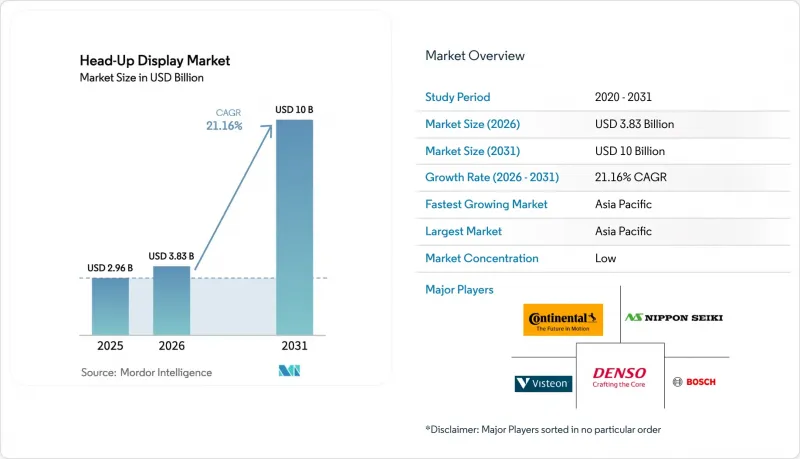
根據 Mordor Intelligence 預測,抬頭顯示器(HUD) 市場將從 2025 年的 29.6 億美元成長到 2026 年的 38.3 億美元,到 2031 年將達到 100 億美元,2026 年至 2031 年的複合年成長率為 21.16%。
這顯示駕駛座技術正經歷快速成長期。
本報告按抬頭顯示器(HUD)類型(擋風玻璃HUD、組合式HUD、擴增實境(AR)HUD和傳統HUD)、顯示格式(2D HUD和3D HUD)、車輛類別(商用車和乘用車)、銷售管道(OEM原廠配套和售後市場)、應用領域(汽車、軍用車輛和乘用車)、銷售通路(OEM原廠配套和售後市場)、應用領域(汽車、軍用和乘用車)以及地區進行民用航空及其他)以及地區進行細分和民用航空及其他地區。市場預測以美元計價。
全球抬頭顯示器市場趨勢及洞察
擴大擴增實境(AR)抬頭顯示器在中階車型的應用。
中歐汽車製造商正將AR投影技術從豪華車系列擴展到售價在3萬至5萬美元之間的車型,重新定義了抬頭顯示器市場的消費者預期。波導光學技術將投影機體積縮小至少於1公升,釋放了儀錶板空間,並將材料成本控制在300美元以下,促進了該技術在大眾市場的廣泛應用。小鵬汽車將於2025年6月推出的G7將採用華為製造的AR抬頭顯示器,投射出亮度超過12,000尼特的87吋虛擬影像。這表明,即使是中端跨界車型,也能儘早實現高階配置。現代汽車和蔡司正在為其主流車型途勝和勝達開發全擋風玻璃全像全像顯示器,目標是在2027年實現量產。這表明,該技術的發展趨勢將繼續向量產平台邁進。隨著搭載率的提高,抬頭顯示器市場的一級供應商必須在光學技術創新和積極的成本削減措施之間取得平衡,以確保在多個價格範圍內獲得項目訂單。
嚴格的安全法規要求配備駕駛員資訊系統。
聯合國第171號法規強制要求使用視線範圍內的視覺警告來輔助駕駛員交接並確認駕駛員的反應,這使得抬頭顯示器(HUD)成為加速L2和L3級自動駕駛專案合規性的關鍵因素。在美國,FMVSS 127法規強制要求將碰撞警告符號放置在狹窄的視線範圍內,而將警告符號投射到擋風玻璃上自然滿足了這項要求。歐洲新車安全評鑑協會(Euro NCAP)於2025年3月發布的「駕駛員參與協議」高度重視透過擴增實境(AR)疊加層顯示自動化狀態的車輛,這使得安全評分成為一項具有競爭力的行銷工具。這些法規正在迅速實施,迫使原始設備製造商(OEM)從基礎平台開發階段就整合HUD硬體,而不是將其作為售後選項。能夠根據ISO/TS 21957標準認證亮度、重影和可視範圍等參數的供應商,正在三大洲的HUD市場新車型項目中獲得優先供應商地位。
全擋風玻璃投射式 AR HUD 系統的成本仍然很高。
全擋風玻璃投影需要全像光學元件、雷射二極體陣列以及持續追蹤駕駛員視線的功能,導致組件成本超過1000美元,使其應用僅限於超豪華車型。 BMW的「全景影像系統」(Panoramic Vision)以投影膜的形式覆蓋整個擋風玻璃,但仍是選配配置而非標配,這反映出汽車製造商不願承擔這些成本。即使採用波導技術,量產擋風玻璃也必須滿足嚴格的畸變容差要求,導致玻璃採購成本更高,檢驗週期更長。這一價格障礙在印度尤為突出,預計到2025年初,印度ADAS(高級駕駛輔助系統)的普及率僅為8.3%,這意味著高階駕駛座功能的預算空間非常有限。在組件價格大幅下降之前,大眾市場仍將繼續依賴較小的擋風玻璃投影區域或組合式解決方案。
細分市場分析
到了2025年,擋風玻璃安裝式投影系統在抬頭顯示器市場佔56.00%的銷售佔有率,這主要得益於汽車製造商對更大虛擬影像和更簡潔儀表板佈局的偏好。儘管這一主導地位預計將持續,但擴增實境(AR)細分市場預計到2031年將以19.40%的複合年成長率成長,這得益於感測器激活箭頭、危險區域標記和車道引導等功能的加入,從而提升了情境察覺。因此,即使AR的市佔率不斷擴大,擋風玻璃安裝式抬頭顯示器的市場規模仍將保持絕對成長,從而形成對傳統設計和全像設計的雙重需求。
BMW計劃在2025年底前為其「新等級」(Neue Klasse)系列的所有車型配備3D疊加顯示功能,預計將使其成為高階內飾的行業標準,從而推動了AR抬頭顯示器(AR HUD)的需求成長。目前,一級供應商正致力於將波導設計的組件成本控制在300美元以下,以便在不犧牲利潤率的情況下將其引入中端市場。組合式附加元件在價格敏感地區仍將繼續存在,但隨著OEM廠商大力推廣可透過OTA空中升級並可與ADAS感測器校準的整合解決方案,其市場佔有率將會萎縮。
在2025年的抬頭顯示器(HUD)市場中,2D顯示器仍將佔據61.50%的市場佔有率,但隨著L2級和L3級自動駕駛技術的普及,3D HUD預計將以每年21.30%的速度成長。深度分離層技術使得電池電量、車速和自動駕駛模式等資訊能夠顯示在駕駛員附近,而方向箭頭和障礙物指示框則顯示在前方10-20米處,從而減少了駕駛員重新調整視線所需的時間。
BMW的3D抬頭顯示器展示了雙平面全像技術如何在量產環境中應用,它與駕駛員和顯示器攝影機協同工作,能夠根據頭部位置的變化自動調整影像。因此,供應商需要將光學技術專長與即時眼動追蹤和基於GPU的渲染技術結合。能夠在電動車的能耗預算範圍內實現這一目標的公司,將在未來的新車市場中佔據主導地位,並在整個預測期內推動3D抬頭顯示器市場佔有率的成長。
區域分析
預計到2025年,亞太地區將佔全球汽車銷量的38.90%,並在2031年之前以12.30%的複合年成長率成長,這主要得益於中國電動車生產的蓬勃發展和日本光電產品的強勁出口。小鵬、蔚來和理想汽車等本土品牌正在大規模應用AR影像技術,以在競爭日益激烈的國內市場中脫穎而出,隨著價格區間的縮小,這項技術的普及速度也在加快。韓國的顯示生態系統正在大規模供應波導和MicroLED,降低了區域汽車製造商的成本。
在北美,豪華車市場的高滲透率和軟體定義架構的早期應用帶來了利好,但針對中國光學元件徵收的301條款關稅使進口成本增加了25%,導致歐洲和東南亞的雙重採購增加。美國聯邦關於碰撞預警可視化的法規要求抬頭顯示器(HUD)必須安裝在合適的視線範圍內,迫使原始設備製造商(OEM)轉向整合投影技術。儘管關稅動盪,加拿大零件供應商仍在積極配合這些項目,以維持組裝廠的運轉率。
在歐洲,嚴格的安全評估標準與豪華品牌日益成長的數位化駕駛座趨勢密切相關。歐洲新車安全評鑑協會(Euro NCAP)的2025年互動協議包含了擴增實境(AR)疊加評估技術,大眾、賓士和寶馬等品牌正在加速推進全擋風玻璃顯示器的藍圖。然而,該地區也面臨先進光學設備型式認證成本飆升的問題。在中東和非洲等新興市場,抬頭顯示器(HUD)作為自動駕駛接駁車的駕駛輔助系統正在探索應用,但由於氣候條件惡劣和價格敏感等因素,其普及程度目前仍受到限制。
其他好處:
- Excel格式的市場預測(ME)表
- 3個月的分析師支持
目錄
第1章:引言
- 研究的先決條件
- 調查範圍
第2章:調查方法
第3章執行摘要
第4章 市場狀況
- 市場概覽
- 產業供應鏈分析
- 波特五力分析
- 宏觀經濟因素對市場的影響
- 技術展望
- 監理情勢
第5章 市場促進因素
- 擴增實境(AR)抬頭顯示器(HUD)在中階車輛的應用日益廣泛
- 嚴格的安全法規要求實施駕駛員資訊系統。
- 加速電動車和軟體定義汽車的普及應用
- 透過波導和微型LED光學元件降低組件成本。
- 透過訂閱式功能解鎖實現HUD軟體的獲利。
- 一級汽車公司與半導體製造商之間的聯合設計合作正在縮短抬頭顯示器 (HUD) 的開發週期。
第6章 市場限制
- 全擋風玻璃增強實境抬頭顯示器的系統成本仍然很高。
- 視野有限,且與擋風玻璃的兼容性有限制。
- 北美關稅導致光元件和積體電路供應面臨風險
- 智慧眼鏡和混合實境(MR)頭戴裝置的出現,加劇了競爭。
第7章 市場規模與成長預測
- HUD類型
- 擋風玻璃式抬頭顯示器
- 組合式HUD
- 擴增實境(AR)HUD
- 按尺寸類型
- 2D HUD
- 3D HUD
- 按車輛類別
- 商用車輛
- 搭乘用車
- 按銷售管道
- 原廠正品零件
- 售後市場
- 透過使用
- 車
- 軍用和民用航空
- 其他(工業、穿戴式及其他顯示器)
- 地區
- 北美洲
- 美國
- 加拿大
- 墨西哥
- 南美洲
- 巴西
- 阿根廷
- 其他南美國家
- 歐洲
- 英國
- 德國
- 法國
- 其他歐洲國家
- 亞太地區
- 中國
- 日本
- 韓國
- 印度
- 其他亞太國家
- 中東
- GCC
- 其他中東國家
- 非洲
- 南非
- 其他非洲國家
- 北美洲
第8章 競爭情勢
- 策略趨勢
- 市佔率分析
- 公司簡介
- Denso Corporation
- Nippon Seiki Co., Ltd.
- Panasonic Automotive Systems
- Visteon Corporation
- Continental AG
- Robert Bosch GmbH
- Valeo SE
- BAE Systems PLC
- Thales Group
- Garmin Ltd.
- Elbit Systems Ltd.
- Pioneer Corporation
- SaaB AB
- Hudway LLC
- Collins Aerospace
- LG Display Co., Ltd.
- Harman International
- WayRay AG
- Envisics Ltd.
- Texas Instruments Incorporated
第9章 市場機會與未來展望
- 評估閒置頻段和未滿足的需求
According to Mordor Intelligence, the head-Up display market size is expected to grow from USD 2.96 billion in 2025 to USD 3.83 billion in 2026 and is forecast to reach USD 10 billion by 2031 at 21.16% CAGR over 2026-2031, underscoring a steep expansion curve for this cockpit technology.
This report is Segmented by HUD Type (Windshield-Based HUD, Combiner-Based HUD, Augmented Reality HUD, and Conventional HUD), Dimension Type (2D HUD, and 3D HUD), Vehicle Class (Commercial Vehicles, and Passenger Vehicles), Sales Channel (OEM-Fitted, and Aftermarket), Application (Automotive, Military and Civil Aviation, and More), and Geography. The Market Forecasts are Provided in Terms of Value (USD).
Global Head-Up Display Market Trends and Insights
Rising Integration of Augmented Reality HUDs in Mid-Range Vehicles
Chinese and European automakers are pushing AR projection from luxury lines into vehicles priced between USD 30,000 and USD 50,000, resetting buyer expectations in the head-up display market. Waveguide optics now shrink projector volume to under 1 liter, freeing dashboard space and lowering material cost below the USD 300 price point that unlocks mass-market adoption. Xpeng's G7 launch in June 2025, using Huawei's AR-HUD, projects an 87-inch virtual image at more than 12,000 nits brightness, proof that premium specifications can arrive early in mid-segment crossovers. Hyundai and Zeiss are developing a full-windshield holographic HUD for mainstream Tucson and Santa Fe models, aiming for 2027 production and signaling that the technology curve will continue to bend toward volume platforms. As attachment rates rise, tier-1 suppliers, in the head-up display market, must balance optical innovation with aggressive cost engineering to secure program awards across multiple price tiers.
Stringent Safety Regulations Mandating Driver Information Systems
UN Regulation 171 specifies handover prompts and driver-availability confirmations that benefit from gaze-aligned visual alerts, making HUDs a compliance accelerant in Level 2 and Level 3 automation programs. In the United States, FMVSS 127 requires collision-warning symbols to reside within a tight sight-line envelope, a target naturally met by windshield projection. Euro NCAP's Driver Engagement Protocol, released in March 2025, awards higher ratings to vehicles that display automation status via augmented reality overlays, making safety scoring a competitive marketing lever. These mandates are arriving quickly, forcing OEMs to integrate HUD hardware during base-platform development rather than as an optional afterthought. Suppliers that can certify luminance, ghost-image, and eyebox parameters under ISO/TS 21957 now win preferred-vendor status in new model programs across three continents in HUD market.
Persistent High System Cost for Full-Windshield AR HUDs
Full-windshield projection demands holographic optical elements, laser diode arrays, and continuous driver-eye tracking, driving the bill of materials above USD 1,000 and restricting adoption to ultra-luxury models. BMW's Panoramic Vision, applied as a projection film across the entire windshield, remains an extra-cost option rather than standard equipment, illustrating OEM caution in absorbing these costs. Even with waveguides, production windshields must meet tight distortion limits, raising glass-sourcing expenses and extending validation schedules. The price barrier is especially severe in India, where ADAS penetration was only 8.3% in early 2025, leaving little budget headroom for premium cockpit features. Until component pricing falls sharply, mass-market vehicles will continue to rely on smaller windshield zones or combiner-based solutions.
Other drivers and restraints analyzed in the detailed report include:
- Accelerated Adoption of Electric and Software-Defined Vehicles
- Component Cost Reduction through Waveguide and MicroLED Optics
- Growing Competition from Smart Glasses and Mixed Reality Headsets
For complete list of drivers and restraints, kindly check the Table Of Contents.
Segment Analysis
Windshield-integrated projection held 56.00% of 2025 revenue share in the head-up display market, as OEMs favored its larger virtual image and cleaner dashboard layout. That dominance will continue, yet the augmented reality subset is forecast to log a 19.40% CAGR through 2031, adding sensor-anchored arrows, hazard framing, and lane cues that elevate situational awareness. The head-up display market size for windshield units will therefore rise in absolute terms even as AR gains mix, creating dual demand streams for both conventional and holographic designs
AR HUD demand is reinforced by BMW's plan to equip every Neue Klasse vehicle with a 3D overlay option by late 2025, setting a de facto standard for premium interiors. Tier-1 suppliers now quote sub-USD 300 bill-of-materials targets for waveguide designs, enabling mid-segment adoption without sacrificing margin. Combiner-type add-ons will linger in price-sensitive geographies, yet their share will erode as OEMs push integrated solutions that can be updated over the air and calibrated to ADAS sensors.
Two-dimensional imaging retained a 61.50% share in 2025 in the head-up display market, yet 3D HUDs are projected to compound at 21.30% annually as Level 2 and Level 3 automation expand. Depth-separated layers present battery charge, speed, and automation mode close to the driver, while turn arrows and obstacle boxes appear 10-20 m ahead, cutting refocus time.
BMW's 3D Head-Up Display demonstrates how dual-plane holography works in production, integrating with driver-monitor cameras to adapt imagery as head position shifts. Suppliers must therefore couple optics expertise with real-time gaze tracking and GPU-based rendering. Those that can do so within EV power budgets will earn an outsized share of upcoming model awards, lifting the head-up display market share for 3D solutions over the forecast window.
Complete Report Scope:
- By HUD Type
- Windshield-Based HUD
- Combiner-Based HUD
- Augmented Reality HUD
- By Dimension Type
- 2D HUD
- 3D HUD
- By Vehicle Class
- Commercial Vehicles
- Passenger Vehicles
- By Sales Channel
- OEM-Fitted
- Aftermarket
- By Application
- Automotive
- Military and Civil Aviation
- Others (Industrial, Wearable, and other Displays)
- Geography
- North America
- United States
- Canada
- Mexico
- South America
- Brazil
- Argentina
- Rest of South America
- Europe
- United Kingdom
- Germany
- France
- Rest of Europe
- Asia-Pacific
- China
- Japan
- South Korea
- India
- Rest of Asia-Pacific
- Middle East
- GCC
- Rest of Middle East
- Africa
- South Africa
- Rest of Africa
- North America
Geography Analysis
Asia-Pacific held 38.90% of global revenue in 2025 and is forecast to grow at a 12.30% CAGR through 2031, buoyed by China's electric-vehicle production boom and Japan's export strength in optoelectronics. Local brands like Xpeng, NIO, and Li Auto embed large AR images to stand out in a hypercompetitive domestic arena, accelerating feature diffusion down the price ladder. South Korea's display ecosystem supplies waveguides and MicroLEDs at scale, compressing cost curves for regional automakers.
North America benefits from high luxury penetration and early software-defined architectures, although Section 301 tariffs on Chinese optics add 25% landed cost, prompting dual sourcing from Europe and Southeast Asia. U.S. federal rules on collision-warning visualization mandate HUD-friendly sight-line placement, nudging OEMs toward integrated projection. Canada's parts suppliers align with these programs to keep assembly plants fully utilized despite tariff turbulence.
Europe marries stringent safety scoring with prestige brands that view cockpit digitalization as a hallmark. Euro NCAP's 2025 engagement protocol rewards AR overlays, pushing Volkswagen, Mercedes-Benz, and BMW to accelerate full-windshield roadmaps. Yet the region also grapples with higher homologation costs for advanced optics. Emerging markets in the Middle East and Africa explore HUD for autonomous shuttle pilots, but harsh climate conditions and price sensitivity keep uptake modest for now.
- Denso Corporation
- Nippon Seiki Co., Ltd.
- Panasonic Automotive Systems
- Visteon Corporation
- Continental AG
- Robert Bosch GmbH
- Valeo SE
- BAE Systems PLC
- Thales Group
- Garmin Ltd.
- Elbit Systems Ltd.
- Pioneer Corporation
- SaaB AB
- Hudway LLC
- Collins Aerospace
- LG Display Co., Ltd.
- Harman International
- WayRay AG
- Envisics Ltd.
- Texas Instruments Incorporated
Additional Benefits:
- The market estimate (ME) sheet in Excel format
- 3 months of analyst support
TABLE OF CONTENTS
1 NTRODUCTION
- 1.1 Study Assumptions
- 1.2 Scope of the Study
2 RESEARCH METHODOLOGY
3 EXECUTIVE SUMMARY
4 MARKET LANDSCAPE
- 4.1 Market Overview
- 4.2 Industry Supply-Chain Analysis
- 4.3 Porter's Five Forces Analysis
- 4.3.1 Threat of New Entrants
- 4.3.2 Bargaining Power of Buyers
- 4.3.3 Bargaining Power of Suppliers
- 4.3.4 Threat of Substitute Products
- 4.3.5 Intensity of Competitive Rivalry
- 4.4 Impact of Macroeconomic Factors on the Market
- 4.5 Technological Outlook
- 4.6 Regulatory Landscape
5 MARKET DRIVERS
- 5.1 Rising Integration of Augmented Reality HUDs in Mid-Range Vehicles
- 5.2 Stringent Safety Regulations Mandating Driver Information Systems
- 5.3 Accelerated Adoption of Electric and Software-Defined Vehicles
- 5.4 Component Cost Reduction through Waveguide and MicroLED Optics
- 5.5 Monetization of HUD Software via Subscription-Based Feature Unlocks
- 5.6 Automotive Tier-1 Semiconductor Co-Design Partnerships Shortening HUD Development Cycles
6 MARKET RESTRAINTS
- 6.1 Persistent High System Cost for Full-Windshield AR HUDs
- 6.2 Limited Field of View and Windshield Compatibility Constraints
- 6.3 Tariff-Driven Optics and IC Supply Risks in North America
- 6.4 Growing Competition from Smart Glasses and Mixed Reality Headsets
7 MARKET SIZE AND GROWTH FORECASTS (VALUE)
- 7.1 By HUD Type
- 7.1.1 Windshield-Based HUD
- 7.1.2 Combiner-Based HUD
- 7.1.3 Augmented Reality HUD
- 7.2 By Dimension Type
- 7.2.1 2D HUD
- 7.2.2 3D HUD
- 7.3 By Vehicle Class
- 7.3.1 Commercial Vehicles
- 7.3.2 Passenger Vehicles
- 7.4 By Sales Channel
- 7.4.1 OEM-Fitted
- 7.4.2 Aftermarket
- 7.5 By Application
- 7.5.1 Automotive
- 7.5.2 Military and Civil Aviation
- 7.5.3 Others (Industrial, Wearable, and other Displays)
- 7.6 Geography
- 7.6.1 North America
- 7.6.1.1 United States
- 7.6.1.2 Canada
- 7.6.1.3 Mexico
- 7.6.2 South America
- 7.6.2.1 Brazil
- 7.6.2.2 Argentina
- 7.6.2.3 Rest of South America
- 7.6.3 Europe
- 7.6.3.1 United Kingdom
- 7.6.3.2 Germany
- 7.6.3.3 France
- 7.6.3.4 Rest of Europe
- 7.6.4 Asia-Pacific
- 7.6.4.1 China
- 7.6.4.2 Japan
- 7.6.4.3 South Korea
- 7.6.4.4 India
- 7.6.4.5 Rest of Asia-Pacific
- 7.6.5 Middle East
- 7.6.5.1 GCC
- 7.6.5.2 Rest of Middle East
- 7.6.6 Africa
- 7.6.6.1 South Africa
- 7.6.6.2 Rest of Africa
- 7.6.1 North America
8 COMPETITIVE LANDSCAPE
- 8.1 Strategic Moves
- 8.2 Market Share Analysis
- 8.3 Company Profiles (includes Global Level Overview, Market Level Overview, Core Segments, Financials as available, Strategic Information, Market Rank/Share for Key Companies, Products and Services, and Recent Developments)
- 8.3.1 Denso Corporation
- 8.3.2 Nippon Seiki Co., Ltd.
- 8.3.3 Panasonic Automotive Systems
- 8.3.4 Visteon Corporation
- 8.3.5 Continental AG
- 8.3.6 Robert Bosch GmbH
- 8.3.7 Valeo SE
- 8.3.8 BAE Systems PLC
- 8.3.9 Thales Group
- 8.3.10 Garmin Ltd.
- 8.3.11 Elbit Systems Ltd.
- 8.3.12 Pioneer Corporation
- 8.3.13 SaaB AB
- 8.3.14 Hudway LLC
- 8.3.15 Collins Aerospace
- 8.3.16 LG Display Co., Ltd.
- 8.3.17 Harman International
- 8.3.18 WayRay AG
- 8.3.19 Envisics Ltd.
- 8.3.20 Texas Instruments Incorporated
9 MARKET OPPORTUNITIES AND FUTURE OUTLOOK
- 9.1 White-Space and Unmet-Need Assessment

 抬頭顯示器市場預測至2034年-全球產品類型、技術、組件、顯示技術、車輛驅動系統、車輛類型、應用、銷售管道和區域分析
 HUD頭盔市場-2026-2032年全球市場預測抬頭顯示器市場:2026-2032年全球市場預測(依設備類型、組件類型、顯示尺寸、技術、最終用途產業及銷售管道)
 2026年全球抬頭顯示器市場報告
 抬頭顯示器:技術與全球市場
 抬頭顯示器(HUD)市場規模、佔有率、趨勢和預測:按產品類型(傳統和擴增實境)、技術、應用和地區分類,2026-2034年2026年全球HUD頭盔市場報告
 抬頭顯示器市場:按組件、類型和地區分類
 抬頭顯示器市場分析及預測(至2035年):依類型、產品類型、技術、組件、應用、形狀、材質、最終使用者、安裝類型及功能分類2026年微機電系統(MEMS)雷射掃描抬頭顯示器(HUD)全球市場報告