


 |
市場調查報告書
商品編碼
2154411
除垢劑:市場佔有率分析、產業趨勢與統計、成長預測(2026-2031 年)Descaling Chemicals - Market Share Analysis, Industry Trends & Statistics, Growth Forecasts (2026 - 2031) |
||||||

※ 本網頁內容可能與最新版本有所差異。詳細情況請與我們聯繫。
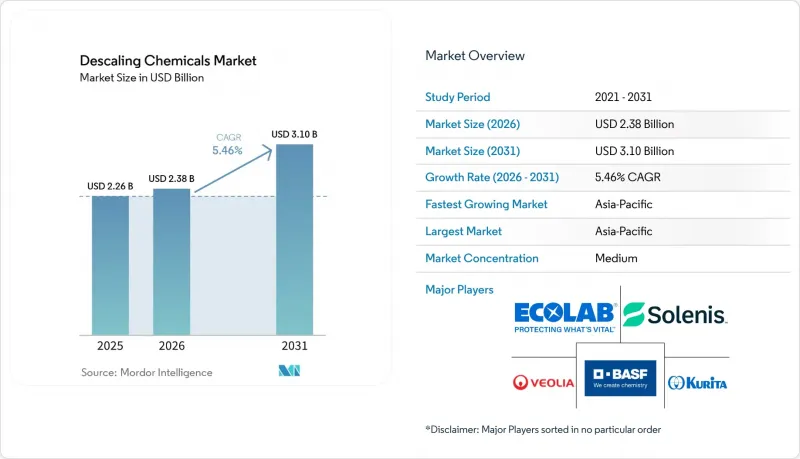
據 Mordor Intelligence 稱,2025 年除垢化學品市場規模估計為 22.6 億美元,預計在預測期(2026-2031 年)內將以 5.46% 的複合年成長率成長,從 2026 年的 23.8 億美元成長到 2031 年的 31 億美元。
全球除垢化學品市場趨勢及洞察
工業能源效率和設備壽命要求
水垢積聚是除垢劑需求持續成長的促進因素,因為它會阻礙鍋爐和熱交換器表面的熱傳遞。根據栗田水處理株式會社的「DReeM Polymer」產品手冊,保持鍋爐表面清潔可以提高能源效率並減少二氧化碳排放。當礦物質沉積物阻礙熱傳遞時,操作人員必須消耗更多燃料才能維持指定的蒸氣輸出。這種成本負擔使得清潔計畫在能源審計和設備壽命規劃中扮演越來越重要的角色。隨著維修團隊將化學清洗視為一項計劃性措施,而非設備故障或效率下降後的被動應對措施,除垢劑市場也從中受益。由此產生的需求較少受短期生產波動的影響,因為它與性能目標、維護程序和合規要求掛鉤。
工業水處理和製程清洗的需求不斷成長。
工業水系統在運作週期內都需要清洗,這擴大了水處理和公用設施應用中除垢化學品的範圍。在水回用系統中,循環水流中可能會出現礦物質濃縮,增加薄膜、管道、熱交換器和淨化設備內部沉積物的風險。因此,除垢化學品市場不僅對減少用水量的設施至關重要,對那些擴大傳統水處理規模的設施也同樣重要。新建的製造、採礦和發電設施增加了需要在定期停機期間進行清洗的基礎設施。當硬水和封閉回路型系統同時使用時,這種需求關係尤其顯著。化學品供應商可以透過提供針對每個現場設備、水質、沉積物類型和運作計劃量身定做的清洗方案來滿足這一需求。
處理危險化學品和遵守廢水法規的相關成本。
酸性配方會增加工業用戶在處理、儲存、工人防護和污水處理的成本。美國環保署 (EPA) 於 2025 年 11 月修訂了其危險化學品清單報告要求,使其與美國職業安全與健康管理局 (OSHA) 的危害資訊發布要求保持一致。這些規定可能會影響使用強酸或受管制螯合劑且用量超過規定限值的設施。歐洲的 REACH 法規也影響化學配方的選擇和使用。這些情況可能會限制傳統酸在除垢劑市場中的使用,尤其是對於合規資源有限的小規模用戶和供應商。這些法規也促進了生物基產品和螯合劑替代品的發展,這些產品處理負擔更輕,並有可能實現更高的產品附加價值。
細分市場分析
2025年,酸性除垢劑佔了除垢化學品市場的47.34%。這一地位反映了其在去除鍋爐、冷卻塔和熱交換器中的碳酸鈣、氧化鐵和矽酸鹽沉積物方面的顯著功效。在礦物去除速度對維護計劃至關重要的場合,酸性配方仍然被廣泛應用。 2026年發表在《發現機械工程》(Discover Mechanical Engineering)期刊上的一項研究報告稱,鹽酸濃度為5 wt%至15 wt%時,碳酸鹽垢能夠快速溶解,同時也強調了防腐蝕的必要性。由於需要同時使用酸和抑制劑,供應商可以透過材料保護、劑量指導和現場配方設計等方式來打造差異化產品。對於僅靠預防性處理無法解決的嚴重沉積物問題,酸性除垢劑在現有設施中也持續發揮至關重要的作用。尤其是在設施停機期間,維護團隊需要一種可靠的方法來恢復對受限區域的訪問時,酸性除垢劑就顯得尤為重要。即使設施已經實施了常規的水軟化和阻垢劑處理,這些產品的持續使用仍然反映了實際的修復需求。
預計到2031年,生物基除垢產品將以7.08%的複合年成長率成長,成為化學品產品類型中成長最快的細分市場。這一成長反映了市場對環境影響較小的配方以及植物來源和可生物分解成分開發的需求日益成長。 Envirofluid公司的Triple7 EnviroScale產品生物基含量高達96%,已獲得美國農業部生物優先認證,為工業和機構用戶進行第三方採購提供了指南。 2025年4月,BASF推出了Trilon G,該產品採用GLDA化學技術,可再生碳含量達56%,並符合OECD 301D標準,可即時生物分解。 《科學報告》也報告了生物基界面活性劑在控制工業水系統中碳酸鈣垢的性能。這些案例表明,對於那些既追求卓越清潔性能又希望減少化學品處理風險的用戶而言,生物基產品正日益成為理想之選。在採購法規、廢水處理要求以及精密設備的存在等因素導致傳統酸性清洗方案難以實施的地區,這種方法的應用尤其廣泛。然而,在這些地區,仍需證明其適用於各種沉積物類型和操作條件。
區域分析
至2025年,亞太地區將佔據全球除垢劑市場32.18%的佔有率,預計到2031年將以6.53%的複合年成長率成長。由於工業產能的擴張和大規模水處理需求,中國、印度、日本、韓國和東南亞國協的需求正在不斷成長。工業生產導致鍋爐、熱交換器、冷卻系統和製程設備的增加,這些設備需要定期清洗。該地區部分地區的高礦物質含量正在加速工業水循環系統中的水垢形成。此外,該地區正在擴大水的再利用和處理基礎設施,這導致循環系統中礦物質的濃度升高。因此,亞太地區是除垢劑市場規模最大且成長最快的區域市場。需求分佈廣泛,涵蓋大規模工業設施、食品服務業、公共產業以及使用製程設備的小規模企業。能夠提供本地技術支援並提案適合當地水質配方的供應商具有商業性優勢。
中國對節水設施的投資以及龐大的工業基礎支撐了電力、化學和製造業的需求。印度也呈現類似的趨勢,硬質地下水和不斷擴大的工業產能推動了循環系統清潔需求的成長。亞洲開發銀行報告稱,到2025年,全部區域仍將存在水資源安全差距和基礎設施限制。日本市場較成熟,汽車、電子和食品加工企業需要針對專用設備量身訂製的低腐蝕性產品。預計該地區的買家將更加重視清潔速度、安全性和材料保護的平衡配方。這項要求適用於成熟的工業市場和快速擴張的製造地,監測和計量服務也有助於使用者更有效地管理清潔流程。
北美和歐洲仍然是高價值市場,擁有完善的資產管理系統和常規維護程序。食品加工、發電、工業製造和高科技設施支撐著這兩個地區的現有需求。北美營運商正在採用供應商提供的數位化水資源管理工具,例如藝康集團 (Ecolab) 於 2026 年推出的 Water Navigator IQ。歐洲買家越來越傾向於選擇環境影響較小且不含膦酸鹽的化學產品,生物基替代品也越來越受歡迎。南美洲、中東和非洲市場規模較小,但由於加工產業、海水淡化相關系統、採礦業和硬水環境對規模管理的需求,這些市場仍具有重要的戰略意義。巴西透過糖和乙醇加工以及食品製造來滿足南美市場的需求,而沙烏地阿拉伯、波灣合作理事會(GCC) 國家和南非則透過工業、公共產業、海水淡化和採礦活動來滿足區域需求。這些市場通常需要根據當地水質、設備條件和操作規範進行調整的產品。儘管市場規模較小,但對於旨在實現本地需求多元化的供應商而言,其重要性永遠不會降低。
其他好處:
- Excel格式的市場預測(ME)表
- 3個月的分析師支持
目錄
第1章:引言
- 研究假設和市場定義
- 調查範圍
第2章:調查方法
第3章執行摘要
第4章 市場狀況
- 市場概覽
- 市場促進因素
- 工業領域對能源效率和設備壽命的要求
- 工業水處理和製程清洗的需求不斷成長。
- 擴大預防性維護和就地清洗(CIP) 項目
- 基於數位秤監測和預測的藥物輸注
- 新興工業和餐飲服務產業叢集面臨的硬水挑戰
- 市場限制因素
- 處理危險化學品和遵守廢水法規的相關成本。
- 其他方法包括軟化水、使用阻垢劑和機械清洗。
- 不同金屬設備材料相容性的風險
- 價值和供應鏈分析
- 波特五力分析
第5章 市場規模與成長預測
- 化學分類
- 酸性除垢劑
- 非酸性除垢劑
- 生物基除垢劑
- 其他(螯合劑、酵素基除垢劑、特殊組合藥物)
- 透過使用
- 工業設備
- 鍋爐
- 熱交換器
- 水處理系統
- 其他
- 按最終用戶行業分類
- 工業製造
- 發電
- 食品/飲料
- 供水和廢水處理
- 其他
- 按地區
- 亞太地區
- 中國
- 印度
- 日本
- 韓國
- 東南亞國協
- 其他亞太國家
- 北美洲
- 美國
- 加拿大
- 墨西哥
- 歐洲
- 德國
- 英國
- 法國
- 義大利
- 北歐國家
- 其他歐洲國家
- 南美洲
- 巴西
- 阿根廷
- 其他南美國家
- 中東和非洲
- 沙烏地阿拉伯
- 南非
- 其他中東和非洲國家
- 亞太地區
第6章 競爭情勢
- 市場集中度
- 策略趨勢
- 市佔率和排名分析
- 公司簡介
- AW Chesterton Company
- Accepta Water Treatment
- BASF
- Betco Corporation
- Diversey Holdings, Ltd.
- Ecolab Inc.
- Goodway Technologies Corp.
- Henkel AG & Co. KGaA
- Kemira Oyj
- Kurita Water Industries Ltd.
- Solenis
- Spartan Chemical Company, Inc.
- The Clorox Company
- Veolia
- Zep Inc.
第7章 市場機會與未來展望
According to Mordor Intelligence, the descaling chemicals market size was estimated at USD 2.26 billion in 2025 and is estimated to grow from USD 2.38 billion in 2026 to USD 3.10 billion by 2031, at a CAGR of 5.46% during the forecast period (2026-2031).
Global Descaling Chemicals Market Trends and Insights
Industrial Energy Efficiency and Equipment-Lifetime Requirements
Scale formation reduces heat transfer across boiler and heat-exchanger surfaces, making it a sustained driver of demand for descaling chemicals. According to Kurita's DReeM Polymer documentation, clean boiler surfaces can improve energy performance and reduce carbon dioxide emissions. When mineral deposits limit heat transfer, operators must consume more fuel to achieve a given steam output. This cost exposure has made cleaning schedules more relevant to energy audits and equipment-life planning. The descaling chemicals market benefits when maintenance teams treat chemical cleaning as a planned measure rather than a response to equipment failure or efficiency decline. The resulting demand is less dependent on short-term production changes because it is tied to performance targets, maintenance procedures, and compliance expectations.
Expansion of Industrial Water Treatment and Process-Cleaning Demand
Industrial water systems require cleaning throughout their operating life, which broadens the use of descaling chemicals across processing and utility applications. Water reuse systems can concentrate minerals in recirculating streams, increasing the risk of deposits inside membranes, piping, heat exchangers, and clarification equipment. This makes the descaling chemicals market relevant to facilities reducing water withdrawals, as well as to those expanding conventional water treatment. New manufacturing, mining, and electricity assets add to the installed equipment base that requires cleaning during scheduled outages. The demand relationship is particularly strong where hard water and closed-loop systems operate together. Chemical suppliers can address this need by offering cleaning programs tailored to the equipment, water quality, deposit type, and operating schedule at each site.
Hazardous-Chemical Handling and Wastewater Compliance Costs
Acid-based formulations can increase costs for handling, storage, worker protection, and wastewater management for industrial users. The U.S. Environmental Protection Agency amended hazardous chemical inventory reporting requirements in November 2025 to align with OSHA hazard communication updates. These obligations can affect facilities that use strong acids and regulated chelating agents at levels above specified limits. European REACH requirements also influence the selection and use of chemical formulations. These conditions can limit the use of conventional acids in the descaling chemicals market, particularly for smaller users and suppliers with limited compliance resources. They also favor bio-based and chelating alternatives that may carry lower handling burdens and support higher-value product positions.
Other drivers and restraints analyzed in the detailed report include:
- Growth of Preventive Maintenance and Clean-in-Place Programs
- Digital Scale Monitoring and Predictive Chemical Dosing
- Substitution by Water Softening, Antiscalants, and Mechanical Cleaning
For complete list of drivers and restraints, kindly check the Table Of Contents.
Segment Analysis
Acid-based products held 47.34% of the descaling chemicals market share in 2025. Their position reflects established effectiveness in removing calcium carbonate, iron oxide, and silicate deposits from boilers, cooling towers, and heat exchangers. Acid formulations remain widely used where the speed of mineral removal is central to the maintenance plan. A 2026 study in Discover Mechanical Engineering reported rapid carbonate-scale dissolution in hydrochloric acid concentrations from 5 wt% to 15 wt%, while also noting the need for corrosion protection. The need to pair acids with inhibitors gives suppliers room to differentiate through material protection, dosing guidance, and site-specific formulation design. Acid-based products also remain relevant for installed equipment with severe deposits that cannot be addressed through preventive treatment alone. They are especially useful during shutdowns, when maintenance teams need a dependable method to restore access to restricted surfaces. Their continued use reflects practical remediation needs, even where facilities have adopted routine softening or antiscalant treatment.
Bio-based descaling products are forecast to grow at a 7.08% CAGR through 2031, making them the fastest-growing chemistry category. Their growth reflects procurement preferences for lower-impact formulations and the development of plant-derived and biodegradable ingredients. Envirofluid's Triple7 EnviroScale received USDA BioPreferred certification with 96% biobased content, providing a third-party purchasing reference for industrial and institutional users. BASF introduced Trilon G in April 2025 using GLDA chemistry with 56% renewable carbon content and ready biodegradability under OECD 301D. Scientific Reports also documented the performance of bio-derived surfactants in controlling calcium carbonate scale in industrial water systems. These examples indicate why bio-based products are becoming more suitable for applications where operators require both cleaning performance and lower chemical-handling concerns. Their adoption is strongest where procurement rules, wastewater considerations, and sensitive equipment make conventional acid programs less practical. The category still needs to demonstrate fit across varying deposit types and operating conditions.
Complete Report Scope:
- By Chemistry
- Acid-Based Descaling Chemicals
- Non-Acid Descaling Chemicals
- Bio-Based Descaling Chemicals
- Others (Chelating Agent-Based Descaling Chemicals, Enzymatic Descaling Chemicals, Specialty Formulations)
- By Application
- Industrial Equipment
- Boilers
- Heat Exchangers
- Water Treatment Systems
- Others
- By End-User Industry
- Industrial Manufacturing
- Power Generation
- Food and Beverage
- Water and Wastewater Treatment
- Others
- By Geography
- Asia-Pacific
- China
- India
- Japan
- South Korea
- ASEAN Countries
- Rest of Asia-Pacific
- North America
- United States
- Canada
- Mexico
- Europe
- Germany
- United Kingdom
- France
- Italy
- NORDIC Countries
- Rest of Europe
- South America
- Brazil
- Argentina
- Rest of South America
- Middle-East and Africa
- Saudi Arabia
- South Africa
- Rest of Middle-East and Africa
- Asia-Pacific
Geography Analysis
Asia-Pacific held 32.18% of the descaling chemicals market share in 2025 and is projected to grow at a 6.53% CAGR through 2031. China, India, Japan, South Korea, and ASEAN countries combine the expansion of industrial capacity with significant water treatment requirements. Industrial production adds boilers, heat exchangers, cooling systems, and process equipment that require regular cleaning. High mineral loads in parts of the region accelerate scale formation within industrial water circuits. The region is also expanding its water reuse and treatment infrastructure, which concentrates minerals in recirculating systems. These conditions make Asia-Pacific both the largest regional market and the fastest-growing area for descaling chemicals. Demand is distributed across large industrial sites and smaller operators using foodservice, utility, and process equipment. Suppliers that can provide local technical support and formulations suited to regional water conditions hold a commercial advantage.
China's investment in water efficiency and its broad industrial base support demand across power, chemical, and manufacturing facilities. India presents a relevant profile, as hard groundwater and growing industrial capacity increase cleaning requirements in recirculation systems. The Asian Development Bank documented ongoing water security gaps and infrastructure constraints across the Asia-Pacific region in 2025. Japan is a more mature market where automotive, electronics, and food-processing operators require low-corrosivity products compatible with specialized equipment. Buyers across the region are expected to place greater value on formulations that balance cleaning speed, safety, and material protection. This requirement applies to both mature industrial markets and rapidly expanding manufacturing centers, and it also supports monitoring and dosing services that help users manage cleaning more consistently.
North America and Europe remain high-value markets with formal asset management systems and recurring maintenance protocols. Food processing, power generation, industrial manufacturing, and high-technology facilities support established demand in both regions. North American operators are also adopting suppliers' digital water management tools, as illustrated by Ecolab's Water Navigator IQ launch in 2026. European buyer preferences increasingly favor lower-impact, phosphonate-free chemistry, supporting bio-based alternatives. South America, the Middle-East, and Africa are smaller markets but remain strategically important, as processing industries, desalination-linked systems, mining operations, and hard-water conditions require scale management. Brazil supports South American demand through sugar-ethanol processing and food manufacturing, while Saudi Arabia, Gulf Cooperation Council (GCC) markets, and South Africa support regional demand through industrial, utility, desalination, and mining activity. These markets often require products adapted to local water composition, asset conditions, and operating practices. Their smaller scale does not reduce their relevance for suppliers seeking diversified regional demand.
- A.W. Chesterton Company
- Accepta Water Treatment
- BASF
- Betco Corporation
- Diversey Holdings, Ltd.
- Ecolab Inc.
- Goodway Technologies Corp.
- Henkel AG & Co. KGaA
- Kemira Oyj
- Kurita Water Industries Ltd.
- Solenis
- Spartan Chemical Company, Inc.
- The Clorox Company
- Veolia
- Zep Inc.
Additional Benefits:
- The market estimate (ME) sheet in Excel format
- 3 months of analyst support
TABLE OF CONTENTS
1 Introduction
- 1.1 Study Assumptions and Market Definition
- 1.2 Scope of the Study
2 Research Methodology
3 Executive Summary
4 Market Landscape
- 4.1 Market Overview
- 4.2 Market Drivers
- 4.2.1 Industrial Energy-Efficiency and Equipment-Lifetime Requirements
- 4.2.2 Expansion of Industrial Water Treatment and Process-Cleaning Demand
- 4.2.3 Growth of Preventive Maintenance and Clean-in-Place Programs
- 4.2.4 Digital Scale Monitoring and Predictive Chemical Dosing
- 4.2.5 Hard-Water Stress in Emerging Industrial and Foodservice Clusters
- 4.3 Market Restraints
- 4.3.1 Hazardous-Chemical Handling and Wastewater Compliance Costs
- 4.3.2 Substitution by Water Softening, Antiscalants and Mechanical Cleaning
- 4.3.3 Material-Compatibility Risk Across Mixed-Metallurgy Equipment
- 4.4 Value and Supply-Chain Analysis
- 4.5 Porter's Five Forces Analysis
- 4.5.1 Bargaining Power of Suppliers
- 4.5.2 Bargaining Power of Buyers
- 4.5.3 Threat of New Entrants
- 4.5.4 Threat of Substitutes
- 4.5.5 Competitive Rivalry
5 Market Size and Growth Forecasts (Value)
- 5.1 By Chemistry
- 5.1.1 Acid-Based Descaling Chemicals
- 5.1.2 Non-Acid Descaling Chemicals
- 5.1.3 Bio-Based Descaling Chemicals
- 5.1.4 Others (Chelating Agent-Based Descaling Chemicals, Enzymatic Descaling Chemicals, Specialty Formulations)
- 5.2 By Application
- 5.2.1 Industrial Equipment
- 5.2.2 Boilers
- 5.2.3 Heat Exchangers
- 5.2.4 Water Treatment Systems
- 5.2.5 Others
- 5.3 By End-User Industry
- 5.3.1 Industrial Manufacturing
- 5.3.2 Power Generation
- 5.3.3 Food and Beverage
- 5.3.4 Water and Wastewater Treatment
- 5.3.5 Others
- 5.4 By Geography
- 5.4.1 Asia-Pacific
- 5.4.1.1 China
- 5.4.1.2 India
- 5.4.1.3 Japan
- 5.4.1.4 South Korea
- 5.4.1.5 ASEAN Countries
- 5.4.1.6 Rest of Asia-Pacific
- 5.4.2 North America
- 5.4.2.1 United States
- 5.4.2.2 Canada
- 5.4.2.3 Mexico
- 5.4.3 Europe
- 5.4.3.1 Germany
- 5.4.3.2 United Kingdom
- 5.4.3.3 France
- 5.4.3.4 Italy
- 5.4.3.5 NORDIC Countries
- 5.4.3.6 Rest of Europe
- 5.4.4 South America
- 5.4.4.1 Brazil
- 5.4.4.2 Argentina
- 5.4.4.3 Rest of South America
- 5.4.5 Middle-East and Africa
- 5.4.5.1 Saudi Arabia
- 5.4.5.2 South Africa
- 5.4.5.3 Rest of Middle-East and Africa
- 5.4.1 Asia-Pacific
6 Competitive Landscape
- 6.1 Market Concentration
- 6.2 Strategic Moves
- 6.3 Market Share (%)/Ranking Analysis
- 6.4 Company Profiles (includes Global Overview, Market Overview, Core Segments, Financials as available, Strategic Information, Products and Services, and Recent Developments)
- 6.4.1 A.W. Chesterton Company
- 6.4.2 Accepta Water Treatment
- 6.4.3 BASF
- 6.4.4 Betco Corporation
- 6.4.5 Diversey Holdings, Ltd.
- 6.4.6 Ecolab Inc.
- 6.4.7 Goodway Technologies Corp.
- 6.4.8 Henkel AG & Co. KGaA
- 6.4.9 Kemira Oyj
- 6.4.10 Kurita Water Industries Ltd.
- 6.4.11 Solenis
- 6.4.12 Spartan Chemical Company, Inc.
- 6.4.13 The Clorox Company
- 6.4.14 Veolia
- 6.4.15 Zep Inc.
7 Market Opportunities and Future Outlook
- 7.1 White-Space and Unmet-Need Assessment

 聚磷酸鹽基阻垢劑市場:全球市場預測(2026-2032年)高效率灰水阻垢劑市場:全球市場預測,2026-2032年
 阻垢劑和除垢劑市場規模、佔有率和趨勢分析報告:按產品、應用、最終用途、地區和細分市場預測(2026-2033 年)
 除垢閥市場規模、佔有率和成長分析:按閥門類型、材料、壓力等級、最終用途產業、操作方式、分銷管道和地區分類-2026-2033年產業預測
 阻垢劑市場:依類型、製程、應用、技術、形態、國家及地區分類-全球產業分析、市場規模、市場佔有率及2026年至2033年預測
 阻垢劑和分散劑市場規模、佔有率和成長分析:按產品化學、製劑形式、目標系統、最終用途產業和地區分類-2026-2033年產業預測
 阻垢劑和防污劑市場規模、佔有率和成長分析:按化學分類、系統運作、最終用途產業和地區分類-2026-2033年產業預測
 全球阻垢劑市場規模、佔有率、趨勢和成長分析報告(2026-2034年)水垢去除劑市場規模、佔有率和趨勢分析報告:按產品、形式、應用、最終用途、地區和細分市場分類(2026-2033 年)
 全球阻垢劑市場:按類型、製程類型、應用和地區分類-預測至2031年