


 |
市場調查報告書
商品編碼
2154402
AI賦能的身份驗證工作流程工具:市場佔有率分析、行業趨勢和統計數據以及成長預測(2026-2031年)AI-Based Certification Workflow Tools - Market Share Analysis, Industry Trends & Statistics, Growth Forecasts (2026 - 2031) |
||||||

※ 本網頁內容可能與最新版本有所差異。詳細情況請與我們聯繫。
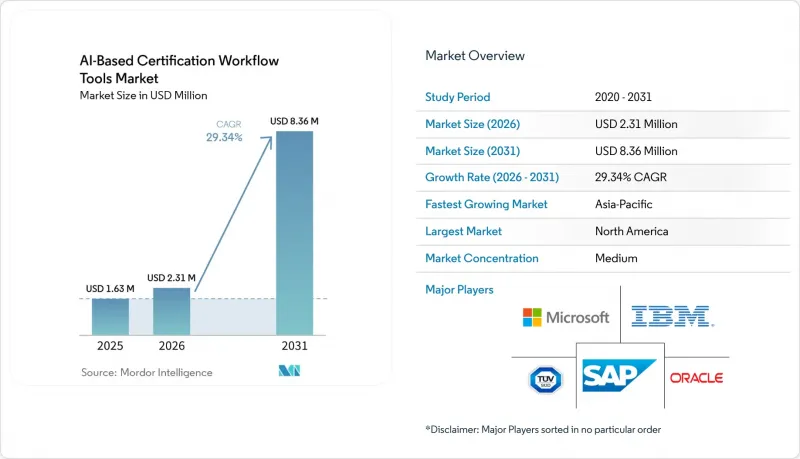
據 Mordor Intelligence 稱,人工智慧驅動的身份驗證工作流程工具市場在 2025 年的價值為 163 萬美元,在 2026 年的價值為 231 萬美元,預計到 2031 年將達到 836 萬美元。
預計從 2026 年到 2031 年,其複合年成長率將達到 29.34%。
全球基於人工智慧的身份驗證工作流程工具市場趨勢及洞察
擴大人工智慧保證和合格評定方面的法規
歐盟的人工智慧法案強制要求對高風險人工智慧供應商進行合格評定,這預示著對基於人工智慧的認證工作流程工具市場的巨大需求。該法規規定,對於某些違規行為,將處以最高3500萬歐元(以2025年公佈的平均匯率計算,相當於3885萬美元)或全球年銷售額7%的罰款。德國聯邦網路管理局(Bundesnetzagentur)於2025年8月開始作為人工智慧合格評定機構的指定公告機構運作。這個制度架構提高了認證機構進行評估時對結構化證據的需求。此外,ISO/IEC 42001提供了一個管理體系框架,認證專案可以利用該框架來評估人工智慧管治。這些要求縮短了受監管領域的採購決策時間,因為在這些領域,組織必須保持最新且可靠的控制證據。
從定期審計過渡到持續合規性監測
人工智慧驅動的身份驗證工作流程工具市場正受到從年度評估轉變為持續監控控制措施和證據的轉變的推動。透過連網系統在整個控制週期中提供記錄,企業可以減少證據準備所需的人工負擔。這種方法使審計團隊更容易在計劃審計開始前識別缺失的文件和不完整的控制措施。此外,證據記錄的建立有助於使用者隨時審查重複出現的問題。與基於批量處理文件請求的平台相比,具備即時證據資料擷取和自動提醒功能的供應商更能滿足企業需求。這種轉變對現有平台有利,因為更長的證據資料保留期使得客戶更難遷移到其他系統。
審計員的職責和個人監督要求
基於人工智慧的認證工作流程工具市場仍受到合格審核員必須負責判定符合性的限制。歐盟人工智慧法規要求對高風險人工智慧系統進行人工監督。認證機構仍在探討合格評定機構使用人工智慧與ISO/IEC 17021能力要求之間的關係。這種不確定性限制了完全取消負責人查核點的工具的適用性。因此,供應商必須在證據收集、不符合項目識別和認證決策的每個階段都加入核准流程。這些控制措施可能會延長大型客戶的部署和銷售週期。此外,即使證據收集的自動化程度較高,審核工作流程中仍會存在一些人工成本。
細分市場分析
預計到2025年,軟體平台將佔據基於人工智慧的認證工作流程工具80.78%的市場佔有率,並在2031年之前以31.07%的複合年成長率成長。這種主導地位反映了跨地域、跨標準和跨審核團隊協調審核程序的必要性。協調的平台可以取代單獨的文檔庫和基於電子郵件的證據請求。 Certyze、Intact Systems、CertRoute和Zertic專注於可設定的工作流程、標準覆蓋範圍和企業整合。 Qualtrax和Jadian等針對GRC(管治、風險和合規)的供應商則滿足客戶管理更廣泛風險計畫的相關需求。 Certyze表示,其軟體支援ISO/IEC 17021-1、ISO/IEC 17025和ISO/IEC 17065工作流程中的認證和合格評定機構。
服務構成剩餘的組成部分,包括實施諮詢、審核員培訓、合規管理服務、應對監管變化的支持,以及為缺乏內部認證專業知識的組織提供的協助。這些服務的作用在導入階段最為顯著,客戶需要將現有的文件管理流程轉化為配置好的工作流程,明確職責,培訓用戶,並將每項關鍵控制措施與現有證據進行核對。 2025年4月,Intact Systems與國際航空航太品質組織合作,為線上航太供應商資訊系統(OASIS)推出了「OASIS Insights」。該工具可在初始審核、再認證審核或監督審核後,為已認證的航太供應商產生績效基準報告,展示已完成的審核事件如何轉化為可操作的品質信息,而不僅僅是靜態記錄。該模型為軟體供應商提供了一種利用定期分析功能來補充其服務的途徑,並有助於解釋為什麼支援持續營運審查的平台比僅儲存文件的舊有系統更有價值。
到2025年,基於雲端的解決方案將佔據人工智慧身分驗證工作流程工具市場73.59%的佔有率,預計到2031年將以32.02%的複合年成長率成長。集中式儲存庫允許分散式負責人在已定義的使用者權限下存取相同的證據。雲端系統還可以透過介面與身分管理和品管應用程式整合。這支持定期收集證據和對控制項目進行定期檢查。警報功能可以在缺陷成為審計發現之前通知管理人員。 Zertic表示,其通過ISO 27001認證的系統為歐洲、北美和南美的認證機構提供支援。
本地部署和混合部署佔據剩餘佔有率,當 GDPR、國家資料本地化法規或內部政策限制在雲端處理證據時,它們仍然發揮著重要作用。混合設計允許組織在其自身基礎設施上維護敏感儲存庫,同時利用雲端服務來安排審計、產生報告、與相關人員溝通以及跨地域協調。這種過渡架構最大限度地減少了從傳統系統遷移的客戶所受到的影響,並保持了對敏感記錄的本地控制。然而,雲端交付符合市場對可隨需求變化而更新的訂閱式軟體的廣泛需求,支援跨多種標準的整合審計,並且無需在每個業務地點部署單獨的本地環境。因此,本地系統供應商在爭取新客戶部署時,需要展現清晰的資料管治概念,而不僅僅是表達對傳統架構的偏好。
區域分析
到2025年,北美將佔據基於人工智慧的認證工作流程工具市場35.12%的佔有率。該地區受惠於眾多認證機構的高度集中,以及金融服務、航太和科技業成熟的合規體系。完善的數位化品管實務為客戶利用整合審計工具奠定了堅實的基礎。與《薩班斯-奧克斯利法案》(SOX)相關的工作為許多美國企業帶來了持續且繁重的工作量。美國公眾公司會計監督委員會(PCAOB)和美國證券交易委員會(SEC)的監管指南不斷界定人工智慧驅動的審計方法的適用範圍。加拿大和墨西哥也透過與北美製造網路相關的供應鏈需求推動了市場需求。
在歐盟人工智慧法案的合格評定要求支持下,預計到2025年,歐洲將成為人工智慧應用規模第二大的地區。必維集團(Bureau Veritas)與亞馬遜雲端服務(AWS)合作,於2026年4月為歐洲企業推出了一項獨立的人工智慧系統審核服務。該服務旨在透過自動化文件分析和測試來縮短審核週期。德國的公告機構已為人工智慧合格評定機構建立了正式的認證途徑。這些法規、認證基礎設施和企業需求共同推動了人工智慧在該地區持續普及應用。
預計亞太地區將成為成長最快的地區,到2031年複合年複合成長率(CAGR)將達到34.04%。中國正在發展的AI管治框架、日本的產業標準制定工作以及新加坡管治環境都在支撐著該地區的需求。印度汽車、製藥和IT供應鏈中已獲得ISO認證的出口商需要高效率的支持,以確保符合多項標準。韓國和澳洲也在進一步推動與管治相關的需求。巴西正透過針對農業和工業出口商的企業認證項目,加速在南美洲的早期應用。中東地區正透過公共部門數位化計畫推動市場發展,而非洲雖然市場規模仍然較小,但在金融服務和電信領域已開始出現早期應用。
其他好處:
- Excel格式的市場預測(ME)表
- 3個月的分析師支持
目錄
第1章:引言
- 研究假設和市場定義
- 調查範圍
第2章:調查方法
第3章執行摘要
第4章 市場狀況
- 市場概覽
- 市場促進因素
- 擴大人工智慧保證和合格評定相關法規
- 從定期審計過渡到持續合規性監測
- 對機器可讀且可透過密碼學檢驗的證據的需求。
- 身份驗證工作流程與企業系統的整合
- 擴展遠端和分散式認證運營
- 人工智慧驅動的文檔分析和審計決策支持
- 市場限制因素
- 審計員的職責和個人監督要求
- 標準碎片化和憑證互通性的局限性
- 高度敏感的客戶資料和模型管治限制
- 不同標準、語言和司法管轄區的訓練數據不一致。
- 產業價值鏈分析
- 監理情勢
- 技術展望
- 波特五力分析
第5章 市場規模與成長預測
- 按組件
- 軟體平台
- 服務
- 部署模式
- 基於雲端的
- 現場
- 混合實現
- 最終用戶
- 認證機構
- 認證機構和方案所有者
- 內部稽核與合規部門
- 測試、檢驗和認證服務提供者
- 其他最終用戶
- 按組織規模
- 大公司
- 小型企業
- 按行業分類
- 資訊科技/通訊
- 製造業和工業
- 醫療保健和生命科學
- 食品和農業
- 能源公用事業
- 建築和基礎設施
- 金融服務
- 運輸/物流
- 其他工業部門
- 按地區
- 北美洲
- 美國
- 加拿大
- 墨西哥
- 南美洲
- 巴西
- 阿根廷
- 哥倫比亞
- 其他南美國家
- 歐洲
- 德國
- 英國
- 法國
- 義大利
- 西班牙
- 俄羅斯
- 其他歐洲國家
- 亞太地區
- 中國
- 日本
- 印度
- 韓國
- 澳洲
- 新加坡
- 其他亞太國家
- 中東
- 阿拉伯聯合大公國
- 沙烏地阿拉伯
- 以色列
- 土耳其
- 其他中東國家
- 非洲
- 南非
- 奈及利亞
- 埃及
- 其他非洲國家
- 北美洲
第6章 競爭情勢
- 市場集中度
- 策略趨勢
- 市佔率分析
- 公司簡介
- Microsoft Corporation
- International Business Machines Corporation
- SAP SE
- Oracle Corporation
- TUV SUD AG
- Intact Systems
- Audit-AI
- AuditOne
- Certyze
- Zertic
- CertRoute
- Jadian
- Qualtrax
- VigiTrust
- Centrieva
- Dossier Solutions
- eLumen
- Liaison International
- Accredible, Inc.
- Parchment LLC
- Bureau Veritas SA
- SGS SA
第7章 市場機會與未來展望
According to Mordor Intelligence, the AI-based certification workflow tools market size was valued at USD 1.63 million in 2025 and USD 2.31million in 2026, and is projected to reach USD 8.36 million by 2031, growing at a CAGR of 29.34% during 2026-2031.
Global AI-Based Certification Workflow Tools Market Trends and Insights
Regulatory Expansion of AI Assurance and Conformity Assessment
The EU AI Act has created a significant demand signal for the AI-based certification workflow tools market because high-risk AI providers face conformity assessment obligations. The regulation allowed penalties of up to EUR 35 million, equivalent to USD 38.85 million at the stated 2025 average rate, or 7% of global annual revenue for certain infringements. Germany's Bundesnetzagentur became an operational notifying authority for AI conformity assessment bodies in August 2025. This institutional structure increases the need for well-organized evidence packages for certification bodies to review. ISO/IEC 42001 also provides a management system framework that certification programs can use to assess AI governance. These requirements are shortening procurement decision-making in regulated sectors where organizations must maintain current and reliable evidence of control.
Shift From Periodic Audits to Continuous Compliance Monitoring
The AI-based certification workflow tools market is driven by the shift from annual assessments to continuous monitoring of controls and evidence. Organizations can reduce the manual effort required to prepare evidence when connected systems provide records throughout the control cycle. This approach helps audit teams identify missing documents and incomplete controls before a scheduled audit begins. It also creates a record of evidence that helps users review recurring issues over time. Vendors with real-time evidence ingestion and automated reminders can better address enterprise needs than platforms built around batch document requests. The change favors established platforms because a longer history of evidence can make migrating to another system more difficult for customers.
Auditor Liability and Human Oversight Requirements
The AI-based certification workflow tools market remains limited by requirements that qualified auditors retain responsibility for conformity decisions. The EU AI Act includes human oversight requirements for high-risk AI systems. Accreditation bodies are still determining how the use of AI by conformity assessment organizations relates to competence requirements under ISO/IEC 17021. This uncertainty limits the scope for tools that remove reviewer checkpoints entirely. Vendors must therefore build approval stages into evidence collection, findings, and certificate decisions. Those controls can lengthen implementation and sales cycles for large customers. They also preserve a level of labor cost within audit workflows, even as evidence gathering becomes more automated.
Other drivers and restraints analyzed in the detailed report include:
- Demand for Machine-Readable and Cryptographically Verifiable Evidence
- Integration of Certification Workflows With Enterprise Systems
- Fragmented Standards and Limited Credential Interoperability
For complete list of drivers and restraints, kindly check the Table Of Contents.
Segment Analysis
Software platforms held 80.78% of the AI-based certification workflow tools market share in 2025 and are projected to grow at a CAGR of 31.07% through 2031. Their lead reflects the need to coordinate audit programs across sites, standards, and audit teams. A connected platform can replace separate document repositories and email-based evidence requests. Certyze, Intact Systems, CertRoute, and Zertic focus on configurable workflows, standards coverage, and enterprise integrations. GRC-oriented providers such as Qualtrax and Jadian address related requirements for customers managing wider risk programs. Certyze stated that its software supports certification bodies and conformity assessment bodies across ISO/IEC 17021-1, ISO/IEC 17025, and ISO/IEC 17065 workflows.
Services make up the remaining component segment and include implementation consulting, auditor training, managed compliance delivery, regulatory-change support, and assistance for organizations that do not have deep internal certification expertise. Their role is most visible during onboarding, when a customer must convert existing document routines into configured workflows, define responsibilities, train users, and map each required control to available evidence. Intact Systems launched OASIS Insights with the International Aerospace Quality Group in April 2025 for the Online Aerospace Supplier Information System. The tool generated performance benchmarking reports for certified aerospace suppliers after initial, recertification, or surveillance audits, showing how completed audit events can become usable quality information rather than remain static records. This model gives software providers a way to complement services with recurring analytics and helps explain why platforms that support continuing operational review can be more valuable than legacy systems that only store documents.
Cloud-based solutions accounted for 73.59% of the AI-based certification workflow tools market size in 2025 and are projected to grow at a CAGR of 32.02% through 2031. Centralized repositories enable distributed auditors to access the same evidence under defined user permissions. Cloud systems can also connect with identity and quality management applications through interfaces. This supports regular evidence collection and scheduled control checks. Alerts can notify control owners before gaps become audit findings. Zertic stated that its ISO 27001-certified system supports certification bodies in Europe, North America, and South America.
On-premises and hybrid deployments hold the remaining share and remain important when data-protection obligations under the GDPR, national data-localization rules, or internal policies limit cloud-hosted evidence processing. Hybrid designs allow organizations to retain sensitive repositories on their own infrastructure while using cloud services for audit scheduling, report production, stakeholder communication, and cross-site coordination. This transitional architecture can reduce disruption for customers moving from older systems and can preserve local control over high-sensitivity records. Cloud delivery nonetheless aligns with a wider preference for subscription software that can be updated as requirements change, can support combined audits across several standards, and does not require a separate local environment for every operating location. Providers of on-premises systems therefore need a clear data-governance case, rather than a simple preference for older architecture, when competing for new customer deployments.
Complete Report Scope:
- By Component
- Software Platforms
- Services
- By Deployment Mode
- Cloud-Based
- On-Premises
- Hybrid Deployment
- By End User
- Certification Bodies
- Accreditation and Scheme Owners
- Internal Audit and Compliance Departments
- Testing, Inspection, and Certification Providers
- Other End Users
- By Organization Size
- Large Enterprises
- Small and Medium-Sized Enterprises
- By Industry Vertical
- Information Technology and Telecommunications
- Manufacturing and Industrial
- Healthcare and Life Sciences
- Food and Agriculture
- Energy and Utilities
- Construction and Infrastructure
- Financial Services
- Transportation and Logistics
- Other Industry Verticals
- By Geography
- North America
- United States
- Canada
- Mexico
- South America
- Brazil
- Argentina
- Colombia
- Rest of South America
- Europe
- Germany
- United Kingdom
- France
- Italy
- Spain
- Russia
- Rest of Europe
- Asia-Pacific
- China
- Japan
- India
- South Korea
- Australia
- Singapore
- Rest of Asia-Pacific
- Middle East
- United Arab Emirates
- Saudi Arabia
- Israel
- Turkey
- Rest of Middle East
- Africa
- South Africa
- Nigeria
- Egypt
- Rest of Africa
- North America
Geography Analysis
North America held 35.12% of the AI-based certification workflow tools market share in 2025. The region benefits from mature compliance programs in financial services, aerospace, and technology, as well as a dense base of accredited certification bodies. Established digital quality management practices give customers a practical foundation for connected audit tools. SOX-related work creates a large and recurring workload for many U.S. organizations. Regulatory guidance from the PCAOB and SEC continues to shape the acceptable use of AI-assisted audit methods. Canada and Mexico also add demand through supply-chain requirements linked to North American manufacturing networks.
Europe represented the second-largest regional position in 2025, supported by EU AI Act conformity assessment requirements. Bureau Veritas launched an independent AI systems audit for European enterprises in April 2026 in partnership with AWS. The offering was designed to reduce audit cycles through automated document analysis and testing. Germany's notifying authority provides a formal route for AI conformity assessment bodies. This combination of regulation, certification infrastructure, and enterprise demand supports continued adoption in the region.
Asia-Pacific is projected to be the fastest-growing geography at a CAGR of 34.04% through 2031. China's developing AI governance framework, Japan's industrial standards work, and Singapore's governance environment support regional demand. India's ISO-certified exporters in automotive, pharmaceutical, and IT supply chains need efficient support for multi-standard compliance. South Korea and Australia add further governance-related demand. Brazil supports early adoption in South America through enterprise certification programs for agricultural and industrial exporters. The Middle East is developing through public-sector digital programs, while Africa remains smaller with early adoption in financial services and telecommunications.
- Microsoft Corporation
- International Business Machines Corporation
- SAP SE
- Oracle Corporation
- TUV SUD AG
- Intact Systems
- Audit-AI
- AuditOne
- Certyze
- Zertic
- CertRoute
- Jadian
- Qualtrax
- VigiTrust
- Centrieva
- Dossier Solutions
- eLumen
- Liaison International
- Accredible, Inc.
- Parchment LLC
- Bureau Veritas SA
- SGS SA
Additional Benefits:
- The market estimate (ME) sheet in Excel format
- 3 months of analyst support
TABLE OF CONTENTS
1 INTRODUCTION
- 1.1 Study Assumptions and Market Definition
- 1.2 Scope of the Study
2 RESEARCH METHODOLOGY
3 EXECUTIVE SUMMARY
4 MARKET LANDSCAPE
- 4.1 Market Overview
- 4.2 Market Drivers
- 4.2.1 Regulatory Expansion of AI Assurance and Conformity Assessment
- 4.2.2 Shift from Periodic Audits to Continuous Compliance Monitoring
- 4.2.3 Demand for Machine-Readable and Cryptographically Verifiable Evidence
- 4.2.4 Integration of Certification Workflows with Enterprise Systems
- 4.2.5 Expansion of Remote and Distributed Certification Operations
- 4.2.6 AI-Assisted Document Intelligence and Audit Decision Support
- 4.3 Market Restraints
- 4.3.1 Auditor Liability and Human Oversight Requirements
- 4.3.2 Fragmented Standards and Limited Credential Interoperability
- 4.3.3 Sensitive Client Data and Model-Governance Constraints
- 4.3.4 Inconsistent Training Data Across Standards, Languages, and Jurisdictions
- 4.4 Industry Value Chain Analysis
- 4.5 Regulatory Landscape
- 4.6 Technological Outlook
- 4.7 Porter's Five Forces Analysis
- 4.7.1 Bargaining Power of Suppliers
- 4.7.2 Bargaining Power of Buyers
- 4.7.3 Threat of New Entrants
- 4.7.4 Threat of Substitutes
- 4.7.5 Competitive Rivalry
5 MARKET SIZE AND GROWTH FORECASTS (VALUE)
- 5.1 By Component
- 5.1.1 Software Platforms
- 5.1.2 Services
- 5.2 By Deployment Mode
- 5.2.1 Cloud-Based
- 5.2.2 On-Premises
- 5.2.3 Hybrid Deployment
- 5.3 By End User
- 5.3.1 Certification Bodies
- 5.3.2 Accreditation and Scheme Owners
- 5.3.3 Internal Audit and Compliance Departments
- 5.3.4 Testing, Inspection, and Certification Providers
- 5.3.5 Other End Users
- 5.4 By Organization Size
- 5.4.1 Large Enterprises
- 5.4.2 Small and Medium-Sized Enterprises
- 5.5 By Industry Vertical
- 5.5.1 Information Technology and Telecommunications
- 5.5.2 Manufacturing and Industrial
- 5.5.3 Healthcare and Life Sciences
- 5.5.4 Food and Agriculture
- 5.5.5 Energy and Utilities
- 5.5.6 Construction and Infrastructure
- 5.5.7 Financial Services
- 5.5.8 Transportation and Logistics
- 5.5.9 Other Industry Verticals
- 5.6 By Geography
- 5.6.1 North America
- 5.6.1.1 United States
- 5.6.1.2 Canada
- 5.6.1.3 Mexico
- 5.6.2 South America
- 5.6.2.1 Brazil
- 5.6.2.2 Argentina
- 5.6.2.3 Colombia
- 5.6.2.4 Rest of South America
- 5.6.3 Europe
- 5.6.3.1 Germany
- 5.6.3.2 United Kingdom
- 5.6.3.3 France
- 5.6.3.4 Italy
- 5.6.3.5 Spain
- 5.6.3.6 Russia
- 5.6.3.7 Rest of Europe
- 5.6.4 Asia-Pacific
- 5.6.4.1 China
- 5.6.4.2 Japan
- 5.6.4.3 India
- 5.6.4.4 South Korea
- 5.6.4.5 Australia
- 5.6.4.6 Singapore
- 5.6.4.7 Rest of Asia-Pacific
- 5.6.5 Middle East
- 5.6.5.1 United Arab Emirates
- 5.6.5.2 Saudi Arabia
- 5.6.5.3 Israel
- 5.6.5.4 Turkey
- 5.6.5.5 Rest of Middle East
- 5.6.6 Africa
- 5.6.6.1 South Africa
- 5.6.6.2 Nigeria
- 5.6.6.3 Egypt
- 5.6.6.4 Rest of Africa
- 5.6.1 North America
6 COMPETITIVE LANDSCAPE
- 6.1 Market Concentration
- 6.2 Strategic Moves
- 6.3 Market Share Analysis
- 6.4 Company Profiles (includes Global Level Overview, Market Level Overview, Core Segments, Financials as available, Strategic Information, Market Rank/Share, Products and Services, Recent Developments)
- 6.4.1 Microsoft Corporation
- 6.4.2 International Business Machines Corporation
- 6.4.3 SAP SE
- 6.4.4 Oracle Corporation
- 6.4.5 TUV SUD AG
- 6.4.6 Intact Systems
- 6.4.7 Audit-AI
- 6.4.8 AuditOne
- 6.4.9 Certyze
- 6.4.10 Zertic
- 6.4.11 CertRoute
- 6.4.12 Jadian
- 6.4.13 Qualtrax
- 6.4.14 VigiTrust
- 6.4.15 Centrieva
- 6.4.16 Dossier Solutions
- 6.4.17 eLumen
- 6.4.18 Liaison International
- 6.4.19 Accredible, Inc.
- 6.4.20 Parchment LLC
- 6.4.21 Bureau Veritas SA
- 6.4.22 SGS SA
7 MARKET OPPORTUNITIES AND FUTURE OUTLOOK
- 7.1 White-Space and Unmet-Need Assessment

 資料科學協作平台市場:全球市場預測,2026-2032年MLOps諮詢服務市場:全球市場預測,2026-2032年高頻交易模型系統市場:全球市場預測,2026-2032年
 2026年全球人工智慧(AI)DevOps市場報告
 邊緣 MLOps 的戰略價值:加速邊緣 AIoT 的可擴展性和品質。
 人工智慧模型監控市場預測至2034年—按組件、部署模式、監控類型、應用、最終用戶和地區分類的全球分析2026年全球人工智慧與機器學習維運軟體市場報告
 2025-2029年全球人工智慧與機器學習營運軟體市場
 人工智慧和機器學習操作化軟體市場機會、成長動力、產業趨勢分析和 2025 - 2034 年預測