


 |
市場調查報告書
商品編碼
2154375
空間音訊軟體:市場佔有率分析、產業趨勢與統計、成長預測(2026-2031)Spatial Audio Software - Market Share Analysis, Industry Trends & Statistics, Growth Forecasts (2026 - 2031) |
||||||

※ 本網頁內容可能與最新版本有所差異。詳細情況請與我們聯繫。
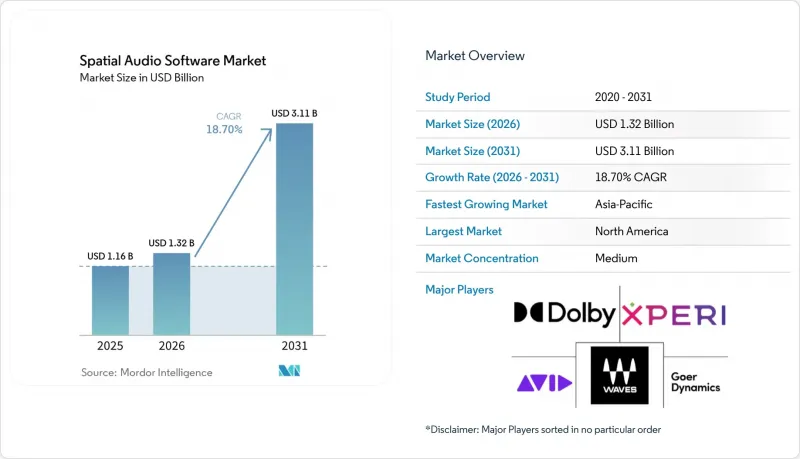
據 Mordor Intelligence 稱,2025 年空間音訊軟體市值為 11.6 億美元,預計從 2026 年的 13.2 億美元成長到 2031 年的 31.1 億美元,在 2026 年至 2031 年的預測期內,複合年成長率為 18.70%。
全球空間音訊軟體市場趨勢與洞察
擴展身臨其境型遊戲和XR內容
空間音訊不再只是可選功能,它已成為許多AAA級遊戲開發流程中的標準技術能力。隨著虛幻引擎5和Unity內建空間音訊功能,中間件供應商正專注於聲學建模和進階創作功能。這種轉變使得當引擎級功能無法滿足精細的聲學需求時,對專用工具的需求日益成長。支援頭部追蹤的雙耳渲染對於保持虛擬環境中的空間一致性仍然至關重要。對圖神經網路場(GNF)方法的研究持續致力於在這些環境中實現HRTF的個人化。中介軟體供應商傾向於使其產品與遊戲引擎的發布週期保持一致,從而將空間編寫工具緊密整合到開發流程中。
串流媒體平台要求交貨空間音訊。
平台要求使得空間音訊傳輸成為唱片公司、錄音室和獨立創作者的必備製作要素。 Apple Music 要求 Dolby Atmos 音訊必須源自原始多聲道音頻,而非立體聲混音。在 2025 年 WWDC 大會上,Apple 推出了 Apple Spatial Audio Format,並強制要求 Apple Immersive Video 僅限亞太地區使用。這些要求意味著,僅靠 Dolby Atmos 工作流程可能不足以滿足 Apple 的原生輸出需求。因此,錄音室可能被迫維護多套工具鏈,從而產生持續的升級成本。 2026 年 6 月,Peacock 在 2026 年 FIFA 世界盃轉播中採用了 Dolby AC-4,將身臨其境型體驗擴展到了體育賽事直播領域。
碎片化的物件式和基於場景的音訊標準
杜比全景聲 (Dolby Atmos)、MPEG-H 3D 音訊、蘋果空間音訊格式 (Apple Spatial Audio Format)、AURO-3D 和 DTS:X 都要求內容製作團隊支援多個發行管道。與單一通用製作格式相比,這增加了編碼和檢驗的成本。雖然 SMPTE 2110-41 標準在廣播流程中支援杜比 AC-4 和 MPEG-H元資料,但不同格式的裝置支援並不一致。三星和 LG 最近決定放棄 DTS:X,顯示設備支援情況變化迅速。為了滿足客戶需求,工作室可能需要並行維護多個數位音訊工作站、插件和轉換系統。因此,儘管需求不斷成長,空間音訊軟體市場也伴隨著額外的許可和工程成本。
細分市場分析
到2025年,軟體將佔組件部分的75.80%。這反映了插件、中間件和渲染引擎在空間音訊製作中的核心作用。所有工作流程都始於軟體許可,之後才需要相關的硬體或專家支援。因此,空間音訊軟體組件市場的規模得益於其在生產鏈中穩固的切入點。預計到2031年,服務業將以19.14%的複合年成長率成長。除了軟體採購之外,整合、校準和工作流程設計的重要性也日益凸顯。
對這些服務的需求源於多格式分發以及與數位音訊工作站 (DAW) 的整合。即使是經驗豐富的製作團隊也可能需要格式轉換和系統配置的協助。此外,當工作室將本地製作環境與雲端存取整合時,服務營運的價值也會提升。SONY AI) 和 Audiokinetic 已將人工智慧驅動的「相似聲音搜尋」功能引入 Wwise,為專業創作環境帶來工作流程功能。這一趨勢表明,持續性服務可以與許可收入並存。因此,空間音訊軟體產業可以提供軟體和專業知識的打包服務,而不僅僅依賴永久軟體銷售。
到2025年,空間音訊渲染軟體將佔產品類型總收入的35.40%。它是遊戲、廣播和其他身臨其境型工作流程中製作流程的核心組件。預計到2031年,雙耳和HRTF插件的複合年成長率將達到19.42%。以耳機為基礎的音訊傳輸方式使得內容無需專用揚聲器系統即可觸及使用者。這降低了創作者在常用播放設備上實現空間音訊輸出的實際門檻。當創作者無需安裝專用硬體即可提供沉浸式音效時,空間音訊軟體市場將從中受益。
對神經場HRTF的研究可望透過支援個人化播放,進一步拓展這些插件的功能。雙耳工具在遠端聆聽、虛擬實境和消費者串流媒體領域尤其重要。 Ambisonics製作外掛程式在虛擬實境內容和實況活動工作流程中持續被應用。物件式的混音和編寫工具對於交付杜比全景聲、MPEG-H和蘋果空間音訊格式仍然至關重要。其他產品包括人工智慧輔助工具和轉換功能,這些功能不屬於現有類別。供應商必須在廣泛的格式支援和對製作團隊友好的工具之間取得平衡。
區域分析
預計到2025年,北美將佔全球銷售額的38.42%。該地區匯聚了許多主流平台營運商、遊戲工作室和空間音訊供應商。北美科技公司提出的需求可能會對全球內容創作者產生影響。蘋果公司針對亞太地區提出的身臨其境型視訊要求是當前週期內關鍵的平台決策。 ATSC 3.0包含了杜比AC-4和MPEG-H等新一代音訊框架,這給美國廣播機構的空間音訊軟體市場帶來了合規性方面的需求。
預計到2031年,亞太地區將以19.64%的複合年成長率成長。中國、韓國和日本透過不同的需求模式為市場做出貢獻。 2026年3月,QQ音樂成為第一個引進最新杜比AC-4增強功能的主流音樂平台。在韓國,TTA標準強制要求下一代電視採用MPEG-H音訊。在日本,遊戲硬體、與汽車產業的合作以及家用電子電器的需求支撐著市場。弗勞恩霍夫IDMT研究所的「Audiofields」技術於2026年2月開始在梅賽德斯-賓士汽車上進行量產。
由於弗勞恩霍夫協會對MPEG-H標準開發的貢獻,歐洲在空間音訊軟體市場中佔據著舉足輕重的地位。德國和波蘭的專業供應商也為該地區的生產基地提供支援。歐洲廣播聯盟(EBU)的「音訊定義模型」支援基於聲道、物件式和基於場景的音訊工作流程。杜比和奧迪於2025年7月完成了杜比全景聲在部分奧迪車型的整合。南美洲、中東和非洲雖然規模仍然較小,但這些新興市場正在快速成長。巴西的SBTVD TV 3.0標準包含了MPEG-H音頻,而對OTT和行動優先內容的投資預計將在未來推動市場需求。
其他好處:
- Excel格式的市場預測(ME)表
- 3個月的分析師支持
目錄
第1章:引言
- 研究假設和市場定義
- 調查範圍
第2章:調查方法
第3章執行摘要
第4章 市場狀況
- 市場概覽
- 市場促進因素
- 擴展身臨其境型遊戲和XR內容
- 串流媒體平台要求交貨空間音訊。
- AI驅動的即時渲染和HRTF個性化
- 基於雲端的生產和遠端協作
- 空間音訊領域高階設備的標準化
- 身臨其境型音訊在汽車和企業領域的應用
- 市場限制因素
- 碎片化的物件式和基於場景的音訊標準
- 認證沉浸式音訊房間高成本
- 空間音訊領域工程師短缺
- 平台對把關和格式轉換的依賴
- 宏觀經濟因素對市場的影響
- 產業價值鏈分析
- 監理情勢
- 技術展望
- 波特五力分析
第5章 市場規模與成長預測
- 按組件
- 軟體
- 服務
- 依產品類型
- 空間音訊渲染軟體
- 雙耳和HRTF插件
- Ambisonics 生產插件
- 物件式的混合和編寫工具
- 其他產品類型
- 部署模式
- 現場
- 基於雲端的
- 透過使用
- 遊戲
- 音樂製作與串流媒體
- 電影、電視、後製
- 虛擬實境(VR)與擴增實境(AR)
- 實況活動及直播
- 車
- 企業協作與培訓
- 最終用戶
- 工作室和後製公司
- 遊戲開發商和發行商
- 串流媒體與媒體平台
- 企業和教育機構
- 個人專家
- 按地區
- 北美洲
- 美國
- 加拿大
- 墨西哥
- 南美洲
- 巴西
- 阿根廷
- 其他南美國家
- 歐洲
- 德國
- 英國
- 法國
- 俄羅斯
- 其他歐洲國家
- 亞太地區
- 中國
- 日本
- 韓國
- 印度
- 東南亞
- 大洋洲
- 其他亞太國家
- 中東
- 阿拉伯聯合大公國
- 沙烏地阿拉伯
- 土耳其
- 其他中東國家
- 非洲
- 南非
- 奈及利亞
- 其他非洲國家
- 北美洲
第6章 競爭情勢
- 市場集中度
- 策略趨勢
- 市佔率分析
- 公司簡介
- Dolby Laboratories, Inc.
- Xperi Holding Corporation
- Goerdyna Group
- Waves Audio Ltd.
- Dear Reality GmbH
- Avid Technology, Inc.
- Fraunhofer-Gesellschaft zur Forderung der angewandten Forschung e. V.
- Blue Ripple Sound Limited
- Sound Particles, Lda.
- Audiokinetic Inc.
- Firelight Technologies Pty Ltd
- VisiSonics Corporation
- Spatial Inc.
- G'Audio Lab, Inc.
- Mach1, Inc.
- Envelop VR, Inc.
- APL-HUD GmbH
- atmoky GmbH
- Ceva, Inc.
- Brandenburg Labs GmbH
- New Audio Technology GmbH
- Wave Arts, Inc.
- SoundField Limited
- Zylia Sp. z oo
第7章 市場機會與未來展望
According to Mordor Intelligence, the spatial audio software market size was valued at USD 1.16 billion in 2025 and is estimated to expand from USD 1.32 billion in 2026 to USD 3.11 billion by 2031, at a CAGR of 18.70% during the forecast period 2026-2031.
Global Spatial Audio Software Market Trends and Insights
Immersive Gaming and XR Content Expansion
Spatial sound has become a standard technical capability in many AAA game development workflows, rather than an optional feature. Unreal Engine 5 and Unity include spatial audio capabilities, which shifts middleware providers toward acoustic modeling and advanced authoring functions. This change increases demand for specialized tools when engine-level functions cannot resolve detailed acoustic requirements. Head-tracked binaural rendering remains necessary to maintain spatial coherence in virtual environments. Research on graph neural field approaches shows continued work on HRTF personalization for these settings. Middleware providers continue to align their products with game-engine release cycles, which keeps spatial authoring tools closely tied to development workflows.
Streaming Platforms Mandating Spatial-Audio Deliverables
Platform requirements are making spatial delivery a production requirement for labels, studios, and independent creators. Apple Music requires Dolby Atmos submissions to come from genuine multichannel sessions rather than stereo upmixes. Apple introduced the Apple Spatial Audio Format and mandated APAC for Apple Immersive Video at WWDC 2025. These requirements can make a Dolby Atmos workflow insufficient for Apple-native output. Studios may therefore maintain more than 1 toolchain and incur repeated upgrade costs. In June 2026, Peacock used Dolby AC-4 for its FIFA World Cup 2026 coverage, extending immersive delivery into live sports.
Fragmented Object-Based and Scene-Based Audio Standards
Dolby Atmos, MPEG-H 3D Audio, Apple Spatial Audio Format, AURO-3D, and DTS:X require content teams to address multiple delivery paths. This raises the cost of encoding and validation compared with a single common production format. SMPTE 2110-41 supports Dolby AC-4 and MPEG-H metadata in broadcast pipelines, but device support is not consistent across formats. Recent television decisions by Samsung and LG to move away from DTS:X show that device support can change quickly. Studios may retain parallel digital audio workstations, plugins, and conversion systems to meet customer needs. The Spatial audio software market consequently carries extra licensing and engineering costs even as demand expands.
Other drivers and restraints analyzed in the detailed report include:
- AI-Assisted Real-Time Rendering and HRTF Personalization
- Cloud-Based Production and Remote Collaboration
- High Cost of Certified Immersive-Audio Rooms
For complete list of drivers and restraints, kindly check the Table Of Contents.
Segment Analysis
Software held 75.80% of the component segment in 2025. This position reflects the central role of plugins, middleware, and rendering engines in spatial production. Every workflow begins with a software license before it requires associated hardware or professional support. The Spatial audio software market size for the software component therefore rests on a durable entry point in the production chain. Services are projected to expand at a 19.14% CAGR through 2031. Integration, calibration, and workflow design are becoming more important alongside software purchases.
The need for services comes from multiformat delivery and digital audio workstation integration. Even experienced production teams may need help with format conversion and system configuration. Service work also becomes more valuable when a studio connects on-premises production with cloud access. Sony AI and Audiokinetic introduced an AI-powered Similar Sound Search capability in Wwise, bringing a workflow function into a professional authoring environment. This direction shows how recurring services can sit beside license revenue. The spatial audio software industry can therefore support software and expertise together rather than relying solely on perpetual software sales.
Spatial audio rendering software held 35.40% of product-type revenue in 2025. It serves as the processing core for production pipelines in gaming, broadcast, and other immersive workflows. Binaural and HRTF plugins are projected to expand at a 19.42% CAGR through 2031. Headphone delivery can reach consumers without requiring dedicated speaker systems. This lowers the practical barrier for creators that want spatial output on common listening devices. The Spatial audio software market benefits when producers can deliver immersive sound without a specialized hardware installation.
Neural-field HRTF research may widen the role of these plugins by supporting individualized playback. Binaural tools are particularly relevant for remote listening, virtual reality, and consumer streaming. Ambisonics production plugins continue to serve virtual reality content and live-event workflows. Object-based mixing and authoring tools remain necessary for Dolby Atmos, MPEG-H, and Apple Spatial Audio Format delivery. Other products include AI-assisted tools and conversion functions that do not fit established categories. Product vendors must balance broad format coverage with tools that remain straightforward for production teams.
Complete Report Scope:
- By Component
- Software
- Services
- By Product Type
- Spatial Audio Rendering Software
- Binaural and HRTF Plugins
- Ambisonics Production Plugins
- Object-Based Mixing and Authoring Tools
- Other Product Types
- By Deployment Mode
- On-Premises
- Cloud-Based
- By Application
- Gaming
- Music Production and Streaming
- Film, Television, and Postproduction
- Virtual Reality and Augmented Reality
- Live Events and Broadcast
- Automotive
- Enterprise Collaboration and Training
- By End User
- Studios and Postproduction Houses
- Game Developers and Publishers
- Streaming and Media Platforms
- Enterprises and Educational Institutions
- Individual Professionals
- By Geography
- North America
- United States
- Canada
- Mexico
- South America
- Brazil
- Argentina
- Rest of South America
- Europe
- Germany
- United Kingdom
- France
- Russia
- Rest of Europe
- Asia-Pacific
- China
- Japan
- South Korea
- India
- Southeast Asia
- Oceania
- Rest of Asia-Pacific
- Middle East
- United Arab Emirates
- Saudi Arabia
- Turkey
- Rest of Middle East
- Africa
- South Africa
- Nigeria
- Rest of Africa
- North America
Geography Analysis
North America held 38.42% of revenue in 2025. The region brings together major platform operators, game studios, and spatial-audio vendors. Requirements issued by North American technology companies can affect content producers worldwide. Apple's APAC requirement for Immersive Video was a significant platform decision in the current cycle. ATSC 3.0 includes next-generation audio frameworks such as Dolby AC-4 and MPEG-H. This creates a compliance-related need for the Spatial audio software market in U.S. broadcast facilities.
Asia-Pacific is projected to expand at a 19.64% CAGR through 2031. China, South Korea, and Japan each contribute through different demand patterns. In March 2026, QQ Music became the first major music platform to deploy the latest Dolby AC-4 enhancements. South Korea's TTA standard requires MPEG-H Audio for next-generation television. Japan supports demand through gaming hardware, automotive relationships, and consumer electronics. Fraunhofer IDMT's Audiofields entered series production in Mercedes-Benz vehicles in February 2026.
Europe has a significant position in the Spatial audio software market because Fraunhofer-Gesellschaft contributes to MPEG-H standards development. Specialist suppliers in Germany and Poland also support the regional production base. The European Broadcasting Union's Audio Definition Model supports channel-based, object-based, and scene-based audio workflows. Dolby and Audi completed Dolby Atmos integration for selected Audi models in July 2025. South America, the Middle East, and Africa remain smaller but emerging markets. Brazil's SBTVD TV 3.0 standard includes MPEG-H Audio, while OTT investment and mobile-first content may add demand over time.
- Dolby Laboratories, Inc.
- Xperi Holding Corporation
- Goerdyna Group
- Waves Audio Ltd.
- Dear Reality GmbH
- Avid Technology, Inc.
- Fraunhofer-Gesellschaft zur Forderung der angewandten Forschung e. V.
- Blue Ripple Sound Limited
- Sound Particles, Lda.
- Audiokinetic Inc.
- Firelight Technologies Pty Ltd
- VisiSonics Corporation
- Spatial Inc.
- G'Audio Lab, Inc.
- Mach1, Inc.
- Envelop VR, Inc.
- APL-HUD GmbH
- atmoky GmbH
- Ceva, Inc.
- Brandenburg Labs GmbH
- New Audio Technology GmbH
- Wave Arts, Inc.
- SoundField Limited
- Zylia Sp. z o.o.
Additional Benefits:
- The market estimate (ME) sheet in Excel format
- 3 months of analyst support
TABLE OF CONTENTS
1 INTRODUCTION
- 1.1 Study Assumptions and Market Definition
- 1.2 Scope of the Study
2 RESEARCH METHODOLOGY
3 EXECUTIVE SUMMARY
4 MARKET LANDSCAPE
- 4.1 Market Overview
- 4.2 Market Drivers
- 4.2.1 Immersive Gaming and XR Content Expansion
- 4.2.2 Streaming Platforms Mandating Spatial-Audio Deliverables
- 4.2.3 AI-Assisted Real-Time Rendering and HRTF Personalization
- 4.2.4 Cloud-Based Production and Remote Collaboration
- 4.2.5 Premium Device Standardization of Spatial Audio
- 4.2.6 Automotive and Enterprise Immersive-Audio Integration
- 4.3 Market Restraints
- 4.3.1 Fragmented Object-Based and Scene-Based Audio Standards
- 4.3.2 High Cost of Certified Immersive-Audio Rooms
- 4.3.3 Shortage of Spatial-Audio Engineering Talent
- 4.3.4 Platform Gatekeeping and Format-Conversion Dependency
- 4.4 Impact of Macroeconomic Factors on the Market
- 4.5 Industry Value Chain Analysis
- 4.6 Regulatory Landscape
- 4.7 Technological Outlook
- 4.8 Porter's Five Forces Analysis
- 4.8.1 Bargaining Power of Suppliers
- 4.8.2 Bargaining Power of Buyers
- 4.8.3 Threat of New Entrants
- 4.8.4 Threat of Substitutes
- 4.8.5 Competitive Rivalry
5 MARKET SIZE AND GROWTH FORECASTS (VALUE)
- 5.1 By Component
- 5.1.1 Software
- 5.1.2 Services
- 5.2 By Product Type
- 5.2.1 Spatial Audio Rendering Software
- 5.2.2 Binaural and HRTF Plugins
- 5.2.3 Ambisonics Production Plugins
- 5.2.4 Object-Based Mixing and Authoring Tools
- 5.2.5 Other Product Types
- 5.3 By Deployment Mode
- 5.3.1 On-Premises
- 5.3.2 Cloud-Based
- 5.4 By Application
- 5.4.1 Gaming
- 5.4.2 Music Production and Streaming
- 5.4.3 Film, Television, and Postproduction
- 5.4.4 Virtual Reality and Augmented Reality
- 5.4.5 Live Events and Broadcast
- 5.4.6 Automotive
- 5.4.7 Enterprise Collaboration and Training
- 5.5 By End User
- 5.5.1 Studios and Postproduction Houses
- 5.5.2 Game Developers and Publishers
- 5.5.3 Streaming and Media Platforms
- 5.5.4 Enterprises and Educational Institutions
- 5.5.5 Individual Professionals
- 5.6 By Geography
- 5.6.1 North America
- 5.6.1.1 United States
- 5.6.1.2 Canada
- 5.6.1.3 Mexico
- 5.6.2 South America
- 5.6.2.1 Brazil
- 5.6.2.2 Argentina
- 5.6.2.3 Rest of South America
- 5.6.3 Europe
- 5.6.3.1 Germany
- 5.6.3.2 United Kingdom
- 5.6.3.3 France
- 5.6.3.4 Russia
- 5.6.3.5 Rest of Europe
- 5.6.4 Asia-Pacific
- 5.6.4.1 China
- 5.6.4.2 Japan
- 5.6.4.3 South Korea
- 5.6.4.4 India
- 5.6.4.5 Southeast Asia
- 5.6.4.6 Oceania
- 5.6.4.7 Rest of Asia-Pacific
- 5.6.5 Middle East
- 5.6.5.1 United Arab Emirates
- 5.6.5.2 Saudi Arabia
- 5.6.5.3 Turkey
- 5.6.5.4 Rest of Middle East
- 5.6.6 Africa
- 5.6.6.1 South Africa
- 5.6.6.2 Nigeria
- 5.6.6.3 Rest of Africa
- 5.6.1 North America
6 COMPETITIVE LANDSCAPE
- 6.1 Market Concentration
- 6.2 Strategic Moves
- 6.3 Market Share Analysis
- 6.4 Company Profiles (includes Global Level Overview, Market Level Overview, Core Segments, Financials as available, Strategic Information, Market Rank/Share, Products and Services, Recent Developments)
- 6.4.1 Dolby Laboratories, Inc.
- 6.4.2 Xperi Holding Corporation
- 6.4.3 Goerdyna Group
- 6.4.4 Waves Audio Ltd.
- 6.4.5 Dear Reality GmbH
- 6.4.6 Avid Technology, Inc.
- 6.4.7 Fraunhofer-Gesellschaft zur Forderung der angewandten Forschung e. V.
- 6.4.8 Blue Ripple Sound Limited
- 6.4.9 Sound Particles, Lda.
- 6.4.10 Audiokinetic Inc.
- 6.4.11 Firelight Technologies Pty Ltd
- 6.4.12 VisiSonics Corporation
- 6.4.13 Spatial Inc.
- 6.4.14 G'Audio Lab, Inc.
- 6.4.15 Mach1, Inc.
- 6.4.16 Envelop VR, Inc.
- 6.4.17 APL-HUD GmbH
- 6.4.18 atmoky GmbH
- 6.4.19 Ceva, Inc.
- 6.4.20 Brandenburg Labs GmbH
- 6.4.21 New Audio Technology GmbH
- 6.4.22 Wave Arts, Inc.
- 6.4.23 SoundField Limited
- 6.4.24 Zylia Sp. z o.o.
7 MARKET OPPORTUNITIES AND FUTURE OUTLOOK
- 7.1 White-Space and Unmet-Need Assessment

 全球身臨其境型虛擬實境市場規模、佔有率、趨勢和成長分析報告(2026-2034)
 身臨其境型虛擬實境:市場佔有率分析、產業趨勢與統計、成長預測(2026-2031)
 自我調整虛擬實境(VR)環境市場:按組件、技術、應用、設備類型、國家和地區分類—全球產業分析、市場規模、市場佔有率和預測(2026-2033 年)
 身臨其境型語言訓練市場預測至2034年-全球分析(按組件、設備類型、技術、應用、最終用戶和地區分類)
 2026年全球延展實境(XR)虛擬工作室市場報告2026年全球國防沉浸式現實市場報告2026年全球智慧虛擬商店設計解決方案市場報告2026年全球沉浸式虛擬實境市場報告2026年身臨其境型時尚全球市場報告
 XR虛擬演播室系統市場按元件、類型、部署方式、應用程式和最終用戶分類 - 全球預測(2026-2032年)