


 |
市場調查報告書
商品編碼
2154347
磷酸錳酸鋰(LMFP)電池:市場佔有率分析、產業趨勢與統計、成長預測(2026-2031)Lithium Manganese Iron Phosphate (LMFP) Battery - Market Share Analysis, Industry Trends & Statistics, Growth Forecasts (2026 - 2031) |
||||||

※ 本網頁內容可能與最新版本有所差異。詳細情況請與我們聯繫。
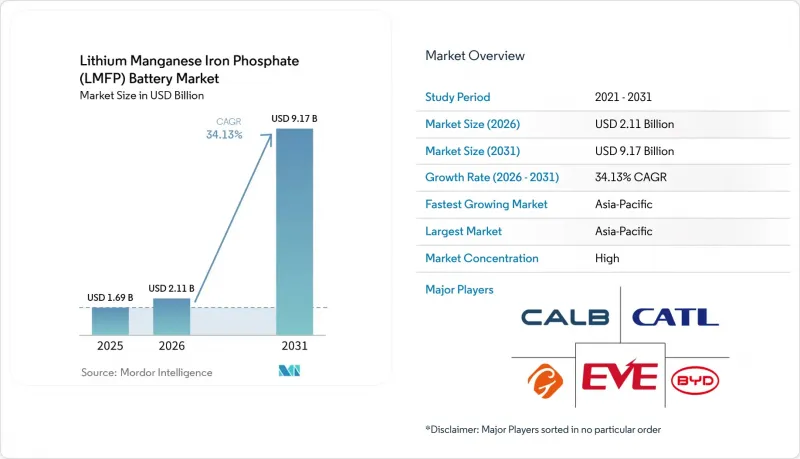
根據 Mordor Intelligence 預測,磷酸鐵鋰電池市場規模預計到 2025 年將達到 16.9 億美元,到 2026 年將達到 21.1 億美元,到 2031 年將達到 91.7 億美元。
預計 2026 年至 2031 年的複合年成長率將達到 34.13%。
全球磷酸錳酸鋰(LMFP)電池市場趨勢及洞察
適用於中續航里程電動車的低成本電池組
液態金屬磷酸鐵鋰電池(LMFP)市場的發展動力源自於汽車製造商尋求更長續航里程,但又不想完全轉向鎳鈷電池系統。 LMFP 的能量密度比標準磷酸鐵鋰電池(LFP)高出 15% 至 25%,而每瓦時的成本溢價不到 5%。根據 IONETIC 預測,到 2026 年,電池組級 LMFP 系統的能量密度預計將達到 186 Wh/kg。這項性能使得中階車型的研發項目能夠在續航里程、安全性和成本之間取得平衡。此外,LMFP 還透過減少對鈷的依賴,降低了製造商的供應鏈風險。因此,LMFP 電池市場正在為主流汽車平臺開闢一條道路,而價格優勢仍然是這些平台的關鍵考慮因素。
汽車製造商可以利用這種更高的能量密度來減少電芯數量並縮小電池機殼。這可以透過減少電池組組裝要求來部分抵消增加的電芯成本。此外,這種化學成分保持了磷酸鐵鋰電池固有的熱穩定性,這對於優先考慮電池安全性的製造商、保險公司和監管機構至關重要。現有鐵基化學成分平台的認證縮短了從電芯測試到車輛實用化的時間。這些因素將鼓勵已經了解磷酸鋰鐵電池製造和系統設計的原始設備製造商(OEM)更廣泛地採用這種技術。
無需使用鎳或鈷即可提高電動車的續航里程
透過錳的替代,LMFP電池的標稱電壓從3.6V提高到3.8V,而LFP電池的標稱電壓為3.2V。更高的電壓使得LMFP電池能夠在維持磷酸鹽骨架結構的同時,縮小與低等級NMC電池的能量密度差距。當汽車製造商尋求在不向正極添加鎳或鈷的情況下提升電池性能時,LMFP電池市場將從中受益。對LMFP材料的研究也表明,鐵和錳不同的氧化還原平台是影響此化學成分性能的關鍵因素。這種工作特性為開發人員在設定續航里程、安全性和成本目標時提供了新的選擇。此外,LMFP電池也適用於無需改變電池組裝即可加工的混合正極材料。
這種性能提升的意義遠不止於電池規格。更小更輕的電池組設計為汽車製造商提供了更大的封裝和平台設計柔軟性。這些優勢可望降低高成本電池帶來的組裝負擔。因此,LMFP電池可以滿足那些NMC電池成本和材料風險不可接受,或需要比標準LFP電池更高能量密度的應用需求。 LMFP電池市場也受惠於陰極成分和電解設計的持續研發。隨著製造商不斷追求商用電池可靠的高壓運行,這項研發工作將繼續發揮重要作用。
錳相關循環壽命和溶解風險
錳浸出仍是液態金屬磷酸鋰電池市場的技術難題。電化學學會針對老化後的液態金屬磷酸鐵鋰電池和石墨軟包電池進行的研究表明,負極表面的錳濃度與上限截止電壓密切相關。錳的遷移會導致固體電解質界面增厚,可能減少循環過程中可用的鋰量。這些影響可能導致電池可用容量隨時間推移而下降。鑑於目前現場檢驗和保固記錄有限,對於需要長壽命電池的買家而言,這個問題尤其重要。製造商必須證明實驗室研發成果能夠在市售電池和電池組中穩定發揮。
電解的研發是解決此限制的途徑之一。對LMFP和石墨軟包電池的研究表明,LiFSI和LiTFSI鹽與LiDFOB共鹽的混合物可以抑制錳的溶解,而雙添加劑系統在首圈循環中實現了89.3%的庫侖效率。此外,分析表明,含有雙添加劑的碳酸酯混合物在600次循環後仍能保持85%以上的容量。這些結果表明,電解-正極界面設計對於商業性差異化至關重要。擁有材料研發和智慧財產權優勢的現有供應商可以利用專有電解配方。 LMFP電池市場需要可靠的充電控制和電池管理系統,這些系統必須能夠適應其雙電壓特性。
細分市場分析
截至2025年,液態金屬磷酸鐵鋰電池(LMFP)將佔整個LMFP電池市場的68.3%,這反映了其商業性認證的進展階段。目的地設備製造商(OEM)和儲能系統開發商通常會在將電芯全面整合到電池組之前對其進行測試和認證。因此,電芯出貨時間可能比電池組出貨時間領先18至24個月。隨著更多電芯專案完成檢驗,預計2026年至2031年間,LMFP電池組的複合年成長率將達到34.5%。隨著汽車、電網和工業領域的客戶從樣品測試轉向系統部署,LMFP電池組市場預計將持續成長。商用電動車(BEV)市場尤其重要,因為模組化電池組設計允許採用LMFP電芯而無需徹底重新設計平台。
華銳電子武漢四期生產基地目前正在進行試運行,設計年產能為40萬套電池組。預計2026年投產。該產能將滿足電芯認證後所需的電池組供應。國騰高科的啟辰二代電芯壓縮密度達到2.58 g/cm³,因而降低了電池組的體積需求。研究持續表明,電子導電性和雙電壓運行是整合方面的挑戰。摻雜技術,包括高熵晶格改性,正被考慮用於提升倍率性能。電池組製造商需要將這些電芯性能的提升與電池管理系統(BMS)的校準、熱設計和品質保證相結合。隨著電池組供應商將其化學技術能力轉化為可靠的系統解決方案,液態金屬磷酸鐵鋰電池(LMFP)產業將從這項變革中受益。
區域分析
預計到2025年,亞太地區將佔全球液態金屬磷酸鐵鋰電池(LMFP)市場的61.4%,並在2031年之前以35.9%的複合年成長率成長。中國從正極材料到成品電池的完整供應鏈是該地區市場地位的基石。國際能源總署(IEA)的報告顯示,中國生產了全球98%以上的磷酸鐵鋰(LFP)和液態金屬磷酸鐵鋰電池(LMFP)正極材料,並佔據了全球95%的高純度硫酸錳精煉產能。隨著電動車和儲能需求的成長,印度、越南和印尼預計將出現更大的需求潛力。印度的先進化學電池生產關聯獎勵計畫(ACCP)旨在支持電池製造領域的投資,並契合了對無鈷化學成分的需求。
根據分析,北美和歐洲主要依賴進口LMFP電池,正極材料的產量有限。這些地區的角色正日益受到政策支持的影響,這些政策旨在促進本地電池供應。美國的生產補貼和針對「外國關注企業(FEOC)」的法規正在推動國內LFP和LMFP的生產,儘管硫酸錳的供應仍然緊張。分析顯示,歐洲尚無商業規模的LMFP生產。 2025-2027年歐洲18億歐元的電池支援計畫促進了對超級工廠的投資。儘管本地電池組生產可能會擴大歐洲LMFP電池市場的規模,但預計在預測期內,上游化學品的供應仍將依賴中國。
寧德時代(CATL)和Stellantis於2025年11月在西班牙菲格雷拉斯(Figuereuras)啟動了一座LFP和LMFP兼容電池工廠的建設,投資額達41億歐元,目標是在2026年底前開始投產。 CALB也於2026年1月簽署了一項20.7億歐元的投資協議,將在葡萄牙錫內斯(Cines)建造一座電池工廠。南美洲、中東和非洲仍處於發展初期,電網穩定性和分散式能源需求可能會在電動車需求全面實現之前支撐儲能需求。這些地區的LMFP電池市場依賴實用儲能設備的採購和企劃案融資。 2026年6月,比亞迪宣布將投資至多5億巴西幣(約9,000萬美元)在巴西建造電池工廠,這是巴西首個儲能競標框架的一部分。沙烏地阿拉伯、阿拉伯聯合大公國(阿拉伯聯合大公國)和南非也在努力提高其儲能和電池材料產能,但預計到 2031 年,這些地區的銷售額佔比將很小。
其他好處:
- Excel格式的市場預測(ME)表
- 3個月的分析師支持
目錄
第1章:引言
- 研究假設和市場定義
- 調查範圍
第2章:調查方法
第3章執行摘要
第4章 市場狀況
- 市場概覽
- 市場促進因素
- 適用於中檔電動車的低成本電池組
- 無需使用鎳或鈷即可提高電動車的續航里程。
- 電力網路和分散式儲能設施的採購
- 中國主導的製造業規模與製程轉移
- 政策驅動的電池供應鏈本地化
- 透過鐵基化學平台提高合格
- 市場限制因素
- 現場檢驗和保證證據有限。
- 錳相關循環壽命和溶解風險
- 高純度錳的強化加工
- 雙電壓電池管理系統與充電最佳化
- 供應鏈分析
- 波特五力分析
- 科技趨勢
- 監理情勢
- 投資分析
第5章 市場規模與成長預測
- 依電池類型
- LMFP細胞
- LMFP電池組
- 最終用戶
- 車
- 能源與電力
- 家用電子產品
- 產業
- 電訊
- 其他最終用戶
- 按地區
- 北美洲
- 美國
- 加拿大
- 墨西哥
- 歐洲
- 德國
- 法國
- 義大利
- 西班牙
- 英國
- 波蘭
- 俄羅斯
- 其他歐洲國家
- 亞太地區
- 中國
- 印度
- 日本
- 韓國
- 澳洲
- 印尼
- 越南
- 泰國
- 其他亞太國家
- 南美洲
- 巴西
- 阿根廷
- 智利
- 其他南美國家
- 中東和非洲
- 沙烏地阿拉伯
- 阿拉伯聯合大公國
- 埃及
- 南非
- 摩洛哥
- 其他中東和非洲國家
- 北美洲
第6章 競爭情勢
- 市場集中度
- 策略趨勢
- 市佔率分析
- 公司簡介
- BYD Company Limited/FinDreams Battery
- CALB Group Co., Ltd.
- CATL(Contemporary Amperex Technology Co., Ltd.)
- Dynanonic Co., Ltd.
- EVE Energy Co., Ltd.
- Gotion High-tech Co., Ltd.
- Great Power Energy & Technology Co., Ltd.
- Guangdong Tianneng Lithium Technology Co., Ltd.
- Hefei Guoxuan High-Tech Power Energy Co., Ltd.
- Hithium Energy Storage Technology
- Hunan Yuneng New Material Technology Co., Ltd.
- Integrals Power Limited
- Lishen Battery(Tianjin Lishen Battery Joint-Stock Co., Ltd.)
- REPT BATTERO Energy Co., Ltd.
- Sunwoda Electronic Co., Ltd.
- SVOLT Energy Technology Co., Ltd.
第7章 市場機會與未來展望
According to Mordor Intelligence, the lithium manganese iron phosphate battery market size is projected to be USD 1.69 billion in 2025, USD 2.11 billion in 2026, and reach USD 9.17 billion by 2031, at a CAGR of 34.13% from 2026 to 2031.
Global Lithium Manganese Iron Phosphate (LMFP) Battery Market Trends and Insights
Lower-Cost Mid-Range EV Packs
The LMFP battery market is supported by vehicle makers that need more range without moving fully to nickel- and cobalt-based battery systems. LMFP can provide 15% to 25% higher energy density than standard LFP, with a cost premium below 5% per watt-hour. IONETIC reported a pack-level LMFP system energy density of 186 Wh/kg in 2026. This performance can help mid-range vehicle programs balance range, safety, and cost. It also reduces dependence on cobalt, which can create supply-chain exposure for manufacturers. The LMFP battery market, therefore, has a route into mainstream vehicle platforms where affordability remains important.
Vehicle manufacturers can use the energy-density gain to reduce cell count or make smaller battery enclosures. That can offset part of the higher cell cost through lower pack-assembly requirements. The chemistry also retains the thermal stability associated with phosphate cathodes. This matters for manufacturers, insurers, and regulators that place value on predictable battery safety behavior. Qualification of existing iron-based chemistry platforms can shorten the path from cell testing to vehicle use. These factors support wider adoption by original equipment manufacturers that already understand LFP manufacturing and system design.
EV Range Improvement Without Nickel and Cobalt
Manganese substitution raises the nominal LMFP cell voltage to 3.6 V to 3.8 V, compared with 3.2 V for LFP. The higher voltage helps LMFP narrow the energy-density gap with lower-tier NMC cells while retaining the phosphate framework. The LMFP battery market can benefit where vehicle makers want this improvement without adding nickel or cobalt to the cathode. Research on LMFP materials has also identified the different iron and manganese redox plateaus as an important part of the chemistry's performance profile. This operating profile gives developers another option when setting range, safety, and cost targets. It also makes LMFP relevant to blended-cathode approaches that can be processed without changing cell assembly lines.
The performance gain has operational importance beyond the cell specification. Smaller or lighter pack designs can give vehicle makers greater flexibility in packaging and platform design. These choices may reduce the assembly burden that follows a higher-priced cell. LMFP can therefore serve programs that cannot accept the cost or materials exposure of NMC, but require more energy density than standard LFP. The LMFP battery market also gains from continued work on cathode composition and electrolyte design. This development work is likely to remain important as manufacturers pursue reliable high-voltage operation in commercial cells.
Manganese-Driven Cycle-Life and Dissolution Risk
Manganese dissolution remains a technical restraint for the LMFP battery market. An Electrochemical Society discussion on aged LMFP and graphite pouch cells reported that manganese concentration on anode surfaces depends strongly on the upper cutoff voltage. Manganese movement can thicken the solid electrolyte interphase and reduce available lithium during cycling. These effects can reduce usable capacity over time. Limited field validation and warranty evidence make this issue especially important for buyers with long service-life requirements. Producers must show that laboratory advances can perform consistently in commercial cells and packs.
Electrolyte development offers a possible way to manage this limitation. Research on LMFP and graphite pouch cells found that LiFSI and LiTFSI salt blends with LiDFOB co-salts could reduce manganese dissolution, while dual-additive systems recorded first-cycle coulombic efficiency of 89.3%. The supplied analysis also cited capacity retention above 85% after 600 cycles for dual-additive carbonate blends. These results show why electrolyte-cathode interphase design is an important commercial differentiator. Proprietary electrolyte formulations can favor established suppliers with stronger materials research and intellectual-property positions. The LMFP battery market will require reliable charging controls and battery-management systems that account for its dual-voltage behavior.
Other drivers and restraints analyzed in the detailed report include:
- Grid and Distributed Energy Storage Procurement
- China-Led Manufacturing Scale and Process Transfer
- Concentrated High-Purity Manganese Processing
For complete list of drivers and restraints, kindly check the Table Of Contents.
Segment Analysis
LMFP Cells held 68.3% of the overall LMFP category in 2025, reflecting the stage of commercial qualification. Original equipment manufacturers and storage developers generally test and approve cells before they commit to complete pack integration. Cell volumes can therefore precede pack volumes by 18 to 24 months. LMFP Battery Packs are projected to record a 34.5% CAGR from 2026 to 2031 as more cell programs complete validation. The LMFP battery market size for packs should benefit as automotive, grid, and industrial customers move from sample testing to system deployment. Battery-electric commercial vehicles are particularly relevant because modular pack designs can accept LMFP cells without a full platform redesign.
CALB's Phase IV Wuhan production base was under equipment commissioning and was designed to produce 400,000 battery-pack units per year, with production expected within 2026. That capacity can support the pack-level supply needed after cell qualification. Gotion High-Tech's Qichen Gen 2 cell demonstrated a compaction density of 2.58 g/cm3, which can reduce pack volume requirements. Research has continued to identify electronic conductivity and dual-voltage operation as integration challenges. Doping approaches, including high-entropy lattice modifications, are being explored to improve rate performance. Pack producers will need to combine these cell improvements with BMS calibration, thermal design, and warranty evidence. The LMFP battery industry can gain from this shift when pack suppliers convert chemistry capability into a reliable system offering.
Complete Report Scope:
- By Battery Type
- LMFP Cells
- LMFP Battery Packs
- By End User
- Automotive
- Energy & Power
- Consumer Electronics
- Industrial
- Telecommunications
- Other End Users
- By Geography
- North America
- United States
- Canada
- Mexico
- Europe
- Germany
- France
- Italy
- Spain
- United Kingdom
- Poland
- Russia
- Rest of Europe
- Asia-Pacific
- China
- India
- Japan
- South Korea
- Australia
- Indonesia
- Vietnam
- Thailand
- Rest of Asia-Pacific
- South America
- Brazil
- Argentina
- Chile
- Rest of South America
- Middle East and Africa
- Saudi Arabia
- United Arab Emirates
- Egypt
- South Africa
- Morocco
- Rest of Middle East and Africa
- North America
Geography Analysis
Asia-Pacific held 61.4% of the overall LMFP category in 2025 and is forecast to grow at a 35.9% CAGR through 2031. China's integrated chain from cathode materials to finished cells underpins the region's position. The International Energy Agency reported that China produced more than 98% of global LFP and LMFP cathode material in the cited analysis and accounted for 95% of high-purity manganese sulfate refining capacity. India, Vietnam, and Indonesia provide additional demand potential as their electric-vehicle and storage needs develop. India's Advanced Chemistry Cell Production Linked Incentive program supports investment in battery manufacturing and aligns with interest in cobalt-free chemistries.
North America and Europe were largely LMFP cell import markets and had limited cathode manufacturing in the supplied analysis. Their role is increasingly shaped by policy support for local battery supply. U.S. production credits and foreign-entity-of-concern rules encourage domestic LFP and LMFP production, although manganese sulfate supply remains constrained. Europe did not manufacture LMFP at a commercial scale in the supplied analysis. The EUR 1.8 billion European battery package for 2025 to 2027 supported gigafactory investment. The LMFP battery market size in Europe can gain from local pack production, but upstream chemistry is likely to remain linked to China during the forecast period.
CATL and Stellantis started construction of a EUR 4.1 billion LFP and LMFP-capable cell plant in Figueruelas, Spain, in November 2025, with initial output targeted by the end of 2026. CALB also signed a EUR 2.07 billion investment agreement for a Sines battery plant in Portugal in January 2026. South America, the Middle East, and Africa remain earlier-stage markets where grid stability and distributed power needs can support storage before mass electric-vehicle demand develops. The LMFP battery market in these regions depends on practical storage procurement and project financing. BYD announced up to BRL 500 million, equivalent to USD 90 million, for battery production in Brazil in June 2026, connected to the country's first energy-storage auction framework. Saudi Arabia, the UAE, and South Africa are also pursuing storage and battery-material capabilities, although these areas are expected to represent a smaller share of revenue through 2031.
- BYD Company Limited / FinDreams Battery
- CALB Group Co., Ltd.
- CATL (Contemporary Amperex Technology Co., Ltd.)
- Dynanonic Co., Ltd.
- EVE Energy Co., Ltd.
- Gotion High-tech Co., Ltd.
- Great Power Energy & Technology Co., Ltd.
- Guangdong Tianneng Lithium Technology Co., Ltd.
- Hefei Guoxuan High-Tech Power Energy Co., Ltd.
- Hithium Energy Storage Technology
- Hunan Yuneng New Material Technology Co., Ltd.
- Integrals Power Limited
- Lishen Battery (Tianjin Lishen Battery Joint-Stock Co., Ltd.)
- REPT BATTERO Energy Co., Ltd.
- Sunwoda Electronic Co., Ltd.
- SVOLT Energy Technology Co., Ltd.
Additional Benefits:
- The market estimate (ME) sheet in Excel format
- 3 months of analyst support
TABLE OF CONTENTS
1 INTRODUCTION
- 1.1 Study Assumptions and Market Definition
- 1.2 Scope of the Study
2 RESEARCH METHODOLOGY
3 EXECUTIVE SUMMARY
4 MARKET LANDSCAPE
- 4.1 Market Overview
- 4.2 Market Drivers
- 4.2.1 Lower-Cost Mid-Range EV Packs
- 4.2.2 EV Range Improvement Without Nickel and Cobalt
- 4.2.3 Grid and Distributed Energy-Storage Procurement
- 4.2.4 China-Led Manufacturing Scale and Process Transfer
- 4.2.5 Policy-Led Battery-Supply-Chain Localization
- 4.2.6 Qualification Pull from Iron-Based Chemistry Platforms
- 4.3 Market Restraints
- 4.3.1 Limited Field Validation and Warranty Evidence
- 4.3.2 Manganese-Driven Cycle-Life and Dissolution Risk
- 4.3.3 Concentrated High-Purity Manganese Processing
- 4.3.4 Dual-Voltage BMS and Charging Optimization
- 4.4 Supply-Chain Analysis
- 4.5 Porter's Five Forces Analysis
- 4.5.1 Bargaining Power of Suppliers
- 4.5.2 Bargaining Power of Buyers
- 4.5.3 Threat of New Entrants
- 4.5.4 Threat of Substitutes
- 4.5.5 Competitive Rivalry
- 4.6 Technology Outlook
- 4.7 Regulatory Landscape
- 4.8 Investment Analysis
5 MARKET SIZE AND GROWTH FORECASTS
- 5.1 By Battery Type
- 5.1.1 LMFP Cells
- 5.1.2 LMFP Battery Packs
- 5.2 By End User
- 5.2.1 Automotive
- 5.2.2 Energy & Power
- 5.2.3 Consumer Electronics
- 5.2.4 Industrial
- 5.2.5 Telecommunications
- 5.2.6 Other End Users
- 5.3 By Geography
- 5.3.1 North America
- 5.3.1.1 United States
- 5.3.1.2 Canada
- 5.3.1.3 Mexico
- 5.3.2 Europe
- 5.3.2.1 Germany
- 5.3.2.2 France
- 5.3.2.3 Italy
- 5.3.2.4 Spain
- 5.3.2.5 United Kingdom
- 5.3.2.6 Poland
- 5.3.2.7 Russia
- 5.3.2.8 Rest of Europe
- 5.3.3 Asia-Pacific
- 5.3.3.1 China
- 5.3.3.2 India
- 5.3.3.3 Japan
- 5.3.3.4 South Korea
- 5.3.3.5 Australia
- 5.3.3.6 Indonesia
- 5.3.3.7 Vietnam
- 5.3.3.8 Thailand
- 5.3.3.9 Rest of Asia-Pacific
- 5.3.4 South America
- 5.3.4.1 Brazil
- 5.3.4.2 Argentina
- 5.3.4.3 Chile
- 5.3.4.4 Rest of South America
- 5.3.5 Middle East and Africa
- 5.3.5.1 Saudi Arabia
- 5.3.5.2 United Arab Emirates
- 5.3.5.3 Egypt
- 5.3.5.4 South Africa
- 5.3.5.5 Morocco
- 5.3.5.6 Rest of Middle East and Africa
- 5.3.1 North America
6 COMPETITIVE LANDSCAPE
- 6.1 Market Concentration
- 6.2 Strategic Moves
- 6.3 Market Share Analysis
- 6.4 Company Profiles (includes Global Level Overview, Market Level Overview, Core Segments, Financials as available, Strategic Information, Market Rank/Share, Products and Services, Recent Developments)
- 6.4.1 BYD Company Limited / FinDreams Battery
- 6.4.2 CALB Group Co., Ltd.
- 6.4.3 CATL (Contemporary Amperex Technology Co., Ltd.)
- 6.4.4 Dynanonic Co., Ltd.
- 6.4.5 EVE Energy Co., Ltd.
- 6.4.6 Gotion High-tech Co., Ltd.
- 6.4.7 Great Power Energy & Technology Co., Ltd.
- 6.4.8 Guangdong Tianneng Lithium Technology Co., Ltd.
- 6.4.9 Hefei Guoxuan High-Tech Power Energy Co., Ltd.
- 6.4.10 Hithium Energy Storage Technology
- 6.4.11 Hunan Yuneng New Material Technology Co., Ltd.
- 6.4.12 Integrals Power Limited
- 6.4.13 Lishen Battery (Tianjin Lishen Battery Joint-Stock Co., Ltd.)
- 6.4.14 REPT BATTERO Energy Co., Ltd.
- 6.4.15 Sunwoda Electronic Co., Ltd.
- 6.4.16 SVOLT Energy Technology Co., Ltd.
7 MARKET OPPORTUNITIES AND FUTURE OUTLOOK
- 7.1 White-Space and Unmet-Need Assessment


