


 |
市場調查報告書
商品編碼
2154341
零售燃料儲存槽:市場佔有率分析、行業趨勢和統計數據、成長預測(2026-2031 年)Retail Fuel Storage Tanks - Market Share Analysis, Industry Trends & Statistics, Growth Forecasts (2026 - 2031) |
||||||

※ 本網頁內容可能與最新版本有所差異。詳細情況請與我們聯繫。
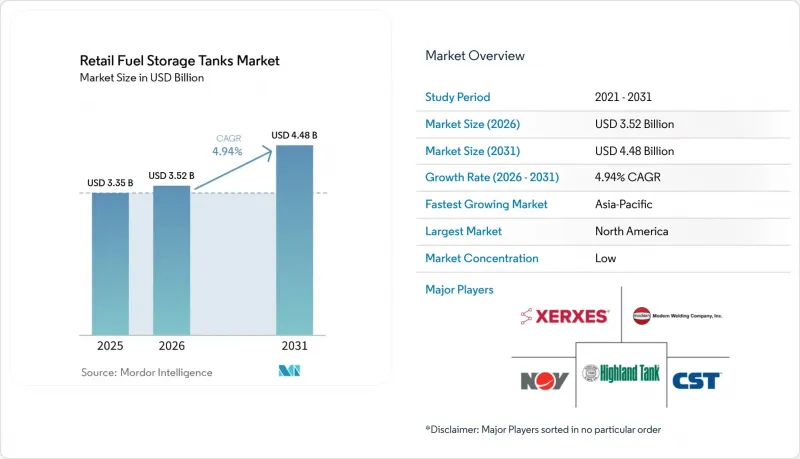
根據 Mordor Intelligence 預測,零售燃料儲存槽市場規模將從 2025 年的 33.5 億美元成長到 2026 年的 35.2 億美元,到 2031 年將達到 44.8 億美元,2026 年至 2031 年的複合年成長率為 4.94%。
全球零售燃料儲存槽市場趨勢與洞察
強制更換老舊的單層地下儲存槽(UST) 正在推動短期需求。
單層地下儲存槽(UST) 的拆除是零售燃料儲存槽市場需求成長的直接促進因素。加州強制要求所有不符合規定的單層 UST 必須在 2025 年 12 月 31 日前永久關閉。自 2026 年 1 月 1 日起,不符合規定的儲罐將面臨每天每個儲罐 500 至 5000 美元的罰款。 2024 年 12 月,美國環保署 (EPA) 報告稱,至少有七個州正在實施獎勵計劃,將財政支持與維修或拆除要求相結合。 EPA 的 2025 財政年度績效報告也顯示,與單層結構相比,雙層壁系統的洩漏傾向較低。這些法規正在推動採購趨勢轉向預製雙層壁儲罐,尤其是在營運商需要遵守規定的關閉期限的情況下。
多燃料零售正在推動多隔間油箱的需求。
零售商越來越需要在同一場所儲存普通汽油、高級汽油、中級汽油、乙醇混合燃料、柴油和可再生燃料。多隔間儲罐可在單一結構內儲存多種產品,從而減少所需的場地面積和設備複雜性。因此,新建加油站的設計旨在容納多種液體燃料類別,這將有利於零售燃料儲存槽市場的發展。據 Xerxes 公司稱,其玻璃鋼多隔間儲槽標配雙層玻璃鋼隔板。美國法規要求業者在改用含 10% 或以上乙醇或 20% 或以上生質柴油的受管制物質之前提前通知。營運商還必須證明整個地下儲罐系統與新物質相容,因此儲罐配置是燃料變更決策的關鍵因素。
對場地造成的影響很大,而且挖掘成本很高,這減緩了更換的速度。
挖掘和場地修復成本可能超過油罐本身的成本,從而延誤小規模加油站的更換工作。 2025年2月為聖路易斯港準備的一份對比報告估計,更換一個6000加侖的地下儲存槽(UST)的挖掘和排水成本為190,500美元。該報告在未考慮對加油站營運的更廣泛影響之前,計算出的項目總成本為620,500美元。這種成本結構可能導致資金有限或工期緊迫的業者推遲合規工作。此外,在當地法規允許的情況下,地上方案可能更具吸引力。如果土木工程成本無法在大規模網路中分攤,小規模獨立零售商的零售燃料儲存槽更換項目可能會減少。大規模連鎖店在協調更換工作方面擁有更大的自主權,這可能會推動燃料零售業的整合,但也可能導致獨立業者的基本客群萎縮。
細分市場分析
預計到2025年,雙層壁儲槽將佔據65.1%的市場佔有率,並將在2031年之前以5.8%的複合年成長率成長。其在零售燃料儲存槽市場的地位反映了鼓勵在新設施和升級項目中採用二次防護的法規。加州對單層壁儲槽的封閉要求,為營運商採購符合規定的替換設備提供了直接動力。加拿大也於2025年修訂了其石油儲存槽法規中包含的技術標準。雙層壁零售燃料儲存槽的市場規模得益於法規驅動的升級改造和新設施的建設。
三層壁儲槽仍然是地下水敏感地區或適用更嚴格安全防護法規的地區設施的特殊選擇。對於場地空間有限、需要處理多種燃料的加油站而言,分隔式和夾套式儲槽的重要性日益凸顯。 2026年5月,歐盟委員會通過了第2026/989號實施決定,修訂了固定式液體燃料箱溢流保護裝置的協調標準EN 13616-1:2025。該決定重申了在成員國整體新安裝項目中記錄產品符合性的重要性。因此,供應商必須在提供認證、安裝支援以及滿足特定場地燃料和安全防護要求方面展開競爭。
到2025年,鋼材在材質市場佔有率中將佔55.3%。鋼材在零售燃料儲存槽市場的地位得益於其成熟的製造能力、熟悉的安裝方法以及廣泛的燃料相容性。根據STI/SPFA的數據,經認證的鋼製儲存槽可用於儲存E10至E100的乙醇混合燃料以及B2至B100的生物柴油混合燃料。這使得鋼材成為預期未來燃料混合比例會改變的營運商的實用選擇。此外,對於需要高容量和地面安裝的儲槽應用而言,鋼材仍然是重要的選擇,因為這些應用對產品強度和傳統製造流程的要求較高。
玻璃纖維增強塑膠 (FRP) 是成長最快的材料類別,預計到 2031 年的複合年成長率將達到 6.3%。其耐腐蝕性在腐蝕性極強的土壤環境以及以長使用壽命為採購優先考慮的場合至關重要。 Xerxes 提供採用多隔間結構和雙層壁隔板的 FRP燃料箱。作為一項 6000 萬美元成長投資計劃的一部分,Mattr 於 2024 年 7 月在位於南卡羅來納州布萊斯伍德和德克薩斯德克薩斯州羅克沃爾的新複合材料技術工廠投產。布萊斯伍德工廠預計將於 2026 年恢復正常生產水準。
區域分析
截至2025年,北美佔31.4%的市佔率。加州將於2026年1月1日生效的法規正在推動符合標準的雙層地下儲存槽(UST)和地上儲存槽(AST)的短期採購需求。美國環保署(EPA)已確定一些州級項目,這些項目將財政支持與維修或拆除要求相結合。 2025年9月,加拿大在《聯邦公報》上發布了一項擬議修正案,以更新其儲存槽系統的技術標準。在墨西哥,高速公路旁的加油站需求不斷成長,營運商正在安裝多燃料和高容量儲槽設施以支援跨境物流。
亞太地區是零售燃料儲存槽市場成長最快的地區,預計到2031年複合年成長率將達到6.7%。中國石化宣布就多種規格的SF6雙層壁儲槽進行競標,其中包括2025年至2026年在福建省的採購。在日本,經評估具有高腐蝕風險的地下儲槽必須進行內塗層、陰極防蝕或雙層壁結構加強。 2025年5月,殼牌同意將其在印尼的加油站業務和格雷西克燃料儲存終端轉讓給Citadel Pacific和Cephas的合資企業。 2025年10月,Chandra Asri Pacific同意收購埃克森美孚在新加坡的零售加油站。
到2025年,歐洲在零售燃料儲存槽市場仍將佔據重要地位,其中德國、法國和波蘭是安裝最活躍的市場之一。歐盟委員會在2026年的決定中修訂了固定式液體燃料箱溢流保護裝置的協調標準,提高了新產品線對最新認證文件的需求。在中東和非洲地區,隨著沙烏地阿拉伯和阿拉伯聯合大公國(阿拉伯聯合大公國)擴大其零售網路,預計將出現長期商機,但南非可能會因外匯波動和資金籌措限制而出現專案延誤。
其他好處:
- Excel格式的市場預測(ME)表
- 3個月的分析師支持
目錄
第1章:引言
- 研究假設和市場定義
- 調查範圍
第2章:調查方法
第3章執行摘要
第4章 市場狀況
- 市場概覽
- 市場促進因素
- 強制更換老舊的單層地下儲存槽(UST)。
- 多燃料零售需要多隔間油箱。
- 亞太地區便利商店網路擴張
- 乙醇和生物柴油混合燃料的主流化
- 數位漏水檢測和遠端庫存監控
- 遵守加州第二階段遏制法規的連鎖反應。
- 市場限制因素
- 現場混亂,挖掘成本高昂
- 儲罐更換過程中的許可和承包商瓶頸
- 與新型燃料混合物相關的腐蝕和相容性風險
- 汽車電氣化帶來的零售燃料需求不確定性
- 供應鏈分析
- 波特五力分析
- 科技趨勢
- 監理情勢
- 投資分析
第5章 市場規模與成長預測
- 坦克型
- 單層水箱
- 雙層壁罐
- 三層壁罐
- 其他類型的坦克
- 儲罐材質
- 鋼
- 玻璃纖維增強塑膠(FRP)
- 複合材料
- 其他材料
- 按安裝類型
- 地下儲存槽(UST)
- 地面儲存槽(AST)
- 水箱容量
- 不足10000加侖
- 10,000–20,000 加侖
- 20,000–40,000 加侖
- 超過4萬加侖
- 按地區
- 北美洲
- 美國
- 加拿大
- 墨西哥
- 歐洲
- 德國
- 法國
- 義大利
- 西班牙
- 英國
- 波蘭
- 俄羅斯
- 其他歐洲國家
- 亞太地區
- 中國
- 印度
- 日本
- 韓國
- 澳洲
- 印尼
- 越南
- 泰國
- 其他亞太國家
- 南美洲
- 巴西
- 阿根廷
- 智利
- 其他南美國家
- 中東和非洲
- 沙烏地阿拉伯
- 阿拉伯聯合大公國
- 埃及
- 南非
- 摩洛哥
- 其他中東和非洲國家
- 北美洲
第6章 競爭情勢
- 市場集中度
- 策略趨勢
- 市佔率分析
- 公司簡介
- Belco Manufacturing Company
- CST Industries, Inc.
- Eaton Sales & Service LLC
- Fiberglass Tank Solutions
- General Industries Co. Ltd.
- Granby Industries
- Highland Tank LLC
- KBK Industries
- Modern Welding Company, Inc.
- NOV Inc.
- Roben Manufacturing, Inc.
- Roth Industries GmbH & Co. KG
- Superior Tank Co., Inc.
- Tank Connection
- Tank Solutions Pty Ltd
- Western Global Limited
- Xerxes Corporation(Mattr)
第7章 市場機會與未來展望
According to Mordor Intelligence, the retail fuel storage tanks market size is expected to grow from USD 3.35 billion in 2025 to USD 3.52 billion in 2026 and is forecast to reach USD 4.48 billion by 2031 at 4.94% CAGR over 2026-2031.
Global Retail Fuel Storage Tanks Market Trends and Insights
Aging Single-Wall UST Replacement Mandates Fuel Near-Term Demand
The retirement of single-wall underground storage tanks is a direct source of demand for the retail fuel storage tanks market. California required the permanent closure of noncompliant single-wall USTs by December 31, 2025. Since January 1, 2026, noncompliance has carried penalties of USD 500 to USD 5,000 per tank each day. The US Environmental Protection Agency reported in December 2024 that at least 7 states had incentive programs that paired financial support with upgrade or removal requirements. The agency's fiscal year 2025 performance reporting also found that double-wall systems had a lower release tendency than single-wall configurations. These rules shift purchasing toward pre-engineered double-wall units, especially where operators need to meet a defined closure date.
Multi-Fuel Retailing Drives Multicompartment Tank Demand
Retailers increasingly need to store regular, premium, mid-grade, ethanol-blended fuel, diesel, and renewable fuels at the same site. A multicompartment tank keeps several products within one structure and can reduce site footprint and equipment complexity. The retail fuel storage tanks market, therefore, benefits when new stations are designed for more than one liquid fuel category. Xerxes states that its fiberglass multicompartment tank uses a double-wall fiberglass bulkhead as a standard feature. US regulations require operators to give notice before switching to regulated substances containing more than 10% ethanol or 20% biodiesel. Operators must also demonstrate that the complete UST system is compatible with the new substance, which makes tank configuration part of the fuel change decision.
High Site-Disruption and Excavation Costs Throttle Replacement Velocity
Excavation and site restoration can cost more than the tank itself, which slows replacement activity at smaller sites. A February 2025 comparison prepared for Port San Luis showed USD 190,500 in excavation and dewatering costs for a 6,000-gallon UST replacement. The same document placed the total project estimate at USD 620,500 before considering the wider effect on station operations. This cost profile can defer compliance work where operators have limited capital or a narrow construction window. It can also make aboveground options more attractive at sites where local rules permit them. The retail fuel storage tanks market may see fewer projects from small independent retailers when civil works costs cannot be spread across a larger network. Larger chains have greater scope to coordinate upgrades, which can support consolidation in fuel retailing while narrowing the independent customer base.
Other drivers and restraints analyzed in the detailed report include:
- Convenience-Store Network Expansion in Asia-Pacific Anchors the Long-Term Volume Story
- Mainstream Adoption of Ethanol and Biodiesel Blends Demands Infrastructure Reconfiguration
- Retail-Fuel Demand Uncertainty from Vehicle Electrification Introduces Long-Range Risk
For complete list of drivers and restraints, kindly check the Table Of Contents.
Segment Analysis
Double-wall tanks held 65.1% share in 2025 and are projected to grow at a 5.8% CAGR through 2031. Their position in the retail fuel storage tanks market reflects rules that favor secondary containment for new installations and replacement projects. California's single-wall closure requirement created an immediate reason for operators to procure compliant replacement equipment. Canada also updated the technical standards incorporated into its petroleum storage tank regulations in 2025. The retail fuel storage tanks market size for double-wall products is strengthened by both regulatory replacement and new-site construction.
Triple-wall tanks remain a specialized option for sites near sensitive groundwater or in jurisdictions with more demanding containment rules. Compartmented and jacketed variants become more relevant when stations offer several fuels from a constrained footprint. The European Commission adopted Implementing Decision 2026/989 in May 2026, updating the harmonized standard EN 13616-1:2025 for overfill-prevention devices on static liquid fuel tanks. The decision reinforces the importance of documented product compliance across new installations in member states. Suppliers must therefore compete on certification, installation support, and the ability to meet site-specific fuel and containment requirements.
Steel held 55.3% share by material in 2025. Its position in the retail fuel storage tanks market is supported by established manufacturing capacity, familiar installation practices, and broad fuel compatibility. STI/SPFA states that qualified steel tanks can be used with ethanol blends from E10 to E100 and biodiesel blends from B2 to B100. This makes steel a practical option for operators who expect future fuel blend changes. Steel also remains relevant in large capacity and aboveground applications where product strength and conventional fabrication are valued.
Fiberglass-reinforced plastic is the fastest-growing material category, with a forecast CAGR of 6.3% through 2031. Its corrosion resistance is important in aggressive soil environments and where long service life is a procurement priority. Xerxes offers fiberglass fuel tanks with multicompartment configurations and double-wall bulkheads. Mattr began production at new composite technology facilities in Blythewood, South Carolina, and Rockwall, Texas, in July 2024 under a USD 60 million growth investment. The Blythewood facility is expected to approach normalized production in 2026.
Complete Report Scope:
- By Tank Type
- Single-Wall Tanks
- Double-Wall Tanks
- Triple-Wall Tanks
- Other Tank Types
- By Tank Material
- Steel
- Fiberglass-Reinforced Plastic (FRP)
- Composite Materials
- Other Materials
- By Installation Type
- Underground Storage Tanks (USTs)
- Aboveground Storage Tanks (ASTs)
- By Tank Capacity
- Below 10,000 Gallons
- 10,000-20,000 Gallons
- 20,000-40,000 Gallons
- Above 40,000 Gallons
- By Geography
- North America
- United States
- Canada
- Mexico
- Europe
- Germany
- France
- Italy
- Spain
- United Kingdom
- Poland
- Russia
- Rest of Europe
- Asia-Pacific
- China
- India
- Japan
- South Korea
- Australia
- Indonesia
- Vietnam
- Thailand
- Rest of Asia-Pacific
- South America
- Brazil
- Argentina
- Chile
- Rest of South America
- Middle East and Africa
- Saudi Arabia
- United Arab Emirates
- Egypt
- South Africa
- Morocco
- Rest of Middle East and Africa
- North America
Geography Analysis
North America held 31.4% share in 2025. California's enforcement action from January 1, 2026, is driving near-term procurement of compliant double-wall USTs and ASTs. The EPA identified state programs that combine financial support with upgrade or removal requirements. Canada gazetted amendments in September 2025 that updated technical standards for storage tank systems. Mexico adds demand at highway corridor stations where operators are adopting multi-fuel and larger-capacity storage to support cross-border logistics.
Asia-Pacific is the fastest-growing area in the retail fuel storage tanks market, at a forecast 6.7% CAGR through 2031. Sinopec issued tenders covering SF double-wall tanks in several sizes, including a Fujian procurement for 2025-2026. Japan requires internal coating, cathodic protection, or double-shell measures for underground tanks assessed as having high corrosion risk. Shell agreed in May 2025 to transfer its Indonesia gas station business and Gresik fuel storage terminal to a Citadel Pacific and Sefas joint venture. Chandra Asri Pacific agreed in October 2025 to acquire ExxonMobil's retail fuel stations in Singapore.
Europe retained a meaningful position in the retail fuel storage tanks market in 2025, with Germany, France, and Poland among the active installation markets. The European Commission's 2026 decision updated the harmonized standard for overfill-prevention devices on static liquid fuel tanks. This increases the need for current certification documentation on new product lines. The Middle East and Africa offer a longer-term opportunity as Saudi Arabia and the UAE upgrade retail networks, while foreign exchange volatility and financing constraints in South Africa can delay projects.
- Belco Manufacturing Company
- CST Industries, Inc.
- Eaton Sales & Service LLC
- Fiberglass Tank Solutions
- General Industries Co. Ltd.
- Granby Industries
- Highland Tank LLC
- KBK Industries
- Modern Welding Company, Inc.
- NOV Inc.
- Roben Manufacturing, Inc.
- Roth Industries GmbH & Co. KG
- Superior Tank Co., Inc.
- Tank Connection
- Tank Solutions Pty Ltd
- Western Global Limited
- Xerxes Corporation (Mattr)
Additional Benefits:
- The market estimate (ME) sheet in Excel format
- 3 months of analyst support
TABLE OF CONTENTS
1 INTRODUCTION
- 1.1 Study Assumptions and Market Definition
- 1.2 Scope of the Study
2 RESEARCH METHODOLOGY
3 EXECUTIVE SUMMARY
4 MARKET LANDSCAPE
- 4.1 Market Overview
- 4.2 Market Drivers
- 4.2.1 Aging Single-Wall UST Replacement Mandates
- 4.2.2 Multi-Fuel Retailing Requires Multicompartment Tanks
- 4.2.3 Convenience-Store Network Expansion in Asia-Pacific
- 4.2.4 Mainstream Adoption of Ethanol and Biodiesel Blends
- 4.2.5 Digital Leak Detection and Remote Inventory Monitoring
- 4.2.6 California-Led Secondary-Containment Compliance Spillover
- 4.3 Market Restraints
- 4.3.1 High Site-Disruption and Excavation Costs
- 4.3.2 Permit and Contractor Bottlenecks for Tank Replacement
- 4.3.3 Corrosion and Compatibility Risk from New Fuel Blends
- 4.3.4 Retail-Fuel Demand Uncertainty from Vehicle Electrification
- 4.4 Supply-Chain Analysis
- 4.5 Porter's Five Forces Analysis
- 4.5.1 Bargaining Power of Suppliers
- 4.5.2 Bargaining Power of Buyers
- 4.5.3 Threat of New Entrants
- 4.5.4 Threat of Substitutes
- 4.5.5 Competitive Rivalry
- 4.6 Technology Outlook
- 4.7 Regulatory Landscape
- 4.8 Investment Analysis
5 MARKET SIZE AND GROWTH FORECASTS
- 5.1 By Tank Type
- 5.1.1 Single-Wall Tanks
- 5.1.2 Double-Wall Tanks
- 5.1.3 Triple-Wall Tanks
- 5.1.4 Other Tank Types
- 5.2 By Tank Material
- 5.2.1 Steel
- 5.2.2 Fiberglass-Reinforced Plastic (FRP)
- 5.2.3 Composite Materials
- 5.2.4 Other Materials
- 5.3 By Installation Type
- 5.3.1 Underground Storage Tanks (USTs)
- 5.3.2 Aboveground Storage Tanks (ASTs)
- 5.4 By Tank Capacity
- 5.4.1 Below 10,000 Gallons
- 5.4.2 10,000-20,000 Gallons
- 5.4.3 20,000-40,000 Gallons
- 5.4.4 Above 40,000 Gallons
- 5.5 By Geography
- 5.5.1 North America
- 5.5.1.1 United States
- 5.5.1.2 Canada
- 5.5.1.3 Mexico
- 5.5.2 Europe
- 5.5.2.1 Germany
- 5.5.2.2 France
- 5.5.2.3 Italy
- 5.5.2.4 Spain
- 5.5.2.5 United Kingdom
- 5.5.2.6 Poland
- 5.5.2.7 Russia
- 5.5.2.8 Rest of Europe
- 5.5.3 Asia-Pacific
- 5.5.3.1 China
- 5.5.3.2 India
- 5.5.3.3 Japan
- 5.5.3.4 South Korea
- 5.5.3.5 Australia
- 5.5.3.6 Indonesia
- 5.5.3.7 Vietnam
- 5.5.3.8 Thailand
- 5.5.3.9 Rest of Asia-Pacific
- 5.5.4 South America
- 5.5.4.1 Brazil
- 5.5.4.2 Argentina
- 5.5.4.3 Chile
- 5.5.4.4 Rest of South America
- 5.5.5 Middle East and Africa
- 5.5.5.1 Saudi Arabia
- 5.5.5.2 United Arab Emirates
- 5.5.5.3 Egypt
- 5.5.5.4 South Africa
- 5.5.5.5 Morocco
- 5.5.5.6 Rest of Middle East and Africa
- 5.5.1 North America
6 COMPETITIVE LANDSCAPE
- 6.1 Market Concentration
- 6.2 Strategic Moves
- 6.3 Market Share Analysis
- 6.4 Company Profiles (includes Global Level Overview, Market Level Overview, Core Segments, Financials as available, Strategic Information, Market Rank/Share, Products and Services, Recent Developments)
- 6.4.1 Belco Manufacturing Company
- 6.4.2 CST Industries, Inc.
- 6.4.3 Eaton Sales & Service LLC
- 6.4.4 Fiberglass Tank Solutions
- 6.4.5 General Industries Co. Ltd.
- 6.4.6 Granby Industries
- 6.4.7 Highland Tank LLC
- 6.4.8 KBK Industries
- 6.4.9 Modern Welding Company, Inc.
- 6.4.10 NOV Inc.
- 6.4.11 Roben Manufacturing, Inc.
- 6.4.12 Roth Industries GmbH & Co. KG
- 6.4.13 Superior Tank Co., Inc.
- 6.4.14 Tank Connection
- 6.4.15 Tank Solutions Pty Ltd
- 6.4.16 Western Global Limited
- 6.4.17 Xerxes Corporation (Mattr)
7 MARKET OPPORTUNITIES AND FUTURE OUTLOOK
- 7.1 White-Space and Unmet-Need Assessment

 鋼製儲存槽市場:全球市場預測,2026-2032年大型鋼製儲存槽市場:全球市場預測(2026-2032年)水儲槽內襯市場:全球市場預測,2026-2032年
 液氧氧氣設備市場 - 全球產業規模、佔有率、趨勢、機會、預測:銷售管道、最終用途、地區和競爭格局,2021-2031年
 2026年全球儲存槽市場報告全球石油儲罐儲存市場(按產品類型、罐體類型、儲存容量、運作方式、罐體材料、罐體結構和最終用戶分類)預測(2026-2032年)氟聚合物儲槽襯裡市場:依材質、厚度範圍、生命週期階段、應用、最終用途產業和供應管道分類-2026-2032年全球預測
 儲存槽市場機會、成長要素、產業趨勢分析及2026年至2035年預測儲罐市場-全球產業規模、佔有率、趨勢、機會和預測(按安裝類型、產品、材料、行業垂直、地區、競爭進行細分,2020-2030 年)
 全球油罐內襯市場