


 |
市場調查報告書
商品編碼
2154338
陶瓷導熱材料:市場佔有率分析、產業趨勢與統計、成長預測(2026-2031)Ceramic Thermal Interface Materials - Market Share Analysis, Industry Trends & Statistics, Growth Forecasts (2026 - 2031) |
||||||

※ 本網頁內容可能與最新版本有所差異。詳細情況請與我們聯繫。
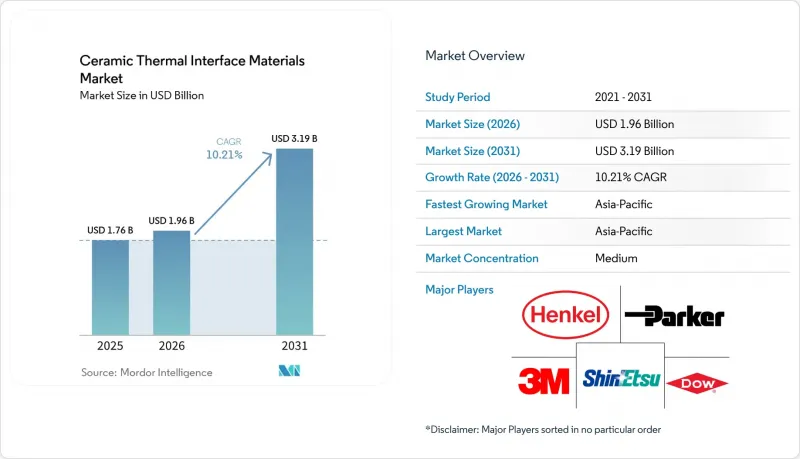
據 Mordor Intelligence 稱,2025 年陶瓷導熱界面材料的市場規模估計為 17.6 億美元,預計在預測期(2026-2031 年)內將以 10.21% 的複合年成長率成長,從 2026 年的 19.6 億美元成長到 2031 億美元的 31.9 億美元。
全球陶瓷導熱界面材料市場趨勢及洞察
人工智慧和高效能運算中的熱通量
在人工智慧和高效能運算硬體領域,從間歇性熱應力到持續性熱應力的轉變正在推動陶瓷導熱介面材料市場的需求。先進的人工智慧加速器模組的熱設計功率已接近700瓦或更高,這增加了晶片-散熱片界面處的熱通量。 IEEE電子封裝協會的分析報告顯示,在先進的多晶片模組中,封裝翹曲的峰谷值可達100-300微米,轉角處的撓度可超過300-400微米。這些機械變化會導致傳統導熱矽脂和相變材料在熱循環過程中被擠出或形成空隙。而置於基板與冷板之間的陶瓷填充導熱界面材料2 (TIM2) 產品,由於其固化或半固化的結構,能夠更有效地抵抗這些變形。隨著液冷超大規模和邊緣人工智慧系統中機架密度的增加,導熱係數為8 W/m*K或更高的點膠式間隙填充材料的重要性日益凸顯。
汽車電力電子電氣化
在電動車牽引逆變器和車載充電器中,矽絕緣柵雙極電晶體(IGBT) 模組被碳化矽金屬氧化物半導體場效電晶體(MOSFET) 模組所取代,這對陶瓷導熱界面材料市場產生了積極影響。在典型的電動車工作循環下,碳化矽 MOSFET 的工作溫度高於 175 度C,而矽 IGBT 模組的最高工作溫度僅為 150 度C。這導致其與冷卻基板的界面處出現更強的溫度梯度和更大的機械應力。 2026 年 7 月,漢高公司推出了導熱係數為 6.5 W/m*K 的“Bergquist Gap Filler TGF 6500LVO”,該產品適用於電動車的高級駕駛輔助系統 (ADAS)、電控系統(ECU) 和電源轉換組件。陶氏化學宣布,將在 2027 年前投資 1 億美元,以擴大其在中國、日本和美國的特殊矽酮產能。這將包括擴建其位於上海和密西根州米德蘭的「冷卻科學實驗室」。電動車產量的成長以及每輛車溫度控管材料使用量的增加,正在推動汽車和電動車電池產業的成長。
氮化硼和氮化鋁高成本
氮化硼和氮化鋁的高成本阻礙了高品質填料在陶瓷導熱界面材料市場的廣泛應用。氮化硼的合成需要高能耗,生產規模有限,需要精確控制顆粒大小才能獲得高面內導熱係數所需的片狀形貌。 2025 年的一項同行評審研究發現,由於大規模生產能力有限,表面改質氮化硼和奈米鑽石在結構和成本方面均不如氧化鋁。雖然氮化鋁具有理論導熱係數超過 320 W/(m·K) 和接近矽的熱膨脹係數等優勢,但其價格遠高於氧化鋁。這些填充材的成本限制了許多消費性電子產品的商業性化導熱係數水平,使其僅為 4–6 W/m·K。 Resonac 的表面處理氮化硼技術旨在透過利用表面化學而不是增加原料用量來實現更高的填充材含量。
細分市場分析
到2025年,導熱墊將佔陶瓷導熱界面材料市場佔有率的36.38%,這反映了其在家用電子電器、電源和工業電子領域的成熟應用。標準化的形狀、易於操作的特性以及均勻的黏合層厚度,有利於自動化大規模生產。此細分市場涵蓋了從通用型1-3 W/m*K導熱墊到專用型6-8 W/m*K導熱墊的各種產品,從而降低了單一終端市場中產品相互替代的風險。
導熱矽脂和導熱凝膠廣泛應用於嵌入式CPU和GPU冷卻系統,在這些系統中,可返工性和薄黏合層的可控性至關重要。相變材料和導熱黏合劑是另一類產品類型,其中導熱黏合劑在電動汽車電池的結構黏合領域應用日益廣泛。導熱間隙填充材料是成長最快的產品類型,預計到2031年,該領域陶瓷導熱界面材料的市場規模將以11.52%的複合年成長率成長。這些材料擴大應用於間隙公差較大且表面形貌不規則的場合,而點膠式導熱凝膠是此類應用的首選。 2026年5月,陶氏化學推出了DOWSIL TC-3120導熱凝膠,該產品具有12 W/m*K的導熱係數、光學級潔淨度和極低的油滲漏,適用於資料中心和汽車應用。 2025 年 12 月,漢高推出了 Bergquist TGF 10000,其導熱係數為 10 W/m*K,適用於高功率汽車、通訊和運算應用。
區域分析
預計到2025年,亞太地區將佔全球市場佔有率的36.68%,並在2031年之前以11.11%的複合年成長率成長。該地區融合了中國電動車和5G基礎設施的規模優勢,以及日本和韓國的材料製造能力。中國正透過電動車生產、5G基地台網路建置和人工智慧運算能力的不斷提升來推動市場需求。這些終端市場對各種產品類型和導熱係數等級的需求都在不斷成長。
日本和韓國透過半導體和家用電子電器供應鏈推動了市場需求。瓦克化學於2025年在日本筑波和韓國鎮川開設了特種矽導熱界面材料生產基地,以服務汽車和電子行業的客戶。在印度,5G部署正在擴展,電動車製造地正在興起。具有成本競爭力的氧化鋁基複合材料非常適合滿足印度的高需求。北美和歐洲分別是第二和第三大區域市場,在高階複合材料、汽車OEM廠商的需求以及資料中心發展上具有優勢。北美超大規模資料中心的投資正在提高晶片-散熱器和模組-冷板界面的功率密度。陶氏化學擴大了位於美國密西根州奧本和中國張家港的特殊矽產能,並擴大了其位於美國中部和上海的冷卻科學實驗室。德國透過汽車OEM廠商和一級供應商支持歐洲的需求,這些廠商和供應商需要可靠的材料用於電動動力傳動系統和高級駕駛輔助系統(ADAS)電子設備。
南美洲、中東和非洲是陶瓷導熱介面材料市場中規模雖小但持續成長的地區。短期需求與巴西、沙烏地阿拉伯和南非的5G部署和電動車(EV)的早期普及密切相關。巴西對消費性電子製造地和電信業的投資也支撐了南美洲的早期需求。沙烏地阿拉伯和阿拉伯聯合大公國(阿拉伯聯合大公國)正在擴建資料中心以支援人工智慧(AI)和數位轉型(DX)項目,從而創造了對高效能伺服器材料的新需求。由於當地製造能力有限且供應鏈尚未成熟,這兩個地區仍然依賴進口,這為全球供應商建立早期供應關係提供了良好機會。
其他好處:
- Excel格式的市場預測(ME)表
- 3個月的分析師支持
目錄
第1章:引言
- 研究假設和市場定義
- 調查範圍
第2章:調查方法
第3章執行摘要
第4章 市場狀況
- 市場概覽
- 市場促進因素
- 人工智慧和高效能運算中的熱通量
- 汽車電力電子電氣化
- 擴大使用具有高電絕緣性和導電性的填料。
- 5G和通訊設備中更高的功率密度
- 單體電池到電池組的電池架構
- 陶瓷填料顆粒的工程設計及高填充率材料的配製
- 市場限制因素
- 氮化硼和氮化鋁高成本
- 高陶瓷含量下的黏度和應用限制
- 填料與聚合物的相容性與聚集性
- 認證週期和可靠性檢驗要求
- 價值鏈分析
- 波特五力分析
第5章 市場規模與成長預測
- 依產品類型
- 導熱矽脂
- 導熱間隙填充物
- 導熱墊
- 其他(相變材料、導熱黏合劑、導熱凝膠)
- 陶瓷填料的類型
- 氧化鋁(Al2O3)
- 氮化硼(BN)
- 氮化鋁(AlN)
- 其他(碳化矽、氧化鎂、氧化鋅、氮化矽和其他陶瓷填料)
- 透過使用
- 家用電子產品
- 汽車和電動車電池
- 電力電子
- 其他(LED照明、射頻和通訊設備、工業電子設備、醫療用電子設備)
- 按地區
- 亞太地區
- 中國
- 印度
- 日本
- 韓國
- 其他亞太國家
- 北美洲
- 美國
- 加拿大
- 墨西哥
- 歐洲
- 德國
- 英國
- 法國
- 義大利
- 其他歐洲國家
- 南美洲
- 巴西
- 阿根廷
- 其他南美國家
- 中東和非洲
- 沙烏地阿拉伯
- 南非
- 其他中東和非洲國家
- 亞太地區
第6章 競爭情勢
- 市場集中度
- 策略趨勢
- 市佔率和排名分析
- 公司簡介
- 3M
- Aremco
- Denka Company Limited
- Dow
- DuPont
- Fujipoly America, Inc.
- Henkel AG & Co. KGaA
- Indium Corporation
- KYOCERA Corporation
- Momentive
- PARKER HANNIFIN CORP
- Resonac Holdings Corporation
- Rogers Corporation
- Saint-Gobain
- Shin-Etsu Chemical Co., Ltd.
- Wacker Chemie AG
第7章 市場機會與未來展望
According to Mordor Intelligence, the ceramic thermal interface materials market size is estimated at USD 1.76 billion in 2025 and is estimated to grow from USD 1.96 billion in 2026 to USD 3.19 billion by 2031, at a CAGR of 10.21% during the forecast period (2026-2031).
Global Ceramic Thermal Interface Materials Market Trends and Insights
AI and High-Performance Computing Heat Flux
The shift from intermittent to sustained thermal stress in AI and high-performance computing hardware is supporting demand in the ceramic thermal interface materials market. Advanced AI accelerator modules are approaching thermal design powers of 700 W or higher, increasing heat flux at the chip-to-spreader interface. An IEEE Electronics Packaging Society analysis reported package warpage of 100-300 μm peak to valley and corner deflections above 300-400 μm in advanced multi-chip modules. These mechanical changes can cause conventional greases and phase-change materials to pump out or form voids during thermal cycling. Ceramic-filled Thermal Interface Material 2 (TIM2) products positioned between baseplates and cold plates resist this movement more effectively due to their cured or semi-cured structure. As rack density rises in liquid-cooled hyperscale and edge AI systems, dispensable gap fillers rated above 8 W/m*K are becoming increasingly important.
Electrification of Vehicle Power Electronics
The replacement of silicon Insulated Gate Bipolar Transistor (IGBT) modules with silicon carbide Metal-Oxide-Semiconductor Field-Effect Transistors (MOSFETs) in EV traction inverters and onboard chargers is benefiting the ceramic thermal interface materials market. Silicon carbide MOSFETs operate above 175°C under typical EV duty cycles, compared with a 150°C ceiling for silicon IGBT modules. This creates stronger thermal gradients and greater mechanical stress at the interface with the cooling substrate. In July 2026, Henkel launched the Bergquist Gap Filler TGF 6500LVO, with a conductivity of 6.5 W/m*K, for Advanced Driver Assistance Systems (ADAS), Electronic Control Unit (ECU), and electric-vehicle power-conversion components. Dow announced USD 100 million in specialty silicones capacity investments through 2027 across China, Japan, and the United States, along with expanded Cooling Science Labs in Shanghai and Midland, Michigan. Higher EV production and greater thermal material content per vehicle are supporting growth in the automotive and EV-battery segments.
High Cost of Boron Nitride and Aluminum Nitride
The high cost of boron nitride and aluminum nitride limits the broader adoption of premium fillers in the ceramic thermal interface materials market. Boron nitride requires energy-intensive synthesis, limited-scale production, and controlled particle engineering to achieve the platelet morphology needed for high through-plane conductivity. A 2025 peer-reviewed study found that surface-modified boron nitride and nanodiamond had structural cost disadvantages relative to aluminum oxide due to limited large-scale production capacity. Aluminum nitride offers a theoretical thermal conductivity above 320 W/(m*K) and a thermal expansion coefficient close to that of silicon, but it also carries a substantial price premium over alumina. The cost of these fillers keeps commercially viable conductivity levels in many consumer electronics products within the 4-6 W/m*K range. Resonac's surface-treated boron nitride technology aims to enable higher filler loading through surface chemistry rather than higher raw material quantities.
Other drivers and restraints analyzed in the detailed report include:
- Rising Power Density in 5G and Telecommunications Equipment
- Cell-to-Pack Battery Architectures
- Viscosity and Dispensing Constraints at High Ceramic Loading
For complete list of drivers and restraints, kindly check the Table Of Contents.
Segment Analysis
Thermal pads held 36.38% of the ceramic thermal interface materials market share in 2025, reflecting their established role in consumer electronics, power supplies, and industrial electronics. Standardized shapes, simple handling, and consistent bond-line thickness support automated high-volume assembly. The segment covers products ranging from commodity 1-3 W/m*K pads to specialty 6-8 W/m*K options, limiting exposure to substitution in any single end market.
Thermal greases and gels are used in installed CPU and GPU cooling systems where reworkability and thin bond-line control are important. Phase-change materials and thermal adhesives form the other product category, with thermal adhesives gaining use in structural EV battery bonding. Thermal gap fillers are the fastest-growing product type, with the ceramic thermal interface materials market size for this segment projected to grow at an 11.52% CAGR through 2031. Their use is increasing in applications with large tolerance gaps and irregular surface profiles, which favor dispensable gels. In May 2026, Dow launched DOWSIL TC-3120 Thermal Gel, offering a thermal conductivity of 12 W/m*K, optical-grade cleanliness, and minimal oil bleed for data center and automotive applications. In December 2025, Henkel launched Bergquist TGF 10000, featuring 10 W/m*K thermal conductivity for high-power automotive, telecommunications, and computing applications.
Complete Report Scope:
- By Product Type
- Thermal Greases
- Thermal Gap Fillers
- Thermal Pads
- Others (Phase Change Materials, Thermal Adhesives, Thermal Gels)
- By Ceramic Filler Type
- Aluminum Oxide (Al2O3)
- Boron Nitride (BN)
- Aluminum Nitride (AlN)
- Others (Silicon Carbide, Magnesium Oxide, Zinc Oxide, Silicon Nitride, Other Ceramic Fillers)
- By Application
- Consumer Electronics
- Automotive and EV Batteries
- Power Electronics
- Others (LED Lighting, RF and Telecom Equipment, Industrial Electronics, Medical Electronics)
- By Geography
- Asia-Pacific
- China
- India
- Japan
- South Korea
- Rest of Asia-Pacific
- North America
- United States
- Canada
- Mexico
- Europe
- Germany
- United Kingdom
- France
- Italy
- Rest of Europe
- South America
- Brazil
- Argentina
- Rest of South America
- Middle-East and Africa
- Saudi Arabia
- South Africa
- Rest of Middle-East and Africa
- Asia-Pacific
Geography Analysis
Asia-Pacific accounted for 36.68% of the regional share in 2025 and is forecast to grow at a CAGR of 11.11% through 2031. The region combines China's EV and 5G infrastructure scale with materials manufacturing capacity in Japan and South Korea. China drives demand through its EV production, 5G base station network, and expanding AI computing capacity. These end markets create demand across product types and conductivity levels.
Japan and South Korea contribute to demand through semiconductor and consumer electronics supply chains. Wacker Chemie opened specialty silicone thermal interface material facilities in Tsukuba, Japan, and Jincheon, South Korea, in 2025 to serve automotive and electronics customers. India has an expanding 5G rollout and an emerging EV manufacturing base. Cost-competitive alumina-based formulations suit India's high demand. North America and Europe are the second- and third-largest regional markets, with strengths in premium formulations, automotive OEM demand, and data center development. North America's hyperscale investments are increasing power density at chip-to-heatsink and module-to-cold-plate interfaces. Dow expanded specialty silicone manufacturing capacity in Auburn, Michigan, and Zhangjiagang, China, and expanded Cooling Science Labs in Midland and Shanghai. Germany anchors European demand through automotive OEMs and tier-1 suppliers that require reliable materials for electrified powertrains and Advanced Driver-Assistance Systems (ADAS) electronics.
South America, the Middle-East, and Africa remain smaller but growing parts of the ceramic thermal interface materials market. Near-term demand is linked to 5G deployment and early EV adoption in Brazil, Saudi Arabia, and South Africa. Brazil's consumer electronics manufacturing base and telecommunications investment support early demand in South America. Saudi Arabia and the UAE are expanding data center capacity to support AI and digital transformation programs, creating new demand for high-performance server materials. Limited local manufacturing capacity and shallow supply chains keep both regions import-dependent, giving global suppliers an opportunity to establish supply relationships early.
- 3M
- Aremco
- Denka Company Limited
- Dow
- DuPont
- Fujipoly America, Inc.
- Henkel AG & Co. KGaA
- Indium Corporation
- KYOCERA Corporation
- Momentive
- PARKER HANNIFIN CORP
- Resonac Holdings Corporation
- Rogers Corporation
- Saint-Gobain
- Shin-Etsu Chemical Co., Ltd.
- Wacker Chemie AG
Additional Benefits:
- The market estimate (ME) sheet in Excel format
- 3 months of analyst support
TABLE OF CONTENTS
1 Introduction
- 1.1 Study Assumptions and Market Definition
- 1.2 Scope of the Study
2 Research Methodology
3 Executive Summary
4 Market Landscape
- 4.1 Market Overview
- 4.2 Market Drivers
- 4.2.1 AI and High-Performance Computing Heat Flux
- 4.2.2 Electrification of Vehicle Power Electronics
- 4.2.3 Increasing Use of Electrically Insulating High-Conductivity Fillers
- 4.2.4 Rising Power Density in 5G and Telecommunications Equipment
- 4.2.5 Cell-to-Pack Battery Architectures
- 4.2.6 Ceramic Filler Particle Engineering and High-Loading Formulations
- 4.3 Market Restraints
- 4.3.1 High Cost of Boron Nitride and Aluminum Nitride
- 4.3.2 Viscosity and Dispensing Constraints at High Ceramic Loading
- 4.3.3 Filler-Polymer Compatibility and Agglomeration
- 4.3.4 Qualification Cycles and Reliability Validation Requirements
- 4.4 Value Chain Analysis
- 4.5 Porter's Five Forces Analysis
- 4.5.1 Threat of New Entrants
- 4.5.2 Bargaining Power of Suppliers
- 4.5.3 Bargaining Power of Buyers
- 4.5.4 Threat of Substitutes
- 4.5.5 Competitive Rivalry
5 Market Size and Growth Forecasts (Value)
- 5.1 By Product Type
- 5.1.1 Thermal Greases
- 5.1.2 Thermal Gap Fillers
- 5.1.3 Thermal Pads
- 5.1.4 Others (Phase Change Materials, Thermal Adhesives, Thermal Gels)
- 5.2 By Ceramic Filler Type
- 5.2.1 Aluminum Oxide (Al2O3)
- 5.2.2 Boron Nitride (BN)
- 5.2.3 Aluminum Nitride (AlN)
- 5.2.4 Others (Silicon Carbide, Magnesium Oxide, Zinc Oxide, Silicon Nitride, Other Ceramic Fillers)
- 5.3 By Application
- 5.3.1 Consumer Electronics
- 5.3.2 Automotive and EV Batteries
- 5.3.3 Power Electronics
- 5.3.4 Others (LED Lighting, RF and Telecom Equipment, Industrial Electronics, Medical Electronics)
- 5.4 By Geography
- 5.4.1 Asia-Pacific
- 5.4.1.1 China
- 5.4.1.2 India
- 5.4.1.3 Japan
- 5.4.1.4 South Korea
- 5.4.1.5 Rest of Asia-Pacific
- 5.4.2 North America
- 5.4.2.1 United States
- 5.4.2.2 Canada
- 5.4.2.3 Mexico
- 5.4.3 Europe
- 5.4.3.1 Germany
- 5.4.3.2 United Kingdom
- 5.4.3.3 France
- 5.4.3.4 Italy
- 5.4.3.5 Rest of Europe
- 5.4.4 South America
- 5.4.4.1 Brazil
- 5.4.4.2 Argentina
- 5.4.4.3 Rest of South America
- 5.4.5 Middle-East and Africa
- 5.4.5.1 Saudi Arabia
- 5.4.5.2 South Africa
- 5.4.5.3 Rest of Middle-East and Africa
- 5.4.1 Asia-Pacific
6 Competitive Landscape
- 6.1 Market Concentration
- 6.2 Strategic Moves
- 6.3 Market Share (%)/Ranking Analysis
- 6.4 Company Profiles (includes Global Overview, Market Overview, Core Segments, Financials as available, Strategic Information, Products and Services, and Recent Developments)
- 6.4.1 3M
- 6.4.2 Aremco
- 6.4.3 Denka Company Limited
- 6.4.4 Dow
- 6.4.5 DuPont
- 6.4.6 Fujipoly America, Inc.
- 6.4.7 Henkel AG & Co. KGaA
- 6.4.8 Indium Corporation
- 6.4.9 KYOCERA Corporation
- 6.4.10 Momentive
- 6.4.11 PARKER HANNIFIN CORP
- 6.4.12 Resonac Holdings Corporation
- 6.4.13 Rogers Corporation
- 6.4.14 Saint-Gobain
- 6.4.15 Shin-Etsu Chemical Co., Ltd.
- 6.4.16 Wacker Chemie AG
7 Market Opportunities and Future Outlook
- 7.1 White-Space and Unmet-Need Assessment

 導熱導體市場:全球市場預測,2026-2032年氮化硼導熱絕緣墊片市場:全球市場預測,2026-2032年
 導熱界面材料市場預測至2034年-按產品類型、化學成分、應用和地區分類的全球分析
 全球電動車導熱材料市場規模、佔有率及成長預測(2026-2031年)全球導熱界面材料市場(2027-2037 年)導熱介面材料市場:2026-2032年全球市場預測(依產品類型、材料、化學形態、導熱係數、終端應用產業及銷售管道)
 2026年半導體導熱界面材料全球市場研究報告
 全球5G導熱材料市場:按應用、產品、地區和國家分類的分析和預測(2025-2035年)
 導熱材料市場:按產品、應用和地區分類
 導熱材料市場規模、佔有率、趨勢和預測:按產品類型、應用和地區分類,2026-2034年