


 |
市場調查報告書
商品編碼
2154287
北美汽車緊固件冷成型:市場佔有率分析、產業趨勢與統計及成長預測(2026-2031)North America Automotive Fastener Cold Forming - Market Share Analysis, Industry Trends & Statistics, Growth Forecasts (2026 - 2031) |
||||||

※ 本網頁內容可能與最新版本有所差異。詳細情況請與我們聯繫。
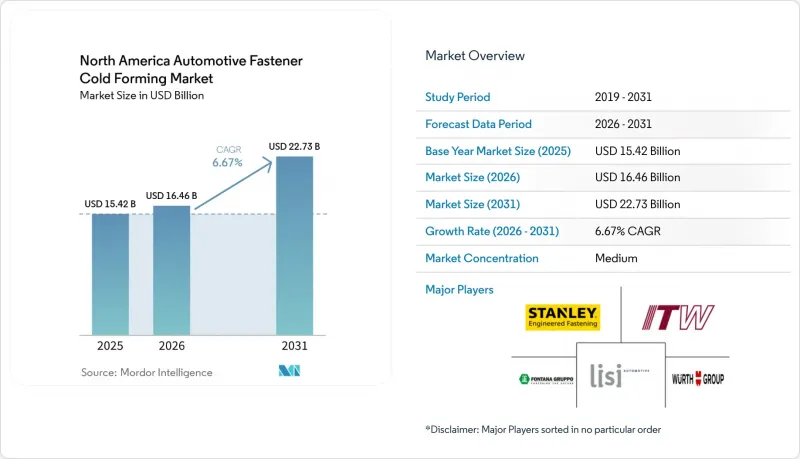
根據 Mordor Intelligence 預測,北美汽車緊固件冷成型市場規模將從 2025 年的 154.2 億美元成長到 2026 年的 164.6 億美元,到 2031 年將達到 227.3 億美元。
預測期(2026-2031 年)的複合年成長率預計為 6.67%。
北美汽車緊固件冷成型市場趨勢與洞察。
滑板式底盤在電動車領域的快速普及
與福特的後底盤Megacast類似,電動滑板車的車架現在也採用大型鑄造零件來承受結構負荷。這項創新顯著減少了緊固件的總數。隨著電動SUV和皮卡配備更大的電池組,這些緊固件用於固定模組、冷卻板和機殼等關鍵部件,從而提高了每輛車的緊固件密度。為了保持結構完整性,採用螺柱焊接將嵌件固定到鋁鑄件上,無需鑽孔。隨著通用汽車在費爾法克斯和斯普林希爾本地化組裝電動車,北美對專用緊固件的需求激增。此外,不斷增加的車輛總重也要求使用高強度螺栓和鉚釘,以承受更大的懸吊負載。
美墨加協定中的在地採購規則正在促進本地採購。
根據這項貿易協定,乘用車必須滿足特定的區域和勞動力增值要求。除了密西根州、俄亥俄州和伊利諾州的緊固件工廠外,克雷塔羅州、新萊昂州和萊昂州也新建了冷鐓產業叢集,所有這些工廠都在努力達到這些標準。伯明罕緊固件公司在克雷塔羅州新建了一家工廠,而奧普蒂姆斯解決方案公司正在擴大在蒙特雷的業務,這兩家公司都凸顯了近岸外包的趨勢。卡瑪斯公司在萊昂州運營一家工廠,為美墨邊境兩側的原始設備製造商 (OEM) 項目提供支持,並利用其位於密西根州的研發中心進行產品檢驗。此外,跨洋走廊鐵路正在縮短從太平洋到大西洋的運輸時間,從而提高進口線材和成品緊固件供應鏈的靈活性。
精密冷成型領域技術純熟勞工短缺
預計2024年至2034年間,美國鍛造和機械操作員的就業人數將大幅下降。同樣,螺絲、螺帽和螺栓製造業的就業人數也預計將進一步減少。到2026年,生產車間工資上漲預計將對中型緊固件製造商構成挑戰。培養熟練的多工位沖壓操作員需要耗費大量時間進行培訓,減緩了產能擴張的速度。雖然墨西哥的人事費用仍然相對較低,但旨在減少工時和提高福利的改革方案可能會導致成本大幅上升。自動化在該行業中繼續發揮至關重要的作用,但由於現有工廠照明和數據基礎設施缺乏標準化,先導計畫仍停留在概念驗證(PoC)階段。
細分市場分析
到2025年,鋼材將佔北美汽車冷成型緊固件市場銷售額的66.14%,主要用於引擎、底盤和懸吊連接件。不銹鋼適用於易腐蝕區域,而合金鋼可承受高達1000兆帕的工作負載。隨著整車製造商降低車輛總重,鋁製緊固件的年複合成長率(CAGR)為8.12%,而鎂合金則用於低應力電池蓋。
我們專有的鋁鎂合金螺栓的疲勞壽命現已可與低碳鋼媲美,同時重量減輕高達 70%。鈦合金仍屬於小眾產品,但其低螺紋力可減少刀具磨損。塑膠已開始用於內裝面板安裝,但使用量仍然很小。 《美墨加協定》(USMCA)規定區域內金屬含量必須達到 70%,這將促進在地採購並增強供應鏈的韌性。
到2025年,螺栓將在北美汽車冷成型緊固件市場佔據主導地位,市佔率高達41.25%。螺栓在動力傳動系統和懸吊組裝中佔據主導地位,因為這些組件對扭力保持至關重要。鉚釘市場正以7.04%的複合年成長率快速成長,這得益於其無需預鑽孔即可透過自衝和摩擦自衝工藝連接鋁和高抗張強度鋼的特性。這項技術對於電動滑板車架至關重要。
混合鉚接黏接技術將結構性黏著劑與自攻鉚釘結合,可提供即時操作強度和長期抗疲勞性能,特別適用於電池托盤。用於大型鑄造的螺柱焊接嵌件可確保鑄件完整性並縮短生產週期。 SAE J1701M 和修訂後的 ASTM F3125 標準正式定義了高強度緊固程序和錨固件設計的一致性。
到2025年,底盤總成將佔總產量的32.51%,其中車身本體、懸吊和副車架連接件將繼續推動對鋼螺栓的需求。電子元件的成長速度最快,複合年成長率達8.84%,這主要得益於電池組和電力電子設備對螺絲和鉚接連接件使用量的增加。大型電池外殼使用超過350個緊固件,儘管透過巨型鑄造技術實現了更高的整合度,但緊固件的總數仍在增加。
電氣螺栓和溫度控管螺絲兼具機械緊固功能以及導電和散熱性能。低磁導率不銹鋼和鋁材提供卓越的電磁干擾屏蔽和耐腐蝕性。線控轉向和再生煞車系統採用了符合LV215規範的新型抗振接頭。
其他好處:
- Excel格式的市場預測(ME)表
- 3個月的分析師支持
目錄
第1章:引言
- 研究假設和市場定義
- 調查範圍
第2章:調查方法
第3章執行摘要
第4章 市場狀況
- 市場概覽
- 市場促進因素
- 電動滑板底盤的迅速普及
- 美墨加協定的在地採購規則鼓勵從當地採購。
- 原始設備製造商正在推廣由輕質鋁和鎂製成的冷成型緊固件。
- 超級工廠的擴建帶動了相關二級零件生產能力的提升。
- 聯邦和州政府對國內生產冷頭機稅額扣抵。
- 人工智慧缺陷檢測技術可降低廢品率。
- 市場限制因素
- 精密冷成型產業技術純熟勞工短缺
- CHQ鋼絲桿價格波動
- 二氧化碳排放法規帶來的資本投資負擔
- 特定接頭的黏合劑替代品
- 價值供應鏈分析
- 監理情勢
- 技術展望
- 波特五力模型
第5章 市場規模與成長預測
- 材料
- 鋼
- 碳鋼
- 合金鋼
- 不銹鋼
- 鋁
- 黃銅
- 鈦
- 塑膠/聚合物複合材料
- 鋼
- 依拉鍊類型
- 螺栓
- 擰緊
- 堅果
- 鉚釘
- 種馬
- 墊圈和其他
- 按應用(車輛子系統)
- 引擎總成
- 傳動系統
- 底盤
- 動力傳動系統
- 懸吊系統
- 車輛內裝/外觀
- 煞車系統
- 轉向系統
- 電氣元件
- 透過分銷管道
- OEM
- 售後市場
- 最終用戶
- 汽車原廠設備製造商
- 一級供應商
- 拉鍊經銷商和組裝
- 車輛類型
- 搭乘用車
- 輕型商用車
- 中型和重型商用車輛
- 透過推進力
- 內燃機(ICE)
- 電的
- 國家
- 美國
- 加拿大
- 墨西哥
- 其他北美國家
第6章 競爭情勢
- 市場集中度
- 策略趨勢
- 市佔率分析
- 公司簡介
- Stanley Engineered Fastening
- Illinois Tool Works(ITW)
- LISI Automotive
- Fontana Gruppo
- Wurth Group
- Penn Engineering & Manufacturing Corp.
- SFS Group
- Bulten AB
- KAMAX
- Norm Holding
- PCC Fasteners
- TriMas Corporation
- ARaymond
- Fastenal Manufacturing
- Howmet Fastening Systems
- MacLean-Fogg Component Solutions
- Koninklijke Nedschroef Holding BV
- B&D Thread Rolling, Inc.
- Indiana Automotive Fasteners Inc.
第7章 市場機會與未來展望
According to Mordor Intelligence, the North America automotive fastener cold forming market is projected to grow from USD 15.42 billion in 2025 to USD 16.46 billion in 2026 and reach USD 22.73 billion by 2031, at a CAGR of 6.67% during the forecast period (2026-2031).
North America Automotive Fastener Cold Forming Market Trends and Insights
Rapid EV Skateboard Chassis Adoption
Electric skateboard frames, like Ford's rear underbody megacast, are now using large castings to consolidate structural loads. This innovation has led to a significant reduction in the total count of fasteners. As electric SUVs and pickups come equipped with large battery packs, these fasteners secure essential components like modules, cooling plates, and enclosures, resulting in increased unit fastener intensity. To maintain structural integrity, no-hole stud welding is employed to attach inserts to aluminum castings. With General Motors localizing electric assembly at Fairfax and Spring Hill, there's a surge in demand for specialty fasteners in North America. Additionally, the increased curb weight necessitates the use of high-strength bolts and rivets, designed to withstand heightened suspension loads.
USMCA Local-Content Rules Boosting Regional Sourcing
Under the trade pact, passenger cars must meet specific regional value and labor value requirements. Fastener plants located in Michigan, Ohio, and Illinois are now complemented by new cold-heading clusters in Queretaro, Nuevo Leon, and Leon, all working to meet these thresholds . Birmingham Fastener has set up a new unit in Queretaro, while Optimas Solutions has expanded operations in Monterrey, both highlighting the trend of near-shoring. KAMAX operates a facility in Leon that not only backs OEM programs on both sides of the border but also utilizes its R&D center in Michigan for product validation. Additionally, the Interoceanic Corridor rail route has shortened the transit time from the Pacific to the Atlantic, enhancing the supply chain's agility for both imported wire rods and finished fasteners.
Skilled-Labor Shortage in Precision Cold Forming
From 2024 to 2034, the United States is expected to experience a significant decline in employment for forging and machine operators. Similarly, jobs in the manufacturing of screws, nuts, and bolts are projected to decrease even further. By 2026, rising production wages are anticipated to create challenges for mid-sized fastener firms. Training programs, which require extensive time, are crucial to develop skilled multi-station header operators, delaying capacity expansions. While labor costs in Mexico remain comparatively lower, proposed reforms aimed at reducing the workweek and enhancing benefits could lead to notable cost increases. Automation continues to play a critical role in the industry; however, most AI vision pilots fail to progress beyond the proof-of-concept stage due to the lack of standardized lighting and data infrastructure in existing facilities.
Other drivers and restraints analyzed in the detailed report include:
- OEM Push for Lightweight Al and Mg Cold-Formed Fasteners
- Gigafactory Build-Out Driving Adjacent Tier-2 Capacity
- CHQ Steel Wire-Rod Price Volatility
For complete list of drivers and restraints, kindly check the Table Of Contents.
Segment Analysis
Steel retained 66.14% of 2025 sales, underpinning engine, chassis, and suspension joints across the North American automotive fastener cold forming market. Stainless grades handle corrosion-sensitive areas, and alloy steel supports 1,000 MPa service loads. Aluminum fasteners grow at an 8.12% CAGR as OEMs trim curb weight, while magnesium alloys appear in low-stress battery covers.
Proprietary Al-Mg bolts now match the fatigue life of low-carbon steel and cut mass up to 70%. Titanium remains niche but benefits from a lower thread-forming force, which reduces tool wear. Plastics enter the interior panel attachment, although volume remains small. Local sourcing accelerates because USMCA demands 70% regional metal content, supporting supply-chain resiliency.
Bolts led with 41.25% North America automotive fastener cold forming market share in 2025. They dominate powertrain and suspension assembly, where torque retentiveness is critical. Rivets are the growth engine at a 7.04% CAGR because self-pierce and friction self-pierce processes join aluminum to high-strength steel without pilot holes, a must for EV skateboard frames .
Hybrid riv-bonding marries structural adhesive with self-pierce rivets, delivering immediate handling strength and long-term fatigue resistance, particularly in battery trays. Stud-welding inserts for megacastings safeguard casting integrity and shorten cycle time. SAE J1701M and revised ASTM F3125 grades formalize high-strength tightening procedures and anchoring design consistency.
Chassis assembly comprised 32.51% of 2025 volume as body-in-white, suspension, and subframe joints continue to drive steel bolt demand. Electrical components register the fastest rise at 8.84% CAGR as battery packs and power electronics multiply threaded and riveted joints. Large battery enclosures employ more than 350 fasteners, lifting unit counts despite megacast consolidation.
Current-carrying bolts and thermal-management screws integrate mechanical fixation with conductive or heat-spreading functions. Low-magnetic-permeability stainless steel and aluminum benefit from EMI shielding and corrosion immunity. Steer-by-wire and regenerative braking add new vibration-tolerant joints that conform to LV215 specifications.
Complete Report Scope:
- By Material
- Steel
- Carbon Steel
- Alloy Steel
- Stainless Steel
- Aluminum
- Brass
- Titanium
- Plastic/Polymer Composites
- Steel
- By Fastener Type
- Bolts
- Screws
- Nuts
- Rivets
- Studs
- Washers and Others
- By Application (Vehicle Sub-system)
- Engine Assembly
- Transmission Systems
- Chassis
- Powertrain
- Suspension System
- Body Interior/Exterior
- Brake System
- Steering System
- Electrical Components
- By Distribution Channel
- OEM
- Aftermarket
- By End-User
- Automotive OEMs
- Tier-1 Suppliers
- Fastener Distributors and Assemblers
- By Vehicle Type
- Passenger Cars
- Light Commercial Vehicles
- Medium and Heavy-duty Commercial Vehicles
- By Propulsion
- Internal Combustion Engine (ICE)
- Electric
- By Country
- United States
- Canada
- Mexico
- Rest of North America
List of Companies Covered in this Report:
- Stanley Engineered Fastening
- Illinois Tool Works (ITW)
- LISI Automotive
- Fontana Gruppo
- Wurth Group
- Penn Engineering & Manufacturing Corp.
- SFS Group
- Bulten AB
- KAMAX
- Norm Holding
- PCC Fasteners
- TriMas Corporation
- ARaymond
- Fastenal Manufacturing
- Howmet Fastening Systems
- MacLean-Fogg Component Solutions
- Koninklijke Nedschroef Holding B.V.
- B&D Thread Rolling, Inc.
- Indiana Automotive Fasteners Inc.
Additional Benefits:
- The market estimate (ME) sheet in Excel format
- 3 months of analyst support
TABLE OF CONTENTS
1 Introduction
- 1.1 Study Assumptions & Market Definition
- 1.2 Scope of the Study
2 Research Methodology
3 Executive Summary
4 Market Landscape
- 4.1 Market Overview
- 4.2 Market Drivers
- 4.2.1 Rapid EV Skateboard Chassis Adoption
- 4.2.2 USMCA Local-Content Rules Boosting Regional Sourcing
- 4.2.3 OEM Push for Lightweight Al and Mg Cold-Formed Fasteners
- 4.2.4 Gigafactory Build-Out Driving Adjacent Tier-2 Capacity
- 4.2.5 Federal/State Tax Credits for On-Shoring Cold Headers
- 4.2.6 AI-Guided Defect Detection Cutting Scrap Rates
- 4.3 Market Restraints
- 4.3.1 Skilled-Labor Shortage in Precision Cold Forming
- 4.3.2 CHQ Steel Wire-Rod Price Volatility
- 4.3.3 CO?-Compliance CAPEX Burden
- 4.3.4 Adhesive Substitution for Selected Joints
- 4.4 Value / Supply-Chain Analysis
- 4.5 Regulatory Landscape
- 4.6 Technological Outlook
- 4.7 Porter's Five Forces
- 4.7.1 Threat of New Entrants
- 4.7.2 Bargaining Power of Suppliers
- 4.7.3 Bargaining Power of Buyers
- 4.7.4 Threat of Substitutes
- 4.7.5 Competitive Rivalry
5 Market Size & Growth Forecasts (Value, USD)
- 5.1 By Material
- 5.1.1 Steel
- 5.1.1.1 Carbon Steel
- 5.1.1.2 Alloy Steel
- 5.1.1.3 Stainless Steel
- 5.1.2 Aluminum
- 5.1.3 Brass
- 5.1.4 Titanium
- 5.1.5 Plastic/Polymer Composites
- 5.1.1 Steel
- 5.2 By Fastener Type
- 5.2.1 Bolts
- 5.2.2 Screws
- 5.2.3 Nuts
- 5.2.4 Rivets
- 5.2.5 Studs
- 5.2.6 Washers and Others
- 5.3 By Application (Vehicle Sub-system)
- 5.3.1 Engine Assembly
- 5.3.2 Transmission Systems
- 5.3.3 Chassis
- 5.3.4 Powertrain
- 5.3.5 Suspension System
- 5.3.6 Body Interior/Exterior
- 5.3.7 Brake System
- 5.3.8 Steering System
- 5.3.9 Electrical Components
- 5.4 By Distribution Channel
- 5.4.1 OEM
- 5.4.2 Aftermarket
- 5.5 By End-User
- 5.5.1 Automotive OEMs
- 5.5.2 Tier-1 Suppliers
- 5.5.3 Fastener Distributors and Assemblers
- 5.6 By Vehicle Type
- 5.6.1 Passenger Cars
- 5.6.2 Light Commercial Vehicles
- 5.6.3 Medium and Heavy-duty Commercial Vehicles
- 5.7 By Propulsion
- 5.7.1 Internal Combustion Engine (ICE)
- 5.7.2 Electric
- 5.8 By Country
- 5.8.1 United States
- 5.8.2 Canada
- 5.8.3 Mexico
- 5.8.4 Rest of North America
6 Competitive Landscape
- 6.1 Market Concentration
- 6.2 Strategic Moves
- 6.3 Market Share Analysis
- 6.4 Company Profiles (includes Global Level Overview, Market Level Overview, Core Segments, Financials as Available, Strategic Information, Market Rank/Share for Key Companies, Products and Services, SWOT Analysis, and Recent Developments)
- 6.4.1 Stanley Engineered Fastening
- 6.4.2 Illinois Tool Works (ITW)
- 6.4.3 LISI Automotive
- 6.4.4 Fontana Gruppo
- 6.4.5 Wurth Group
- 6.4.6 Penn Engineering & Manufacturing Corp.
- 6.4.7 SFS Group
- 6.4.8 Bulten AB
- 6.4.9 KAMAX
- 6.4.10 Norm Holding
- 6.4.11 PCC Fasteners
- 6.4.12 TriMas Corporation
- 6.4.13 ARaymond
- 6.4.14 Fastenal Manufacturing
- 6.4.15 Howmet Fastening Systems
- 6.4.16 MacLean-Fogg Component Solutions
- 6.4.17 Koninklijke Nedschroef Holding B.V.
- 6.4.18 B&D Thread Rolling, Inc.
- 6.4.19 Indiana Automotive Fasteners Inc.
7 Market Opportunities & Future Outlook
- 7.1 White-space & Unmet-Need Assessment

 汽車鎖定墊圈市場:全球市場預測,2026-2032年汽車製造用鉚螺母市場:全球市場預測,2026-2032年
 汽車緊固件:市場佔有率分析、產業趨勢與統計、成長預測(2026-2031)
 汽車緊固件市場預測至2034年-按產品類型、材料、車輛類型、應用、銷售管道和地區分類的全球分析
 2026年全球高溫V型卡箍法蘭市場報告
 汽車緊固件市場:按產品類型、車輛類型、應用和地區分類。2026年全球汽車緊固件市場報告
 汽車緊固件市場規模、佔有率、成長及全球產業分析:按類型、應用和地區分類,並預測至2026-2034年
 汽車緊固件市場分析及預測(至2035年):類型、產品類型、材質類型、應用、技術、最終用戶、功能、安裝類型、工藝全球汽車緊固件市場規模、佔有率、趨勢和成長分析報告(2026-2034年)