


 |
市場調查報告書
商品編碼
2115058
汽車緊固件:市場佔有率分析、產業趨勢與統計、成長預測(2026-2031)Automotive Fasteners - Market Share Analysis, Industry Trends & Statistics, Growth Forecasts (2026 - 2031) |
||||||

※ 本網頁內容可能與最新版本有所差異。詳細情況請與我們聯繫。
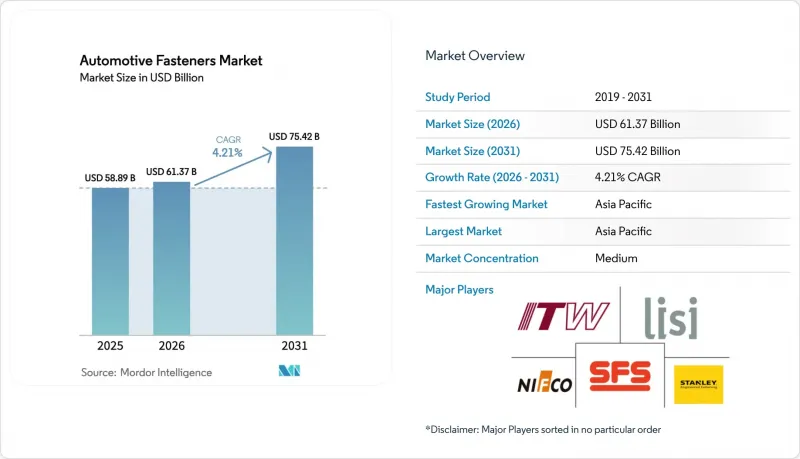
根據 Mordor Intelligence 預測,汽車緊固件市場規模將從 2025 年的 588.9 億美元成長到 2026 年的 613.7 億美元,到 2031 年將達到 754.2 億美元,2026 年至 2031 年的複合年成長率為 4.21%。
本報告按緊固件類型(例如螺絲型)、車輛類型(例如摩托車)、驅動系統(例如內燃機)、功能(可拆卸/不可拆卸)、材質、塗層/表面處理、應用、配銷通路和地區進行分類。市場預測以價值(美元)和數量(單位)表示。
全球汽車緊固件市場趨勢及洞察
輕量化設計正在加速對先進拉鍊的需求。
隨著美國平均燃油經濟性標準 (CAFE) 的修訂以及歐盟 2025 年車輛平均二氧化碳排放目標的訂定,汽車製造商面臨大幅降低車輛重量的壓力。這種對減重的關注使得緊固件備受關注。雖然緊固件在車輛重量中所佔比例很小,但它們卻是不可或缺的重要組成部分。鋁製螺栓相比鋼製螺栓重量更輕,但需要絕緣套管和鍍鋅鎳層以防止電流腐蝕。這些額外的措施會略微增加每個緊固件的成本。同時,鈦製緊固件的價格遠高於 8.8 級鋼製緊固件,但其應用範圍正從電動方程式賽車到高階豪華電動車 (EV) 領域日益普及。鈦製緊固件的優點在於其顯著的減重效果,足以抵消高成本。此外,對緊固件的要求也變得越來越複雜。過去只需要幾種尺寸鋼製螺栓的車身本體,現在需要更多種類的緊固件,包括鋁製、不銹鋼和塗層鋼製緊固件。此次擴張顯著增加了二級供應商的營運資金需求,他們的要求也變得更加嚴格。
全球汽車生產復甦
2024年,微型車產量顯著復甦,預計2026年將進一步成長。這一復甦表明,近年來半導體短缺之後,汽車緊固件的基準需求正在恢復。在此期間,中國成為主要驅動力,印度和東南亞也在緊固件需求成長中發揮了重要作用。這些地區合計貢獻了需求成長的很大一部分。受印度基礎設施獎勵策略和加州排放氣體法規的推動,商用車產量實現了顯著成長,尤其是在重型車輛領域。這一成長使亞洲供應商受益,他們擁有快速的交貨時間,這使他們相對於依賴預庫存的歐洲製造商具有明顯的優勢。儘管歐洲產量保持穩定,但全球產量成長的趨勢正在為其提供輔助。
電動車架構減少了每輛車的緊固件數量。
電池式電動車(BEV) 省去了引擎缸體、變速箱、排氣系統和燃料箱等零件。與傳統內燃機汽車相比,這項變更顯著減少了每輛車的緊固件數量。例如,特斯拉 Model Y 使用的緊固件數量少於其汽油跨界車型,反映了顯著的減少。此外,電池的結構設計進一步減少了所需的緊固件數量。雖然高強度 10.9 伏特緊固件在純電動車中的價值正在提升,部分抵消了產量下降的影響,但對汽車緊固件市場的整體影響仍然是負面的。
細分市場分析
到2025年,螺紋緊固件的銷售額將佔總銷售額的53.41%,這反映了其在底盤、動力傳動系統和內裝系統中的廣泛應用。由於嚴格的碰撞測試標準,扭力屈服螺栓和自鎖螺帽等特殊用途和安全關鍵零件對於安全帶錨點和電池組的固定至關重要,預計到2031年,這些零件的複合年成長率將達到4.23%。雖然通用螺紋零件在純電動車(BEV)生產中的需求逐漸下降,但混合動力汽車和傳統內燃機汽車的絕對需求意味著該細分市場的汽車緊固件市場仍然龐大。
採用螺紋鎖固劑和專屬式墊圈的專用緊固件可減少保固索賠和生產線返工,因此其售價可高出兩到五倍。無螺絲卡扣和鉚釘是內飾件的必備配件,但隨著豪華車白車身塗裝工藝中黏合劑的普及,它們的成長速度正在放緩。即使在標準化的採購環境下,專用產品的溢價也有助於維持利潤率。
到2025年,乘用車將佔總產量的67.73%,這反映了緊固件的高密度使用以及全球整體6,800萬輛的產量。同時,摩托車預計將保持最高的成長率,到2031年將以4.37%的複合年成長率成長,這主要得益於印度和中國踏板車的電動化,以及電池外殼和馬達支架中螺紋螺栓的應用。輕型商用車和重型卡車合計佔總產量的18%,這主要得益於最後一公里配送的電氣化。
雖然每輛電動滑板車使用的緊固件平均數量呈指數級成長,但電動乘用車使用的螺栓數量比內燃機 (ICE) 車型少 220 到 280 個。採用模組化貨箱設計的車隊營運商正在將緊固件 SKU 標準化,涵蓋 3 到 5 個負載容量等級,從而將零件庫存減少多達五分之二。
即使到了2025年,內燃機汽車(ICE)仍將佔據緊固件需求的81.15%,但由於中國和歐盟的零排放法規,電池式電動車(BEV)預計將以4.35%的複合年成長率成長。儘管純電動車每輛車使用的緊固件數量較少,但由於轉向使用10.9級螺栓和不銹鋼螺栓,每輛車的緊固件價值卻在增加。混合動力汽車佔據著一個過渡性的細分市場,其緊固件使用量與內燃機汽車基本相同,同時新增了40至60個與電池相關的連接點。
例如,特斯拉的 4680 電池組使用了 112 個 M8 鍍鋅鎳螺栓,扭力為 25 牛頓米,以防止氫脆,這表明即使減少了螺栓的數量,仍然存在高價值的商業機會。
區域分析
預計到2025年,亞太地區將佔全球需求的37.86%,並在2031年之前以4.31%的複合年成長率成長。該地區的汽車產業尤其強勁,這主要得益於中國龐大的汽車產量和印度的快速成長。東南亞的汽車產量也在不斷成長,隨著汽車製造商(OEM)將籌資策略從中國轉移,東南亞正成為緊固件工廠的新目的地,並受到越來越多的關注。尤其值得注意的是,目前中國本土供應商滿足了近一半的本地汽車製造商需求,與歐洲同行相比,他們擁有更快的交貨速度和更具競爭力的價格。印度快速成長的電動摩托車市場進一步鞏固了亞洲在汽車緊固件領域的領先地位。
歐洲在全球2025年的需求中佔據了相當大的佔有率,但由於生產停滯以及高階品牌轉向黏合劑連接,其成長速度有所放緩。在汽車生產大國德國,緊固件的消耗量龐大,主要由業界領導者KAMAX和Bossard供應的高強度緊固件。修訂後的報廢車輛指令(ELV指令)繼續推薦使用可拆卸連接件,這支撐了對螺絲緊固件的需求,儘管車身修理廠的產量有所下降。同時,Stellantis將現有品牌整合到STLA平台下,顯著減少了SKU數量,並精簡了供應商名單。
預計到2025年,北美將佔據全球緊固件需求的大部分佔有率,並持續成長至2031年。美國輕型卡車和SUV的產量強勁,而《通膨控制法案》規定的國內訂單要求正引導緊固件訂單流向伊利諾伊工具公司(Illinois Tool Works)和史丹利工程緊固件公司(Stanley Engineered Fastening)等國內供應商。此外,反傾銷稅的實施已將進口從中國轉移到越南和墨西哥,導致進口成本增加。墨西哥汽車製造業的快速擴張吸引了大量投資用於新建緊固件產能,而位於加拿大安大略省的工廠則高度依賴高效的跨境供應鏈。
其他好處:
- Excel格式的市場預測(ME)表
- 3個月的分析師支持
目錄
第1章:引言
- 研究假設和市場定義
- 調查範圍
第2章:調查方法
第3章執行摘要
第4章 市場狀況
- 市場概覽
- 市場促進因素
- 隨著輕量化技術的進步,對先進拉鍊的需求也加速成長。
- 全球汽車生產復甦
- 需要微型緊固件的電子元件產能增加
- 模組化車輛架構正在推動對基於平台的解決方案的需求。
- 老舊車輛數量的不斷增加,推動了售後市場對替換車輛的需求。
- 有關再利用和循環經濟的法規正在推動對可拆卸緊固件的需求。
- 市場限制因素
- 電動車架構減少了每台設備上的拉鍊數量。
- 黏合劑黏接和雷射焊接的替代方案
- 原料價格波動和供應中斷
- 貿易保護措施和反傾銷稅會擾亂供應鏈
- 價值供應鏈分析
- 監理情勢
- 技術展望
- 波特五力模型
第5章 市場規模與成長預測
- 依拉鍊類型
- 帶螺絲
- 無螺絲
- 特殊用途/安全關鍵用途
- 車輛類型
- 摩托車
- 搭乘用車
- 輕型商用車
- 中型和重型商用車輛
- 非公路用車輛
- 透過推進力
- 內燃機車
- 電池式電動車
- 混合動力汽車和燃料電池汽車
- 按功能
- 可拆卸
- 不可拆卸
- 材料
- 鋼
- 不銹鋼
- 鋁
- 黃銅
- 塑膠和複合材料
- 塗層/表面處理
- 鋅
- 磷酸鹽
- 鎳和鉻
- 有機塗層和乾膜
- 透過使用
- 車身及外觀
- 底盤和懸吊
- 動力傳動系統和引擎
- 內裝和座椅
- 電子與電機工程
- 透過分銷管道
- OEM
- 售後市場
- 按地區
- 北美洲
- 美國
- 加拿大
- 其他北美國家
- 南美洲
- 巴西
- 阿根廷
- 其他南美國家
- 歐洲
- 德國
- 英國
- 法國
- 義大利
- 西班牙
- 其他歐洲國家
- 亞太地區
- 中國
- 印度
- 日本
- 韓國
- 其他亞太國家
- 中東和非洲
- 阿拉伯聯合大公國
- 沙烏地阿拉伯
- 南非
- 土耳其
- 其他中東和非洲國家
- 北美洲
第6章 競爭情勢
- 市場集中度
- 策略趨勢
- 市佔率分析
- 公司簡介
- Illinois Tool Works Inc.
- LISI Group
- Nifco Inc.
- SFS Group AG
- Stanley Black & Decker Inc.(Stanley Engineered Fastening)
- Bulten AB
- KAMAX Holding GmbH & Co. KG
- Bossard Group
- Trifast plc(TR Fastenings Ltd.)
- Sundram Fasteners Limited
- ARaymond
- Shanghai Tianbao Fastener Manufacturing Co. Ltd.
- KOVA Fasteners Pvt. Ltd.
- The Phillips Screw Company
- Jiangsu Xing Chang Jiang International Co. Ltd.
- Penn Engineering & Manufacturing Corp.
- Aoyama Seisakusho Co. Ltd.(Indiana Automotive Fasteners)
第7章 市場機會與未來展望
According to Mordor Intelligence, the automotive fasteners market size is expected to grow from USD 58.89 billion in 2025 to USD 61.37 billion in 2026 and is forecast to reach USD 75.42 billion by 2031 at a 4.21% CAGR over 2026-2031.
This report is Segmented by Fastener Type (Threaded and More), Vehicle Type (Two-Wheelers and More), Propulsion (ICE Vehicles and More), Function (Detachable and Non-Detachable), Material, Coating/Finish, Application, Distribution Channel, and Geography. Market Forecasts are Provided in Value (USD) and Volume (Units).
Global Automotive Fasteners Market Trends and Insights
Lightweighting Accelerating Demand for Advanced Fasteners
In response to the U.S. Corporate Average Fuel Economy (CAFE) updates and the European Union's 2025 fleet-average CO2 targets, automakers are under pressure to significantly reduce vehicle weight. This focus on weight reduction has brought attention to fasteners, which contribute a small but notable percentage of a vehicle's curb weight. While aluminum bolts offer substantial weight savings compared to steel, they require isolation sleeves or zinc-nickel coatings to prevent galvanic corrosion. These additional measures slightly increase the cost of each fastener. On the other hand, titanium fasteners, which are considerably more expensive than Grade 8.8 steel, are making their way from the world of Formula E racing to high-end luxury electric vehicles (EVs). Here, the appeal lies in the significant weight reduction that justifies the higher cost. Furthermore, the complexity of fastener requirements has increased: a body-in-white that previously relied on a few steel bolt sizes now demands a wider variety of SKUs. These include aluminum, stainless steel, and coated steel options. This expansion has led to a notable rise in working capital needs for tier-2 vendors, with requirements increasing considerably .
Recovery of Global Vehicle Production
In 2024, light-vehicle output experienced a significant rebound and is projected to grow further by 2026. This resurgence signals a restoration of baseline demand in the automotive fasteners market, following the semiconductor shortfall of recent years. During this period, China emerged as a major contributor, with India and Southeast Asia also playing substantial roles in driving demand for fasteners. Together, these regions accounted for a considerable share of the increased demand. Buoyed by an infrastructure stimulus in India and emissions mandates in California, commercial-vehicle production saw notable growth, particularly in heavy-duty segments. This surge benefits Asian suppliers, who boast rapid delivery windows, giving them a distinct advantage over European mills that rely on pre-positioned inventory. While Europe's production remained steady, the global momentum in unit builds serves as a supportive tailwind .
EV Architecture Reducing Fastener Count Per Vehicle
Battery-electric vehicles (BEVs) shed components like engine blocks, transmissions, exhaust systems, and fuel tanks. This change results in a significant reduction in the number of fasteners per unit when compared to traditional internal-combustion vehicles. For instance, Tesla's Model Y employs fewer fasteners than a gasoline crossover, marking a notable reduction. Additionally, structural battery designs further decrease the number of fasteners required. While the value of high-strength Grade 10.9 bolts in BEVs has increased, partially compensating for the reduced volume, the overall impact on the automotive fasteners market remains negative.
Other drivers and restraints analyzed in the detailed report include:
- Growing Electronics Content Requiring Micro-Fasteners
- Modular Vehicle Architectures Boosting Platform-Based Demand
- Adhesive Bonding and Laser Welding Substitution
For complete list of drivers and restraints, kindly check the Table Of Contents.
Segment Analysis
Threaded fasteners held 53.41% of 2025 revenue, underlining their versatility in chassis, powertrain, and interior systems. Specialty and safety-critical units, including torque-to-yield bolts and self-locking nuts, will post a 4.23% CAGR to 2031 as stringent crash-test protocols make them indispensable for seat-belt anchorages and battery-pack retention. Commodity threaded parts face gradual volume erosion in BEVs, yet their absolute demand in hybrids and traditional internal-combustion cars keeps the automotive fasteners market size substantial for this segment.
Specialty fasteners command 2-5X higher prices by integrating thread-locking compounds or captive washers that cut warranty claims and line rework. Non-threaded clips and rivets, while essential in interior trim, grow slower as adhesives gain favor in premium body-in-white. The premium attached to specialty items shields margins even in a platform-standardized procurement environment.
Passenger cars consumed 67.73% of all units in 2025, reflecting higher fastener intensity and global builds of 68 million vehicles. Two-wheelers, however, will log the fastest 4.37% CAGR through 2031 as India and China electrify scooter fleets, adding threaded bolts for battery enclosures and motor mounts. Light commercial vehicles and heavy trucks together account for 18% of volume, supported by last-mile delivery electrification.
Average fastener content per electric scooter is climbing exponentially, while electric passenger cars lose 220-280 bolts versus ICE models. Fleet operators adopting modular cargo bed designs standardize fastener SKUs across 3-5 payload classes, lowering parts inventories by up to two-fifths.
Internal-combustion vehicles still generated 81.15% of fastener demand in 2025, yet BEVs will expand at a 4.35% CAGR due to zero-emission rules in China and the EU. Although BEVs use fewer fasteners per vehicle, the shift toward Grade 10.9 bolts and stainless-steel variants lifts value per unit. Hybrid cars occupy a transitional niche, keeping most ICE fasteners while adding 40-60 new battery-related joints.
Tesla's 4680 pack, for instance, employs 112 M8 zinc-nickel-coated bolts torqued to 25 Nm to prevent hydrogen embrittlement, illustrating value-rich opportunities even as counts decline.
Complete Report Scope:
- By Fastener Type
- Threaded
- Non-threaded
- Specialty/Safety-critical
- By Vehicle Type
- Two-Wheelers
- Passenger Cars
- Light Commercial Vehicles
- Medium and Heavy Commercial Vehicles
- Off-Highway Vehicles
- By Propulsion
- IC Engine Vehicles
- Battery Electric Vehicles
- Hybrid and Fuel-Cell Vehicles
- By Function
- Detachable
- Non-detachable
- By Material
- Steel
- Stainless Steel
- Aluminum
- Brass
- Plastics and Composites
- By Coating/Finish
- Zinc
- Phosphate
- Nickel and Chrome
- Organic and Dry Film
- By Application
- Body and Exterior
- Chassis and Suspension
- Powertrain and Engine
- Interior and Seating
- Electronics and Electrical
- By Distribution Channel
- OEM
- Aftermarket
- By Geography
- North America
- United States
- Canada
- Rest of North America
- South America
- Brazil
- Argentina
- Rest of South America
- Europe
- Germany
- United Kingdom
- France
- Italy
- Spain
- Rest of Europe
- Asia Pacific
- China
- India
- Japan
- South Korea
- Rest of Asia Pacific
- Middle East and Africa
- United Arab Emirates
- Saudi Arabia
- South Africa
- Turkey
- Rest of Middle East and Africa
- North America
Geography Analysis
Asia Pacific held 37.86% of global demand in 2025 and is expected to grow at a 4.31% CAGR to 2031. China's significant automotive output, coupled with India's rapid growth, underscores the region's automotive prowess. Southeast Asia, with its growing vehicle production, is becoming a magnet for new fastener plants as OEMs pivot their sourcing strategies away from China. Notably, domestic suppliers in China are now meeting nearly half of local OEM demands, boasting swift delivery times and competitive pricing compared to their European counterparts. India's booming electric two-wheeler market has further solidified Asia's dominance in the automotive fasteners arena.
Europe, which represented a substantial portion of global demand in 2025, experienced a slower growth rate, attributed to production stagnation and a shift by premium brands towards adhesive bonding. In Germany, with its significant automotive output, a large volume of fasteners was consumed, predominantly high-strength grades supplied by industry leaders KAMAX and Bossard. The revision of the End-of-Life Vehicles Directive continues to favor detachable joints, bolstering the demand for threaded fasteners, even as body-shop volumes wane. Meanwhile, Stellantis's consolidation of legacy brands under the STLA platform has led to a notable reduction in SKUs and a more streamlined supplier roster.
North America, accounting for a significant share of global demand in 2025, is set to achieve steady growth through 2031. U.S. production of light trucks and SUVs has been robust, with the Inflation Reduction Act's content stipulations channeling fastener orders towards domestic suppliers like Illinois Tool Works and Stanley Engineered Fastening. Additionally, anti-dumping duties have shifted imports from China to Vietnam and Mexico, resulting in increased landed costs. Mexico's burgeoning automotive output has attracted significant investment in new fastener capacity, while Ontario's plants in Canada are heavily dependent on efficient cross-border supply chains.
- Illinois Tool Works Inc.
- LISI Group
- Nifco Inc.
- SFS Group AG
- Stanley Black & Decker Inc. (Stanley Engineered Fastening)
- Bulten AB
- KAMAX Holding GmbH & Co. KG
- Bossard Group
- Trifast plc (TR Fastenings Ltd.)
- Sundram Fasteners Limited
- ARaymond
- Shanghai Tianbao Fastener Manufacturing Co. Ltd.
- KOVA Fasteners Pvt. Ltd.
- The Phillips Screw Company
- Jiangsu Xing Chang Jiang International Co. Ltd.
- Penn Engineering & Manufacturing Corp.
- Aoyama Seisakusho Co. Ltd. (Indiana Automotive Fasteners)
Additional Benefits:
- The market estimate (ME) sheet in Excel format
- 3 months of analyst support
TABLE OF CONTENTS
1 Introduction
- 1.1 Study Assumptions & Market Definition
- 1.2 Scope of the Study
2 Research Methodology
3 Executive Summary
4 Market Landscape
- 4.1 Market Overview
- 4.2 Market Drivers
- 4.2.1 Lightweighting Accelerating Demand for Advanced Fasteners
- 4.2.2 Recovery of Global Vehicle Production
- 4.2.3 Growing Electronics Content Requiring Micro-Fasteners
- 4.2.4 Modular Vehicle Architectures Boosting Platform-Based Demand
- 4.2.5 Ageing Vehicle PARC Driving Aftermarket Replacements
- 4.2.6 Re-Use and Circular-Economy Mandates Spurring Demand for Removable Fasteners
- 4.3 Market Restraints
- 4.3.1 EV Architecture Reducing Fastener Count Per Vehicle
- 4.3.2 Adhesive Bonding and Laser Welding Substitution
- 4.3.3 Raw-Material Price Volatility and Supply Disruptions
- 4.3.4 Trade-Defense Measures and Anti-Dumping Duties Disrupting Supply Chains
- 4.4 Value / Supply-Chain Analysis
- 4.5 Regulatory Landscape
- 4.6 Technological Outlook
- 4.7 Porter's Five Forces
- 4.7.1 Bargaining Power of Suppliers
- 4.7.2 Bargaining Power of Buyers
- 4.7.3 Threat of New Entrants
- 4.7.4 Threat of Substitutes
- 4.7.5 Competitive Rivalry
5 Market Size & Growth Forecasts (Value (USD) and Volume (Units))
- 5.1 By Fastener Type
- 5.1.1 Threaded
- 5.1.2 Non-threaded
- 5.1.3 Specialty/Safety-critical
- 5.2 By Vehicle Type
- 5.2.1 Two-Wheelers
- 5.2.2 Passenger Cars
- 5.2.3 Light Commercial Vehicles
- 5.2.4 Medium and Heavy Commercial Vehicles
- 5.2.5 Off-Highway Vehicles
- 5.3 By Propulsion
- 5.3.1 IC Engine Vehicles
- 5.3.2 Battery Electric Vehicles
- 5.3.3 Hybrid and Fuel-Cell Vehicles
- 5.4 By Function
- 5.4.1 Detachable
- 5.4.2 Non-detachable
- 5.5 By Material
- 5.5.1 Steel
- 5.5.2 Stainless Steel
- 5.5.3 Aluminum
- 5.5.4 Brass
- 5.5.5 Plastics and Composites
- 5.6 By Coating/Finish
- 5.6.1 Zinc
- 5.6.2 Phosphate
- 5.6.3 Nickel and Chrome
- 5.6.4 Organic and Dry Film
- 5.7 By Application
- 5.7.1 Body and Exterior
- 5.7.2 Chassis and Suspension
- 5.7.3 Powertrain and Engine
- 5.7.4 Interior and Seating
- 5.7.5 Electronics and Electrical
- 5.8 By Distribution Channel
- 5.8.1 OEM
- 5.8.2 Aftermarket
- 5.9 By Geography
- 5.9.1 North America
- 5.9.1.1 United States
- 5.9.1.2 Canada
- 5.9.1.3 Rest of North America
- 5.9.2 South America
- 5.9.2.1 Brazil
- 5.9.2.2 Argentina
- 5.9.2.3 Rest of South America
- 5.9.3 Europe
- 5.9.3.1 Germany
- 5.9.3.2 United Kingdom
- 5.9.3.3 France
- 5.9.3.4 Italy
- 5.9.3.5 Spain
- 5.9.3.6 Rest of Europe
- 5.9.4 Asia Pacific
- 5.9.4.1 China
- 5.9.4.2 India
- 5.9.4.3 Japan
- 5.9.4.4 South Korea
- 5.9.4.5 Rest of Asia Pacific
- 5.9.5 Middle East and Africa
- 5.9.5.1 United Arab Emirates
- 5.9.5.2 Saudi Arabia
- 5.9.5.3 South Africa
- 5.9.5.4 Turkey
- 5.9.5.5 Rest of Middle East and Africa
- 5.9.1 North America
6 Competitive Landscape
- 6.1 Market Concentration
- 6.2 Strategic Moves
- 6.3 Market Share Analysis
- 6.4 Company Profiles (includes Global Level Overview, Market Level Overview, Core Segments, Financials as Available, Strategic Information, Market Rank/Share for Key Companies, Products and Services, SWOT Analysis, and Recent Developments)
- 6.4.1 Illinois Tool Works Inc.
- 6.4.2 LISI Group
- 6.4.3 Nifco Inc.
- 6.4.4 SFS Group AG
- 6.4.5 Stanley Black & Decker Inc. (Stanley Engineered Fastening)
- 6.4.6 Bulten AB
- 6.4.7 KAMAX Holding GmbH & Co. KG
- 6.4.8 Bossard Group
- 6.4.9 Trifast plc (TR Fastenings Ltd.)
- 6.4.10 Sundram Fasteners Limited
- 6.4.11 ARaymond
- 6.4.12 Shanghai Tianbao Fastener Manufacturing Co. Ltd.
- 6.4.13 KOVA Fasteners Pvt. Ltd.
- 6.4.14 The Phillips Screw Company
- 6.4.15 Jiangsu Xing Chang Jiang International Co. Ltd.
- 6.4.16 Penn Engineering & Manufacturing Corp.
- 6.4.17 Aoyama Seisakusho Co. Ltd. (Indiana Automotive Fasteners)
7 Market Opportunities & Future Outlook
- 7.1 White-space & Unmet-need Assessment

 汽車製造用鉚螺母市場:全球市場預測,2026-2032年汽車緊固件市場-2026-2032年全球市場預測
 2026-2030年全球汽車緊固件市場
 汽車緊固件市場預測至2034年-按產品類型、材料、車輛類型、應用、銷售管道和地區分類的全球分析
 2026年全球高溫V型卡箍法蘭市場報告
 汽車緊固件市場:按產品類型、車輛類型、應用和地區分類。2026年全球汽車緊固件市場報告
 汽車緊固件市場規模、佔有率、成長及全球產業分析:按類型、應用和地區分類,並預測至2026-2034年
 汽車緊固件市場分析及預測(至2035年):類型、產品類型、材質類型、應用、技術、最終用戶、功能、安裝類型、工藝全球汽車緊固件市場規模、佔有率、趨勢和成長分析報告(2026-2034年)