

 |
市場調查報告書
商品編碼
2154283
日本電動車租賃市場:市場佔有率分析、產業趨勢與統計及成長預測(2026-2031)Japan Electric Vehicle Leasing - Market Share Analysis, Industry Trends & Statistics, Growth Forecasts (2026 - 2031) |
||||||

※ 本網頁內容可能與最新版本有所差異。詳細情況請與我們聯繫。
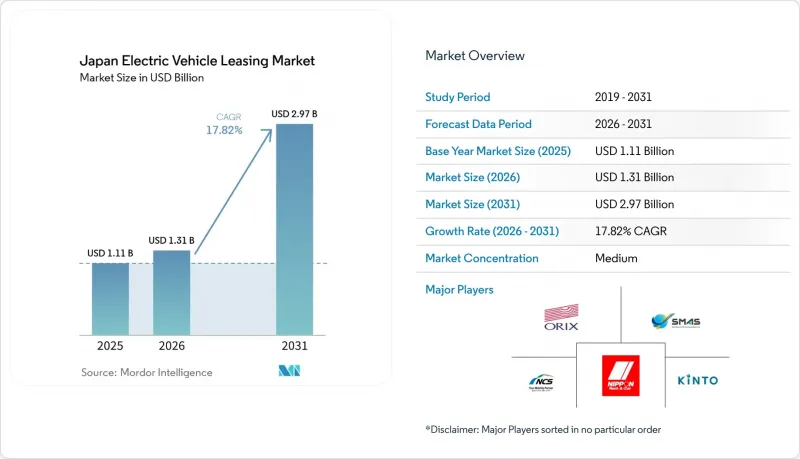
據 Mordor Intelligence 稱,2025 年日本電動車租賃市場價值 11.1 億美元,預計將從 2026 年的 13.1 億美元成長到 2031 年的 29.7 億美元,2026 年至 2031 年的複合年成長率為 17.82%。
日本電動車租賃市場趨勢與分析
政府對電動車租賃的補貼和稅收優惠
日本經濟產業省已為2024-2025財政年度累計。這筆資金將用於支持充電基礎設施建設項目,並繼續推行“清潔能源汽車補貼”,該補貼電池式電動車提供最高130萬日元的補貼。此外,透過實施“綠色鋼鐵獎勵”,補貼金額可能會進一步增加。在東京,政府已推出津貼,用於支付公寓大樓充電樁的大部分費用,從而簡化了多用戶住宅的充電樁推廣流程。此外,全國範圍內的車輛重量稅豁免政策(適用於第二次車輛檢驗後)也提高了車輛的殘值。這是因為第二代及以後的車主可以享有稅收減免。這些限時優惠政策鼓勵車隊管理者提前下單,尤其是在相關標準收緊之前,這將進一步推動日本電動租車市場的發展。
企業ESG目標正在加速車隊電氣化進程。
為了響應科學碳目標舉措和投資者責任準則,各公司正將電動車的採用納入永續性策略。繼NTT集團承諾「EV100」之後,已為許多市政當局推出了承包租賃方案。這項轉變正推動採購慣例從「機會主義」轉向嚴格的合規驅動。例如,豐田在2025年箱根驛傳上發布的燃料電池汽車等重要案例,凸顯了國家層級營運的準備就緒。這種日益成長的關注促使供應鏈合作夥伴加快營運電氣化進程,以確保合約的簽署。此外,由於核心租戶的網路效應,需求正以遠超初始訂單量的速度激增。這一趨勢不僅為租賃公司鞏固了多年的收入來源,還將環境、社會和治理(ESG)壓力轉化為可靠的租賃交易管道。
電動車殘值不確定且折舊風險高
由於對電池健康狀況的擔憂以及車型快速更新換代,電池式電動車(BEV)的轉售價值低於內燃機汽車。租賃公司遠端檢測電池健康狀況,在租賃期滿且車輛仍在保固期內時出售車輛。精算資料的缺乏增加了殘值風險。如果電池劣化超出預期,租賃公司將蒙受損失,這可能導致租賃價格上漲,並降低日本電動車租賃市場的需求。豐田等汽車製造商正在探索將電池用於儲能,以賦予其二次利用的價值,從而確定電池的殘值。然而,長期租賃協議的普及仍然受到貨幣化方式分散、分銷市場流動性不足以及電池健康狀況資訊揭露缺乏標準化等問題的限制。
細分市場分析
截至2025年,乘用車將佔日本電動車租賃市場佔有率的75.13%,而商用車預計到2031年將以18.14%的複合年成長率成長。鈴木和豐田正利用日本政府對輕型車的稅收優惠政策,以低於進口競爭對手的價格銷售小型商用貨車。這些車型的續航里程足以滿足大多數城市路線的需求,並滿足了微型物流中心的需求。同時,計劃於2027年推出的燃料電池輕型卡車預計將零排放營運範圍擴展到農村地區。考慮到電池重量和充電延遲先前一直阻礙這些路線的生產力,這一點尤其重要。
乘用車在提升早期採用者的認知度方面發揮著至關重要的作用。 Times Car 擁有龐大的會員基礎,正利用電動車的數據來改進其殘值計算演算法並最佳化選配方案。然而,隨著技術的快速發展,企業客戶傾向於縮短租賃期限,以最大限度地降低車型過時的風險。這一趨勢正在為日本電動車租賃市場帶來顯著變化,而商用車市場也因此受到越來越多的關注。
2025年,電池式電動車(BEV)佔日本電動車租賃市場的67.34%。在豐田第三代燃料電池堆和巖谷株式會社52座加氫站的支持下,燃料電池汽車(FCEV)預計將在2026年至2031年間以22.16%的年均成長率成長,成為所有動力傳動系統中增速最快的。隨著福島氫能調查區綠色氫氣供應的擴大以及跨境OEM合作的建立,預計到2030年氫氣價格將大幅下降。如果氫氣價格與純電動車持平,燃料電池車將比純電動車更具成本效益,尤其對於日行駛里程較長的車輛而言,這將刺激日本電動車租賃市場的成長,尤其是在長途物流領域。
其他好處:
- Excel格式的市場預測(ME)表
- 3個月的分析師支持
目錄
第1章:引言
- 研究假設和市場定義
- 調查範圍
第2章:調查方法
第3章執行摘要
第4章 市場狀況
- 市場概覽
- 市場促進因素
- 政府對電動車租賃的補貼和稅收優惠
- 企業ESG目標正在加速汽車電氣化進程。
- 公營和私營部門擴大充電基礎設施
- 與內燃機汽車 (ICE) 相比,電動車 (EV) 的總擁有成本更低。
- OEM電池狀況分析可降低殘值風險。
- 車輛到電網(V2G)定價方案試點項目,該方案支持收益分成租賃
- 市場限制因素
- 電動車殘值不確定且折舊風險較高
- 公寓大樓內個人充電樁數量有限。
- 保守的消費金融文化傾向長期租賃
- 進口導致交貨時間波動
- 價值供應鏈分析
- 監理情勢
- 技術展望
- 波特五力分析
第5章 市場規模與成長預測
- 車輛類型
- 搭乘用車
- 商用車輛
- 依推進類型
- 電池式電動車
- 插電式混合動力電動車
- 燃料電池電動車
- 最終用戶
- 個人客戶
- 企業用車
- 政府機構
- 共乘和配送平台
- 時期
- 短期(不足1年)
- 中期(1-3年)
- 長期(超過3年)
第6章 競爭情勢
- 市場集中度
- 策略趨勢
- 市佔率分析
- 公司簡介
- ORIX Corporation
- Sumitomo Mitsui Auto Service Co., Ltd.
- Nippon Car Solutions Co., Ltd.
- Tokyo Century Corp.(Nippon Rent-A-Car)
- Toyota Financial Services Corporation(KINTO)
- Fuyo Auto Lease Co., Ltd.
- JA Mitsui Leasing, Ltd.
- Joycal Japan Co., Ltd.
- Marubeni Auto Leasing Corp.
- Hitachi Capital Auto Lease Corp.
- Nissan Financial Services Co., Ltd.
- Ayvens Group
第7章 市場機會與未來展望
According to Mordor Intelligence, the Japanese electric vehicle leasing market size was valued at USD 1.11 billion in 2025, and is expected to grow from USD 1.31 billion in 2026 to USD 2.97 billion by 2031, growing at a CAGR of 17.82% over 2026-2031.
Japan Electric Vehicle Leasing Market Trends and Insights
Government Subsidies and Tax Incentives for EV Leases
Japan's Ministry of Economy, Trade, and Industry has allocated funds for the fiscal years 2024-2025. This funding will support charging projects and continue the Clean Energy Vehicle subsidy, which provides up to JPY 1.3 million per battery-electric vehicle. This figure can rise with green-steel bonuses . Notably, this subsidy amount can increase with the addition of green-steel bonuses. In Tokyo, a grant that covers a significant portion of the costs for condominium chargers is making it easier for multi-unit dwellings to adopt these technologies. Additionally, a national weight-tax exemption, applicable after a vehicle's second inspection, enhances residual value projections. This is because secondary owners benefit from a lighter tax burden. Such time-sensitive incentives are prompting fleet managers to expedite their orders, especially before the criteria become stricter, thereby boosting the momentum of Japan's electric vehicle leasing market.
Corporate ESG Targets Accelerating Fleet Electrification
Corporations are now integrating electric vehicle adoption into their sustainability strategies, aligning with the Science Based Targets initiative and investor stewardship codes. Following NTT Group's EV100 commitment, turnkey leasing programs have been launched, serving numerous municipalities. This shift has transitioned procurement practices from being opportunistic to strictly compliance-driven. Notable deployments, such as Toyota fuel-cell vehicles showcased during the 2025 Hakone Ekiden relay, have underscored operational readiness at the national level. This visibility has spurred supply-chain partners to electrify their operations to secure contracts. Furthermore, demand has surged beyond initial orders, thanks to network effects from anchor tenants. This trend not only solidifies multi-year revenue streams for lessors but also turns ESG pressures into reliable lease pipelines.
Uncertain EV Residual Values and Higher Depreciation Risk
Battery electric vehicles (BEVs) have lower resale values than internal combustion engine vehicles due to battery health concerns and rapid model advancements. Lessors use battery-state telemetry to certify battery health and market off-lease vehicles with remaining warranty coverage. Limited actuarial data increases residual-value risk. If battery degradation exceeds projections, lessors absorb the loss, potentially raising lease payments and reducing demand in Japan's electric vehicle leasing market. OEMs such as Toyota are exploring second-life energy storage to establish battery salvage values. However, fragmented monetization, limited secondary-market liquidity, and a lack of standardized battery-health disclosures continue to discourage longer lease terms.
Other drivers and restraints analyzed in the detailed report include:
- Expansion of Public and Private Charging Infrastructure
- Falling EV Total Cost-of-Ownership vs. ICE Vehicles
- Limited Private-Charger Installation in Multi-Unit Dwellings
For complete list of drivers and restraints, kindly check the Table Of Contents.
Segment Analysis
Passenger cars hold 75.13% of Japan's electric vehicle leasing market share in 2025, whereas the commercial vehicles are projected to grow at an 18.14% CAGR through 2031. Leveraging kei-class tax benefits, Suzuki and Toyota priced their mini-commercial van competitively, undercutting imported competitors. With a range suitable for most intra-city routes, the model meets the demands of micro-logistics hubs. Meanwhile, fuel-cell light-duty trucks, set to debut in fiscal 2027, promise to extend zero-emission capabilities to regional routes. This is significant, as battery weight and charging delays have previously hindered productivity in that range.
Passenger cars play a pivotal role in enhancing visibility for early adopters. Times Car, with a substantial membership base, utilizes data from electric units to refine residual algorithms and plan option packages. However, as technology evolves rapidly, corporate buyers are opting for shorter leases to minimize their risk of model-year obsolescence. This trend is driving a notable shift in Japan's electric vehicle leasing market, with an increasing focus on commercial asset classes.
Battery electric vehicles captured 67.34% share of the Japanese electric vehicle leasing market size in 2025. Fuel-cell electric vehicles are projected to expand at 22.16% annually over 2026-2031, the quickest pace among powertrains, supported by Toyota's third-generation stack and Iwatani's 52-station hydrogen network . With green hydrogen supplies scaling up at the Fukushima Hydrogen Energy Research Field and cross-border OEM alliances forming, hydrogen prices are projected to decline significantly by 2030. Achieving this price parity could position fuel-cell vehicles as more cost-effective than their battery counterparts, especially for fleets covering substantial daily distances, thereby spurring growth in Japan's electric vehicle leasing market, particularly in long-haul logistics.
Complete Report Scope:
- By Vehicle Type
- Passenger Cars
- Commercial Vehicles
- By Propulsion Type
- Battery Electric Vehicles
- Plug-in Hybrid Electric Vehicles
- Fuel-Cell Electric Vehicles
- By End User
- Individual Customers
- Corporate Fleets
- Government Agencies
- Ride-Sharing and Delivery Platforms
- By Duration
- Short-Term (Less than 1 year)
- Mid-Term (1-3 years)
- Long-Term (More than 3 years)
List of Companies Covered in this Report:
- ORIX Corporation
- Sumitomo Mitsui Auto Service Co., Ltd.
- Nippon Car Solutions Co., Ltd.
- Tokyo Century Corp. (Nippon Rent-A-Car)
- Toyota Financial Services Corporation (KINTO)
- Fuyo Auto Lease Co., Ltd.
- JA Mitsui Leasing, Ltd.
- Joycal Japan Co., Ltd.
- Marubeni Auto Leasing Corp.
- Hitachi Capital Auto Lease Corp.
- Nissan Financial Services Co., Ltd.
- Ayvens Group
Additional Benefits:
- The market estimate (ME) sheet in Excel format
- 3 months of analyst support
TABLE OF CONTENTS
1 Introduction
- 1.1 Study Assumptions & Market Definition
- 1.2 Scope of the Study
2 Research Methodology
3 Executive Summary
4 Market Landscape
- 4.1 Market Overview
- 4.2 Market Drivers
- 4.2.1 Government Subsidies and Tax Incentives for EV Leases
- 4.2.2 Corporate ESG Targets Accelerating Fleet Electrification
- 4.2.3 Expansion of Public and Private Charging Infrastructure
- 4.2.4 Falling EV Total Cost-of-Ownership vs. ICE Vehicles
- 4.2.5 OEM Battery-Health Analytics Lowering Residual-Value Risk
- 4.2.6 Vehicle-to-Grid Tariff Pilots Enabling Revenue-Sharing Leases
- 4.3 Market Restraints
- 4.3.1 Uncertain EV Residual Values and Higher Depreciation Risk
- 4.3.2 Limited Private-Charger Installation in Multi-Unit Dwellings
- 4.3.3 Conservative Consumer Finance Culture Toward Long-Term Leases
- 4.3.4 Import-Driven Delivery Lead-Time Volatility
- 4.4 Value / Supply-Chain Analysis
- 4.5 Regulatory Landscape
- 4.6 Technological Outlook
- 4.7 Porter's Five Forces Analysis
- 4.7.1 Threat of New Entrants
- 4.7.2 Bargaining Power of Suppliers
- 4.7.3 Bargaining Power of Buyers
- 4.7.4 Threat of Substitutes
- 4.7.5 Industry Rivalry
5 Market Size & Growth Forecasts (Value, USD)
- 5.1 By Vehicle Type
- 5.1.1 Passenger Cars
- 5.1.2 Commercial Vehicles
- 5.2 By Propulsion Type
- 5.2.1 Battery Electric Vehicles
- 5.2.2 Plug-in Hybrid Electric Vehicles
- 5.2.3 Fuel-Cell Electric Vehicles
- 5.3 By End User
- 5.3.1 Individual Customers
- 5.3.2 Corporate Fleets
- 5.3.3 Government Agencies
- 5.3.4 Ride-Sharing and Delivery Platforms
- 5.4 By Duration
- 5.4.1 Short-Term (Less than 1 year)
- 5.4.2 Mid-Term (1-3 years)
- 5.4.3 Long-Term (More than 3 years)
6 Competitive Landscape
- 6.1 Market Concentration
- 6.2 Strategic Moves
- 6.3 Market Share Analysis
- 6.4 Company Profiles (Includes Global Level Overview, Market Level Overview, Core Segments, Financials as Available, Strategic Information, Market Rank/Share for Key Companies, Products and Services, SWOT Analysis, and Recent Developments)
- 6.4.1 ORIX Corporation
- 6.4.2 Sumitomo Mitsui Auto Service Co., Ltd.
- 6.4.3 Nippon Car Solutions Co., Ltd.
- 6.4.4 Tokyo Century Corp. (Nippon Rent-A-Car)
- 6.4.5 Toyota Financial Services Corporation (KINTO)
- 6.4.6 Fuyo Auto Lease Co., Ltd.
- 6.4.7 JA Mitsui Leasing, Ltd.
- 6.4.8 Joycal Japan Co., Ltd.
- 6.4.9 Marubeni Auto Leasing Corp.
- 6.4.10 Hitachi Capital Auto Lease Corp.
- 6.4.11 Nissan Financial Services Co., Ltd.
- 6.4.12 Ayvens Group
7 Market Opportunities & Future Outlook
- 7.1 White-Space & Unmet-Need Assessment

 汽車租賃市場預測至2034年-按租賃類型、車輛類型、客戶類型、租賃期限、提供者類型和地區分類的全球分析
 美國電動汽車租賃:市場佔有率分析、行業趨勢和統計數據以及成長預測(2026-2031 年)
 全球汽車租賃市場規模、佔有率、趨勢和成長分析報告(2026-2034)汽車租賃市場預測至2034年-按產品類型、車輛類型、租賃形式、最終用戶和地區分類的全球分析
 2026-2030年全球電動車隊能源管理市場
 2026-2030年全球汽車租賃市場
 汽車設備租賃市場:依設備類型、租賃期限、最終用戶產業、預訂管道和燃料類型分類-2026-2032年全球市場預測
 2026年全球汽車設備租賃市場報告電動車隊部署市場預測至2034年:按組件、車隊類型、動力類型、充電方式、最終用戶和地區分類的全球分析
 電動車隊管理市場:依組件、車輛類型、車隊類型、應用和部署類型劃分 - 至2036年的全球預測