


 |
市場調查報告書
商品編碼
2154232
歐洲種植機械:市場佔有率分析、產業趨勢與統計、成長預測(2026-2031)Europe Planting Machinery - Market Share Analysis, Industry Trends & Statistics, Growth Forecasts (2026 - 2031) |
||||||

※ 本網頁內容可能與最新版本有所差異。詳細情況請與我們聯繫。
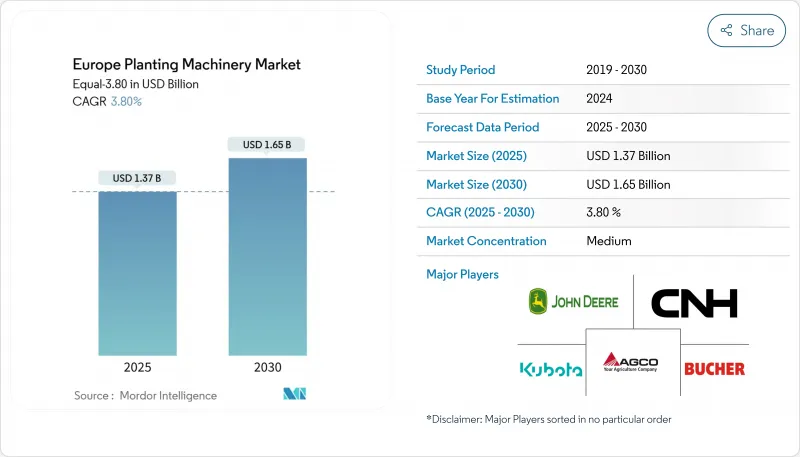
根據 Mordor Intelligence 預測,歐洲種植機械市場規模預計將在 2025 年達到 13.7 億美元,2026 年成長至 14.2 億美元,到 2031 年達到 17.1 億美元,在 2026 年至 2031 年的預測期內,複合年成長率將達到 3.79%。
歐洲種植機械市場趨勢與洞察
歐盟通用農業政策戰略計畫與國家農業機械補貼
2023-2027年通用農業政策(CAP)策略計畫透過投資措施支持農場現代化,其中包括精密農業設備和數位技術。根據歐盟委員會2023年的數據,已批准的CAP戰略計畫下的投資支持旨在惠及約40萬個農場,用於基礎設施和農業實踐的現代化改造。這些措施鼓勵投資於具備精準控制、資料收集和投入管理功能的播種機。由於每個歐盟成員國都根據其國家和地區的優先事項實施各自的CAP戰略計劃,因此歐洲各地的農業機械支援計劃的可用性和內容各不相同。這為播種機製造商和分銷商提供了機會,可以根據當地資助的投資計劃客製化設備規格、資金籌措方案和技術支持,從而滿足對現代化播種機的需求。
歐洲農業勞動力短缺和農業工資上漲
隨著農業勞動力的減少,機械化和省力技術在歐洲農場的重要性日益凸顯。根據歐盟統計局2026年發布的數據,歐盟農業就業人數預計將從2013年佔總就業人數的5.2%下降到2023年的3.9%,農業勞動力總數將達到840萬人。農業勞動力的減少促使生產者採用能夠以更少的勞動力覆蓋更大面積並減少重複性人工調整的播種機。因此,市場需求正轉向具備自動種子稱重、反壓調節、導航功能和駕駛室內控制系統等能夠提高作業效率的機器。隨著勞動力短缺日益嚴重,可靠且易於操作的播種機正在幫助農場維持播種能力,同時減少對人工的依賴,從而推動了歐洲各地對先進播種機的需求。
歐洲機械價格高企,農業融資成本不斷上漲
設備價格上漲和資金籌措會限制對先進播種機械的投資,尤其是在現金流有限或盈利不確定的農場。精準播種系統通常比傳統設備需要更大的前期投資,而不斷上漲的借貸成本會進一步增加總擁有成本。這種情況可能會促使農民延遲更換機器、選擇配置較低的型號或延長現有設備的使用壽命。因此,當設備成本和資金籌措與農業盈利下降同時發生時,歐洲播種市場面臨更大的壓力。租賃、季節性付款計劃和靈活的設備融資可以幫助減輕初始財務負擔。此外,製造商和分銷商可以透過提供資金籌措支援來改善先進播種技術的普及程度。
細分市場分析
截至2025年,自動化播種系統將佔歐洲播種機市場58.0%的設計佔有率,成為最大的設計細分市場,預計2026年至2031年將以7.0%的複合年成長率成長。這一領先地位反映了市場對電子種子稱重、分段控制和互聯操作日益成長的需求,尤其是在大規模農場中,這些農場尋求更高的播種精度和更少的人工調整。自動化系統也符合歐洲精密農業技術的發展趨勢。 2025年11月,LEMKEN GmbH & Co. KG公司展示了其「Faya MF」精準播種機,該播種機配備了ISOBUS iQblue作業系統、獨立行料斗和自動分段控制功能,進一步體現了自動化功能在播種設備中的持續整合。隨著歐洲農場擴大採用精準播種方法,對自動化系統的需求預計將推動該細分市場的成長。
半自動化系統為那些僅需特定電子功能而非高規格設備全自動化的農場提供了一種折衷選擇。這些系統仍然高度依賴操作員干預,同時支援電子監控等功能。如果經濟性、易操作性和完善的售後服務是關鍵的購買考量因素,那麼機械系統仍然是一個重要的選擇。全自動、半自動和機械配置的供應,使製造商能夠滿足歐洲市場不同規模農場、投資能力、技術要求和區域服務覆蓋範圍的需求。即使自動播種技術日益普及,這種廣泛的設備系列預計仍將維持該設計領域的市場需求。
其他好處:
- Excel格式的市場預測(ME)表
- 3個月的分析師支持
目錄
第1章:引言
- 研究假設和市場定義
- 調查範圍
第2章:調查方法
第3章執行摘要
第4章 市場狀況
- 市場概覽
- 市場促進因素
- 歐盟通用農業政策戰略計畫與國家農業支持補貼
- 歐洲農業勞動力短缺和農業工資上漲
- 歐洲氣候變遷與播種季節縮短
- 在歐盟,精準播種有助於減少投入並實現永續性目標。
- 由於機械設備老化,歐洲對更換設備的需求增加。
- 適用於歐洲分散農場可互通的種植系統
- 市場限制因素
- 歐洲設備價格高企,農業融資成本飆漲
- 小規模、分散的所有權結構限制了機器的年度運轉率。
- 連網種植設備的技術服務能力有限。
- 歐洲汽車產品組合中跨品牌數據和實施相容性的差距。
- 監理情勢
- 技術展望
- 波特五力分析
第5章 市場規模與成長預測
- 有意為之
- 機械的
- 自動的
- 半自動
- 透過操作
- 車載設備
- 拖曳設備
- 自行式設備
- 步行裝備
- 搭乘用型設備
- 按作物類型
- 穀類和穀類食品
- 米
- 小麥
- 迷宮
- 其他穀類和穀類食品
- 油籽/豆類
- 大豆
- 花生
- 豆子
- 水果和蔬菜
- 蔬菜
- 水果作物
- 棉布
- 甘蔗
- 其他作物類型
- 穀類和穀類食品
- 按地區
- 德國
- 英國
- 法國
- 義大利
- 西班牙
- 荷蘭
- 波蘭
- 俄羅斯
- 其他歐洲國家
第6章 競爭情勢
- 市場集中度
- 策略趨勢
- 市佔率分析
- 公司簡介
- Deere & Company
- AGCO Corporation
- KUHN SA(Bucher Industries AG)
- Kverneland AS(Kubota Corporation)
- YANMAR HOLDINGS CO., LTD.
- Kubota Corporation
- Mahindra & Mahindra Limited
- CNH Industrial NV
- ISEKI & CO., LTD.
- DAEDONG CORPORATION
- YTO Group Corporation(China National Machinery Industry Corporation)
- Zoomlion Heavy Industry Science & Technology Co., Ltd.
- MASCHIO GASPARDO SpA
- AMAZONEN-WERKE H. DREYER SE & Co. KG
- HORSCH Maschinen GmbH
第7章 市場機會與未來展望
According to Mordor Intelligence, the Europe planting machinery market was valued at USD 1.37 billion in 2025 and is forecasted to grow from USD 1.42 billion in 2026 to USD 1.71 billion by 2031, at a CAGR of 3.79% during the forecast period 2026-2031.
Europe Planting Machinery Market Trends and Insights
European Union CAP Strategic Plans and national machinery grants
The Common Agricultural Policy (CAP) Strategic Plans for 2023-2027 support farm modernization through investment measures covering precision farming equipment and digital technologies. According to European Commission data in 2023, investment support under the approved CAP Strategic Plans was targeted to benefit close to 400,000 farms for modernization of infrastructure and practices. These measures strengthen the investment case for planting machinery with precision-control, data-capture, and input-management capabilities. As each European Union Member State implements its own CAP Strategic Plan according to national and regional priorities, the availability and design of machinery-support programs vary across Europe. This creates opportunities for planting-machinery manufacturers and dealers to align equipment specifications, financing options, and technical support with locally funded investment programs, supporting demand for modern planting machinery.
European Farm-Labor Shortages and Rising Agricultural Wages
A declining agricultural workforce is increasing the importance of mechanization and labor-saving technologies across European farms. According to Eurostat data published in 2026, agricultural employment in the European Union fell from 5.2% of total employment in 2013 to 3.9% in 2023, with 8.4 million people employed in agriculture. This reduction in available farm labor encourages growers to use planting machinery that can cover larger areas with fewer operators and reduce repetitive manual adjustments. Demand is therefore shifting toward equipment with automated seed metering, coulter-pressure adjustment, guidance, and in-cab controls that improve operating efficiency. As labor availability becomes more constrained, reliable and easy-to-operate planting equipment can help farms maintain planting capacity while reducing dependence on manual intervention, supporting demand for advanced planting machinery across Europe.
High Equipment Prices and Elevated European Farm Financing Costs
High equipment prices and financing costs can constrain investment in advanced planting machinery, particularly for farms operating with limited cash flow or uncertain profitability. Precision-capable planting systems typically require greater upfront investment than conventional equipment, while higher borrowing costs can further increase the total cost of equipment ownership. These conditions can encourage farmers to postpone machinery replacement, choose lower-specification configurations, or continue using existing equipment for longer. The Europe planting machinery market therefore faces greater pressure when equipment costs and financing constraints coincide with weaker farm profitability. Leasing, seasonal payment structures, and flexible equipment financing can help reduce the initial capital burden, while manufacturers and dealers offering financing support can improve access to advanced planting technologies.
Other drivers and restraints analyzed in the detailed report include:
- Climate Volatility and Compressed European Planting Windows
- Replacement Demand from Aging European Machinery Fleets
- Limited Technical Service Capacity for Connected Planting Equipment
For complete list of drivers and restraints, kindly check the Table Of Contents.
Segment Analysis
Automatic systems held 58.0% of the Europe planting machinery market by design in 2025, making them the largest design segment, and are forecast to expand at a 7.0% CAGR between 2026 and 2031. Their leading position reflects increasing demand for electronic seed metering, section control, and connected operation, particularly on larger arable farms seeking greater planting accuracy and reduced manual adjustments. Automatic configurations also align with the broader adoption of precision-farming technologies across Europe. In November 2025, LEMKEN GmbH & Co. KG introduced the Faya MF precision seed drill, featuring ISOBUS iQblue operation, individual row hoppers, and automatic section control, demonstrating the continued integration of automated functions into planting equipment. As European farms increasingly adopt precision-oriented planting practices, demand for automated systems is anticipated to support growth in the segment.
Semi-Automatic systems provide an intermediate option for farms seeking selected electronic functions without the full automation of higher-specification equipment. These systems can support features such as electronic monitoring and control while retaining greater reliance on operator intervention. Mechanical Systems remain relevant where equipment affordability, operational simplicity, and established servicing capabilities are important purchasing considerations. The availability of automatic, semi-automatic, and mechanical configurations allows manufacturers to address differences in farm size, investment capacity, technical requirements, and local service availability across European markets. This broad range of equipment configurations is anticipated to maintain demand across the design segment, even as adoption of automated planting technologies increases.
Complete Report Scope:
- By Design
- Mechanical
- Automatic
- Semi-Automatic
- By Operation
- Mounted equipment
- Trailed equipment
- Self-Propelled equipment
- Walk-Behind equipment
- Ride-On equipment
- By Crop Type
- Cereals and Grains
- Rice
- Wheat
- Maize
- Other Cereals and Grains
- Oilseeds and Pulses
- Soybean
- Groundnut
- Pulses
- Fruits and Vegetables
- Vegetables
- Fruit Crops
- Cotton
- Sugarcane
- Other Crop Types
- Cereals and Grains
- By Geography
- Germany
- United Kingdom
- France
- Italy
- Spain
- Netherlands
- Poland
- Russia
- Rest of Europe
List of Companies Covered in this Report:
- Deere & Company
- AGCO Corporation
- KUHN S.A. (Bucher Industries AG)
- Kverneland AS (Kubota Corporation)
- YANMAR HOLDINGS CO., LTD.
- Kubota Corporation
- Mahindra & Mahindra Limited
- CNH Industrial N.V.
- ISEKI & CO., LTD.
- DAEDONG CORPORATION
- YTO Group Corporation (China National Machinery Industry Corporation)
- Zoomlion Heavy Industry Science & Technology Co., Ltd.
- MASCHIO GASPARDO S.p.A.
- AMAZONEN-WERKE H. DREYER SE & Co. KG
- HORSCH Maschinen GmbH
Additional Benefits:
- The market estimate (ME) sheet in Excel format
- 3 months of analyst support
TABLE OF CONTENTS
1 INTRODUCTION
- 1.1 Study Assumptions and Market Definition
- 1.2 Scope of the Study
2 RESEARCH METHODOLOGY
3 EXECUTIVE SUMMARY
4 MARKET LANDSCAPE
- 4.1 Market Overview
- 4.2 Market Drivers
- 4.2.1 European Union CAP strategic plans and national machinery grants
- 4.2.2 European farm-labor shortages and rising agricultural wages
- 4.2.3 Climate volatility and compressed European planting windows
- 4.2.4 Precision seeding for EU input-reduction and sustainability targets
- 4.2.5 Replacement demand from aging European machinery fleets
- 4.2.6 Interoperable planting systems for fragmented European farms
- 4.3 Market Restraints
- 4.3.1 High equipment prices and elevated European farm financing costs
- 4.3.2 Small and fragmented holdings limiting annual machine utilization
- 4.3.3 Limited technical service capacity for connected planting equipment
- 4.3.4 Cross-brand data and implement compatibility gaps across European fleets
- 4.4 Regulatory Landscape
- 4.5 Technological Outlook
- 4.6 Porter's Five Forces Analysis
- 4.6.1 Supplier Bargaining Power
- 4.6.2 Buyer Bargaining Power
- 4.6.3 Threat of New Entrants
- 4.6.4 Threat of Substitutes
- 4.6.5 Intensity of Competitive Rivalry
5 MARKET SIZE AND GROWTH FORECASTS (VALUE)
- 5.1 By Design
- 5.1.1 Mechanical
- 5.1.2 Automatic
- 5.1.3 Semi-Automatic
- 5.2 By Operation
- 5.2.1 Mounted equipment
- 5.2.2 Trailed equipment
- 5.2.3 Self-Propelled equipment
- 5.2.4 Walk-Behind equipment
- 5.2.5 Ride-On equipment
- 5.3 By Crop Type
- 5.3.1 Cereals and Grains
- 5.3.1.1 Rice
- 5.3.1.2 Wheat
- 5.3.1.3 Maize
- 5.3.1.4 Other Cereals and Grains
- 5.3.2 Oilseeds and Pulses
- 5.3.2.1 Soybean
- 5.3.2.2 Groundnut
- 5.3.2.3 Pulses
- 5.3.3 Fruits and Vegetables
- 5.3.3.1 Vegetables
- 5.3.3.2 Fruit Crops
- 5.3.4 Cotton
- 5.3.5 Sugarcane
- 5.3.6 Other Crop Types
- 5.3.1 Cereals and Grains
- 5.4 By Geography
- 5.4.1 Germany
- 5.4.2 United Kingdom
- 5.4.3 France
- 5.4.4 Italy
- 5.4.5 Spain
- 5.4.6 Netherlands
- 5.4.7 Poland
- 5.4.8 Russia
- 5.4.9 Rest of Europe
6 COMPETITIVE LANDSCAPE
- 6.1 Market Concentration
- 6.2 Strategic Moves
- 6.3 Market Share Analysis
- 6.4 Company Profiles (Includes Global Level Overview, Market Level Overview, Core Segments, Financials as Available, Strategic Information, Market Rank/Share, Products and Services, Recent Developments)
- 6.4.1 Deere & Company
- 6.4.2 AGCO Corporation
- 6.4.3 KUHN S.A. (Bucher Industries AG)
- 6.4.4 Kverneland AS (Kubota Corporation)
- 6.4.5 YANMAR HOLDINGS CO., LTD.
- 6.4.6 Kubota Corporation
- 6.4.7 Mahindra & Mahindra Limited
- 6.4.8 CNH Industrial N.V.
- 6.4.9 ISEKI & CO., LTD.
- 6.4.10 DAEDONG CORPORATION
- 6.4.11 YTO Group Corporation (China National Machinery Industry Corporation)
- 6.4.12 Zoomlion Heavy Industry Science & Technology Co., Ltd.
- 6.4.13 MASCHIO GASPARDO S.p.A.
- 6.4.14 AMAZONEN-WERKE H. DREYER SE & Co. KG
- 6.4.15 HORSCH Maschinen GmbH
7 MARKET OPPORTUNITIES AND FUTURE OUTLOOK

 底卸式播種機市場:全球市場預測,2026-2032年播種機市場趨勢:全球市場預測(2026-2032年)曳引機式機械播種機市場:全球市場預測,2026-2032年肥料與種子處理系統市場:全球市場預測,2026-2032年
 2026年全球搭乘用式插秧機市場報告
 樹木移植機市場規模、佔有率和成長分析:按產品類型、樹木尺寸、驅動系統、最終用戶、應用、分銷管道和地區分類-2026-2033年產業預測
 播種施肥機械:市場佔有率分析、產業趨勢與統計、成長預測(2026-2031)2026年全球智慧播種機市場報告
 種植設備市場:按類型、作物類型、設計和地區分類-預測至2031年化肥機械市場:2026-2032年全球市場預測(依產品類型、動力來源、部署方式、技術、作物類型、最終用戶和銷售管道)