


 |
市場調查報告書
商品編碼
2154214
歐洲電動貨運自行車:市場佔有率分析、產業趨勢與統計及成長預測(2026-2031 年)Europe E-Cargo Bike - Market Share Analysis, Industry Trends & Statistics, Growth Forecasts (2026 - 2031) |
||||||

※ 本網頁內容可能與最新版本有所差異。詳細情況請與我們聯繫。
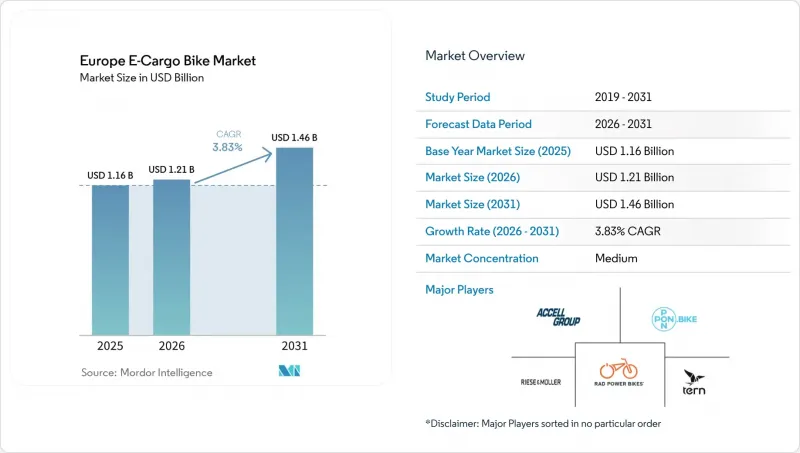
根據 Mordor Intelligence 估計,歐洲電動貨運自行車市場在 2025 年的價值為 11.6 億美元,在 2026 年的價值為 12.1 億美元,預計到 2031 年將達到 14.6 億美元,在預測期(2026-2031 年成長率)內以 3.83%。
歐洲電動貨運自行車市場的趨勢與洞察
城市物流零排放法規
目前,歐洲已有超過30個城市對柴油貨車實施了限制和罰款,迫使業者改用可避免堵塞費和停車罰款的助力貨運自行車。阿姆斯特丹將於2025年實施相關規定,巴黎早在2011年之前就已禁止柴油車輛通行,倫敦的超低排放區(ULEZ)也在不斷擴大,這些舉措都促成了試點車輛的引入,顯著減少了貨車在市中心環路上的行駛里程。隨著歐盟城市交通框架的推進,物流公司如今不再將電動貨運自行車視為試驗品,而是視為合規的必要手段。車隊管理人員表示,自行車無需四處尋找停車位,可以直接停放在路邊,從而縮短了每個包裹的處理時間,並顯著提高了配送密度。預計到2031年,這些監管措施和營運效率的綜效將形成強勁的市場需求。
對商用電動貨運自行車車隊的補貼
現金獎勵正在降低初始成本並縮短投資回收期。義大利的2024年環保獎勵計畫為每輛車提供大量補貼,德國也提供巨額補貼。荷蘭提供的補貼金額較小,但可以與市政補貼結合使用。這些計劃往往很快耗盡預算,凸顯市場需求超出了財務預測。法國正在撥款支持電動車,但各大城市也正在實施各自的扶持措施,這要求採購團隊應對這種複雜的情況。儘管面臨行政方面的挑戰,這些獎勵正在縮短常用車輛的投資回收期,並引導經營團隊做出採用電動自行車的決策。
路邊充電設施短缺
在阿姆斯特丹,只有少數公共自行車充電樁可以容納貨運車架,而米蘭則完全沒有此類設施,因此充電只能在車庫進行,每日行駛里程也受到限制。電池組價格昂貴,人們擔心電池被盜,導致夜間路邊停車不便,這使得除荷蘭和丹麥以外,其他地區的自行車難以實現多班次運作。哥本哈根的太陽能充電站潛力巨大,但目前只能滿足車隊需求的一小部分,凸顯了中期基礎設施的不足,阻礙了自行車的利用。
細分市場分析
根據歐盟第168/2013號法規,功率低於250瓦的系統無需註冊,預計到2025年,助力自行車將佔總銷售量的92.15%。油門輔助平台雖然基數小規模,但正在快速成長。斯圖加特和慕尼黑的物流運營商已接受L1e-A註冊,允許使用功率在351至500瓦之間的電機,這些電機能夠輕鬆爬上6%的坡度,而不會使騎行者感到疲勞。預計在預測期內,此類平台的成長率將達到4.81%。雖然合規成本較高,但在某些細分市場,其在丘陵路段操控性能的提升足以證明這種轉變的合理性。
因此,相關法規建立了一種雙層層級構造。主流車隊傾向於選擇助力騎行,以避免繁瑣的手續;而專業用戶則更注重動力輸出,即使這意味著要承擔一些手續上的麻煩。這種趨勢確保了助力騎行保持其主導地位,同時也為L1e-A供應商提供了一個穩定且盈利的細分市場,進而推動了歐洲電動貨運自行車市場產品種類的豐富化。
預計到2025年,鋰離子電池將佔據91.21%的市場佔有率,並繼續保持化學電池的主導地位,年複合成長率(CAGR)為4.45%。到2031年,歐洲電動貨運自行車市場,尤其是採用磷酸鐵鋰電池的車型,預計將穩定成長。磷酸鐵鋰電池組比鎳鈷錳酸鋰電池組更重,但其更低的電芯成本和更優異的耐用性使其在車隊競標中備受歡迎。另一方面,鉛酸電池目前仍主要用於低價車型,主要在波蘭和匈牙利銷售。
在商用領域,雙電池配置正日益受到關注,它使長途運輸公司無需在營運期間充電即可延長續航里程。可拆卸電池因其允許室內充電,從而降低了被盜風險,目前佔據市場主導地位。然而,在高階車型中,整合式電池管正變得越來越受歡迎,因為車隊營運商往往更注重卓越的防水性能,並且能夠接受只能在基地台充電的限制。
儘管預計到2025年輪轂馬達系統將佔據57.03%的市場佔有率,但中置馬達系統正以每年6.12%的速度成長,因為車隊採購商優先考慮扭力和效率。預計到2025年,中置馬達系統將在歐洲電動貨運自行車市場中獲得顯著成長,並在2029年超越輪轂馬達系統。 Riese & Muller等品牌強調,使用博世Cargo Line馬達可以顯著提昇在崎嶇地形上的續航里程。電池成本的長期降低也證明了較高的初始購買價格是合理的。
東歐對價格較為敏感的宅配業者仍然偏好後輪轂馬達系統,尤其是在平坦地形上;而西歐的市政當局則在公共採購中越來越重視中置馬達系統。隨著電池價格持續下降,營運商更加重視可靠性和扭矩,這推動了中置馬達系統的普及。
其他好處:
- Excel格式的市場預測(ME)表
- 3個月的分析師支持
目錄
第1章:引言
- 研究假設和市場定義
- 調查範圍
第2章:調查方法
第3章執行摘要
第4章:主要產業趨勢
- 自行車年銷量
- 平均售價和價格區間細分
- 電動自行車及其零件的跨境貿易(進口/出口)。
- 電動自行車在自行車總銷量中所佔的百分比
- 單程通勤距離為 5-15 公里的通勤者 (%)
- 自行車和電動自行車租賃市場的規模
- 電動自行車電池組的價格
- 電池化學成分的價格比較
- 最後一公里(超本地化)配送量
- 受保護的自行車道(公里)
- 電動自行車電池容量(瓦時)
- 都市交通壅塞指數
- 法律規範
- 電動自行車的型式認可和認證
- 出口、進口和貿易法規
- 分類、道路通行權和使用者規則
- 電池、充電器和充電安全
第5章 市場狀況
- 市場概覽
- 市場促進因素
- 城市物流強制零排放
- 商用電動貨車補貼
- 電池價格(美元/千瓦時)暴跌至 100 歐元以下。
- 高密度微型倉配網路的擴展
- 企業環境、社會及公司治理(ESG)採購目標
- 低速電動車的保險激勵措施
- 市場限制因素
- 有限的安全路邊充電
- 與廂型車相比,負載容量和續航里程之間存在權衡取捨
- 不同部件的規格
- 中置驅動系統熟練技工短缺
- 價值供應鏈分析
- 技術展望
- 波特五力模型
第6章 市場規模與成長預測
- 依推進類型
- 腳踏輔助型
- 油門輔助類型
- 依電池類型
- 鉛酸電池
- 鋰離子電池
- 其他
- 馬達佈置
- 輪轂(前/後)
- 中置馬達
- 透過驅動系統
- 鏈傳動
- 皮帶傳動
- 馬達輸出
- 小於250瓦
- 251~350 W
- 351~500 W
- 501~600 W
- 600瓦或以上
- 按價格範圍
- 低於1000美元
- 1,000 美元 – 1,499 美元
- 1,500 美元 – 2,499 美元
- 2,500-3,499 美元
- 3,500-5,999 美元
- 超過6000美元
- 按銷售管道
- 線上
- 離線
- 按最終用途
- 商業航運
- 零售和產品配送
- 食品和飲料配送
- 服務供應商
- 其他
- 商業航運
- 按地區
- 西歐
- 德國
- 法國
- 英國
- 荷蘭
- 比利時
- 盧森堡
- 南歐
- 義大利
- 西班牙
- 葡萄牙
- 希臘
- 北歐的
- 丹麥
- 瑞典
- 挪威
- 芬蘭
- 東歐
- 波蘭
- 捷克共和國
- 匈牙利
- 斯洛伐克
- 瑞士
- 其他歐洲國家
- 西歐
第7章 競爭情勢
- 市場集中度
- 策略趨勢
- 市佔率分析
- 公司簡介
- Accell Group
- Bakfiets.nl
- CUBE Bikes
- Douze Factory SAS
- Giant Manufacturing Co. Ltd.
- Pon Holdings BV(incl. Urban Arrow)
- Rad Power Bikes Inc.
- Riese & Muller GmbH
- RYTLE GmbH
- Yubabikes Inc.
- Tern Bicycles
- Benno Bikes LLC
- Larry vs Harry
- Butchers & Bicycles(EventyrCykler)
- Triobike A/S
- ONOMOTION GmbH
第8章 市場機會與未來展望
- 評估閒置頻段和未滿足的需求
第9章:電動自行車公司執行長面臨的關鍵策略挑戰
According to Mordor Intelligence, the European e-cargo bike market was valued at USD 1.16 billion in 2025, is estimated at USD 1.21 billion in 2026, and is projected to reach USD 1.46 billion by 2031, at a CAGR of 3.83% during the forecast period (2026-2031).
Europe E-Cargo Bike Market Trends and Insights
Urban-Logistics Zero-Emission Mandates
More than 30 European cities now restrict or fine diesel vans, effectively pushing operators toward pedal-assist cargo bikes that avoid congestion charges and parking fines . Amsterdam's 2025 roll-out, Paris' ban on pre-2011 diesels, and London's ULEZ expansion have each led to pilot fleets that significantly reduced van kilometers in inner-city rings. With the EU Urban Mobility Framework indicating a wider alignment, logistics firms are now viewing e-cargo bikes as essential for compliance rather than mere experiments. Fleet managers report notable improvements in drop density, as bikes can park curb-side without the need to circle for space, thus reducing labor time per parcel. This combination of regulatory measures and operational efficiencies establishes a solid demand foundation through 2031.
Subsidies for Commercial E-Cargo Fleets
Cash incentives are reducing upfront prices and speeding up payback periods. Italy's 2024 ecobonus offers significant support per unit, while Germany provides notable reimbursements . The Netherlands, though offering smaller amounts, allows these to be combined with municipal bonuses. These programs often deplete their budgets quickly, highlighting a demand that outstrips fiscal forecasts. France has redirected national funds towards electric vehicles, but major cities are stepping in with local assistance, necessitating procurement teams to navigate this complex landscape. Even with the administrative challenges, these incentives are reducing amortization periods for frequently used fleets, swaying boardroom decisions towards bike adoption.
Limited Secure On-Street Charging
In Amsterdam, only a limited number of public bike chargers accommodate cargo frames, while Milan lacks any such facilities, leading to depot-only recharging and limiting daily range. Battery theft, with packs being highly valuable, discourages overnight street parking, making multi-shift operations difficult outside the Netherlands and Denmark. While solar-powered hubs in Copenhagen hold potential, they currently meet only a small portion of fleet demand, highlighting a medium-term infrastructure gap that hampers utilization rates.
Other drivers and restraints analyzed in the detailed report include:
- Rapid Drop in Battery USD/KWH Below EUR 100
- Dense Micro-Fulfillment Network Growth
- Payload and Range Trade-Offs Versus Vans
For complete list of drivers and restraints, kindly check the Table Of Contents.
Segment Analysis
Pedal-assist bikes captured 92.15% of 2025 sales after EU Regulation 168/2013 exempted sub-250-watt systems from registration. Throttle-assist platforms grow from a small base as logistics operators in Stuttgart and Munich accept L1e-A registration to unlock 351-500 watt motors that climb 6% grades without rider fatigue, and it is registering a growth rate of 4.81% during the forecast period. While compliance adds high costs in annual fees, the throughput gains on hilly routes justify the shift for specific niches.
Regulations therefore lock in a two-tier structure: mainstream fleets favor pedal-assist to avoid red tape, while specialized users trade bureaucracy for power. This dynamic keeps pedal-assist dominant but allows a stable, profitable pocket for L1e-A suppliers, widening product variety within the European e-cargo bike market.
Lithium-ion commanded a 91.21% share in 2025 and remains the anchor chemistry, growing at a 4.45% CAGR. By 2031, the market for e-cargo bikes in Europe, particularly those utilizing LFP batteries, is projected to grow steadily. Despite LFP packs being heavier than their NMC counterparts, their lower cell prices and impressive durability have secured them fleet tenders. Meanwhile, lead-acid batteries are still found in models priced at the lower end, predominantly sold in Poland and Hungary.
Commercial sales now see dual-battery configurations gaining traction, enabling long-haul couriers to achieve extended ranges without the need for mid-shift charging. Removable batteries dominate the market due to their ability to mitigate theft risks through indoor charging. However, integrated tubes are becoming popular in premium models, where fleets are willing to compromise on depot-only charging for enhanced water sealing.
Hub units held a 57.03% share in 2025, yet mid-drive systems are growing 6.12% annually as fleet buyers chase torque and efficiency. Mid-drive systems gained significant traction in the European e-cargo bike market in 2025 and are expected to achieve equal footing with hub systems by 2029. Brands like Riese & Muller emphasize the enhanced range on hilly terrain when using Bosch Cargo Line motors. The long-term battery savings justify the initial premium cost at purchase.
Price-sensitive couriers in Eastern Europe continue to prefer rear hubs, especially on flat terrain, while municipalities in Western Europe increasingly prioritize mid-drive systems in public tenders. As battery prices continue to decline, operators are focusing more on reliability and torque, driving the adoption of mid-drive systems.
Complete Report Scope:
- By Propulsion Type
- Pedal Assisted
- Throttle Assisted
- By Battery Type
- Lead Acid Battery
- Lithium-ion Battery
- Others
- By Motor Placement
- Hub (Front/Rear)
- Mid-drive
- By Drive Systems
- Chain Drive
- Belt Drive
- By Motor Power
- Below 250 W
- 251-350 W
- 351-500 W
- 501-600 W
- Above 600 W
- By Price Band
- Up to USD 1,000
- USD 1,000-1,499
- USD 1,500-2,499
- USD 2,500-3,499
- USD 3,500-5,999
- Above USD 6,000
- By Sales Channel
- Online
- Offline
- By End Use
- Commercial Delivery
- Retail and Goods Delivery
- Food and Beverage Delivery
- Service Providers
- Others
- Commercial Delivery
- By Geography
- Western Europe
- Germany
- France
- United Kingdom
- Netherlands
- Belgium
- Luxembourg
- Southern Europe
- Italy
- Spain
- Portugal
- Greece
- Northern Europe
- Denmark
- Sweden
- Norway
- Finland
- Eastern Europe
- Poland
- Czech Republic
- Hungary
- Slovakia
- Switzerland
- Rest of Europe
- Western Europe
List of Companies Covered in this Report:
- Accell Group
- Bakfiets.nl
- CUBE Bikes
- Douze Factory SAS
- Giant Manufacturing Co. Ltd.
- Pon Holdings B.V. (incl. Urban Arrow)
- Rad Power Bikes Inc.
- Riese & Muller GmbH
- RYTLE GmbH
- Yubabikes Inc.
- Tern Bicycles
- Benno Bikes LLC
- Larry vs Harry
- Butchers & Bicycles (EventyrCykler)
- Triobike A/S
- ONOMOTION GmbH
Additional Benefits:
- The market estimate (ME) sheet in Excel format
- 3 months of analyst support
TABLE OF CONTENTS
1 Introduction
- 1.1 Study Assumptions and Market Definition
- 1.2 Scope of the Study
2 Research Methodology
3 Executive Summary
4 Key Industry Trends
- 4.1 Annual Bicycle Sales
- 4.2 Average Selling Price & Price-Band Mix
- 4.3 Cross-Border Trade in E-Bikes & Parts (Imports/Exports)
- 4.4 E-Bike Share of Total Bicycle Sales
- 4.5 Commuters with 5-15 km One-Way Trips (%)
- 4.6 Bicycle/E-Bike Rental Market Size
- 4.7 E-Bike Battery Pack Price
- 4.8 Battery Chemistry Price Comparison
- 4.9 Last-Mile (Hyper-Local) Delivery Volume
- 4.10 Protected Bicycle Lanes (km)
- 4.11 E-Bike Battery Capacity (Wh)
- 4.12 Urban Traffic Congestion Index
- 4.13 Regulatory Framework
- 4.13.1 Homologation & Certification of E-Bicycles
- 4.13.2 Export-Import and Trade Regulation
- 4.13.3 Classification, Road Access and User Rules
- 4.13.4 Battery, Charger and Charging Safety
5 Market Landscape
- 5.1 Market Overview
- 5.2 Market Drivers
- 5.2.1 Urban-Logistics Zero-Emission Mandates
- 5.2.2 Subsidies for Commercial E-Cargo Fleets
- 5.2.3 Rapid Drop in Battery USD/KWH Below EUR 100
- 5.2.4 Dense Micro-Fulfillment Network Growth
- 5.2.5 Corporate ESG Procurement Targets
- 5.2.6 Insurance Incentives for Low-Speed EVs
- 5.3 Market Restraints
- 5.3.1 Limited Secure On-Street Charging
- 5.3.2 Payload and Range Trade-Offs Versus Vans
- 5.3.3 Fragmented Component Standards
- 5.3.4 Skilled-Mechanic Shortage for Mid-Drive Systems
- 5.4 Value / Supply-Chain Analysis
- 5.5 Technological Outlook
- 5.6 Porter's Five Forces
- 5.6.1 Threat of New Entrants
- 5.6.2 Bargaining Power of Suppliers
- 5.6.3 Bargaining Power of Buyers
- 5.6.4 Threat of Substitutes
- 5.6.5 Competitive Rivalry
6 Market Size and Growth Forecasts (Value (USD) and Volume (Units))
- 6.1 By Propulsion Type
- 6.1.1 Pedal Assisted
- 6.1.2 Throttle Assisted
- 6.2 By Battery Type
- 6.2.1 Lead Acid Battery
- 6.2.2 Lithium-ion Battery
- 6.2.3 Others
- 6.3 By Motor Placement
- 6.3.1 Hub (Front/Rear)
- 6.3.2 Mid-drive
- 6.4 By Drive Systems
- 6.4.1 Chain Drive
- 6.4.2 Belt Drive
- 6.5 By Motor Power
- 6.5.1 Below 250 W
- 6.5.2 251-350 W
- 6.5.3 351-500 W
- 6.5.4 501-600 W
- 6.5.5 Above 600 W
- 6.6 By Price Band
- 6.6.1 Up to USD 1,000
- 6.6.2 USD 1,000-1,499
- 6.6.3 USD 1,500-2,499
- 6.6.4 USD 2,500-3,499
- 6.6.5 USD 3,500-5,999
- 6.6.6 Above USD 6,000
- 6.7 By Sales Channel
- 6.7.1 Online
- 6.7.2 Offline
- 6.8 By End Use
- 6.8.1 Commercial Delivery
- 6.8.1.1 Retail and Goods Delivery
- 6.8.1.2 Food and Beverage Delivery
- 6.8.2 Service Providers
- 6.8.3 Others
- 6.8.1 Commercial Delivery
- 6.9 By Geography
- 6.9.1 Western Europe
- 6.9.1.1 Germany
- 6.9.1.2 France
- 6.9.1.3 United Kingdom
- 6.9.1.4 Netherlands
- 6.9.1.5 Belgium
- 6.9.1.6 Luxembourg
- 6.9.2 Southern Europe
- 6.9.2.1 Italy
- 6.9.2.2 Spain
- 6.9.2.3 Portugal
- 6.9.2.4 Greece
- 6.9.3 Northern Europe
- 6.9.3.1 Denmark
- 6.9.3.2 Sweden
- 6.9.3.3 Norway
- 6.9.3.4 Finland
- 6.9.4 Eastern Europe
- 6.9.4.1 Poland
- 6.9.4.2 Czech Republic
- 6.9.4.3 Hungary
- 6.9.4.4 Slovakia
- 6.9.5 Switzerland
- 6.9.6 Rest of Europe
- 6.9.1 Western Europe
7 Competitive Landscape
- 7.1 Market Concentration
- 7.2 Strategic Moves
- 7.3 Market Share Analysis
- 7.4 Company Profiles (Includes Global Level Overview, Market Level Overview, Core Segments, Financials as Available, Strategic Information, Market Rank/Share for Key Companies, Products and Services, SWOT Analysis, and Recent Developments)
- 7.4.1 Accell Group
- 7.4.2 Bakfiets.nl
- 7.4.3 CUBE Bikes
- 7.4.4 Douze Factory SAS
- 7.4.5 Giant Manufacturing Co. Ltd.
- 7.4.6 Pon Holdings B.V. (incl. Urban Arrow)
- 7.4.7 Rad Power Bikes Inc.
- 7.4.8 Riese & Muller GmbH
- 7.4.9 RYTLE GmbH
- 7.4.10 Yubabikes Inc.
- 7.4.11 Tern Bicycles
- 7.4.12 Benno Bikes LLC
- 7.4.13 Larry vs Harry
- 7.4.14 Butchers & Bicycles (EventyrCykler)
- 7.4.15 Triobike A/S
- 7.4.16 ONOMOTION GmbH
8 Market Opportunities & Future Outlook
- 8.1 White-space & Unmet-need Assessment


