


 |
市場調查報告書
商品編碼
2154208
聚亞苯硫醚(PPS)複合材料:市場佔有率分析、行業趨勢和統計數據以及成長預測(2026-2031 年)Polyphenylene Sulfide (PPS) Composite - Market Share Analysis, Industry Trends & Statistics, Growth Forecasts (2026 - 2031) |
||||||

※ 本網頁內容可能與最新版本有所差異。詳細情況請與我們聯繫。
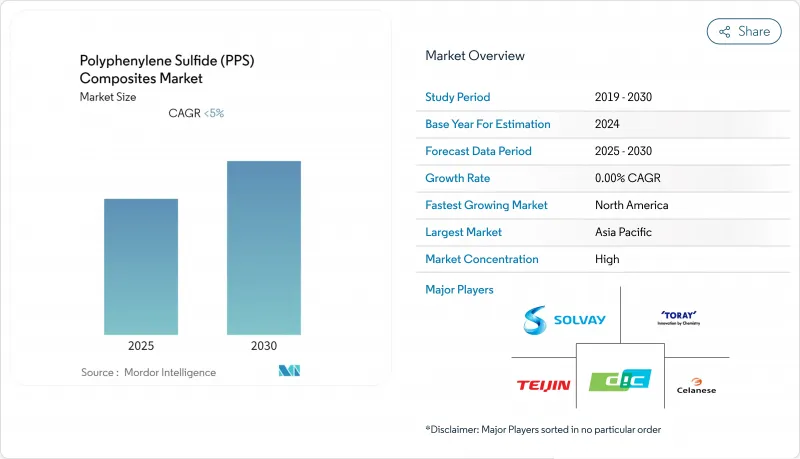
據 Mordor Intelligence 稱,2025 年聚亞苯硫醚 (PPS) 複合材料的市場規模為 29.3 億美元,預計到 2031 年將從 2026 年的 31.7 億美元成長至 46.7 億美元,預測期(2026-2031 年)的複合年成長率為 8.06%。
全球聚苯硫(PPS)複合材料市場趨勢及洞察
電動汽車電池溫度控管整合
溫度控管是鋰離子電池系統設計中的關鍵性能要求。 PPS複合材料被用於冷卻泵殼體、恆溫器本體和連接器包覆成型件中,這些部件在180 度C至260 度C的溫度範圍內工作,並與高密度封裝電池系統中的水-乙二醇混合物接觸。 2025年5月,Envario公司報告稱,其玻璃纖維增強型Xytron G4080HR PPS材料即使在135 度C的水-乙二醇冷卻液中運行3000小時後,也僅出現極少的分層現象。每個電池組都需要多個熱穩定性聚合物組件,包括結構支架、隔熱材料、電絕緣體和冷卻系統組件,因此認證決定可能會同時影響多個組件組。這項要求推動了電動車對PPS複合材料的需求,並提升了聚亞苯硫醚(PPS)複合材料市場對汽車級玻璃纖維增強複合材料的需求。
小型化高頻電子設備
第五代 (5G) 毫米波網路和人工智慧 (AI) 推理基礎設施需要基板和連接器具備低介電損耗、可靠的訊號傳輸以及即使在高頻率也能保持穩定的性能。 PPS 衍生物在 10吉赫吉赫下的介電損耗角正切為 0.00087,介電常數為 2.80 月,24 年,旨在降低一種薄膜和 Unit 公司,旨在降低薄膜 公司,旨在降低薄膜 公司,旨在降低薄膜 公司和 Unit 公司,旨在降低薄膜 公司,旨在降低薄膜 公司,公司和 Unit 公司。 30-300吉赫毫米波頻段的傳輸損耗。這種材料正準備用於下一代通訊設備和汽車雷達的大規模生產,在這些應用中,基板的選擇會影響最終硬體的有效性能範圍。
高昂的材料成本和加工成本
加工PPS複合材料需要超過300 度C的熔融溫度和專用混煉設備。 PPS會釋放硫化物,腐蝕標準鋼製零件,因此必須使用不銹鋼或雙金屬料筒和螺桿組件。在中國,PPS化合物的價格為每公斤3.00至3.80美元,而含30%玻璃纖維的聚醯胺66的價格為每公斤1.80至2.20美元。將標準混煉生產線改造為耐腐蝕模具可能需要每條生產線數百萬美元的資本投資,這會增加新項目或小批量項目的成本。對於注重成本的原始設備製造商(OEM),如果所需的性能不足以抵消PPS的加工成本,他們會考慮使用其他材料。
細分市場分析
到2025年,玻璃纖維增強複合材料將佔據聚亞苯硫醚(PPS)複合材料市場58.45%的佔有率,這得益於其在汽車、電氣和工業過濾應用領域成熟的加工技術。玻璃纖維含量在30%至40%之間的此類材料可達到接近260 度C的熱變形溫度,即使在接觸冷卻劑和化學品的情況下,也能維持零件的尺寸穩定性。由於成熟的模具和材料規範能夠縮短認證零件投入生產所需的時間,因此這些等級的材料仍然是批量生產射出成型零件的理想選擇。它們廣泛應用於冷卻系統、電氣連接器、泵體以及其他需要耐熱且材料成本可控的零件。廣泛的應用基礎支撐了此類材料在成熟終端應用中的持續需求,也為供應商開發新等級材料奠定了堅實的基礎。
受航太領域認證活動和電動車輕量化電池機殼需求的推動,預計到2031年,碳纖維增強複合材料將以8.75%的複合年成長率成長。與熱固性碳環氧樹脂材料不同,連續碳纖維聚苯硫醚(PPS)複合材料可以焊接、熱成型和回收。這種加工柔軟性有助於製造商在不影響結構或半結構部件所需剛度的前提下,減少零件數量和生產廢棄物。此外,它還能夠滿足在最大限度減輕零件重量的同時需要高剛度的應用需求,從而擴大了連續纖維在聚亞苯硫醚(PPS)複合材料市場中的應用範圍。
區域分析
預計到2025年,亞太地區將佔據聚亞苯硫醚(PPS)複合材料市場62.87%的佔有率,並將以9.21%的複合年成長率持續成長至2031年。中國擁有全球最大的電動車生產基地,PPS複合材料廣泛應用於電池組的隔熱材料、結構支架以及冷卻系統連接器等領域。憑藉其樹脂生產、混煉能力和終端應用製造能力,亞太地區擁有從材料認證到組件生產的一體化供應鏈。日本和韓國仍是高品質PPS樹脂的重要來源地,東麗株式會社、DIC株式會社、KUREHA株式會社和SK化學株式會社等公司均經營多個生產基地。這些生產基地正在鞏固亞太地區在聚亞苯硫醚(PPS)複合材料市場中的地位。
隨著中國產能的擴大,中檔汽車和工業複合材料的進口替代正在推進。新和合材料(NHU PM)計劃透過其四期專案將PPS年產量提升至3萬噸。東台啟鑫於2025年8月在安徽省黃山市啟動了一座年產8萬噸PPS樹脂的生產計畫。該項目一期投資額為16億元人民幣(約2.2億美元)。產能的擴張加劇了下游應用領域中日韓廠商的競爭壓力。
北美市場的需求主要受航太和國防採購、汽車溫度控管以及工業過濾的驅動。 2025年5月,Syensqo公司位於喬治亞奧古斯塔的工廠擴大了其Ryton PPS複合材料的產能,該工廠已獲得國際汽車工作組(IATF)16949認證。在歐洲,德國和法國的汽車電氣化以及英國和法國的航太複合材料產業正在推動市場成長。儘管預計到2031年,南美、中東和非洲的需求貢獻將保持溫和,但沙烏地阿拉伯的能源投資正在支撐煉油廠和海水淡化廠零件的需求。
其他好處:
- Excel格式的市場預測(ME)表
- 3個月的分析師支持
目錄
第1章:引言
- 研究假設和市場定義
- 調查範圍
第2章:調查方法
第3章執行摘要
第4章 市場狀況
- 市場概覽
- 市場促進因素
- 電動汽車電池溫度控管整合
- 小型化高頻電子設備
- 金屬替代和組件整合
- 高溫過濾系統升級
- 氫燃料電池輔助裝置的引入
- 市場限制因素
- 原料和加工成本上漲
- 與高溫聚醯胺的競爭
- 易腐蝕處理設備
- 價值鏈分析
- 波特五力分析
- 監理情勢
- 技術展望
第5章 市場規模與成長預測
- 按類型
- 玻璃纖維增強複合材料
- 碳纖維增強複合材料
- 其他類型
- 按形式
- 模塑化合物
- 電影
- 板材
- 其他形式
- 按最終用戶行業分類
- 車
- 航太/國防
- 工業(石油和天然氣)
- 電氣和電子設備
- 其他終端用戶產業
- 按地區
- 亞太地區
- 中國
- 印度
- 日本
- 韓國
- 東南亞國協
- 其他亞太國家
- 北美洲
- 美國
- 加拿大
- 墨西哥
- 歐洲
- 德國
- 英國
- 法國
- 義大利
- 北歐國家
- 其他歐洲國家
- 南美洲
- 巴西
- 阿根廷
- 其他南美國家
- 中東和非洲
- 沙烏地阿拉伯
- 南非
- 其他中東和非洲國家
- 亞太地區
第6章 競爭情勢
- 市場集中度
- 策略趨勢
- 市佔率和排名分析
- 公司簡介
- Avient Corporation
- Celanese Corporation
- DIC CORPORATION
- Ensinger
- IDEMITSU FINE COMPOSITES CO., LTD.
- KUREHA CORPORATION
- LG Chem
- NHU PM
- RTP Company
- SABIC
- SK chemicals
- Solvay
- TEIJIN LIMITED
- TORAY INDUSTRIES, INC.
- Tosoh Corporation
第7章 市場機會與未來展望
According to Mordor Intelligence, the polyphenylene sulfide (PPS) composite market size was valued at USD 2.93 billion in 2025 and is estimated to grow from USD 3.17 billion in 2026 to reach USD 4.67 billion by 2031, at a CAGR of 8.06% during the forecast period (2026-2031).
Global Polyphenylene Sulfide (PPS) Composite Market Trends and Insights
EV Battery Thermal Management Integration
Thermal management has become a major performance requirement in lithium-ion battery system design. PPS composites are used in coolant pump housings, thermostat bodies, and connector overmolds that operate at 180 °C to 260 °C while contacting water-glycol mixtures in tightly packaged battery systems. Envalior reported in May 2025 that its glass-fiber-reinforced Xytron G4080HR PPS grade showed minimal delamination after 3,000 hours in water-glycol coolant at 135 °C. Each battery pack requires multiple thermally stable polymer parts, including structural brackets, thermal barriers, electrical isolators, and cooling-system components, so that qualification decisions may affect several component families at once. This requirement increases PPS composite content per electric vehicle and supports automotive-grade glass fiber-reinforced composites in the polyphenylene sulfide (PPS) composite market.
Miniaturized High-Frequency Electronics
Fifth-generation (5G) millimeter-wave networks and artificial intelligence inference infrastructure require substrates and connectors with low dielectric loss, reliable signal transmission, and stable properties at high frequencies. PPS derivatives can deliver dielectric constants below 3.0 and dissipation factors below 0.003 at frequencies of 10 gigahertz and above. A 2025 Communications Materials study reported a dissipation factor of 0.00087 at 10 gigahertz and a dielectric constant of 2.80 for poly(2,6-dimethyl-1,4-phenylene sulfide). DIC CORPORATION and Unitika Ltd. announced a PPS film in October 2024 that was engineered to reduce transmission loss at millimeter-wave frequencies from 30 to 300 gigahertz. The material was being prepared for commercial production for next-generation communication devices and automotive radar, where the choice of substrate affects the usable performance window of the finished hardware.
High Material and Processing Cost
PPS composite processing requires melt temperatures above 300 °C and specialized compounding equipment. Stainless-steel or bimetallic barrel-and-screw assemblies are required because PPS can release sulfur compounds that corrode standard steel hardware. Chinese PPS compound prices ranged from USD 3.00 to USD 3.80 per kilogram, compared with USD 1.80 to USD 2.20 per kilogram for polyamide 66 with 30% glass fiber. Retrofitting a standard compounding line with corrosion-resistant tooling can require capital expenditure of millions of USD per line, which increases the cost of serving new or lower-volume programs. Cost-sensitive original equipment manufacturer programs continue to assess other materials where the required performance does not justify PPS processing costs.
Other drivers and restraints analyzed in the detailed report include:
- Metal Replacement and Part Consolidation
- High-Temperature Filtration Upgrades
- Competition from High-Temperature Polyamides
For complete list of drivers and restraints, kindly check the Table Of Contents.
Segment Analysis
Glass fiber-reinforced composites held 58.45% of the polyphenylene sulfide (PPS) composite market share in 2025, supported by established processing practices in automotive, electrical, and industrial filtration applications. Glass fiber loading of 30% to 40% enables heat-deflection temperatures close to 260 °C and helps components retain dimensional stability during coolant or chemical exposure. These grades remain a practical choice for high-volume injection-molded parts because established tooling and material specifications reduce the time needed to introduce a qualified component. They are used in cooling systems, electrical connectors, pump bodies, and other components that require heat resistance with manageable material cost. The broad application base supports continued demand for this type across established end uses and gives suppliers a durable base for grade development.
Carbon fiber-reinforced composites are projected to advance at an 8.75% CAGR through 2031, supported by aerospace qualification activity and demand for lightweight electric vehicle battery enclosures. Continuous carbon fiber PPS composites can be welded, thermoformed, and recycled, unlike thermoset carbon-epoxy materials. This processing flexibility supports manufacturers that are seeking to reduce part counts and production waste without giving up the stiffness required for structural or semi-structural components. It also enables applications that require high stiffness with lower component weight, which broadens the role of continuous-fiber formats in the polyphenylene sulfide (PPS) composite market.
Complete Report Scope:
- By Type
- Glass Fiber-reinforced Composites
- Carbon Fiber-reinforced Composites
- Other Types
- By Form
- Molding Compounds
- Films
- Sheets and Plates
- Other Forms
- By End-user Industry
- Automotive
- Aerospace and Defense
- Industrial (Oil and Gas)
- Electrical and Electronics
- Other End-user Industries
- By Geography
- Asia-Pacific
- China
- India
- Japan
- South Korea
- ASEAN Countries
- Rest of Asia-Pacific
- North America
- United States
- Canada
- Mexico
- Europe
- Germany
- United Kingdom
- France
- Italy
- NORDIC Countries
- Rest of Europe
- South America
- Brazil
- Argentina
- Rest of South America
- Middle East and Africa
- Saudi Arabia
- South Africa
- Rest of Middle East and Africa
- Asia-Pacific
Geography Analysis
Asia-Pacific held 62.87% of the polyphenylene sulfide (PPS) composite market share in 2025 and is projected to advance at a 9.21% CAGR through 2031. China has the largest electric vehicle production base and uses PPS composite thermal barriers, structural brackets, and coolant-system connectors in battery packs. The region combines resin production, compounding capacity, and end-use manufacturing, which shortens supply paths between material qualification and component production. Japan and South Korea remain important sources of high-grade PPS resin through multi-plant systems operated by TORAY INDUSTRIES, INC., DIC CORPORATION, KUREHA CORPORATION, and SK chemicals. This regional production base reinforces Asia-Pacific's role in the polyphenylene sulfide (PPS) composite market.
China's expanding capacity is increasing import substitution in mid-grade automotive and industrial composites. NHU PM is targeting a total PPS production of 30,000 metric tons per year through its Phase IV project. Dongtai Qixin began construction of an 80,000-metric-tons-per-year PPS resin project in Huangshan, Anhui Province, in August 2025. The project had a Phase I investment of CNY 1.6 billion (approximately USD 220 million). This capacity expansion is raising competitive pressure on Japanese and Korean producers in downstream applications.
North America's demand is supported by aerospace and defense procurement, automotive thermal management, and industrial filtration. Syensqo expanded its Ryton PPS compounding capability in Augusta, Georgia, in May 2025 at an International Automotive Task Force 16949-certified site. Europe benefits from automotive electrification in Germany and France, and aerospace composites in the United Kingdom and France. South America and the Middle East and Africa are projected to remain modest contributors through 2031, although Saudi Arabia's energy investment supports demand for refinery and desalination components.
- Avient Corporation
- Celanese Corporation
- DIC CORPORATION
- Ensinger
- IDEMITSU FINE COMPOSITES CO., LTD.
- KUREHA CORPORATION
- LG Chem
- NHU PM
- RTP Company
- SABIC
- SK chemicals
- Solvay
- TEIJIN LIMITED
- TORAY INDUSTRIES, INC.
- Tosoh Corporation
Additional Benefits:
- The market estimate (ME) sheet in Excel format
- 3 months of analyst support
TABLE OF CONTENTS
1 Introduction
- 1.1 Study Assumptions and Market Definition
- 1.2 Scope of the Study
2 Research Methodology
3 Executive Summary
4 Market Landscape
- 4.1 Market Overview
- 4.2 Market Drivers
- 4.2.1 EV Battery Thermal Management Integration
- 4.2.2 Miniaturized High-Frequency Electronics
- 4.2.3 Metal Replacement and Part Consolidation
- 4.2.4 High-Temperature Filtration Upgrades
- 4.2.5 Hydrogen Fuel-Cell Balance-of-Plant Adoption
- 4.3 Market Restraints
- 4.3.1 High Material and Processing Cost
- 4.3.2 Competition from High-Temperature Polyamides
- 4.3.3 Corrosion-Sensitive Processing Equipment
- 4.4 Value Chain Analysis
- 4.5 Porter's Five Forces Analysis
- 4.5.1 Bargaining Power of Suppliers
- 4.5.2 Bargaining Power of Buyers
- 4.5.3 Threat of New Entrants
- 4.5.4 Threat of Substitutes
- 4.5.5 Competitive Rivalry
- 4.6 Regulatory Landscape
- 4.7 Technological Outlook
5 Market Size and Growth Forecasts (Value)
- 5.1 By Type
- 5.1.1 Glass Fiber-reinforced Composites
- 5.1.2 Carbon Fiber-reinforced Composites
- 5.1.3 Other Types
- 5.2 By Form
- 5.2.1 Molding Compounds
- 5.2.2 Films
- 5.2.3 Sheets and Plates
- 5.2.4 Other Forms
- 5.3 By End-user Industry
- 5.3.1 Automotive
- 5.3.2 Aerospace and Defense
- 5.3.3 Industrial (Oil and Gas)
- 5.3.4 Electrical and Electronics
- 5.3.5 Other End-user Industries
- 5.4 By Geography
- 5.4.1 Asia-Pacific
- 5.4.1.1 China
- 5.4.1.2 India
- 5.4.1.3 Japan
- 5.4.1.4 South Korea
- 5.4.1.5 ASEAN Countries
- 5.4.1.6 Rest of Asia-Pacific
- 5.4.2 North America
- 5.4.2.1 United States
- 5.4.2.2 Canada
- 5.4.2.3 Mexico
- 5.4.3 Europe
- 5.4.3.1 Germany
- 5.4.3.2 United Kingdom
- 5.4.3.3 France
- 5.4.3.4 Italy
- 5.4.3.5 NORDIC Countries
- 5.4.3.6 Rest of Europe
- 5.4.4 South America
- 5.4.4.1 Brazil
- 5.4.4.2 Argentina
- 5.4.4.3 Rest of South America
- 5.4.5 Middle East and Africa
- 5.4.5.1 Saudi Arabia
- 5.4.5.2 South Africa
- 5.4.5.3 Rest of Middle East and Africa
- 5.4.1 Asia-Pacific
6 Competitive Landscape
- 6.1 Market Concentration
- 6.2 Strategic Moves
- 6.3 Market Share (%)/Ranking Analysis
- 6.4 Company Profiles (includes Global Overview, Market Overview, Core Segments, Financials as available, Strategic Information, Products and Services, and Recent Developments)
- 6.4.1 Avient Corporation
- 6.4.2 Celanese Corporation
- 6.4.3 DIC CORPORATION
- 6.4.4 Ensinger
- 6.4.5 IDEMITSU FINE COMPOSITES CO., LTD.
- 6.4.6 KUREHA CORPORATION
- 6.4.7 LG Chem
- 6.4.8 NHU PM
- 6.4.9 RTP Company
- 6.4.10 SABIC
- 6.4.11 SK chemicals
- 6.4.12 Solvay
- 6.4.13 TEIJIN LIMITED
- 6.4.14 TORAY INDUSTRIES, INC.
- 6.4.15 Tosoh Corporation
7 Market Opportunities and Future Outlook
- 7.1 White-Space and Unmet-Need Assessment

 無氯聚苯胺樹脂市場:全球市場預測(2026-2032年)
 2026-2030年全球聚苯硫市場2-氯乙基苯基硫醚市場:全球市場預測,2026-2032年PPS樹脂市場:全球市場預測,2026-2032年聚亞苯硫醚市場:全球市場預測,2026-2032年
 聚亞苯硫醚(PPS)樹脂:市場佔有率分析、行業趨勢和統計數據、成長預測(2026-2031)
 聚亞苯硫醚(PPS)市場規模、佔有率、趨勢及預測(按類型、可回收性、應用和地區分類),2026-2034年PPS長絲市場按長絲類型、製造技術、應用、終端用戶產業和分銷管道分類-2026-2032年全球預測
 聚亞苯硫醚市場規模、佔有率及成長分析(按形態、類型、應用和地區分類)-2026-2033年產業預測
 聚亞苯硫醚市場規模、佔有率和趨勢分析報告:按產品、應用、地區和細分市場預測(2025-2033 年)