


 |
市場調查報告書
商品編碼
2043833
聚亞苯硫醚(PPS)樹脂:市場佔有率分析、行業趨勢和統計數據、成長預測(2026-2031)Polyphenylene Sulfide (PPS) Resin - Market Share Analysis, Industry Trends & Statistics, Growth Forecasts (2026 - 2031) |
||||||

※ 本網頁內容可能與最新版本有所差異。詳細情況請與我們聯繫。
2025 年聚亞苯硫醚樹脂市值為 11.6 億美元,預計到 2031 年將達到 15.5 億美元,而 2026 年為 12.2 億美元,預測期(2026-2031 年)複合年成長率為 4.97%。
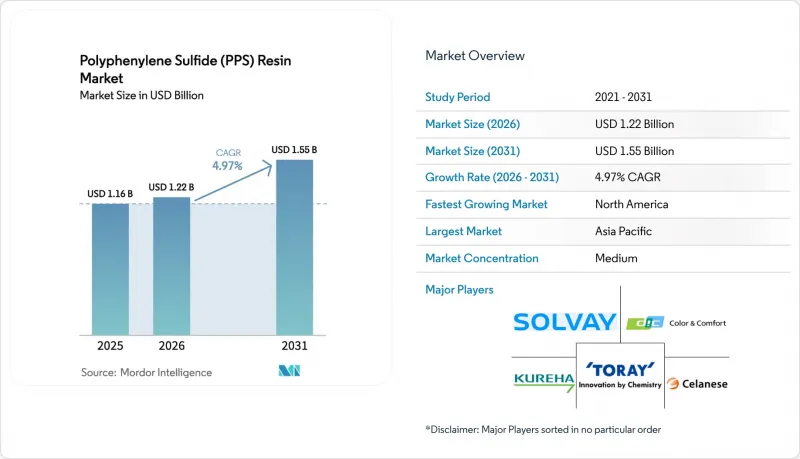
受電子設備小型化、氫燃料電池系統激增以及工業廢氣過濾系統升級改造(要求在190 度C以上高溫下穩定運作)的推動,市場呈現穩定成長動能。亞太地區消費量領先,但北美地區在促進國內電池生產的政策推動下,正迅速縮小差距。同時,歐洲正轉向無鹵阻燃樹脂。儘管中國產能擴張有效控制了價格上漲,但現有供應商正在尋求策略重組,包括專注於特種級產品、垂直整合至混煉環節以及強化數位化流程。簡而言之,聚亞苯硫醚(PPS)樹脂市場面臨成本壓力,但其發展方向顯然正轉向通用熱塑性塑膠難以滿足的高溫、受監管應用領域。
全球聚亞苯硫醚(PPS)樹脂市場趨勢及洞察
隨著 5G 和 AI 電子設備變得越來越小,具有穩定介電性能的 PPS 就顯得特別重要。
5G毫米波無線電和邊緣AI硬體需要基板不僅要在10 GHz以上頻率下保持低介電損耗,還要能承受260 度C的無鉛回流焊接。新近商用的低介電常數PPS薄膜符合這些嚴格的標準,具有極低的吸濕性,即使在反覆的熱衝擊下也能保持機械強度。智慧型手機製造商、汽車ECU供應商和基地台製造商正擴大採用這些薄膜,將其作為液晶聚合物的經濟高效的替代方案。隨著5G的擴展,東麗、DIC和Unitika等產業領導者近期投資了新的產能。這種協同效應正在推動聚亞苯硫醚(PPS)樹脂市場的發展,尤其是在高頻連接器和天線外殼領域,這些領域需要在不依賴鹵素添加劑的情況下實現更薄的壁厚,同時還要達到UL 94 V-0標準。
從 2025 年起,依照美國和歐盟的毒性法規,過渡到無氯 PPS 等級。
2025年,十氯苯醚被納入歐盟持久性有機污染物(POPs)法規,其允許濃度在2028年之前設定為接近零。這項法規變更迫使電子產品原始設備製造商(OEM)放棄使用鹵代阻燃劑。值得注意的是,聚苯硫醚(PPS)即使在極薄的截面中也能自然滿足UL 94 V-0標準,這使得供應商無需進行成本高昂的配方調整。為了滿足對無鹵解決方案的激增需求,德國和美國的新混煉廠於2025年投產,顯著縮短了歐洲和北美客戶的前置作業時間。這種對法規的快速適應預計將波及亞太地區的出口商,從而鞏固聚亞苯硫醚(PPS)樹脂市場作為跨價值鏈合規性最佳選擇的地位。
來自低成本、耐高溫尼龍的競爭日益加劇。
聚鄰苯二甲醯胺的可追溯性指數 (CTI) 已達到 600 V,並在 0.4 mm 厚度下獲得 UL 94 V-0 認證。這些材料在 90–110 度C的溫度下模塑成型,目前已在許多汽車連接器領域與聚苯硫醚 (PPS) 競爭。BASF於 2025 年推出了 Ultramid T6000。儘管其連續工作溫度範圍高達 150–160 度C,但原始設備製造商 (OEM) 仍在調整規格以降低零件成本,從而減少了對成本敏感的聚亞苯硫醚 (PPS) 樹脂市場的依賴。
細分市場分析
截至2025年,線性PPS將佔據聚亞苯硫醚(PPS)樹脂市場56.11%的佔有率,預計在2026年至2031年的預測期內將以5.03%的複合年成長率成長。線性PPS黏度低,與標準射出成型設備相容性高,使其成為薄壁成型的理想選擇,特別適用於汽車高壓連接器和泵浦葉輪。聚合後交聯的固化PPS即使在200 度C以上的溫度下也能保持嚴格的尺寸公差,因此被應用於航空航太管道和工業泵浦零件等特殊領域。支鏈PPS具有高彈性模量,同時確保可回收性,使其適用於電動車(EV)電池的結構部件。 2024年,DIC推出了一種用於5G天線外殼的可金屬化PPS化合物。該化合物可實現直接金屬化,無需金屬嵌件,從而減輕重量。由於應用範圍的擴大,線性和分支等級的鋼材出貨量增加,而特殊硬化處理的鋼材價格也較高。
區域分析
到2025年,亞太地區將主導聚亞苯硫醚(PPS)樹脂市場,佔67.26%的市佔率。中國、日本、韓國和台灣等國家和地區新能源汽車產量的激增以及蓬勃發展的電子產品供應鏈鞏固了這一主導地位。受多個大型專案建設動能的推動,中國的產能已於2024年擴大,預計2027年將成長一倍以上。為因應這些市場變化,現有供應商正致力於加強差異化產品和技術服務,以在競爭日益激烈的市場中保持競爭力。
北美正處於成長軌道上,這得益於國內對電池和氫能領域的強勁投資,預計在 2026 年至 2031 年的預測期內,其複合年成長率將達到 5.16%,成為成長最快的地區。 Fortron Industries 位於威爾明頓的工廠對 PPS 的本地消費進一步推動了這一成長。
同時,歐洲對鹵素和再生材料含量的嚴格規定構成了一項挑戰。這些規定雖然為引入替代材料提供了機遇,但也推高了合規成本,為中小加工企業帶來了困境。另一方面,南美洲、中東和非洲是新興市場,工業過濾和油氣產業的應用刺激了有限的市場需求。
其他好處:
- Excel格式的市場預測(ME)表
- 3個月的分析師支持
目錄
第1章:引言
- 研究假設和市場定義
- 調查範圍
第2章:調查方法
第3章執行摘要
第4章 市場狀況
- 市場促進因素
- 用於 5G/AI 的微型電子設備需要具有優異介電穩定性的 PPS。
- 從 2025 年起,依照美國和歐盟危險物質法規,過渡到無氯 PPS 等級。
- 將汽車氫燃料電池應用於工廠輔助系統。
- AI最佳化的複合製程減少了廢料,並擴大了PPS的應用範圍。
- 亞太地區超低氮氧化物鍋爐濾袋的快速更換。
- 市場限制因素
- 低成本、耐高溫尼龍的出現加劇了競爭
- 交聯PPS在處置時回收所面臨的挑戰。
- 高溫聚合物加工人員短缺
- 價值鏈分析
- 波特五力模型
- 供應商的議價能力
- 買方的議價能力
- 新進入者的威脅
- 替代品的威脅
- 競爭程度
第5章 市場規模與成長預測
- 按類型
- 線性PPS
- 硬化PPS
- 分支PPS
- 按最終用戶行業分類
- 車
- 電氣和電子
- 產業
- 航太
- 其他終端用戶產業
- 按地區
- 亞太地區
- 中國
- 印度
- 日本
- 韓國
- 東南亞國協
- 亞太其他地區
- 北美洲
- 美國
- 加拿大
- 墨西哥
- 歐洲
- 德國
- 英國
- 義大利
- 法國
- 其他歐洲地區
- 南美洲
- 巴西
- 阿根廷
- 南美洲其他地區
- 中東和非洲
- 沙烏地阿拉伯
- 南非
- 其他中東和非洲
- 亞太地區
第6章 競爭情勢
- 市場集中度
- 策略趨勢
- 市佔率(%)/排名分析
- 公司簡介
- Celanese Corporation
- Chengdu Letian Plastics Co. , Ltd
- Chevron Phillips Chemical Company LLC.
- DIC Corporation
- Ensinger
- Glion
- IDEMITSU FINE COMPOSITES CO., LTD.
- Kolon Plastics Inc.
- KUREHA CORPORATION
- NHU Materials Co.
- Polyplastics Co. Ltd
- RTP Company
- SABIC
- SK Innovation
- Solvay
- TEIJIN LIMITED.
- TORAY INDUSTRIES, INC.
- Tosoh Corporation
第7章 市場機會與未來展望
The Polyphenylene Sulfide Resin Market size was valued at USD 1.16 billion in 2025 and is estimated to grow from USD 1.22 billion in 2026 to reach USD 1.55 billion by 2031, at a CAGR of 4.97% during the forecast period (2026-2031).
Driven by the miniaturization of electronics, a surge in hydrogen fuel-cell systems, and upgrades in industrial flue-gas filtration that require consistent service above 190°C, the market is witnessing steady momentum. The Asia-Pacific region leads in consumption, while North America is catching up, spurred by battery onshoring incentives. Meanwhile, Europe is pivoting toward halogen-free, flame-retardant resins. Although price increases are being moderated by capacity expansions in China, established suppliers are strategically repositioning themselves, focusing on specialty grades, vertically integrating into compounding, and enhancing digital processes. In essence, the Polyphenylene Sulfide (PPS) resin market is grappling with cost pressures but is distinctly shifting toward high-temperature, regulatory-compliant applications, an area where commodity thermoplastics struggle.
Global Polyphenylene Sulfide (PPS) Resin Market Trends and Insights
Miniaturized 5G and AI Electronics Need Dielectric-Stable PPS
5G millimeter-wave radios and edge AI hardware require substrates that not only exhibit low dielectric loss above 10 GHz but can also withstand lead-free solder reflow at 260°C. Newly commercialized low-dielectric PPS films meet these stringent criteria, boasting minimal moisture uptake and maintaining mechanical integrity even under repeated thermal shocks. Smartphone manufacturers, automotive ECU suppliers, and base-station producers are increasingly adopting these films as cost-effective alternatives to liquid-crystal polymers. In tandem with the expansion of 5G, industry giants Toray, DIC, and Unitika have rolled out new capacities in recent years. This collective momentum is propelling the Polyphenylene Sulfide (PPS) resin market, particularly in high-frequency connectors and antenna housings, which must achieve UL 94 V-0 standards at thinner sections without relying on halogenated additives.
Shift to Chlorine-Free PPS Grades After 2025 US and EU Toxicity Regulations
In 2025, Dechlorane Plus was added to the EU's Persistent Organic Pollutants Regulation, with a near-zero allowable concentration set for 2028. This regulatory shift has spurred electronics OEMs to move away from halogenated flame retardants. Importantly, PPS naturally meets the UL 94 V-0 standard at thin sections, enabling suppliers to avoid costly reformulations. Responding to the surging demand for halogen-free solutions, new compounding plants in Germany and the United States began operations in 2025, drastically cutting lead times for clients in Europe and North America. This rapid regulatory adaptation is expected to resonate with Asia-Pacific exporters, positioning the Polyphenylene Sulfide (PPS) resin market as the preferred choice for compliance across diverse value chains.
Rising Competition from Lower-Cost High-Temperature Nylons
Polyphthalamides have secured a Comparative Tracking Index of 600 V and achieved UL 94 V-0 certification at a thickness of 0.4 mm. These materials, processed in molds at temperatures between 90-110°C, are now rivaling PPS in numerous automotive connectors. In 2025, BASF introduced its Ultramid T6000. Although a continuous-use temperature range of 150-160°C is adequate, OEMs are adjusting specifications to reduce bills of material, thereby decreasing their stake in the cost-sensitive Polyphenylene Sulfide (PPS) resin market.
Other drivers and restraints analyzed in the detailed report include:
- On-Board Hydrogen Fuel-Cell Balance-of-Plant Adoption
- AI-Optimized Compounding Cuts Scrap and Widens PPS Use
- Recycling End-of-Life Hurdles for Cross-Linked PPS
For complete list of drivers and restraints, kindly check the Table Of Contents.
Segment Analysis
In 2025, Linear PPS held a 56.11% share of the Polyphenylene Sulfide (PPS) resin market and is projected to grow at a 5.03% CAGR through the forecast period of 2026-2031. Its lower viscosity and compatibility with standard injection equipment make Linear PPS ideal for thin-wall molding, particularly in automotive high-voltage connectors and pump impellers. Cured PPS, which undergoes post-polymerization cross-linking, maintains tight dimensional tolerances above 200°C and is used in niche applications such as aerospace ducts and industrial pump parts. Branched PPS offers a higher modulus while ensuring recyclability, making it suitable for structural components in electric vehicle (EV) batteries. In 2024, DIC launched a plateable PPS compound for 5G antenna housings, enabling direct metallization and eliminating the need for metal inserts, thereby reducing weight. This broadened application spectrum boosts the volume of linear and branched grades, while specialty cured variants command premium prices.
The Polyphenylene Sulfide (PPS) Resin Market Report is Segmented by Type (Linear PPS, Cured PPS, and Branched PPS), End-User Industry (Automotive, Electrical and Electronics, Industrial, Aerospace, and Other End-User Industries), and Geography (Asia-Pacific, North America, Europe, South America, Middle-East and Africa). The Market Forecasts are Provided in Terms of Value (USD).
Geography Analysis
In 2025, the Asia-Pacific region dominated the Polyphenylene Sulfide (PPS) resin market, accounting for 67.26% of its size. This leadership position was strengthened by the burgeoning production of new-energy vehicles and a thriving electronics supply chain in nations such as China, Japan, South Korea, and Taiwan. China's production capacity saw a boost in 2024, with forecasts suggesting it could more than double by 2027, thanks to the momentum from several large-scale projects. In response to these market shifts, established suppliers are now focusing on differentiated grades and enhanced technical services to counter heightened price competition.
North America is on a growth trajectory, boasting the fastest rate at a CAGR of 5.16% through the forecast period of 2026-2031, driven by robust domestic investments in batteries and hydrogen. This growth is further supported by local consumption of PPS at Fortron Industries' Wilmington plant.
On the other hand, Europe faces challenges with its stringent halogen and recycled-content regulations. While these rules open doors for substitutions, they also inflate compliance costs, making it tough for smaller converters. Meanwhile, South America, the Middle-East, and Africa are emerging as fledgling markets, with their limited demand for PPS being spurred by industrial filtration and oil-and-gas applications.
- Celanese Corporation
- Chengdu Letian Plastics Co. , Ltd
- Chevron Phillips Chemical Company LLC.
- DIC Corporation
- Ensinger
- Glion
- IDEMITSU FINE COMPOSITES CO., LTD.
- Kolon Plastics Inc.
- KUREHA CORPORATION
- NHU Materials Co.
- Polyplastics Co. Ltd
- RTP Company
- SABIC
- SK Innovation
- Solvay
- TEIJIN LIMITED.
- TORAY INDUSTRIES, INC.
- Tosoh Corporation
Additional Benefits:
- The market estimate (ME) sheet in Excel format
- 3 months of analyst support
TABLE OF CONTENTS
1 Introduction
- 1.1 Study Assumptions and Market Definition
- 1.2 Scope of the Study
2 Research Methodology
3 Executive Summary
4 Market Landscape
- 4.1 Market Drivers
- 4.1.1 Miniaturised 5G/AI electronics need dielectric-stable PPS
- 4.1.2 Shift to chlorine-free PPS grades after 2025 US/EU tox regs
- 4.1.3 On-board hydrogen fuel-cell balance-of-plant adoption
- 4.1.4 AI-optimised compounding cuts scrap and widens PPS use
- 4.1.5 Rapid Asia-Pacific filter-bag upgrades for ultra-low-NOx boilers
- 4.2 Market Restraints
- 4.2.1 Rising competition from lower-cost high-temp nylons
- 4.2.2 Recycling-end-of-life hurdles for cross-linked PPS
- 4.2.3 Talent gap in high-temperature polymer processing
- 4.3 Value Chain Analysis
- 4.4 Porter's Five Forces
- 4.4.1 Bargaining Power of Suppliers
- 4.4.2 Bargaining Power of Buyers
- 4.4.3 Threat of New Entrants
- 4.4.4 Threat of Substitutes
- 4.4.5 Degree of Competition
5 Market Size and Growth Forecasts (Value)
- 5.1 By Type
- 5.1.1 Linear PPS
- 5.1.2 Cured PPS
- 5.1.3 Branched PPS
- 5.2 By End-user Industry
- 5.2.1 Automotive
- 5.2.2 Electrical and Electronics
- 5.2.3 Industrial
- 5.2.4 Aerospace
- 5.2.5 Other End-user Industries
- 5.3 By Geography
- 5.3.1 Asia-Pacific
- 5.3.1.1 China
- 5.3.1.2 India
- 5.3.1.3 Japan
- 5.3.1.4 South Korea
- 5.3.1.5 ASEAN Countries
- 5.3.1.6 Rest of Asia-Pacific
- 5.3.2 North America
- 5.3.2.1 United States
- 5.3.2.2 Canada
- 5.3.2.3 Mexico
- 5.3.3 Europe
- 5.3.3.1 Germany
- 5.3.3.2 United Kingdom
- 5.3.3.3 Italy
- 5.3.3.4 France
- 5.3.3.5 Rest of Europe
- 5.3.4 South America
- 5.3.4.1 Brazil
- 5.3.4.2 Argentina
- 5.3.4.3 Rest of South America
- 5.3.5 Middle-East and Africa
- 5.3.5.1 Saudi Arabia
- 5.3.5.2 South Africa
- 5.3.5.3 Rest of Middle-East and Africa
- 5.3.1 Asia-Pacific
6 Competitive Landscape
- 6.1 Market Concentration
- 6.2 Strategic Moves
- 6.3 Market Share(%)/Ranking Analysis
- 6.4 Company Profiles (includes Global Overview, Market Overview, Core Segments, Financials, Strategic Information, Products and Services, Recent Developments)
- 6.4.1 Celanese Corporation
- 6.4.2 Chengdu Letian Plastics Co. , Ltd
- 6.4.3 Chevron Phillips Chemical Company LLC.
- 6.4.4 DIC Corporation
- 6.4.5 Ensinger
- 6.4.6 Glion
- 6.4.7 IDEMITSU FINE COMPOSITES CO., LTD.
- 6.4.8 Kolon Plastics Inc.
- 6.4.9 KUREHA CORPORATION
- 6.4.10 NHU Materials Co.
- 6.4.11 Polyplastics Co. Ltd
- 6.4.12 RTP Company
- 6.4.13 SABIC
- 6.4.14 SK Innovation
- 6.4.15 Solvay
- 6.4.16 TEIJIN LIMITED.
- 6.4.17 TORAY INDUSTRIES, INC.
- 6.4.18 Tosoh Corporation
7 Market Opportunities and Future Outlook
- 7.1 White-space and Unmet-need Assessment

 PPS樹脂市場:全球市場預測,2026-2032年聚亞苯硫醚市場:全球市場預測,2026-2032年
 聚亞苯硫醚(PPS)市場規模、佔有率、趨勢及預測(按類型、可回收性、應用和地區分類),2026-2034年PPS長絲市場按長絲類型、製造技術、應用、終端用戶產業和分銷管道分類-2026-2032年全球預測
 聚亞苯硫醚市場規模、佔有率及成長分析(按形態、類型、應用和地區分類)-2026-2033年產業預測
 聚亞苯硫醚市場規模、佔有率和趨勢分析報告:按產品、應用、地區和細分市場預測(2025-2033 年)
 聚亞苯硫醚(PPS)-全球市佔率及排名、總收入及需求預測(2025-2031年)
 聚苯硫(PPS)市場 - 預測 2025-2030
 聚苯硫(PPS)全球市場需求分析(按類型、應用及預測至2034年)
 聚苯硫(PPS) 複合材料:市場佔有率分析、產業趨勢與統計、成長預測(2025-2030 年)