

 |
市場調查報告書
商品編碼
2125754
紡織印花:市場佔有率分析、產業趨勢與統計、成長預測(2026-2031)Textile Printing - Market Share Analysis, Industry Trends & Statistics, Growth Forecasts (2026 - 2031) |
||||||

※ 本網頁內容可能與最新版本有所差異。詳細情況請與我們聯繫。
根據 Mordor Intelligence 預測,紡織品印花市場規模將從 2025 年的 1,229.9 億美元成長到 2026 年的 1,276.9 億美元,到 2031 年將達到 1,540.1 億美元,2026 年至 2031 年的複合成長率為 3.82%。
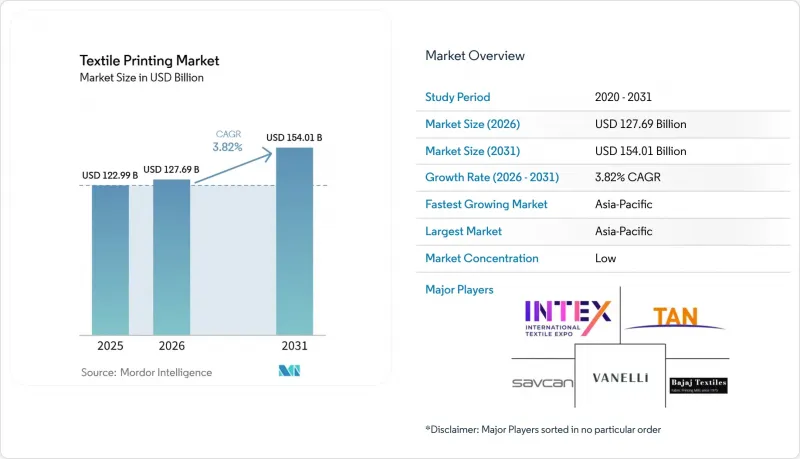
本報告按印花布料類型(梭織印花布料、針織印花布料及其他)、印花技術(圓網印花、數位紡織印花及其他)、布料材質(天然纖維、合成纖維及其他)、終端用途產業(服裝時尚、家用紡織品及其他)和地區(北美、南美及其他)進行細分。市場預測以美元計價。
全球紡織印染市場趨勢與洞察
電子商務、客製印刷、樣品到生產的工作流程。
到2025年,全球整體客製印刷平台將處理約1.5億件客製化服飾,徹底改變樣品和大量訂單的經濟模式。數位化平台能夠以極低的成本實現一次性檢驗,並降低原型製作過程中設計浪費的風險。 2025年4月,BELLA+CANVAS和Stakes Manufacturing宣佈建立合作關係,透過美國本土生產和近岸生產模式,大規模提供零售品質的數位印刷服務。此次合作旨在滿足品牌降低海外生產關稅風險的需求。紡織印花市場對整合設計工具、自動化文件到印刷系統以及可靠的數位輸出的需求日益成長。這些功能縮短了從樣品到批量生產的周期,並可能促使客戶轉向反應更快的加工商。
時尚日曆縮寫與印刷設計週轉
全球服飾零售商正在縮短從設計到商店的時間,這催生了對能夠處理小規模、更頻繁訂單的印刷方式的需求。快時尚企業已將前置作業時間從平均 12 週縮短至不到 3 週。旋轉網版印刷機可能會阻礙設計的快速變更,因為每種新的顏色變更都需要重新製版和設定。混合型印刷機可以利用類比設備進行大規模生產,並利用數位生產線進行季節性變化。隨著零售商對設計變化的期望不斷提高,數位系統降低了設計迭代的成本。印刷設計檔案成為可重複使用的數位庫存,因為它們可以被啟動、修改和停用,而無需產生丟棄未使用網版的成本。
整合印刷和後加工生產線的資本密集度
數位紡織印花生產線需要大量資本投資,入門級設備的投資額為 20 萬美元,而高速單一途徑系統的投資額則超過 100 萬美元。這些成本還不包括活性染料和顏料印花製程中使用的預處理和後處理固色設備。南亞和東南亞的中型加工商往往需要投入全部資產來取代其低成本的旋轉絲網印花生產線。印字頭每 4-6 年更換一次,需要持續的資本投入。那些遲遲不願採用數位化技術的公司可能會面臨客戶對數位化功能的特定要求,而早期採用者則需要在原料和能源價格劇烈波動時期承擔資金籌措成本。對於孟加拉、印度和土耳其那些為快時尚買家供貨且利潤率較低的中小型印刷企業而言,這種限制尤其嚴重。
細分市場分析
到2025年,梭織印花布料將佔紡織品印花市場總規模的54%,成為主要的基材類型。家居佈置、正裝、傳統紗麗布料、室內裝飾布料和工業應用都支撐著這一地位。梭織結構在需要印花、洗滌或機械應力下保持穩定性能的應用中,能夠提供尺寸可預測性。此外,多樣化的結構選擇能夠滿足裝飾和功能性需求。梭織紡織品印花的市場規模反映了梭織布料在大量生產應用中的既有地位。家用紡織品製造商和工業用戶在需要布料性能精準性的場合,仍然非常重視穩定性。南亞傳統服裝市場也支撐著對梭織布料的持續需求。對於經營高產能印花生產線的供應商而言,這一領域仍然至關重要。
預計2026年至2031年,針織印花布料市場將以5.60%的複合年成長率成長。休閒、休閒服飾和日常休閒服等注重彈性和舒適性的品類正在推動這個市場擴張。 2025年10月,RSWM投資9.2億印度盧比(約1,100萬美元)在其LNJ針織廠新增一條針織印花產品線。該項目將使針織布料總產能從每月750噸提升至900噸,增幅達20%,主要面向時尚針織布料市場,預計該市場將佔針織布料總需求的30%至35%。不織布廣泛應用於醫療、農業和工業包裝領域。塗層和層壓布料則用於汽車座椅、行李箱和防護外套等需要耐磨性和防水性的產品。由於針織布料的彈性容易影響圖案對齊,因此在針織布料上進行數位印花更具挑戰性。到2025年,印表頭和油墨化學技術的進步將縮小聚酯針織結構的性能差距。這些進步擴大了服務於休閒供應鏈的加工商的目標市場。
截至2025年,按技術分類,圓網印刷佔據了紡織品印花市場55.40%的佔有率。它仍然是室內裝飾、紗麗布料以及工業製造中重複圖案印花的主要工藝。其每分鐘80-100米的處理能力使其能夠處理超過1000米的訂單。中國、印度和土耳其的主要地區長期以來一直在運作圓網印刷設備,並已收回了大量的資本投資。這項技術的全球市場佔有率反映了其良好的發展記錄以及在處理重複性大量訂單方面的高效性。它仍然是顏色變化穩定且訂單量大的應用的理想選擇。此外,圓網印刷能夠滿足那些優先考慮規模而非頻繁設計調整的買家的需求。這種穩固的基礎確保了模擬印刷在紡織品印花市場繼續保持其重要地位。
預計從2026年到2031年,數位紡織印花將以5.90%的複合年成長率成長,成為成長最快的印花技術。對小批量生產、更低起訂量和永續性的需求正在推動其普及。到2026年,單一途徑系統的生產速度預計將達到每分鐘75公尺。熱昇華印花對於運動服和軟指示牌產品仍然十分重要,尤其適用於聚酯含量高的產品。平板網版印刷適用於需要精細網版控制的高階品牌商品以及手工家用紡織品生產。轉印、植絨、燙金和拔染等技術在質感豐富的高級產品中繼續發揮至關重要的作用。 Creditex SAA的一項研究發現,對於每1000米棉織物上的16色設計,數位紡織印花在多項環境指標上都優於傳統印花。這為採購團隊審查供應商規格提供了基礎。
區域分析
預計到2025年,亞太地區將佔全球紡織印花市場佔有率的45.60%,並在2026年至2031年間以4.50%的複合年成長率成長。亞太地區紡織印花市場以中國為中心,該地區擁有最高的圓網印花和數位印花產能集中度,主要集中在紹興、杭州和廣州等城市。中國紡織工業聯合會預測,到2030年,中國數位噴墨印花產量將超過70億米,佔全球數位印花總量的30%以上。日益嚴格的環保法規正在推動節水數位系統的應用,而印度則透過資本投資補貼計畫擴大產能。蘇拉特和蒂爾普爾是國內快時尚和出口服飾的主要生產地,孟加拉、韓國、日本和東協等國家和地區也正在推動市場需求。
在歐洲,高階家用紡織品和數位印花服裝布料創造了相對於產量而言較高的附加價值。歐洲紡織印花市場以義大利、北歐國家和法國的生產為主,德國、英國和西班牙在小批量服裝印花領域也扮演著重要角色。根據義大利時尚工業聯合會(Confindustria Moda)的報告,到2025年,義大利紡織服裝業的銷售額將達到583.9億歐元(630.6億美元),出口額將達到369億歐元(398.5億美元)。紡織品單獨收集制度將於2025年1月開始實施,歐洲議會已於2025年9月批准了生產者延伸責任制(EPR)。土耳其工業紡織品出口額在2025年前10個月將達到19.63億美元,其位置為供應商提供了近岸生產的優勢。
在北美紡織印花市場,按需生產、電商履約和休閒領域預計將迎來成長,這主要得益於2025年即將實施的關稅措施,這些措施將提升墨西哥和中美洲的國內及近岸生產能力。美墨加協定(USMCA)地區的紡織印花市場也受惠於對更快履約速度和接近性生產基地的需求。南美洲市場仍在發展中,但Benninger AG和Grupo NS於2026年7月宣佈建立合作關係,旨在提升巴西的染色、印花和後整理生產效率。中東和非洲是一個新興地區,波灣合作理事會(GCC)的投資為其提供了支持,土耳其也為北非和海灣市場提供服務。
其他好處
- Excel格式的市場預測(ME)表
- 3個月的分析師支持
目錄
第1章:引言
- 研究假設和市場定義
- 調查範圍
第2章:調查方法
第3章執行摘要
第4章 市場狀況
- 市場概覽
- 市場促進因素
- 縮短時裝期賽程並更換印刷設計
- 對訂製布料和低起訂量布料的需求
- 電子商務、客製印刷以及從樣品到批量生產的工作流程。
- 減少紡織加工過程中的水、化學品和廢水的使用
- 近岸生產和區域供應鏈韌性
- 數位色彩管理,縮短從樣品到大量生產的過渡期。
- 市場限制因素
- 整合印刷和後加工生產線的資本密集度
- 染料、油墨、能源和底布成本的波動
- 熟練企業和色彩管理人員短缺
- 印花織物的合格、合規性和可重複性負擔
- 價值和供應鏈分析
- 監管情勢和合規趨勢
- 技術採納和創新趨勢
- 關於印刷過程和生產流程的考量。
- 一項關於布料和基礎材料發展趨勢的研究。
- 紡織印花業的永續性和ESG趨勢
- 全球貿易分析要點
- 投資和生產能力擴張趨勢
- 創新和產品開發趨勢
- 評估地緣政治事件對紡織印染市場的影響
第5章 市場規模與成長預測
- 印花布料類型
- 梭織印花布料
- 針織印花布料
- 不織布印花布
- 塗層/覆膜印花織物
- 其他
- 透過印刷技術
- 旋轉網版印刷
- 平板網版印刷
- 數位紡織印花
- 熱昇華列印
- 特殊印刷(轉印、植絨、燙金、拔染等)
- 其他
- 按材質分類的織物
- 天然纖維(棉、羊毛、絲綢等)
- 合成纖維(聚酯纖維、尼龍、人造絲/黏膠纖維等)
- 其他(混紡/再生纖維、高性能纖維等)
- 按最終用途行業分類
- 服裝與時尚
- 家用紡織品
- 運動服和功能性紡織品
- 技術及工業紡織品
- 汽車紡織品
- 醫用防護紡織品
- 其他(軟指示牌和展示織物)
- 按地區
- 北美洲
- 美國
- 加拿大
- 墨西哥
- 南美洲
- 巴西
- 阿根廷
- 其他南美國家
- 歐洲
- 德國
- 義大利
- 英國
- 法國
- 西班牙
- 比荷盧經濟聯盟(比利時、荷蘭、盧森堡)
- 北歐國家(丹麥、芬蘭、冰島、挪威、瑞典)
- 其他歐洲國家
- 亞太地區
- 中國
- 印度
- 日本
- 韓國
- 孟加拉
- 東協(印尼、泰國、菲律賓、馬來西亞、越南)
- 其他亞太國家
- 中東和非洲
- 沙烏地阿拉伯
- 阿拉伯聯合大公國
- 卡達
- 科威特
- 土耳其
- 埃及
- 南非
- 奈及利亞
- 其他中東和非洲國家
- 北美洲
第6章 競爭情勢
- 市場集中度
- 策略趨勢
- 安裝數位印刷生產線並擴大生產能力
- 織造、染色、印花和整理的垂直整合。
- 近岸生產、契約製造和區域倉儲發展。
- 永續性認證和閉合迴路加工
- 市佔率分析
- 公司簡介
- Bajaj Textiles
- Subhagyam Prints Pvt. Ltd.
- Savcan Textile
- Tan Group
- INTEKS International Textile
- Vespa Textiles and CizgiTeks
- Vanelli Textile
- Soletex Technical Textile
- KVS Tekstil
- Ilay Textile
- Seride Srl
- Santee Print Works
- New Focus Textiles
- Hangzhou FY Textile Digital Printing Co., Ltd.
- Zhejiang Wondray Textile Printing and Dyeing Co., Ltd.
- Jiangsu Maolun Textile Technology Co., Ltd.
- Huzhou Meixin Digital Printing Co., Ltd.
- Hongtao Textile
- Muhammad Textile Manufacturing
- CottonBee
第7章 市場機會與未來展望
According to Mordor Intelligence, the textile printing market size is expected to grow from USD 122.99 billion in 2025 to USD 127.69 billion in 2026 and is forecast to reach USD 154.01 billion by 2031 at 3.82% CAGR over 2026-2031.
This report is Segmented by Fabric Type (Woven Printed Fabrics, Knitted Printed Fabrics, and More), by Printing Technology (Rotary Screen Printing, Digital Textile Printing, and More), by Fabric Material (Natural, Synthetic, Others), by End-Use Industry (Apparel, Home Textiles, and More), and by Geography (North America, South America, and More). The Market Forecasts are Provided in Terms of Value (USD).
Global Textile Printing Market Trends and Insights
E-Commerce, Print-on-Demand, and Sample-to-Production Workflows
Print-on-demand platforms handled approximately 150 million customized garments globally in 2025, changing the economics of sample and bulk orders. Digital platforms enable individual-unit verification at marginal cost and reduce the design write-off risk associated with trial runs. BELLA+CANVAS and Stakes Manufacturing announced a partnership in April 2025 to provide retail-quality digital printing at scale through Made-in-the-USA and nearshore production models. The partnership addressed demand from brands seeking to reduce tariff exposure from offshore production. The textile printing market increasingly requires connected design tools, automated file-to-print systems, and reliable digital output. These capabilities shorten the sample-to-bulk cycle and can shift customer preference toward responsive converters.
Shorter Fashion Calendars and Print-Design Turnover
Global apparel retailers have reduced design-to-shelf windows, creating demand for printing methods capable of handling smaller, more frequent orders. Fast-fashion operators pushed lead times from an average of 12 weeks toward under 3 weeks. Rotary screen printers need screen engraving and setup for each new colorway, which can slow down rapid design changes. Hybrid converters can use analog capacity for volume-based runs and digital lines for seasonal variations. Digital systems lower the cost of design iteration while retailer expectations for design variety continue to rise. Print-design files can be activated, amended, and retired without the scrap costs of unused screens, making them a reusable digital inventory.
Capital Intensity of Integrated Printing and Finishing Lines
Digital textile printing lines require capital expenditure from USD 200,000 for entry-level machines to over USD 1 million for high-speed single-pass systems. These costs exclude pre-treatment and downstream fixation infrastructure used in reactive and pigment workflows. Mid-tier converters in South Asia and Southeast Asia often require a full balance-sheet commitment to replace lower-cost rotary screen lines. Printhead generations turn over every 4 to 6 years, which creates a recurring capital requirement. Delayed adopters may face client specifications requiring digital capabilities, while early adopters absorb financing costs during periods of volatile material and energy prices. The constraint is acute for small- and medium-sized printers in Bangladesh, India, and Turkey that supply fast-fashion buyers on thin operating margins.
Other drivers and restraints analyzed in the detailed report include:
- Water, Chemical, and Wastewater Reduction in Fabric Processing
- Nearshore Production and Regional Supply-Chain Resilience
- Volatile Dye, Ink, Energy, and Base-Fabric Costs
For complete list of drivers and restraints, kindly check the Table Of Contents.
Segment Analysis
Woven printed fabrics accounted for 54% of the textile printing market size in 2025, making them the leading substrate format. Home furnishings, formal apparel, traditional sari fabrics, furnishing fabrics, and industrial uses support their position. Woven constructions provide dimensional predictability in applications that require stable behavior during printing, washing, or mechanical stress. Their range of possible constructions also supports decorative and functional requirements. The textile printing market size for woven formats reflects the established role of woven formats in large-volume applications. Home textile producers and industrial users continue to value their stability when precise fabric behavior is required. Traditional apparel categories in South Asia also support recurring demand for woven formats. The segment remains important for suppliers operating high-throughput printing lines.
Knitted printed fabrics are projected to grow at 5.60% CAGR from 2026 to 2031. Athleisure, activewear, and casual wear support this expansion because these categories depend on stretch and comfort. RSWM Ltd. committed INR 92 crore (USD 11 million) in October 2025 to add a printed knits product line at its LNJ Knits facilities. The project expanded total knitting capacity by 20% from 750 MT to 900 MT per month and targeted a fashion knitted segment estimated at 30% to 35% of total knitted fabric demand. Nonwoven fabrics serve medical, agricultural, and industrial packaging uses. Coated and laminated fabrics serve automotive seating, luggage, and protective outerwear where abrasion and water resistance are needed. Digital printing on knitted substrates is more difficult because extensible fabric can distort pattern registration. Printhead and ink-chemistry advances through 2025 narrowed this performance gap for polyester knit constructions. These advances broadened the addressable base for converters serving athleisure supply chains.
Rotary screen printing retained 55.40% of the textile printing market share by technology in 2025. It remained the primary volume process for long-run repeat patterns in home furnishings, sari fabrics, and industrial production. Its throughput advantage of 80-100 meters per minute supported orders exceeding 1,000 meters. Major hubs in China, India, and Turkey have operated and amortized rotary screen equipment over long periods. The technology's global share reflects this installed base and its efficiency in repeat-volume orders. It remains appropriate where colorways and order sizes are stable. Rotary screen printing also serves buyers who require scale rather than frequent design adjustments. This established base means analog printing remains an important part of the textile printing market.
Digital textile printing is projected to grow at 5.90% CAGR from 2026 to 2031, the fastest rate among printing technologies. Shorter runs, lower minimum orders, and sustainability requirements support its adoption. Single-pass systems in 2026 achieve production speeds of 75 meters per minute. Dye sublimation remains important for polyester-rich sportswear and soft signage products. Flatbed screen printing serves luxury branded merchandise and artisanal home-textile runs that require individual screen control. Transfer, flock, foil, and discharge methods remain relevant for premium products with tactile effects. The Creditex S.A.A. study found digital textile printing favorable across multiple environmental measures for a 16-color design on 1,000 meters of cotton fabric. This gives procurement teams evidence for reviewing supplier specifications.
Complete Report Scope:
- By Printed Fabric Type
- Woven Printed Fabrics
- Knitted Printed Fabrics
- Nonwoven Printed Fabrics
- Coated & Laminated Printed Fabrics
- Others
- By Printing Technology
- Rotary Screen Printing
- Flatbed Screen Printing
- Digital Textile Printing
- Dye Sublimation Printing
- Specialty Printing (Transfer, Flock, Foil, Discharge, etc.)
- Others
- By Fabric Material
- Natural Fibre (Cotton, Wool, Silk, etc.)
- Synthetic Fibre (Polyester, Nylon, Rayon/Viscose, etc.)
- Others (Blended & Recycled Fibers, High-Performance Fibres, etc.)
- By End-use Industry
- Apparel and Fashion
- Home Textiles
- Sportswear and Performance Textiles
- Technical and Industrial Textiles
- Automotive Textiles
- Healthcare and Protective Textiles
- Others (Soft Signage and Display Fabrics)
- By Geography
- North America
- United States
- Canada
- Mexico
- South America
- Brazil
- Argentina
- Rest of South America
- Europe
- Germany
- Italy
- United Kingdom
- France
- Spain
- BENELUX (Belgium, Netherlands, and Luxembourg)
- NORDICS (Denmark, Finland, Iceland, Norway, and Sweden)
- Rest of Europe
- Asia-Pacific
- China
- India
- Japan
- South Korea
- Bangladesh
- ASEAN (Indonesia, Thailand, Philippines, Malaysia, Vietnam)
- Rest of Asia-Pacific
- Middle East and Africa
- Saudi Arabia
- United Arab Emirates
- Qatar
- Kuwait
- Turkey
- Egypt
- South Africa
- Nigeria
- Rest of Middle East and Africa
- North America
Geography Analysis
Asia-Pacific accounted for 45.60% of the global textile printing market share in 2025 and is projected to grow at a 4.50% CAGR from 2026 to 2031. The textile printing market in Asia-Pacific is centered on China, which has the largest regional concentration of rotary screen and digital capacity, including Shaoxing, Hangzhou, and Guangzhou. The China Textile and Apparel Council projected that China's digital inkjet printing output will exceed 7 billion meters by 2030, accounting for more than 30% of global digital printing volume. Stricter environmental requirements are encouraging the adoption of water-efficient digital systems, while India is upgrading capacity through capital expenditure reimbursement programs. Surat and Tiruppur serve domestic fast-fashion and export apparel production, while Bangladesh, South Korea, Japan, and ASEAN economies add to demand.
Europe generates a high share of value relative to volume through premium home textiles and digitally printed apparel fabrics. The textile printing market in Europe draws on production in Italy, the Nordics, and France, while Germany, the United Kingdom, and Spain are important for short-run apparel printing. Confindustria Moda reported EUR 58.39 billion (USD 63.06 billion) in revenue for the Italian textile and apparel sector in 2025, and EUR 36.9 billion (USD 39.85 billion) in exports. Separate textile collection applied since January 2025, and the European Parliament approved extended producer responsibility schemes in September 2025. Turkey's technical textile exports reached USD 1.963 billion in the first 10 months of 2025, and its location gives suppliers a nearshore advantage.
The textile printing market in North America is growing in on-demand production, e-commerce fulfillment, and athleisure as 2025 tariffs encouraged domestic and nearshore capacity in Mexico and Central America. The textile printing market in the USMCA region benefits from demand for faster fulfillment and closer production locations. South America remains less developed, although Benninger AG and Grupo NS announced a July 2026 partnership to improve Brazilian dyeing, printing, and finishing productivity. Middle East and Africa is an emerging area supported by Gulf Cooperation Council investment, while Turkey also serves North African and Gulf markets.
- Bajaj Textiles
- Subhagyam Prints Pvt. Ltd.
- Savcan Textile
- Tan Group
- INTEKS International Textile
- Vespa Textiles and CizgiTeks
- Vanelli Textile
- Soletex Technical Textile
- KVS Tekstil
- Ilay Textile
- Seride S.r.l.
- Santee Print Works
- New Focus Textiles
- Hangzhou FY Textile Digital Printing Co., Ltd.
- Zhejiang Wondray Textile Printing and Dyeing Co., Ltd.
- Jiangsu Maolun Textile Technology Co., Ltd.
- Huzhou Meixin Digital Printing Co., Ltd.
- Hongtao Textile
- Muhammad Textile Manufacturing
- CottonBee
Additional Benefits:
- The market estimate (ME) sheet in Excel format
- 3 months of analyst support
TABLE OF CONTENTS
1 INTRODUCTION
- 1.1 Study Assumptions and Market Definition
- 1.2 Scope of the Study
2 RESEARCH METHODOLOGY
3 EXECUTIVE SUMMARY
4 MARKET LANDSCAPE
- 4.1 Market Overview
- 4.2 Market Drivers
- 4.2.1 Shorter Fashion Calendars and Print-Design Turnover
- 4.2.2 Demand for Customized and Low-Minimum-Order Fabrics
- 4.2.3 E-Commerce, Print-on-Demand, and Sample-to-Production Workflows
- 4.2.4 Water, Chemical, and Wastewater Reduction in Fabric Processing
- 4.2.5 Nearshore Production and Regional Supply-Chain Resilience
- 4.2.6 Digital Color Management and Faster Sampling-to-Bulk Conversion
- 4.3 Market Restraints
- 4.3.1 Capital Intensity of Integrated Printing and Finishing Lines
- 4.3.2 Volatile Dye, Ink, Energy, and Base-Fabric Costs
- 4.3.3 Skilled Operator and Color-Management Shortages
- 4.3.4 Qualification, Compliance, and Reproducibility Burden for Printed Fabrics
- 4.4 Value and Supply-Chain Analysis
- 4.5 Regulatory and Compliance Landscape
- 4.6 Technology Adoption and Innovation Landscape
- 4.7 Insights on Printing Processes and Production Workflow
- 4.8 Insights on Fabric and Substrate Trends
- 4.9 Sustainability and ESG Trends in Textile Printing
- 4.10 Spotlight on Global Trade Analysis
- 4.11 Investment and Capacity Expansion Trends
- 4.12 Innovation and Product Development Landscape
- 4.13 Impact Assessment of Geoplotical Events on the Textile Printing Market
5 MARKET SIZE AND GROWTH FORECASTS
- 5.1 By Printed Fabric Type
- 5.1.1 Woven Printed Fabrics
- 5.1.2 Knitted Printed Fabrics
- 5.1.3 Nonwoven Printed Fabrics
- 5.1.4 Coated & Laminated Printed Fabrics
- 5.1.5 Others
- 5.2 By Printing Technology
- 5.2.1 Rotary Screen Printing
- 5.2.2 Flatbed Screen Printing
- 5.2.3 Digital Textile Printing
- 5.2.4 Dye Sublimation Printing
- 5.2.5 Specialty Printing (Transfer, Flock, Foil, Discharge, etc.)
- 5.2.6 Others
- 5.3 By Fabric Material
- 5.3.1 Natural Fibre (Cotton, Wool, Silk, etc.)
- 5.3.2 Synthetic Fibre (Polyester, Nylon, Rayon/Viscose, etc.)
- 5.3.3 Others (Blended & Recycled Fibers, High-Performance Fibres, etc.)
- 5.4 By End-use Industry
- 5.4.1 Apparel and Fashion
- 5.4.2 Home Textiles
- 5.4.3 Sportswear and Performance Textiles
- 5.4.4 Technical and Industrial Textiles
- 5.4.5 Automotive Textiles
- 5.4.6 Healthcare and Protective Textiles
- 5.4.7 Others (Soft Signage and Display Fabrics)
- 5.5 By Geography
- 5.5.1 North America
- 5.5.1.1 United States
- 5.5.1.2 Canada
- 5.5.1.3 Mexico
- 5.5.2 South America
- 5.5.2.1 Brazil
- 5.5.2.2 Argentina
- 5.5.2.3 Rest of South America
- 5.5.3 Europe
- 5.5.3.1 Germany
- 5.5.3.2 Italy
- 5.5.3.3 United Kingdom
- 5.5.3.4 France
- 5.5.3.5 Spain
- 5.5.3.6 BENELUX (Belgium, Netherlands, and Luxembourg)
- 5.5.3.7 NORDICS (Denmark, Finland, Iceland, Norway, and Sweden)
- 5.5.3.8 Rest of Europe
- 5.5.4 Asia-Pacific
- 5.5.4.1 China
- 5.5.4.2 India
- 5.5.4.3 Japan
- 5.5.4.4 South Korea
- 5.5.4.5 Bangladesh
- 5.5.4.6 ASEAN (Indonesia, Thailand, Philippines, Malaysia, Vietnam)
- 5.5.4.7 Rest of Asia-Pacific
- 5.5.5 Middle East and Africa
- 5.5.5.1 Saudi Arabia
- 5.5.5.2 United Arab Emirates
- 5.5.5.3 Qatar
- 5.5.5.4 Kuwait
- 5.5.5.5 Turkey
- 5.5.5.6 Egypt
- 5.5.5.7 South Africa
- 5.5.5.8 Nigeria
- 5.5.5.9 Rest of Middle East and Africa
- 5.5.1 North America
6 COMPETITIVE LANDSCAPE
- 6.1 Market Concentration
- 6.2 Strategic Moves
- 6.2.1 Digital-Printing Line Installation and Capacity Expansion
- 6.2.2 Vertical Integration of Weaving, Dyeing, Printing, and Finishing
- 6.2.3 Nearshore Production, Contract Manufacturing, and Regional Warehousing
- 6.2.4 Sustainability Certifications and Closed-Loop Processing
- 6.3 Market Share Analysis
- 6.4 Company Profiles (includes Global Level Overview, Market Level Overview, Core Segments, Financials as available, Strategic Information, Products and Services, Recent Developments)
- 6.4.1 Bajaj Textiles
- 6.4.2 Subhagyam Prints Pvt. Ltd.
- 6.4.3 Savcan Textile
- 6.4.4 Tan Group
- 6.4.5 INTEKS International Textile
- 6.4.6 Vespa Textiles and CizgiTeks
- 6.4.7 Vanelli Textile
- 6.4.8 Soletex Technical Textile
- 6.4.9 KVS Tekstil
- 6.4.10 Ilay Textile
- 6.4.11 Seride S.r.l.
- 6.4.12 Santee Print Works
- 6.4.13 New Focus Textiles
- 6.4.14 Hangzhou FY Textile Digital Printing Co., Ltd.
- 6.4.15 Zhejiang Wondray Textile Printing and Dyeing Co., Ltd.
- 6.4.16 Jiangsu Maolun Textile Technology Co., Ltd.
- 6.4.17 Huzhou Meixin Digital Printing Co., Ltd.
- 6.4.18 Hongtao Textile
- 6.4.19 Muhammad Textile Manufacturing
- 6.4.20 CottonBee
7 MARKET OPPORTUNITIES AND FUTURE OUTLOOK
- 7.1 White-Space and Unmet-Need Assessment

 數位紡織印花市場規模、佔有率、成長及產業分析:按產品類型、油墨類型、應用、基材、地區分類,並預測至2034年
 數位紡織印花市場:依印花技術、印表機類型、材質類型、油墨類型、應用、企業規模與銷售管道分類-2026-2032年全球市場預測
 紡織印花:市場佔有率分析、產業趨勢與統計、成長預測(2026-2031)
 數位紡織印花機械市場-全球產業規模、佔有率、趨勢、機會、預測:按產品類型、印花技術、應用、地區和競爭格局分類,2021-2031年
 紡織印花技術市場預測至2034年—按印花方法、油墨類型、承印物、應用和地區分類的全球分析
 2026-2030年全球數位紡織印花市場
 數位紡織印花市場規模、佔有率、趨勢和預測:按印花方法、承印物類型、油墨類型、應用和地區分類,2026-2034年
 數位紡織印花市場:按油墨類型、承印物、印花工藝、應用和地區分類紡織品印花市場:依印花技術、油墨類型、承印物、產量及應用分類-2026-2032年全球預測日本數位紡織印花市場規模、佔有率、趨勢及預測(按印花方法、承印物類型、油墨類型、應用及地區分類,2026-2034年)