


 |
市場調查報告書
商品編碼
2061902
紡織印花:市場佔有率分析、產業趨勢與統計、成長預測(2026-2031)Textile Printers - Market Share Analysis, Industry Trends & Statistics, Growth Forecasts (2026 - 2031) |
||||||

※ 本網頁內容可能與最新版本有所差異。詳細情況請與我們聯繫。
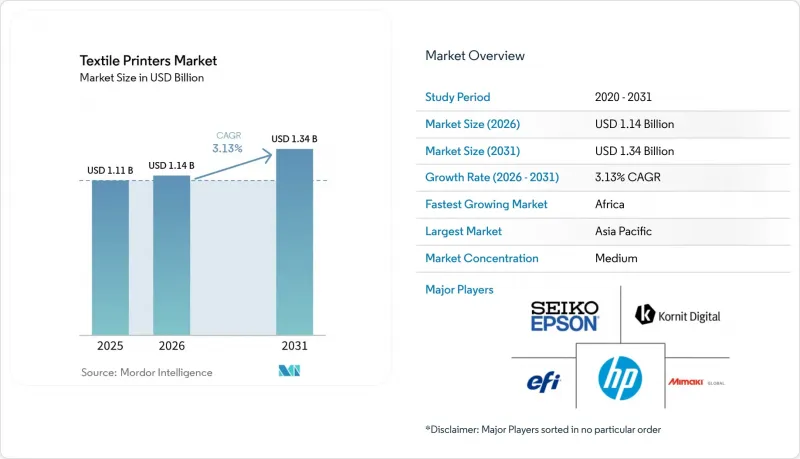
據 Mordor Intelligence 稱,2025 年紡織印表機市值為 11.1 億美元,預計到 2031 年將從 2026 年的 11.4 億美元成長至 13.4 億美元,預測期(2026-2031 年)的複合年成長率為 3.13%。
本報告按印刷技術(數位噴墨印刷、網版印刷等)、油墨類型(活性染料油墨、酸性染料油墨、顏料油墨、分散染料油墨和熱昇華油墨等)、應用領域(服飾、家用紡織品、標牌和展示圖文等)、布料(棉、滌綸、絲綢等)和地區進行細分。市場預測以美元計價。
全球紡織印花機市場趨勢與洞察
快時尚和訂製服裝的需求不斷成長
隨著季節性系列逐漸被每周小批量發布所取代,小批量訂單的需求日益成長,而傳統的網版印刷已無法滿足這一需求。數位設備的引入省去了製版工序,並可在幾分鐘內完成圖案更改,使歐洲品牌能夠將生產轉移到近岸地區,從而快速補貨。據報道,在2025年採用單一途徑顏料印表機的企業,在轉型為客製印刷模式後,庫存損失減少了兩位數。在銷售地點附近印刷布料還能降低物流成本,符合即將實施的歐洲可追溯性法規。
紡織品印刷從類比印刷轉向數位印刷的轉變
當批量低於1000公尺時,數位化滲透速度加快,而1000公尺正是圓網印刷的經濟損益平衡點。像愛普生SureColor F10070H這樣的平台整合了線上預處理和固色功能,將多個濕式製程合併為一個乾式製程。染料昇華印刷的快速普及得益於其無需印後洗滌的特性,但隨著在線固色工藝能夠提供與之媲美的耐光性,棉和粘膠纖維等布料也正在迅速迎頭趕上。預計到2025年,這些趨勢將使中國織物噴墨印刷系統的銷售量首次超過圓網印刷。
工業規模機械設備的前期投資較高
單一途徑印刷機的價格在50萬美元到200萬美元之間,對於許多中小企業來說難以負擔。即使可以租賃,所需的信用擔保也造成了普及率的不平衡,因此在南美洲和非洲,人們仍然依賴旋轉絲網印刷機。雖然「設備即服務 (EaaS)」模式預計到2025年將開始流行,但要實現投資回報,仍然需要超過50萬平方公尺的年產量,而新興市場中只有少數加工商能夠達到這一標準。
細分市場分析
到2025年,數位噴墨解決方案將佔紡織品印表機市場銷售額的62.51%,成為此細分市場成長的主要驅動力。預計從2026年到2031年,隨著單一途徑印表機在實現與模擬印表機相媲美的速度的同時,提供無限的圖案柔軟性,該細分市場將以3.45%的複合年成長率成長。目前,紡織品印表機市場正從純粹的機械特性轉向軟體主導的運作,供應商正在將預測性維護分析與硬體租賃相結合。
由於旋轉式網版印刷機的速度超過100公尺/分鐘,網版印刷在大批量通用商品生產中仍然佔據主導地位,但隨著品牌商越來越傾向於在地化生產和小批量訂單,其重要性正在下降。平板網版印刷仍用於實現噴墨墨滴無法達到的紋理效果,但隨著多層數位清漆技術的進步,這一優勢也逐漸縮小。混合平台將網版印刷單元置於底部,噴墨印表機頭置於其後,這種平台正在贏得那些不願立即放棄現有設備的加工商的青睞,並逐漸佔據市場佔有率。
隨著顏料化學技術以4.22%的複合年成長率快速發展,紡織印花市場如今無需依賴耗水量大的蒸汽處理即可達到4-5級耐洗牢度。這項進步對於市場符合零有害化學物質排放(ZDHC)標準和即將訂定的歐盟資訊揭露法規至關重要。 NeoPigment墨水與線上預處理模組相結合,使得棉織物的印花產量達到了以往只有活性染料才能實現的水平。因此,亞洲多家紡織廠已開始逐步淘汰蒸汽處理設備,這趨勢在2025年將加速發展。這反映了在永續性和法規遵循的驅動下,生產方式正在發生重大轉變。
分散型和昇華型油墨預計到2025年將佔聚酯運動服市場銷售額的41.08%,由於親和性以及鮮豔的色彩,目前仍佔據該領域的主導地位。然而,隨著品牌商不斷拓展佈料選擇,採用多種混紡布料以減少對單一聚酯的依賴,該領域的成長速度正在放緩。同時,UV固化型油墨在標牌產業,尤其是在對戶外耐久性和環境適應性要求較高的應用中,越來越受到關注。此外,雖然生物基黏合劑目前的市場佔有率較小,但隨著品牌商根據永續性目標和監管要求,將生命週期評估(LCA)納入採購決策,其應用正在逐步增加。
區域分析
預計到2025年,亞太地區將佔全球市場規模的39.34%,並在2031年之前保持顯著成長。這主要得益於中國預計到2030年數位普及率將超過35%,以及印度的獎勵計畫可報銷高達25%的資本投資。蘇拉特和廣東的投資叢集正在推動單一途徑昇華染色生產線的應用,而日本和韓國的軟體升級也提振了市場需求。東南亞出口商,尤其是越南和孟加拉國,正在採用混合平台以在歐洲近岸外包趨勢下保持競爭力。
非洲正以3.91%的成長速度成為該地區成長最快的國家,這主要得益於世界貿易組織棉花舉措的推動。該舉措正在投資50億美元,用於在衣索比亞、埃及、摩洛哥和肯亞建造綜合紡織園區。在衣索比亞,位於哈瓦薩工業園區的一家工廠計劃於2025年安裝一條顏料噴墨生產線,以滿足歐洲零售商日益成長的供應鏈可追溯性需求。同時,摩洛哥正利用其接近性西班牙和法國的地理優勢,透過建立一套72小時內向這些市場交貨印花布料的系統,鞏固其作為該地區主要供應商的地位。
儘管北美和歐洲的成長率分別僅為2.8%和2.9%,較為溫和,但它們作為技術培養箱仍發揮著至關重要的作用。人工智慧驅動的色彩匹配和數位產品護照正在加速這些成熟市場的數位化。南美和中東由於進口關稅和缺乏技術支援而落後,但在阿拉伯聯合大公國(阿拉伯聯合大公國),無水顏料噴墨生產線正被指定用於豪華飯店的整修,以滿足其內部永續發展政策的要求。
其他好處:
- Excel格式的市場預測(ME)表
- 3個月的分析師支持
目錄
第1章:引言
- 研究假設和市場定義
- 調查範圍
第2章:調查方法
第3章執行摘要
第4章 市場狀況
- 市場概覽
- 市場促進因素
- 快時尚和訂製服飾的需求不斷成長
- 紡織業從類比印刷到數位印刷的過渡。
- 高速噴墨印表機頭和熱昇華墨水技術的進步
- 拓展電子商務與網路印刷平台
- 推出符合 ZDHC 標準的無水顏料墨水印表機。
- 在紡織廠引進人工智慧驅動的印刷工作流程自動化
- 市場限制因素
- 工業規模機械的初始資本投入較高
- 紡織油墨原料價格波動
- 某些數位墨水的色域和耐光性有其局限性
- 監管機構監測聚酯昇華印刷產生的廢水中的奈米顆粒。
- 產業價值鏈分析
- 監理情勢
- 技術展望
- 宏觀經濟因素對市場的影響
- 波特五力分析
第5章 市場規模與成長預測
- 透過印刷技術
- 數位噴墨列印
- 直接印染織物(DTF)
- 直接成衣印花 (DTG)
- 熱昇華列印
- 單一途徑及其他
- 網版印刷
- 旋轉篩
- 平板螢幕
- 其他印刷技術
- 數位噴墨列印
- 按墨水類型
- 活性染料墨水
- 酸性染料墨水
- 顏料墨水
- 分散型油墨和熱昇華油墨
- UV固化油墨和混合油墨
- 其他墨水類型
- 透過使用
- 服飾和服飾
- 家用紡織品
- 指示牌和展示圖形
- 技術紡織品
- 其他用途
- 按布料類型
- 棉布
- 聚酯纖維
- 絲綢
- 混合
- 其他布料
- 按地區
- 北美洲
- 美國
- 加拿大
- 墨西哥
- 南美洲
- 巴西
- 阿根廷
- 其他南美國家
- 歐洲
- 英國
- 德國
- 法國
- 義大利
- 其他歐洲國家
- 亞太地區
- 中國
- 日本
- 印度
- 韓國
- 其他亞太國家
- 中東
- 阿拉伯聯合大公國
- 沙烏地阿拉伯
- 土耳其
- 以色列
- 其他中東國家
- 非洲
- 南非
- 埃及
- 其他非洲國家
- 北美洲
第6章 競爭情勢
- 市場集中度
- 策略趨勢
- 市佔率分析
- 公司簡介
- Seiko Epson Corporation
- Kornit Digital Ltd.
- Electronics For Imaging(EFI Reggiani)
- HP Inc.
- Mimaki Engineering Co., Ltd.
- Brother Industries, Ltd.
- Roland DG Corporation
- Durst Group AG
- Ricoh Company, Ltd.
- Mutoh Holdings Co., Ltd.
- MS Printing Solutions Srl
- Aeoon Technologies GmbH
- ColorJet India Ltd.
- SPGPrints BV
- DGI Co., Ltd.
- Sawgrass Technologies, Inc.
- JHF Technology Group Co., Ltd.
- Shenzhen Homer Textile Digital Printing Co., Ltd.
- Fujifilm Holdings Corporation
- Zhejiang Atexco Digital Technology Co., Ltd.
第7章 市場機會與未來展望
According to Mordor Intelligence, the textile printers market size was valued at USD 1.11 billion in 2025 and was estimated to grow from USD 1.14 billion in 2026 to reach USD 1.34 billion by 2031, at a CAGR of 3.13% during the forecast period (2026-2031).
This report is Segmented by Printing Technology (Digital Inkjet Printing, Screen Printing, and More), Ink Type (Reactive Dye Inks, Acid Dye Inks, Pigment Inks, Disperse and Sublimation Inks, and More), Application (Garments and Apparel, Home Textiles, Signage and Display Graphics, More), Fabric (Cotton, Polyester, Silk, and More), and Geography. The Market Forecasts are Provided in Terms of Value (USD).
Global Textile Printers Market Trends and Insights
Growing Demand for Fast Fashion and Customized Apparel
Weekly micro-drops now replace seasonal collections, pushing converters toward low-minimum orders that analog screens cannot satisfy. Digital devices eliminate screen engraving and allow pattern changes in minutes, enabling European brands to nearshore production for rapid replenishment. Operators that adopted single-pass pigment printers in 2025 reported double-digit reductions in inventory write-offs after shifting to print-on-demand models. Logistics savings also mount as fabric is printed closer to the point of sale, a factor that aligns with upcoming Europe traceability mandates.
Shift From Analog to Digital Printing in Textiles
Digital penetration is accelerating once job lengths fall below 1 000 meters, the economic break-even against rotary screens. Platforms such as the Epson SureColor F10070H integrate inline pretreatment and fixation, combining multiple wet processes into a single dry pass. Polyester sportswear has moved fastest because dye sublimation avoids post-print washing, but cotton and viscose are catching up now that inline curing achieves comparable fastness. These dynamics explain why direct-to-fabric inkjet systems outsold rotary screens for the first time in China during 2025.
High Initial Capital Investment for Industrial-Scale Machines
Single-pass printers priced between USD 500 000 and USD 2 million are out of reach for many small and medium enterprises. Even where leasing is available, required credit guarantees keep adoption uneven, prolonging reliance on rotary screens in South America and Africa. Equipment-as-a-service models gained traction in 2025, yet payback still depends on volumes above 500 000 m2 per year, a threshold few emerging-market converters can reach.
Other drivers and restraints analyzed in the detailed report include:
- Advancements in High-Speed Inkjet Heads and Sublimation Inks
- Expanding E-Commerce and Web-to-Print Platforms
- Volatility in Textile Ink Raw Material Prices
For complete list of drivers and restraints, kindly check the Table Of Contents.
Segment Analysis
Digital inkjet solutions accounted for 62.51% of 2025 revenue, making the segment a key driver of the textile printers market's growth. Between 2026 and 2031, the segment is projected to grow at a 3.45% CAGR, as single-pass machines match analog speed while offering unlimited pattern flexibility. The textile printers market now rewards software-driven uptime more than purely mechanical attributes, prompting suppliers to couple predictive-maintenance analytics with hardware leases.
Screen printing still dominates high-volume commodity runs because rotary units exceed 100 m min-1, but their relevance erodes each time brands push for localized production or smaller order lots. Flatbed screens persist for textured effects unattainable with inkjet drops, though even this moat is narrowing as multi-layer digital varnish evolves. Hybrid platforms that hold a base screen station followed by inkjet heads are gaining share among converters unwilling to scrap legacy assets overnight.
Pigment chemistries, expanding at a 4.22% CAGR, are enabling the textile printers market to achieve grade 4-5 wash-fastness without relying on water-intensive steaming processes. This advancement is crucial to helping the market comply with Zero Discharge of Hazardous Chemicals (ZDHC) limits and with upcoming EU disclosure regulations. NeoPigment inks, combined with inline pretreatment modules, have now achieved cotton yields previously achieved only with reactive dyes. As a result, several textile mills across Asia have begun decommissioning their steamers, a trend that gained momentum in 2025, reflecting a significant shift in production practices driven by sustainability and regulatory compliance.
Disperse and sublimation inks, which accounted for 41.08% of 2025 revenue, continue to dominate the polyester sportswear segment due to their compatibility with synthetic fabrics and vibrant color output. However, the growth rate in this segment is slowing as brands diversify their fabric choices to include multiple blends, reducing dependency on polyester alone. Meanwhile, UV-curable ink sets are gaining traction in the signage industry, particularly in applications where outdoor durability and resistance to environmental factors are critical. Additionally, bio-based binders, though currently a small share of the market, are gradually gaining adoption as brands incorporate life-cycle assessments into their purchasing decisions, aligning with sustainability goals and regulatory requirements.
Geography Analysis
Asia-Pacific accounted for 39.34% of the 2025 value and is projected to grow significantly through 2031, as China's digital penetration surpasses 35% by 2030 and India's incentive scheme refunds up to 25% of capital outlays. Investment clusters in Surat and Guangdong lead installations of single-pass dye-sublimation lines, with software upgrades driving incremental demand in Japan and South Korea. Southeast Asian exporters, notably Vietnam and Bangladesh, are installing hybrid platforms to remain competitive amid near-shoring in Europe.
Africa is experiencing the fastest regional growth, at 3.91%, driven by the WTO Cotton Initiative, which is channeling USD 5 billion into the development of integrated textile parks in Ethiopia, Egypt, Morocco, and Kenya. In Ethiopia, mills within the Hawassa Industrial Park installed pigment-inkjet corridors in 2025 to meet the growing demand of European retailers for traceability in their supply chains. Meanwhile, Morocco is capitalizing on its geographical proximity to Spain and France, enabling it to deliver printed fabric to these markets within 72 hours, thereby strengthening its position as a key supplier in the region.
North America and Europe expand more slowly, at 2.8% and 2.9% respectively, yet remain technology incubators. AI-based color-matching and digital product passports accelerate digital retrofits in these mature markets. South America and the Middle East lag due to import tariffs and limited technical support, although premium hospitality refurbishments in the United Arab Emirates now specify waterless pigment lines to meet internal sustainability charters.
- Seiko Epson Corporation
- Kornit Digital Ltd.
- Electronics For Imaging (EFI Reggiani)
- HP Inc.
- Mimaki Engineering Co., Ltd.
- Brother Industries, Ltd.
- Roland DG Corporation
- Durst Group AG
- Ricoh Company, Ltd.
- Mutoh Holdings Co., Ltd.
- MS Printing Solutions S.r.l.
- Aeoon Technologies GmbH
- ColorJet India Ltd.
- SPGPrints B.V.
- DGI Co., Ltd.
- Sawgrass Technologies, Inc.
- JHF Technology Group Co., Ltd.
- Shenzhen Homer Textile Digital Printing Co., Ltd.
- Fujifilm Holdings Corporation
- Zhejiang Atexco Digital Technology Co., Ltd.
Additional Benefits:
- The market estimate (ME) sheet in Excel format
- 3 months of analyst support
TABLE OF CONTENTS
1 INTRODUCTION
- 1.1 Study Assumptions and Market Definition
- 1.2 Scope of the Study
2 RESEARCH METHODOLOGY
3 EXECUTIVE SUMMARY
4 MARKET LANDSCAPE
- 4.1 Market Overview
- 4.2 Market Drivers
- 4.2.1 Growing Demand for Fast Fashion and Customized Apparel
- 4.2.2 Shift From Analog to Digital Printing in Textiles
- 4.2.3 Advancements in High-Speed Inkjet Heads and Sublimation Inks
- 4.2.4 Expanding E-Commerce and Web-to-Print Platforms
- 4.2.5 Adoption of Waterless Pigment Ink Printers to Meet ZDHC Guidelines
- 4.2.6 Integration of AI-Based Print Workflow Automation in Textile Mills
- 4.3 Market Restraints
- 4.3.1 High Initial Capital Investment for Industrial-Scale Machines
- 4.3.2 Volatility in Textile Ink Raw Material Prices
- 4.3.3 Limited Color Gamut and Fastness for Certain Digital Inks
- 4.3.4 Regulatory Scrutiny on Wastewater Nanoparticles From Polyester Sublimation
- 4.4 Industry Value-Chain Analysis
- 4.5 Regulatory Landscape
- 4.6 Technological Outlook
- 4.7 Impact of Macroeconomic Factors on the Market
- 4.8 Porter's Five Forces Analysis
- 4.8.1 Threat of New Entrants
- 4.8.2 Bargaining Power of Suppliers
- 4.8.3 Bargaining Power of Buyers
- 4.8.4 Threat of Substitutes
- 4.8.5 Competitive Rivalry
5 MARKET SIZE AND GROWTH FORECASTS (VALUE)
- 5.1 By Printing Technology
- 5.1.1 Digital Inkjet Printing
- 5.1.1.1 Direct-to-Fabric (DTF)
- 5.1.1.2 Direct-to-Garment (DTG)
- 5.1.1.3 Dye-Sublimation
- 5.1.1.4 Single-Pass and Others
- 5.1.2 Screen Printing
- 5.1.2.1 Rotary Screen
- 5.1.2.2 Flatbed Screen
- 5.1.3 Other Printing Technologies
- 5.1.1 Digital Inkjet Printing
- 5.2 By Ink Type
- 5.2.1 Reactive Dye Inks
- 5.2.2 Acid Dye Inks
- 5.2.3 Pigment Inks
- 5.2.4 Disperse and Sublimation Inks
- 5.2.5 UV-Curable and Hybrid Inks
- 5.2.6 Other Ink Types
- 5.3 By Application
- 5.3.1 Garments and Apparel
- 5.3.2 Home Textiles
- 5.3.3 Signage and Display Graphics
- 5.3.4 Technical Textiles
- 5.3.5 Other Applications
- 5.4 By Fabric
- 5.4.1 Cotton
- 5.4.2 Polyester
- 5.4.3 Silk
- 5.4.4 Blends
- 5.4.5 Other Fabrics
- 5.5 By Geography
- 5.5.1 North America
- 5.5.1.1 United States
- 5.5.1.2 Canada
- 5.5.1.3 Mexico
- 5.5.2 South America
- 5.5.2.1 Brazil
- 5.5.2.2 Argentina
- 5.5.2.3 Rest of South America
- 5.5.3 Europe
- 5.5.3.1 United Kingdom
- 5.5.3.2 Germany
- 5.5.3.3 France
- 5.5.3.4 Italy
- 5.5.3.5 Rest of Europe
- 5.5.4 Asia-Pacific
- 5.5.4.1 China
- 5.5.4.2 Japan
- 5.5.4.3 India
- 5.5.4.4 South Korea
- 5.5.4.5 Rest of Asia-Pacific
- 5.5.5 Middle East
- 5.5.5.1 United Arab Emirates
- 5.5.5.2 Saudi Arabia
- 5.5.5.3 Turkey
- 5.5.5.4 Israel
- 5.5.5.5 Rest of Middle East
- 5.5.6 Africa
- 5.5.6.1 South Africa
- 5.5.6.2 Egypt
- 5.5.6.3 Rest of Africa
- 5.5.1 North America
6 COMPETITIVE LANDSCAPE
- 6.1 Market Concentration
- 6.2 Strategic Moves
- 6.3 Market Share Analysis
- 6.4 Company Profiles (includes Global Level Overview, Market Level Overview, Core Segments, Financials as available, Strategic Information, Market Rank/Share, Products and Services, Recent Developments)
- 6.4.1 Seiko Epson Corporation
- 6.4.2 Kornit Digital Ltd.
- 6.4.3 Electronics For Imaging (EFI Reggiani)
- 6.4.4 HP Inc.
- 6.4.5 Mimaki Engineering Co., Ltd.
- 6.4.6 Brother Industries, Ltd.
- 6.4.7 Roland DG Corporation
- 6.4.8 Durst Group AG
- 6.4.9 Ricoh Company, Ltd.
- 6.4.10 Mutoh Holdings Co., Ltd.
- 6.4.11 MS Printing Solutions S.r.l.
- 6.4.12 Aeoon Technologies GmbH
- 6.4.13 ColorJet India Ltd.
- 6.4.14 SPGPrints B.V.
- 6.4.15 DGI Co., Ltd.
- 6.4.16 Sawgrass Technologies, Inc.
- 6.4.17 JHF Technology Group Co., Ltd.
- 6.4.18 Shenzhen Homer Textile Digital Printing Co., Ltd.
- 6.4.19 Fujifilm Holdings Corporation
- 6.4.20 Zhejiang Atexco Digital Technology Co., Ltd.
7 MARKET OPPORTUNITIES AND FUTURE OUTLOOK
- 7.1 White-Space and Unmet-Need Assessment

 紡織印花:市場佔有率分析、產業趨勢與統計、成長預測(2026-2031)
 數位紡織印花市場規模、佔有率、成長及產業分析:按產品類型、油墨類型、應用、基材、地區分類,並預測至2034年
 數位紡織印花市場:依印花技術、印表機類型、材質類型、油墨類型、應用、企業規模與銷售管道分類-2026-2032年全球市場預測
 數位紡織印花機械市場-全球產業規模、佔有率、趨勢、機會、預測:按產品類型、印花技術、應用、地區和競爭格局分類,2021-2031年
 紡織印花技術市場預測至2034年—按印花方法、油墨類型、承印物、應用和地區分類的全球分析
 2026-2030年全球數位紡織印花市場
 數位紡織印花市場規模、佔有率、趨勢和預測:按印花方法、承印物類型、油墨類型、應用和地區分類,2026-2034年
 數位紡織印花市場:按油墨類型、承印物、印花工藝、應用和地區分類紡織品印花市場:依印花技術、油墨類型、承印物、產量及應用分類-2026-2032年全球預測日本數位紡織印花市場規模、佔有率、趨勢及預測(按印花方法、承印物類型、油墨類型、應用及地區分類,2026-2034年)