


 |
市場調查報告書
商品編碼
2125727
歐洲 SOCaaS(安全營運中心即服務):市場佔有率分析、產業趨勢與統計資料、成長預測(2026-2031 年)Europe SOC As A Service (SOCaaS) - Market Share Analysis, Industry Trends & Statistics, Growth Forecasts (2026 - 2031) |
||||||

※ 本網頁內容可能與最新版本有所差異。詳細情況請與我們聯繫。
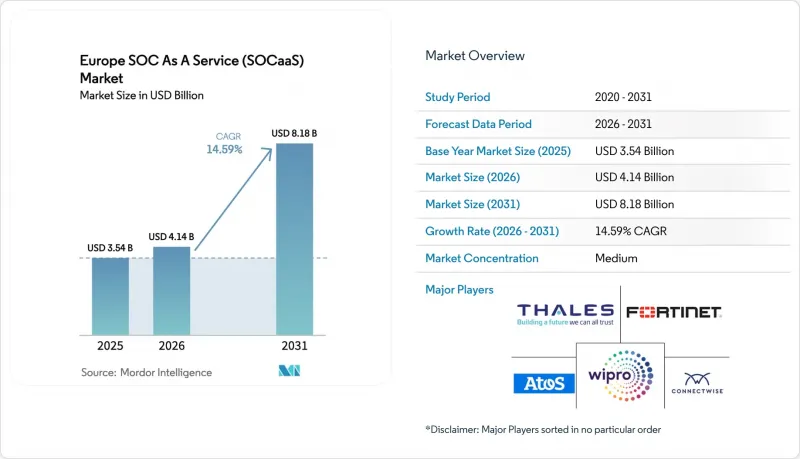
根據 Mordor Intelligence 預測,歐洲 SOCaaS(安全營運中心即服務)市場規模預計將在 2025 年達到 35.4 億美元,2026 年達到 41.4 億美元,到 2031 年達到 81.8 億美元,2026 年至 2031 年的複合年成長率為 14.59%。
本報告按組織規模(中小企業和大型企業)、最終用戶(IT和電信、銀行、金融服務和保險、其他)、服務類型(託管檢測和回應、其他)、部署模式(雲端、本地、混合)、安全類型(網路安全、終端安全、其他)和地區進行細分。市場預測以美元計價。
歐洲SOCaaS(安全營運中心即服務)市場的趨勢與洞察
歐盟NIS2合規性要求
NIS2 將受監管機構的數量從約 2,000 家擴大到超過 16 萬家,要求即使是中型公共產業、醫院和運輸業者也必須維護持續監控系統,違規者將面臨高達 1,000 萬歐元(1,070 萬美元)的罰款。由於這些機構中很少有能夠全天候運行內部安全運營中心 (SOC) 的,因此對提供符合審計要求的儀錶板和自動化事件報告功能的供應商的需求持續旺盛。德國和法國的監管機構透過國家資料駐留法規強化了這項指令,有效地鼓勵與在其各自國家營運資料中心的供應商簽訂合約。與美國三天的寬限期相比,歐洲 24 小時的報告期限增加了緊迫性,也使得人工智慧驅動的偵測功能能夠獲得更高的價格。
中小企業的快速雲端遷移
根據歐盟統計局的數據,到2024年,歐盟擁有數十至249名員工的企業中,將有45%使用雲端服務,高於三年前的38%。這種擴張模糊了傳統的界限,暴露了傳統防火牆無法偵測到的身份和API層。預算有限的中小型企業很少聘請專門的安全專家,但它們也像大型企業一樣面臨著勒索軟體攻擊激增的威脅。因此,部署一個能夠自動偵測Microsoft 365和Google Workspace中工作負載的SOCaaS平台,可以以可預測的每月成本提供高水準的保護。包括工具和人事費用在內的平均總擁有成本約為內部部署成本的六分之一,這帶來了明顯的經濟效益。
網路安全人員短缺
到2025年,歐洲將面臨約35萬網路安全專業人員的缺口,主要經濟體二級分析師的平均招募週期超過四個月。薪資上漲推高了服務提供者的成本,一些供應商甚至在人才儲備充足之前限制新客戶的數量。可能的解決方案包括將業務近岸外包至羅馬尼亞和保加利亞、提高自動化程度以及與大學合作,例如Orange Cyberdefense的雙軌制碩士項目,該項目旨在到2027年每年培養200名畢業生。儘管採取了這些措施,人員數量有限仍將減緩招募進程,並可能導致在大規模安全事件激增期間服務品質下降。
細分市場分析
目前,中小企業 (SME) 的總支出佔比不高,但預計從 2026 年到 2031 年,其複合年成長率將達到 15.68%,且其需求成長預計將超過大型企業。許多中小企業在 2024 年首次符合 NIS2 的資格,導致對價格合理的 24/7 全天候監控服務的需求活性化。 Arctic Wolf 於 2025 年推出的每月 5,000 美元的固定費率套餐受到了用戶少於 250 人的公司的歡迎,因為它消除了因事件數量而導致的不可預測的價格波動。相較之下,已經營運內部安全營運中心 (SOC) 的大型企業成長速度較慢,這主要是因為它們將突發容量和專業功能外包。大型企業的基礎設施涵蓋多個資料中心、雲端和營運技術 (OT) 網路,到 2025 年,它們仍將佔據歐洲 SOCaaS 市場佔有率的 58.38%。
每家供應商都採用不同的打入市場策略。對於中小企業 (SME),供應商強調「快速實現價值」、引導式設定精靈以及無需專業服務即可與 Microsoft 365 和 Salesforce 整合的預先配置方案。同時,對於全球性企業集團,合約的核心是客製化的服務等級協定 (SLA)、威脅情報訂閱以及高階經營團隊的桌面演練。因此,預計到 2031 年,由中小企業組成的歐洲 SOCaaS 市場規模將成長近三倍,而大型企業的支出預計將成長約一倍。
受《數位營運韌性法案》的影響,銀行業、金融服務業和保險業仍將是最大的支出產業,在2025年佔總收入的24.53%。然而,成長最快的行業是醫療保健,預計到2031年將以15.01%的複合年成長率成長。 2023年至2025年間,針對醫院的勒索軟體攻擊增加了210%,迫使先前網路安全投資不足的醫療網路簽訂多年期安全營運中心即服務(SOCaaS)合約。如今,保險合約續約需要提供全天候監控的證明文件,這提高了潛在客戶的轉換率。
同時,製造企業正努力整合缺乏日誌記錄功能的傳統可程式邏輯控制器 (PLC),減緩了其普及速度。然而,這也催生了對營運技術 (OT) 解決方案(例如 Fortinet 計劃於 2025 年發布的 FortiSOC)的利基需求。隨著政府機構從國家預算中獲得專款,政府採購群體正在擴大,但地方政府採購實踐的差異阻礙了其即時普及。
其他好處
- Excel格式的市場預測(ME)表
- 3個月的分析師支持
目錄
第1章:引言
- 研究假設和市場定義
- 調查範圍
第2章:調查方法
第3章執行摘要
第4章 市場狀況
- 市場概覽
- 宏觀經濟因素的影響
- 產業價值鏈分析
- 監理情勢
- 技術展望
- 波特五力分析
- 市場促進因素
- 擴展計量收費支出模式
- 中小企業的快速雲端遷移
- 網路保險對全天候監控的要求越來越高。
- 歐盟NIS2指令帶來的合規要求增加
- 利用生成的AI進行威脅狩獵的功能
- 電信業者和託管服務供應商對託管式 XDR商品搭售銷售的需求激增
- 提高歐洲主權雲端的可用性
- 市場限制因素
- 資料駐留和主權相關的複雜問題
- 歐洲網路安全營運中心(SOC)等級網路安全人才短缺
- 多租戶 SIEM 系統中隱藏的長期總擁有成本
- 與傳統OT環境整合時的摩擦
第5章 市場規模與成長預測
- 按組織規模
- 小型企業
- 大公司
- 最終用戶
- IT/通訊
- BFSI
- 零售和消費品
- 衛生保健
- 製造業
- 政府
- 其他
- 按服務類型
- 託管偵測與回應
- 安全監控
- 脆弱性評估
- 事件回應
- 威脅情報
- 託管式安全資訊與事件管理 (SIEM)
- 其他
- 部署模式
- 雲
- 現場
- 混合
- 按安全類型
- 網路安全
- 端點安全
- 應用程式安全
- 雲端安全
- 其他安全類型
- 國家
- 德國
- 英國
- 法國
- 義大利
- 西班牙
- 荷蘭
- 奧地利
- 比利時
- 瑞典
- 其他歐洲國家
第6章 競爭情勢
- 市場集中度
- 策略趨勢
- 市佔率分析
- 公司簡介
- IBM Corporation
- SecureWorks Inc.
- Fortinet Inc.
- Atos SE
- Thales Group
- Wipro Limited
- Cloudflare Inc.
- ConnectWise LLC
- Sophos Limited
- Ontinue Inc.
- PlusServer GmbH
- Teceze Limited
- Arctic Wolf Networks Inc.
- Rapid7 Inc.
- Orange Cyberdefense SA
- NTT Security Holdings Corporation
- Accenture PLC
- Telefonica Tech SLU
- Deloitte Touche Tohmatsu Limited
- KPMG International Limited
第7章 市場機會與未來展望
According to Mordor Intelligence, the Europe SOC as a Service market size is projected to be USD 3.54 billion in 2025, USD 4.14 billion in 2026, and reach USD 8.18 billion by 2031, growing at a CAGR of 14.59% from 2026 to 2031.
This report is Segmented by Organization Size (Small and Medium-Sized Enterprises, and Large Enterprises), End User (IT and Telecom, BFSI, and More), Service Type (Managed Detection and Response, and More), Deployment Mode (Cloud, On-Premise, and Hybrid), Security Type (Network Security, Endpoint Security, and More), and Geography. The Market Forecasts are Provided in Terms of Value (USD).
Europe SOC As A Service (SOCaaS) Market Trends and Insights
EU NIS2 Compliance Mandate
NIS2 widened the pool of regulated entities from roughly 2,000 to more than 160,000, compelling even mid-sized utilities, hospitals, and transport operators to maintain continuous monitoring or face fines up to EUR 10 million (USD 10.7 million). As few of these organizations can staff an in-house SOC around the clock, providers offering audit ready dashboards and automated incident reporting enjoy a sustained demand floor. German and French regulators reinforce the directive with national data-residency rules, effectively steering contracts toward vendors running data centers inside each country. Compared with the United States three-day reporting allowance, Europe's 24-hour window increases urgency and justifies premium pricing for AI enhanced detection.
Rapid Cloud Migration Among SMEs
Eurostat recorded that 45% of EU firms with 10-249 employees used cloud services in 2024, up from 38% three years earlier. This expansion dissolves the traditional perimeter, exposing identity and API layers that legacy firewalls miss. Budget constrained SMEs rarely field a dedicated security professional yet face the same ransomware surge as larger peers. Onboarding to SOCaaS platforms that auto-discover workloads inside Microsoft 365 or Google Workspace therefore offers high protection for a predictable monthly fee. Average total cost of ownership, including tooling and staff, runs roughly one-sixth of an in-house build, creating a clear economic argument.
Cyber Talent Scarcity
Europe lacked roughly 350,000 cybersecurity professionals in 2025, and median hiring time for a tier-two analyst exceeded four months in major economies. Wage inflation raises provider costs, and some vendors cap new customer intake until staffing pipelines catch up. Solutions include near-shoring to Romania and Bulgaria, heavy automation, and university partnerships like Orange Cyberdefense's dual-track master's program targeting 200 graduates per year by 2027. Despite these tactics, limited headcount slows onboarding speed and can constrain service quality during major incident surges.
Other drivers and restraints analyzed in the detailed report include:
- Generative-AI Threat Hunting
- XDR Bundling by Telcos and MSPs
- Data Residency and Sovereignty Rules
For complete list of drivers and restraints, kindly check the Table Of Contents.
Segment Analysis
Small and medium-sized enterprises account for a modest portion of total spending today, yet they are forecast to grow at a 15.68% CAGR between 2026 and 2031, overtaking large enterprises in incremental demand. Many SMEs came under NIS2 jurisdiction only in 2024, triggering a scramble for affordable 24x7 monitoring. Arctic Wolf's fixed-fee bundle at USD 5,000 per month, launched in 2025, removes unpredictable event-volume pricing and resonates with firms managing fewer than 250 users. In contrast, large enterprises that already run internal SOCs primarily outsource burst capacity or specialized functions, which tempers their growth rate. Nonetheless, big firms still represent 58.38% of Europe's SOC As A Service market share in 2025 because their infrastructures span multiple data centers, clouds, and operational technology networks.
Providers deploy separate go-to-market motions. For SMEs, vendors stress time to value, guided setup wizards, and pre-configured playbooks that attach to Microsoft 365 and Salesforce without professional services. For global conglomerates, contracts revolve around bespoke service level agreements, threat intelligence subscriptions, and executive tabletop exercises. As a result, the Europe SOC As A Service market size captured by SMEs is expected to almost triple by 2031, while large enterprise spending roughly doubles.
Banking financial services and insurance entities remain the top spenders, holding 24.53% of revenue in 2025 thanks to the Digital Operational Resilience Act. Yet healthcare is the fastest climber, advancing at 15.01% CAGR through 2031. Ransomware campaigns targeting hospitals rose 210% between 2023 and 2025, forcing clinical networks that historically underinvested in cybersecurity to sign multi-year SOCaaS contracts. Insurance renewals now require documented 24x7 monitoring, driving up funnel conversion.
Meanwhile, manufacturing firms struggle to integrate legacy programmable logic controllers that lack logging, slowing uptake but opening niche demand for OT aware offerings like Fortinet's 2025 FortiSOC launch. Government buyers expand as national budgets allocate ring fenced funds, but procurement fragmentation across municipalities tempers immediate adoption.
Complete Report Scope:
- By Organization Size
- Small and Medium-Sized Enterprises
- Large Enterprises
- By End User
- IT and Telecom
- BFSI
- Retail and Consumer Goods
- Healthcare
- Manufacturing
- Government
- Other End Users
- By Service Type
- Managed Detection and Response
- Security Monitoring
- Vulnerability Assessment
- Incident Response
- Threat Intelligence
- Managed SIEM
- Other Service Types
- By Deployment Mode
- Cloud
- On-Premise
- Hybrid
- By Security Type
- Network Security
- Endpoint Security
- Application Security
- Cloud Security
- Other Security Types
- By Country
- Germany
- United Kingdom
- France
- Italy
- Spain
- Netherlands
- Austria
- Belgium
- Sweden
- Rest of Europe
List of Companies Covered in this Report:
- IBM Corporation
- SecureWorks Inc.
- Fortinet Inc.
- Atos SE
- Thales Group
- Wipro Limited
- Cloudflare Inc.
- ConnectWise LLC
- Sophos Limited
- Ontinue Inc.
- PlusServer GmbH
- Teceze Limited
- Arctic Wolf Networks Inc.
- Rapid7 Inc.
- Orange Cyberdefense SA
- NTT Security Holdings Corporation
- Accenture PLC
- Telefonica Tech S.L.U.
- Deloitte Touche Tohmatsu Limited
- KPMG International Limited
Additional Benefits:
- The market estimate (ME) sheet in Excel format
- 3 months of analyst support
TABLE OF CONTENTS
1 INTRODUCTION
- 1.1 Study Assumptions and Market Definition
- 1.2 Scope of the Study
2 RESEARCH METHODOLOGY
3 EXECUTIVE SUMMARY
4 MARKET LANDSCAPE
- 4.1 Market Overview
- 4.2 Impact of Macroeconomic Factors
- 4.3 Industry Value-Chain Analysis
- 4.4 Regulatory Landscape
- 4.5 Technological Outlook
- 4.6 Porter's Five Forces Analysis
- 4.6.1 Threat of New Entrants
- 4.6.2 Bargaining Power of Buyers
- 4.6.3 Bargaining Power of Suppliers
- 4.6.4 Threat of Substitutes
- 4.6.5 Competitive Rivalry
- 4.7 Market Drivers
- 4.7.1 Rise in Adoption of Pay-per-Use Opex Model
- 4.7.2 Rapid Cloud Migration Among SMEs
- 4.7.3 Mounting Cyber-Insurance Prerequisites for 24x7 Monitoring
- 4.7.4 EU NIS2 Directive Amplifying Compliance Demand
- 4.7.5 Generative AI-Powered Threat Hunting Capabilities
- 4.7.6 Surge in Managed XDR Bundling by Telcos and MSPs
- 4.7.7 Increasing Availability of Sovereign European Clouds
- 4.8 Market Restraints
- 4.8.1 Data Residency and Sovereignty Complexities
- 4.8.2 Scarcity of European SOC-Grade Cyber Talent
- 4.8.3 Hidden Long-Term TCO in Multi-Tenant SIEM
- 4.8.4 Integration Friction with Legacy OT Environments
5 MARKET SIZE AND GROWTH FORECASTS (VALUE)
- 5.1 By Organization Size
- 5.1.1 Small and Medium-Sized Enterprises
- 5.1.2 Large Enterprises
- 5.2 By End User
- 5.2.1 IT and Telecom
- 5.2.2 BFSI
- 5.2.3 Retail and Consumer Goods
- 5.2.4 Healthcare
- 5.2.5 Manufacturing
- 5.2.6 Government
- 5.2.7 Other End Users
- 5.3 By Service Type
- 5.3.1 Managed Detection and Response
- 5.3.2 Security Monitoring
- 5.3.3 Vulnerability Assessment
- 5.3.4 Incident Response
- 5.3.5 Threat Intelligence
- 5.3.6 Managed SIEM
- 5.3.7 Other Service Types
- 5.4 By Deployment Mode
- 5.4.1 Cloud
- 5.4.2 On-Premise
- 5.4.3 Hybrid
- 5.5 By Security Type
- 5.5.1 Network Security
- 5.5.2 Endpoint Security
- 5.5.3 Application Security
- 5.5.4 Cloud Security
- 5.5.5 Other Security Types
- 5.6 By Country
- 5.6.1 Germany
- 5.6.2 United Kingdom
- 5.6.3 France
- 5.6.4 Italy
- 5.6.5 Spain
- 5.6.6 Netherlands
- 5.6.7 Austria
- 5.6.8 Belgium
- 5.6.9 Sweden
- 5.6.10 Rest of Europe
6 COMPETITIVE LANDSCAPE
- 6.1 Market Concentration
- 6.2 Strategic Moves
- 6.3 Market Share Analysis
- 6.4 Company Profiles (includes Global Level Overview, Market Level Overview, Core Segments, Financials as available, Strategic Information, Market Rank/Share, Products and Services, Recent Developments)
- 6.4.1 IBM Corporation
- 6.4.2 SecureWorks Inc.
- 6.4.3 Fortinet Inc.
- 6.4.4 Atos SE
- 6.4.5 Thales Group
- 6.4.6 Wipro Limited
- 6.4.7 Cloudflare Inc.
- 6.4.8 ConnectWise LLC
- 6.4.9 Sophos Limited
- 6.4.10 Ontinue Inc.
- 6.4.11 PlusServer GmbH
- 6.4.12 Teceze Limited
- 6.4.13 Arctic Wolf Networks Inc.
- 6.4.14 Rapid7 Inc.
- 6.4.15 Orange Cyberdefense SA
- 6.4.16 NTT Security Holdings Corporation
- 6.4.17 Accenture PLC
- 6.4.18 Telefonica Tech S.L.U.
- 6.4.19 Deloitte Touche Tohmatsu Limited
- 6.4.20 KPMG International Limited
7 MARKET OPPORTUNITIES AND FUTURE OUTLOOK
- 7.1 White-Space and Unmet-Need Assessment

 應用程式管理服務市場:按服務、部署模式、應用程式和最終用戶產業分類-2026-2032年全球市場預測
 EMEA電子製造服務業(2024-2029):歐洲、中東和北非(EMEA)EMS產業策略調查(第23版)
 碳意識型應用程式介面 (API) 和軟體開發工具包 (SDK) 平台:市場佔有率分析、行業趨勢和統計數據以及成長預測 (2026-2031)
 AI合規SaaS市場:按組件、部署類型、應用、產業、國家及地區分類-產業分析、市場規模、市場佔有率及2026年至2033年預測
 2026年全球基於應用程式介面(API)的薪資核算技術市場報告2026年全球應用程式介面(API)經濟市場報告2026年基於SaaS(軟體即服務)的人力資源管理(HRM)全球市場報告2026年全球應用程式介面(API)即服務市場報告
 2026-2030年全球應用管理服務市場2026年全球應用管理服務市場報告